Unitas is Committed to Building a Global Savings Layer for Digital Assets and Compliant High-Yield Stablecoins

marsbit2026-01-12 tarihinde yayınlandı2026-01-12 tarihinde güncellendi

Özet

Unitas introduces a new market-neutral yield infrastructure standard, aiming to establish a global savings layer and compliant high-yield stablecoin ecosystem. It provides a modular yield service platform that decouples capital access, asset custody, and yield execution, serving both individual and institutional users without taking directional market risk. The core strength lies in its self-developed and self-operated yield engine, which manages the full lifecycle of signal generation, execution, and risk response. Unitas runs multiple market-neutral strategies under a unified risk framework, including delta-neutral liquidity strategies and basis arbitrage, ensuring returns come from market activity rather than price speculation. Built-in risk controls monitor exposures and hedging deviations in real-time, prioritizing stability over speed during volatility. Backed by 24/7 human oversight, the system demonstrated strong performance with a 16.7% net APY and only -0.16% max drawdown in 2025, including zero loss during extreme market conditions. Unitas emphasizes transparency through real-time disclosure of collateral and risk parameters. Future plans include expansion into TradFi, integration with RWA like tokenized stocks and commodities, and serving as a foundational yield layer connecting DeFi and traditional finance.

The digital asset infrastructure innovation team Unitas has announced the launch of a new market-neutral yield infrastructure standard. By constructing a "Yield Layer" for digital assets, Unitas is committed to providing professional market-neutral returns to global users based on full transparency and institutional-grade risk control.

Modular Architecture: Reshaping the Accessibility of Yield Services

Unitas provides a modular yield service platform designed to achieve sustainable capital growth without taking on market directional risk. Through a unified infrastructure, the platform decouples capital access, asset custody, and yield execution, serving not only individual investors but also meeting the stringent security and compliance requirements of corporate and institutional treasuries.

Proprietary Core Engine: Mastering the Full Lifecycle of Yield Execution

Different from the "strategy outsourcing" model that relies on third-party protocols, Unitas's core competitiveness lies in its self-developed, self-operated, and self-managed yield engine. Unitas controls the entire lifecycle from signal generation and trade execution to real-time monitoring and risk response.

Currently, the platform operates multiple market-neutral strategies in parallel under a unified risk framework:

  • Liquidity-Driven Delta Neutral Strategy: Captures real transaction fees and incentives in on-chain liquidity pools, supplemented by dynamic hedging, ensuring returns stem from market activity rather than price fluctuations.

  • Funding Rate and Basis Arbitrage: Captures structural price differences between spot and futures in derivative markets.

By integrating these strategies within a single system, Unitas achieves yield diversification while maintaining extremely high control over exposure, leverage, and liquidity.

System-Embedded Risk Control: Robust Performance in Extreme Market Conditions

Unitas deeply embeds risk control into the strategy execution layer. The system monitors net exposure, margin utilization, and hedge deviation in real-time, using them as hard constraints for position adjustments.

Its execution mechanism prioritizes "robustness" over mere response speed. During periods of severe market volatility, the system proactively limits adjustment frequency to avoid slippage risk and combines it with a "24/7 manual real-time supervision" model to ensure precise human-machine collaborative intervention under abnormal conditions.

Practical Data Validation: Exceptional Resilience Across Cycles

Data statistics show that throughout 2025, with a deployment scale of approximately $25 million, Unitas achieved an average net annualized yield of 16.7%, with a Maximum Drawdown of only -0.16%.
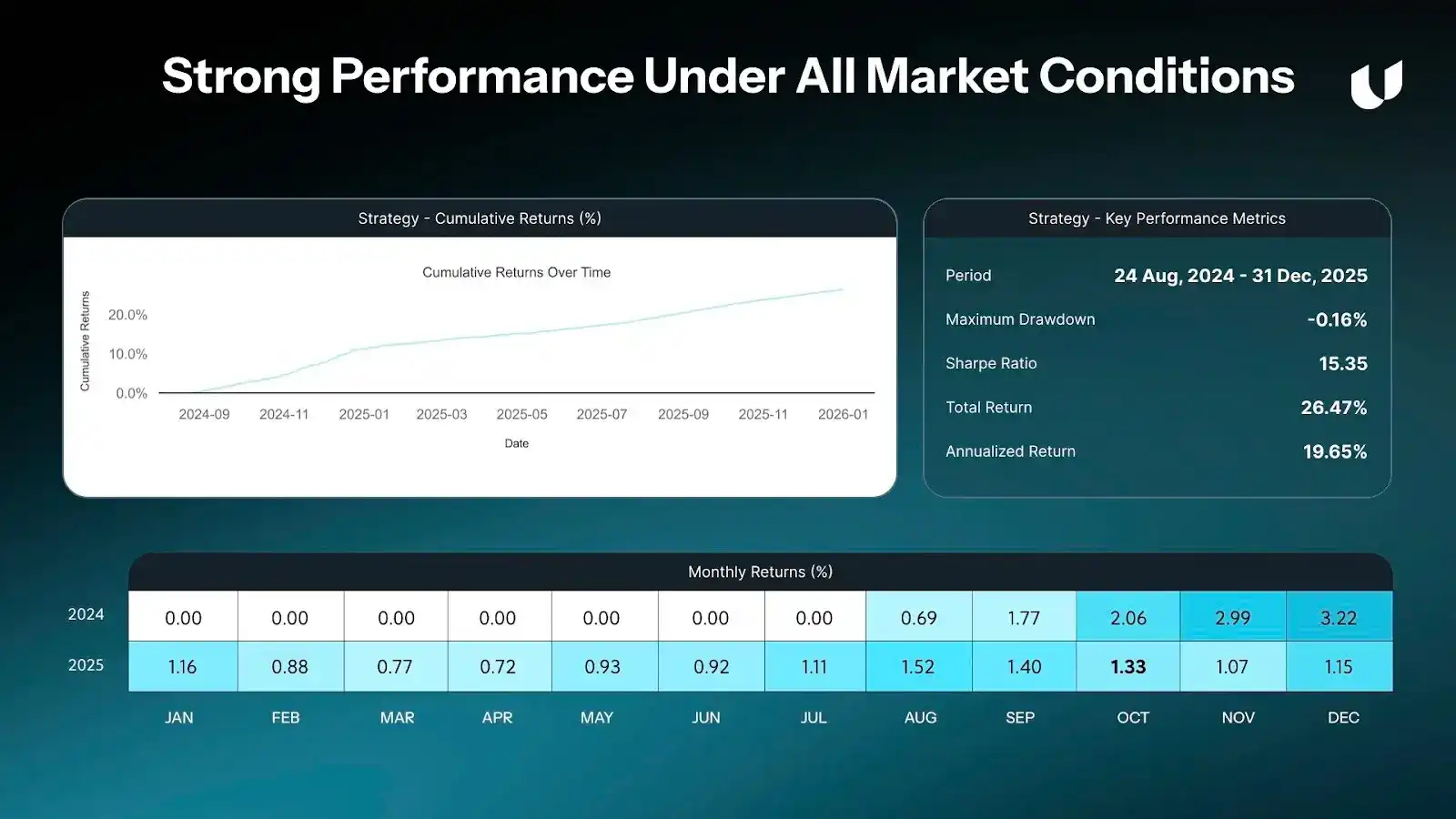
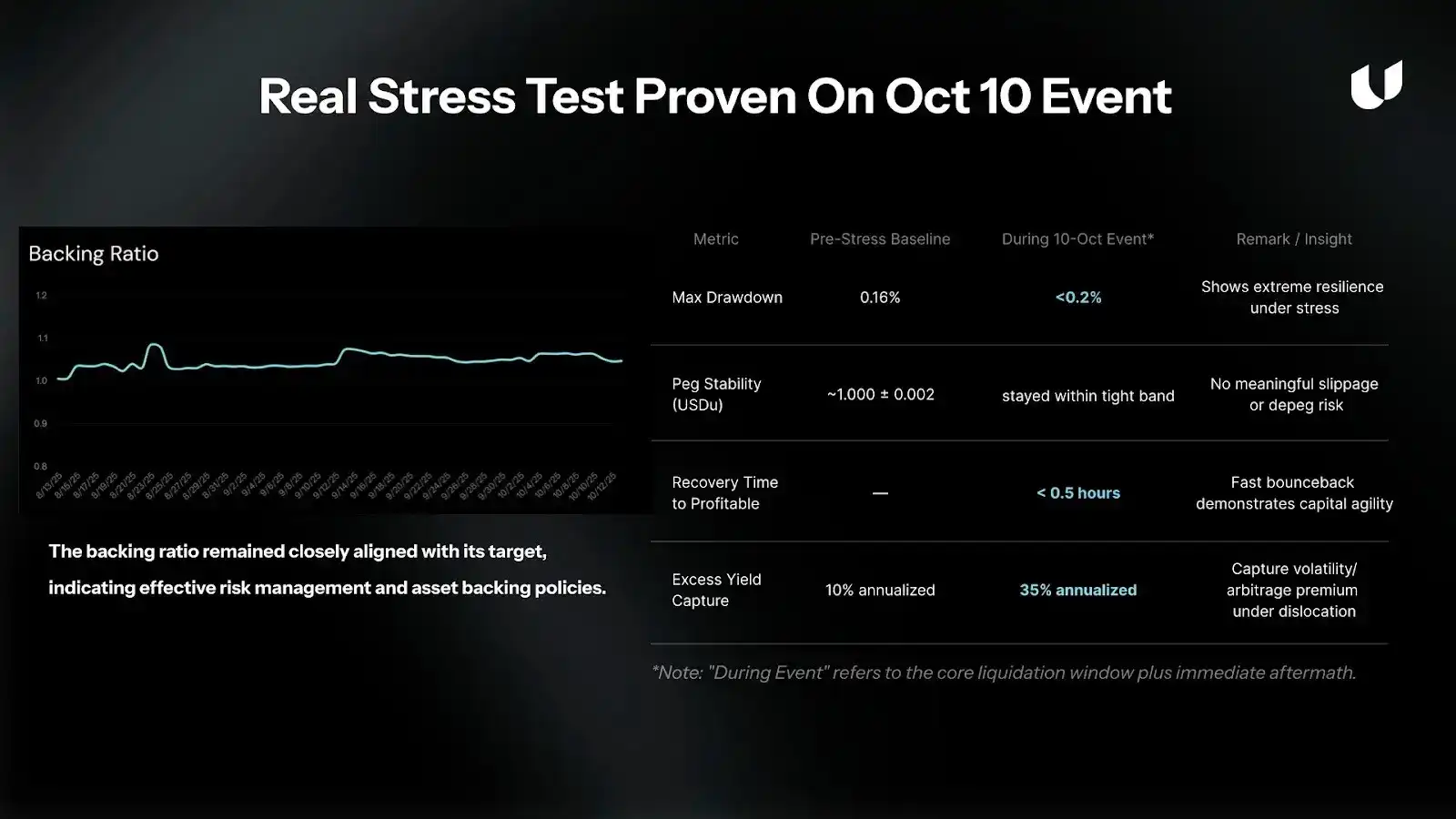
Especially during periods of extreme market volatility, such as on October 10, 2025, Unitas achieved zero actual losses through disciplined execution, with drawdowns始终控制在 0.2% 以内. This performance strongly demonstrates its实战 capability under real market depth and risk constraints, not just in experimental environments.
Transparency and Future Vision: Bridging Web3 and Traditional Finance

Unitas adheres to a high degree of audit transparency. Yield distribution is based entirely on actual performance, and collateral status and risk parameters are disclosed in real-time, eliminating "black box" concerns for users seeking long-term stable returns.

Looking ahead to 2026, Unitas's vision will extend further into the traditional finance (TradFi)领域. The platform plans deep integration with compliant institutions, treasury management platforms, and settlement systems. Its roadmap includes expanding the yield engine to real-world assets (RWA), such as tokenized stocks, commodities, and other structured notes, while maintaining consistent market-neutral logic and risk control standards.

By decoupling yield generation and distribution, Unitas aims to become the underlying cornerstone supporting savings, treasury management, and cross-border settlement, building a unified yield infrastructure spanning decentralized and traditional financial systems.

İlgili Sorular

QWhat is the core mission and vision of Unitas as described in the article?

AUnitas aims to build a global savings layer for digital assets and provide compliant, high-yield stablecoins. Its vision is to create a market-neutral yield infrastructure standard, offering professional, transparent, and institutionally risk-managed returns to users worldwide.

QHow does Unitas's modular platform differentiate itself in terms of risk and accessibility?

AUnitas provides a modular yield service that decouples capital access, asset custody, and yield execution. It operates without taking directional market risk and is designed to serve not only individual investors but also meet the stringent security and compliance needs of corporate and institutional treasuries.

QWhat is a key technological advantage of Unitas's yield engine compared to 'strategy outsourcing' models?

AA key advantage is that Unitas's core yield engine is self-developed, self-operated, and self-managed. It controls the entire lifecycle from signal generation and trade execution to real-time monitoring and risk response, unlike models that rely on third-party protocols.

QWhat were the key performance metrics achieved by Unitas in 2025, as stated in the article?

AIn 2025, with approximately $25 million in deployed capital, Unitas achieved an average net annualized yield of 16.7% while maintaining a maximum drawdown of only -0.16%.

QWhat is Unitas's future roadmap, particularly concerning integration with Traditional Finance (TradFi)?

AIn 2026, Unitas plans to deeply integrate with compliant institutions, treasury management platforms, and settlement systems. Its roadmap includes expanding its yield engine to Real World Assets (RWA) like tokenized stocks, commodities, and structured notes, all while maintaining its market-neutral logic and risk control standards.

İlgili Okumalar

From 'Global Computer/Settlement Layer' to 'Bulletin Board': What Are Ethereum and Vitalik Trying to Achieve?

In a significant shift of perspective, Vitalik Buterin recently proposed that Ethereum's core value may not lie in its function as a "world computer" or "global settlement layer," but rather as a simple yet powerful primitive: a cryptographically secure, globally shared "public bulletin board." This concept emphasizes data availability—a neutral, uncensorable, and permanent data layer where anyone can read and write information, but no single entity (including governments or developers) can alter or erase it. This "global shared memory" supports applications like secure voting systems, certificate revocation lists, and decentralized coordination—scenarios that require verifiable and tamper-proof data publishing rather than complex on-chain execution. The emergence of AI further validates this direction. As AI agents and services grow, so does the need for privacy-preserving and trustless interactions. Proposals like ZK API Usage Credits illustrate how Ethereum can enable anonymous AI model access and agent-to-agent economic coordination, relying precisely on the blockchain’s transparent and immutable data layer. Rather than a step back, this reframing represents a maturation of Ethereum’s vision—from defining what it can do to serving as essential infrastructure for what the world truly needs: a foundational layer of truth in an increasingly automated and opaque digital era.

marsbit35 dk önce

From 'Global Computer/Settlement Layer' to 'Bulletin Board': What Are Ethereum and Vitalik Trying to Achieve?

marsbit35 dk önce

When Wall Street's ETH Starts to 'Earn': From BlackRock's ETHB to Ethereum's Asset Attribute Shift

Wall Street Embraces Staking: BlackRock's ETHB and Ethereum's Shift to a Yield-Generating Asset On March 12, 2026, BlackRock launched the iShares Staked Ethereum Trust (ETHB) on Nasdaq, a groundbreaking Ethereum ETF that not only holds spot ETH but also stakes a significant portion (70-95%) of its assets to generate and distribute yield to investors. This move effectively answers a long-debated question: whether ETH can be accepted by mainstream finance as a yield-bearing asset. ETHB operates by delegating staking to professional validators like Figment via Coinbase Prime. It distributes approximately 82% of the staking rewards (estimated at 2.3%-2.5% APY after fees) to shareholders monthly, while retaining 18% as service fees and charging a 0.25% annual management fee. This provides a predictable, automated cash flow, though it lacks the compounding effect of native on-chain staking unless investors manually reinvest distributions. This development is significant as it marks the formal entry of staking—a core crypto-native activity—into Wall Street's asset framework. Under new SEC leadership, regulatory barriers have eased, allowing BlackRock to legitimize staking rewards as a viable investment return. This paves the way for other PoS-based ETFs (e.g., Solana, Cardano) and may shift substantial capital from traditional spot ETFs to yield-generating products. While on-chain staking options remain popular (e.g., native staking, liquid staking via Lido/Rocket Pool, or wallet-based staking), ETHB’s introduction signals a broader shift: ETH is increasingly viewed not just as a speculative asset, but as a productive, cash-flow-generating machine. The trend of making assets "work" is now irreversible, whether through traditional financial products or decentralized protocols.

marsbit1 saat önce

When Wall Street's ETH Starts to 'Earn': From BlackRock's ETHB to Ethereum's Asset Attribute Shift

marsbit1 saat önce

The 4 Truths and Fee Traps Behind Polymarket's LP Market Making Incentives

Polymarket, a prediction market platform, has recently shifted its focus to incentivizing liquidity providers (LPs) to address its core issue of low liquidity. While most markets remain free, it now charges a taker fee on specific markets like crypto price movements and select sports events. This fee, highest near 50% probability, funds new LP reward programs. There are two primary reward systems: one pays LPs when their limit orders are executed (maker rewards), and another rewards simply for placing orders within a set spread to provide liquidity, even if they don't get filled. A third mechanism allows anyone to sponsor additional incentives for specific markets. A positive view argues this structure values genuine liquidity over mere trading volume, making fees earned and rewards received a potential key, anti-sybil metric for a future POLY token airdrop. It rewards users who improve market depth and stability. A contrasting, negative view claims the LP program is a "trap." Critics argue that professional market makers avoid it due to insider trading risks and that most LPs are actually losing money due to hidden "LP wear and tear" (impermanent loss), only participating based on speculation of a valuable airdrop. They warn that if Polymarket expands fees to fund these unsustainable rewards, it could lose its competitive edge of zero fees and better odds compared to traditional sportsbooks. Proposed solutions include a fixed fee only on profits, using a native POLY pool for liquidity, or charging for premium products like parlays instead of core markets.

marsbit3 saat önce

The 4 Truths and Fee Traps Behind Polymarket's LP Market Making Incentives

marsbit3 saat önce

The 4 Truths Behind Polymarket's LP Market-Making Incentives and the Fee Trap

Polymarket, a prediction market platform, has recently shifted its incentive structure towards rewarding Liquidity Providers (LPs) to solve its core problem of low market depth. While most markets remain free, it now charges a taker fee on specific markets (all Crypto markets, NCAAB basketball, and Serie A football) to fund new LP reward programs. The fee is calculated on a symmetric curve, highest near 50% probability. The platform has introduced two main incentive systems: one rewards LPs whose limit orders are executed (Maker Incentives), and another rewards LPs simply for providing resting liquidity, even if orders aren't filled (Liquidity Incentives). A third system allows anyone to sponsor additional rewards for specific markets. A key argument is that the fees paid and rewards earned could be a strong anti-sybil metric for a potential POLY token airdrop, valuing genuine liquidity provision over mere trading volume. However, a counter viewpoint argues the LP program is a potential trap. Critics claim that the displayed ROI for LPs is misleading as it doesn't account for "LP wear and tear"—losses from filled orders that can't be easily exited. They state professional market makers avoid it due to insider trading risks and that the model of subsidizing liquidity with massive daily rewards is unsustainable. The concern is that widespread fee implementation could erase Polymarket's competitive edge over traditional betting platforms. Proposed solutions include a fixed fee on profits only, using a POLY token for native liquidity, and charging for premium products like parlays instead of core markets.

Odaily星球日报3 saat önce

The 4 Truths Behind Polymarket's LP Market-Making Incentives and the Fee Trap

Odaily星球日报3 saat önce

İşlemler

Spot
Futures

Popüler Makaleler

LAYER Nasıl Satın Alınır

HTX.com’a hoş geldiniz! Solayer (LAYER) satın alma işlemlerini basit ve kullanışlı bir hâle getirdik. Adım adım açıkladığımız rehberimizi takip ederek kripto yolculuğunuza başlayın. 1. Adım: HTX Hesabınızı OluşturunHTX'te ücretsiz bir hesap açmak için e-posta adresinizi veya telefon numaranızı kullanın. Sorunsuzca kaydolun ve tüm özelliklerin kilidini açın. Hesabımı Aç2. Adım: Kripto Satın Al Bölümüne Gidin ve Ödeme Yönteminizi SeçinKredi/Banka Kartı: Visa veya Mastercard'ınızı kullanarak anında Solayer (LAYER) satın alın.Bakiye: Sorunsuz bir şekilde işlem yapmak için HTX hesap bakiyenizdeki fonları kullanın.Üçüncü Taraflar: Kullanımı kolaylaştırmak için Google Pay ve Apple Pay gibi popüler ödeme yöntemlerini ekledik.P2P: HTX'teki diğer kullanıcılarla doğrudan işlem yapın.Borsa Dışı (OTC): Yatırımcılar için kişiye özel hizmetler ve rekabetçi döviz kurları sunuyoruz.3. Adım: Solayer (LAYER) Varlıklarınızı SaklayınSolayer (LAYER) satın aldıktan sonra HTX hesabınızda saklayın. Alternatif olarak, blok zinciri transferi yoluyla başka bir yere gönderebilir veya diğer kripto para birimlerini takas etmek için kullanabilirsiniz.4. Adım: Solayer (LAYER) Varlıklarınızla İşlem YapınHTX'in spot piyasasında Solayer (LAYER) ile kolayca işlemler yapın.Hesabınıza erişin, işlem çiftinizi seçin, işlemlerinizi gerçekleştirin ve gerçek zamanlı olarak izleyin. Hem yeni başlayanlar hem de deneyimli yatırımcılar için kullanıcı dostu bir deneyim sunuyoruz.

228 Toplam GörüntülenmeYayınlanma 2025.02.11Güncellenme 2025.03.21

LAYER Nasıl Satın Alınır

Tartışmalar

HTX Topluluğuna hoş geldiniz. Burada, en son platform gelişmeleri hakkında bilgi sahibi olabilir ve profesyonel piyasa görüşlerine erişebilirsiniz. Kullanıcıların LAYER (LAYER) fiyatı hakkındaki görüşleri aşağıda sunulmaktadır.

活动图片