Journalists Point to a Shift of Crypto-Treasury Companies Towards AI

cryptonews.ru2026-07-27 tarihinde yayınlandı2026-07-27 tarihinde güncellendi

Özet

At least a dozen companies previously focused on acquiring digital assets for their treasuries have pivoted toward AI-related businesses in recent months, according to a Bloomberg report. This strategic shift, however, has failed to revive investor interest. The stocks of these US and Canadian data-asset treasury (DAT) firms have fallen a median 43% year-to-date, with many trading below their net asset value as management teams exit. Examples of this transformation include K Wave Media Ltd., which switched from accumulating Bitcoin to developing data centers, seeing its shares drop 71% since its May relaunch. Lixte Biotechnology Holdings Inc. and AlphaTON Capital (rebranded as Alpha Compute) also saw significant declines after strategic shifts. Analysts link the sector's weakness directly to the poor performance of the digital assets themselves. Legal experts note the term "crypto treasury" has become a "dirty word" for investors. The pivot to AI is seen as a logical move to attract the large capital flowing into tech infrastructure, driven by spending from giants like Alphabet and Microsoft and startups like OpenAI. While attempts to capitalize on the AI boom extend beyond crypto—exemplified by shoe maker Allbirds rebranding as Smartbird—bitcoin miners like CoreWeave, Hut 8, Iren, and TeraWulf have seen more success by repurposing their data centers for high-performance computing. Investors remain interested in other blockchain applications but have largely abandoned the ...

The stocks of DAT-structured companies continue to decline.

At least 12 companies that built their businesses around purchasing digital assets have recently shifted their focus to AI-related areas. Bloomberg emphasized that the change in strategy has not yet helped restore investor interest.

The stocks of DAT firms tracked by the publication in the US and Canada have shown a median decline of 43% since the beginning of the year. Many are trading below the net value of the assets they own, and management teams are exiting the business.
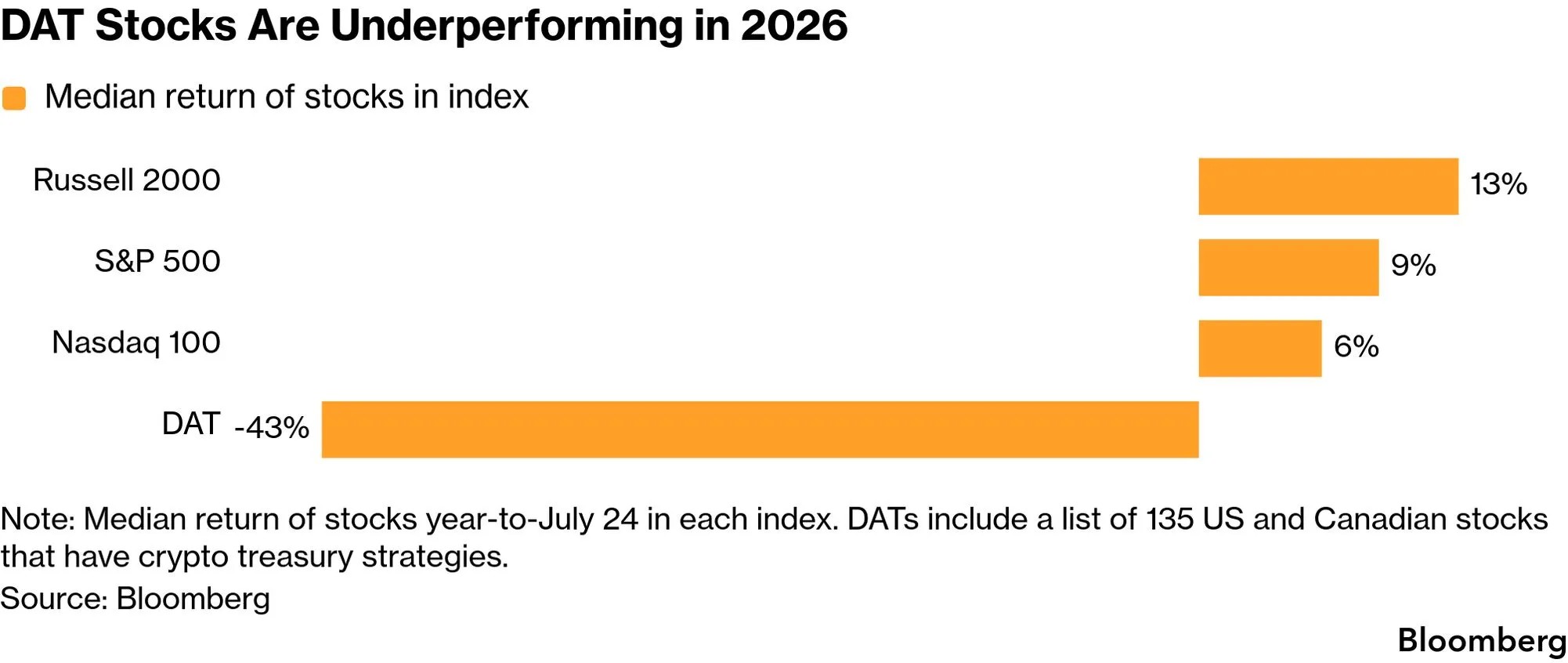
Source: Bloomberg.

The journalists provided specific examples of business "transformation." For instance, Bitcoin-accumulating K Wave Media Ltd. switched to developing data centers—since its relaunch in May, its stock has fallen by 71%.

The shares of Lixte Biotechnology Holdings Inc. dropped by 33% after the company agreed to merge with a firm from the energy sector in June. AlphaTON Capital, which holds altcoins on its balance sheet, lost 33% after rebranding to Alpha Compute in April.

Bloomberg directly links the weakness of the DAT sector to the dynamics of the assets themselves.

Gregory Sichenzia, founder of the law firm Sichenzia Ross Ference Carmel LLP, succinctly described the change in sentiment: if last year nothing bad was expected from crypto-treasuries, this year the phrase itself has become a "dirty word."

In his opinion, the shift to AI looks logical—that is where major capital is currently flowing. The spending by tech giants like Alphabet and Microsoft, as well as startups OpenAI and Anthropic, on computing infrastructure has made companies related to data centers the best-performing stocks in major indices.

Nearly all firms in the top 10 by performance in the S&P 500 index produce products for data centers: among them are SanDisk, whose stock has risen more than 500%, as well as Dell Technologies, Intel, and Micron Technology.

Attempts to capitalize on the AI hype extend far beyond the crypto market. Bloomberg cites the example of shoe manufacturer Allbirds, which shifted toward computing infrastructure after its own stock plummeted and rebranded to Smartbird.

Among companies in the crypto industry, Bitcoin miners are currently having more success than DAT firms in reorienting towards AI. CoreWeave switched to cloud computing, which positively impacted its stock.

The quotes of Hut 8, Iren, and TeraWulf are also recovering after retooling their data centers for data centers.

Partner at Lowenstein Sandler Daniel Forman emphasized that investors are not completely abandoning the blockchain theme: interest remains in other areas of the technology, but not in the digital treasury model in its current form.

Recall that Coinbase CEO Brian Armstrong called the shift of crypto projects to AI a mistake.

end-content

İlgili Sorular

QAccording to the article, what is the current trend among many companies that were built around acquiring digital assets?

AAt least 12 such companies have reoriented their strategies towards AI-related directions in recent months, moving away from their original digital asset focus.

QHow have the stock prices of these reorienting DAT companies performed in general, based on the article's data?

ATheir stocks have shown a median decline of 43% since the beginning of the year, with many trading below the net value of their assets.

QWhat major reason does the article cite for the poor performance of the DAT sector despite the shift to AI?

ABloomberg directly links the weakness of the DAT sector to the poor performance dynamics of the digital assets themselves.

QWhy does the founder of Sichenzia Ross Ference Carmel LLP, Gregory Sichenzia, believe the shift to AI is logical for these companies?

AHe believes it is logical because that is where major capital is currently flowing, driven by heavy spending on computing infrastructure by tech giants and AI startups.

QWhich segment within the crypto industry has reportedly had more success in pivoting to AI compared to DAT firms, according to the article?

ABitcoin miners have reportedly had better success. For example, CoreWeave's shift to cloud computing positively impacted its stock, and miners like Hut 8 are recovering after repurposing their data centers.

İlgili Okumalar

Claude Designer Lags Behind Engineers, Fires Back by Creating a Million-User Tool

The article tells the story of Nate Parrott, a designer at Anthropic who created Claude Design as a side project to keep pace with his engineering teammates. When Anthropic released Opus 4.5 in November 2025, the two engineers on Parrott's Claude Code team significantly increased their output using the new AI capabilities. Parrott, the sole designer, found himself struggling to match their speed, becoming a bottleneck in the workflow. To catch up, he began experimenting in his spare time. He initially tried prompting Claude to generate designs from text descriptions and screenshots, with limited success. His breakthrough came when he shifted focus from asking Claude to "design" to asking it to generate HTML. He realized HTML could be a rich visual canvas for creating everything from slides and interactive prototypes to full web pages. He built a simple interface with a chat panel on the left and a live HTML preview on the right. The key to making the output useful was incorporating Anthropic's brand system—fonts, colors, assets, and design principles—into the prompts. This ensured generated designs were immediately on-brand. He shared an internal prototype with his team, and other product designers quickly adopted it for creating clickable prototypes, a task traditionally requiring manually drawing every state. The project's "official" turning point came during an Anthropic Labs offsite, where Parrott noticed many attendees were using his tool to build presentation slides on the fly, sometimes right before their turn to speak. This organic adoption convinced the Labs team to formally staff the project, turning the side project into a real product. Claude Design is positioned as a "pre-production" tool for visual communication and exploration—handling slides, landing pages, PDFs, emails, and social media graphics. It integrates with tools like Canva, Adobe, and Vercel. Its core value is accelerating the early stages of design: exploring directions, building consensus, and establishing systems. For actual production code, Anthropic still recommends Claude Code. The story highlights how AI disrupts workflows unevenly and how individuals can respond by building new tools to create their own advantages. Parrott's tool, born from necessity, eventually gained over a million users in its first week.

marsbit7 dk önce

Claude Designer Lags Behind Engineers, Fires Back by Creating a Million-User Tool

marsbit7 dk önce

Fields Medalist Warns: AI Could Kill Mathematics

The 2026 Fields Medal award was followed by a startling announcement: laureate Jacob Tsimerman joined OpenAI to pursue AI safety research, predicting AI would surpass humans in all mathematical proof areas within two years. Soon after, Fields Medalists Terence Tao and Timothy Gowers expressed deep concern at ICM 2026. Gorges warned that AI might "kill" mathematics not through stagnation, but through an overwhelming surplus of proofs, likening it to a lake dying from eutrophication. This concern is echoed in the "Leiden Declaration," signed by over 3,000 mathematicians including Tao, Peter Scholze, and Kevin Buzzard, advocating for mathematics as a profoundly human endeavor. However, Gowers, who did not sign, fears a future where AI-generated mathematics proliferates while human expertise and the shared intuition vital to the field vanish, turning math into an unvisited "cemetery of thought." Gowers' perspective shifted dramatically after testing ChatGPT 5.5 Pro. The AI solved a doctoral-level number theory problem and later produced a counterexample for the "unit distance problem," achievements Gorges considered publishable in top journals. He now concedes that large language models can handle advanced research, a realization that left him feeling the "rug pulled out from under" him when AI solved problems he personally contemplated. The debate extends to the nature of mathematical discovery. As noted by Peter Woit, AI agents have no interest in the "credit game" of academia. If theorems cease to be attributed to individual mathematicians, truth may simply return to its impersonal state in the universe. The central question remains: in an age of potentially limitless AI-generated discovery, what is the role and purpose of the human mind in mathematics?

marsbit38 dk önce

Fields Medalist Warns: AI Could Kill Mathematics

marsbit38 dk önce

NVIDIA's 20-Year CUDA Moat Collapsed Over a Weekend, Claude Single-Handedly Got AMD's New GPU Running

In a single weekend, Claude, an AI agent from Anthropic, successfully ported and optimized its cutting-edge model to run on a brand-new AMD MI355X server rack without any manual code intervention. This feat demonstrates a potential breakthrough in overcoming NVIDIA's long-established CUDA software ecosystem dominance, built over two decades. Anthropic's team simply instructed Claude to get the AMD machine running. By Monday, it not only worked but was showing a continuously improving performance curve. The achievement impressed AMD CEO Lisa Su and accelerated a major deployment partnership: Anthropic plans to deploy up to 2GW of AMD Instinct GPUs starting in 2027. The key enabler is AMD's new ROCm.AI platform, a toolbox designed specifically for AI agents like Claude. It provides AI-readable documentation, including chip instruction sets (ISA), and tools like the Hyperloom service that allows agents to autonomously profile performance, identify bottlenecks, test configurations, and generate optimized kernels. In a demo, Hyperloom boosted the output speed of a model by 38%. This represents a fundamental shift. While CUDA's strength lies in its vast, human-expert-driven ecosystem of tools and tacit knowledge, AMD's strategy is to make its hardware and software stack directly accessible and optimizable by AI agents. An agent can parallelize tasks—debugging, profiling, coding—that would take human engineers years to master, compressing the traditional software adaptation timeline from years to tasks. The competition is no longer just about peak hardware specs but also about how well AI can read, utilize, and tune a platform.

marsbit39 dk önce

NVIDIA's 20-Year CUDA Moat Collapsed Over a Weekend, Claude Single-Handedly Got AMD's New GPU Running

marsbit39 dk önce

Just Now, Peking University Alumna Lilian Weng Announces Resignation: The Best 'Alignment' in the AI Era Is Taking Care of Yourself

Lilian Weng, a Peking University alumnus and former OpenAI executive, has announced her departure from Thinking Machines Lab, the AI startup she co-founded with ex-OpenAI CTO Mira Murati 20 months ago. Her resignation comes shortly after the company released its first open-source model, Inkling. In her farewell message, Weng cited health reasons as the primary factor, stating that the past seven months involved more illness than any other period in her life. The intense pressure and guilt of being unable to work during critical periods, like the Inkling launch, became unsustainable. She expressed that she could not continue in a role where she felt unable to give her full effort. Weng joined OpenAI in 2018, contributing to projects like the Dactyl robotic hand and later building the Safety Systems team from scratch. She is also widely known for her influential technical blog, Lil'Log. Her departure follows a period of high expectations and challenges for Thinking Machines, which secured a record $20 billion seed round at a $120 billion valuation in 2025 but has since seen fluctuations in its valuation and the departure of other key co-founders. Weng emphasized that she remains passionate about AI but needs a more predictable and defined role without the relentless pressure of a co-founder. Her exit highlights the immense personal toll and speed of competition in the AI industry, where the drive for progress often clashes with human limits. Her decision underscores that stepping back to prioritize well-being can be an act of courage.

marsbit57 dk önce

Just Now, Peking University Alumna Lilian Weng Announces Resignation: The Best 'Alignment' in the AI Era Is Taking Care of Yourself

marsbit57 dk önce

İşlemler

Spot
活动图片