Note: This article is speculative; I hope you have the patience to read it through.
By: Xiao Bing
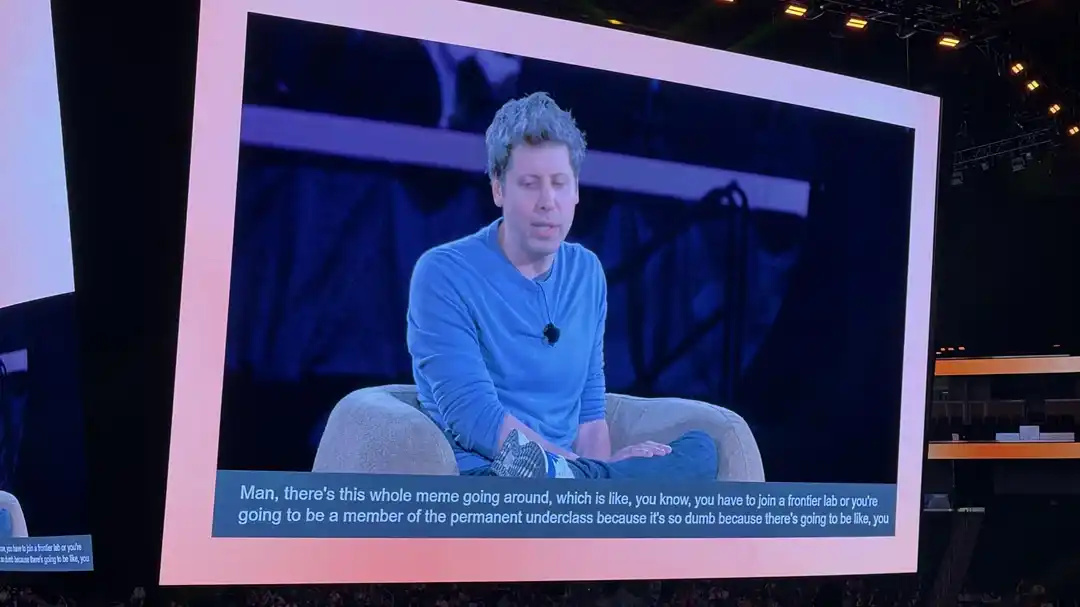
On July 26, Sam Altman stood on the stage at the Chase Center in San Francisco and said, "It's silly to say that if you don't get into a frontier lab, you'll fall into the permanent underclass."
"Permanent underclass"—this trendy term entered the spotlight once again.
It gradually gained popularity in the tech circles on X in the summer of 2025, with its theoretical framework stemming from The Intelligence Curse, and the paper Capital in the Twenty-Second Century by Trammell and Patel.
This notion isn't just predicting "AI will make many people unemployed"; it describes a more extreme future: when AI can perform the vast majority of cognitive and physical labor, enterprises will no longer need to employ so many people to create wealth. The importance of wages in the economy will consequently decline, while profits increasingly flow to those who control the models, computing power, energy, and data centers.
It's not just one group of people becoming temporarily poorer; it's the labor they rely on for upward mobility losing its value. It's not just the rich becoming richer than before; it's that those without capital cannot become capital owners through work. This is what is called the "permanent underclass."
In the absence of large-scale wealth redistribution, public ownership, or a global progressive capital tax, this theory ultimately leads to a disturbing conclusion:
Almost all assets may gradually flow to those who were already the wealthiest at the time of the AI transition.
Of course, this is still just a projection, but it reminds me of a small incident.
Over the past year, the writer Jasmine Sun conducted an almost naive fieldwork project. She met with researchers from frontier AI labs one by one, engaging in hour-long conversations each time, without recording or keeping notes, asking them like an anthropologist about their genuine views on the future of AI.
There was one question she almost always asked:
Imagine standing before you is an ordinary 17-year-old American child. He is not a genius programmer, has only B-average grades, and doesn't pay much attention to AI. What would you advise him to prepare for the future?
Almost no one could answer.
These researchers held diverse political stances and their judgments on AI spanned optimism and pessimism, yet their answers were surprisingly consistent:
I don't know. The current situation is scary; there probably won't be many jobs left for him, and he just happens to be trapped in the most painful transitional period...
But the real trouble facing that 17-year-old child may not be whether he will become poor.
What's Permanent is Not Poverty
There have always been the poor, and there has always been an underclass in any era, but the "underclass" of the past was not necessarily a permanent identity.
A person could sell their labor for wages, then exchange those wages for education, housing, and assets; workers could also organize, strike, and engage in collective bargaining, demanding that capital convert part of productivity growth into higher wages and better benefits.
This mechanism was not fair, but it at least preserved an upward channel.
The truly stinging aspect of the "permanent underclass" is its suggestion that this channel itself may disappear.
Looking back at labor history, unions, minimum wage, and the weekend system were all built on the same fact: capital and labor cannot completely substitute for each other.
Factory owners needed workers, tech companies needed engineers, so the two sides had to sit down and negotiate.
Marx predicted the high concentration of capital but also offered a set of solutions. Because in his world, workers still held something capital needed but could not create out of thin air: labor.
Strikes worked because laborers could temporarily withhold it. If workers didn't enter the factory, machines couldn't run; if engineers didn't write code, products couldn't launch.
But if computing power can purchase all the labor a person can provide, what laborers can withhold approaches zero.
At that point, the problem is not just some people's wages declining, but that capital no longer needs to negotiate with most people. Laborers would find it difficult both to accumulate assets through wages and to demand a redistribution of benefits by withholding their work.
What makes the underclass "permanent" is that the very machine that once could return the poor to the middle class—labor, bargaining, and asset accumulation—is being dismantled.
Evidence that this machine is loosening has already moved from theory to pay stubs.
Using ADP microdata covering 4.6 million workers, the Stanford Digital Economy Lab found: after the proliferation of generative AI, in occupations with the highest AI exposure, employment among workers aged 22 to 25 showed a relative decline of about 16%. The unemployment rate for new college graduates in the US reached 5.6%, up 1.6 percentage points from three years ago. The hiring scale for new graduates by large tech companies dropped by 25% within two years.
The elevator is still running normally; it's just that the button for the first floor has been removed.
Those Who Cannot Answer Are Buying Insurance for Themselves
Back to Sun's interviews.
The researchers who couldn't answer "what should the 17-year-old do?" did not stop their work because of that.
Sun continued to probe: Since you believe the future is so dangerous, why continue building it?
The answers roughly fell into three categories.
The first sincerely believes that, once past the transition period, AI can ultimately cure diseases and eliminate scarcity.
The second believes in technological determinism: even if they don't do it, someone else will.
The third is the most honest, and also the most awkward:
If the great upheaval is really coming, at least secure a position for yourself in the future first.
This impulse to "secure a position" is changing the talent flow across the entire AI industry.
A friend of Sun's studying for a Ph.D. in AI at Berkeley said about half of their cohort decided to graduate early, with some even choosing their dissertation topics based on "which research direction makes it easiest to get an offer from an AI lab."
Many independent writers and policy researchers around Sun also abandoned their original positions and joined AI labs.
These stories might sound like anecdotes, but they are genuinely shaping a generation's life choices and continually draining talent from the ecosystem of independent research and public policy.
And what's being drained is precisely the group most capable of building the negotiating table.
An important reason why factory automation in the 20th century did not universally escalate into intense conflict was that before machines entered the factory, management usually had to negotiate with the union first: automation had to be explained as a safety upgrade, and wage increases needed to be tied to productivity gains.
Between capital and labor, there was a negotiating table.
Today's white-collar workers don't have this table.
What's more subtle is that those most capable of building this table—scholars, independent researchers, and policy talents—are being persuaded into labs by the narrative that "labor is about to lose its value." Because only by entering the lab can they potentially obtain equity and stand on the side of capital in advance.
A closed loop thus forms:
The more people believe labor's bargaining power is about to disappear, the more people will abandon building that bargaining power and instead scramble for equity; and the fewer the builders, the faster labor's bargaining power disappears.
No One is Absolutely Safe
That 17-year-old child isn't completely without advice.
In the face of uncertainty brought by AI, people have offered many answers, most directly giving rise to two types of reactions.
One is to learn AI as quickly as possible, striving to be among the last to be replaced. The other is to acquire AI assets as quickly as possible, striving to stand on the side of capital before labor loses its value.
The latter impulse is particularly evident in Silicon Valley, and even among the affluent class in China.
Some are willing to go to great lengths to obtain equity in Anthropic, OpenAI, or other frontier AI companies. The theory is simple: If the singularity truly arrives, labor may rapidly depreciate. At that point, what determines a person's situation will no longer be what they can do, but what they have acquired in advance.
According to this logic, as long as one converts labor income into equity in AI companies before the window closes, there's a chance to shift from being someone replaced by technology to someone who owns the technology.
This is also the most enticing aspect of the "permanent underclass" narrative; it not only manufactures fear but also hints at an escape route:
Since capital may replace labor, then quickly transform from a laborer to a capital owner.
The problem is, this path doesn't belong to most people in the first place.
OpenAI and Anthropic are not companies ordinary people can easily purchase on the public market. Those who truly have a chance to obtain such equity are usually lab employees, early investors, and affluent individuals with access to the private equity market.
Therefore, this is almost a circular argument:
To avoid falling into the underclass due to a lack of capital, one first needs to possess the capital that only the upper echelons can access.
More importantly, even if one successfully obtains equity, this insurance may not be permanently effective.
Fernando Borretti, the creator of the programming language Austral, points out that there is an internal contradiction within the "permanent underclass" theory.
If AI can truly perform almost all cognitive and physical labor at a lower cost, then while ordinary laborers may lose economic value, those who hold shares in AI companies in advance may not necessarily become the "permanent upper class."
The reason is simple: wealth is not written into the laws of nature.
A person owns a company, land, or computing power not just because their name is on a contract, but because courts, police, and governments are willing to recognize and protect that property right.
But if we continue projecting the scenario of "super AI replacing everything," AI may eventually be able to handle production, management, governance, and even warfare. At that point, today's wealthy neither provide labor nor possess any practical power beyond the machines. So, why would a future state or superintelligence necessarily forever recognize the ownership they acquired in the old era?
Buying equity in AI companies might allow a person to weather the transition period, but it cannot guarantee they will remain in the upper class permanently.
If owning AI assets isn't a path everyone can take, the more common answer is learning AI.
This path presents another paradox:
The better a person becomes at using AI to increase productivity, the more likely they are to help enterprises reduce the demand for other laborers.
They might manage to stay in the elevator temporarily, but they are also participating in removing buttons for other floors.
This doesn't mean people shouldn't learn AI. For individuals, becoming proficient with AI may still be the most rational choice at present. The problem is, when everyone tries to avoid being replaced by increasing their own replaceable efficiency, the ultimate result may be that enterprises need even fewer workers.
Individual rational choices, when aggregated, might instead accelerate the decline of labor's overall bargaining power.
Another answer is to move away from fields most easily replicated by AI, towards work that requires physical presence.
If the supply of digital products approaches infinity, then physical operations that cannot be replicated remotely, on-site responsibility, and interpersonal trust may indeed command a higher premium.
Data centers need electricians, an aging society needs caregivers, and people are still willing to pay for the real presence of doctors, teachers, and service personnel. But again, this is not a retreat path everyone can take.
The above seem to be three different paths, but they are all answering the same question:
How to make oneself fall a little later?
But the answer that 17-year-old child truly needs might be: Why must a person's survival depend on whether they are still needed by capital?
The reason the researchers couldn't answer is that this question ultimately doesn't require a personal plan, but a new distribution system.
When labor remains irreplaceable, wages, unions, and strikes together constitute the distribution mechanism. If labor truly begins to lose its scarcity, then society must find another way to distribute the wealth created by machines to those no longer needed by them.
This cannot be solved by everyone learning AI more diligently, nor can it be accomplished by each person buying a few stocks in advance.
What individuals can buy is only buffer time; what's truly missing is still that negotiating table.
A Negotiating Table
Building the negotiating table is not something any individual effort can replace.
China unexpectedly provides a comparative sample.
In December 2025, a Beijing court ruled that a position being replaced by AI could not directly constitute legal grounds for dismissal. Also, some state-owned enterprise employees said the AI tools they used could handle the work of about two employees, but the company promised not to conduct layoffs on the grounds of AI.
After spending two weeks in China, Sun summarized: The societal attitude there is not simple technological optimism, but a pragmatism of "resistance isn't realistic, so get on board first."
But at least, someone is trying to catch the people falling in the technological transition with numerous scattered rules and legislation.
The United States faces something closer to an institutional vacuum.
In April 2026, someone threw a Molotov cocktail at Altman's residence in San Francisco; in the same month, a city councilor supporting a data center project was shot at in his home. Boos targeting AI company executives also began appearing at graduation ceremonies.
When emotions cannot find an institutional outlet, they will find an outlet on their own.
Meanwhile, data from the St. Louis Fed showed that 39% of US GDP growth in 2025 came from data center and AI-related investments.
The entire nation is betting its growth on a technology from which most citizens feel no immediate benefit.
The US will hold midterm elections in 2026, and the 2028 primaries for both parties are destined to be crowded, with Mark Kelly, Ro Khanna, and Josh Hawley having already released their respective AI action plans.
Therefore, perhaps the most worthwhile indicator to watch in the next two years is just one:
Can that negotiating table be set out before the anger?
It might be a law stipulating that companies cannot simply convert all productivity gains into layoffs. It might be a new form of union, allowing employees in the same company, even with different professions, to jointly participate in negotiations about AI deployment. It might also be a check with an AI company's name on it, using taxes, dividends, or a public fund to redistribute the benefits created by technology to those bearing the transition costs.
The specific form is yet to be determined, but the core question can no longer be avoided:
When enterprises no longer need to employ most people to create wealth, on what basis should most people share in that wealth?
As for that 17-year-old child with B-average grades, he probably will never know:
When the smartest group of people in an entire industry were asked "what should we do with him," the answer they gave was "no answer."
And then, they each went back to continue buying insurance for themselves.