The Value Distribution of Stablecoins

marsbit2026-06-15 tarihinde yayınlandı2026-06-15 tarihinde güncellendi

Özet

**Summary: The Value Distribution of Stablecoins** The article argues that stablecoins are evolving from mere trading tools into broader channels for dollar access. It divides the stablecoin ecosystem into four layers to analyze how value is distributed: 1. **Issuance Layer:** Mints stablecoins, holds reserve assets, and captures the spread between reserve yield and user costs (e.g., Tether, Circle). This layer currently earns the largest profit margin. 2. **Infrastructure Layer:** Connects stablecoins to the traditional financial system, handling fiat on/off-ramps, banking integration, compliance (KYC/AML), and asset management (e.g., Bridge, BVNK). This is the "unglamorous" but critical work, building the essential bridges between crypto and real-world finance. 3. **Acquiring/Distribution Layer:** Integrates stablecoins into merchant systems, manages payment flows, and provides enterprise financial software (e.g., Stripe, Coinbase). They act as the access point for businesses. 4. **Application Layer:** The end-users and businesses that ultimately use stablecoins for payments, settlements, or as a store of value. They benefit from convenience but have little pricing power. The core thesis is that while the issuance layer currently dominates profits, the often-overlooked **infrastructure layer holds significant long-term potential**. The real challenge and barrier to mass adoption is not the on-chain transfer of stablecoins (which is simple), but the complex "last mile...

Author: @0xjiawei

Previous chapters discussed the broad direction: stablecoins are evolving from mere trading tools into a general-purpose dollar channel.

This chapter examines how the stablecoin "pie" is divided.
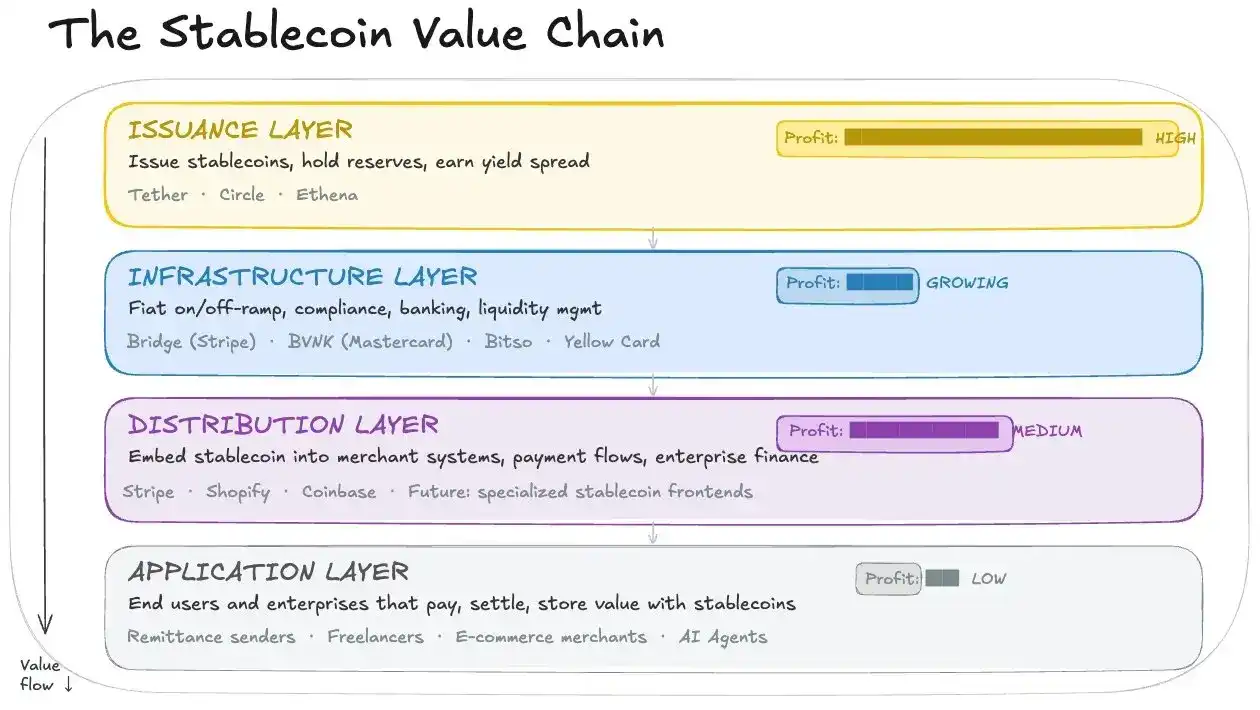
I categorize stablecoins into four layers:

  1. Issuance Layer: Mints stablecoins, holds reserve assets, captures the interest rate spread. Representatives: Tether and Circle.
  2. Infrastructure Layer: Connects stablecoins to the real-world financial system – fiat on/off-ramps, bank integrations, asset management, compliance. Representatives: Bridge (acquired by Stripe), BVNK (acquired by Mastercard), Bitso, Yellow Card, etc.
  3. Acquiring/Distribution Layer: Embeds stablecoins into merchant systems, manages payment flows, enterprise financial software. Representatives: Stripe, Infini, Coinbase.
  4. Application Layer: End users and businesses that ultimately use stablecoins for payments, settlement, or as a store of value.

The issuance layer captures user funds and earns the thickest interest spread; the middle two layers profit from traffic, distribution fees, and foundational infrastructure; the application layer enjoys convenience but lacks pricing power.

I believe the infrastructure layer is currently undervalued by the market.

It does the gritty, thankless work: integrating with banks, handling KYC/AML, managing local fiat on/off-ramps, connecting merchants and APIs, interfacing with card networks, and solving settlement and regulatory issues across different countries.

But conversely, this is precisely where its moat lies. Because the technology behind stablecoins is straightforward—transferring USDC on-chain isn't the hard part. The real challenge is penetrating the real world, convincing a Latin American company, an African payment provider, or a cross-border e-commerce platform to incorporate stablecoins into their daily cash flows. This gritty work is essential and must be done by someone.

The On-Chain Part is Easiest; The Bridge to Reality is Hardest

At first glance, stablecoin payments seem simple: on-chain transfers are fast, confirm quickly, have low fees. The rest is just distributing the product to users, right?

But the real difficulty with stablecoins lies in the vast gap between the blockchain and the traditional financial system. Businesses have decision-making and switching costs; they won't overhaul a perfectly functional workflow just because they heard stablecoins settle in one second.

This raises a cascade of questions: How do I convert fiat to stablecoins? And back again? How do I handle reconciliation and taxes? Will my bank block me later? Do users still need to learn how to use a wallet?

The core task of the infrastructure layer is bridging these two worlds: connecting to blockchains and wallets on one side, and to banks, local payment networks, enterprise systems, and compliance on the other.

Stripe's acquisition of Bridge in 2025 brought Bridge's "stablecoin orchestration" system—helping businesses integrate stablecoin capabilities into their operations. Mastercard's announcement in March 2026 to acquire BVNK followed a similar logic.

In other words, traditional payment companies are competing to become the default gateway for enterprises using stablecoins.

The key to scaling stablecoin payments lies precisely here.

The Road Builders

Looking closer at the infrastructure layer, its functions include:

  1. On/Off-Ramps + FX: Most enterprise use cases involve a "local currency → stablecoin → local currency" flow. This touches on banking relationships, compliance, liquidity, and other issues.
  2. >API + Account Layer: Businesses need a set of financial capabilities embedded into their workflows—account opening, sending/receiving payments, fund splitting, clearing, reconciliation. This resembles financial SaaS, similar to the concept of Neobanks.
  3. Payment Network Connectivity: The more payment rails, banks, and regions connected, the greater the customer dependency and switching costs become over time.
  4. Capital Efficiency: Helping businesses reduce idle funds, wait times, and FX losses.

I believe this layer has three defining characteristics that ensure its path is arduous before it becomes rewarding.

  • It's gritty, thankless work. Requires integrating with banks, achieving compliance, obtaining licenses, and building local teams, country by country.
  • It requires upfront investment to capture the gateway. Enterprises won't easily switch their payment infrastructure. Whoever first secures large clients, banking relationships, compliant pathways, and local fiat rails will later benefit from network effects. Companies at this stage are more in a "land grab" phase, far from reaping the harvest.
  • It's squeezed between upstream and downstream players. Upstream issuers capture the interest spread first, while downstream platforms want to control the user gateway. Infrastructure sits in the middle, in an awkward position, easily becoming "everyone needs you, but no one wants you to earn too much."

Right now, it's in an intermediate stage moving towards "forming pricing power."

If we look only at today, the issuance layer takes the largest profits, while the infrastructure layer is thinner and more burdensome.

But if we're talking about how to invest in the stablecoin space, the seigniorage logic of the issuance layer is already well-understood by the market, and its valuation will increasingly revolve around interest rates, regulation, and profit-sharing. The infrastructure layer is less conspicuous today, largely because it's still in the heavy-investment phase; pricing power and solidified user habits haven't fully formed yet.

Once stablecoins further become the default rails for enterprise finance, the true beneficiaries will be those who spent years building the bridges between stablecoins and the real-world commercial system.


İlgili Sorular

QAccording to the article, what are the four layers of the stablecoin value stack?

AThe four layers are: 1) The Issuance Layer (e.g., Tether, Circle), which mints stablecoins, holds reserve assets, and earns the spread. 2) The Infrastructure Layer (e.g., Bridge, BVNK, Bitso, Yellow Card), which connects stablecoins to the real-world financial system (fiat on/off-ramps, bank integration, compliance). 3) The Acquirer/Distribution Layer (e.g., Stripe, Infini, Coinbase), which embeds stablecoins into merchant systems and manages payment flows. 4) The Application Layer, comprising the end-users and enterprises that use stablecoins for payments, settlements, and storing value.

QWhy does the author believe the Infrastructure Layer is currently underappreciated?

AThe author believes the Infrastructure Layer is underappreciated because it handles the 'dirty work' or heavy lifting: integrating with banks, performing KYC/AML, managing local fiat on/off-ramps, connecting to merchants and APIs, interfacing with card networks, and navigating the complex compliance and regulatory issues across different countries. This work, while not glamorous, builds a significant moat and is essential for stablecoins to penetrate real-world business operations.

QWhat is the most difficult part of enabling stablecoin payments, according to the article?

AAccording to the article, the most difficult part is not the on-chain transfer itself, which is simple, fast, and cheap. The true challenge lies in the vast middle ground 'between the blockchain and the real-world financial system.' This involves solving problems like converting fiat to/from stablecoins, handling reconciliation and taxation, managing banking relationships, and ensuring user-friendliness for businesses with high switching costs and decision-making inertia.

QWhat examples does the article provide of traditional payment companies acquiring infrastructure layer firms, and why?

AThe article cites Stripe's 2025 acquisition of Bridge and Mastercard's 2026 announcement to acquire BVNK. These acquisitions were made to obtain these firms' 'stablecoin orchestration' systems. The goal is to become the default gateway for businesses to integrate stablecoin capabilities into their operations, indicating that traditional payment giants are competing to control this crucial entry point for enterprise stablecoin adoption.

QWhat are the three characteristics of the Infrastructure Layer that suggest its path will be 'hard work first, rewards later'?

AThe three characteristics are: 1) It involves labor-intensive 'dirty work' requiring country-by-country integration with banks, compliance, licensing, and local team building. 2) It requires significant upfront investment to capture key entry points (major clients, banking relationships, regulatory pathways, local fiat rails) to build network effects for the future. 3) It is squeezed between the upstream Issuance Layer, which takes the thickest profits, and the downstream platforms that want to control user access, putting it in a vulnerable position where 'everyone needs you, but no one wants you to earn too much.'

İlgili Okumalar

Gate Research Institute: ETF Outflows Suppress Risk Appetite, Two-Way System Navigates Weak Market

Gate Institute Research Report: May 2026 Crypto Market Review & Strategy Analysis In May 2026, the crypto market shifted from an early-month rally to a mid-month correction, concluding with low-volatility consolidation. BTC, ETH, and SOL peaked in early May before declining. The primary market dynamic was a divergence between weakening spot ETF inflows and persistently high leverage-driven perpetual trading volume. A dual-direction moving average cluster breakout strategy outperformed, returning +2.11% for an equally-weighted BTC/ETH/SOL portfolio. This contrasted with a -6.09% return for buy-and-hold and -3.65% for a long-only version of the strategy. Profits were primarily generated from short positions on ETH and SOL during the mid-to-late May downtrend, demonstrating the month's suitability for two-way trend trading. Market structure evolved in three phases: an initial surge (May 1-6), a failure and reversal (starting May 7), and low-volatility compression (May 22 onward). While stablecoin supply remained stable, significant outflows from mainstream BTC and ETH ETFs created selling pressure. Concurrently, high correlation with the S&P 500 (~0.6) and stronger performance from AI equities like Nvidia highlighted crypto's position as a high-beta risk asset within a broader risk-budget framework, lacking independent momentum. The successful strategy employed a 4-hour chart system using a cluster of six moving averages (EMA6,12,24 & SMA6,12,24). A breakout signal was triggered after the cluster width compressed below 2.2%. Trades were managed with a 2.5% fixed stop-loss, a 3:1 Risk/Reward (7.5%) take-profit, and an EMA12-based exit rule to control losses from false breakouts. The strategy's low win rate but high payoff from a few large trend moves was effective in May's conditions. The report concludes that for June, a disciplined, bidirectional approach remains superior to subjective directional bets. The framework should adapt signal weighting based on BTC's position relative to key EMAs, ETF flow trends, and the relative strength of the Nasdaq, prioritizing risk management and trend preservation.

marsbit3 dk önce

Gate Research Institute: ETF Outflows Suppress Risk Appetite, Two-Way System Navigates Weak Market

marsbit3 dk önce

Anthropic CEO's Latest Interview: On Technological Explosion, Safety Red Lines, and the Civilization Contract

Interview with Anthropic CEO Dario Amodei covers the intense pressures and ethical dilemmas of leading AI development. He describes the experience as "exponential growth," feeling constant acceleration akin to relativistic time dilation. The discussion delves into his departure from OpenAI, rooted in a fundamental loss of trust and divergent values rather than mere technical disagreements. Amodei emphasizes Anthropic's enterprise-focused business model, arguing it aligns better with safety and responsible deployment than consumer-facing, ad-driven models. He addresses critical issues like AI's impact on employment, advocating for proactive macroeconomic policies and a shift towards "doing more with the same resources" to avoid widespread job displacement. On safety and governance, he details Anthropic's cautious approach, including delaying the release of the powerful "Mythos" model due to its advanced cyber capabilities. He stresses the need for "human-in-the-loop" principles in military applications, setting red lines against autonomous weapons and mass surveillance. Amodei calls for industry collaboration among trustworthy actors to establish standards and advocates for a balanced regulatory framework with checks and balances, such as Anthropic's Long-term Benefit Trust, rather than corporate or government monopoly over the technology. He expresses geopolitical concerns, particularly regarding China, and a belief that AI should bolster liberal democracies. While acknowledging a non-zero risk of civilizational catastrophe from advanced AI, he asserts Anthropic's actions are aimed at significantly reducing that probability. The interview concludes with Amodei arguing that trust must be earned through concrete actions, like sacrificing commercial gain for safety, to distinguish Anthropic in a Silicon Valley landscape he criticizes for eroded public trust.

marsbit6 dk önce

Anthropic CEO's Latest Interview: On Technological Explosion, Safety Red Lines, and the Civilization Contract

marsbit6 dk önce

The Brutal Truth Behind CARDS' $535M FDV: Only $43M in Net Revenue and Halved Profit Margins

The article titled "The Brutal Truth Behind CARDS' $535 Million FDV: Only $43 Million Net Revenue, Profit Margins Halved" provides a critical analysis of Collector Crypt (CC), a platform combining physical collectible cards with NFTs in a gacha-style system. Key findings include: * CC has generated $635 million in total user deposits. However, 90.6% ($576 million) is instantly returned to users via automatic card buybacks, resulting in only $43 million in net platform revenue (6.7% retention). * Activity is highly concentrated among dozens of high-frequency wallets, with an average of only ~420 daily active players. * There is minimal secondary market activity for the cards (under $5 million total), indicating the platform functions more as a gambling casino than a collector's marketplace. eBay sales as a percentage of gacha volume have declined for six consecutive quarters. * Despite a tripling in transaction volume, net profit margins have been halved from 11.2% to 5.8% as activity shifts to higher-priced card packs with lower margins. * Value captured by the CARDS token is minimal: only $140,000 (from burns and recent buybacks), representing just 3.4% of CC's cumulative net revenue. In contrast, wallets linked to operational infrastructure have off-ramped $45.7 million in USDC. * The token's ~$535 million Fully Diluted Valuation (FDV) represents a 7.3x multiple of annualized net revenue. Only 20.5% of the token supply is floating, with 72% allocated to insiders and locked until November 2027. The conclusion is that CC has found product-market fit as a high-speed gambling platform for a niche user base, not as a growing collector economy. The token currently captures a negligible share of the platform's revenue.

Foresight News31 dk önce

The Brutal Truth Behind CARDS' $535M FDV: Only $43M in Net Revenue and Halved Profit Margins

Foresight News31 dk önce

İşlemler

Spot
Futures
活动图片