Virtuals Launches Hyperboost: Extends 14 Days of Rewards for Each Graduated Token to Combat 'Peak on Day One' Curse

marsbit2026-07-29 tarihinde yayınlandı2026-07-29 tarihinde güncellendi

Özet

Virtuals Protocol launched "Hyperboost" on July 27, 2026, to combat the "first-day peak" trend where over 75% of its AI Agent tokens see trading volume peak within 24 hours of graduation (launch to Uniswap). The mechanism automatically allocates a fraction of each token's previously idle graduation supply into a 14-day reward pool. Rewards are distributed daily, split between users based on trading volume share and creators for content posted about the token on platforms like X. Claims are immediate with no vesting. Early data from the first ~48 hours shows newly graduated tokens like AMARA and MAGE still experiencing significant post-graduation price declines (-78% and -55% in 24h respectively), indicating it's too early to judge effectiveness. Community concerns focus on potential wash trading due to volume-based rewards and a lack of transparency around content reward criteria. Hyperboost is part of Virtuals' broader ecosystem, which has over 18,000 AI Agent tokens and $750M+ in protocol revenue. While the feature could theoretically boost activity for its native VIRTUAL token by increasing trading volume in its paired pools, VIRTUAL's price remains influenced by broader market trends, down 7.4% over the past week. Observers note that several weeks of data will be needed to properly assess the mechanism's impact on sustaining post-graduation trading activity.

Author: Claude, Shenchao TechFlow

Shenchao TL;DR: Virtuals Protocol launched the "Hyperboost" mechanism on July 27th, which converts a portion of the idle token supply at graduation into 14 days of daily released trading and content rewards, automatically covering all newly graduated tokens.

Official data shows that over 75% of tokens on the platform reach their trading volume peak within 24 hours after graduation launch, followed by a rapid decline. Hyperboost aims to extend this price discovery window, but the mechanism has only been live for two days. Early graduated projects still show the typical 'post-graduation plunge' trend, and its effectiveness remains to be seen.
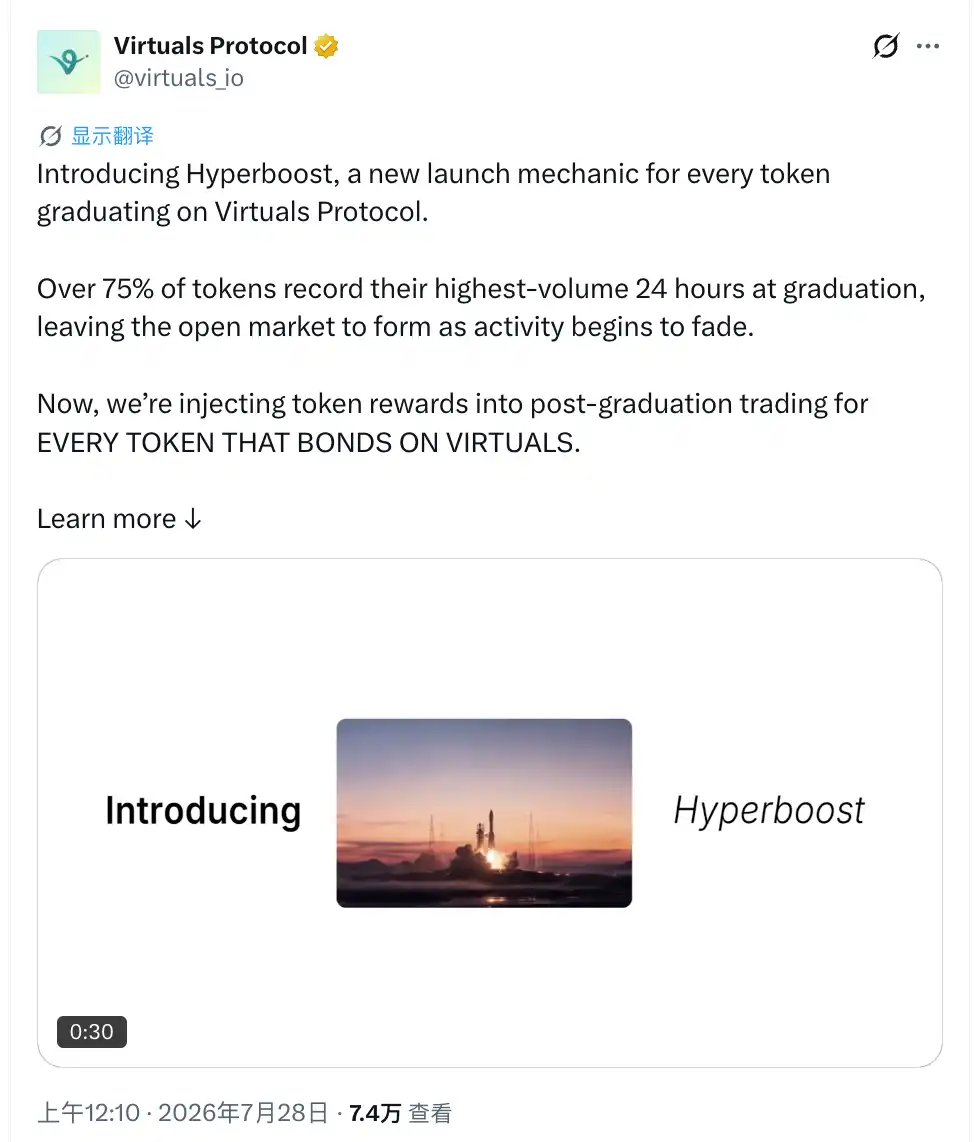
The AI Agent token launch platform Virtuals Protocol has long faced a persistent issue:

The day a token "graduates" from the bonding curve and launches, its trading volume typically peaks and then declines steadily. Platform data indicates that over 75% of tokens record their highest trading volume within 24 hours after graduation, with public market activity quickly fading thereafter.

On July 27th, Virtuals introduced the Hyperboost mechanism, attempting to use economic incentives to prolong post-graduation market interest.

Mechanism Breakdown: Idle Supply Converted to Trading Rewards, Released Daily for 14 Days

The core logic of Hyperboost is to activate a portion of token supply that was previously idle.

In the past, when a token graduated from the bonding curve and entered public trading on Uniswap, a portion of the supply was reserved for smoothing the transition, essentially remaining idle.

Hyperboost reallocates this portion, converting it into a reward pool released daily over the 14 days following graduation.

Rewards are distributed along two tracks: trading rewards are allocated based on a wallet's proportion of the day's trading volume; content rewards are directed at creators publishing content about the token on platforms like X. A total of 1/14th of the total rewards are released each day, with no lock-up or vesting restrictions upon claiming. Rewards are claimable upon arrival.

This mechanism activates automatically, requiring no founder configuration or manual activation. All tokens completing graduation after 16:00 UTC on July 27th will automatically enter the Hyperboost window.

The official whitepaper does not disclose the specific idle supply ratio or reward allocation percentage, only describing it as "a fraction of token supply".

Details regarding the content reward evaluation criteria are also limited. The community has raised questions about the transparency of anti-sybil mechanisms and content scoring rules.

Virtuals Ecosystem Status: 18k+ Agents, Market Cap ~$400M

Hyperboost is not an isolated product; it is embedded within Virtuals' broader AI Agent tokenization ecosystem.

As of H1 2026, the Virtuals Protocol platform has launched over 18,000 AI Agent tokens, with cumulative protocol revenue exceeding $75 million.

Amidst overall crypto market shifts and AI Agent development, Virtuals has undertaken intensive ecosystem and product expansion efforts since the beginning of the year. In March, it launched the ERC-8183 standard (in collaboration with the Ethereum Foundation) for on-chain AI Agent identity.

In early July, it completed the migration of cross-chain infrastructure from LayerZero to Chainlink CCIP, involving over $700 million in VIRTUAL liquidity. Robinhood Chain also announced plans to integrate Virtuals' AI Agent infrastructure on its new chain.

The above developments align more with long-term considerations and updates to the product foundation. Hyperboost appears more like an innovative play in token trading and rules.

Two Days Post-Launch, Some Graduated Projects Still 'Plummeting as Usual'

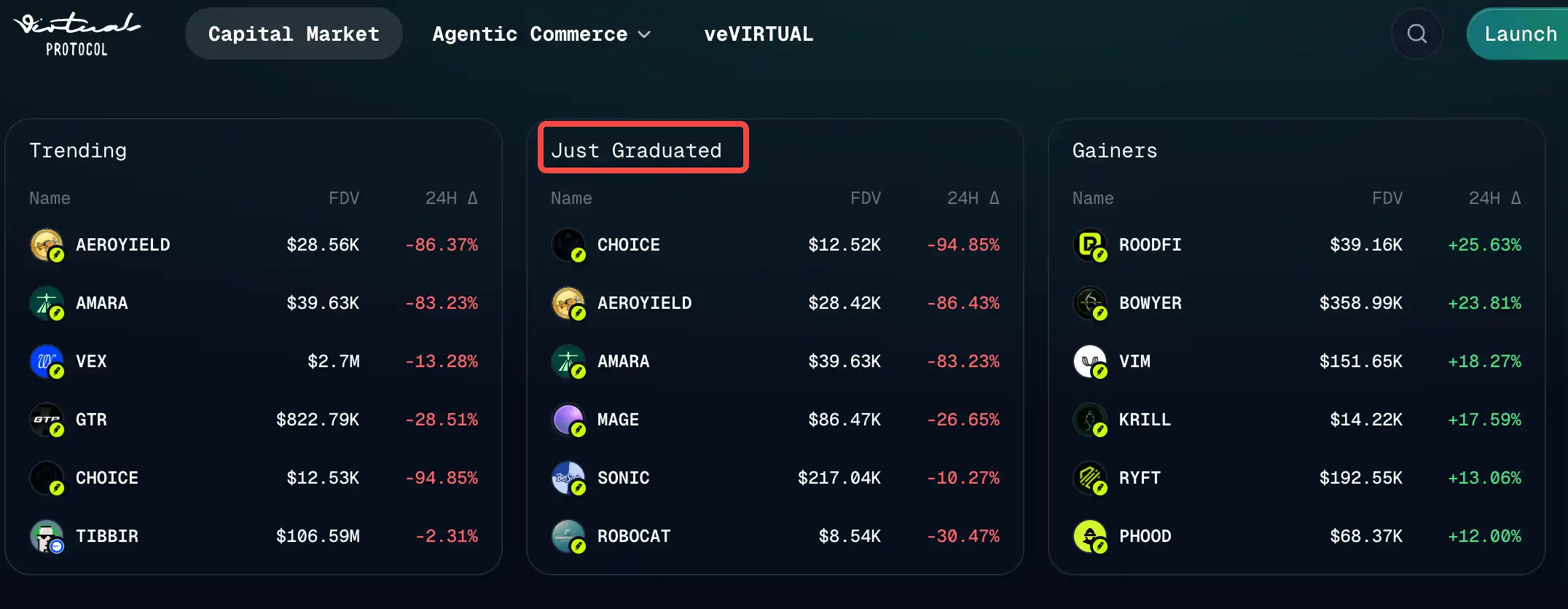
Hyperboost has been live for only about two days. The "Just Graduated" section on app.virtuals.io shows some early examples.

AMARA (Amara Exchange) graduated about 9 hours ago, FDV ~$51k, 24-hour decline ~78%, trading volume ~$358k, holders ~185.

MAGE is associated with the Mage Trading AI Agent, 24-hour decline ~55%. GTR (gtr.trade) launched ~4 days ago, FDV ~$700k, 24-hour decline ~44%, holders ~1700, liquidity ~$110k.

The data from these examples still presents the typical "peak post-graduation followed by decay" pattern, precisely what Hyperboost aims to mitigate. However, given the mechanism has been active for less than 48 hours and the first 14-day reward cycle is not yet complete, the current sample size and time span are insufficient to judge effectiveness.
Core Questions: Could Trading Volume Rewards Become a Farmer's ATM?

Currently, community discussions around this new product focus on several key points.

First, if trading rewards are allocated based on trading volume share, this design inherently attracts wash trading. If a wallet contributes 50% of the day's trading volume, it claims 50% of that day's trading rewards. For tokens with an FDV of only tens of thousands of dollars, the cost of wash trading could be lower than the reward revenue, creating a clear arbitrage opportunity.

The official response is that the daily reward pool is fixed. Even if someone wash trades, they merely take a larger slice of a fixed pie, not infinitely inflating it. However, this argument holds only if the reward pool itself is relatively small (undisclosed by the official). If the reward scale is significant, wash trading incentives remain.

Second, the evaluation criteria for content rewards are also vague. Current rules state "parameters are set by the protocol and may be adjusted to maintain distribution integrity" but do not disclose specifics like the content scoring mechanism, whether account verification is needed, or how to prevent bulk spamming.

For a mechanism publicly stated to incentivize content creation on platform X, the absence of these rules casts doubt on its practical effectiveness.

Limited Impact on VIRTUAL Token

In narrative terms, Hyperboost provides VIRTUAL with a new growth story. If the mechanism genuinely extends the active trading period of graduated tokens, it implies more trading volume flows through VIRTUAL-paired liquidity pools, indirectly increasing demand for VIRTUAL.

According to TronWeekly, the VIRTUAL price showed short-term technical bullish signals following the Hyperboost launch, with some analysts setting a short-term target of $0.70.

However, simultaneously, VIRTUAL has declined about 7.4% over the past 7 days, still generally weighed down by the broader market downturn. BTC recently turned negative, and overall crypto market sentiment is weak.

A breakout star token might be more effective in reversing this trend. Follow-up metrics to watch include the trading volume retention rate of graduated tokens during the 14-day window, whether the number of newly graduated tokens increases due to the incentives, and the actual consumption of VIRTUAL as a pairing asset.

Accumulating sufficient data for these points will likely take at least 2 to 4 weeks. Nevertheless, in a climate where many crypto projects are shutting down or pivoting, it is encouraging to see Virtuals continuously iterate and update its playbook.

Trend Kriptolar

İlgili Sorular

QWhat is the Hyperboost mechanism launched by Virtuals Protocol and what problem does it aim to solve?

AVirtuals Protocol launched the Hyperboost mechanism on July 27th. It aims to combat the 'first-day peak curse,' where over 75% of tokens on the platform see their highest trading volume within 24 hours of graduation before rapidly declining. Hyperboost automatically converts a portion of a graduating token's initially idle supply into a 14-day reward pool, released daily to incentivize trading and content creation, thereby attempting to extend the price discovery window.

QHow does the Hyperboost mechanism distribute its rewards?

AThe Hyperboost reward pool is distributed across two tracks over 14 days: 1) Trading Rewards: Distributed to wallets based on their daily trading volume share for that specific token. 2) Content Rewards: Awarded to creators who publish content about the token on platforms like X (formerly Twitter). Each day, 1/14th of the total reward pool is released. Users can claim their rewards with no lock-up or vesting period.

QAccording to the article, what are the main concerns within the community regarding the Hyperboost mechanism?

AThe community's main concerns focus on potential exploitation: 1) Trading rewards based on volume share could incentivize wash trading, especially for low-FDV tokens where the reward might outweigh the cost of fake trading. 2) The criteria and anti-spam mechanisms for content rewards are vague and lack transparency, raising questions about how content quality is judged and how 'farming' with bot accounts will be prevented.

QWhat was the performance of some early token samples after the Hyperboost launch, and what does this indicate?

AEarly samples like AMARA, MAGE, and GTR, which graduated shortly after Hyperboost went live, still showed significant price declines (~44% to ~78% in 24 hours). This indicates the typical 'post-graduation slump' pattern that Hyperboost is designed to mitigate. However, the article notes that with the mechanism being active for less than 48 hours and the full 14-day cycle not yet complete, it's too early to judge its effectiveness based on this limited data.

QWhat is the potential impact of Hyperboost on the VIRTUAL token itself, and what factors will determine its success?

AHyperboost could indirectly benefit the VIRTUAL token by potentially increasing trading activity and volume across its paired liquidity pools, thus boosting demand for VIRTUAL as the pairing asset. However, its direct impact is considered limited, as VIRTUAL's price remains influenced by broader market trends. The mechanism's success should be measured by observing metrics over 2-4 weeks, such as the retention of trading volume for graduated tokens during the 14-day window, an increase in new token graduations, and the actual consumption/utility of VIRTUAL in these pools.

İlgili Okumalar

CryptoQuant Analyst Claims 'Frightening Scenario and Simultaneously Promising Signal for Bitcoin' Reveals Ultimate Bottom Point! Here Are the Details

Bitcoin, the leading cryptocurrency, entered a bear market after hitting a historic high of $126,000 in October 2025 and has since fallen over 50%. As BTC recently dropped to around $57,000, opinions diverge on whether the bottom has been reached, with some expecting a drop closer to $50,000. According to a pseudonymous CryptoQuant analyst, the Bitcoin bear market may be nearing its end. The analyst notes that as selling pressure following the all-time high weakens, price corrections are becoming shorter and recovery periods more substantial. The July decline was only slightly below lows seen in early February, and BTC has remained relatively stable around $60,000 since, indicating diminished seller influence. Positive technical signals are also cited, with MACD and RSI showing bullish signals, positive divergences, and oversold conditions, collectively suggesting a potential bottom formation for BTC. However, the analyst does not rule out a final sell-off in the short term. They suggest the ultimate market bottom could be around $51,336, corresponding to the 61.8% Fibonacci retracement level. The $50,000 area is highlighted as a crucial historical support zone, aligning with the average investor cost basis and the 200-week moving average—conditions similar to bottoms in previous bear markets. *This is not investment advice.

cryptonews.ru22 dk önce

CryptoQuant Analyst Claims 'Frightening Scenario and Simultaneously Promising Signal for Bitcoin' Reveals Ultimate Bottom Point! Here Are the Details

cryptonews.ru22 dk önce

İşlemler

Spot

Popüler Makaleler

ONE Nasıl Satın Alınır

HTX.com’a hoş geldiniz! Harmony (ONE) satın alma işlemlerini basit ve kullanışlı bir hâle getirdik. Adım adım açıkladığımız rehberimizi takip ederek kripto yolculuğunuza başlayın. 1. Adım: HTX Hesabınızı OluşturunHTX'te ücretsiz bir hesap açmak için e-posta adresinizi veya telefon numaranızı kullanın. Sorunsuzca kaydolun ve tüm özelliklerin kilidini açın. Hesabımı Aç2. Adım: Kripto Satın Al Bölümüne Gidin ve Ödeme Yönteminizi SeçinKredi/Banka Kartı: Visa veya Mastercard'ınızı kullanarak anında Harmony (ONE) satın alın.Bakiye: Sorunsuz bir şekilde işlem yapmak için HTX hesap bakiyenizdeki fonları kullanın.Üçüncü Taraflar: Kullanımı kolaylaştırmak için Google Pay ve Apple Pay gibi popüler ödeme yöntemlerini ekledik.P2P: HTX'teki diğer kullanıcılarla doğrudan işlem yapın.Borsa Dışı (OTC): Yatırımcılar için kişiye özel hizmetler ve rekabetçi döviz kurları sunuyoruz.3. Adım: Harmony (ONE) Varlıklarınızı SaklayınHarmony (ONE) satın aldıktan sonra HTX hesabınızda saklayın. Alternatif olarak, blok zinciri transferi yoluyla başka bir yere gönderebilir veya diğer kripto para birimlerini takas etmek için kullanabilirsiniz.4. Adım: Harmony (ONE) Varlıklarınızla İşlem YapınHTX'in spot piyasasında Harmony (ONE) ile kolayca işlemler yapın.Hesabınıza erişin, işlem çiftinizi seçin, işlemlerinizi gerçekleştirin ve gerçek zamanlı olarak izleyin. Hem yeni başlayanlar hem de deneyimli yatırımcılar için kullanıcı dostu bir deneyim sunuyoruz.

566 Toplam GörüntülenmeYayınlanma 2024.12.12Güncellenme 2026.06.02

ONE Nasıl Satın Alınır

Tartışmalar

HTX Topluluğuna hoş geldiniz. Burada, en son platform gelişmeleri hakkında bilgi sahibi olabilir ve profesyonel piyasa görüşlerine erişebilirsiniz. Kullanıcıların ONE (ONE) fiyatı hakkındaki görüşleri aşağıda sunulmaktadır.

活动图片