US Stock Storage Fever Spreads to Crypto for the Third Time, VVV Leads 'AI Data Infrastructure' Sector Gains

marsbit2026-05-11 tarihinde yayınlandı2026-05-11 tarihinde güncellendi

Özet

U.S. stock storage rally spreads to crypto for the third time, with VVV leading the 'AI data infrastructure' sector. On May 11, Venice Token (VVV) surged 17.63% with $65.05M volume, followed by Chainbase, SQD, and Vana, rising 5-8%. This mirrors gains in U.S. storage stocks like SanDisk and Micron. The crypto AI narrative is shifting. The initial wave (May 6-7) saw pure storage tokens like FIL, AR, and STORJ rise, driven by spillover from the U.S. storage chip boom. The second wave saw broader DePIN sector gains. The current third wave has moved beyond pure storage to broader "AI infrastructure." VVV, a decentralized AI inference platform, leads due to its own catalysts like a token burn mechanism and partnership news, alongside the broader market trend. Notably, traditional storage tokens showed minimal gains (<4%) on May 11, indicating the rally is becoming more selective, focusing on projects with specific narratives like AI data or compute. The pattern suggests the sector rally may be in a later stage, with sustainability depending on whether the U.S. storage chip boom continues.

Author: Claude, Shenchao TechFlow

Shenchao Insight: The capital spillover effect of the US stock market's storage chip "super cycle" is recurring in the crypto market with a frequency of three times a week. On May 11, the 'AI Data Infrastructure' sector token Venice Token (VVV) surged 17.63% in a single day, leading the gains with a trading volume of $65.05 million; Chainbase, SQD, and Vana followed with gains between 5% and 8%. Meanwhile, the fuel hasn't died down on the US stock end. On May 8, SanDisk skyrocketed 16.60%, Micron Technology rose 15.49%, pushing its market cap past $842.2 billion, and accumulated a nearly 38% gain for the week. From FIL breaking out of its range on May 6, to IO soaring 69% in a single day on May 7, and VVV taking the baton this Monday, the market trend has extended from single storage leaders to the entire "AI Data + Inference Compute" infrastructure sector.

The crypto AI sector is up again today, but the narrative is quietly shifting.

If the story a week ago was "the three major storage leaders FIL, AR, and STORJ rising in tandem with US stocks SanDisk and Micron," then entering this week, the main market trend has spread from pure storage to a broader "AI infrastructure": AI inference compute (VVV), on-chain data networks (Chainbase), data indexing (SQD), user data DAOs (Vana) are taking turns leading the charge. However, the driving source behind all this remains unchanged: the still-burning storage chip frenzy in US stocks.

First Wave of Transmission: May 6, FIL/AR/STORJ Triple Rise

The first instance of follow-on gains in the crypto market occurred on May 6.

According to a BanklessTimes report on May 6, Filecoin (FIL) opened at $0.975 that day, reaching an intraday high of $1.161 and closing at $1.122, marking a single-day gain of 15.08%, breaking out of a sideways consolidation range that had lasted over three months since early February. FIL's spot trading volume for the day reached $372 million, a sharp 260.22% increase from the previous day; futures trading volume hit $816 million, up 213.63% sequentially. In the same sector, Storj gained 40% and Arweave rose 20% for the day.

Chinese crypto information channel Followin that day forwarded analyst Ao Ying's viewpoint, directly attributing this round of gains to capital spillover from US stock storage trading, stating "funds from equity market storage trading are repricing FIL." The logic chain is that AI infrastructure's consumption of storage capacity has already booked capacity through 2026; this supply-demand logic first gets priced in the US stock market, then transmits to crypto tokens pegged as "on-chain storage."

Second Wave Continuation: May 7, IO Soars 69% in a Day, DePIN Sector Follows Suit and Spreads

The market movement didn't stop after a single day. According to TradingView data cited by CoinMarketCap CMC AI, FIL rose another 15.5% on May 7, breaking through the key resistance level of $1.08 that it had failed to breach since February.

The sector's diffusion was even more dramatic, with IO surging 69% and STORJ rising another 30% on the same day. The second wave of gains indicates this is no longer a localized rally of "leaders rising alone while the long tail remains calm," but rather the DePIN (Decentralized Physical Infrastructure Networks) sector being systematically repriced by the market.

However, CoinMarketCap CMC AI also cited a bearish analysis on the same day, labeling FIL a "dead asset," citing the token's cumulative decline of 99% from its all-time high. This contradiction precisely reflects the current rift in the crypto storage sector: short-term beta-driven gains from capital spillover coexist with medium-to-long-term skepticism about business models.

Third Wave Diffusion: May 11, VVV Leads 'AI Data + Inference Compute' Gains

This Monday's rally saw the main theme shift from "pure storage" to broader "AI infrastructure."

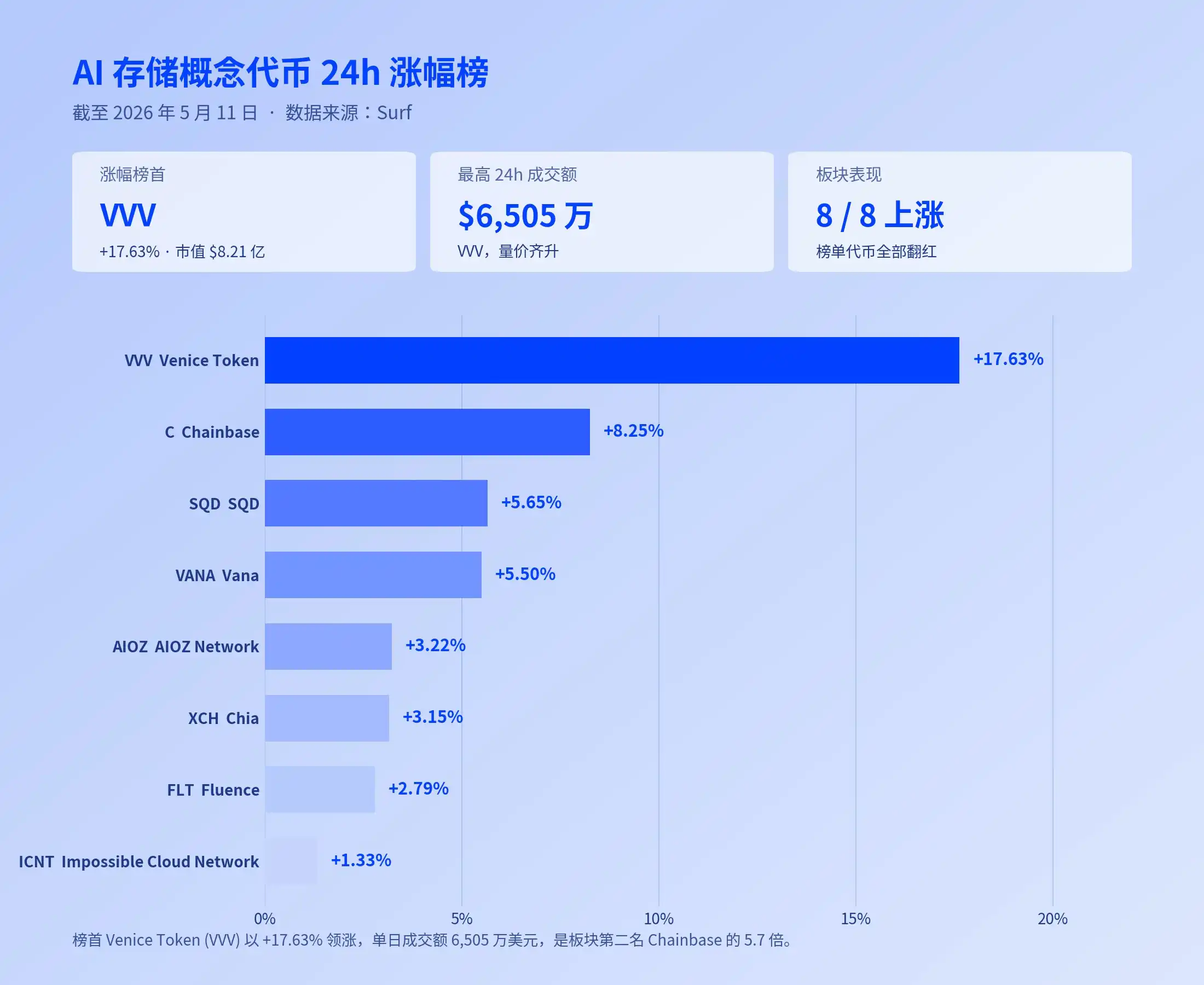
Data shows VVV's current price is $17.83, with a market cap of $821 million and a single-day trading volume of $65.05 million, 5.7 times that of the second-ranked project in the sector, Chainbase. Ranks two through four in the sector were Chainbase (C, +8.25%), SQD (+5.65%), and Vana (VANA, +5.50%), with market caps ranging between $14 million and $54 million.
However, VVV is not strictly a storage token. According to a January 2025 report by The Block and Venice's official documentation, VVV is the native token of Venice, a decentralized AI inference platform founded by Erik Voorhees, positioned to "provide private, uncensorable inference services for AI Agents." Staking VVV allows users to proportionally share in the compute power revenue from the Venice API, without needing to pay per request.

VVV's leading gains have their own fundamental catalysts. According to a Phemex analysis on April 7, Venice permanently reduced its annual token inflation by 25% on February 10, 2026 (from 80 million to 60 million). On March 2, it surged 20% in a single day after OpenClaw announced selecting Venice as its primary inference model supplier. According to Messari data, Venice officially launched a "programmatic VVV buyback and burn" mechanism on April 15, where every Venice Pro subscription triggers a $1 on-chain token buyback and burn. CMC AI data shows that as of March, approximately 33 million VVV (42% of the initial supply) had been burned.

At this point, the crypto AI sector's story can be broken into two layers: the external factor is the spillover from the US stock storage frenzy, while the internal factor is that tokens like VVV, which have real deflation mechanisms and concrete partnership developments, are catalyzing themselves. The tokens that have delivered outsized gains in this rally almost all possess both layers of logic.

Four Genuine Storage Tokens Gained Less Than 4% Today

It's worth noting that the genuine storage projects are not among the top gainers on today's Surf list. Four traditional decentralized storage projects—AIOZ Network (+3.22%), Chia (+3.15%), Fluence (+2.79%), and Impossible Cloud Network (+1.33%)—all gained less than 4%. Last week's leaders, FIL, AR, and STORJ, don't even appear on this list.

This structural difference signals that the pure "storage beta transmission" rally might have entered its second stage. The first stage (May 6-7) was the catch-up rally of storage leaders. The second stage (this week) sees tokens with their own narrative catalysts taking the baton: VVV has its buy-and-burn mechanism, Chainbase carries the "AI data" label, while SQD and Vana belong to the "data network" concept. Capital is picking "tokens with a story" within the sector, rather than indiscriminately deploying funds.

Historically, this three-phase pattern of "leader catch-up → concept diffusion → capital cherry-picking" often signifies that a sector rally has entered its latter half. Future sustainability will depend on whether the US stock storage chip frenzy can maintain momentum. Based on the current supply-demand landscape of DRAM contract prices rising 58% to 63% and HBM capacity sold out through 2026, the story, at least from a fundamental perspective, is not over yet.


İlgili Sorular

QWhat are the three major phases of the 'storage hype' spillover from the U.S. stock market into the crypto market as described in the article?

AThe three phases are: 1) Initial spillover on May 6th with leading storage tokens like FIL, AR, and STORJ rising. 2) Continuation and diffusion on May 7th, extending to the broader DePIN/AI infrastructure sector, highlighted by IO's surge. 3) Further diffusion on May 11th, where the rally spread from pure storage to 'AI data + inference compute' infrastructure, led by VVV and followed by projects like Chainbase, SQD, and Vana.

QWhy did VVV (Venice Token) experience a significant price increase on May 11th, according to the article?

AVVV's surge was driven by a combination of external and internal factors. Externally, it benefited from the ongoing spillover effect from the U.S. stock market's storage chip rally. Internally, it had specific fundamental catalysts: a permanent 25% reduction in annual token inflation in February 2026, a partnership announcement with OpenClaw in March that boosted its price, and the launch of a 'programmatic VVV buyback and burn' mechanism on April 15th, where every Venice Pro subscription triggers a $1 token buyback and burn.

QWhat key difference does the article highlight between the market performance on May 11th and the initial rallies on May 6th-7th?

AOn May 11th, the rally shifted from purely 'storage' tokens (like FIL, AR, STORJ) to a broader 'AI infrastructure' theme, including AI inference compute (VVV), on-chain data networks (Chainbase), data indexing (SQD), and user data DAOs (Vana). In contrast, the initial rallies on May 6th-7th were more focused on traditional decentralized storage龙头 tokens. Furthermore, on May 11th, actual storage projects like AIOZ Network and Chia saw minimal gains (<4%), indicating资金 was becoming more selective, focusing on projects with stronger narratives beyond just the storage beta.

QWhat is the primary external driver identified for the rallies in the crypto AI/data infrastructure sector throughout the discussed period?

AThe primary external driver is the capital spillover from the 'super cycle' boom in U.S. stock market storage chip companies, specifically the massive gains seen in stocks like美光科技 (Micron) and闪迪 (SanDisk). The article states that the logic is that AI infrastructure's huge demand for storage capacity, which has already driven up prices and valuations in traditional markets, is now being repriced into crypto tokens that represent 'on-chain storage' and related AI data infrastructure.

QAccording to the article, what does the current market structure (with selective gains in narrative-driven tokens) suggest about the stage of the sector's rally?

AThe article suggests that the market structure, moving from 'leader catch-up' to 'concept diffusion' and then to 'capital picking specific stories,' typically indicates the sector rally is entering its later stages. The sustainability from this point forward will depend more on whether the U.S. stock market storage hype continues and on the individual fundamentals of the crypto projects, rather than on broad, indiscriminate buying across the entire sector.

İlgili Okumalar

Anthropic and OpenAI Have Single-Handedly Severed the Logic of Pre-IPO Stock Tokenization

The pre-IPO stock token market is experiencing significant turmoil following strong statements from AI giants Anthropic and OpenAI. Both companies have updated their official policies, declaring that any transfer of their company shares—including sales, transfers, or assignments of share interests—without prior board approval is "invalid" and will not be recognized in their corporate records. This means buyers in such unauthorized transactions would not be recognized as shareholders and would have no shareholder rights. A major point of contention is the use of Special Purpose Vehicles (SPVs), which are legal entities commonly used by pre-IPO token platforms to pool investor funds and indirectly acquire shares from employees or early investors. The companies explicitly state they do not permit SPVs to acquire their shares, and any such transfer violates their restrictions. They warn that third parties selling shares through SPVs, direct sales, forward contracts, or stock tokens are likely engaged in fraud or are offering worthless investments due to these transfer limits. This stance directly threatens the core model of many pre-IPO token platforms, which rely on SPV structures. The announcement revealed additional risks within this model, such as complex "SPV-within-SPV" layering that obscures legal transparency, increases management fees, and creates a chain reaction risk of invalidation. Following the news, tokens like ANTHROPIC and OPENAI on platforms like PreStocks fell sharply (over 20%). The market reaction highlights a divergence: while asset-backed pre-IPO tokens plummeted, purely speculative pre-IPO futures contracts, which are bilateral bets on future IPO prices with no claim to actual shares, remained relatively stable as they are unaffected by the transfer restrictions. The industry is split on the implications. Some believe the fundamental logic of pre-IPO token trading is broken if leading companies reject SPV-held shares, potentially causing a domino effect. Others, like Rivet founder Nick Abouzeid, argue that buyers of such unofficial tokens always knowingly accepted the risk of non-recognition by the company. The statements serve as a stark risk warning and a corrective measure for a market where valuations for some AI-related pre-IPO tokens had soared to irrational levels, far exceeding recent funding round valuations.

marsbit4 dk önce

Anthropic and OpenAI Have Single-Handedly Severed the Logic of Pre-IPO Stock Tokenization

marsbit4 dk önce

Anthropic and OpenAI Personally Sever the Logic of Pre-IPO Crypto-Stocks

The pre-IPO token market has been rocked by strong statements from Anthropic and OpenAI. Both AI giants have updated official warnings, declaring that any sale or transfer of their company shares without explicit board approval is "invalid" and will not be recognized on their corporate records. This directly targets Special Purpose Vehicles (SPVs), the common legal structure used by pre-IPO token platforms. These platforms typically use an SPV to acquire shares from employees or early investors, then issue blockchain-based tokens representing a claim on the SPV's economic benefits. Anthropic and OpenAI's position means that if an SPV's share purchase lacked authorization, the underlying asset could be deemed worthless, nullifying the token's value. Anthropic explicitly warned that any third party selling its shares—via direct sales, forwards, or tokens—is likely fraudulent or offering a valueless investment. The crackdown highlights risks in the popular SPV model, including complex multi-layered "Russian doll" SPV structures that obscure legal ownership, add fees, and concentrate risk. If one layer is invalidated, the entire chain could collapse. Following the announcements, tokens like ANTHROPIC and OPENAI on platforms like PreStocks fell sharply (over 20%). In contrast, purely speculative pre-IPO prediction contracts remained stable, as they involve no actual share ownership. The move is seen as a corrective measure amid a market frenzy where some pre-IPO token valuations (e.g., Anthropic's token hitting a $1.4 trillion implied valuation) far exceeded recent official funding rounds. Opinions are split: some believe this undermines the core logic of pre-IPO token trading if top companies reject SPVs, while others argue buyers always assumed this legal risk when accessing unofficial channels. The statements serve as a stark warning and a potential catalyst for market de-leveraging and clearer boundaries.

Odaily星球日报7 dk önce

Anthropic and OpenAI Personally Sever the Logic of Pre-IPO Crypto-Stocks

Odaily星球日报7 dk önce

The Waged Worker Driven to Poverty by AI Subscriptions

"AI Membership: The Hidden Cost Pushing Workers Toward 'Poverty'" The widespread corporate push for AI adoption is creating a hidden financial burden for employees. Companies, from giants like Alibaba to small firms, are mandating AI use, often tying token consumption to KPIs, but frequently refuse to cover the costs. Workers are forced to pay for subscriptions out of pocket to stay competitive and avoid being replaced. Front-end developer Long Shen spends up to 2000 RMB monthly on tools like Cursor and ChatGPT Plus, seeing it as a necessary 3% salary investment to handle 90% of his coding tasks. While it boosted his performance and led to promotions, he now faces idle time at work, pretending to be busy. Designer Peng Peng navigates strict company firewalls by using personal devices and accounts for AI image generation tools like Midjourney, spending hundreds monthly without reimbursement, while her boss demands faster, more numerous revisions. The pressure creates workplace anxiety and suspicion. Programmer Li Huahua, after a friend's experience of raised KPIs following AI success, fears being branded a "traitor" for using it yet worries about falling behind if she doesn't. The dynamic allows management to demand results without understanding the tools or covering expenses, treating employees like AI "agents." While some, like entrepreneur Jin Tu, find high value in paid AI, building entire systems and winning competitions, for most, it's a trap. Free tools like Kimi and Doubao are introducing fees, closing off alternatives. The initial efficiency gains individual advantage, but as AI becomes ubiquitous, the personal edge disappears, workloads increase, and a cycle of dependency begins. Workers like Long Shen realize they cannot maintain AI-generated code without AI, making stopping harder than continuing to pay. The tool promising liberation is instead becoming a compulsory, costly chain in the modern workplace.

marsbit57 dk önce

The Waged Worker Driven to Poverty by AI Subscriptions

marsbit57 dk önce

SK Hynix's Trillion-Won Empire: The Successors

"SK Hynix's Trillion-Won Empire and Its Heirs" explores the unconventional succession narrative within SK Group, South Korea's second-largest conglomerate, following SK Hynix's dramatic market rise. Unlike traditional chaebol scripts prioritizing the eldest son, ownership, and political marriages, Chairman Choi Tae-won's three children from his first marriage are charting distinct paths. The eldest daughter, Choi Yun-jeong, is considered the most visible candidate. With a background in biology, consulting, and a PhD, she holds executive roles at SK Bioscience and SK Inc.'s growth strategy unit, focusing on biopharma and new businesses. Her marriage is to an AI infrastructure entrepreneur, not a traditional chaebol heir. The second daughter, Choi Min-jeong, took a unique route by voluntarily serving as a South Korean naval officer, including a tour in the Gulf of Aden. She later worked on policy and strategy for SK Hynix in Washington D.C. before co-founding an AI-driven healthcare startup in San Francisco. She married a former U.S. Marine Corps officer, connecting the family to U.S. defense and policy networks. The son, Choi In-geun, who has Type 1 diabetes, followed a more classic preparatory path with a physics degree and a stint at SK E&S but left to join McKinsey's Seoul office. He remains publicly silent and holds no SK shares, defying the traditional "crown prince" archetype. Their paths unfold against the backdrop of their parents' high-profile, contentious divorce and a record-setting asset division lawsuit. The article argues that as SK Hynix becomes a geopolitical asset in the AI era, the conventional rules of chaebol inheritance are changing. The heirs are being groomed not simply to take over, but to navigate a complex global landscape defined by AI, biotech, geopolitics, and policy, forging legitimacy through their own expertise and networks rather than birth order alone.

marsbit1 saat önce

SK Hynix's Trillion-Won Empire: The Successors

marsbit1 saat önce

İşlemler

Spot
Futures
活动图片