Author: Dong Jing
Source: Wall Street News
The direction of the Iran situation and the outlook for the Federal Reserve's monetary policy are becoming the two most critical factors influencing global markets.
Deutsche Bank's economic research team, in its latest report, systematically outlined the potential impact on the Fed's policy path based on three possible outcomes of the Iran ceasefire negotiations—ranging from the fading of near-term interest rate hike risks to multiple hikes in 2026, and to two-way policy uncertainty. Each scenario corresponds to a distinct market logic.
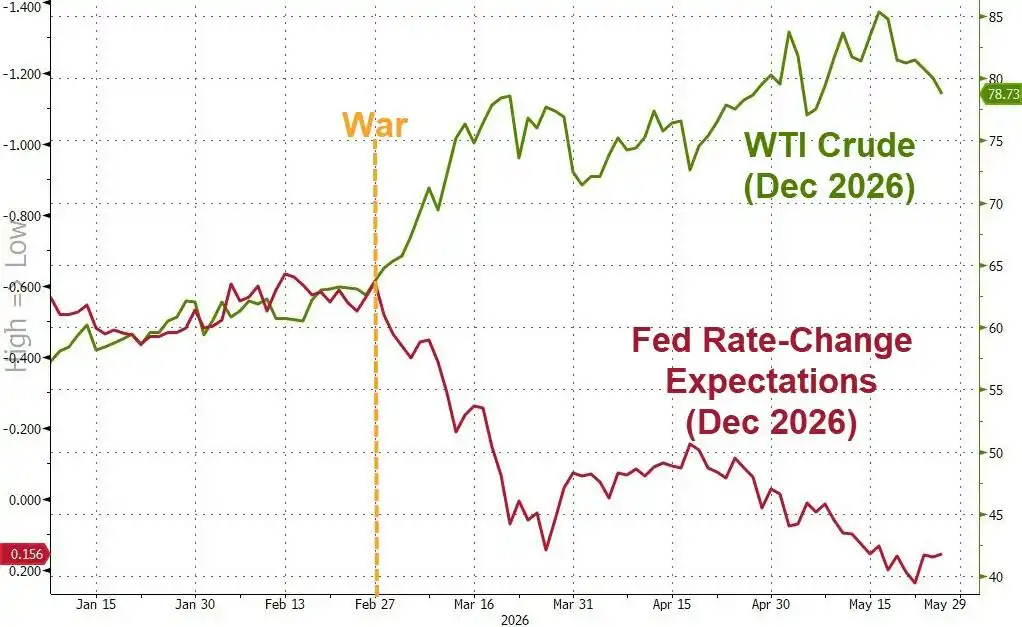
The analysis points out that oil price movements will directly affect the anchoring of inflation expectations, thereby determining whether the Fed needs to restart rate hikes. In the bank's view, the most concerning scenario currently is not the extreme conflict escalation, but the intermediate state of "failed negotiations and a stalemate"—this scenario is most likely to force the Fed to take substantive tightening action in 2026 due to persistently high oil prices.
Currently, the latest developments in the geopolitical situation show that negotiations on extending the ceasefire agreement and reopening the Strait of Hormuz have made some progress, with markets reacting optimistically. Brent crude oil futures fell below $100 per barrel, touching a near one-month low; the yield on the 10-year U.S. Treasury note also retreated significantly, erasing most of the gains from the past week. However, uncertainties remain in the negotiation details, and core disputes such as Iran's nuclear program remain unresolved.
Scenario One: A Peace Agreement is Reached – Near-term Rate Hike Pressure Fades, but Medium-term Risks Linger
In Deutsche Bank's first scenario, the negotiations achieve a breakthrough, the Strait of Hormuz reopens, oil prices extend their recent downward trend but remain above pre-war levels; U.S. Treasury yields fall further, risk asset markets strengthen overall as tail risks dissipate, and financial conditions ease.
Against this backdrop, the pressure on the Fed to raise interest rates at its upcoming meetings will significantly diminish. With overall inflation data softening and short-term inflation expectations retreating, Fed officials would be inclined to view recent core inflation pressures as temporary disturbances caused by the energy price shock, opting to "look through" them rather than respond immediately. Deutsche Bank expects the new Fed Chair, Warsh, to reinforce this inclination.
However, the bank simultaneously warns that the baseline narrative of "inflation not being persistent" will take time to be disproven, and rate hike risks do not disappear entirely. If the labor market remains tight, inflation expectations shift further upward, or inflation remains stubbornly high after tariff and energy pressures fade, the risk of policy rate increases will more likely materialize in 2027.
Scenario Two: Negotiations Fail, Stalemate Persists – Highest Rate Hike Risk in 2026
Deutsche Bank characterizes the second scenario as having the "highest rate hike risk" among the three current ones. In this scenario, peace agreement talks fail, the Strait of Hormuz remains closed long-term, but the conflict does not escalate further, with oil prices maintaining high levels rather than surging sharply.
Persistently high oil prices would transmit more significantly into core inflation and pose a greater risk of unanchoring inflation expectations. Meanwhile, oil prices in this scenario are not high enough to severely damage demand and force the Fed to shift its focus to the labor market, meaning the Fed would face one-sided inflation pressure without the justification to "stand pat due to an economic downturn."
The bank believes the Fed is unlikely to take rate hike action before the September meeting—a policy pivot would need to go through multiple steps: removing the easing bias (June), some officials publicly discussing the possibility of rate hikes (July to September), and the committee reaching a consensus.
However, it also points out that Fed Governor Waller recently stated that rate hikes could be a reasonable choice if "inflation does not decline fast enough," suggesting the Fed may be willing to tighten policy more rapidly. Therefore, the possibility of multiple rate hikes in 2026 should not be ruled out.
Scenario Three: Conflict Escalates Again – Policy Outlook Faces Two-way Risks
The third scenario envisions a renewed escalation in the Iran situation, leading to a larger and more persistent surge in oil prices. Deutsche Bank believes this scenario does not necessarily mean the Fed will unilaterally move towards rate hikes, but rather introduces two-way uncertainty to the policy outlook.
On one hand, conflict escalation would drive a larger and more sustained rise in overall inflation, with core inflation facing more significant transmission risks, and the possibility of inflation expectations becoming unanchored would rise tangibly. The Fed would then need to signal clearly through policy communication its willingness to tighten policy to address price stability risks.
On the other hand, a significant and sustained rise in oil prices would increase the risk of non-linear shocks to the real economy, eventually affecting the labor market.
Deutsche Bank notes that consumers can currently still tolerate energy prices near current levels, with tax cut policies partially offsetting the pressure from rising oil prices; but if oil and gas prices rise substantially further, this buffer will be depleted. At that point, the labor market could slide out of its current fragile equilibrium of "low hiring, low layoffs," with further demand contraction or a wave of layoffs finally arriving.
In this scenario, the Fed's ultimate policy stance would depend on the sequence in which the above two types of risks materialize: if the economy remains resilient but inflation expectations become unanchored first, forceful tightening would be needed; if cracks appear in the labor market first, the Fed might instead lean towards rate cuts, citing prospective easing price pressures.
Synthesizing the three scenarios, Deutsche Bank's analytical framework reveals a clear logic chain: the Iran situation determines oil price trends, oil price trends determine the nature and duration of inflation pressure, and whether inflation expectations become unanchored ultimately determines the Fed's policy space.
Key signals currently worth monitoring include: substantive progress in ceasefire talks, whether Brent crude can stabilize below $100 per barrel, and changes in the rhetoric of Fed officials in upcoming meetings—particularly whether they begin to remove the easing bias or if any officials publicly discuss the possibility of rate hikes. These signals will be crucial observation windows for judging the probability distribution of the above three scenarios.