The Peak of Bitcoin's Bull Cycle May Be Driven by Global Demand for ETFs

cryptonews.ru2026-08-30 tarihinde yayınlandı2026-08-30 tarihinde güncellendi

Özet

The peak of Bitcoin's current bull cycle may be driven by global institutional capital and demand for spot Bitcoin ETFs outside the US, according to Ki Young Ju, CEO of CryptoQuant. He suggests that while US products have opened the market to regulated participation, the next phase of growth will come from international markets like South Korea, where spot Bitcoin ETFs are not yet accessible to retail and corporate investors. Ju indicates that peak market saturation may occur when such products become widely recommended even to conservative investors globally. The adoption is extending beyond direct holdings to include tokenized real-world assets (RWA) and stablecoins, which improve liquidity and infrastructure for institutional use. Although US spot Bitcoin ETFs have seen massive inflows, Ju believes global institutionalization, deeper stablecoin liquidity, and RWA channels will define Bitcoin's next adoption stage. The overall potential remains significant as banks and financial institutions worldwide continue to expand their digital asset capabilities.

According to Ki Young Ju, the founder and CEO of Cryptoquant—a platform for cryptocurrency market analytics—the peak of Bitcoin's current bull cycle may be driven by inflows of institutional capital and exchange-traded funds (ETFs) outside the US. He presented this forecast in an X post on August 27, pointing to access to international markets as a potential source of demand after US products facilitated an expansion of regulated market participation.

Ju stated:

“The peak of this bull cycle is likely to be driven by institutional investments and ETFs outside the US.”

As an example of barriers that remain outside the US, he pointed to South Korea. He said that the country has no spot Bitcoin ETF, retail investors cannot buy spot Bitcoin ETFs listed on foreign exchanges, and most companies still cannot open exchange accounts to buy $BTC. South Korea has begun to gradually permit participation by corporate investors, and the Financial Services Commission (FSC) roadmap includes a stage for about 3,500 listed companies and qualified professional investors. Financial companies and other corporations remain excluded from this system.

Ju illustrated how broad access by retail investors could signal the peak of the cycle: “The peak of this cycle could come when a banker at a regional bank in Korea recommends a spot Bitcoin ETF to a grandmother for investing her savings.”

This forecast shifts focus from US capital flows to markets where regulated Bitcoin investment products are still unavailable or have limited availability. The US Securities and Exchange Commission (SEC) approved spot Bitcoin exchange-traded products in January 2024, allowing investors to open positions through regular brokerage and investment accounts. Ju argues that similar access in other countries could expand investor participation in the next phase of the cycle.

Institutional Players Building Bitcoin and Tokenization Infrastructure

Bitcoin adoption by institutional investors already extends beyond direct Bitcoin purchases and spot ETF ownership, though access and service provision remain uneven. The Banking Bitcoin Adoption Index, developed by Strategy, evaluated 25 major institutions based on criteria such as trading, custody, digital asset-based products, financing, and corporate involvement. The banking sector adoption rating showed an overall adoption level of 32%, indicating significant potential for banks to expand their digital asset capabilities.

Tokenized real-world assets (RWA) may become another component of financial infrastructure that Ju believes will drive broader adoption. As of August 29, according to the “Global Market Overview” from RWA.xyz, the value of distributed assets reached $38.63 billion, a 2.65% increase from 30 days prior. Such products, which are part of the tokenized RWA market, transfer rights to assets, including government securities and private loans, onto blockchain-based systems for issuance, settlement, and transfer.

Stablecoin Liquidity Could Facilitate Broader Market Access

The development of stablecoin markets could provide institutions with more liquidity for trading, settlement, and cross-border transfers as regulated access expands. The Bank for International Settlements (BIS) stated that stablecoins show some potential for faster and programmable payments while also warning that existing models could pose risks to financial integrity, liquidity, and the monetary system. Its assessment shows that expanding financial infrastructure on blockchain does not eliminate regulatory or operational challenges.

Bitcoin’s fixed supply cap and decentralized settlement remain separate from the regulated funds and tokenized financial channels that provide investor access. Expanding ETF distribution could broaden access to Bitcoin without altering the underlying network architecture. Ju expects both access to investments and the supporting infrastructure to extend beyond the US market.

His assessment follows the rapid adoption of Bitcoin ETFs in the US, where spot funds attracted approximately $57 billion in net inflows over the first two years. “So far, it’s been a US adoption story, but the next phase will be global institutionalization with deeper stablecoin liquidity and real-world asset (RWA) channels,” noted Ju, adding:

“More and more institutional investors will hold $BTC as a strategic asset, and access to it will improve in many countries where ETFs are still absent.”

The forecast focuses on broader ETF availability internationally, institutional allocations, and blockchain-based financial infrastructure as conditions that could define Bitcoin's next adoption phase.

end-content
İlgili Sorular

QWhat does Ki Young Ju, founder and CEO of Cryptoquant, believe will drive the peak of Bitcoin's current bull cycle?

AHe believes the peak of Bitcoin's current bull cycle could be driven by institutional investment and ETF demand outside the United States.

QWhat example did Ki Young Ju use to illustrate remaining barriers for Bitcoin investment outside the U.S.?

AHe used South Korea as an example, where spot Bitcoin ETFs are not available, retail investors cannot buy foreign-listed spot Bitcoin ETFs, and most companies still cannot open exchange accounts to buy $BTC.

QAccording to the article, what did the U.S. Securities and Exchange Commission (SEC) approve in January 2024?

AThe U.S. Securities and Exchange Commission (SEC) approved spot Bitcoin exchange-traded products in January 2024.

QBeyond direct purchases and ETFs, what are institutional investors doing regarding Bitcoin, according to the article?

AInstitutional investors are building infrastructure for Bitcoin and tokenization, which includes the development of tokenized real-world assets (RWA) as part of financial infrastructure.

QHow might stablecoin market development impact institutional access to crypto markets, based on the article's discussion?

AStablecoin market development could provide institutions with more liquidity for trading, settlements, and cross-border transfers as regulated access expands, though it doesn't eliminate regulatory or operational challenges.

İlgili Okumalar

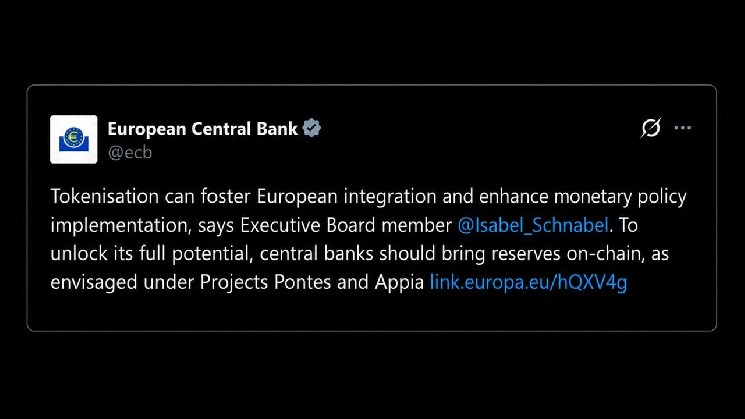
ECB's Schnabel says central bank money 'should move to blockchain'

ECB Executive Board member Isabel Schnabel stated that central bank money "must move onto the blockchain." She argued that stablecoins lack the independent ability to scale liquidity during financial stress—a gap only a central bank can fill. Her proposed solution involves tokenization, which she says can make transactions faster, safer, and more programmable, but only if the safest asset (central bank money) is on the same "rails" as other tokenized assets. This marks a notable shift for the Eurosystem, which had previously viewed Distributed Ledger Technology (DLT) mainly as a tool for regulating stablecoins and crypto, not as infrastructure to adopt directly. The first step is Project Pontes, launching in September. It will initially synchronize the ECB’s existing TARGET services with private DLT platforms. Eventually, it aims to enable settlement finality on a Eurosystem-managed DLT platform with smart contract functionality and 24/7 operation. The long-term strategy is Project Appia, tasked with developing the architecture, standards, and legal framework for a genuine European tokenized asset market by 2028. Trials have already processed around €1.6 billion, and since March 2026, the ECB accepts DLT-based assets as collateral. While not directly impacting Bitcoin's price, these developments signal that a major G7 central bank is preparing to settle transactions on-chain, lending legitimacy to the underlying infrastructure of crypto markets. The ECB's move to avoid "disintermediation" by private tokenization shows that debates in central bank boardrooms are now aligning with discussions long followed in the crypto space.

cryptonews.ru2 saat önce

ECB's Schnabel says central bank money 'should move to blockchain'

cryptonews.ru2 saat önce

Ripple Labs Warns of a New Challenge for Blockchains

Ripple Labs is preparing the XRP Ledger for quantum threats but now emphasizes a broader challenge: ensuring financial infrastructure can adapt simultaneously to quantum computing and artificial intelligence. Senior Director of Engineering Ayo Akinyele states the goal is not merely anticipating a "Q-Day" but building infrastructure capable of preemptively adopting new security mechanisms without network disruption. The shift to post-quantum cryptography involves more than swapping algorithms; it requires flexible infrastructure, improved key management, and clear upgrade paths. Financial systems were not designed with quantum computers in mind, necessitating a rethink of transaction, identity, asset, and data protection. This is underscored by significant investments, such as the $2 billion U.S.-IBM quantum factory initiative and a 2030 U.S. government mandate for post-quantum cryptography adoption. AI introduces distinct risks by driving automation and autonomous economic activity, increasing demand for an always-on, internet-oriented payment infrastructure. AI agents could soon conduct transactions independently, creating new security requirements. Ripple Labs advocates for proactive, orderly preparation rather than a crisis-driven transition, having outlined a four-phase strategy aiming for a full XRP Ledger transition by 2028, now expanded to address both quantum and AI-driven challenges.

cryptonews.ru2 saat önce

Ripple Labs Warns of a New Challenge for Blockchains

cryptonews.ru2 saat önce

İşlemler

Spot
活动图片