Are Rising U.S. Stocks Getting More Dangerous? Goldman Sachs: Downside Protection Mechanisms Have Almost Failed

marsbit2026-06-01 tarihinde yayınlandı2026-06-01 tarihinde güncellendi

Özet

The US stock market rally is showing signs of becoming increasingly precarious as key downside protection mechanisms fail, according to Goldman Sachs. Derivatives strategist Brian Garrett notes that the S&P 500 options volatility skew has plunged to an 18-month low, indicating the market now prices an 8% probability for both a 10% drop and a 10% rise—a sign of "skew failure." Concurrently, Goldman's Panic Index hit a two-year low, reflecting minimal demand for tail-risk hedging. This complacency emerges amid a relentless market surge, with the S&P 500 setting new records frequently in 2024. Garrett highlights three major concerns: extreme concentration in the top ten stocks (40% of index weight), heavy reliance on AI-themed performance, and a price pattern eerily similar to the 1998-1999 period. Despite pervasive media pessimism, this fear is absent in options pricing. Downside hedge costs are historically low. Goldman suggests tactical trades: buying RSP outperformance options versus the SPX for a broadening rally, purchasing VIX calls for protection, and going long on Bitcoin ETF volatility. Hedge funds have been net buyers for two weeks, with sector rotation into financials and out of industrials. Notably, the global single-stock leveraged/ inverse ETF AUM has doubled to over $60 billion in two months, underscoring growing speculative activity.

The market's fear of downside risk has nearly vanished, and a core pricing mechanism in the options market is failing.

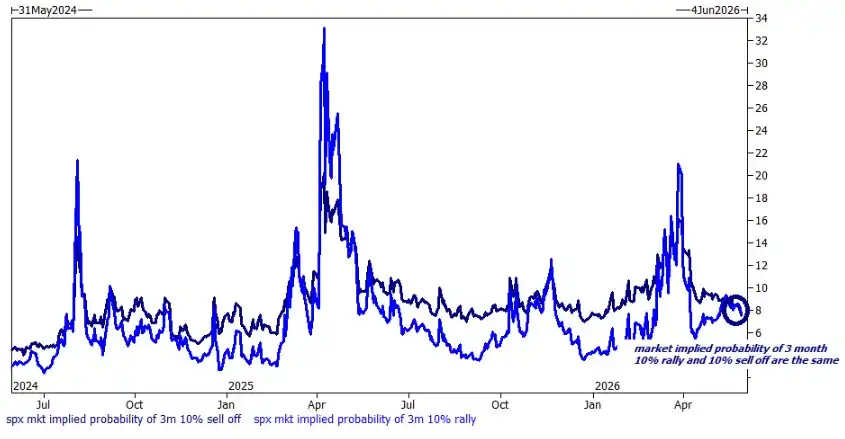
In a latest weekend report, Goldman Sachs derivatives strategist Brian Garrett pointed out that the volatility skew of S&P 500 options has fallen to an 18-month low. The market is pricing a roughly 8% probability for both a 10% decline and a 10% rise—a phenomenon directly characterized by Goldman's volatility team as 'Skew Failure.'

At the same time, the Goldman Sachs Panic Index closed in single digits, hitting a two-year low, indicating that market demand for hedging against tail risks has fallen to extremely low levels.
This signal appears against the backdrop of the U.S. stock market's continued surge. The S&P 500 has been hitting record highs on average every five trading days this year, and Micron's stock price surpassed $1,000 for the first time after hours on Sunday.

Garrett admitted that internal team discussions have evolved from 'Make it stop' in March to 'This is still going up?' in May. However, his own stance is shifting from cautious optimism to increasing pessimism, and he clearly listed several bearish reasons.

Three Bearish Signals Emerge, Cracks Appear Between Market Sentiment and Fundamentals

Garrett listed three major concerns in the current market.

First, market leadership is extremely narrow. The top ten weighted stocks in the S&P 500 now account for 40% of the index's weight, and the last four record highs occurred when overall market breadth was negative—a phenomenon that has never occurred before.

Second, thematic concentration is extremely high. Year-to-date, the S&P 500 excluding AI-related stocks has lagged the overall index by 700 basis points.

Third, price action is highly similar to history. Garrett noted that the 2026 price pattern closely resembles that of late 1998 to 1999.

Although bearish voices are flooding media headlines and social media, Garrett emphasized that this concern is not reflected in the pricing of the options market—at least, the fear of downside risk is almost nowhere to be seen.

Skew Failure: Downside Hedging Costs Fall to Historic Lows

Goldman's volatility team provided three key observations from the options market.

First, the S&P 500 volatility skew has fallen to an 18-month low. This move is driven by two forces: the put wing is unusually cheap, while the call wing is relatively expensive.

Second, the Goldman Sachs Panic Index closed in single digits last Friday, hitting a two-year low. This index synthesizes the two-year percentile rankings of VVIX, VIX, Skew, and at-the-money volatility.

Third, and most crucially: the market prices the probability of a 10% decline and a 10% rise as exactly the same, both around 8%. This means the options market no longer assigns extra premium to downside risk; the protective function of Skew has effectively failed.

Garrett pointed out that the direct implication of the above phenomena is: for investors looking to hedge correlation risk, the current hedging cost is extremely low.

Low-Cost Hedging Paired with Right-Tail Positioning

Based on the above assessment, Garrett provided several specific trade recommendations.

For investors bullish on market style rotation, expecting the rally to shift from concentration to dispersion, Goldman recommends buying RSP (Invesco S&P 500 Equal Weight ETF) outperformance options relative to SPX, with a 1-month 100% outperformance option costing about 145 basis points. It also recommends buying VIX call options as a hedging tool, noting that the term structure for August and beyond is extremely flat, with VVIX at 86.

For investors seeking simple downside protection, Garrett suggests directly buying S&P 500 put options—given the extremely low put skew, the payout structure is quite attractive.

Additionally, Goldman recommends going long Bitcoin ETF volatility with delta-neutral hedging. Garrett noted that Bitcoin has historically performed like a 'leveraged Nasdaq,' but its current pricing is at a two-year low and about 10 volatility points lower than SMH.

Fund Flows: Hedge Funds Net Buyers for Two Consecutive Weeks, Single-Stock ETF Assets Double

According to Goldman's latest Prime Brokerage data, hedge funds have been net buyers for two consecutive weeks, at the fastest pace this year, mainly reflected in long additions and macro short covering.

Significant sector rotation is evident: Financials (down 6% YTD) saw net buying, while Industrials (up 11.5% YTD) saw net selling.

On the futures side, end-user positioning has rebounded to near 2024 highs. Goldman's team specifically noted that levered ETFs are mechanically expanding their balance sheet size; CTA strategies are currently positioned near neutral, but systematic strategies show clear asymmetry towards the left tail—buying about $12 billion in a flat 1-month scenario versus selling about $100 billion in a down 1-month scenario.

Notably, global leveraged and inverse single-stock ETF assets under management have surpassed $60 billion, doubling in two months. The size of this niche market can no longer be ignored.


İlgili Sorular

QAccording to Goldman Sachs, what is currently malfunctioning in the equity options market and what does it indicate?

AGoldman Sachs states that the volatility skew (Skew) for S&P 500 options is malfunctioning, having dropped to an 18-month low. This indicates that the market is pricing the probability of a 10% decline and a 10% rise as virtually identical (both around 8%), meaning the protective mechanism against downside risk has nearly failed.

QWhat are the three major concerns or bearish signals listed by Goldman's Brian Garrett regarding the current market?

AThe three concerns are: 1) Extremely narrow market leadership, where the top 10 stocks account for 40% of the S&P 500 weight and recent highs occurred with negative market breadth. 2) High thematic concentration, with the S&P 500 ex-AI significantly underperforming the full index. 3) Price action that is highly similar to the 1998-1999 period.

QWhat is the Goldman Sachs Panic Index, and what level did it recently reach?

AThe Goldman Sachs Panic Index is a composite index that incorporates the 2-year percentile rankings of the VVIX, VIX, Skew, and at-the-money volatility. It recently closed in single digits, hitting a two-year low, signaling extremely low demand for hedging tail risks.

QWhat specific trading recommendations did Goldman Sachs provide based on its market analysis?

ARecommendations include: 1) Buying RSP (Invesco S&P 500 Equal Weight ETF) outperform options vs. SPX for investors betting on a market rotation. 2) Buying VIX call options for hedging. 3) Buying S&P 500 put options for direct downside protection. 4) Going long Bitcoin ETF volatility with delta-neutral hedging.

QWhat notable trend was observed in hedge fund activity and single-stock ETFs according to Goldman's prime brokerage data?

AHedge funds have been net buyers for two consecutive weeks at the fastest pace this year, driven by long additions and macro short covering. Meanwhile, the assets under management (AUM) for global leveraged and inverse single-stock ETFs surpassed $60 billion, doubling in two months.

İlgili Okumalar

AI Competition's New Battlefield: Long-term Memory Becomes the Pain Point, How Users Can Secure Their Own Context Ownership

A new front is emerging in the AI competition: user ownership of long-term memory and context. As AI models like ChatGPT evolve from chat tools into persistent digital assistants that learn user preferences and workflows, a critical question arises: who owns this accumulated "memory"? Currently, this personalized data is siloed within each platform (e.g., OpenAI, Anthropic, Google), creating a fragmented experience when users switch models. The article highlights ZetaChain's strategic pivot from blockchain interoperability to addressing this AI "memory" challenge. Its new focus is on building a "Private Memory Layer" and an "AI Consumer Layer." Through its consumer product Anuma, ZetaChain aims to give users encrypted, portable memory that can be used across different AI models. This system also envisions programmable, auditable permissions for AI agents and a framework where user knowledge can be monetized as shareable assets. Ultimately, ZetaChain's transformation reflects a broader infrastructure shift. The future bottleneck is less about raw model capability and more about continuous context, user-controlled identity, and permission management across multiple collaborating AI agents. The company's ZETA token is being repositioned as an "AI infrastructure token" to facilitate access, payments, and permissions within this proposed ecosystem. The core narrative advocates for returning control of personal context and AI relationships to users, rather than leaving them locked within proprietary platforms.

marsbit11 dk önce

AI Competition's New Battlefield: Long-term Memory Becomes the Pain Point, How Users Can Secure Their Own Context Ownership

marsbit11 dk önce

İşlemler

Spot
Futures

Popüler Makaleler

CORE Nasıl Satın Alınır

HTX.com’a hoş geldiniz! CORE (CORE) satın alma işlemlerini basit ve kullanışlı bir hâle getirdik. Adım adım açıkladığımız rehberimizi takip ederek kripto yolculuğunuza başlayın. 1. Adım: HTX Hesabınızı OluşturunHTX'te ücretsiz bir hesap açmak için e-posta adresinizi veya telefon numaranızı kullanın. Sorunsuzca kaydolun ve tüm özelliklerin kilidini açın. Hesabımı Aç2. Adım: Kripto Satın Al Bölümüne Gidin ve Ödeme Yönteminizi SeçinKredi/Banka Kartı: Visa veya Mastercard'ınızı kullanarak anında CORE (CORE) satın alın.Bakiye: Sorunsuz bir şekilde işlem yapmak için HTX hesap bakiyenizdeki fonları kullanın.Üçüncü Taraflar: Kullanımı kolaylaştırmak için Google Pay ve Apple Pay gibi popüler ödeme yöntemlerini ekledik.P2P: HTX'teki diğer kullanıcılarla doğrudan işlem yapın.Borsa Dışı (OTC): Yatırımcılar için kişiye özel hizmetler ve rekabetçi döviz kurları sunuyoruz.3. Adım: CORE (CORE) Varlıklarınızı SaklayınCORE (CORE) satın aldıktan sonra HTX hesabınızda saklayın. Alternatif olarak, blok zinciri transferi yoluyla başka bir yere gönderebilir veya diğer kripto para birimlerini takas etmek için kullanabilirsiniz.4. Adım: CORE (CORE) Varlıklarınızla İşlem YapınHTX'in spot piyasasında CORE (CORE) ile kolayca işlemler yapın.Hesabınıza erişin, işlem çiftinizi seçin, işlemlerinizi gerçekleştirin ve gerçek zamanlı olarak izleyin. Hem yeni başlayanlar hem de deneyimli yatırımcılar için kullanıcı dostu bir deneyim sunuyoruz.

229 Toplam GörüntülenmeYayınlanma 2024.12.13Güncellenme 2026.06.02

CORE Nasıl Satın Alınır

Tartışmalar

HTX Topluluğuna hoş geldiniz. Burada, en son platform gelişmeleri hakkında bilgi sahibi olabilir ve profesyonel piyasa görüşlerine erişebilirsiniz. Kullanıcıların CORE (CORE) fiyatı hakkındaki görüşleri aşağıda sunulmaktadır.

活动图片