Franklin Templeton Joins Blackrock, Fidelity, and Goldman Sachs in Supporting the CLARITY Act

cryptonews.ru2026-07-28 tarihinde yayınlandı2026-07-28 tarihinde güncellendi

Özet

Financial giant Franklin Templeton has announced its support for the CLARITY Act, joining other major firms like BlackRock, Fidelity, and Goldman Sachs in advocating for clearer cryptocurrency regulations. The company, with $1.79 trillion in assets under management, stated the legislation would establish clearer rules for digital assets, providing regulatory certainty that the industry has long sought. The updated bill, recently released by Republican senators, aims to define the respective oversight roles of the SEC and CFTC over digital securities and commodities. Key supporters argue that a unified national regulatory framework is crucial for fostering responsible innovation, ensuring market transparency, and protecting investors. Wall Street banks have shown growing interest in blockchain-based services, viewing the act as a catalyst for broader institutional and retail adoption of digital assets.

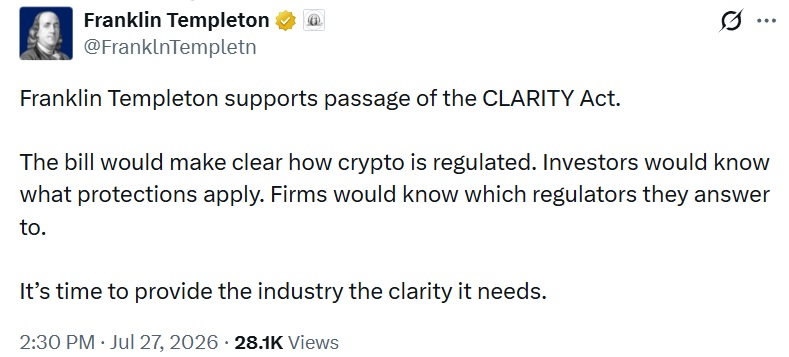
Financial giant Franklin Templeton, a subsidiary of Franklin Resources Inc. (NYSE: BEN), announced its support for the CLARITY Act on July 27 after reporting assets under management of $1.79 trillion as of June 30.

The company stated that the CLARITY Act would establish clearer rules for digital assets, helping investors better understand the protections available to them and providing companies with greater certainty about which federal regulatory bodies oversee their activities. Franklin Templeton added that this law would provide the regulatory clarity the crypto industry has long sought.
On July 6, Franklin Resources announced that preliminary data showed assets under management rose to $1.79 trillion at the end of June, up from $1.78 trillion the previous month, driven by long-term net inflows of $9 billion, partially offset by market fluctuations, income distributions, and other factors.

With this support, Franklin Templeton joins a number of companies such as the world's largest asset manager Blackrock Inc. (NYSE: BLK), investment giant Fidelity Investments, and global investment banking leader Goldman Sachs Group Inc. (NYSE: GS), all of which have publicly voiced their support for the CLARITY Act.

Financial Giants Urge Congress to Adopt Clearer Cryptocurrency Rules

Blackrock Senior Managing Director and Global Head of Market Development Samara Cohen characterized the bill as an important step toward creating a regulatory framework for digital assets that fosters innovation while maintaining transparency, market capital resilience, and investor protection, detailing Blackrock's rationale for supporting the legislation.

Fidelity Investments, which manages approximately $7.1 trillion in assets, also urged senators to approve the bill, arguing that a single national regulatory framework would encourage responsible innovation while providing greater certainty for investors and market participants as part of its call to advance the Senate bill.

Major Wall Street banks are also among the bill's supporters. Goldman Sachs CEO David Solomon endorsed the proposal, highlighting the banking sector's growing interest in tokenization, digital asset custody, trading, and blockchain-based financial services, as per his public statement in support of the proposal.

Charles Schwab Corp. (NYSE: SCHW), one of the nation's largest brokerage firms, also characterized the measure as a catalyst for broader adoption of digital assets by financial institutions and retail investors, while outlining its vision for the future of the industry.

Updated CLARITY Bill Defines Federal Oversight Mechanisms

On July 22, Republican senators unveiled an updated text of the CLARITY Act, reflecting the collaborative work of the Senate Banking Committee and the Senate Committee on Agriculture, as lawmakers sought to secure broader support.

According to the bill's official section-by-section summary, the proposal allocates responsibilities between the U.S. Securities and Exchange Commission (SEC) and the Commodity Futures Trading Commission (CFTC).

This regulatory framework defines how securities and digital commodities will be regulated, establishing registration standards, customer protection measures, disclosure obligations, and preserving anti-fraud authority.

end-content

İlgili Sorular

QOn what date did Franklin Templeton announce its support for the CLARITY Act?

AFranklin Templeton announced its support for the CLARITY Act on July 27.

QWhich other major financial companies have publicly supported the CLARITY Act according to the article?

AAccording to the article, Blackrock Inc., Fidelity Investments, Goldman Sachs Group Inc., and Charles Schwab Corp. have also publicly supported the CLARITY Act.

QWhat does the CLARITY Act aim to achieve regarding digital assets?

AThe CLARITY Act aims to establish clearer rules for digital assets, provide investors with better understanding of their protections, give companies greater certainty about which federal regulators oversee them, and provide the regulatory clarity the crypto industry has long sought.

QWhat was the value of assets under management by Franklin Resources as of the end of June?

AFranklin Resources had assets under management of $1.79 trillion as of the end of June.

QWhich two U.S. regulatory bodies does the CLARITY Act propose to assign responsibilities to for overseeing digital assets?

AThe CLARITY Act proposes to assign responsibilities to the U.S. Securities and Exchange Commission (SEC) and the Commodity Futures Trading Commission (CFTC).

İlgili Okumalar

Why P2P and Exchangers Are Becoming Obsolete, and What Will Replace Them

Titled "Why P2P and Exchanges Are Becoming Obsolete, and What Will Replace Them," this article discusses the evolution of stablecoins, particularly USDT, from a trading tool to a global payment method. However, converting crypto back to fiat for daily expenses remains a challenge. The process of using P2P platforms or crypto exchanges has become increasingly risky and complex due to stricter banking anti-fraud measures, new legislation in Russia, and rampant fraud schemes like "triangles," where sellers can inadvertently receive stolen funds. The article highlights that while P2P was convenient, banks now scrutinize frequent peer-to-peer transfers, often freezing accounts. Exchanges also pose risks like unfavorable rates and unclear compliance. The market is therefore shifting towards integrated services that eliminate the manual conversion step. It cites OneSix as an example—a crypto wallet accessible via Telegram and web that embeds currency conversion directly into payment and withdrawal scenarios. Users can pay bills or send money as if using a bank app, with the crypto-to-fiat exchange happening seamlessly in the background. It also offers invoicing for freelancers and conducts AML checks, returning suspicious transactions instantly instead of freezing them. In conclusion, as crypto integrates into everyday finance, the demand for manual, risky exchange methods is declining. The future lies in unified platforms that combine storage, compliance, conversion, and payments into a single, secure user experience.

cryptonews.ru38 dk önce

Why P2P and Exchangers Are Becoming Obsolete, and What Will Replace Them

cryptonews.ru38 dk önce

The CEO of MARA Holdings Compares AI Operations to Bitcoin Mining! Which is More Profitable?

Fred Thiel, CEO of MARA Holdings (a major Bitcoin mining company), states that the rapid growth of the artificial intelligence (AI) sector is transforming mining companies' business models. He claims that powering data centers for AI is significantly more profitable than Bitcoin mining. In a recent interview, Thiel explained why many mining firms are diversifying into AI infrastructure. According to Thiel, the energy demands of data centers are surging, especially due to the spread of generative AI applications. This creates new revenue opportunities for Bitcoin mining companies with robust power infrastructure. MARA Holdings is among those monitoring this shift and aims to develop its energy and infrastructure services for AI data centers. Thiel emphasized that this move toward AI does not mean the end of Bitcoin mining. He stated that Bitcoin mining remains a sustainable business model, especially for miners in regions with low electricity costs, and it is still a crucial field for utilizing excess or idle power capacity. In recent years, many Bitcoin mining companies have begun using their energy-intensive infrastructure not just for block production but also for high-performance computing (HPC) and AI applications. This strategy aims to diversify revenue sources and increase resilience against cryptocurrency market volatility. Analysts note that the growing energy demand in the AI sector presents significant transformation opportunities for mining companies. The need for high-power, uninterrupted electricity supply, particularly for large data centers, gives Bitcoin miners with existing energy infrastructure expertise a considerable advantage.

cryptonews.ru49 dk önce

The CEO of MARA Holdings Compares AI Operations to Bitcoin Mining! Which is More Profitable?

cryptonews.ru49 dk önce

Ratio's CEO Says Multi-Currency Stablecoins Could Eliminate Costly FX Conversions in Asia

The CEO of Ratio, John Cho, argues that multi-currency stablecoins could save Asia billions by eliminating costly foreign exchange conversions in regional trade. While USD stablecoins like USDT and USDC work for global settlements, local Asian trade is conducted in local currencies like the Korean won or Singapore dollar. Forcing these transactions through USD intermediaries creates unnecessary costs and currency risk. Cho envisions a complementary ecosystem where local-currency stablecoins work alongside USD stablecoins, enabling seamless cross-border settlements without conversion friction. A key pain point in traditional banking is the need for pre-funded Nostro and Vostro accounts, which lock up vast amounts of working capital. Blockchain-based settlement layers like Ratio offer a 24/7 alternative, using on-chain liquidity to enable instant execution even when traditional channels are closed. Modern Web3 infrastructure providers are focusing on pragmatic integration with existing corporate systems like ERPs, allowing businesses to gradually shift volumes to digital channels for better speed, cost, and reduced slippage. Clear regulation is cited as the critical catalyst for widespread institutional adoption. As jurisdictions like the U.S. advance legislation (e.g., the CLARITY Act) and Asian countries are expected to pass their own stablecoin laws within 12-24 months, regulatory uncertainty is receding. The ultimate vision is for regulated stablecoins to become an invisible settlement layer integrated into national payment systems, where payments simply happen on-chain, erasing the boundary between traditional banking and digital assets.

cryptonews.ru1 saat önce

Ratio's CEO Says Multi-Currency Stablecoins Could Eliminate Costly FX Conversions in Asia

cryptonews.ru1 saat önce

Huang Xiaoming, Li Bin, Lei Jun, Liang Wenfeng... Who Are the Biggest Winners in the CXMT IPO Feast?

Changxin Technology, a leading Chinese memory chip manufacturer, successfully listed on the Shanghai Stock Exchange's STAR Market (科创板) on July 8, 2026. Its share price surged from the IPO price of 8.66 yuan to close at 49 yuan on the first day, catapulting its market capitalization to 3.28 trillion yuan, making it the most valuable A-share company and triggering a massive wealth creation event. The biggest winners were the company's founder, Zhu Yiming, and its employees. Zhu Yiming's family wealth skyrocketed nearly 300% to approximately $13.9 billion, with his direct stake in Changxin valued at around 80 billion yuan. Additionally, over 6700 employees benefited from stock ownership plans, creating at least 237 new millionaires (in CNY). Zhu also pledged to donate 768 million shares, worth over 37.6 billion yuan, for future employee incentives over a ten-year period. Several prominent investors and corporate clients also reaped significant paper gains from the IPO. Notable figures include: * **Liang Wenfeng**, founder of DeepSeek, whose funds netted a paper profit of approximately 827 million yuan. * **Kong Jianping**, founder of Nano Labs, saw his indirect holdings valued at roughly 940 million yuan. * **Li Bin**, founder of Nio, whose company's strategic investment of 158 million yuan is now worth about 740 million yuan. * **Lei Jun**, founder of Xiaomi, whose subsidiary holds shares currently showing a paper gain of over 736 million yuan. Xiaomi clarified this is a corporate investment, not direct personal wealth. The article notes that while this IPO created immense wealth for insiders and large investors, retail investors who were lucky enough to win an allotment in the lottery typically profited by around 20,000 yuan. The listing solidifies Changxin's position as China's premier domestic memory chipmaker.

marsbit1 saat önce

Huang Xiaoming, Li Bin, Lei Jun, Liang Wenfeng... Who Are the Biggest Winners in the CXMT IPO Feast?

marsbit1 saat önce

İşlemler

Spot
活动图片