UBS: The Crowdedness of A-Share Tech Stocks Is Far From Reaching Historical Peaks

marsbit2026-06-05 tarihinde yayınlandı2026-06-05 tarihinde güncellendi

Özet

UBS: A-share tech stocks still far from peak crowding levels A-shares' technology sector has seen a strong rebound, with trading activity hitting record highs, raising concerns about market crowding. However, UBS Securities argues that a key indicator of institutional positioning suggests the current crowding level remains well below historical peaks. While the large-cap tech sector's share of total A-share trading volume and market capitalization have reached historical highs, the overweight ratio of domestic mutual funds in this sector stood at 9.9% in Q1 2026. This is down from 11.6% in Q3 2025 and significantly lower than the historical peak of 14.1% in Q4 2015. It also pales in comparison to the historical peak overweight of 18.7% for the consumer sector. UBS notes that typical cycles from a low to a peak in fund overweighting last about three years, and the current outperformance of the tech/growth style has lasted less than two years since the policy pivot in September 2024. UBS expects A-share earnings recovery to accelerate, providing fundamental support. It forecasts 2026 A-share profit growth to rise to 11% from 3.9% in 2025. Non-financial A-share profits grew 11.8% YoY in Q1 2026, with gross and net profit margins at their highest since 2023. Persistent fund inflows, the expansion of thematic ETFs, and a recovery in private fund issuance are supporting market liquidity. In tactical allocation, UBS favors growth and cyclical styles under its "slow bull" base ca...

Author: Xu Chao

Source: Wall Street News

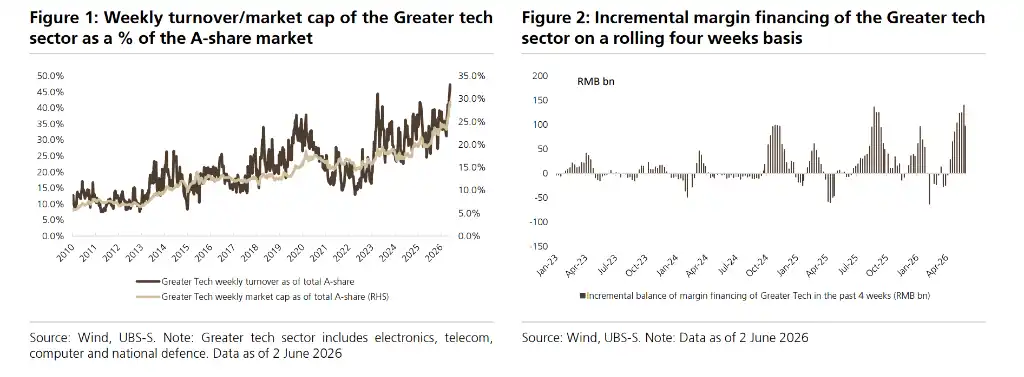
A-share tech stocks have staged a strong rebound, with trading activity repeatedly hitting new highs, raising market concerns about crowding. However, the latest research report from UBS Securities offers a more reassuring judgment: although the trading volume and market cap proportion of the large tech sector have both surpassed historical highs, key indicators measuring the concentration of institutional holdings show that the current crowdedness is still significantly below historical peaks, and the duration of this tech growth style has not yet reached two years.

According to the latest UBS Securities report, as of the first quarter of 2026, the overweight ratio of public funds in the large tech sector (including electronics, communications, computers, and defense) was 9.9%, lower than the 11.6% in the third quarter of 2025 and significantly lower than the historical peak of 14.1% in the fourth quarter of 2015; it also lags far behind the historical maximum overweight ratio of 18.7% for the consumer sector.
UBS points out that it typically takes about three years for the public fund overweight ratio to cycle from a trough to a peak. Since the policy pivot in September 2024, the outperformance of this tech growth style has lasted less than two years so far.

Meanwhile, the A-share earnings recovery is accelerating, providing more solid fundamental support for the market rally.

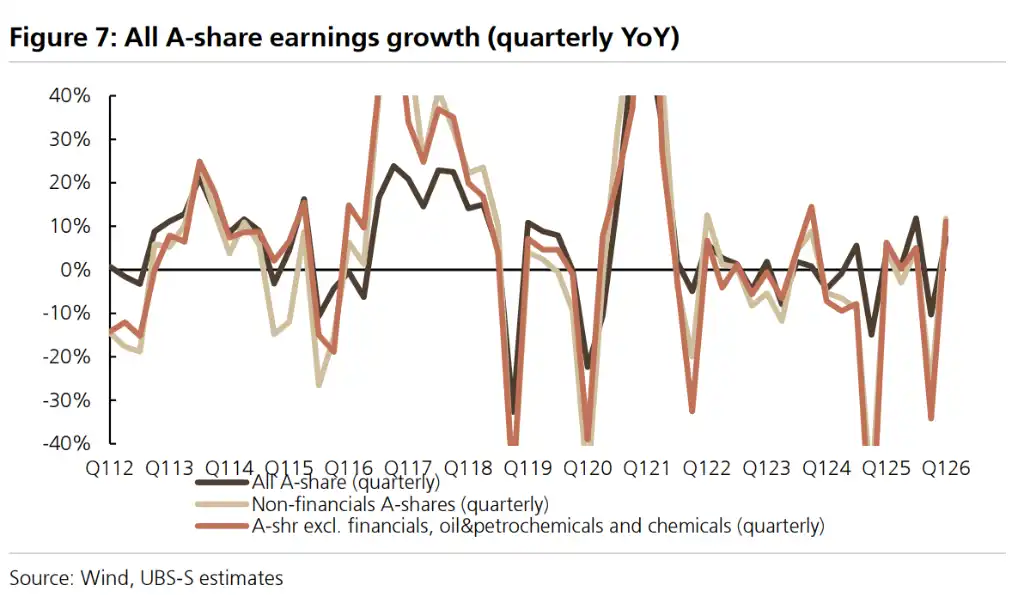
UBS expects the profit growth rate for all A-shares to rise from 3.9% in 2025 to 11% in 2026. In the first quarter of 2026, non-financial sector profits increased by 11.8% year-on-year, with both gross margin and net profit margin hitting their highest levels since 2023. Continued inflows from multiple funding channels, sustained expansion of industry-theme ETF sizes, and the recovery of private fund issuance collectively form important support for the current market micro-liquidity.

In tactical allocation, UBS leans towards growth and cyclical styles under its baseline "slow bull" scenario. At the sector level, it strongly favors electronics, communications, electrical equipment, machinery, non-ferrous metals, and chemicals, and maintains buy ratings on multiple related stocks.

Tech Overweight Ratio Still Has Room, Current Style Duration Still Short

The trading heat and capital concentration in the tech sector have warmed up significantly recently.

According to UBS data, as of June 2, 2026, the weekly trading volume of the large tech sector accounted for 45.5% of total A-share trading volume, and its market cap accounted for 28.6% of the total market. Both metrics are at historical highs. Since the Iran-US ceasefire on April 8, which repaired risk appetite, the STAR 50 and ChiNext indices have surged 35.5% and 30.4% cumulatively, significantly outperforming the 11.0% gain of the Wind All-A Index and the 9.8% gain of the CSI 300 Index over the same period.

However, UBS believes that using trading heat and short-term gains to judge crowdedness has limitations, and the public fund overweight ratio is a more core indicator for measuring institutional positioning concentration. From this perspective, the current overweight ratio of the large tech sector is not only lower than its own historical peak but also far behind levels seen at historical peaks for the consumer sector, such as 22.8% in the third quarter of 2010 and 21.0% in the third quarter of 2012.

UBS reviewed the historical patterns of five major style rotations in A-shares since 2014:

  • From 2014 to 2015, leveraged funds drove sharp market fluctuations.
  • From 2017 to 2019, foreign inflows fueled the "blue-chip stock" rally.
  • From 2019 to 2021, public funds chased profit-compounding companies, forming a positive feedback loop.
  • From 2022 to before the policy pivot in 2024, insurance capital and the "national team" drove defensive sectors to outperform.
  • After the policy pivot in 2024, margin financing, ETFs, and private funds have propelled the outperformance of small-cap and growth styles.

The study found that each style typically lasts about three years from formation to rotation — the high fundamental growth of a single sector rarely lasts more than three years, and there is a natural ceiling to fund concentration. Pressure from redemptions after narrowing outperformance transmits to stock prices and triggers a trend reversal.

However, signals from some sub-sectors are already worth noting. The overweight ratio for the electronics sector has reached 6.6%, exceeding the previous high of 5.4% in the third quarter of 2020. The overweight ratio for the communications sector has refreshed its record high since 2010 for three consecutive quarters, reaching 4.0%. UBS stated it will continue to monitor changes in related indicators.

Earnings Recovery Accelerates, Solidifying Market Rally Foundation

UBS expects the profit growth rate for all A-shares to rise to 11% in 2026 and points out that multiple top-down and bottom-up indicators confirm the acceleration of the earnings improvement trend.

Based on Q1 2026 earnings data, the year-on-year profit growth rate for non-financial A-shares surged from 0.8% in 2025 to 11.8%; excluding oil, petrochemicals, and basic chemicals, the growth rate reached 12.3%. The profit growth rate for the STAR Market in Q1 was as high as 204.7%, and the ChiNext Market reached 22.7%, both significantly outperforming the main board's 5.5%. Gross margin and net profit margin increased by 0.6 and 0.3 percentage points year-on-year, respectively, both hitting their highest levels since 2023, indicating that margin pressure for downstream companies remains manageable despite high oil prices.
On the macro level, April PPI rose 2.8% year-on-year, and CPI rose 1.2%. UBS expects inflation to rise further in the coming months. Since non-financial A-share revenue growth is highly correlated with nominal GDP and PPI trends, rising inflation will directly drive faster expansion on the revenue side.

Bottom-up data also confirms the upward profit trend.

In the first four months of this year, profits for industrial enterprises above designated size grew 18.2% year-on-year, with profits in computer, communication, and electronic equipment manufacturing soaring 107.7% year-on-year; profits in non-ferrous metal mining, mining, and coal washing sectors grew 94.9%, 26.0%, and 21.0% year-on-year, respectively. Regarding profit expectations, earnings growth expectations for the IT, raw materials, real estate, and energy sectors over the past six months have all been revised upward by more than 20 percentage points. The trajectory of these upward revisions is highly similar to past earnings upcycle years like 2017, 2019, and 2021.

From a medium-term perspective, an increasing share of overseas business is another important support for margin expansion. The proportion of overseas revenue for non-financial A-shares has steadily increased from 9.5% in 2010 to 18.7% in 2025. Furthermore, the gross margin of overseas business has consistently been higher than that of domestic business, with the gap widening further in 2025. UBS believes that the continued advancement of "anti-involution" policies and the implementation of supportive policies will also drive further sector margin recovery over the medium term.

Tactical Allocation: Emphasis on Growth and Cyclicals, Six Sectors Overweighted

At the style allocation level, under its baseline "slow bull" scenario, UBS favors growth styles. The backdrop of rising PPI and industrial profits supports cyclical styles. Sustained ample liquidity and high market turnover favor small-cap styles.

However, the continued expansion of industry-theme ETF sizes is providing additional capital support to leading companies. UBS expects the relative performance of large-cap versus small-cap styles to be more balanced in the second half of the year compared to 2025.

At the sector level, UBS is overweight six areas: Electronics (benefiting from semiconductor inventory cycle recovery and AI innovation), Communications (driven by AI computing demand and widespread adoption of industrial internet, fueling profit growth for sub-sector leaders), Machinery (automation equipment and industrial robotics benefiting from domestic capital expenditure recovery and import substitution), Non-ferrous Metals (rising copper and aluminum prices, lithium sector demand recovery), Chemicals (advancement of anti-involution and accelerated exit of overseas capacity accelerating bottom formation), and Electrical Equipment (policy support and AI data center power demand driving energy storage development).


İlgili Sorular

QAccording to UBS, is the crowding in A-share technology stocks at a historically high level currently?

ANo. While trading volume and market cap share of the large tech sector are at historical highs, the core indicator measuring institutional position concentration, the public fund overweight ratio, is still far below historical peaks. The current overweight ratio for the large tech sector is 9.9%, significantly lower than its historical peak of 14.1% in Q4 2015 and much lower than the consumer sector's historical peak overweight of 18.7%.

QWhat is the expected profit growth rate for all A-shares in 2026 according to UBS's report?

AUBS expects the profit growth rate for all A-shares to increase to 11% in 2026, up from 3.9% in 2025.

QWhat are the two tech sub-sectors where the overweight ratios have already reached concerning levels as per UBS's analysis?

AThe two sub-sectors are Electronics and Communications. The Electronics sector's overweight ratio has reached 6.6%, surpassing its previous high of 5.4% in Q3 2020. The Communications sector's overweight ratio has hit 4.0%, a new high for three consecutive quarters since 2010.

QWhat are the six sectors that UBS recommends overweighting in its tactical asset allocation under the 'slow bull' baseline scenario?

AThe six sectors are: Electronics, Communications, Electrical Equipment, Machinery, Non-ferrous Metals, and Chemicals.

QBased on historical patterns studied by UBS, how long does a typical market style cycle from formation to rotation usually last in the A-share market?

AUBS's research on style shifts since 2014 indicates that a typical market style cycle, from formation to rotation, usually lasts about three years.

İlgili Okumalar

Trump's 'Bitcoin Retirement Plan' Hits Roadblock: Democrats Claim It Endangers American Workers' Pensions?

Democratic Senators Bernie Sanders (I-VT) and Elizabeth Warren (D-MA), along with Rep. Bobby Scott (D-VA), are urging the Labor Department to repeal a proposed rule that would open U.S. retirement savings accounts, like 401(k) plans, to investments in Bitcoin and other cryptocurrencies. In a letter to Acting Labor Secretary Keith Sonderling, they argue the rule would endanger workers' financial futures and contradicts long-standing legal precedents under the Employee Retirement Income Security Act (ERISA). The rule, stemming from a Trump executive order, would shift the legal standard for plan fiduciaries. Instead of requiring them to prove they conducted due diligence on volatile assets, it would presume prudence if they followed a specified process. The lawmakers warn this exposes the $14.2 trillion in 401(k) savings to highly volatile and less-regulated assets, citing FINRA warnings on crypto's risks and FBI data on massive crypto scam losses. The letter also alleges a conflict of interest, noting that President Trump's adult children manage the family's crypto business, which has raised billions. They claim the rule could allow the Trump family to profit at the expense of workers and retirees. Consumer advocates echo concerns that it could turn retirement savings into a lifeline for a risky industry. The Trump administration defends the rule as expanding worker choice, with officials stating it ends the department "picking winners and losers" and requires fiduciaries to follow a prudent process.

foresightnews_api2 dk önce

Trump's 'Bitcoin Retirement Plan' Hits Roadblock: Democrats Claim It Endangers American Workers' Pensions?

foresightnews_api2 dk önce

Rules Change Mid-Game, Polymarket’s Billion-Dollar Bitcoin Prediction Market Mired in Settlement Controversy

A nearly $150 million prediction market contract on Polymarket is in turmoil after the platform refused to settle in favor of traders who correctly predicted that MicroStrategy (now Strategy) would sell Bitcoin. The core dispute revolves around a sale of 32 BTC, which occurred between May 26-31 but was officially disclosed in an SEC 8-K filing on June 1. The original contract stated it would resolve to "Yes" if Strategy sold any Bitcoin before May 31, 11:59 PM ET, using public disclosures and on-chain data as proof. After the filing on June 1, traders who saw the disclosure rushed to buy "Yes" contracts, believing it was conclusive evidence. However, Polymarket's operators later added a rule that the disclosure itself must occur by the deadline, not just the transaction, invalidating the filing as proof. This retroactive rule change has sparked accusations of market manipulation, leaving traders like "willo2," who invested $527,000, facing total losses. The controversy highlights a deeper structural flaw in Polymarket's decentralized settlement system, which relies on UMA's optimistic oracle. Disputed resolutions are ultimately decided by a vote among UMA token holders, a mechanism critics say is vulnerable to manipulation by large holders ("whales") who can vote in their own financial interest rather than on objective facts. Data suggests a high concentration of voting power and significant overlap between voters and Polymarket traders. The dispute emerges as prediction markets like Polymarket and Kalshi are experiencing massive growth and seeking mainstream financial legitimacy, having recently secured regulatory approval from the U.S. CFTC. However, the incident underscores the unresolved tension between decentralized, token-vote-based settlement and the need for transparent, rules-based outcomes in high-stakes financial contracts.

foresightnews_api5 dk önce

Rules Change Mid-Game, Polymarket’s Billion-Dollar Bitcoin Prediction Market Mired in Settlement Controversy

foresightnews_api5 dk önce

Ethereum Foundation Researcher: Quantum Day Is Approaching, Plans to Complete Quantum-Resistant Migration by 2029

Ethereum Foundation researcher Justin Drake discusses the implications of a recent quantum computing breakthrough by Google’s quantum AI team, which demonstrated a 10x efficiency improvement in Shor’s algorithm against the secp256k1 elliptic curve used in Bitcoin and Ethereum. Notably, Google kept key algorithmic details confidential, using zero-knowledge proofs to verify the result without disclosure—a first in academia. Shortly after, the core optimization was independently reproduced, and an open-source competition (ecdsa.fail) emerged, further improving the algorithm by 8.4%. Meanwhile, startup Oratomic published research suggesting that neutral-atom quantum architectures could break secp256k1 with only 10,000 physical qubits, accelerating the timeline for "Q-Day"—the day quantum computers can break widely used cryptography. Drake estimates a 50% probability of Q-Day by 2032 and a 10% chance by 2030, contrasting with the U.S. government’s more conservative 2035 forecast. He warns against panic but stresses timely migration to post-quantum cryptography. Ethereum plans to complete its migration by 2029, covering consensus, data, and execution layers with hash-based systems. The Foundation is also developing leanVM, a formally verifiable zkVM, and has launched two $1 million initiatives to advance SNARK-friendly cryptography.

foresightnews_api5 dk önce

Ethereum Foundation Researcher: Quantum Day Is Approaching, Plans to Complete Quantum-Resistant Migration by 2029

foresightnews_api5 dk önce

İşlemler

Spot
Futures
活动图片