Deribit Obtains Broker-Dealer License in Dubai via Coinbase

cryptonews.ru2026-08-18 tarihinde yayınlandı2026-08-18 tarihinde güncellendi

Özet

Deribit has secured a broker-dealer license in Dubai from the Virtual Assets Regulatory Authority (VARA), enabling its spot orders for buying, selling, and trading to be routed directly to Coinbase for execution. This integration provides Deribit's primarily professional trader base with access to Coinbase's deeper centralized order book liquidity. It also paves the way for Deribit to expand beyond its traditional Bitcoin and Ether derivatives, potentially adding hundreds of new assets. Coinbase CEO Brian Armstrong hailed the license as a sign of the UAE embracing modern finance. This marks Deribit's second VARA approval, following its 2025 headquarters establishment in Dubai. The integration follows Coinbase's completed acquisition of Deribit in August 2025 for approximately $2.9 billion, positioning Coinbase as a leader in the crypto derivatives market. The move highlights the UAE's progressive regulatory framework, which is attracting crypto firms and stands in contrast to slower developments in the US and Europe. While not affecting US operations, the deal strengthens Coinbase's "universal exchange" model and boosts its reported trading volumes.

The broker-dealer license issued to Deribit by the Dubai Virtual Assets Regulatory Authority (VARA) means that the exchange's spot orders to buy, sell, and trade are now routed directly to the Coinbase exchange for execution. This integration provides Deribit's predominantly professional trader base with access to Coinbase's centralized order book—a significantly deeper pool of liquidity than the platform had on its own.

Furthermore, it opens up possibilities for expansion far beyond Deribit's traditional domain (that is, bitcoin and ether derivatives), with the new integration expected to eventually bring hundreds of additional assets onto the platform. Client funds can remain within Deribit's own ecosystem, even when being used as collateral for derivative trading.

Coinbase co-founder and CEO Brian Armstrong called this a "significant moment for both Deribit and Coinbase," adding that the clearance demonstrates that "the UAE is truly embracing modern finance and digital assets."
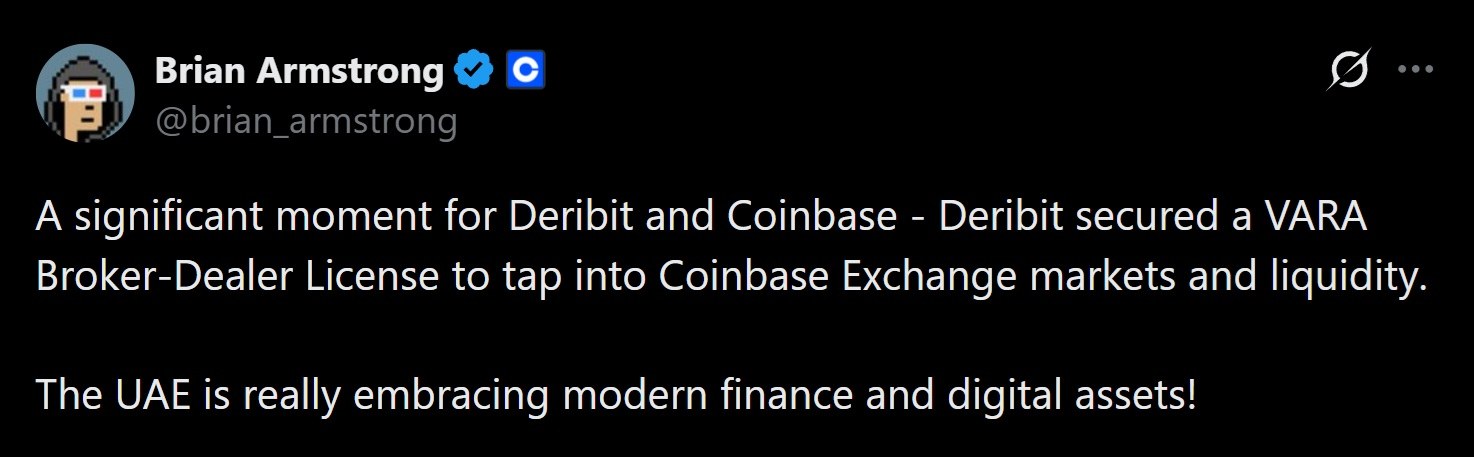
Image source: X

This marks the second clearance Deribit has received from VARA in less than two years. The exchange became the first cryptocurrency derivatives platform to receive VARA approval when it opened its global headquarters in Dubai in early 2025, and it had already been offering spot trading since January of that year under a separate VARA exchange license.

Bitcoin.com News reported on Coinbase's initial agreement to acquire Deribit for roughly $2.9 billion, a deal structured as approximately $700 million in cash plus 11 million shares of Coinbase class A common stock, and later reported that Coinbase completed the deal in August 2025, becoming the undisputed leader in the global cryptocurrency derivatives market.

At the deal's close, Deribit was seeing a monthly trading volume of $185 billion and held an open interest of roughly $60 billion—figures that made the company a clear prize in the derivatives market, which Coinbase had been trying to enter for years.

A Big Bet on the UAE

VARA's approval comes as several other exchanges are also eyeing Dubai as a testing ground for regulated cryptocurrency derivatives and spot trading, significantly outpacing the adoption of similar comprehensive regulatory frameworks in the U.S. or Europe.

For Coinbase, connecting Deribit's liquidity directly to its own order book is also a step towards the "universal exchange" model the company has been building since completing the acquisition, bringing spot trading, futures, options, and now deeper access to offshore liquidity under one roof.

However, this integration does not change how Deribit operates in the U.S. market, as the VARA license is exclusively for activity regulated in Dubai. But it clearly signals where Coinbase sees its near-term growth, which is not in obtaining new U.S. clearances—a process still moving slowly and fraught with political debate—but in accumulating regulatory wins in jurisdictions like the UAE, which have already established clear digital asset licensing frameworks.

Every additional Deribit client connected to Coinbase liquidity also bolsters Coinbase's own trading volume metrics—a figure closely watched by investors as the company reports quarterly derivatives trading volume growth alongside its more mature spot business.


İlgili Sorular

QWhat is the significance of Deribit obtaining a broker-dealer license from Dubai's VARA?

AThe license allows Deribit's spot orders to be routed directly to Coinbase for execution, giving Deribit's user base access to Coinbase's deep centralized order book and liquidity pool.

QWhat key benefit does the Coinbase-Deribit integration provide to Deribit's clients?

AClients' funds can remain within Deribit's own ecosystem, even when being used as collateral for trading derivatives on the platform.

QHow much was the Coinbase acquisition of Deribit valued at, and what was the deal structure?

AThe acquisition was valued at approximately $2.9 billion, structured as around $700 million in cash plus 11 million shares of Coinbase's Class A common stock.

QAccording to the article, what does Dubai's regulatory advancement signal compared to the US and Europe?

AIt indicates that the UAE is significantly outpacing the US and Europe in adopting comprehensive regulatory frameworks for digital assets and embracing modern finance.

QWhy is the integration strategically important for Coinbase's business model and growth?

AIt is a step towards Coinbase's 'universal exchange' model, expands its reach into regulated offshore liquidity (like the UAE), and boosts its reported trading volume metrics, which are closely watched by investors.

İlgili Okumalar

Uniswap Founder: Why AMM Could Become the Core Engine of Financial Markets

In this article, Uniswap founder Hayden Adams argues that Automated Market Makers (AMMs) have the potential to become the core engine of future financial markets, drawing parallels to the disruptive rise of index funds 50 years ago. He posits that asset tokenization is more than just an infrastructure upgrade; it enables programmable markets and changes who can provide liquidity. AMMs like Uniswap have already found product-market fit in long-tail crypto assets and stablecoin pairs, where passive strategies can outcompete traditional market makers due to lower capital costs. The traditional market-making model is vertically integrated, creating high barriers to entry. Blockchain technology dismantles this by decoupling execution, custody, and settlement into competitive, open layers. In this new landscape, capital is the scarcest resource, and advantage goes to those with the lowest cost of holding assets—such as asset issuers or long-term holders who naturally have exposure. A key emerging pattern is "correlated pairs" (e.g., an asset trading against a related index like SPY instead of USD). When two assets are correlated, passive AMM strategies perform much closer to active ones, and liquidity providers bear less risk. This structure naturally organizes markets for efficiency, with passive AMMs dominating correlated pairs and active players competing on the fewer, high-volatility "bridging pairs" (like SPY/USD). Early examples already exist, such as tokenized stocks trading directly against SPY on Uniswap. Adams concludes that, much like passive index funds eventually outperformed most active managers, passive liquidity provision via AMMs is on a path to win by dramatically lowering the cost and complexity of creating and accessing markets.

marsbit13 dk önce

Uniswap Founder: Why AMM Could Become the Core Engine of Financial Markets

marsbit13 dk önce

İşlemler

Spot
活动图片