Original | Odaily Planet Daily (@OdailyChina)
Author | Azuma (@azuma_eth)
In the early morning of June 18th Beijing time, the Federal Reserve officially announced the latest interest rate decision. Without any suspense, the federal funds rate remained unchanged within the predetermined range, in line with market expectations.
In the market pricing over the past few weeks, the interest rate path was almost uncontested, and the market had already fully priced it in. Therefore, the real focus of this rate decision was not "whether to cut rates," but on how the new Fed Chair Warsh would initiate his first policy communication — this is Warsh's first FOMC meeting as Chair, and the market's first opportunity to observe how he will shape the monetary policy communication framework for the coming years.
The Dot Plot Remains, but Warsh Himself Is Absent
The change that sparked the most market discussion from this meeting came from the structure of the economic projections and the Dot Plot itself.
- Odaily Note: The so-called "Dot Plot" is a quarterly interest rate projection tool published by the Fed, where each dot represents an FOMC member's forecast for future interest rate levels. Although these projections are not formal policy commitments, because they reflect the policymakers' overall assessment of economic and inflation prospects, the Dot Plot has long been considered by the market as an important reference for interpreting the Fed's policy direction.
In the latest FOMC economic projections, only 18 of the 19 Fed officials submitted Dot Plot forecasts. Among them, 1 person believes interest rates should be raised by a cumulative 75 basis points in the remainder of 2026, 5 believe in a cumulative 50 basis point hike, 3 believe in a cumulative 25 basis point hike, 8 believe rates should remain unchanged, 1 believes in a cumulative 25 basis point cut, and 1 was absent.
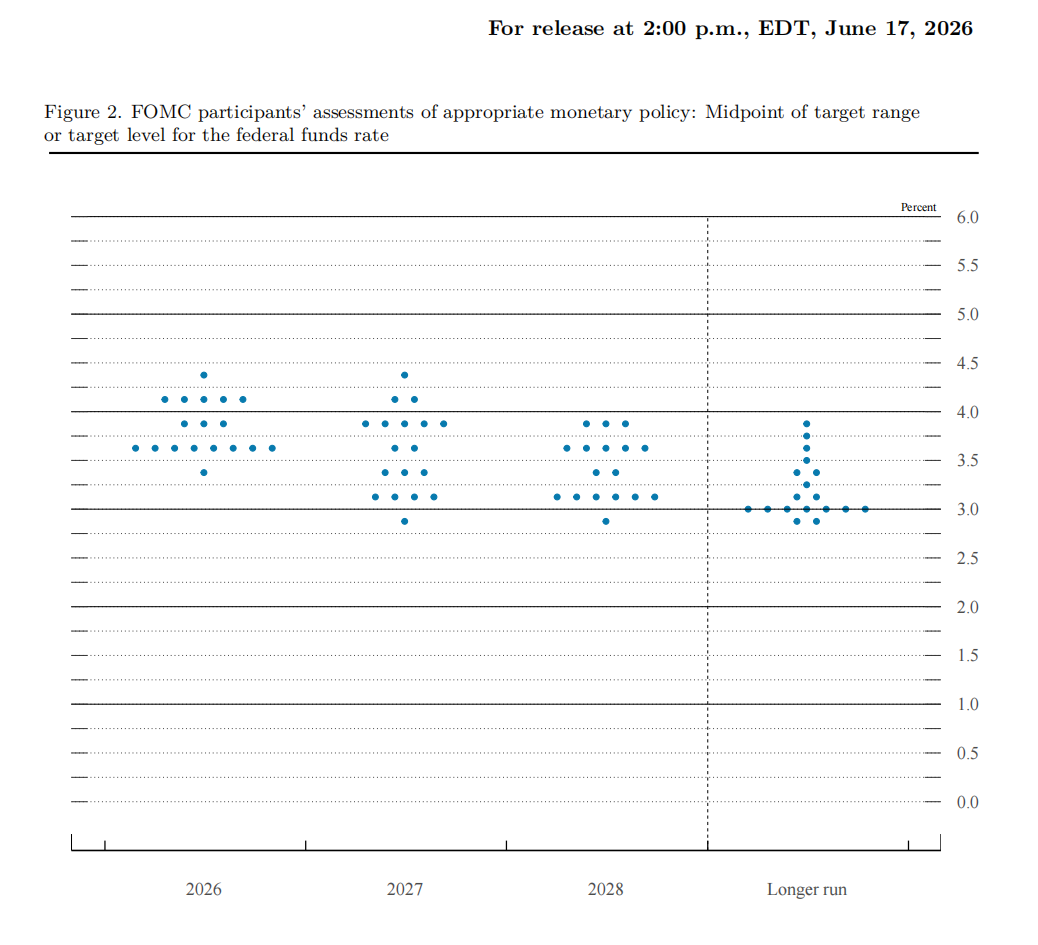
Warsh later admitted during the press conference that he was the one who did not submit an interest rate forecast. Warsh's explanation was: "I did not present any projections of my own, consistent with my longstanding views, at least about its current structure."
Compared to his predecessor Powell's highly transparent and frequent communication style, Warsh has long been a representative figure of the "say less" school. He has repeatedly expressed doubts about "the effectiveness of the Dot Plot," "excessive forward guidance," and "frequent policy signaling." In Warsh's view, the Fed does not need to tell the market exactly how it will proceed at every step in the future but should make decisions based on real-time economic data.
Although the market once speculated that Warsh might promote reforms to the Dot Plot mechanism or even abolish it outright, it was not directly canceled in this meeting. However, Warsh's own absence still sent a clear signal — the Fed is weakening the guidance significance of the Dot Plot.
A Subtle Shift in the Fed's Communication Framework
Warsh also stated during the press conference that he would promote a series of reform measures at the Fed in the future, including establishing multiple specialized working groups to explore more open data collection methods and study improvements to the Fed's existing statistical indicator system.
In the subsequent Q&A session with reporters, when repeatedly questioned about whether the next step is a rate hike and whether the current interest rate is restrictive, Warsh repeatedly declined to provide clear guidance.
Over the past decade, one of the Fed's core capabilities has been to consistently reduce market uncertainty through the Dot Plot, SEP (Summary of Economic Projections), and press conferences. The fundamental reason why the market closely watches the Fed's various activities is that it provides a "predictable path."
But Warsh's statements are changing this logic. Clearly, Warsh emphasizes data dependence, decision-making at each meeting, and consistently maintaining more restrained expressions about the future path.
If this tendency continues, the market will face a structural change — the Fed will no longer try to "explain the future," but only describe "current judgments." This will directly weaken the certainty function of forward guidance.
Rate Hike Expectations Heat Up, Market Risk Appetite Drops
After the interest rate decision was announced, market repricing of the policy path quickly unfolded.
Following Warsh's remarks emphasizing that "the central bank will not tolerate high inflation," the market began reassessing the upper bound of the Fed's policy reaction function—that is, whether there exists a possibility of more aggressive tightening than previously expected in a scenario where inflation has not declined significantly.
This change was first reflected in short-term assets.
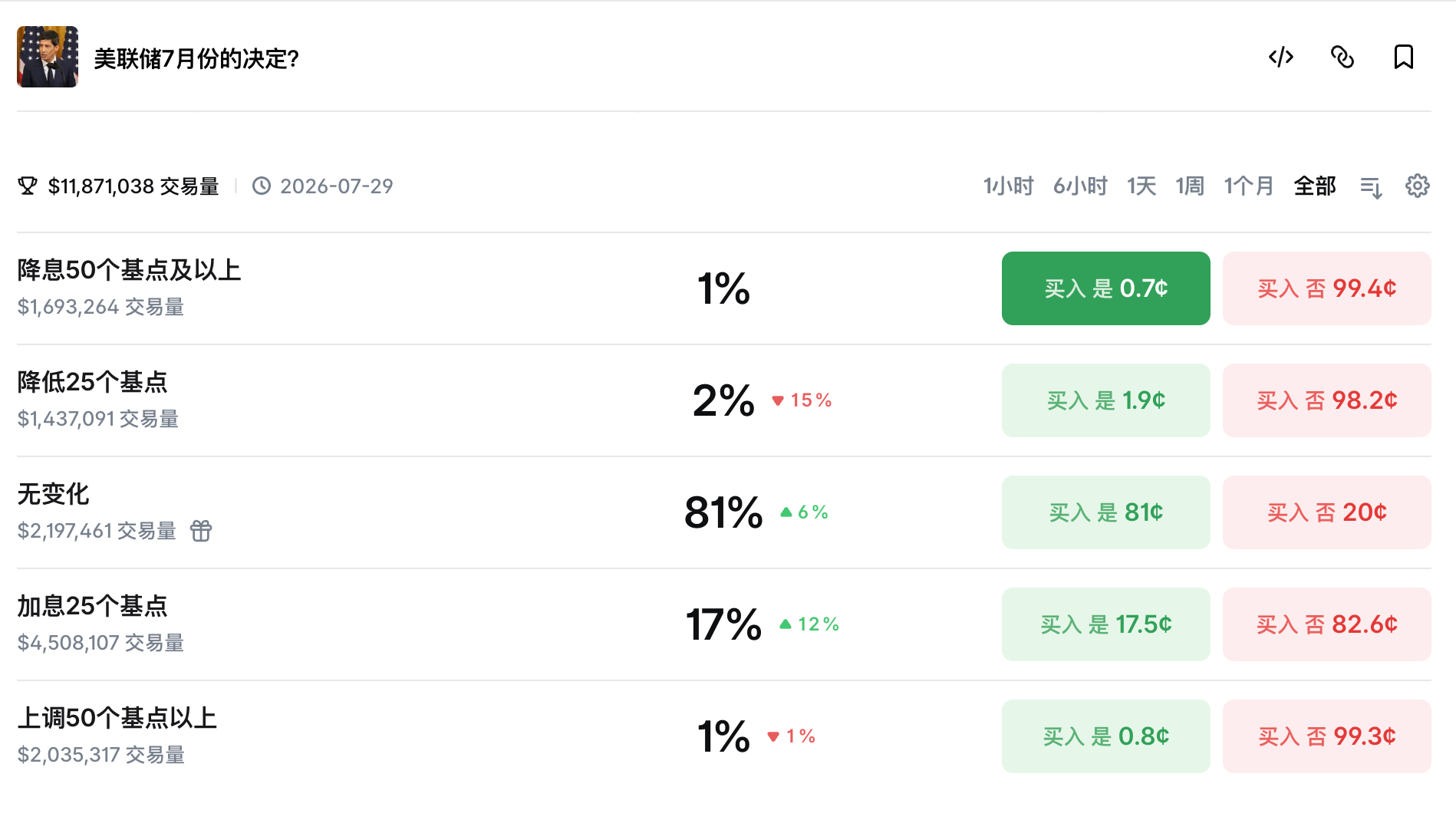
Traders began re-pricing a higher terminal rate path. Some interest rate futures contracts indicate that the market is already discussing the possibility of another rate hike as early as around October, while not ruling out tail risks of a more aggressive path. Polymarket probability data also rose in sync, reflecting that market pricing for a "reopened rate hike window" is opening up.
U.S. stocks saw a noticeable decline after the decision, with the three major indices closing lower, the S&P 500 (-1.2%) and Nasdaq (-1.3%) both falling over 1%, led by a decline in tech stocks, indicating a clear cooling of market risk appetite.
Structurally, this round of adjustment is not a single-factor-driven "interest rate shock" but rather a more typical triple repricing:
- Short-term rates rise: The path for rate hikes is reopened;
- Risk assets retreat: Valuation sensitivity to interest rates amplifies;
- Dollar strengthens + yield curve volatility: Reflects rising policy uncertainty.
It is worth noting that the market is not simply trading "economic weakness" or "the disappearance of rate cut expectations," but is trading a more complex logic — under the new communication framework led by Warsh, inflation constraints are being re-elevated, and the "upside tail risk" of the policy path is becoming more real.
In other words, if inflation does not fall quickly, will the Fed turn towards tightening earlier and faster than the market originally expected?
Warsh's Pivot May Have Just Begun
In conclusion, if you look only at the outcome of this meeting, the Fed did not undergo a radical pivot. Rates are unchanged, the Dot Plot remains, and the system is still running. But if you shift the focus from "policy path" to "communication style," changes have already begun to appear.
Warsh's debut was more like a signal test. He didn't discard the old tools, but he didn't fully rely on them either. He chose to "weaken their effect, reduce their weight."
Looking at longer-term implications, the biggest question left by this debut is not "will the Fed hike next," but "how will the market reprice the world when the Fed no longer spoils the path ahead."