Red Alert: Bank of Japan's 25bp Rate Hike Imminent, Are US Stocks and Crypto Set for a Repeat of the 2024 Flash Crash?

marsbit2026-06-11 tarihinde yayınlandı2026-06-11 tarihinde güncellendi

Özet

Japanese central bank likely to raise interest rates by 25 basis points to 1.0% in June, its highest level since 1995, with market probability at 98%. This move, driven by persistent inflation risks from energy costs and a weak yen, risks triggering a "carry trade" unwind. Investors who borrowed cheap yen to invest in higher-yield assets like US stocks and crypto may be forced to sell, potentially causing significant volatility. An estimated $500 billion in yen-funded positions remains vulnerable. This could mirror the August 2024 flash crash, where a yen surge triggered a global stock sell-off and a sharp Bitcoin drop. High-valuation AI and tech stocks are particularly sensitive to tighter global liquidity and rising energy costs. Cryptocurrencies, as high-beta assets, face amplified risk from higher leverage costs and competing for scarcer market liquidity. Analysts warn of short-term pressure on risk assets, advising caution regarding leverage amid heightened volatility.

Original | Odaily Planet Daily (@OdailyChina)

Author | Qin Xiaofeng (@QinXiaofeng 888 )
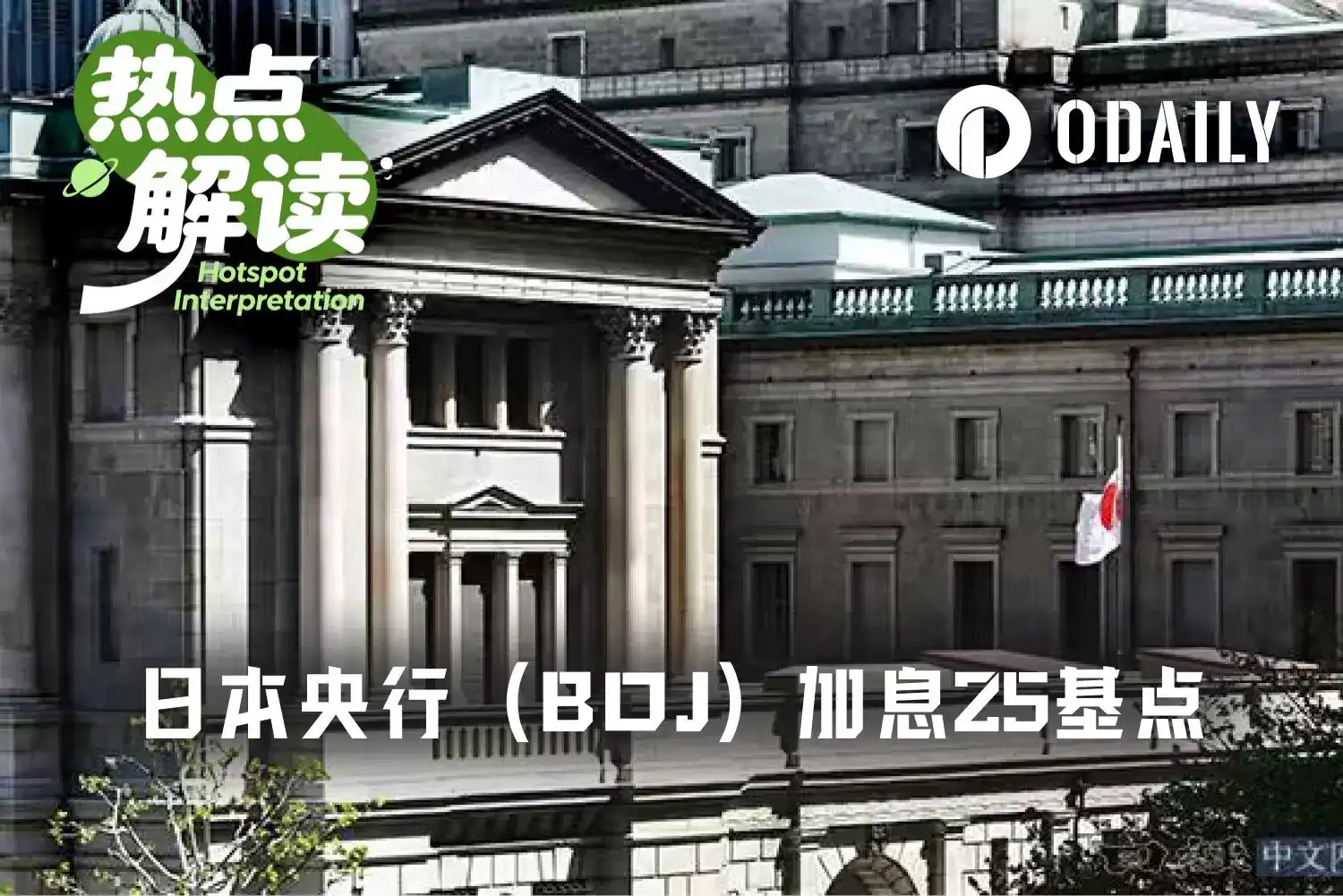
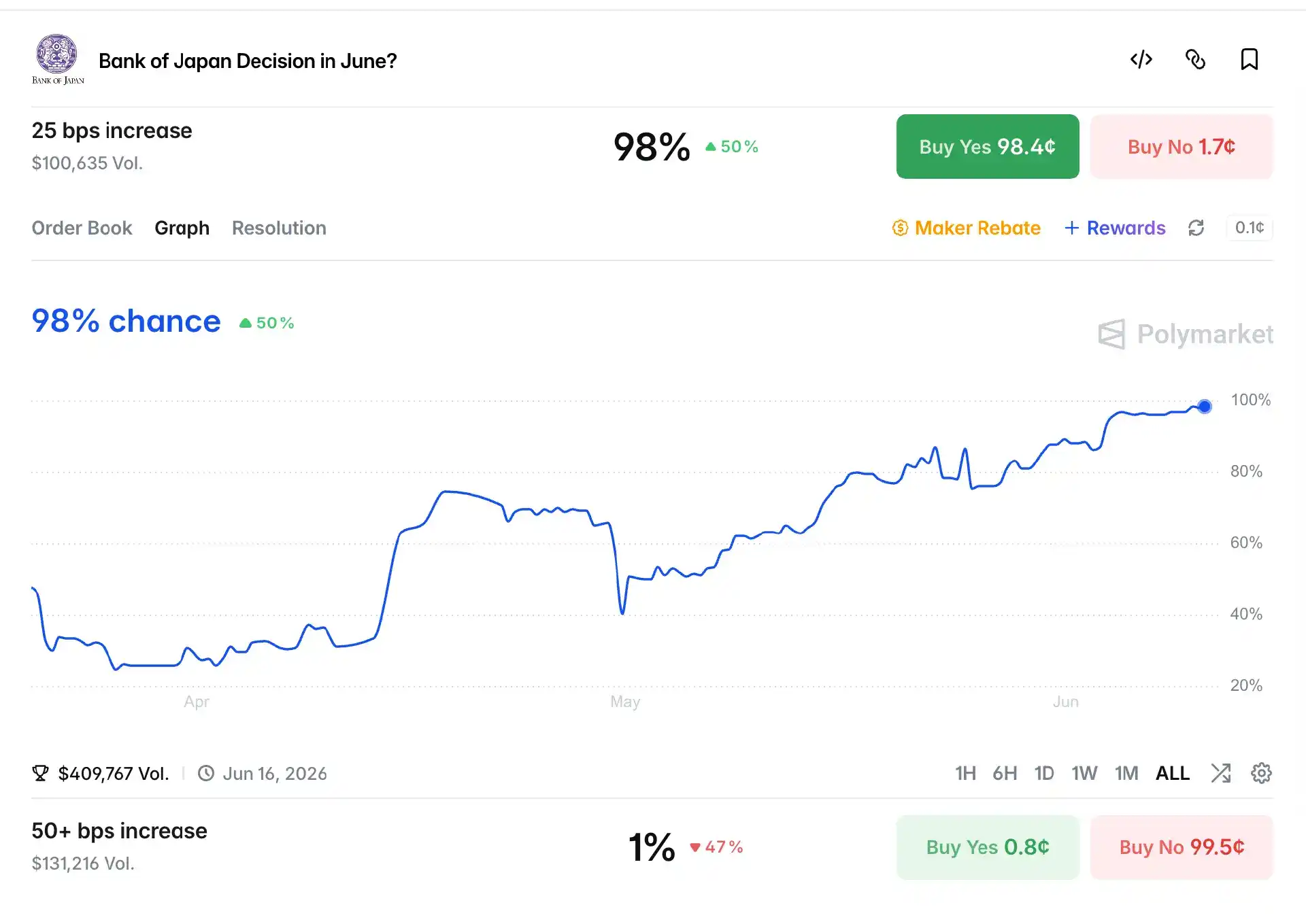
According to Nikkei News, the Bank of Japan (BoJ) is expected to raise its short-term policy rate from 0.75% to 1.0% during the monetary policy meeting on June 15-16, which would be the highest policy rate level since 1995. Currently, market pricing for a rate hike is extremely high, with the probability of a "25bp (basis point) hike" on PolyMarket surging from 25% in early April to 98%.
With a BoJ rate hike imminent, a large number of investors engaged in yen carry trades may be forced to sell overseas assets, convert back to yen, and repay loans, triggering a chain reaction and amplifying volatility in global risk assets—the flash crash in August 2024 serves as a classic example, where a sharp yen appreciation led to a short-term plunge in global stock markets, with Bitcoin plummeting nearly $20,000 in a single day, a maximum drop of 15%.

Odaily Planet Daily will analyze the macro backdrop and transmission mechanism of the BoJ rate hike, and focus on assessing the risk impact on AI tech stocks and cryptocurrencies for readers' reference.

1. Inflation Risks Drive BoJ Rate Hike

Over the past two years, hawkish voices within the BoJ have grown increasingly strong, culminating in the end of a 17-year negative interest rate policy in March 2024, raising the policy rate from -0.1% to a range of 0% to 0.1%, marking the first rate hike in this cycle. In July 2024, the BoJ hiked rates again by 15bp to 0.25% and announced a gradual balance sheet reduction; in January and December 2025, it raised rates by 25bp each, bringing the rate to 0.75%; rates remained unchanged in the first three meetings of 2026. The following outlines the BoJ's rate hikes in several meetings:
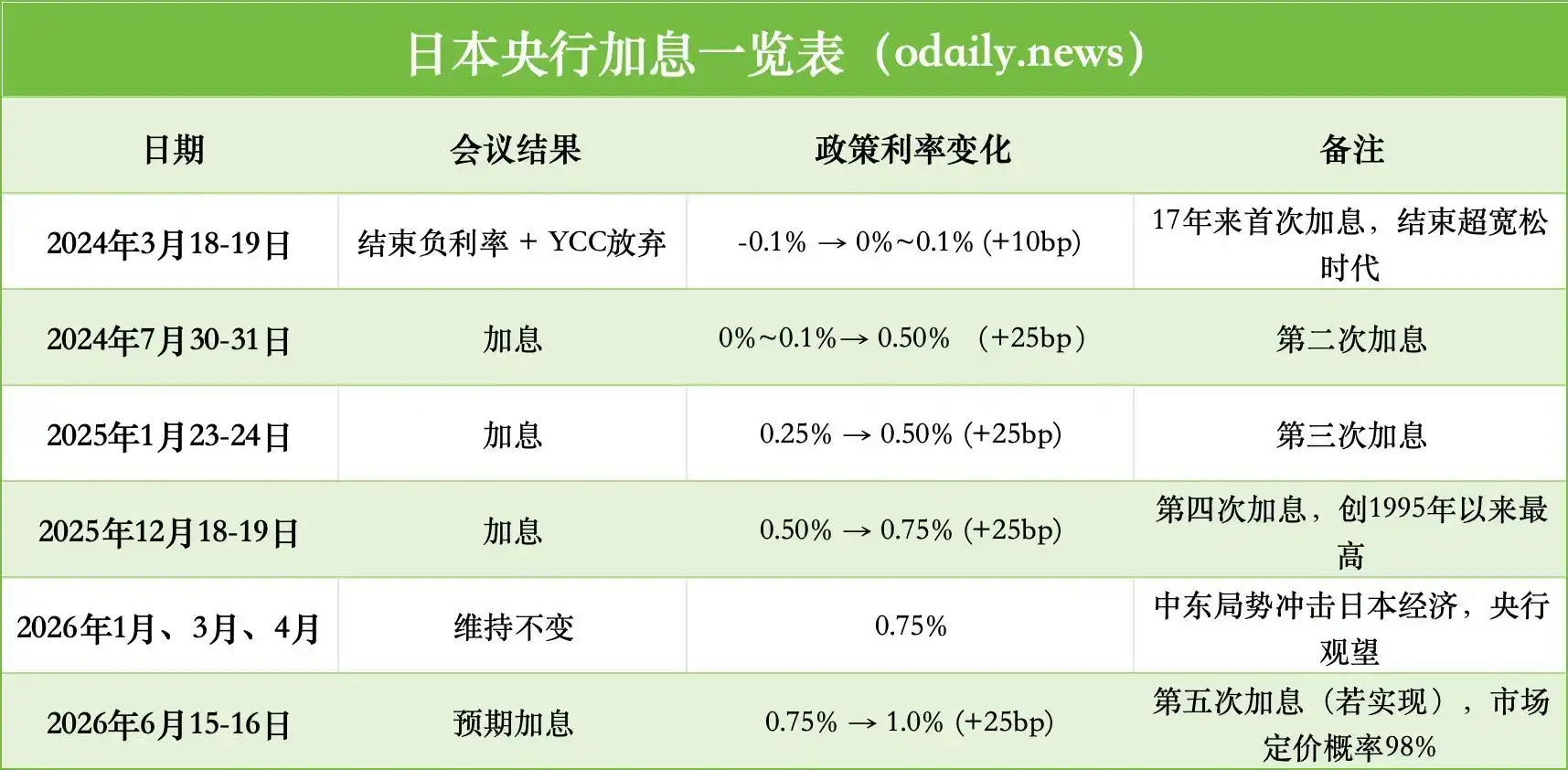
After keeping rates unchanged for half a year, why is the BoJ now eager to embark on a new round of rate hikes? This hike primarily stems from two aspects.

First, energy shocks and imported inflation pressure. As oil price volatility occurred due to Middle East conflicts in the first half of the year, Japan, highly dependent on imported energy, saw a significant rise in import costs. The Corporate Goods Price Index (CGPI) rose 6.3% year-on-year in May, the fastest pace since 2023, with petroleum products up 9.6% and utilities up 8.5%. The BoJ expects core CPI for fiscal 2026 to rise to 2.5-3.0%, far above the established 2% target.

Second, a weak yen exacerbates imported inflation. The current USD/JPY exchange rate continues to hover around the 158-160 high, nearing historically extreme weakness. The sharp depreciation of the yen directly weakens the import purchasing power of Japanese companies, leading to a significant increase in import costs for commodities such as energy and raw materials, further pushing up domestic prices. Although Japan's Ministry of Finance has repeatedly intervened in the foreign exchange market, the effects have been limited and unsustainable. This situation is forcing the BoJ to tighten monetary policy (i.e., raise rates) at the June meeting to avoid runaway inflation expectations.

In a speech on June 3, BoJ Governor Kazuo Ueda explicitly shifted the narrative towards fighting inflation, emphasizing that if upside risks to prices outweigh downside risks to the economy, the pros and cons of a rate hike must be discussed.

Reuters, citing three informed sources, reported that unless the Middle East conflict escalates sharply, the BoJ will raise rates in June and may slow the pace of bond portfolio reduction to maintain market stability. Bloomberg and institutions like ING maintain similar judgments and expect the BoJ to hike a total of 50bp in 2026.

This series of changes marks Japan's shift from the "world's last lender" to a normalizing central bank, posing a direct challenge to global assets reliant on cheap yen financing.

2. Unwinding Yen Carry Trades, Sustained Liquidity Tightening

The Bank of Japan's prolonged maintenance of ultra-loose monetary policy has made yen carry trades a key component of global liquidity over the past decade. Investors borrow yen at near-zero interest rates and invest in high-yielding assets like US stocks, tech stocks, emerging markets, and cryptocurrencies to earn interest differentials and capital gains.

The BoJ's upcoming rate hike will directly increase yen financing costs and could trigger yen appreciation (USD/JPY decline), forcing leveraged investors to unwind positions, creating a positive feedback loop: yen appreciation leads to expanding exchange rate losses → rising financing costs → forced investor deleveraging → large-scale selling of risk assets → further decline in asset prices → triggering more stop-losses → intensifying unwinding pressure.

Historically, every BoJ policy tightening signal has triggered severe market volatility.

On July 31, 2024, the BoJ hiked rates by 15bp to 0.25% and announced gradual balance sheet reduction, coupled with weak US employment data, triggering severe global market turbulence. At that time, South Korea's two major stock indices (KOSPI and KOSDAQ) plunged simultaneously, triggering circuit breakers; Japanese stocks crashed, with the Nikkei 225 plummeting 12.4% in a single day, accumulating a weekly loss of over 20%, the worst performance since 1987; global stock markets fell in tandem, with US stocks and tech stocks adjusting synchronously, and the VIX fear index soaring. Crypto also suffered heavy losses, with Bitcoin and ETH plunging over 30% in just a week, and leveraged liquidations surging.

According to Morgan Stanley estimates, although a significant number of positions have been gradually unwound since 2024, there are still approximately $500 billion in outstanding yen-funded positions in the market. Although the market has priced in some risks in advance, these positions still pose a significant hidden danger. Morgan Stanley warns that a rapid yen appreciation could trigger chain unwinding during periods of thin liquidity, especially impacting high-leverage assets severely.

J.P. Morgan's Global Head of Market Strategy, Dubravko Lakos-Bujas, and FX strategist Meera Chandan both pointed out that the policy divergence between the BoJ and the Federal Reserve will increase the instability of carry trade unwinding, potentially leading to a valuation reassessment of global risk assets.

3. Global Risk Assets Take a Hit, US Stocks and Crypto Not Spared

The AI-driven tech frenzy was the main theme for US stocks in the first half of 2026, with chip stocks like Nvidia and Broadcom and hyperscale cloud service providers leading the Nasdaq to repeatedly hit new highs.

However, entering June, significant rotation and pullbacks emerged in the market, particularly on June 5, when US stocks experienced their most severe single-day pullback of 2026 so far. The Nasdaq plunged 4.18%, marking its largest single-day drop since April 2025; the S&P 500 fell 2.64%, ending a nine-week winning streak; the Dow fell 1.35%, the Philadelphia Semiconductor Index plummeted over 10%, with core AI stocks like Nvidia, Broadcom, Micron, and Marvell leading the declines. (Recommended reading: "Nasdaq Drops 4.2% in a Day, Did 'Black Friday' Puncture the US Stock Bubble?")

The US stock market pullback is due to macro factors like geopolitical tensions and Fed policy uncertainty, but an undeniable factor is also the potential impact of the BoJ's impending rate hike.

First, liquidity tightening will directly hit high-valuation growth stocks. AI companies have massive capital expenditure scales and are highly dependent on cheap financing. Unwinding yen carry trades will reduce inflows of global risk-seeking capital, with high-beta tech stocks bearing the brunt. Semiconductor leaders like Nvidia and Broadcom, as well as hyperscalers like Meta and Microsoft, have extremely high valuation sensitivity and are highly susceptible to selling. Investing.com analysis points out that high-valuation growth sectors are most sensitive to changes in global liquidity; once carry trade unwinding begins, rapid deleveraging often occurs.

Second, rising energy costs will significantly compress AI profit margins. Middle East conflicts pushing up oil prices lead to a sharp increase in data center power and cooling costs, forming a "stagflationary" macro environment alongside BoJ rate hikes, severely testing the sustainability of the AI business model.

BitMex founder Arthur Hayes explicitly warned in his latest article "Reality Test": "The energy reality is testing the market's current 'dreaming' state." High oil prices not only raise operating costs but may also slow the growth of corporate token usage, further dampening AI-related revenue expectations.

Lastly, mega IPO supply shocks and political regulatory risks. Giants like SpaceX, Anthropic, and OpenAI plan to list intensively in the second half of 2026, with valuations often at hundreds of times sales; lock-up expirations will bring massive supply pressure. Meanwhile, Trump may shift to an anti-AI stance for midterm elections, increasing regulatory uncertainty.

As the highest-beta global risk asset, cryptocurrencies are even more precarious. On one hand, the BoJ rate hike brings rising global financing costs, directly increasing the cost of leveraged crypto trading, forcing large-scale liquidation of crypto leveraged positions; on the other hand, in competing for liquidity with AI, AI capital expenditure has already absorbed substantial market funds, leaving crypto lagging behind, and BoJ action will further tighten marginal liquidity.

Yahoo Finance analyst Lockridge Okoth stated that the 98% probability of a rate hike could trigger the next liquidity shock for Bitcoin. Investing.com analysis points out that yen appreciation and BTC weakness often move in high synchrony, a typical signal of rising global risk aversion.

Arthur Hayes has also emphasized in multiple analyses that the dynamics of yen carry trades remain one of the key variables affecting Bitcoin liquidity, reminding investors to pay attention to short-term liquidity shocks triggered by policy signals. In recent articles, Arthur Hayes emphasized the need to be wary of the combined impact of short-term energy costs and monetary policy risks; BTC/ETH may adjust alongside risk assets in the short term, with the long-term outlook depending on liquidity restarting.

Conclusion:

The rekindled concerns over a BoJ rate hike are not an isolated event but a signal of marginal tightening in global liquidity. Particularly with the current Middle East geopolitical conflict pushing oil prices higher, AI capital expenditure consuming liquidity, and multiple factors like Fed policy uncertainty superimposed, the buffer space is further compressed.

For investors, global risk assets—especially high-leverage, high-valuation sectors (AI tech stocks and cryptocurrencies)—may face significant downward pressure in the short term, with volatility set to rise noticeably. It is crucial to remain highly vigilant and mindful of leverage risks.


İlgili Sorular

QWhat is the main reason the Bank of Japan (BOJ) is expected to raise interest rates by 25 basis points in June 2026?

AThe main reason is to combat inflation. Two key factors are driving this: energy price shocks and input inflation due to rising oil prices from Middle East conflicts, and a persistently weak Yen (USD/JPY near 158-160), which increases import costs for energy and raw materials, further pushing up domestic prices. The BOJ's inflation forecast for fiscal 2026 has risen above its 2% target.

QHow does the Bank of Japan's potential interest rate hike pose a risk to global risk assets, particularly AI tech stocks and cryptocurrencies?

AThe rate hike increases the cost of Yen funding, potentially triggering the unwinding of the massive Yen carry trade. Investors who borrowed cheap Yen to invest in higher-yielding assets like US tech stocks and crypto may be forced to sell those assets to repay loans, especially if the Yen appreciates. This creates a vicious cycle of selling pressure, reduced global liquidity, and heightened volatility, directly impacting high-valuation, high-beta assets like AI stocks and cryptocurrencies.

QWhat historical event from 2024 is mentioned as a precedent for the market impact of BOJ policy tightening?

AThe article references the market flash crash in August 2024. Following a sharp appreciation of the Yen, global stock markets experienced a short but severe downturn. Bitcoin, as a prime example, plummeted by nearly $20,000 in a single day, recording a maximum intraday drop of 15%.

QAccording to the article, what are the estimated size of the remaining Yen carry trade positions and which financial institution provided this estimate?

AAccording to estimates from Morgan Stanley, there are still approximately $500 billion in outstanding Yen-funded positions in the market. The article warns that a rapid appreciation of the Yen could trigger chain-liquidations of these positions, especially in thin liquidity periods.

QBesides the BOJ rate hike, what other factors are mentioned as contributing to the potential pressure on AI tech stocks?

AThree additional factors are cited: 1) Rising energy costs from Middle East conflicts increasing data center power and cooling expenses, squeezing AI profit margins. 2) A looming supply shock from massive IPOs of companies like SpaceX, Anthropic, and OpenAI in H2 2026. 3) Increased political and regulatory uncertainty, with the possibility of the Trump administration adopting anti-AI rhetoric ahead of midterm elections.

İlgili Okumalar

AI Investors' 2026 Anxiety: When Models Devour Everything, What Moat Is Left for Startups?

In 2026, a wave of investor anxiety questions the defensibility of AI startups as models improve, fearing that most companies are just "thin wrappers" destined to be absorbed by foundation models or chipmakers. The author argues against this despair, positing that true moats lie not in benchmark performance but in areas models cannot easily reach. The logic of despair is that if models excel at all measurable tasks, only compute and cutting-edge model weights hold lasting value. However, the essay contends that the most valuable work is inherently "untrainable." Benchmarks measure what can be measured and thus optimized for, but real-world correctness often resides in private, complex systems. Examples include legacy codebases, intricate legal transactions, or hospital workflows. This kind of correctness is proprietary, costly to establish, and cannot be validated quickly—it requires time and trust within an organization. As models commodify visible, measurable tasks from both above (labs absorbing scaffolding) and below (saturation by cheaper models), value shifts to "untrainable ground." This encompasses work where correctness is a private truth, locked behind integration barriers, licenses, liability frameworks, and entrenched user habits. Trust and adoption are slow, human-centric processes that smarter models cannot accelerate. Successful companies defend their position by embedding deeply into client operations, owning the definition of "good" within a specific domain (e.g., Harvey in law, OpenEvidence in medicine), and pricing on outcomes rather than tokens. While labs compete fiercely, they are incentivized to keep the application layer vibrant. The future belongs not to those competing on generic benchmarks but to those navigating unscoreable terrain, doing the "unsexy work" of translation between models and messy human realities. The most cited benchmark scores are thus maps of territory about to become worthless, signaling who will lose the right to define what counts as good.

marsbit13 dk önce

AI Investors' 2026 Anxiety: When Models Devour Everything, What Moat Is Left for Startups?

marsbit13 dk önce

Trump's Crypto Empire: A $2.3 Billion Wealth Transfer Experiment

In June 2026, Reuters investigations revealed that since Donald Trump's return to the White House, his family has accumulated roughly $2.3 billion in profits from four core crypto ventures: World Liberty Financial (WLFI), the $TRUMP meme coin, American Bitcoin, and ALT5 Sigma (later renamed AI Financial). Coincidentally, overall investor losses in these projects were estimated to be a similar amount. The businesses, spanning DeFi, stablecoins, meme coins, Bitcoin mining, and digital payments, largely relied not on technological innovation but on converting the political influence and notoriety of the Trump brand into financial assets sold to the market. This marks a dramatic shift from Trump's earlier skepticism of cryptocurrencies. The ventures operated on a similar logic: leveraging the Trump name to generate market hype and trust, attracting investment through token sales or public listings, and enabling the family to capture profits upfront through equity, token allocations, and fees, while later entrants often bore the brunt of the risk as markets cooled. WLFI, the most profitable venture, generated an estimated $1.6 billion for the family, primarily through sales of its locked, illiquid governance token and its USD1 stablecoin. The $TRUMP meme coin, a direct monetization of the presidential IP, brought in over $600 million for Trump-linked entities before its price crashed nearly 97% from its peak. American Bitcoin gained a "Trump stock" premium for its mining operations, and ALT5 Sigma/AI Financial combined Trump, AI, and crypto themes for a temporary valuation surge. The episode underscores how political influence can be packaged into financial assets, creating substantial wealth for promoters while highlighting the risks for investors who base decisions on hype and brand allegiance over fundamental business models and cash flows.

marsbit54 dk önce

Trump's Crypto Empire: A $2.3 Billion Wealth Transfer Experiment

marsbit54 dk önce

CFTC Proposes New Rules for Prediction Markets, Redefining Which Events Can Be Listed and Who Can Participate

The U.S. Commodity Futures Trading Commission (CFTC) has proposed new rules to establish a clearer regulatory framework for prediction markets. The proposal aims to modify how "event contracts" are reviewed, creating a structured process to determine if contracts involving terrorism, assassination, war, or illegal activities violate the public interest. This moves away from a blanket ban toward a case-by-case assessment of whether a contract's subject matter is acceptable for financial trading. A key focus is distinguishing between predicting the impact of risks and predicting the occurrence of harm. The proposal suggests that many sports-based prediction markets—such as those on game outcomes, scores, or season standings—may be permissible as they can provide price discovery and meaningful information. However, markets on easily manipulated events like specific player injuries, referee calls, or outcomes of youth sports would face stricter scrutiny. The rules directly target insider trading and manipulation risks, highlighting cases where individuals with non-public information or the ability to influence an event's outcome could unfairly profit. This underscores a shift toward ensuring market fairness. The proposal does not end the regulatory debate, particularly with state gambling regulators who argue that sports prediction markets are essentially sports betting and should fall under state jurisdiction. Nonetheless, the CFTC's action signals a move toward formalizing prediction markets, pushing the industry from a phase of rapid, often unregulated expansion into a more institutionalized, rule-based environment that more closely resembles traditional financial markets.

marsbit1 saat önce

CFTC Proposes New Rules for Prediction Markets, Redefining Which Events Can Be Listed and Who Can Participate

marsbit1 saat önce

İşlemler

Spot
Futures

Popüler Makaleler

$BANK Nedir

Bank AI: Bankacılıkta Devrimsel Bir Adım Giriş Teknolojideki hızlı ilerlemelerin damgasını vurduğu bir çağda, Bank AI, yapay zeka (AI) ve bankacılık hizmetleri kesişiminde yer almaktadır. Bu yenilikçi proje, finansal manzarayı yeniden tanımlamayı, operasyonel verimliliği, güvenlik önlemlerini ve müşteri deneyimlerini AI'nin gücüyle geliştirmeyi hedefliyor. Bank AI yolculuğuna çıkarken, projenin içeriğine, operasyonel dinamiklerine, tarihsel bağlamına ve önemli kilometre taşlarına dalacağız. Bank AI Nedir? Bank AI, yapay zekanın çeşitli bankacılık operasyonlarına entegrasyonunu hedefleyen dönüştürücü bir girişimi temsil etmektedir. Bu proje, süreçleri otomatikleştirmek, risk yönetimi protokollerini geliştirmek ve kişiselleştirilmiş hizmetler aracılığıyla müşteri etkileşimini artırmak için AI'nin yeteneklerinden yararlanmaktadır. Bank AI'nin temel hedefleri şunlardır: Bankacılık Fonksiyonlarının Otomasyonu: AI teknolojilerini kullanarak, Bank AI rutin görevleri otomatikleştirmeyi, insan kaynakları üzerindeki yükü azaltmayı ve verimliliği artırmayı amaçlamaktadır. Geliştirilmiş Risk Yönetimi: Proje, dolandırıcılık ve diğer tehditlere karşı güvenlik önlemlerini güçlendirerek riski tahmin edip tanımlamak için AI algoritmalarını kullanmaktadır. Bankacılık Hizmetlerinin Kişiselleştirilmesi: Bank AI, müşteri verilerini ve davranışlarını analiz ederek, özel finansal ürünler ve hizmetler sunmaya odaklanmaktadır. Müşteri Deneyimini İyileştirme: Chatbotlar ve sanal asistanlar gibi AI destekli çözümlerin uygulanması, kullanıcıların daha insana yakın etkileşimler yaşamasını sağlamayı hedeflemekte, bankalarla etkileşim biçimlerini devrim niteliğinde değiştirmektedir. Bu hedeflerle, Bank AI, bankacılığı daha verimli, güvenli ve kullanıcı odaklı hale getiren önemli bir oyuncu olarak kendini konumlandırmaktadır. Bank AI'nin Yaratıcısı Kimdir? Bank AI'nin yaratıcısı hakkında detaylar bilinmemektedir. Bu nedenle, mevcut bilgilerde belirli bir kişi veya organizasyon tanımlanmamıştır. Projenin başlangıcı etrafındaki anonimlik soruları gündeme getirse de, bunun iddialı vizyonu ve hedefleri üzerinde bir olumsuz etkisi yoktur. Bank AI'nin Yatırımcıları Kimlerdir? Proje yaratıcılarında olduğu gibi, Bank AI'nin yatırımcıları veya destekleyen organizasyonları hakkında da özel bilgiler açıklanmamıştır. Bu bilgiler olmadan, projenin ilerlemesini destekleyen finansal destek ve kurumsal destek hakkında bir çerçeve çizmek zordur. Yine de, böyle yenilikçi bir alanda gelişimi sürdürmek için sağlam bir yatırım temelinin önemi büyüktür. Bank AI Nasıl Çalışır? Bank AI, geleneksel bankacılık çerçevelerinden ayıran benzersiz faktörlere odaklanarak birden fazla yenilikçi alanda faaliyet göstermektedir. İşte temel operasyonel özellikler: Otomasyon: Makine öğrenimi algoritmalarını uygulayarak, Bank AI bankalar içindeki çeşitli manuel süreçleri otomatikleştirir. Bu, operasyonel maliyetleri azaltır ve insan çalışanların daha stratejik faaliyetlere yönelmelerini sağlar. Gelişmiş Risk Yönetimi: Risk yönetimi uygulamalarına AI entegrasyonu, bankaların dolandırıcılık gibi potansiyel tehditleri doğru bir şekilde tahmin etme araçlarıyla donatılmasını sağlar, böylece müşteri bilgileri ve varlıkları güvence altına alınır. Özelleştirilmiş Finansal Tavsiyeler: Müşteri etkileşimlerinden sürekli olarak öğrenerek, AI sistemleri kullanıcı ihtiyaçlarının daha iyi anlaşılmasını sağlar ve finansal kararlar hakkında özelleştirilmiş tavsiyeler sunar. Geliştirilmiş Müşteri Etkileşimleri: AI destekli chatbotlar ve sanal asistanlar kullanarak, Bank AI daha etkileşimli bir müşteri deneyimi sunar, kullanıcıların sorularını hızlı bir şekilde çözmelerine imkan tanır, bekleme sürelerini azaltır ve memnuniyet seviyelerini artırır. Bu operasyonel özellikler, Bank AI'yi bankacılık sektöründe bir öncü olarak konumlandırmakta ve hizmet sunumu ile operasyonel mükemmeliyet için yeni standartlar belirlemektedir. Bank AI Zaman Çizelgesi Bank AI'nin gidişatını anlamak için tarihsel bağlamına bir göz atmak gerekmektedir. Aşağıda önemli kilometre taşlarını ve gelişmeleri vurgulayan bir zaman çizelgesi bulunmaktadır: 2010'ların Başları: AI entegrasyonunun bankacılık hizmetlerine olan ilgisi arttı, bankacılık kurumları potansiyel faydalarını tanımaya başladılar. 2018: Bankaların temel müşteri hizmetleri ve geliştirilmiş güvenlik yönetimi için risk yönetim sistemlerinde chatbotlar gibi AI araçları kullanmaya başlamasıyla AI teknolojilerinin uygulanmasında belirgin bir artış yaşandı. 2023: AI'nin karmaşıklığı artmaya devam etti ve belge işleme ile gerçek zamanlı yatırım analizi gibi daha karmaşık görevler için üretken AI devreye alındı. Bu yıl, AI teknolojisi sayesinde bankaların sahip olduğu yeteneklerde önemli bir sıçrama yaşandı. 2024-Güncel Durum: Bu yıl itibarıyla, Bank AI yükselişte, devam eden araştırmalar ve geliştirmeler bankacılık operasyonlarındaki yetenekleri daha da artırmaya hazırlanıyor. AI uygulamalarının sürekli araştırılması, heyecan verici gelişmelere işaret etmektedir. Bank AI Hakkında Anahtar Noktalar Bankacılıkta AI Entegrasyonu: Bank AI, bankacılık süreçlerini kolaylaştırmak ve kullanıcı deneyimlerini geliştirmek için yapay zekanın benimsenmesine odaklanmaktadır. Otomasyon ve Risk Yönetimi Vurgusu: Proje, rutin görevlerin yükünü azaltmayı amaçlarken, tahmine dayalı analizlerle güvenlik çerçevelerini geliştirmeye büyük önem vermektedir. Kişiselleştirilmiş Bankacılık Çözümleri: Müşteri verilerinden yararlanarak, Bank AI bireysel kullanıcı ihtiyaçlarına yönelik özelleştirilmiş bankacılık hizmetleri sunar. Gelişime Bağlılık: Bank AI, teknolojinin sürekli evrimi ile uyumlu olmasını sağlamak ve güncel kalmak için sürekli araştırma ve geliştirme çabalarına bağlı kalmaktadır. Sonuç Özetle, Bank AI bankacılık endüstrisinde önemli bir adımı temsil etmekte, yapay zekayı kullanarak operasyonel paradigmaları yeniden şekillendirmekte, güvenliği artırmakta ve müşteri memnuniyetini teşvik etmektedir. Yaratıcı ve yatırımcılar hakkındaki bilgi eksikliklerine rağmen, Bank AI'nin net hedefleri ve işlevsel mekanizmaları, devam eden evrimi için güçlü bir temel sunmaktadır. AI teknolojisi gelişmeye ve bankacılık sektörüyle birleşmeye devam ettikçe, Bank AI finansal hizmetlerin geleceğini önemli ölçüde etkilemeye hazır durumda, bankacılıkla olan anlayışımızı ve etkileşim biçimlerimizi geliştirmektedir.

145 Toplam GörüntülenmeYayınlanma 2024.04.06Güncellenme 2024.12.03

$BANK Nedir

BANK Nasıl Satın Alınır

HTX.com’a hoş geldiniz! Lorenzo Protocol (BANK) satın alma işlemlerini basit ve kullanışlı bir hâle getirdik. Adım adım açıkladığımız rehberimizi takip ederek kripto yolculuğunuza başlayın. 1. Adım: HTX Hesabınızı OluşturunHTX'te ücretsiz bir hesap açmak için e-posta adresinizi veya telefon numaranızı kullanın. Sorunsuzca kaydolun ve tüm özelliklerin kilidini açın. Hesabımı Aç2. Adım: Kripto Satın Al Bölümüne Gidin ve Ödeme Yönteminizi SeçinKredi/Banka Kartı: Visa veya Mastercard'ınızı kullanarak anında Lorenzo Protocol (BANK) satın alın.Bakiye: Sorunsuz bir şekilde işlem yapmak için HTX hesap bakiyenizdeki fonları kullanın.Üçüncü Taraflar: Kullanımı kolaylaştırmak için Google Pay ve Apple Pay gibi popüler ödeme yöntemlerini ekledik.P2P: HTX'teki diğer kullanıcılarla doğrudan işlem yapın.Borsa Dışı (OTC): Yatırımcılar için kişiye özel hizmetler ve rekabetçi döviz kurları sunuyoruz.3. Adım: Lorenzo Protocol (BANK) Varlıklarınızı SaklayınLorenzo Protocol (BANK) satın aldıktan sonra HTX hesabınızda saklayın. Alternatif olarak, blok zinciri transferi yoluyla başka bir yere gönderebilir veya diğer kripto para birimlerini takas etmek için kullanabilirsiniz.4. Adım: Lorenzo Protocol (BANK) Varlıklarınızla İşlem YapınHTX'in spot piyasasında Lorenzo Protocol (BANK) ile kolayca işlemler yapın.Hesabınıza erişin, işlem çiftinizi seçin, işlemlerinizi gerçekleştirin ve gerçek zamanlı olarak izleyin. Hem yeni başlayanlar hem de deneyimli yatırımcılar için kullanıcı dostu bir deneyim sunuyoruz.

716 Toplam GörüntülenmeYayınlanma 2025.05.09Güncellenme 2026.06.02

BANK Nasıl Satın Alınır

Tartışmalar

HTX Topluluğuna hoş geldiniz. Burada, en son platform gelişmeleri hakkında bilgi sahibi olabilir ve profesyonel piyasa görüşlerine erişebilirsiniz. Kullanıcıların BANK (BANK) fiyatı hakkındaki görüşleri aşağıda sunulmaktadır.

活动图片