Ethereum Q1 2026 Review: On-chain Activity Hits New Highs, Tokenized Assets Lead the Industry

Foresight News2026-06-18 tarihinde yayınlandı2026-06-18 tarihinde güncellendi

Özet

Ethereum Q1 2026 Review: Chain Activity Hits Record High, Tokenized Assets Lead the Industry In Q1 2026, the Ethereum ecosystem displayed a dual narrative: record-high on-chain activity coincided with declining USD-denominated metrics. User adoption surged, with monthly active addresses reaching 13.2 million (up 53.5% QoQ) and layer-1 transactions hitting 200.4 million (up 38% QoQ). However, the total value locked (TVL) decreased 11% to $316.2B, and protocol revenue fell 16.9% to $2.0B, largely due to a broader crypto market downturn. Tokenized assets emerged as a key strength. Their total market cap reached $203.4B, with significant growth in tokenized funds (+73.1% YoY) and commodities (+325.9% YoY). Ethereum dominated cross-chain comparisons, holding over 61% of stablecoin value and 84% of tokenized commodities value among top chains. A major development was the impact of network scaling. The "Blob" upgrade significantly increased data capacity, causing average transaction fees on layer-1 to plummet 47.9% QoQ despite higher usage. This demonstrates the "Jevons Paradox" in action: cheaper block space stimulates demand. The report highlights Ethereum's established position as the primary settlement layer for institutional tokenization, evidenced by new fund launches from giants like BlackRock and JPMorgan in May. Analysts draw parallels between Ethereum's current stage and the internet in the mid-1990s, suggesting its open, neutral network is poised to become the foundat...


Author: Token Terminal

Compiled by: Saoirse, Foresight News


Ethereum serves as the core underlying settlement network for on-chain assets, relying on ETH to pay transaction fees and stake to maintain network security. Traditional finance suffers from issues like slow settlements, numerous intermediaries, and high counterparty risks, while tokenized assets and stablecoins offer on-chain solutions. From 2025 to 2026, as relevant regulations gradually matured, institutional deployment of on-chain businesses formally gained the conditions for implementation.


Various stablecoins, tokenized funds, commodities, and on-chain equities are issued and settled on Ethereum, with Layer 2 networks diverting transactions before ultimately returning to Layer 1 for final settlement, through which ETH continuously accumulates value. By market capitalization, Ethereum remains the world's largest platform for carrying tokenized assets, operated jointly by the Ethereum Foundation and the developer community. Teams like Etherealize specialize in connecting with traditional financial institutions, promoting the entry of institutional capital. In Q1 2026, the Ethereum ecosystem exhibited a polarized trend. The following analysis provides a detailed breakdown using complete data from Token Terminal.


The market in Q1 2026 presented a distinct two-sided situation: on-chain usage scale reached historical highs—monthly active users, total transaction volume, and throughput all set new records; however, asset valuations and fee metrics denominated in US dollars contracted simultaneously, with fully diluted market capitalization, total value locked, trading volume, and both types of fee data declining quarter-over-quarter. Key events this quarter profoundly shaped this unique market dynamic:


In January, the second round of the Fusaka upgrade cycle, only the Blob Parameter Optimism fork (BPO#2) was implemented, significantly increasing data storage and carrying capacity.

In February, the ERC-8004 standard launched on the mainnet, becoming the universal standard for AI agent identity and credit ratings.

The Ethereum Foundation established three core goals for the 2026 protocol roadmap: scaling, optimizing user experience, and strengthening Layer 1 foundational security.

In March, the Institutional Ethereum Forum was held, with significantly increased participation from traditional financial institutions.


Key Metrics for Ethereum Q1 2026


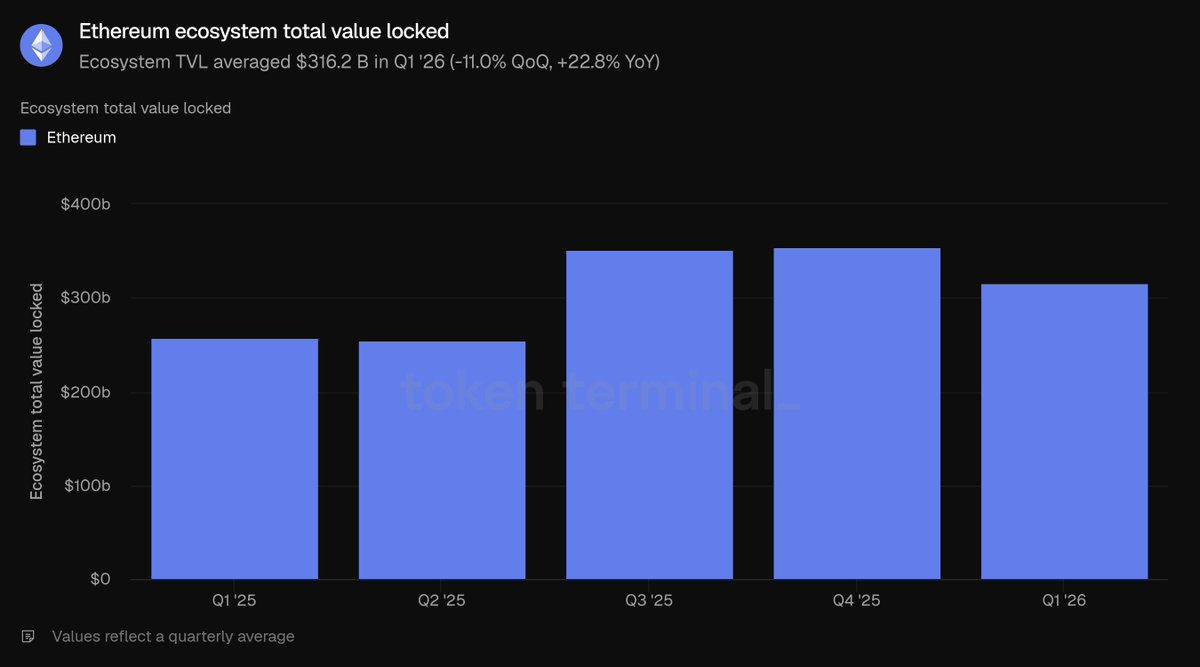
Total Value Locked (TVL) in the Ecosystem: $316.2 billion (QoQ -11.0%, YoY +22.8%)

Outstanding Active Debt in the Ecosystem: $21.8 billion (QoQ -16.6%, YoY +39.0%)

Total Decentralized Exchange (DEX) Trading Volume in the Ecosystem: $134.5 billion (QoQ -24.0%, YoY -31.2%)

Total Application Fee Revenue across the Ecosystem: $2.0 billion (QoQ -16.9%, YoY -7.8%)

Total Market Capitalization of On-chain Tokenized Assets: $203.4 billion (QoQ -0.7%, YoY +42.9%)

Stablecoins: $178.9 billion (QoQ -2.3%, YoY +37.6%)

Tokenized Funds: $19.4 billion (QoQ +4.9%, YoY +73.1%)

Tokenized Commodities: $4.7 billion (QoQ +60.0%, YoY +325.9%)

Tokenized Stocks: $365.1 million (QoQ +16.5%)

Monthly Active User Addresses: 13.20 million (QoQ +53.5%, YoY +85.9%)

Total Layer 1 Transaction Count: 200.4 million (QoQ +38.0%, YoY +81.5%)

Average Transactions Processed per Second (TPS): 25.78 (QoQ +41.2%, YoY +81.7%)

Total Layer 1 Mainnet Transaction Fee Revenue: $39.90 million (QoQ -47.9%, YoY -81.9%)

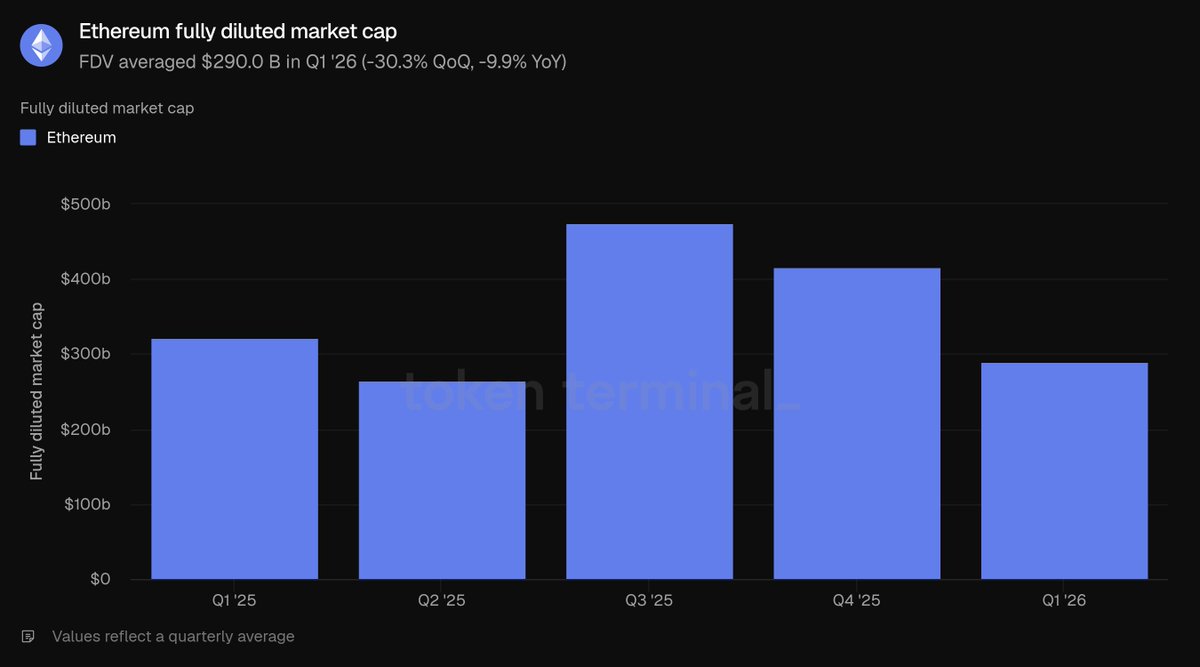
ETH Fully Diluted Market Capitalization: $290.0 billion (QoQ -30.3%, YoY -9.9%)

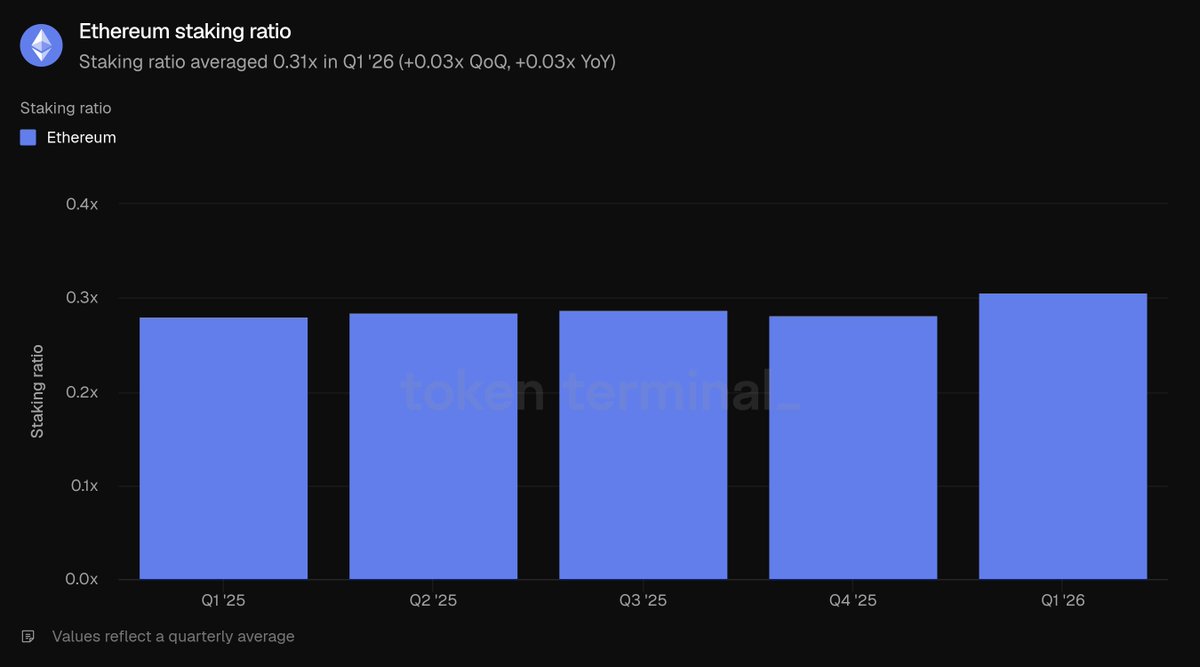
ETH Staking Ratio: 0.31 (both QoQ and YoY increased by 0.03)

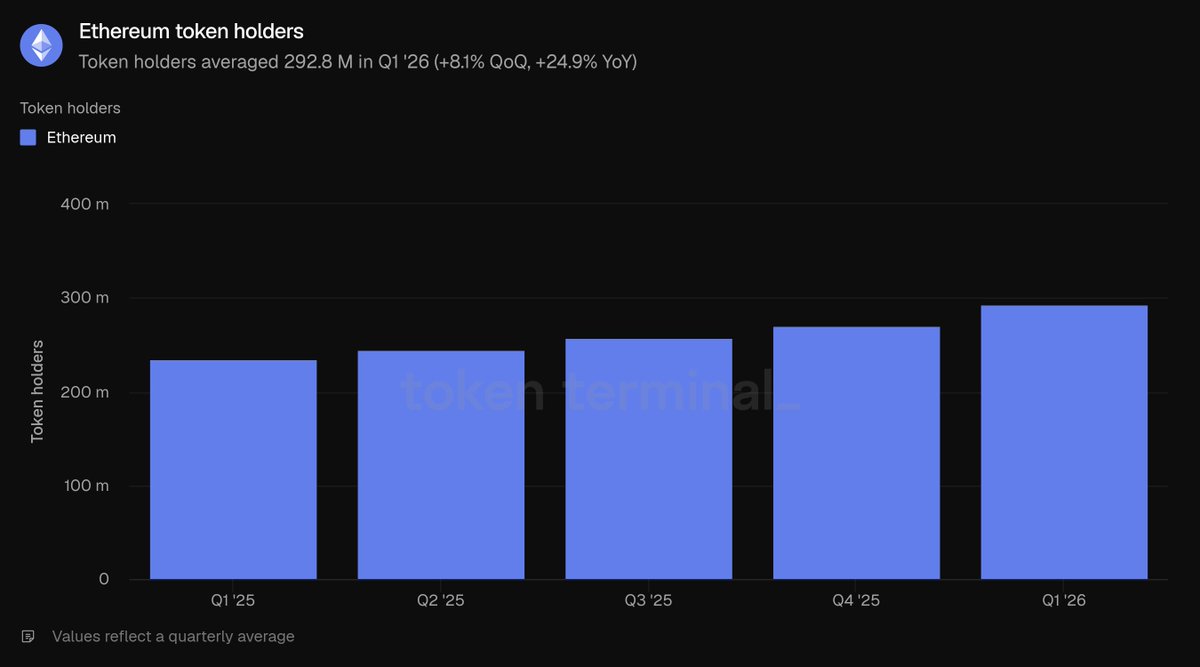
Total Number of ETH Holding Addresses: 292.8 million (QoQ +8.1%, YoY +24.9%)


Note: This report's statistical scope covers only the Ethereum Layer 1 mainnet. Layer 2 networks are considered independent blockchains, and their data is not included in Ethereum's statistics.


Overall Ecosystem Development


Total Value Locked (TVL) refers to the total US dollar value of assets deposited into various on-chain applications. It is a leading indicator for revenue-generating activities like lending, trading, and staking. This statistic measures the on-chain, withdrawable funds deposited by users across the entire Ethereum ecosystem. In Q1 2026, the average TVL for the Ethereum ecosystem reached $316.2 billion, down 11.0% quarter-over-quarter but up 22.8% year-over-year. The quarterly decline stemmed from a general price correction in crypto assets, while the significant year-over-year growth demonstrates substantial expansion in ecosystem scale compared to the same period last year.


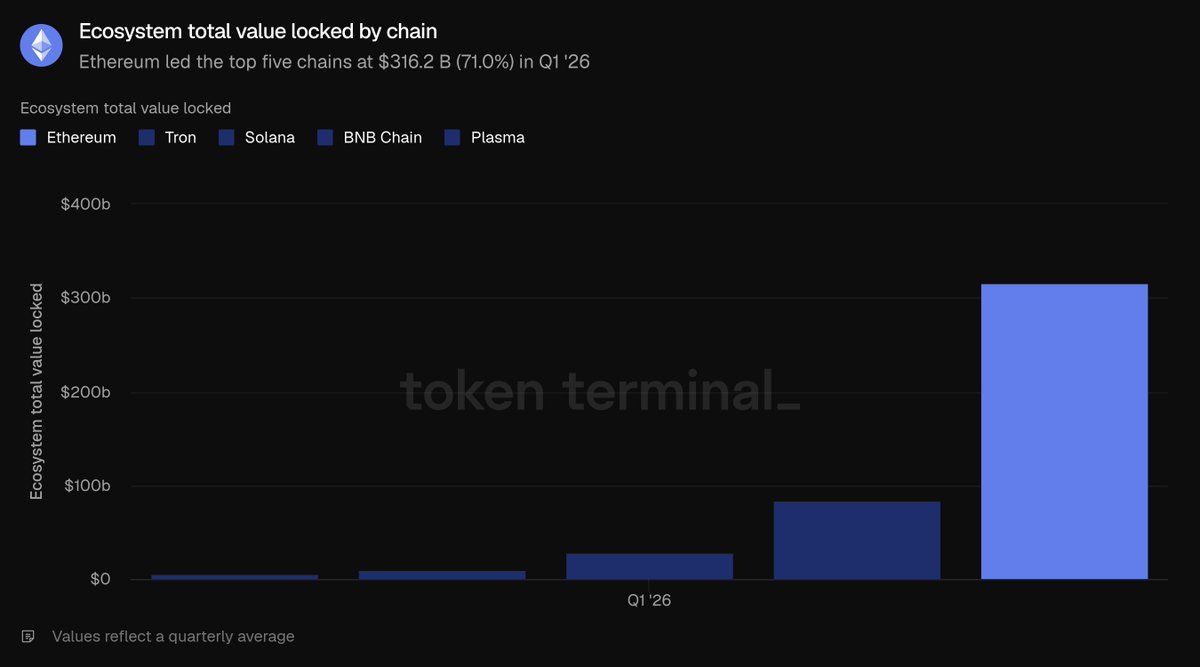
Among the top five public blockchains, Ethereum's locked value stands far ahead: $316.2 billion significantly surpasses the combined totals of Tron ($84.5B), Solana ($28.8B), BNB Chain ($10.3B), and Plasma ($5.7B), accounting for 71% of the total locked value across these five chains. Funds are primarily concentrated in two major sectors: the liquid staking sector led by Lido, and the lending sector centered around Aave; restaking protocols like EigenLayer and ether.fi, as well as synthetic dollar stablecoin platforms like Ethena and Sky, also hold substantial funds. High concentration of capital remains Ethereum's most prominent structural advantage.


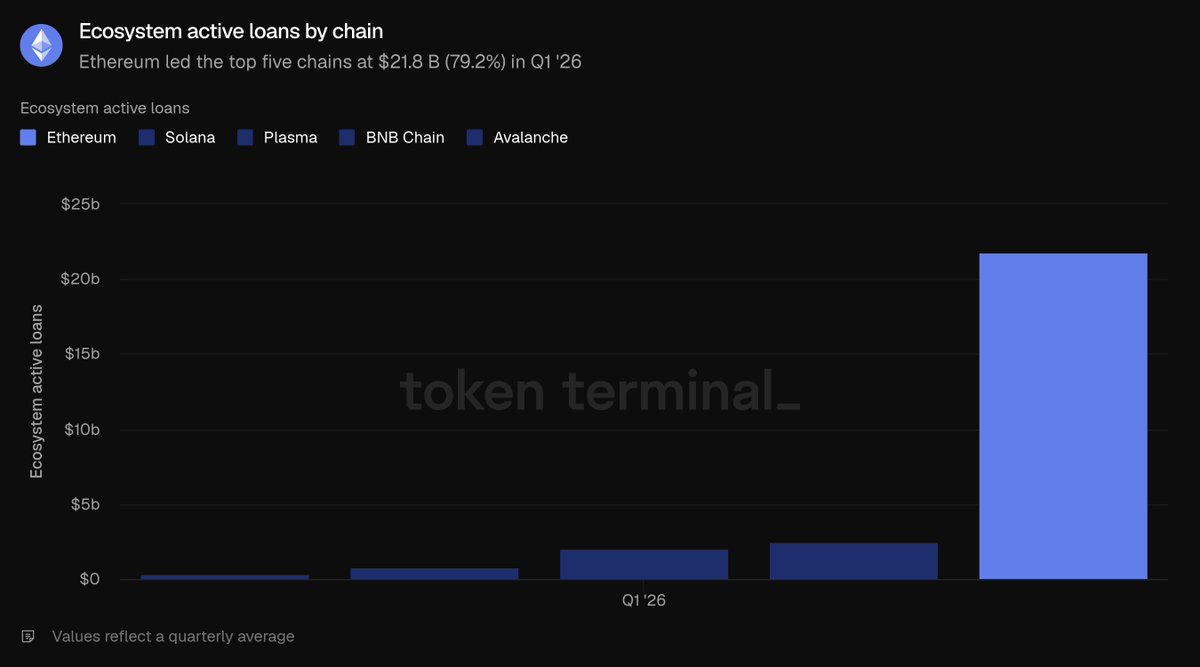
The Active Lending metric represents the scale of user deposits that are lent out and generate interest income, directly reflecting lending business revenue. This statistic measures the total outstanding loan amount across all lending applications on Ethereum. In Q1, the average active lending size in the ecosystem was $21.8 billion, down 16.6% QoQ but up 39.0% YoY. The contraction in lending balances in sync with TVL reflects a cooling of overall market risk appetite, but the scale remains far higher than the same period last year.
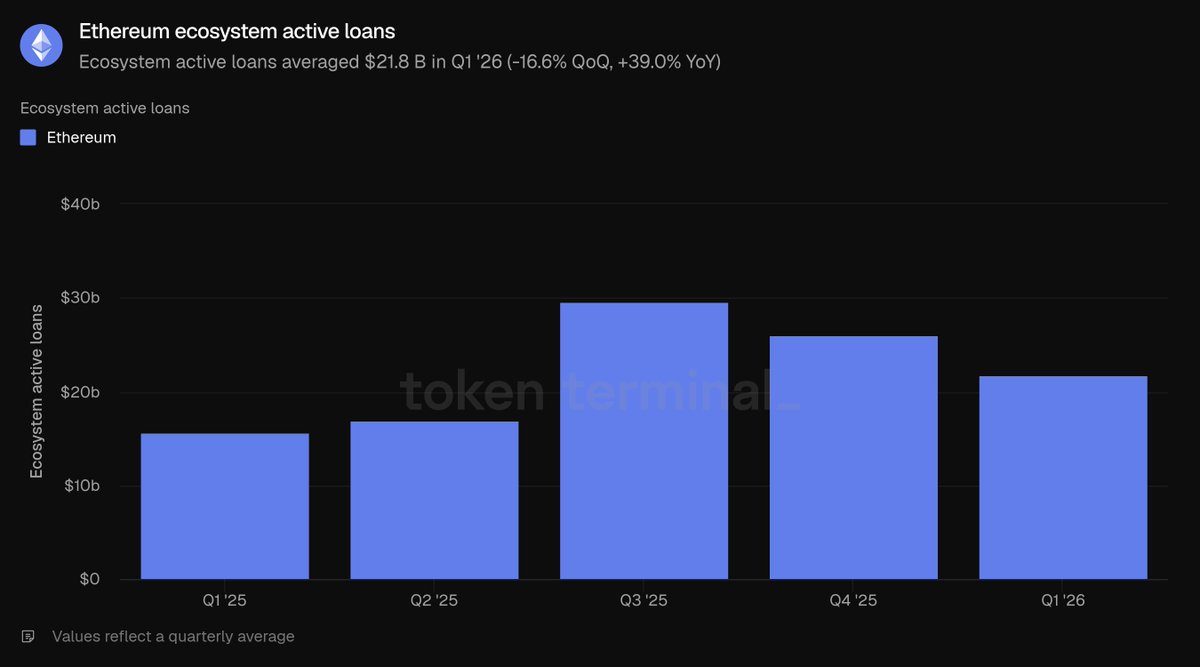


Ethereum's lending market is concentrated in a few liquidity pools, with Aave dominating: its outstanding active lending size at quarter-end was approximately $13.5 billion, capturing the vast majority of the ecosystem's share; followed by Morpho (~$1.9B), Spark under Sky (~$1.0B), and Maple (~$0.84B). The contraction in lending size this quarter was primarily driven by Aave, as declining crypto asset prices led to reduced borrowing demand, with its total loan volume shrinking by about 24%. Comparing across the five major chains, Ethereum's $21.8 billion in active lending far exceeds Solana ($2.5B), Plasma ($2.1B), BNB Chain ($0.7608B), and Avalanche ($0.3924B), accounting for 79.2% of the total lending volume across these five chains. This is the sector where Ethereum holds the highest percentage share among the top chains.


Decentralized Exchange (DEX) trading volume refers to the total transaction amount completed on on-chain spot exchanges. Traders pay fees when executing trades, making trading volume highly correlated with platform revenue. This data aggregates trading across all DEXs in the Ethereum ecosystem. In Q1, the ecosystem's total trading volume was $134.5 billion, down 24% QoQ and 31.2% YoY. The decline in trading volume was steeper than the contraction in TVL, confirming a significant reduction in market risk appetite during this quarter's asset downtrend cycle.
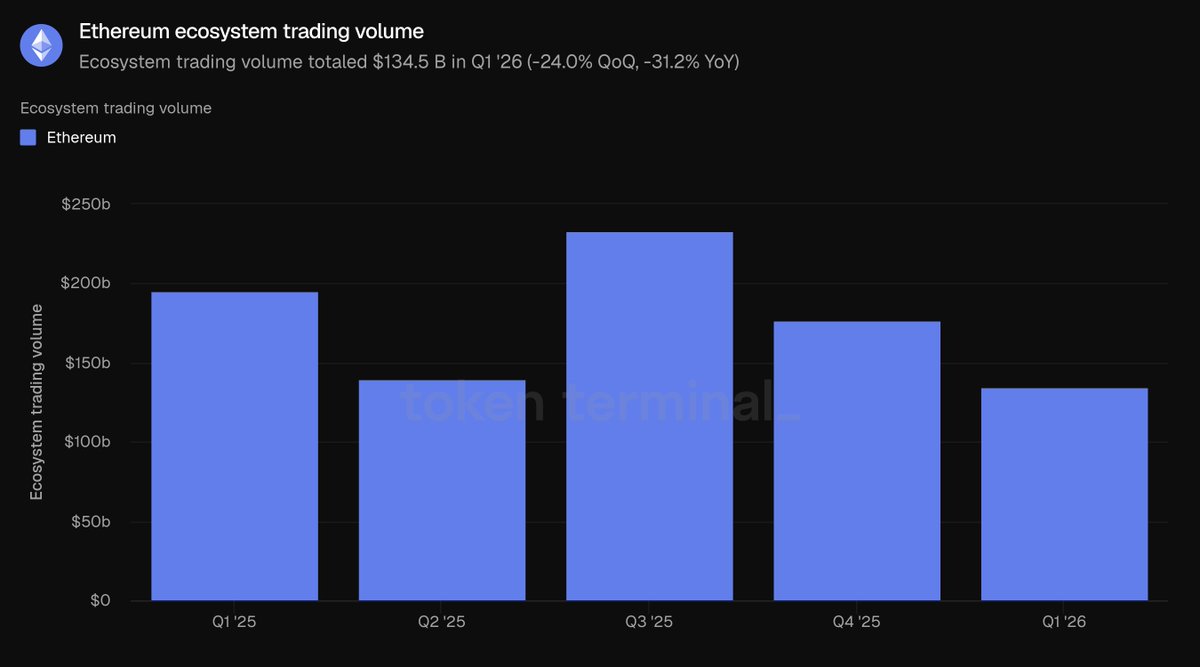


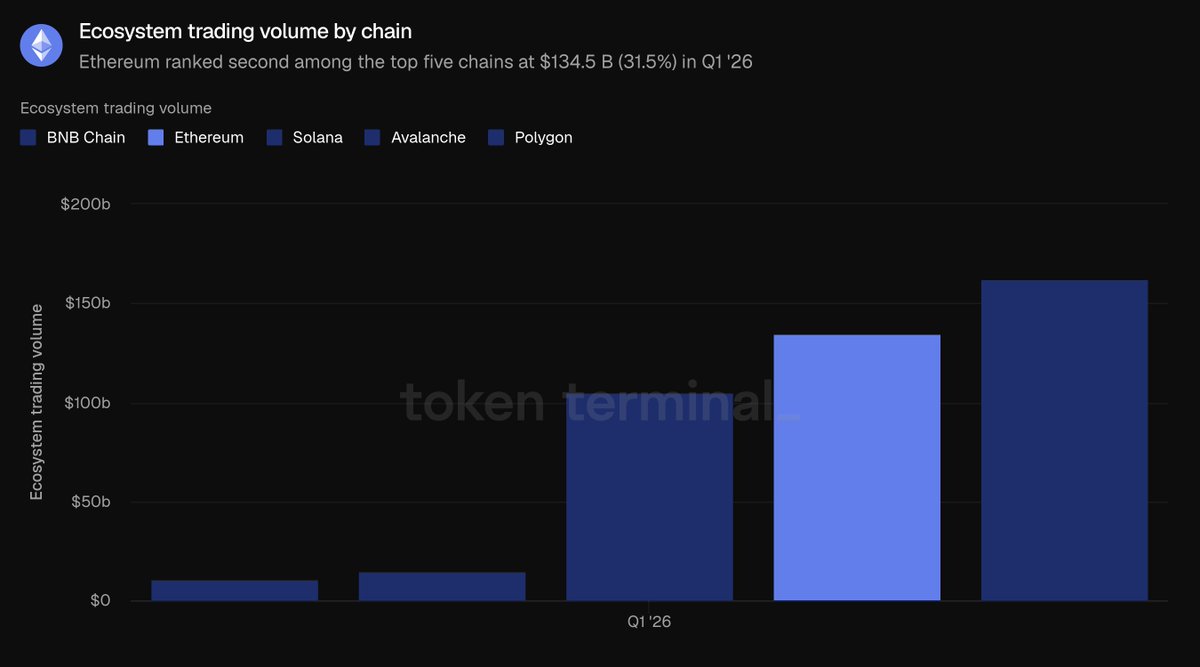
Ethereum's DEX trading flow is highly concentrated among top platforms: Uniswap's Q1 trading volume was approximately $85.5 billion, accounting for two-thirds of the ecosystem total; followed by Curve (~$22.1B) and CoW Swap (~$12.4B). Trading volume is the only metric where Ethereum did not top the five major chains: BNB Chain's total trading volume of $162.5 billion exceeded Ethereum's $134.5 billion, with Solana following closely ($104.9B), and Avalanche ($14.5B) and Polygon ($10.7B) ranking lower. Ethereum's trading volume constituted 31.5% of the combined total of the five chains, second to BNB Chain's 38%.


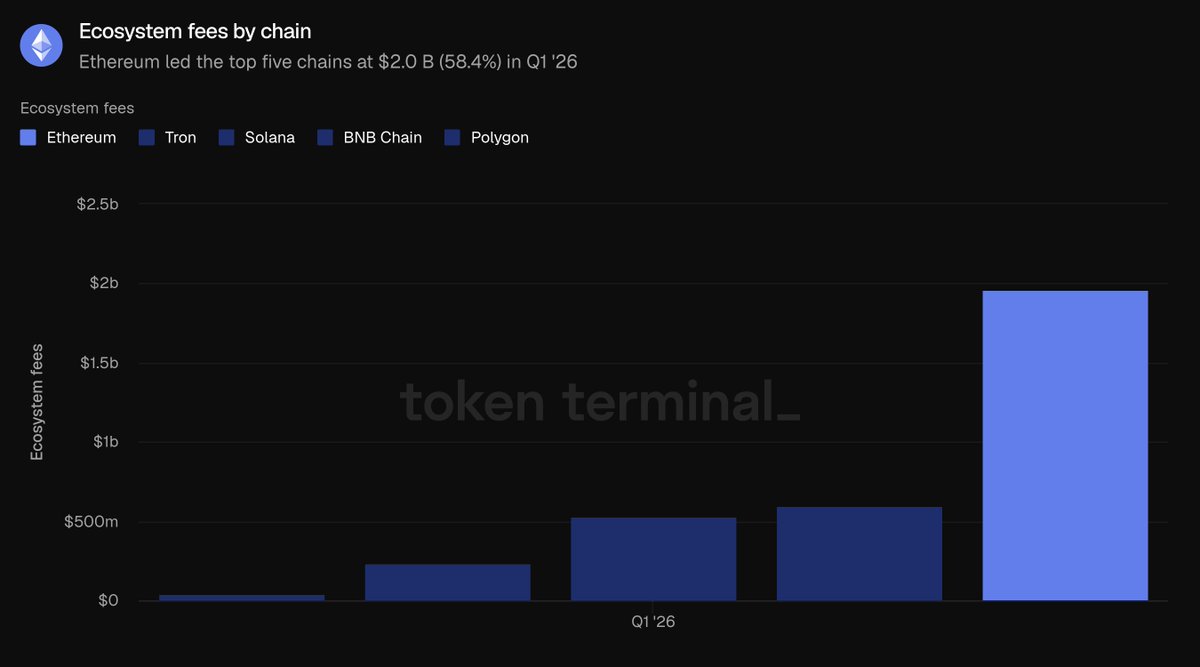
Ecosystem fees refer to all fees generated by users using various applications, including borrower interest and trader transaction fees. This directly reflects the economic value created by the ecosystem, aggregating total fees from all Ethereum applications. In Q1, total ecosystem fees amounted to $2.0 billion, down 16.9% QoQ and 7.8% YoY, declining in sync with lower trading and lending activity.
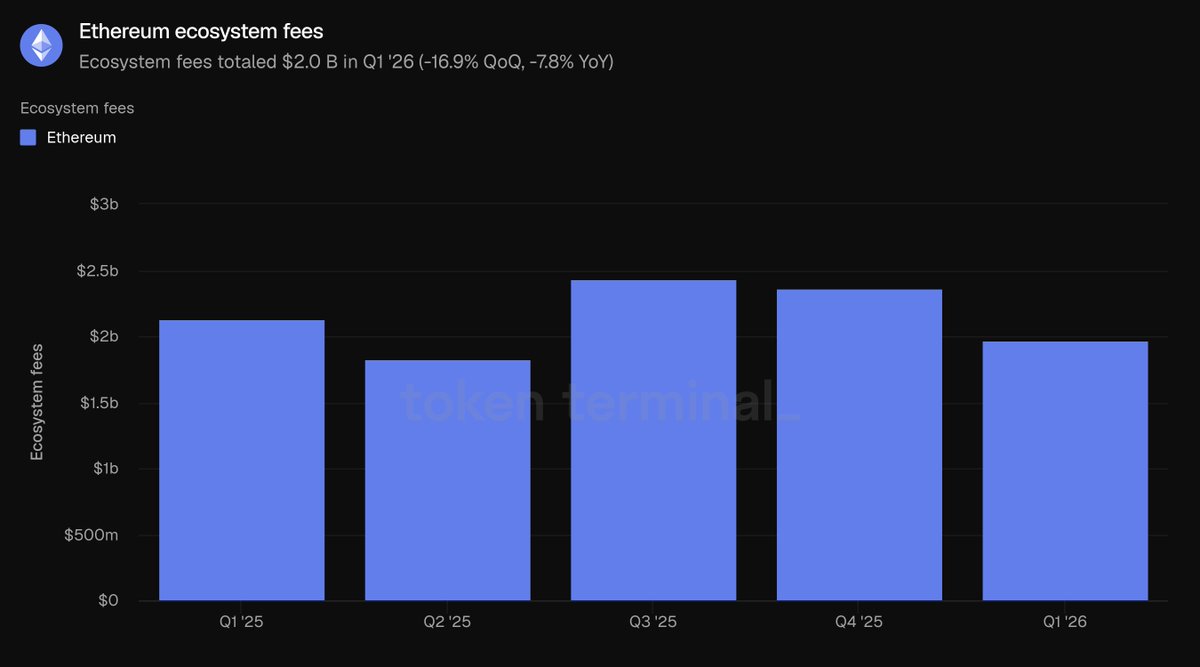


Ethereum's $2.0 billion in ecosystem fees far outpaces Tron ($599.3 million), Solana ($532.5 million), BNB Chain ($231.9 million), and Polygon ($38.8 million), accounting for 58.4% of the total fees across the five major chains. Even with this quarter's decline, Ethereum remains the industry's largest source of application fees. Summarizing all indicators in this section: Ethereum leads the industry in total locked value, lending size, and ecosystem fees, with only DEX trading volume falling short of BNB Chain.


Tokenized Assets Sector


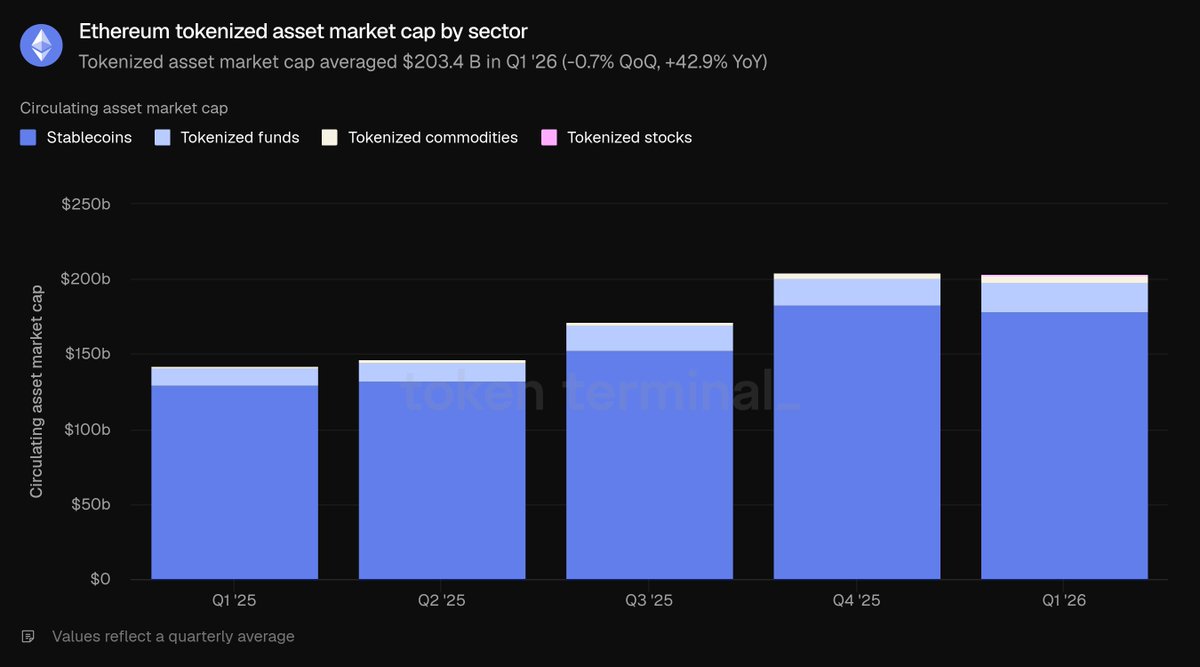
Total Market Capitalization of Circulating Assets refers to the total value of on-chain tokenized assets, calculated as the circulating supply multiplied by the daily closing price. For stablecoins, it's the total circulating issuance; for tokenized funds, it's the on-chain asset under management; for tokenized stocks, it's the total value of on-chain issued shares. This section only counts assets issued on Ethereum.


In Q1, the average total market capitalization of tokenized assets on Ethereum was $203.4 billion, essentially flat QoQ (down only 0.7%) but up a significant 42.9% YoY. Stablecoins account for 87.9% of the total size, with the remaining share split among tokenized funds, commodities, and stocks.


Stablecoins


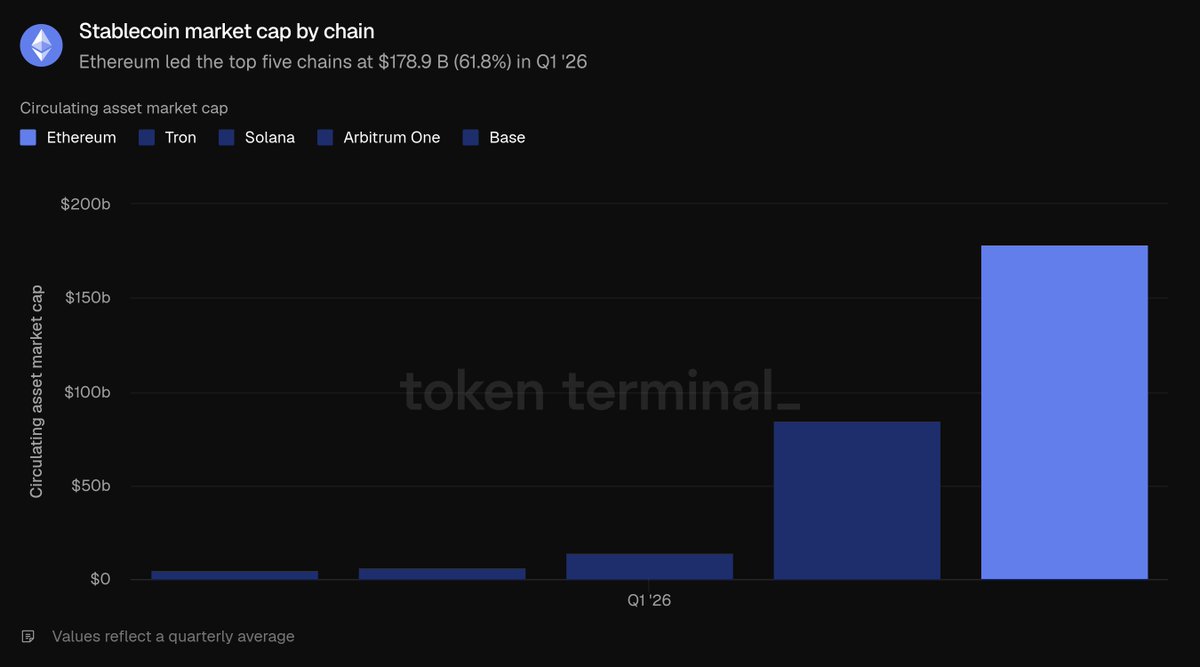
The average stablecoin size on Ethereum in Q1 was $178.9 billion, down slightly by 2.3% QoQ but up 37.6% YoY. It was the only tokenized sub-category to see a quarterly contraction. The market is dominated by two major issuers: at quarter-end, Tether's USDT ($94.1B) and Circle's USDC ($54.5B) together accounted for the vast majority of Ethereum's stablecoin market cap; other leading products include Sky USDS ($12.4B), Ethena USDe ($5.9B), and PayPal PYUSD ($2.9B); new compliant tokens like Ripple's RLUSD ($1.1B) have also launched. Comparing across the five major chains, Ethereum's $178.9 billion stablecoin scale leads Tron ($84.5B), Solana ($14.5B), Arbitrum One ($6.8B), and Base ($4.7B), accounting for 61.8% of the total stablecoin value across these five chains.


Tokenized Funds


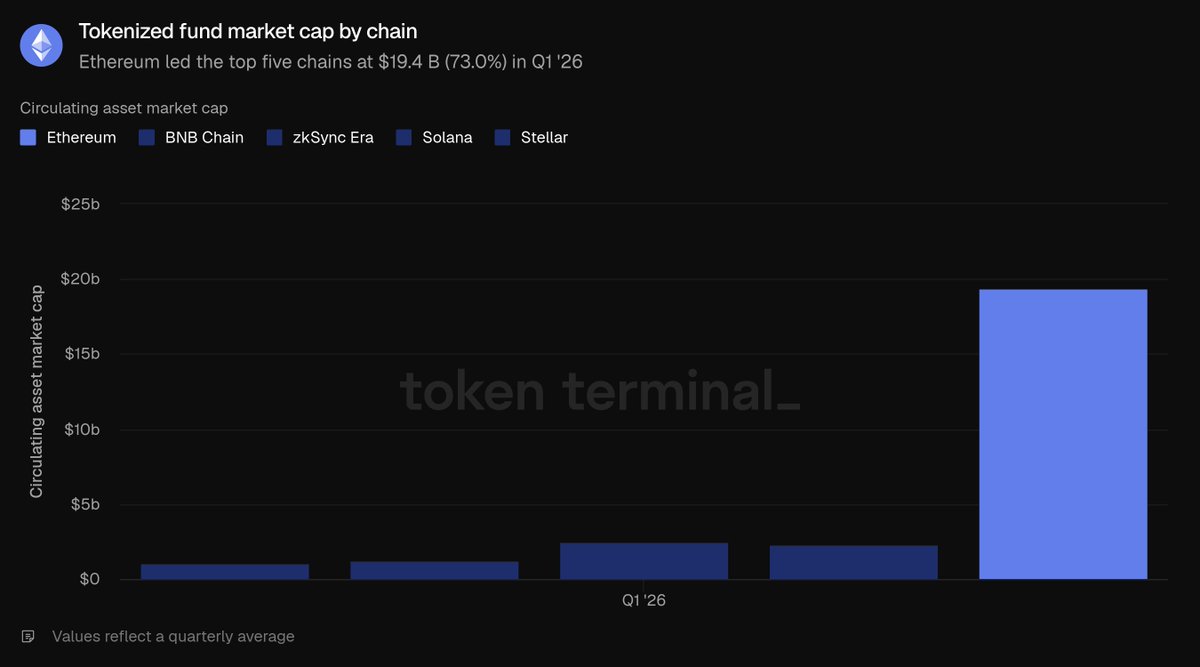
The average size of tokenized funds on Ethereum in Q1 was $19.4 billion, up 4.9% QoQ and surging 73.1% YoY. The sector is divided into two main types:


Yield-bearing on-chain USD products (largest by size): Sky sUSDS (~$6.4B), Ethena sUSDe (~$3.5B);

Traditional financial compliant funds (core vehicles for the institutional narrative): BlackRock BUIDL (issued via Securitize, ~$1.0B), WisdomTree Government Money Fund (~$0.815B), Superstate USTB (~$0.62B), with Ondo OUSG (~$0.32B) following closely. Comparing the five major chains, Ethereum's $19.4 billion in tokenized funds significantly leads ZKsync Era ($2.5B), BNB Chain ($2.3B), Solana ($1.3B), and Stellar ($1.1B), accounting for 73% of the total. This is the second most dominant tokenized asset sector for Ethereum.


Tokenized Commodities


The average size of tokenized commodities on Ethereum in Q1 was $4.7 billion, up 60% QoQ and surging 325.9% YoY, making it the fastest-growing tokenized category. The sector consists almost entirely of on-chain gold: Tether Gold XAUT (~$2.6B) and Paxos Gold PAXG (~$2.4B) together account for the entire sector share. Comparing across the five relevant chains, Ethereum's $4.7 billion scale far exceeds Ripple ($736.6M), Arbitrum One ($95.9M), BNB Chain ($38.4M), and Solana ($29.8M), accounting for 84% of the total. This is the tokenized sub-sector where Ethereum exerts the strongest dominance.
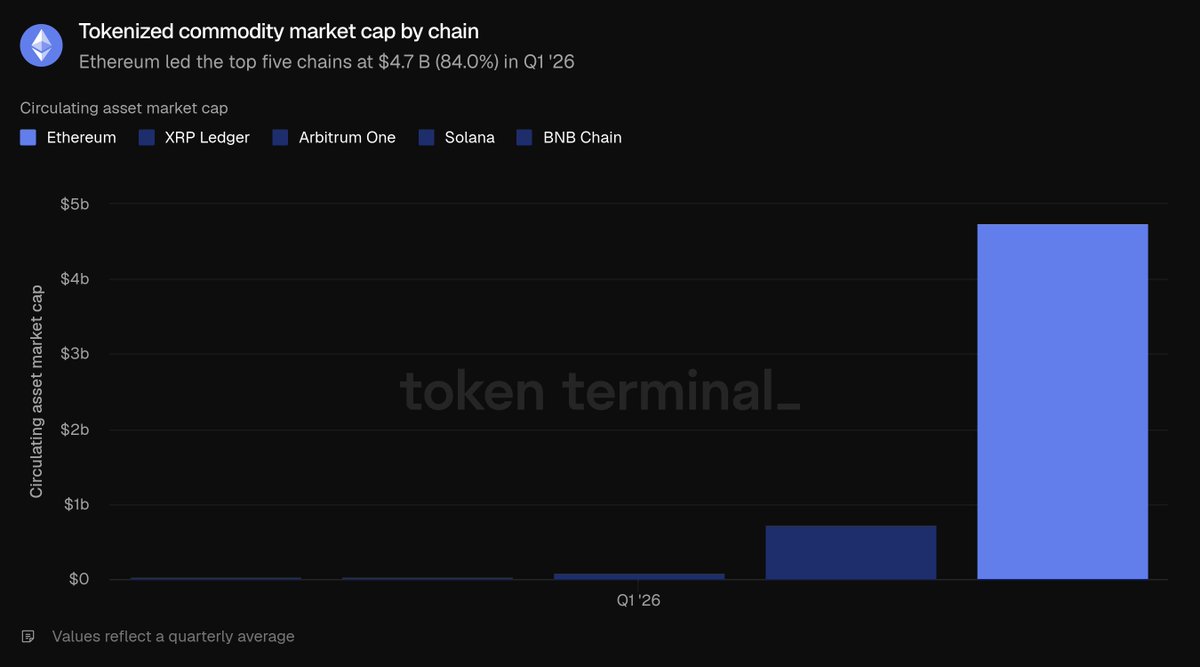


Tokenized Stocks


Tokenized stocks are the smallest sub-category. The average size on Ethereum in Q1 was $365.1 million, virtually zero a year ago, and up 16.5% QoQ. The sector is almost exclusively dominated by Ondo Finance, which issues on-chain assets for broad-based indices like the S&P 500 and Nasdaq 100, as well as dozens of individual stocks, constituting the vast majority of Ethereum's tokenized stock market cap. Comparing across the five major chains, Ethereum's $365.1M slightly leads Solana ($249.0M), BNB Chain ($150.5M), Arbitrum One ($29.0M), and Stellar ($4.2M), accounting for only 45.8% of the total tokenized stock value across these five chains. This is the only tokenized asset sector where Ethereum does not hold an absolute majority share.
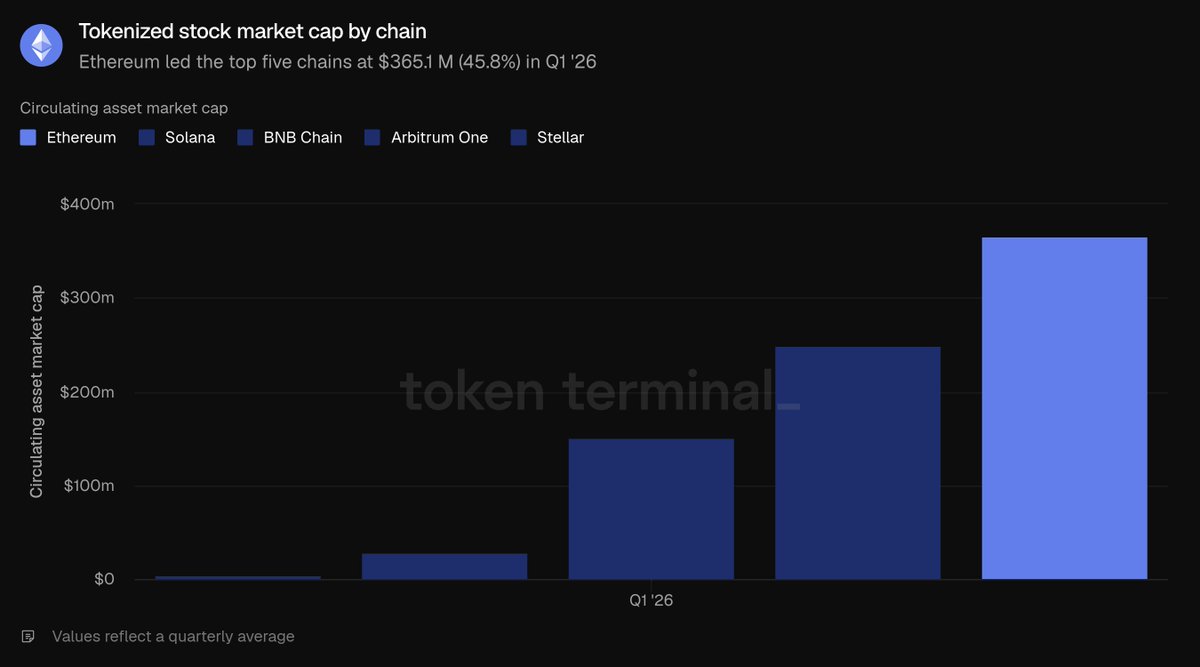


Summary of the Tokenized Assets Sector: Stablecoin stockpiles saw a slight decline in Q1, but Ethereum's dominant position in tokenized funds and commodities continues to solidify.


On-chain Usage Activity


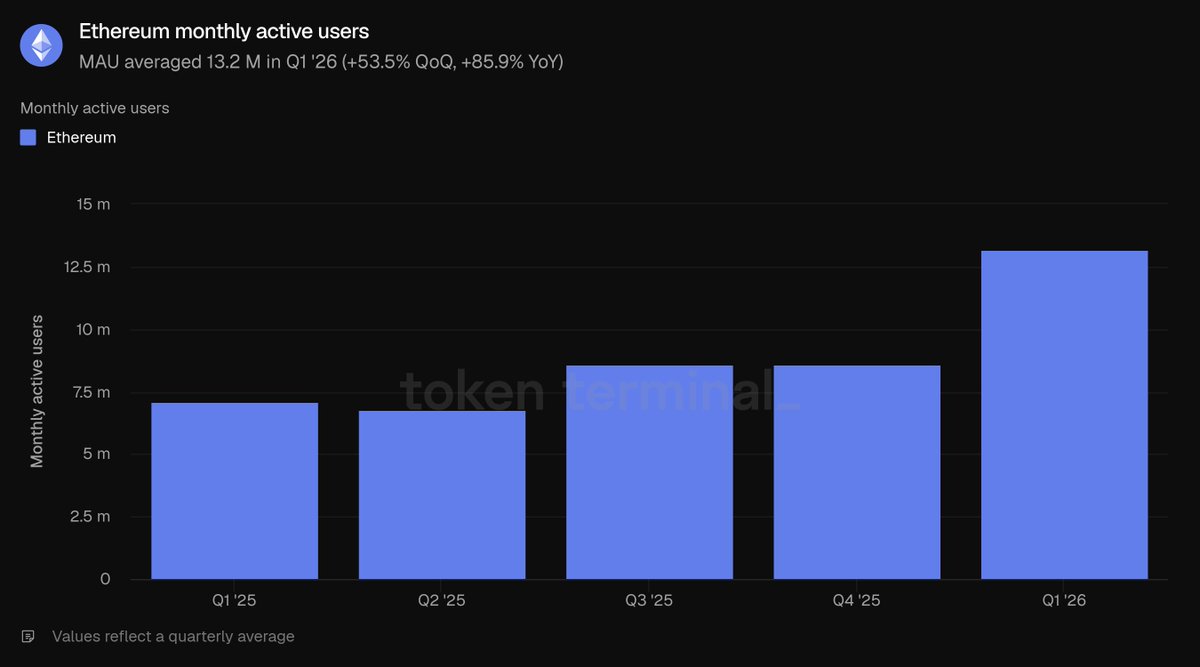
Monthly Active Users are defined as unique addresses that generate revenue-generating on-chain transactions each month. This metric only counts addresses interacting with the Ethereum Layer 1 mainnet. The average monthly active users in Q1 were 13.20 million, surging 53.5% QoQ and up 85.9% YoY, setting a new historical record and ending the slow growth trend of previous quarters, with user growth accelerating significantly.


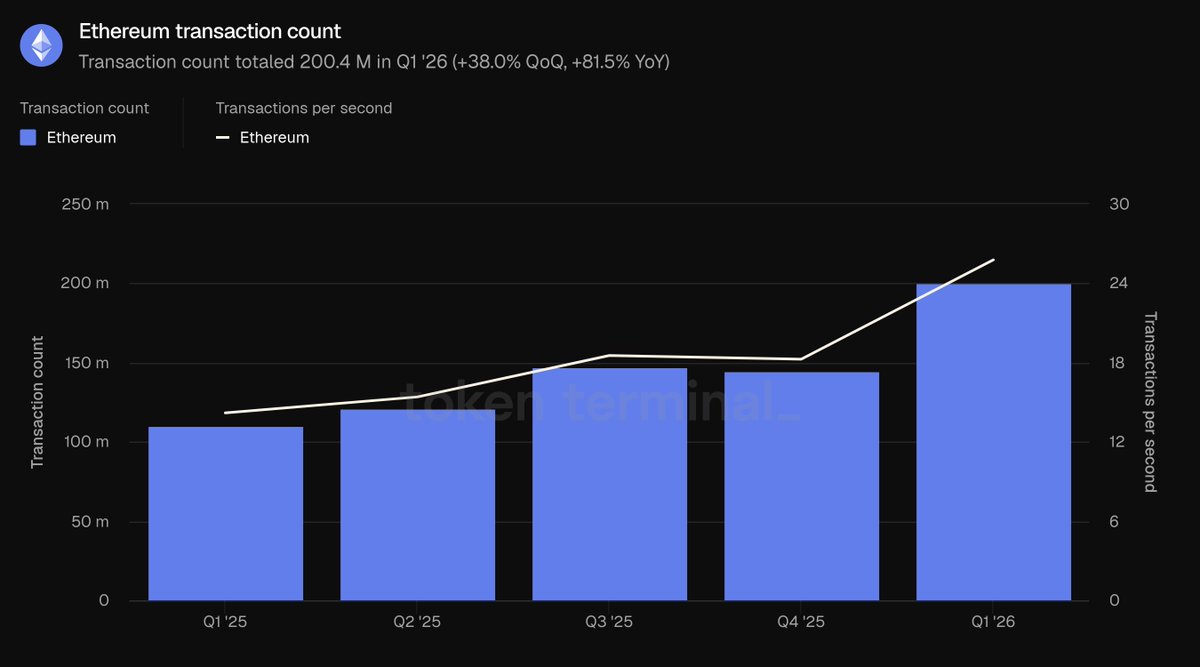
Total Transaction Count refers to the number of transactions written to the blockchain and confirmed, reflecting user on-chain interaction intensity. Transactions Processed per Second (TPS) is the average confirmation rate within the period, measuring the network's real-time carrying capacity. Both metrics are counted for the Ethereum Layer 1 mainnet only. In Q1, Layer 1 total transactions reached 200.4 million, up 38% QoQ and 81.5% YoY; average TPS increased to 25.78, up 41.2% QoQ. Both figures set new historical highs, proving that user growth has translated into real on-chain business volume increases.


Fees here specifically refer to the base network costs users pay for initiating transactions on Ethereum Layer 1, distinguished from the total ecosystem application fees in Part 2. In Q1, total Layer 1 transaction fees were $39.90 million, plummeting 47.9% QoQ and dropping sharply 81.9% YoY. The core data contrast this quarter is rising activity alongside sharply declining fees: while transaction volume increased 38%, total fees contracted by nearly half. The core reason is that Blob scaling significantly increased block storage capacity, ensuring ample block space supply and substantially reducing the cost per transaction.
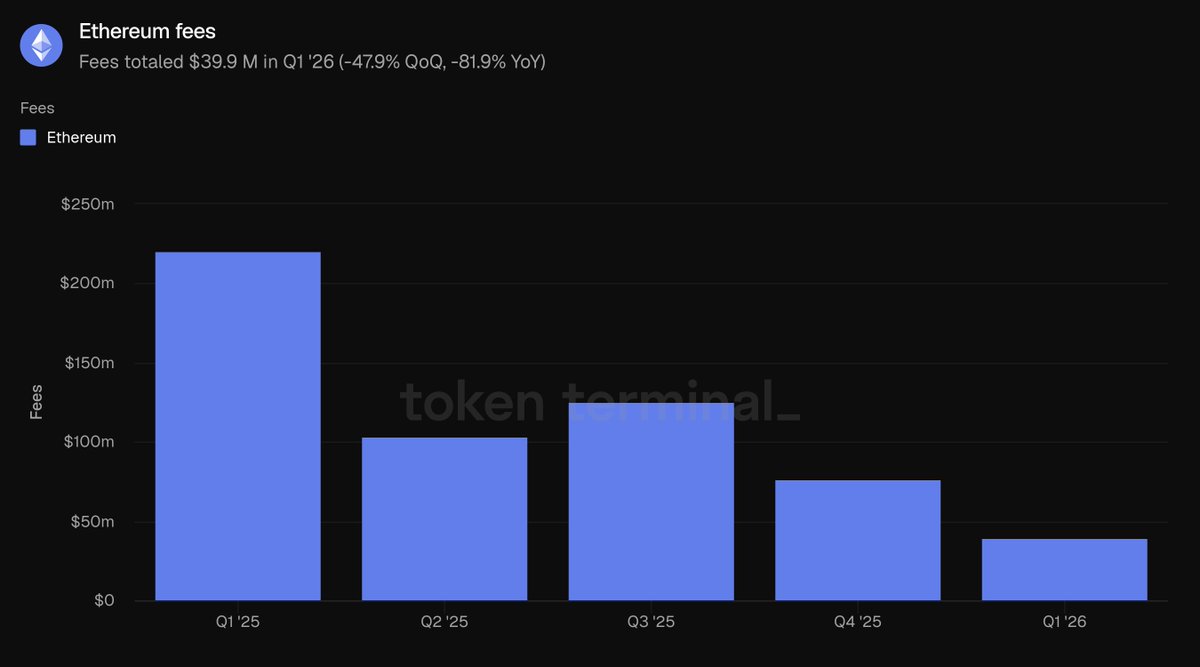


The core conclusion of this section is that scaling benefits have materialized: users and transaction counts have simultaneously reached new highs, while overall network usage costs have declined. When network throughput expansion outpaces the growth rate of market transaction demand, the characteristic "activity up, fees down" emerges.


Native Token ETH Fundamentals


Fully Diluted Market Capitalization calculation logic: ETH token price × the total potential supply under the current token economic model (including circulating, locked, unlocked, and yet-to-be-issued tokens). In Q1, ETH's average fully diluted market cap was $290.0 billion, down sharply 30.3% QoQ and 9.9% YoY. This is the indicator with the largest quarterly decline among all valuation metrics in the report and the core factor driving the contraction in the dollar-denominated asset scale across the entire ecosystem.


Staking Ratio: The ratio of the total value of ETH staked to secure the Proof-of-Stake network to the overall market capitalization of ETH; 0.31 indicates approximately 31% of ETH's market value is participating in staking. The average staking ratio in Q1 was 0.31, higher than the 0.28 from the previous quarter and the same period last year. Even as ETH's overall market cap significantly corrected, the proportion of tokens participating in network security staking continued to rise, indicating stable long-term staking意愿 among users during the price downtrend cycle.


Token Holder Metric: The total number of unique wallet addresses holding ETH. The average number of ETH holding addresses in Q1 was 292.8 million, up 8.1% QoQ and 24.9% YoY, marking five consecutive quarters of steady growth. Against the backdrop of a continuously declining fully diluted market cap, the expansion of holding addresses signifies further dispersion of the ETH-holding群体, with ordinary users'布局意愿 not cooling with short-term market trends.


Etherealize Team Commentary


The most core contradictory phenomenon this quarter: Ethereum Layer 1 mainnet on-chain usage scale hit historical highs, while network transaction fees simultaneously declined. Ethereum actively推进 network scaling, sacrificing short-term fee revenue for the long-term logic: cheaper block space will unleash massive potential market demand, ultimately driving long-term全网 revenue growth.


Data from Token Terminal's "Ethereum Report Q1 2026" proves this long-term logic正在兑现: on a year-over-year basis, monthly active users grew 85.9%, total transaction volume increased 81.5%, and network throughput rose 81.7%. This is a classic manifestation of Jevons Paradox. The team predicts that the long-term increase in全网 transaction demand will completely offset the short-term revenue loss caused by the decline in per-transaction fees. Drawing an analogy to the semiconductor industry: when Gordon Moore proposed Moore's Law in 1975, industry revenue规模 was limited; today, industry revenue has grown by several orders of magnitude. Scaling红利尚未完全释放: the planned Glamsterdam upgrade in Q3 aims to increase the Gas limit more than threefold; according to Ethereum's long-term roadmap规划, by 2029, it aims to achieve tens of thousands of TPS, creating a high-speed Layer 1 blockchain with second-level transaction finality.


The team agrees with BlackRock CEO Larry Fink's观点 from last December: the current stage of the tokenization industry is equivalent to the internet in 1996—when Amazon's online book sales were only $16 million. At the time, the market普遍 believed Amazon was merely an online bookstore surviving on the internet bubble and持续亏损; but Jeff Bezos预判 that the internet would彻底重塑 the retail industry,放弃短期盈利 to全力打造 network effects and scale advantages. Ethereum is now making the same取舍 to巩固 its position as the global financial底层 settlement layer.


Internet development offers another crucial启示: open, permissionless networks最终一定会战胜封闭私有 networks. In 1995, Bill Gates predicted in "The Road Ahead" that digital commerce would rely on enterprise proprietary private networks, "information highways," rather than the open internet. At the time, Microsoft created MSN, and America Online, CompuServe, Prodigy all operated封闭围墙花园, boasting millions of paying users; France's Minitel terminal system still had more users globally than the entire internet until late 1996. Yet all these封闭 systems ultimately failed. No正规大型 enterprise is willing to build its business on a network controlled by a competitor; more importantly, no single company can permanently keep up with the pace of innovation in a permissionless open ecosystem. History repeatedly confirms this规律: Linux surpassed proprietary Unix systems, the open web replaced enterprise封闭 intranets, Wikipedia replaced Encyclopædia Britannica. At the beginning of each transition, proprietary products gain first-mover advantages凭借更精准的功能,充足营销, and商务资源; but when the open ecosystem accumulates sufficient development tools, developers, and neutral, trustworthy attributes, first-mover advantages rapidly dissipate.


Now this industry规律 is replaying in financial infrastructure领域. All data in this report can佐证 that Ethereum has crossed the ecosystem critical mass threshold:它 holds绝对 market share in all core sectors. Institutions choosing Ethereum for deploying tokenized finance is not due to理念偏好, but because生态流动性, composability, and成熟机构落地案例 are already concentrated here. Report data shows: Ethereum holds 79.2% of DeFi active lending, 61.8% of stablecoins, 73% of tokenized funds, and 84% of tokenized commodities market share across the five major chains. Each new type of tokenized asset further thickens生态流动性,持续吸引更多机构入场; a neutral, non-biased底层 is the industry's only stable equilibrium solution—large financial institutions will绝不会统一选择竞品私有链 for asset settlement. Moreover, institutions are gradually realizing that private interactions, access restrictions, KYC compliance, and asset transfer controls can all be implemented through privacy computing environments and permissioned token standards on top of Ethereum, while fully tapping into the全网公共流动性. Conversely,封闭私有链 cannot嫁接 the massive liquidity and diverse applications of an open ecosystem.


After the quarter ended, institutional deployment accelerated further. In May alone, several significant implementations emerged: In asset management: BlackRock filed for two new tokenized funds; JPMorgan Chase issued its second on-chain货币基金 JLTXX on Ethereum; Fidelity International launched the Moody's AAA-rated dollar liquidity fund FILQ,上线 as an ERC-20 token. In the stablecoin sector: The Japanese Blockchain Foundation's yen stablecoin EJPY is即将部署 on Ethereum; a European alliance of 12 major banks (including BNP Paribas, ING, UniCredit, BBVA, etc.) is preparing a compliant euro stablecoin.


In 1990, the internet seemed遥不可及; by 2005, it had become a societal刚需. If Fink's assessment of the tokenization industry's development stage is accurate, the next few years may be the most opportune phase in Ethereum's development history. The team's previous "Efficient Money" report proposed the core观点: network fees构建 ETH's intrinsic value floor; the long-term optimistic logic is that依托更完善的货币属性, ETH有望吸纳 the combined超 $30 trillion monetary贮藏 value溢价 of gold and Bitcoin. Ethereum can establish industry leadership without relying on high fees.

Trend Kriptolar

İlgili Sorular

QAccording to the article, what is the key contradiction observed in Ethereum's performance during Q1 2026?

AThe key contradiction was that while on-chain usage (monthly active users, total transactions, throughput) hit record highs, the network transaction fees collected on Layer 1 plummeted (down 47.9% QoQ).

QWhat are the three core protocol goals set by the Ethereum Foundation for 2026?

AThe three core protocol goals for 2026 are: scaling, optimizing user experience, and strengthening the underlying Layer 1 security.

QWhich on-chain activity metric saw the largest year-on-year percentage growth in Q1 2026?

AThe on-chain activity metric with the largest year-on-year percentage growth was Tokenized Commodities, which increased by 325.9% compared to Q1 2025.

QWhy does the Etherealize team believe open, permissionless networks like Ethereum will ultimately prevail over private, closed networks for financial infrastructure?

AThey believe that no large, formal enterprise will build critical business on a network controlled by a competitor, and crucially, no single company can keep pace with the innovation speed of a permissionless, open ecosystem over the long term, as historically seen with Linux and the open web.

QWhat does the article identify as the primary factor driving the significant drop in Layer 1 transaction fees despite increased usage in Q1 2026?

AThe primary factor was the successful implementation of the second Blob Parameter Fork (BPO#2) as part of the Fusaka upgrade cycle in January, which greatly increased data storage capacity (blob space), making block space more abundant and reducing the cost per transaction.

İlgili Okumalar

WeChat AI Card Hands-On Guide: Has the AI Shopping Era Arrived?

**"WeChat AI Card" Practical Test Guide: Has the Era of AI Shopping Arrived?** WeChat has officially launched the "AI Exclusive Card," a feature integrated into its Workbuddy AI assistant. This card is designed to handle payments for AI-initiated purchases. Our hands-on test reveals it's not yet a tool for fully autonomous AI shopping, but rather a controlled payment layer for AI agents. The AI Card functions as an isolated sub-wallet within WeChat Pay. Users must bind the card and transfer funds into it from their main wallet. Crucially, every transaction requires explicit user confirmation via smartphone scan; AI cannot spend autonomously. Currently accessible through the Workbuddy agent, the card targets specific digital consumption scenarios: purchasing paid content (reports, data), calling paid APIs/tools, and subscribing to services. Its design prioritizes security and control by separating funds and mandating approval for each payment. We tested a real-world scenario: ordering bubble tea via Workbuddy using a "Meituan Life Assistant" skill. The process encountered multiple hurdles: high "skill" usage costs (exceeding daily free credits), and most importantly, while a payment was successfully initiated, the AI purchased an incorrect product (a mismatched group-buy coupon instead of the desired drink). This highlights the current limitation: the **AI Card only solves the payment step**. The broader challenge lies in the **AI agent's execution chain**—accurately understanding intent, navigating third-party platforms, selecting the right product, and ensuring proper fulfillment. The payment succeeded, but the purchase failed to meet the user's need. In conclusion, the WeChat AI Exclusive Card is a cautious, early-step experiment in AI commerce. It provides a secure, user-controlled payment method for agent interactions but is not yet capable of reliable, end-to-end complex purchases. For now, it's best used for low-value, low-risk digital services with careful user verification at each step. The vision of AI handling complete shopping tasks remains a work in progress.

marsbit51 dk önce

WeChat AI Card Hands-On Guide: Has the AI Shopping Era Arrived?

marsbit51 dk önce

Deconstructing Notion's Growth: From a Note-taking Tool to 100 Million Users—How Notion Built a Triple Growth Flywheel Through Product, Templates, and Community

Notion's growth from a niche note-taking tool to a platform with 100 million users is powered by three interconnected flywheels: Product-Led Growth (PLG), a Template Economy, and Community-Driven Growth. First, Notion's PLG strategy relies on a highly flexible, "plastic" product that users can adapt to countless personal and team workflows. Its freemium model lowers the barrier to entry, while features like page sharing and collaboration drive organic, usage-based viral growth as users naturally invite others. Second, the Template Economy solves the "blank page" problem. Templates, created by both Notion and its community, transform abstract product capabilities into concrete, copyable solutions for specific scenarios (e.g., project management, content calendars). This dramatically lowers activation costs for new users and fuels SEO-driven discovery. Third, a vibrant Community acts as a distributed growth engine. Users and official Ambassadors create tutorials, share use cases, and host local events. This community not only educates users but also fosters a sense of identity around pursuing "better ways of working," strengthening loyalty and enabling global, low-cost expansion. Together, these flywheels create a self-reinforcing ecosystem: a great product attracts users who create templates and community content, which in turn attracts more users and deepens engagement. This system allowed Notion to scale from individuals to teams and enterprises through a bottom-up adoption path. Looking ahead, AI integration promises to accelerate these flywheels further by making templates smarter and the platform a potential AI-native work operating system. Ultimately, Notion's defensible advantage is not just its features, but this deeply entrenched network of user assets, creators, and community trust.

marsbit52 dk önce

Deconstructing Notion's Growth: From a Note-taking Tool to 100 Million Users—How Notion Built a Triple Growth Flywheel Through Product, Templates, and Community

marsbit52 dk önce

$10 Billion, Qualcomm to Acquire Chip Legend Jim Keller's Company

Global mobile chip giant Qualcomm is in advanced talks to acquire AI chip startup Tenstorrent in a deal valued between $8-10 billion, according to media reports. This potential acquisition would be one of the largest in the AI chip sector in recent years. Tenstorrent, led by legendary chip architect Jim Keller, has gained prominence for its RISC-V architecture and AI accelerator designs. The move highlights Qualcomm's strategic push to diversify beyond its core smartphone chip business. As the smartphone market matures, Qualcomm is aggressively targeting growth in automotive, data center, and cloud AI. Acquiring Tenstorrent would allow Qualcomm to rapidly enter the high-end AI computing market, bypassing lengthy in-house development cycles. Tenstorrent's cost-effective system architecture, which avoids expensive HBM memory and relies on standard Ethernet for clustering, offers a potential alternative to Nvidia's costly solutions. Furthermore, Tenstorrent's high-performance RISC-V CPU technology and its focus on the automotive and edge computing segments align with Qualcomm's strategic goals, including its "Snapdragon Digital Chassis" platform. Despite the strategic rationale, the high valuation has sparked some investor caution. The successful integration of Tenstorrent's open-source culture and independent team into Qualcomm's organization, along with the commercialization of its technology, remains a key challenge.

marsbit1 saat önce

$10 Billion, Qualcomm to Acquire Chip Legend Jim Keller's Company

marsbit1 saat önce

CARDS' Brutal Truth of $535M FDV: Only $43M Net Revenue, Profit Margin Halved

The article deconstructs Collector Crypt (CC), a blockchain-based platform for trading tokenized collectible cards, revealing a significant disparity between its high volume and actual business fundamentals. Key findings include: * CC's cumulative revenue of $635M is misleading; 90.6% is instantly returned to users via card buybacks, leaving only $43M in net revenue (6.7% retention). * Trading activity is minimal, with real secondary market trading below $5M. eBay sales as a percentage of volume have declined for six consecutive quarters. * The platform's user base is highly concentrated, with a few dozen high-frequency wallets driving most of the volume, resembling a "casino" with ~420 daily active players. * As volume shifts to higher-priced card packs, the net profit margin has halved from 11.2% to 5.8%. * Token value capture (via burns and buybacks) totals only $1.4M, just 3.4% of net revenue. Meanwhile, operational wallets have off-ramped $45.7M in USDC. * With a Fully Diluted Valuation (FDV) of ~$535M, the token trades at 7.3x net revenue. The float is only 20.5%, with 72% of the supply allocated to insiders and locked until November 2027. The analysis concludes that while CC has found product-market fit as a high-speed gacha machine, it shows little evidence of evolving into a sustainable collector's marketplace, with minimal value accruing to its CARDS token.

marsbit1 saat önce

CARDS' Brutal Truth of $535M FDV: Only $43M Net Revenue, Profit Margin Halved

marsbit1 saat önce

İşlemler

Spot
Futures

Popüler Makaleler

ETH 2.0 Nedir

ETH 2.0: Ethereum için Yeni Bir Dönem Giriş ETH 2.0, Ethereum 2.0 olarak da bilinir, Ethereum blok zincirinde önemli bir yükseltmeyi işaret eder. Bu geçiş yalnızca bir yüz değiştirme değil; ağın ölçeklenebilirliğini, güvenliğini ve sürdürülebilirliğini temelinden geliştirmeyi hedeflemektedir. Enerji yoğun Proof of Work (PoW) konsensüs mekanizmasından daha verimli olan Proof of Stake (PoS) mekanizmasına geçişle birlikte, ETH 2.0 blok zinciri ekosistemine dönüştürücü bir yaklaşım vaat etmektedir. ETH 2.0 Nedir? ETH 2.0, Ethereum'un yeteneklerini ve performansını optimize etmeye odaklanmış özel, birbirine bağlı güncellemelerin bir derlemesidir. Yenileme, mevcut Ethereum mekanizmasının karşılaştığı kritik zorlukları, özellikle işlem hızı ve ağ tıkanıklığı ile ilgili sorunları ele almak üzere tasarlanmıştır. ETH 2.0'ın Amaçları ETH 2.0'ın ana amaçları, üç temel unsuru geliştirmeye odaklanmaktadır: Ölçeklenebilirlik: Ağın saniye başına işleyebileceği işlem sayısını önemli ölçüde artırmayı hedefleyen ETH 2.0, mevcut yaklaşık 15 işlem/saniye sınırlamasını aşmayı ve potansiyel olarak binlerce işleme ulaşmayı planlamaktadır. Güvenlik: Geliştirilmiş güvenlik önlemleri, özellikle siber saldırılara karşı daha iyi direnç sağlama ve Ethereum'un merkeziyetsiz görünümünü koruma açısından ETH 2.0 için hayati öneme sahiptir. Sürdürülebilirlik: Yeni PoS mekanizması, sadece verimliliği artırmakla kalmayıp aynı zamanda enerji tüketimini de önemli ölçüde azaltma hedefiyle tasarlanmış olup, Ethereum'un operasyonel çerçevesini çevresel kaygılarla uyumlu hale getirmektedir. ETH 2.0'ın Yaratıcısı Kimdir? ETH 2.0'ın yaratılması Ethereum Vakfı'na atfedilebilir. Ethereum'un gelişimini destekleme konusunda kritik bir rol oynayan bu kar amacı gütmeyen kuruluş, dikkat çekici kurucu ortağı Vitalik Buterin tarafından yönetilmektedir. Daha ölçeklenebilir ve sürdürülebilir bir Ethereum vizyonu, bu yükseltmenin arkasındaki itici güç olmuştur ve protokolü geliştirmek için kendini adamış küresel bir geliştici ve meraklı topluluğunun katkılarını içermektedir. ETH 2.0'ın Yatırımcıları Kimlerdir? ETH 2.0 yatırımcıları ile ilgili detaylar kamuoyuna açıklanmamış olsa da, Ethereum Vakfı'nın blok zinciri ve teknoloji alanında çeşitli kuruluşlar ve bireyler tarafından desteklendiği bilinmektedir. Bu ortaklar arasında merkeziyetsiz teknolojilerin ve blok zinciri altyapısının geliştirilmesine karşılıklı ilgi duyan girişim sermayesi şirketleri, teknoloji firmaları ve hayır kurumları yer almaktadır. ETH 2.0 Nasıl Çalışır? ETH 2.0, onu öncüsünden ayıran bir dizi önemli özelliği tanıtmasıyla dikkat çekmektedir. Proof of Stake (PoS) PoS konsensüs mekanizmasına geçiş, ETH 2.0'ın en belirgin değişikliklerinden biridir. İşlem doğrulama için enerji yoğun madenciliğe dayanmak yerine, PoS kullanıcıların ağa yatırdıkları ETH miktarına göre işlemleri doğrulayıp yeni bloklar oluşturmalarına olanak tanır. Bu, enerji verimliliğinin artırılmasına yol açarak tüketimi yaklaşık %99,95 oranında azaltmakta ve Ethereum 2.0'ı önemli ölçüde daha çevre dostu bir alternatif haline getirmektedir. Shard Zincirleri Shard zincirleri, ETH 2.0'ın diğer bir kritik yeniliğidir. Bu daha küçük zincirler, ana Ethereum zinciri ile paralel olarak çalışarak birden fazla işlemin aynı anda işlenmesine olanak tanır. Bu yaklaşım, ağın genel kapasitesini artırarak Ethereum'u rahatsız eden ölçeklenebilirlik sorunlarını ele alır. Beacon Zinciri ETH 2.0'ın temelinde, ağı koordine eden ve PoS protokolünü yöneten Beacon Zinciri yer almaktadır. Bu, bir tür organizatör olarak işlev görür: doğrulayıcıları denetler, shard'ların ağa bağlı kalmasını sağlar ve blok zinciri ekosisteminin genel sağlığını izler. ETH 2.0 Zaman Çizelgesi ETH 2.0'ın yolculuğu, bu önemli yükseltmenin evrimini gösteren birkaç önemli dönüm noktası ile tanımlanmıştır: Aralık 2020: Beacon Zinciri'nin başlatılması, PoS'un tanıtımını işaret etmiş ve ETH 2.0’a geçiş için sahneyi hazırlamıştır. Eylül 2022: "The Merge" tamamlanması, Ethereum ağının başarılı bir şekilde PoW'den PoS çerçevesine geçiş yaptığı kritik bir anı temsil etmekte ve Ethereum için yeni bir dönemi müjdelemektedir. 2023: Shard zincirlerinin beklenen dağıtımı, Ethereum ağının ölçeklenebilirliğini daha da artırmayı hedeflemekte ve ETH 2.0'ı merkeziyetsiz uygulamalar ve hizmetler için sağlam bir platform haline getirmeyi pekiştirmektedir. Ana Özellikler ve Faydalar Geliştirilmiş Ölçeklenebilirlik ETH 2.0'ın en önemli avantajlarından biri, geliştirilmiş ölçeklenebilirliğidir. PoS ve shard zincirlerinin kombinasyonu, ağın kapasitesini artırarak, eski sistemle kıyaslandığında çok daha fazla işlem hacmi karşılayabilmesini sağlamaktadır. Enerji Verimliliği PoS'un uygulanması, blok zinciri teknolojisinde enerji verimliliği yönünde büyük bir adım teşkil etmektedir. Enerji tüketimini ciddi şekilde azaltarak, ETH 2.0 yalnızca işletme maliyetlerini düşürmekle kalmaz, aynı zamanda küresel sürdürülebilirlik hedefleriyle daha yakın bir uyum sağlar. Geliştirilmiş Güvenlik ETH 2.0'ın güncellenmiş mekanizmaları, ağ genelinde güvenliğin artırılmasına katkıda bulunmaktadır. PoS'un uygulanması ve shard zincirleri ile Beacon Zinciri aracılığıyla geliştirilen yenilikçi kontrol önlemleri, potansiyel tehditlere karşı daha yüksek bir koruma sağlar. Kullanıcılar için Düşük Maliyetler Ölçeklenebilirlik geliştikçe, işlem maliyetleri üzerindeki etkiler de belirgin hale gelecektir. Artan kapasite ve azalan tıkanıklığın, kullanıcılar için düşük ücretler anlamına gelmesi beklenmekte ve Ethereum'u günlük işlemler için daha erişilebilir hale getirmektedir. Sonuç ETH 2.0, Ethereum blok zinciri ekosisteminde önemli bir evrimi işaret etmektedir. Ölçeklenebilirlik, enerji tüketimi, işlem verimliliği ve genel güvenlik gibi temel sorunları ele alırken, bu güncellemenin önemi abartılamaz. Proof of Stake'e geçiş, shard zincirlerinin tanıtımı ve Beacon Zinciri'nin altyapı çalışmaları, Ethereum'un merkeziyetsiz piyasalarının artan taleplerini karşılayabileceği bir geleceği göstermektedir. Yenilik ve ilerleme ile şekillenen bir sektörde, ETH 2.0, blok zinciri teknolojisinin daha sürdürülebilir ve verimli bir dijital ekonomi için yol açmadaki yeteneklerinin bir kanıtıdır.

177 Toplam GörüntülenmeYayınlanma 2024.04.04Güncellenme 2024.12.03

ETH 2.0 Nedir

ETH 3.0 Nedir

ETH3.0 ve $eth 3.0: Ethereum'un Geleceği Üzerine Derinlemesine Bir İnceleme Giriş Hızla evrilen kripto para ve blok zinciri teknolojisi ortamında, ETH3.0, sıklıkla $eth 3.0 olarak adlandırılmakta, önemli bir ilgi ve spekülasyon konusu haline gelmiştir. Bu terim, netleştirilmesi gereken iki temel kavramı kapsamaktadır: Ethereum 3.0: Bu, mevcut Ethereum blok zincirinin yeteneklerini artırmayı hedefleyen olası bir gelecekteki güncellemeyi temsil eder, özellikle ölçeklenebilirlik ve performansı iyileştirmeye odaklanmaktadır. ETH3.0 Meme Token: Bu ayrı kripto para projesi, Ethereum blok zincirini kullanarak meme merkezli bir ekosistem oluşturmayı amaçlamakta ve kripto para topluluğu içinde etkileşimi artırmaktadır. ETH3.0'ün bu yönlerini anlamak, yalnızca kripto meraklıları için değil, aynı zamanda dijital alandaki daha geniş teknolojik trendleri gözlemleyenler için de hayati öneme sahiptir. ETH3.0 Nedir? Ethereum 3.0 Ethereum 3.0, zaten kurulmuş olan Ethereum ağına önerilen bir güncelleme olarak duyurulmaktadır; bu ağ, kuruluşundan bu yana birçok merkeziyetsiz uygulamanın (dApp'ler) ve akıllı sözleşmelerin belkemiği olmuştur. Tasarlanan iyileştirmeler, esasen ölçeklenebilirlik üzerine yoğunlaşmakta – shardlama ve sıfır bilgi kanıtları (zk-proofs) gibi ileri teknolojileri entegre etmektedir. Bu teknolojik yenilikler, saniyede eşi benzeri görülmemiş sayıda işlem (TPS) gerçekleştirmeyi kolaylaştırmayı amaçlamakta olup, muhtemelen milyonlara ulaşarak mevcut blok zinciri teknolojisinin karşılaştığı en büyük sınırlamalardan birine çözüm getirmektedir. İyileştirme yalnızca teknik değil, aynı zamanda stratejiktir; Ethereum ağını, merkeziyetsiz çözümlere olan artan talep ile belirginleşen bir geleceğe hazırlamak için tasarlanmıştır. ETH3.0 Meme Token Ethereum 3.0'ın aksine, ETH3.0 Meme Token, internet meme kültürünü kripto para dinamikleriyle birleştirerek daha hafif ve eğlenceli bir alanda hareket etmektedir. Bu proje, kullanıcıların Ethereum blok zincirinde meme alım, satım ve ticaret yapmalarına izin vererek, yaratıcılık ve ortak ilgi alanları aracılığıyla topluluk etkileşimini teşvik eden bir platform sunmaktadır. ETH3.0 Meme Token, blok zinciri teknolojisinin dijital kültürle nasıl kesişebileceğini göstererek, hem eğlenceli hem de finansal olarak sürdürülebilir kullanım senaryoları oluşturmayı hedeflemektedir. ETH3.0'un Yaratıcısı Kimdir? Ethereum 3.0 Ethereum 3.0'a yönelik girişim, esas olarak Ethereum topluluğundaki bir geliştirici ve araştırmacı konsorsiyumu tarafından yönlendirilmektedir ve bunlar arasında Justin Drake de bulunmaktadır. Ethereum'un evrimine yönelik içgörüleri ve katkılarıyla tanınan Drake, Ethereum'u “Beam Chain” olarak adlandırılan yeni bir konsensüs katmanına geçirme konusundaki tartışmalarda öne çıkan bir figür olmuştur. Geliştirmeye yönelik bu iş birliği yaklaşımı, Ethereum 3.0'ın tek bir yaratıcının ürünü olmadığını, aksine blok zinciri teknolojisini ilerletmeye odaklanmış kolektif bir dehanın tezahürü olduğunu göstermektedir. ETH3.0 Meme Token ETH3.0 Meme Token'ın yaratıcısına dair detaylar şu anda izlenemez durumdadır. Meme tokenların doğası, genellikle daha merkeziyetsiz ve topluluk odaklı bir yapıya yol açmakta olup, bu da spesifik bir atıf eksikliğini açıklayabilir. Bu durum, yeniliğin genellikle iş birliği yerine bireysel çabalardan ortaya çıktığı kripto topluluğunun genel felsefesiyle uyumludur. ETH3.0 Yatırımcıları Kimlerdir? Ethereum 3.0 Ethereum 3.0'a olan destek, esasen Ethereum Vakfı ve hevesli bir geliştirici ve yatırımcı topluluğu tarafından sağlanmaktadır. Bu temel birliktelik, yıllar süren ağ operasyonlarıyla inşa edilen güven ve itibarından yararlanarak önemli bir meşruiyet sağlamaktadır. Kripto para dünyasının hızla değişen ikliminde, topluluk desteği, gelişim ve benimsemeyi yönlendirmede kritik bir rol oynamakta ve Ethereum 3.0'ı gelecekteki blok zinciri ilerlemeleri için ciddi bir rakip haline getirmektedir. ETH3.0 Meme Token Mevcut kaynaklar, ETH3.0 Meme Token'ı destekleyen yatırım temelleri veya kuruluşları hakkında net bilgiler sağlamasa da, bu durum meme tokenlar için tipik olan finansman modelini göstermektedir; bu model genellikle tabandan destek ve topluluk katılımına dayanır. Bu tür projelerdeki yatırımcılar genellikle toplum odaklı yenilik potansiyeli ve kripto topluluğunda bulunan iş birliği ruhuyla motive olmuş bireylerden oluşmaktadır. ETH3.0 Nasıl Çalışır? Ethereum 3.0 Ethereum 3.0'ın ayırt edici özellikleri, önerilen shardlama ve zk-proof teknolojisinin uygulanmasında yatmaktadır. Shardlama, blok zincirini daha küçük, yönetilebilir parçalara veya “parçalara” ayırma yöntemidir; bu parçalar işlemleri ardışık değil, eşzamanlı olarak işleyebilir. Bu işlem yükünün merkeziyetsizliği, tıkanıklığı önlemeye yardımcı olur ve ağın yoğun yük altında bile yanıt verebilir olmasını sağlar. Sıfır bilgi kanıtı (zk-proof) teknolojisi, işleme katılan temel verileri ifşa etmeden işlem doğrulaması sağlamasıyla başka bir sofistike katman ekler. Bu yön, sadece gizliliği artırmakla kalmaz, aynı zamanda ağın genel verimliliğini de artırır. Bu güncellemeye, ağın yeteneklerini ve faydasını daha da artırarak sıfır bilgi Ethereum Sanal Makinesi (zkEVM) entegrasyonunun da eklenmesi gündeme gelmektedir. ETH3.0 Meme Token ETH3.0 Meme Token, meme kültürünün popülaritesinden yararlanarak kendini farklılaştırmaktadır. Kullanıcıların sadece eğlence için değil, aynı zamanda potansiyel ekonomik kazançlar için meme ticareti yapmalarına olanak tanıyacak bir pazar yeri oluşturur. Stake etme, likidite sağlama ve yönetim mekanizmaları gibi özelliklerin entegrasyonu sayesinde, proje topluluk etkileşimini ve katılımını teşvik eden bir ortam oluşturur. Eğlence ve ekonomik fırsatların eşsiz bir karışımını sunarak, ETH3.0 Meme Token, kripto tutkunlarından gündelik meme meraklılarına kadar çeşitli bir kitleyi çekmeyi hedeflemektedir. ETH3.0 Zaman Çizelgesi Ethereum 3.0 11 Kasım 2024: Justin Drake, ölçeklenebilirlik iyileştirmeleri etrafında şekillenen yaklaşan ETH 3.0 güncellemesine işaret ediyor. Bu duyuru, Ethereum'un gelecekteki mimarisi hakkında resmi tartışmaların başlangıcını simgeliyor. 12 Kasım 2024: Ethereum 3.0'a yönelik beklenen önerinin, Bangkok'taki Devcon'da açıklanması planlanıyor ve bu, daha geniş topluluk geri bildirimi ve gelişim için olası sonraki adımların zeminini hazırlıyor. ETH3.0 Meme Token 21 Mart 2024: ETH3.0 Meme Token, CoinMarketCap'ta resmi olarak listeleniyor, bu da kamusal kripto alanına adım atarak meme merkezli ekosisteminin görünürlüğünü artırıyor. Ana Noktalar Sonuç olarak, Ethereum 3.0, gelişmiş teknolojiler aracılığıyla ölçeklenebilirlik ve performansla ilgili sınırlamaların üstesinden gelmeye odaklanan Ethereum ağındaki önemli bir evrimi temsil etmektedir. Önerilen güncellemeleri, gelecekteki talepler ve kullanılabilirlik için proaktif bir yaklaşımı yansıtmaktadır. Öte yandan, ETH3.0 Meme Token, kripto para alanındaki topluluk odaklı kültürün özünü kapsamakta, meme kültürünü kullanarak kullanıcı yaratıcılığını ve katılımını teşvik eden etkileşimli platformlar oluşturmayı hedeflemektedir. ETH3.0 ve $eth 3.0'un farklı amaçlarının ve işlevlerinin anlaşılması, kripto alanındaki gelişmeleri takip eden herkes için hayati öneme sahiptir. Her iki girişim de benzersiz yollar çizerek, blok zinciri yeniliğinin dinamik ve çok yönlü doğasını birlikte vurgulamaktadır.

174 Toplam GörüntülenmeYayınlanma 2024.04.04Güncellenme 2024.12.03

ETH 3.0 Nedir

ETH Nasıl Satın Alınır

HTX.com’a hoş geldiniz! Ethereum (ETH) satın alma işlemlerini basit ve kullanışlı bir hâle getirdik. Adım adım açıkladığımız rehberimizi takip ederek kripto yolculuğunuza başlayın. 1. Adım: HTX Hesabınızı OluşturunHTX'te ücretsiz bir hesap açmak için e-posta adresinizi veya telefon numaranızı kullanın. Sorunsuzca kaydolun ve tüm özelliklerin kilidini açın. Hesabımı Aç2. Adım: Kripto Satın Al Bölümüne Gidin ve Ödeme Yönteminizi SeçinKredi/Banka Kartı: Visa veya Mastercard'ınızı kullanarak anında Ethereum (ETH) satın alın.Bakiye: Sorunsuz bir şekilde işlem yapmak için HTX hesap bakiyenizdeki fonları kullanın.Üçüncü Taraflar: Kullanımı kolaylaştırmak için Google Pay ve Apple Pay gibi popüler ödeme yöntemlerini ekledik.P2P: HTX'teki diğer kullanıcılarla doğrudan işlem yapın.Borsa Dışı (OTC): Yatırımcılar için kişiye özel hizmetler ve rekabetçi döviz kurları sunuyoruz.3. Adım: Ethereum (ETH) Varlıklarınızı SaklayınEthereum (ETH) satın aldıktan sonra HTX hesabınızda saklayın. Alternatif olarak, blok zinciri transferi yoluyla başka bir yere gönderebilir veya diğer kripto para birimlerini takas etmek için kullanabilirsiniz.4. Adım: Ethereum (ETH) Varlıklarınızla İşlem YapınHTX'in spot piyasasında Ethereum (ETH) ile kolayca işlemler yapın.Hesabınıza erişin, işlem çiftinizi seçin, işlemlerinizi gerçekleştirin ve gerçek zamanlı olarak izleyin. Hem yeni başlayanlar hem de deneyimli yatırımcılar için kullanıcı dostu bir deneyim sunuyoruz.

3.6k Toplam GörüntülenmeYayınlanma 2024.12.10Güncellenme 2026.06.02

ETH Nasıl Satın Alınır

Tartışmalar

HTX Topluluğuna hoş geldiniz. Burada, en son platform gelişmeleri hakkında bilgi sahibi olabilir ve profesyonel piyasa görüşlerine erişebilirsiniz. Kullanıcıların ETH (ETH) fiyatı hakkındaki görüşleri aşağıda sunulmaktadır.

活动图片