VELVET stalls at $2—How deep could the current pullback go?

ambcrypto2026-07-02 tarihinde yayınlandı2026-07-02 tarihinde güncellendi

Özet

Velvet (VELVET) experienced a bullish push above the key $2.00 resistance on June 29, reaching a high of $2.17, fueled by partnership news with Aerodrome Finance. However, momentum has since slowed, with an 11.5% price correction in 24 hours and a 27.1% drop in trading volume. Technical analysis shows mixed signals. While the On-Balance Volume (OBV) indicates sustained buying pressure, the Chaikin Money Flow (CMF) has turned negative, signaling significant capital outflows and short-term distribution. The overall structure remains bearish on the 1-day chart, though the recent correction found support at the 20-day moving average. Market data suggests the current pullback represents controlled selling pressure rather than a full trend reversal. Key supports to watch are the $2.00 level and the 20-day moving average near $0.75. The risk-to-reward ratio for new long positions is currently unfavorable, but the steady spot Cumulative Volume Delta (CVD) and funding rate indicate underlying bullish strength. Traders may consider using a deeper pullback as a potential buying opportunity.

Velvet [VELVET] has continued its bullish trend. Powered by the Aerodrome Finance partnership news, the token price briefly pushed past the $2.0 round-number resistance on Monday, June 29.

Since then, its momentum has slowed down. The altcoin saw an 11.5% correction in the past 24 hours, and its daily trading volume has fallen by 27.1%, according to CoinMarketCap statistics.

Assessing if Velvet can reach its projected extension targets

AMBCrypto had reported on the bullish catalysts, technical indicators, and price structure, but also warned of increased volatility. The rally to $2.17 has subsided within the past 72 hours.
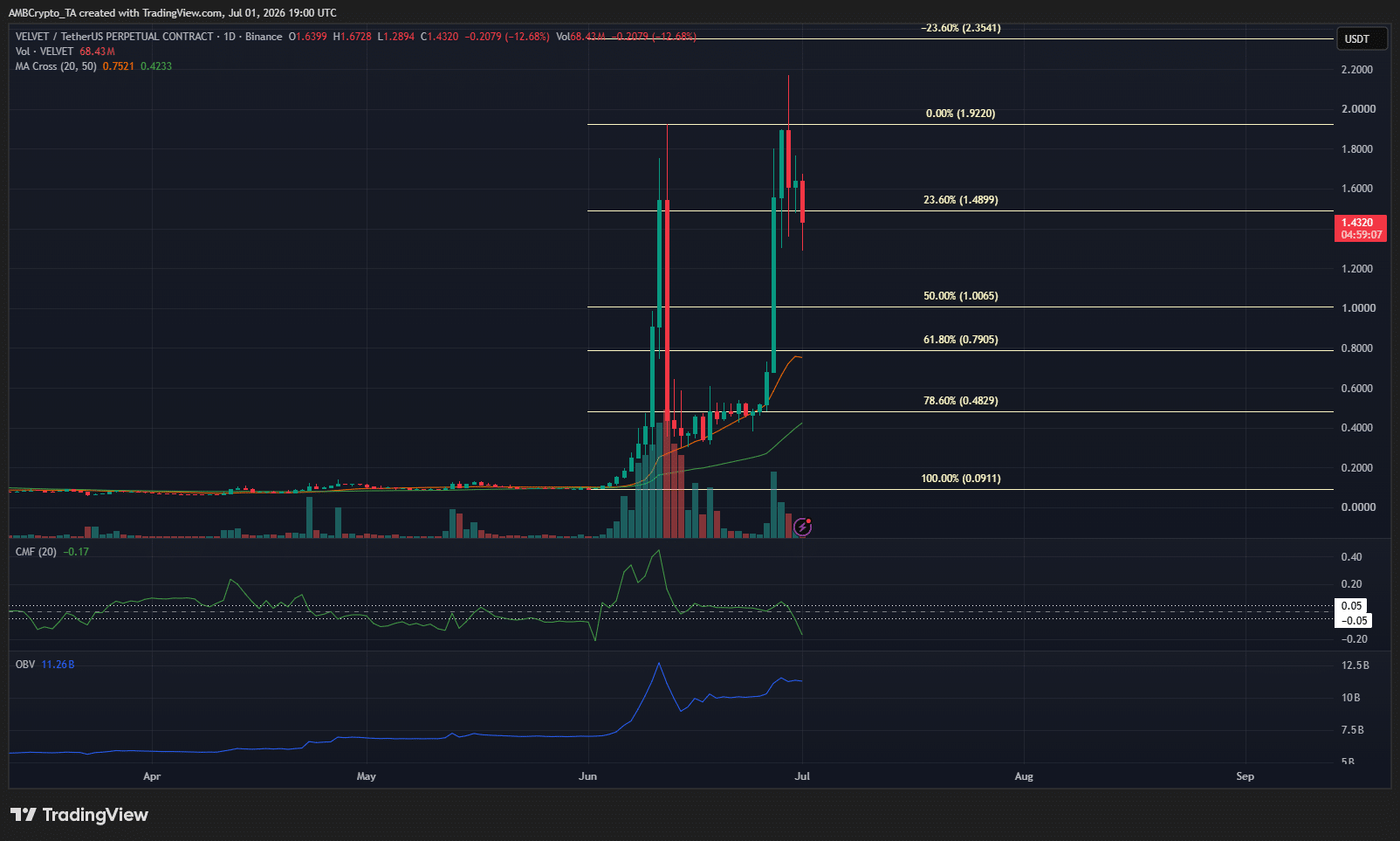
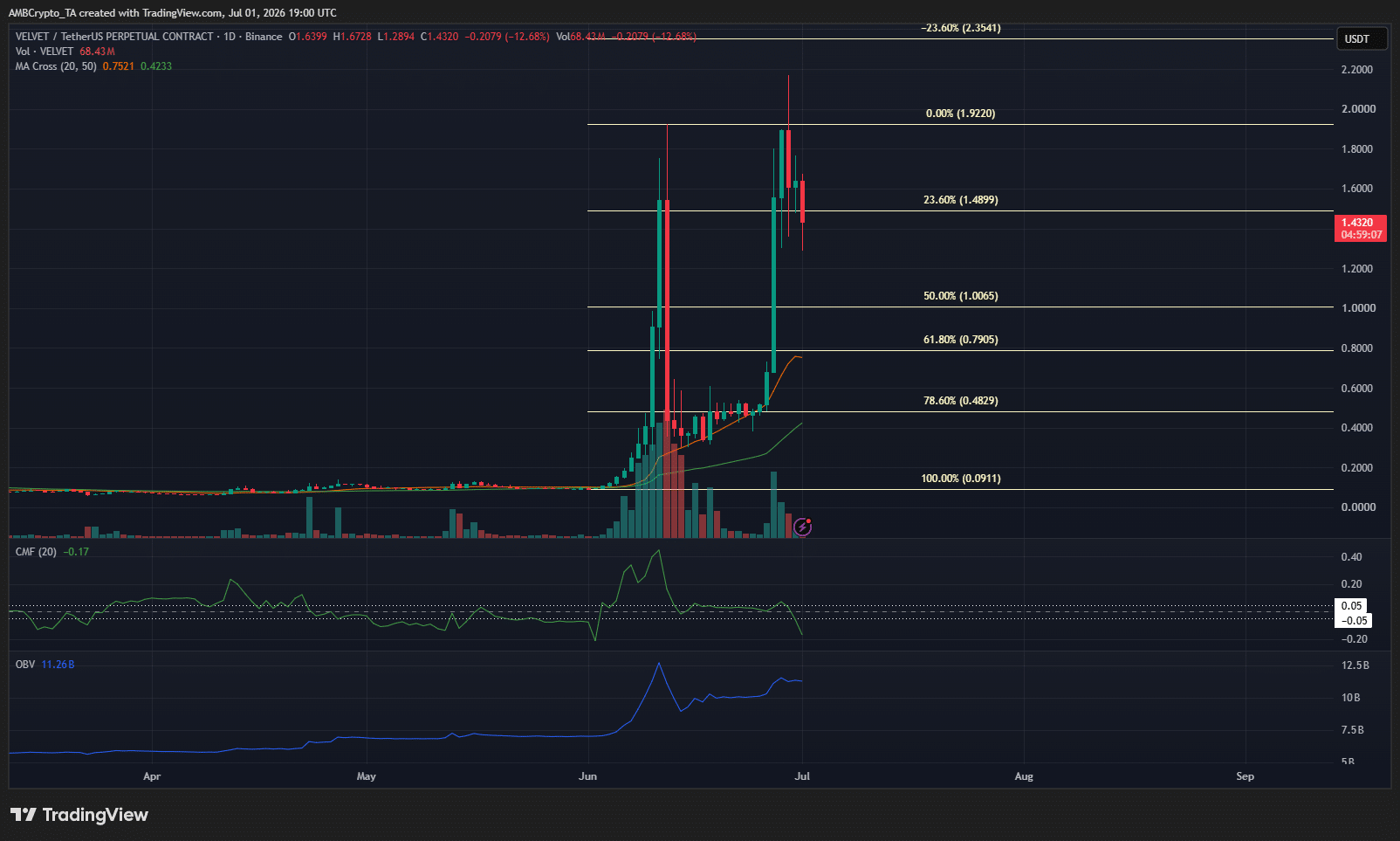
Source: VELVET on TradingView

The 1-day structure was bearish despite the deep correction from $1.922 to $0.302 in the second week of June. Interestingly, this retracement halted at the 20-day moving average dynamic support.

Since this correction, VELVET has rallied to the local $1.922 highs once again, climbing to $2.17 before pulling back in the past three days as discussed earlier.

The volume indicators gave mixed signals. The OBV was rising higher to show steady buying pressure, but the CMF sank below -0.05 in the past couple of days. Its current reading of -0.17 highlighted severe capital outflows from the VELVET market.

This incongruence between the volume indicators meant that there was short-term distributory pressure on the altcoin. Overall, the buying volume in recent weeks has been high, and the current wave of selling has not dented it.

Traders’ call to action- Use a pullback to buy

The risk-to-reward ratio was too low for traders to go long now. At the same time, there was no guarantee that VELVET had run its uptrend to the fullest and would now descend toward $0.48 and lower once again.
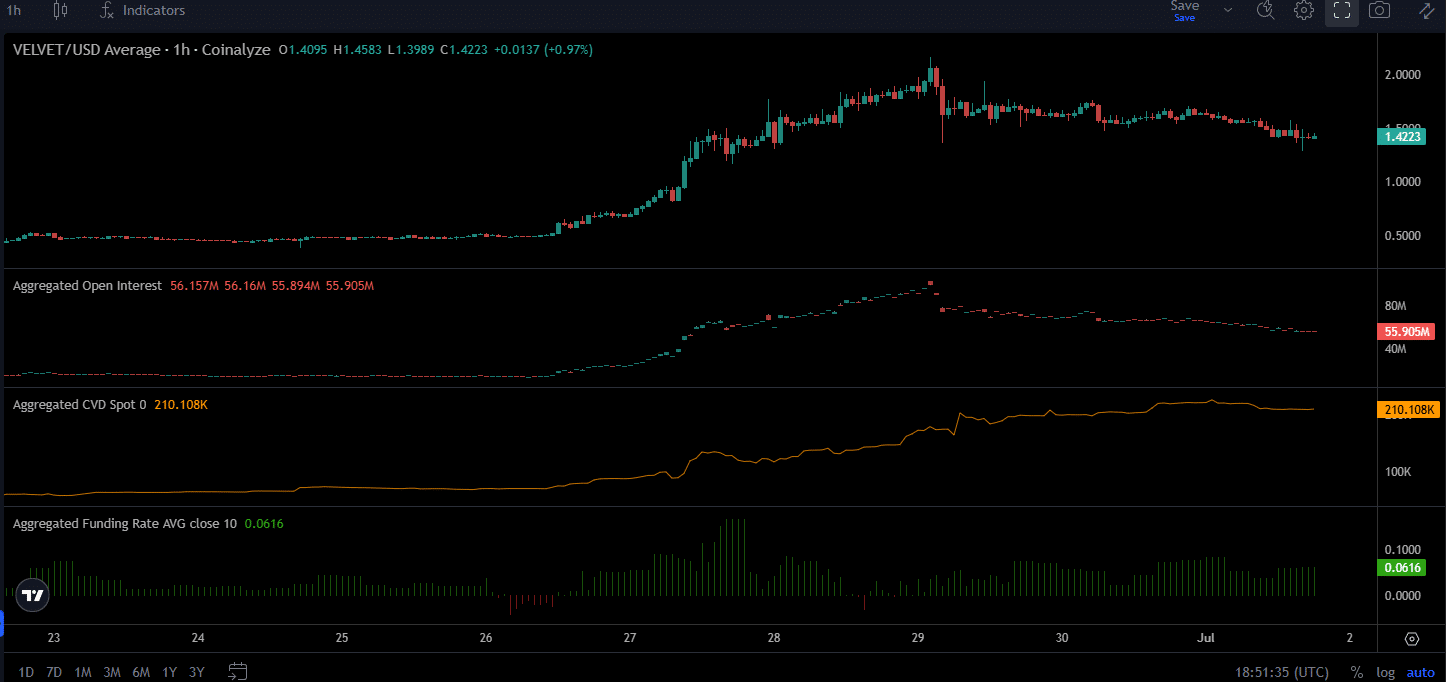
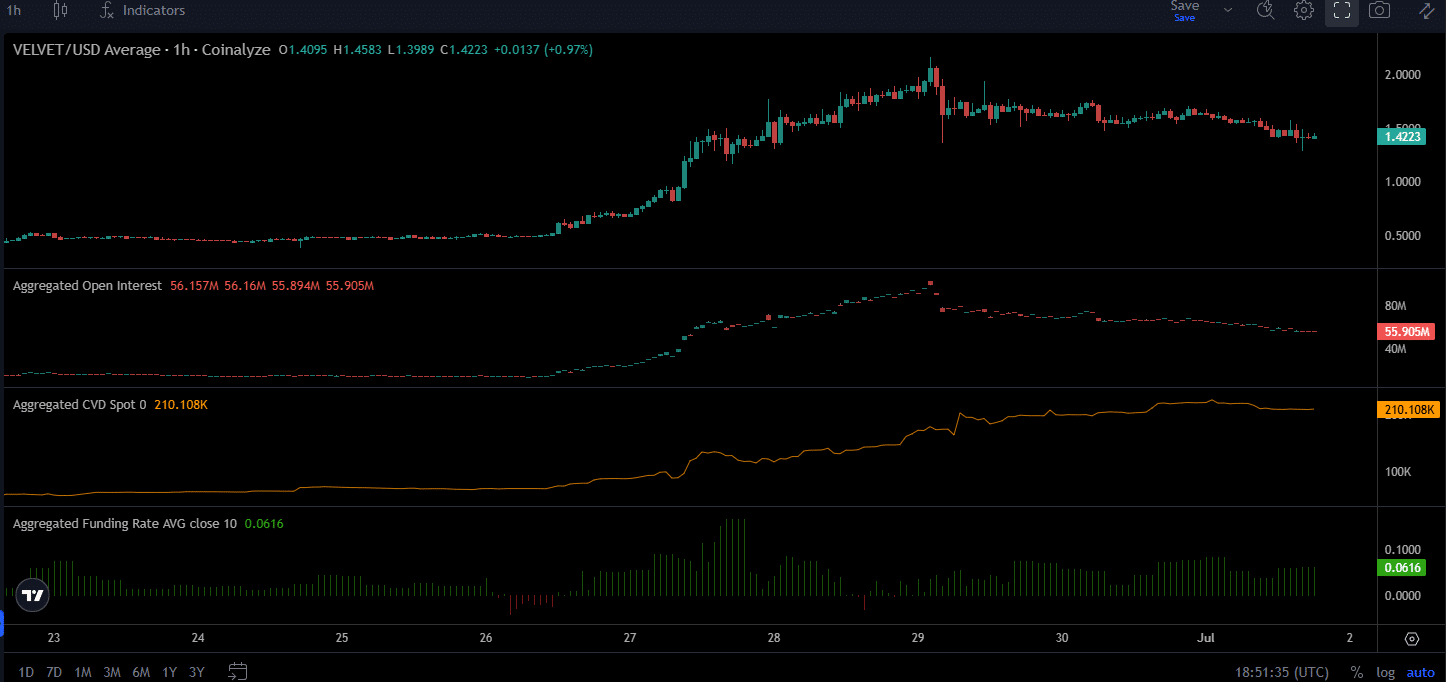
Source: Coinalyze

Though the OI was in decline, the spot CVD remained steady, as did the funding rate. This suggested short-term bearish momentum, but there was a good chance VELVET bulls would try to claim the $2 support once more.

The 20-day moving average at $0.75 was an interesting dynamic support to keep an eye on in case of a pullback.


Final Summary

  • Velvet had rallied to a high of $2.17 but was unable to flip the $2 psychological level from resistance to support.
  • It is unclear how deep the current pullback could go, but the evidence pointed toward controlled short-term distributory trends instead of full-blown profit-taking.

İlgili Sorular

QWhat was the key event that helped push Velvet's price briefly above $2.0?

AThe key event was the partnership news with Aerodrome Finance.

QAccording to the article, what are the conflicting signals shown by the volume indicators (OBV and CMF)?

AThe OBV was rising, showing steady buying pressure, while the CMF sank below -0.05, indicating severe capital outflows. This shows short-term distributory pressure despite high overall recent buying volume.

QWhat does the article suggest as a potential dynamic support level in case of a pullback for VELVET?

AThe article suggests the 20-day moving average at $0.75 as an interesting dynamic support level to watch in case of a pullback.

QBased on the data from Coinalyze, what do the steady spot CVD and funding rate suggest despite declining Open Interest?

AThe steady spot CVD and funding rate, despite declining Open Interest, suggest short-term bearish momentum but a good chance that VELVET bulls will try to reclaim the $2 support level again.

QWhat is the article's overall conclusion about the nature of the current pullback for VELVET?

AThe article concludes that while the depth of the pullback is unclear, the evidence points toward controlled short-term distributory trends rather than full-blown profit-taking by investors.

İlgili Okumalar

Robinhood Chain Mainnet Goes Live: Can Stocks Finally Be Moved Into Wallets?

Robinhood has officially launched its public mainnet, Robinhood Chain, along with stock-like tokens, the USDG yield product, and a DeFi lending portal. This marks a significant shift where a major online broker is integrating its user interface, regulatory compliance, self-custody wallet, and on-chain protocols into a single, streamlined experience. The goal is to simplify access to stock exposure, stablecoin yields, collateralized lending, and AMM trading for mainstream users. Eligible non-U.S. users can hold these "Stock Tokens"—structured as tokenized debt securities—in the Robinhood Wallet for 24/7 exposure to assets like U.S. stocks or ETFs. U.S. users can access an estimated ~7% APY on dollar-backed USDG through the Robinhood Earn program via self-custody wallets, with lending infrastructure powered by Morpho protocol. Built as a Layer 2 on Arbitrum, Robinhood Chain leverages existing DeFi protocols like Uniswap. The core strategy is not to reinvent DeFi but to channel Robinhood's large traditional finance user base (27.4 million funded customers as of Q1 2026) into on-chain finance, lowering the technical barriers. However, key limitations exist. The stock tokens are not direct equity ownership and are unavailable in the U.S. and some jurisdictions due to regulatory constraints. The ~7% yield is variable and carries inherent DeFi risks, not guaranteed principal protection. Furthermore, while AMMs enable trading, price discovery for major stocks will likely remain anchored in traditional markets like NASDAQ for the foreseeable future. Ultimately, Robinhood Chain is an early experiment in "on-chain brokerage." Its success will depend on real-world metrics like trading volume, sustained user migration to self-custody, stable yield performance, and regulatory feedback, rather than its launch narrative.

marsbit7 dk önce

Robinhood Chain Mainnet Goes Live: Can Stocks Finally Be Moved Into Wallets?

marsbit7 dk önce

Circle CEO Responds to OUSD Challenge: Stablecoin Market Is 'Winner-Takes-All', Consortium Model Doomed to Fail

Circle CEO Jeremy Allaire addresses market concerns following the announcement of the Open USD (OUSD) stablecoin project backed by 140 global companies. Allaire argues the stablecoin market exhibits "winner-takes-all" dynamics due to powerful network effects. He cites USDC's near-decade lead in three key areas: 1) **Application Integration & Protocol Development**: Thousands of integrated services and protocols (like CCTP) create utility and lock-in for developers and users. 2) **Liquidity Network Effects**: A deeply embedded, globally distributed liquidity infrastructure across primary and secondary markets, built over years. 3) **Regulatory Integration**: Extensive licensing and compliance groundwork ensuring USDC's acceptance in major markets like Europe and Japan. Allaire challenges OUSD's proposed advantages. He contends that promises of free redemption, while appealing, face market realities where such models can become exit routes for other stablecoins. He also questions the feasibility of fully distributing all revenue to an alliance, stating it would "starve" the critical infrastructure investments needed for scale and utility. Furthermore, he expresses skepticism about large alliance governance models, noting they often lead to slow decision-making and misaligned incentives. While welcoming OUSD to the ecosystem, Allaire reaffirms confidence in USDC's dominant position, backed by its long-term infrastructure investments and strong partnerships, including its ongoing collaboration with Coinbase.

marsbit9 dk önce

Circle CEO Responds to OUSD Challenge: Stablecoin Market Is 'Winner-Takes-All', Consortium Model Doomed to Fail

marsbit9 dk önce

Circle CEO Responds to OUSD Challenge: Alliance Model Doomed to Fail, It's a 'Winner-Takes-All' Game

Circle CEO Jeremy Allaire addresses the challenge posed by the new Open USD (OUSD) stablecoin project, backed by 140 global companies. He argues that the stablecoin market exhibits "winner-take-all" characteristics, where USDC's near-decade-long lead in application integrations, global liquidity, and regulatory compliance secures its dominant position. Allaire outlines three key network effects underpinning USDC's strength: 1) Extensive integration as an internet protocol layer, 2) Deep, globally distributed liquidity networks, and 3) Deep integration with global policy and regulatory frameworks. He cites data showing USDC facilitated 80% of on-chain USD stablecoin transaction volume in Q1 2026. He directly counters OUSD's proposed advantages: 1) "Free minting and redemption" may not be sustainable against market realities, which USDC addresses via contractual mechanisms. 2) "Sharing all revenue" risks starving the infrastructure of necessary investment for growth and reliability. 3) A "consortium model" often leads to slow innovation and poor coordination compared to focused, independent operators like Circle. Allaire reaffirms Circle's strong partnership with Coinbase and notes that Circle continues to collaborate with many OUSD founding members. He concludes by welcoming OUSD to the ecosystem while expressing confidence in USDC's entrenched network advantages and continued expansion.

Odaily星球日报13 dk önce

Circle CEO Responds to OUSD Challenge: Alliance Model Doomed to Fail, It's a 'Winner-Takes-All' Game

Odaily星球日报13 dk önce

dYdX Changes Tack and Starts Anew, This Time Partnering with Robinhood: Will It Succeed?

On July 1st, dYdX Labs, in partnership with Robinhood Crypto, launched the Beta version of Arcus, a new decentralized exchange (DEX). Deployed on the newly launched Robinhood Chain (an L2 built on Arbitrum), Arcus supports spot trading for 95 tokenized stocks and plans to introduce cross-asset perpetual contracts. This marks a separate, new product line for the dYdX team, distinct from the existing dYdX Chain. Arcus's core features promise 24/7 trading, self-custody, and institutional-grade liquidity. Initial offerings include zero-fee web-based spot trading and a perpetual contracts testnet. Future plans involve using tokenized stocks as collateral and providing access to Pre-IPO investments. The platform is not available to users in the US, Canada, the UK, and other restricted jurisdictions. This move follows dYdX's v4 upgrade, which, while achieving full decentralization, faced criticism over performance and tokenomics, leading to a loss of market share. Arcus represents a strategic pivot, leveraging Robinhood's vast user base to target the RWA (Real World Assets) sector and global 24/7 trading. The dYdX Foundation clarified that Arcus is a parallel product incubated by dYdX Labs, and the original dYdX Chain continues to operate independently. While no official token plans have been announced, market participants speculate about potential new tokens or airdrops from the Arcus project.

Foresight News20 dk önce

dYdX Changes Tack and Starts Anew, This Time Partnering with Robinhood: Will It Succeed?

Foresight News20 dk önce

İşlemler

Spot
活动图片