Introducing: Market Compass

insights.glassnode2026-06-18 tarihinde yayınlandı2026-06-18 tarihinde güncellendi

Özet

Glassnode introduces Market Compass, a dashboard providing a unified view of Bitcoin market conditions. It consolidates thousands of on-chain and market metrics into seven "lenses." Four forward-looking lenses (Macro, Capital Flows, Investor Behavior, On-Chain Fundamentals) feed a headline composite score from 0 (Risk-Off) to 100 (Risk-On). Three standalone lenses (Cycle Position, Derivatives, Cross-Asset Rotation) describe the current market structure. In the current reading, the headline score is 14/100 (Risk-Off), indicating a defensive regime. The Macro lens is the weakest at 23, constrained by a strong US Dollar (DXY) trading above its 200-day average. While the other forward-looking lenses show moderate improvement from recent lows, the overall picture suggests bottom-fishing within an unturned market cycle. Key observations include stablecoin supply shrinking (reduced buying power), long-term holders absorbing supply, tepid on-chain demand, and a derivatives market coiled for a potential move. The tool is designed as a contextual map, not a direct trading signal, synthesizing complex data into a single coherent read.

The hardest part of using Glassnode has never been finding the right metric. It is knowing which of the thousands to trust on any given morning, and what they add up to. The Glassnode Market Compass fixes that. It takes the indicators our analysts trust most, reads them together, and puts a single coherent read on your screen.

It does this through seven lenses. Each lens is scored from 0 to 100 and mapped to a named regime, so a glance tells you whether macro is Tightening or Expansionary, whether capital is Drained or Flush, whether holders are Distributing or Accumulating. The dashboard refreshes every day. The written read on top of it refreshes every week.

Seven lenses, two jobs

Four of the lenses are forward-looking. Macro, Capital Flows, Investor Behaviour and On-Chain Fundamentals each carry a historical relationship with where Bitcoin trades next, so the Compass averages them into the headline score that runs from Risk-Off to Risk-On. Read this one first. It is a forward-looking index, not a forecast.

The other three are standalone. Cycle Position, Derivatives and Cross-Asset Rotation describe where the market sits today rather than where it heads, so they are kept out of the headline on purpose. A frothy derivatives book tells you positioning is stretched, not which way price breaks.

Forward-looking (these feed the headline):

  • Macro: Tightening to Expansionary
  • Capital Flows & Liquidity: Drained to Flush
  • Investor Behaviour: Distributing to Accumulating
  • On-Chain Fundamentals: Contracting to Hot

Standalone (these describe the current environment):

  • Cycle Position: Capitulation to Euphoria
  • Derivatives: Deleveraged to Frothy
  • Cross-Asset Rotation: BTC Season to Altseason
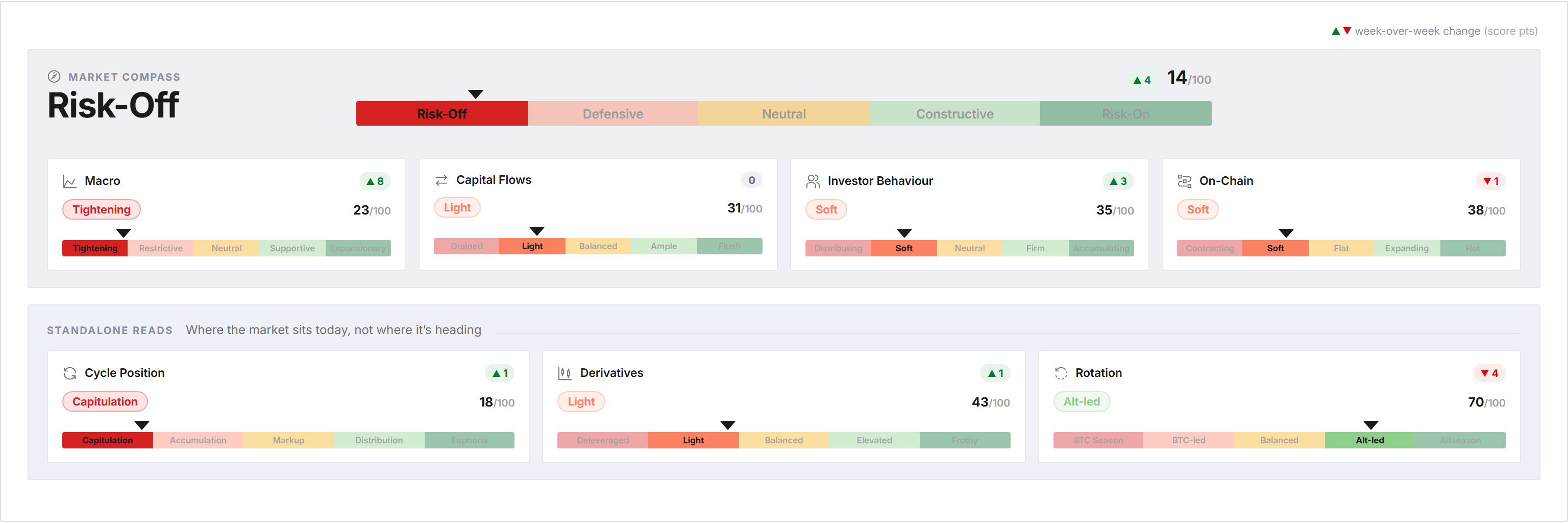
The Market Compass at a glance: the headline composite above the four forward-looking lenses, with the three standalone reads below.

What it is, and what it is not

The Compass is a map. It does not tell you to buy or sell, and it is not the Bitcoin Vector, our systematic product, where strategies like the Moderate Strategy actually move allocation in and out of the market. The Vector acts. The Compass tells you where you are standing, so that a signal, or your own judgement, has context to work from.

The consolidation is the whole point. Glassnode's problem has never been too little data; there are thousands of charts to choose from, each of which answers a sliver of the question. The Compass reads them together and takes a position. Some of what it shows, a handful of the lens-level analyses, is built specifically for this product and is not on the API or in Studio. The Compass is currently still in Beta and we will be updating this with our newest experimental metrics regularly.

How to read a lens

Every lens works the same way. A basket of indicators is distilled into one 0 to 100 reading, ranked against its own multi-year history, so the score answers a precise question: how does today compare to everything this lens has done before? Five named bands turn that number into plain language

A lens score draws on an index that is built from more than just the charts on its page. The additional figures often add important context that is difficult to capture in a single score. We also provide the change, showing each lens carry its 7-day and 30-day move next to the score. This helps the reader intuitively understand how fast scores are changing.

Reading the Compass today

The headline currently reads 14 out of 100, Risk-Off, a level the composite only reaches in genuine bear phases, with Bitcoin near $64,400 and down 16% on the month. Beneath the number, there is additional useful context: four of the forward-looking lenses are climbing off their 30-day lows at once. The regime is defensive but it is quietly repairing from the inside.

Macro

Macro reads the backdrop for risk: the dollar, the yield curve, the front-end policy path. It sits at 23, Tightening, the weakest of the four forward-looking lenses and the binding constraint on the headline. The dollar is the reason for this. DXY is at 100.3, about 1.7% above its 200-day average, the widest premium to trend of the whole downturn. The lens has climbed from 9 a month ago, showing a moderate improvement in macro conditions. It remains to be seen whether that can help BTC heal.
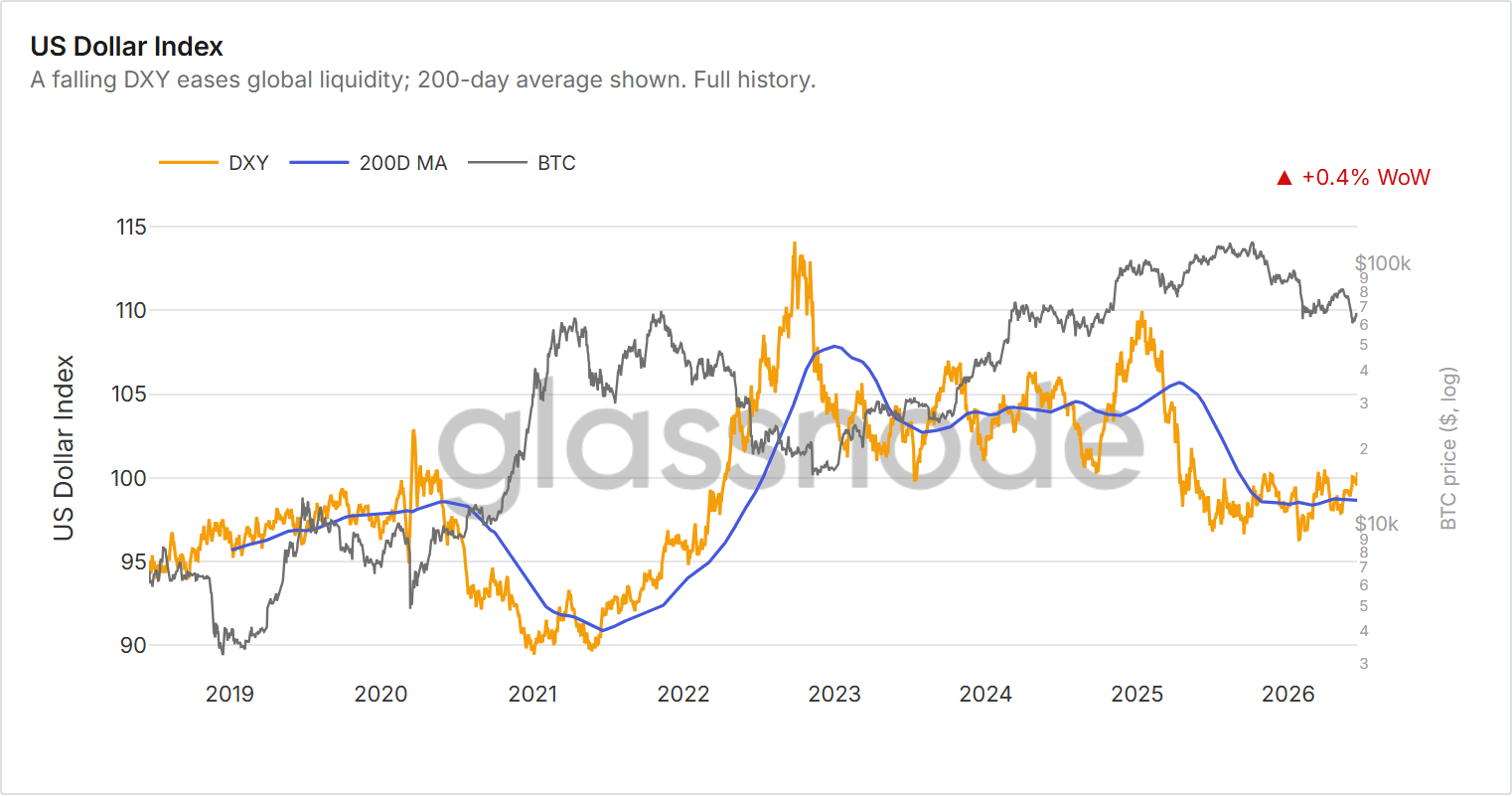
The US Dollar Index against its 200-day average, with BTC overlaid. A dollar bid above trend is a headwind for risk.

A DXY close back below its 200-day average is the single most important threshold in the framework, and it has not happened.

Capital Flows & Liquidity

Capital Flows tracks the money available to bid: stablecoin firepower, coins moving on and off exchanges, the stock held by patient accumulators. It reads 31, Light, down from 49 a month ago and flat on the week. A strong signal we are seeing here is stablecoin supply, the market's dry powder, whose 30-day rate of change has turned negative near minus 2%.
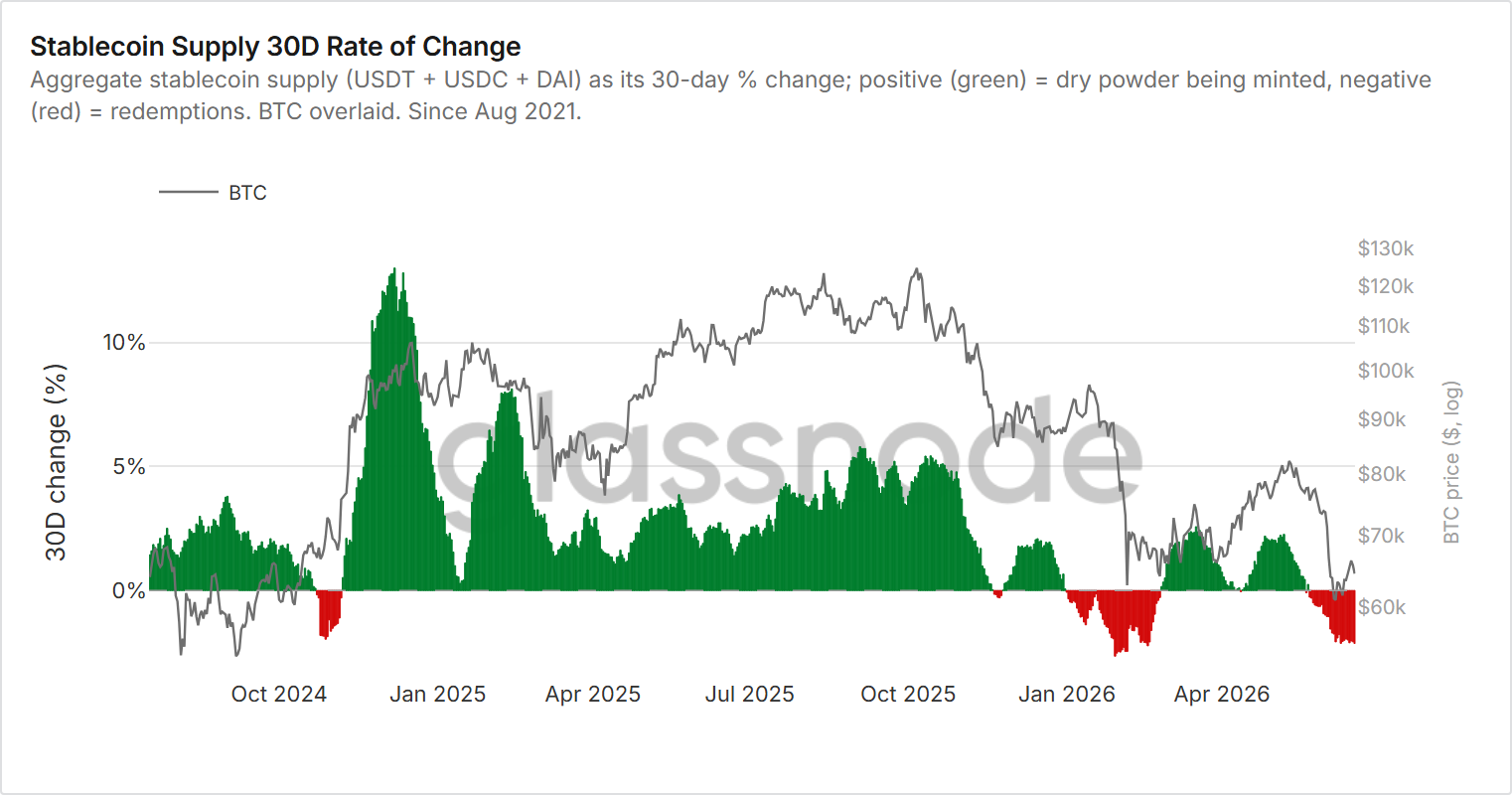
Stablecoin supply as a 30-day rate of change. Green bars are dry powder being minted; red bars are redemptions.

Exchange balances keep draining and spot buying has held net positive for two straight weeks, so the marginal coin is still being absorbed even as firepower leaves. The engine is not leaking hard, but it is not running either, and a minor flip back to positive on US spot ETF flows is the first clean sign it has restarted.

Investor Behaviour

Investor Behaviour reads what holders do with their coins: accumulate or distribute, hold or spend, and at what age. At 35, Soft, it is the most-improved forward-looking lens, up from 15 a month ago, the classic drawdown mechanic of supply migrating into stronger hands. Long-Term Holder supply just set a multi-year high at 88.1% of the float.
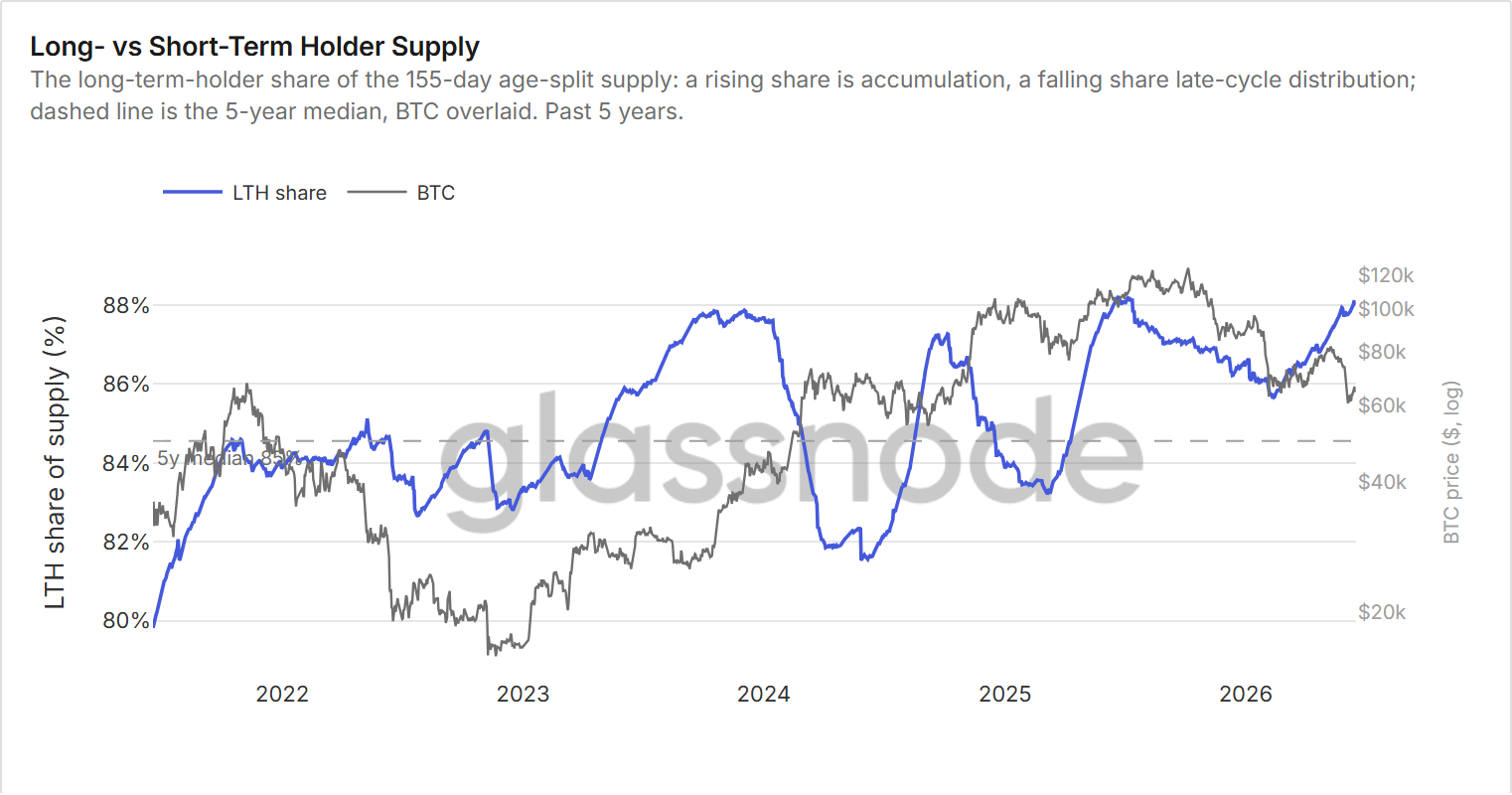
The long-term-holder share of supply against BTC. A rising share is accumulation; a falling share is late-cycle distribution.

The intensity has halved, though. Hodler Net Position is still positive but down more than 60% on the week, and the Accumulation Trend Score has stalled at 0.44. Holders are soaking up the supply that sellers hand them, and the lens only turns firm once the Accumulation Trend Score crosses 0.5.

On-Chain Fundamentals

On-Chain Fundamentals is the synthesis of our demand picture: new users arriving, the network's valuation against the throughput it settles, and blockspace demand in native Bitcoin rather than dollars, which strips out the price leg. It reads 38, Soft, a network still contracting with one corner firming. Fee momentum has climbed to 0.987, near the 1.0 line that marks demand turning up, and small-entity activity runs well above large-entity activity.
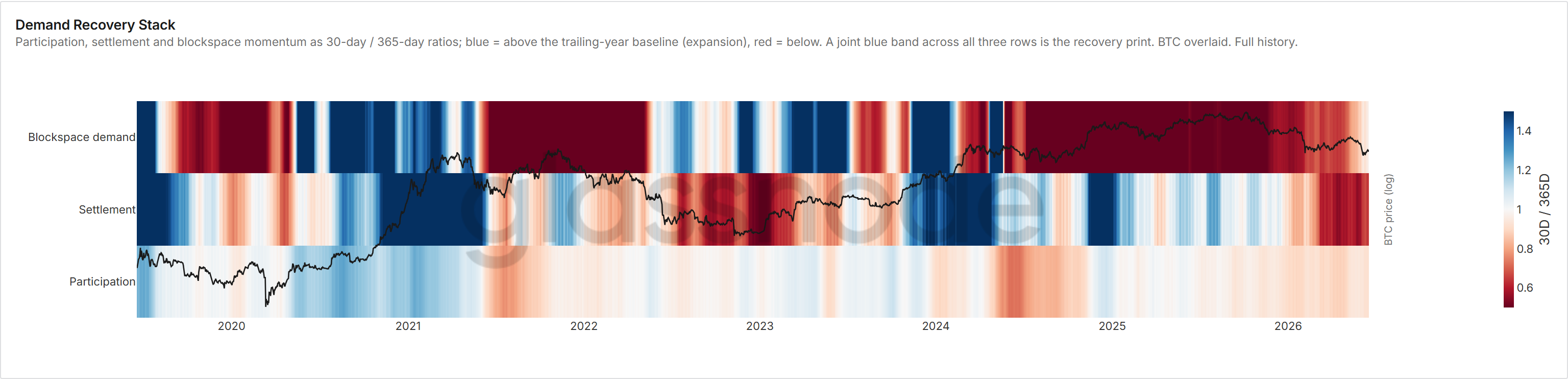
The Demand Recovery Stack: participation, settlement and blockspace momentum. Blue is above the trailing-year baseline, red is below.

A joint blue band across all three rows of the stack is the recovery print; today blockspace is warm but the trend is cooling while participation and valuation lag. Price is being repriced higher faster than the network is recovering, and fee momentum clearing 1.0 is what would confirm the economy is catching up.

Cycle Position

The standalone lenses describe structure rather than feeding the headline. Cycle Position places the market on its clock, from Capitulation to Euphoria, using profitability and holder conviction rather than price alone. It reads 18, Capitulation, down from 36 a month ago.
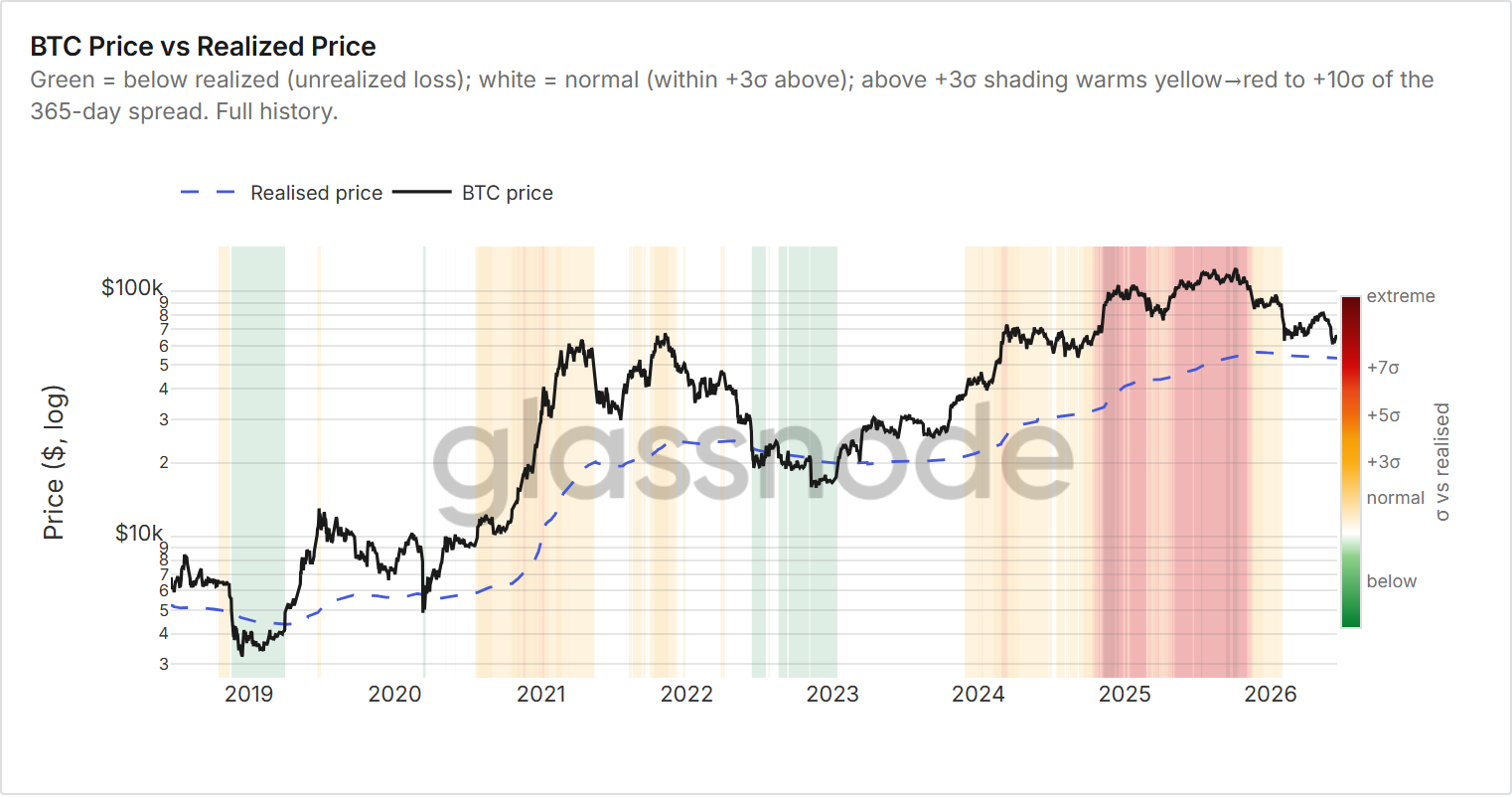
A Realized Profit/Loss Ratio at a fresh cycle low is what dragged the lens into the Capitulation band. Yet spot near $64,400 still trades well above the Realized Price around $53,500, and the chart's shading has cooled from the deep red of late 2025 back toward neutral. The stress shows up in realized-loss flows while spot holds above cost basis, which reads as a liquidity-led bounce rather than a true value bottom.

Derivatives

Derivatives measures leverage and froth: open interest against market size, the cost of carrying a perpetual, and the futures term structure. It reads 43, Light, a coiled and well-hedged book. Funding is negative, so shorts pay to stay short, and BTC implied volatility has compressed below 40, both ingredients of a squeeze.
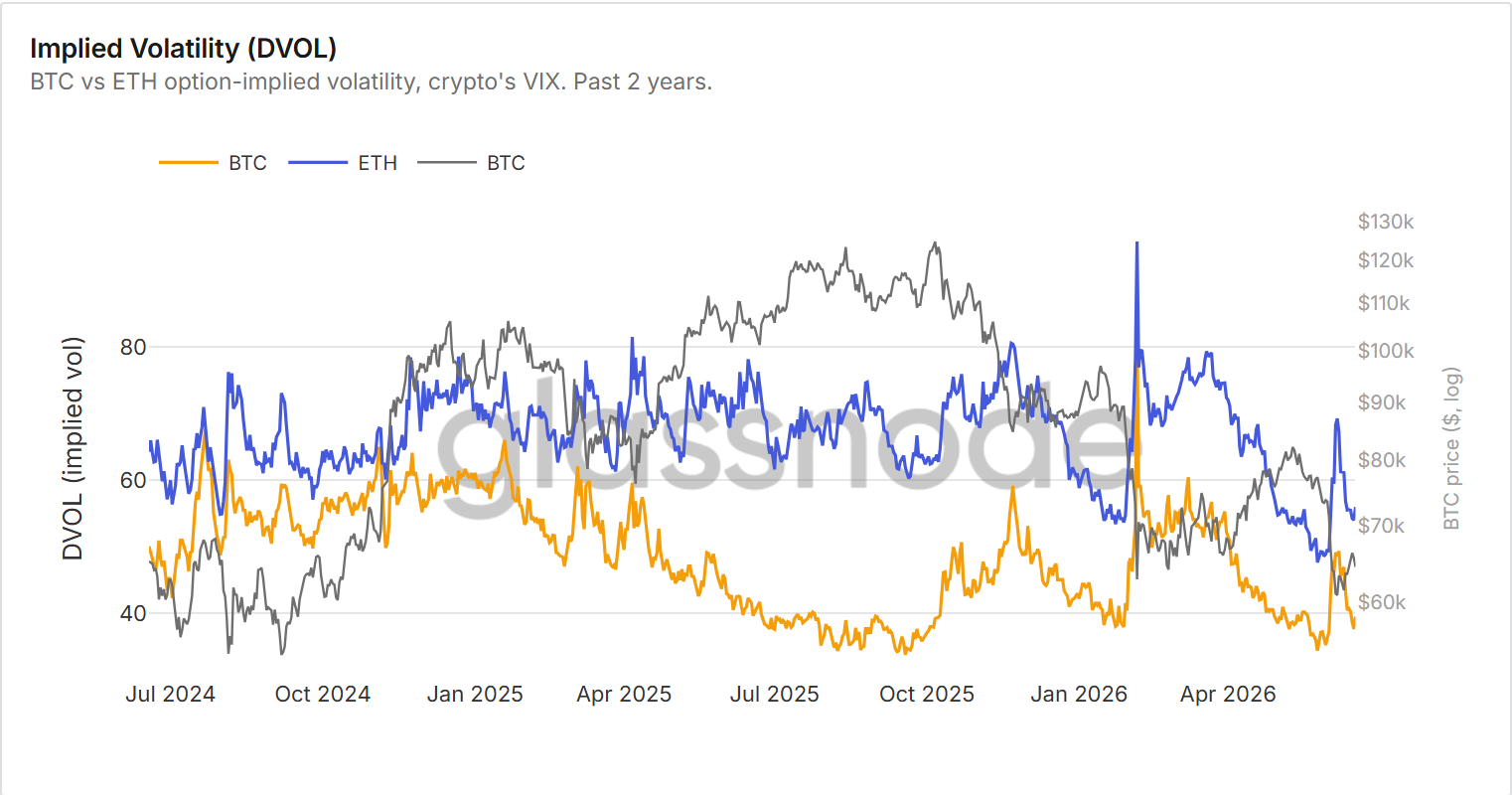
BTC and ETH option-implied volatility, crypto's VIX. BTC DVOL has compressed below 40.

The catch is that 25-delta skew is positive across every tenor, so the same desks are paying for downside protection. Positioning is coiled, not committed, and a DVOL break below 35 or back above 40 will show which way the spring releases.

Cross-Asset Rotation

Rotation reads capital moving between Bitcoin and everything else, from BTC Season to Altseason. It is the loudest reading on the board at 70, Alt-led, with the Altcoin Season Index at 87.5. That sounds like risk appetite.
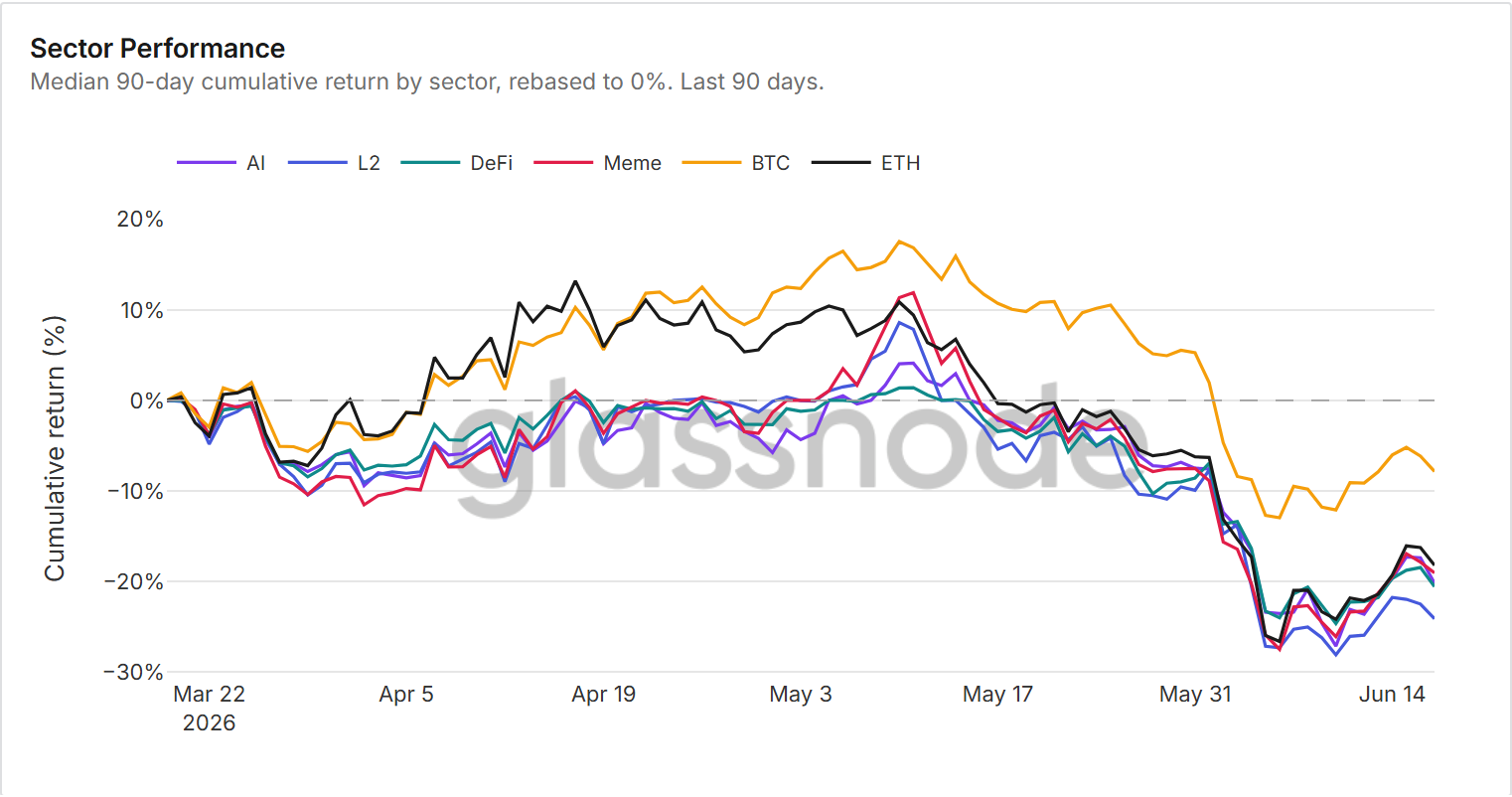
Median 90-day cumulative return by sector, rebased to zero. Every tracked sector is deeply negative.

The sector chart says otherwise: every tracked sector is down 19% to 24% over 90 days. What the index captures is outperformance by falling less, with large-cap alts down 14% on the month against Bitcoin's 16%. It marks dispersion and a relative cushion rather than a fresh bid, and because the index measures relative performance on a rolling 90-day window, the spring alt run aging out of the lookback sets up a mechanical fade even if nothing else changes.

Putting it together

Top to bottom, the Compass tells a story no single metric would. The composite at 14 is held down by Macro, and Macro is held down by a dollar trading above trend. Underneath, the forward-looking lenses are repairing as the drawdown pushes coins into stronger hands. The standalone lenses fill in the texture: a cycle washing out in flows but not valuation, a derivatives book coiled and hedged, and a rotation read that looks bullish until you notice everything is down. The honest read is bottom-fishing inside a regime that has not turned, and the one move that would turn it, a dollar back below its 200-day average, has not come.

That is the case for reading the whole board at once instead of one chart at a time.

Now live for Glassnode Advanced and Professional users, with the data refreshed daily and the written summary refreshed by our analyst team each week.

Explore the Market Compass

  • Follow us on X for timely market updates and analysis
  • Join our Telegram channel
  • For on-chain metrics, dashboards, and alerts, visit Glassnode Studio

İlgili Sorular

QWhat is the primary purpose of the Glassnode Market Compass and what problem does it aim to solve?

AThe primary purpose of the Glassnode Market Compass is to provide a consolidated, coherent market read by synthesizing numerous complex on-chain and market indicators. It solves the problem of information overload and analysis paralysis, as Glassnode's difficulty was never finding the right metric but knowing which of the thousands to trust and what they collectively indicate on any given day.

QWhat are the two distinct groups of lenses in the Market Compass, and how are they used differently?

AThe two groups are forward-looking lenses and standalone lenses. The four forward-looking lenses (Macro, Capital Flows & Liquidity, Investor Behaviour, On-Chain Fundamentals) are averaged into the composite headline score (Risk-Off to Risk-On) as they have a historical relationship with future price direction. The three standalone lenses (Cycle Position, Derivatives, Cross-Asset Rotation) describe the current market structure and environment but are purposely kept out of the headline score as they indicate current positioning rather than future direction.

QAccording to the article's current analysis, what is the single most important threshold needed for the market regime to turn, and has it been met?

AThe single most important threshold for the market regime to turn, according to the framework, is a close of the US Dollar Index (DXY) back below its 200-day average. As of the article's analysis, this has not happened, with DXY trading about 1.7% above its 200-day average.

QHow does the 'Cross-Asset Rotation' lens reaching a score of 70 ('Alt-led') align with the actual performance of altcoin sectors described in the article?

AThere is a contradiction. While the 'Cross-Asset Rotation' lens reads a high 70 ('Alt-led'), indicating altcoin season, the underlying sector chart shows every tracked altcoin sector is down 19% to 24% over 90 days. The high index score reflects relative outperformance (e.g., large-cap alts down 14% vs. Bitcoin's 16% in a month), meaning they are falling less, not that there is fresh buying interest. It signals dispersion and a relative cushion, not a bullish altcoin bid.

QWhat is the 'honest read' or overall conclusion the Compass provides about the current Bitcoin market state as of the article's publication?

AThe honest read is that the market is in a phase of 'bottom-fishing inside a regime that has not turned.' The composite score is a deep Risk-Off 14, held down primarily by a strong US Dollar (Macro lens). While the forward-looking lenses show internal repair (e.g., coins moving to stronger hands), the standalone lenses reveal a cycle washing out in flows but not valuation, coiled derivatives positioning, and misleadingly strong rotation metrics. The overall regime remains defensive, awaiting a key catalyst (DXY dropping below its 200-day average) to signal a turn.

İlgili Okumalar

Conversation with Investor Zheng Di: MicroStrategy's Coin Sale Experiment, AI Economy, and Opportunities in US Stocks

Frontier tech investor Zheng "Didier" Di discusses the recent Bitcoin price drop, the financial strategy shift at MicroStrategy, the AI-driven surge in U.S. stocks, and the evolving role of crypto exchanges. Didier posits that the recent BTC decline stems less from macro factors or ETF outflows, and more from market repricing due to MicroStrategy's new financial structure. Following a wave of preferred stock and debt issuance (STRC, STRZ, etc.), MicroStrategy must now manage cash flow to pay dividends, potentially leading to a market expectation of sustained, small-scale BTC sales to maintain its "per-share bitcoin neutral" principle. Didier views this as a financial "experiment" testing market capacity for such recurring sell pressure, which, while creating near-term structural headwinds, likely avoids a true "death spiral" absent major new external shocks. Shifting to AI, Didier argues that tokens are becoming the new form of labor, with AI models and compute (tokenized inputs) increasingly replacing human roles in execution and middle-management. This drives enterprise efficiency and higher margins, fueling the sustained rally in U.S. semiconductor, data center, and infrastructure stocks. He foresees an emerging "machine economy" where automated agents transact and collaborate on-chain. Regarding crypto exchanges offering U.S. equities, Didier sees this as a natural evolution. With few crypto-native assets generating lasting value, exchanges are pivoting towards real-world assets (RWAs) like stocks and bonds. This doesn't necessarily cannibalize crypto but reflects a maturing industry focusing on blockchain's core utilities: decentralized choice and efficient settlement. He notes that trading logic for crypto natives doesn't need to drastically change, as meme-driven and fundamentalist strategies find analogs in U.S. markets. The "1011 event" (likely referring to a major market crash) severely damaged crypto market liquidity, marking a probable end to the altcoin speculative cycle, with capital flowing towards the deeper liquidity of U.S. markets. For the macro outlook, Didier is cautious about near-term market pressure from potential mega-IPOs (e.g., SpaceX) and the U.S. midterm elections, which could bring more regulatory scrutiny. Long-term, he remains bullish on AI's productivity gains and its convergence with blockchain/Web3, predicting a shift from speculative frenzy to a more institutionalized, industrial phase for the crypto sector.

marsbit24 dk önce

Conversation with Investor Zheng Di: MicroStrategy's Coin Sale Experiment, AI Economy, and Opportunities in US Stocks

marsbit24 dk önce

Playnance’s $GCOIN Lists on KoinBX Amid Rapid Growth in India

Playnance's native token, $GCOIN, has been listed on the cryptocurrency exchange KoinBX as of June 18. This move aims to enhance accessibility for its rapidly growing community, particularly in India, where the blockchain-powered Web3 iGaming ecosystem has gained significant traction. Over 130 partners in Playnance's "Be the Boss" program have built communities engaging thousands of active players in the region. The "Be the Boss" model allows participants to create and manage their own gaming communities, earning rewards tied to community activity. CEO Pini Peter noted India's high engagement, with community leaders successfully building player networks. One partner, Dr. Nicolas, reported earning over $57,000 through the program in recent months, highlighting both the financial rewards and the opportunity to grow an engaged community. $GCOIN serves as the ecosystem's core utility token, incentivizing participation and aligning the interests of players and community leaders ("Bosses"). The listing on KoinBX is part of Playnance's strategy to expand globally, increasing the token's utility and accessibility by combining community ownership, gamified engagement, and blockchain-based incentives. Founded in 2020, Playnance is a Web3 iGaming infrastructure company focused on creating live, non-custodial, on-chain products to onboard mainstream users. It currently processes approximately one million transactions daily, aiming to simplify the user experience while maintaining full on-chain transparency.

TheNewsCrypto1 saat önce

Playnance’s $GCOIN Lists on KoinBX Amid Rapid Growth in India

TheNewsCrypto1 saat önce

STRC Hits Historic Low, Saylor's Perpetual Motion Machine Grinds to a Halt

STRC, the perpetual preferred stock issued by MicroStrategy to fund its Bitcoin purchases, hit a historic low of $85.32, a 17% discount to its $100 par value. Designed as a "digital credit engine" to trade stably near par and enable continuous share issuance for buying Bitcoin, its plunge signals a breakdown in this model. Three key factors drove the decline: 1. Bitcoin's price fell over 50% from its peak, trading around $63,000 amid hawkish Fed signals. 2. MicroStrategy's cash reserves were depleted after a $1.5 billion convertible note repayment, slashing the dividend coverage for STRC's 11.5% yield to ~7 months. The company then sold 32 BTC to cover dividends—Michael Saylor's first Bitcoin sale since 2022—damaging the "never sell" narrative. 3. A competing Bitcoin-backed preferred stock, Strive's SATA, offers a higher yield (~13%) and daily dividends, drawing investors away from STRC. The drop triggers a negative cycle: STRC below par halts ATM share issuances, cutting off a key funding source for Bitcoin buys and potentially forcing more BTC sales for dividends, further eroding confidence. While Saylor argues the model is mathematically sound—needing only 2.3% annual Bitcoin growth to sustain itself—the market is testing the resilience of the leveraged Bitcoin treasury strategy in a bear market. The STRC price now reflects rising skepticism about this financial machinery's durability during downturns.

marsbit1 saat önce

STRC Hits Historic Low, Saylor's Perpetual Motion Machine Grinds to a Halt

marsbit1 saat önce

A Guide to Grayscale’s ‘Bottom Fishing’: Using Cash Flow to Assess Cryptocurrency Value

**Title:** Grayscale's Guide to Bottom-Fishing: Valuing Cryptoassets Using Cash Flows **Summary:** This report by Grayscale Research presents a fundamental valuation framework for cryptocurrency assets, moving beyond pure speculation to analyze those with underlying cash flows. It distinguishes between "commodity-like" assets (e.g., Bitcoin) and "cash-flow" assets, primarily within DeFi. Using the leading decentralized lending protocol Aave as a case study, the analysis applies traditional financial methodologies like Discounted Cash Flow (DCF) and Price-to-Earnings (P/E) multiples. Key findings indicate that AAVE tokens are currently undervalued. Despite recent challenges, the protocol's strong revenue growth, ~50% net profit margin, and diversified treasury support a fundamental valuation range of $80-$100 per token (compared to a ~$75 market price at the time of writing). In a base-case scenario driven by stablecoin adoption and regulatory clarity, the fair value could rise to around $175 within a year. The report emphasizes that protocol success does not automatically translate to token value. It critically examines the "value capture" mechanisms—such as buybacks, burns, and staking rewards—that channel protocol profits to token holders. Furthermore, it addresses the legal and governance complexities of Decentralized Autonomous Organizations (DAOs), noting their difference from traditional corporate equity but highlighting how robust, transparent governance can align protocol economics with holder interests. The conclusion is that the crypto market is maturing, with capital increasingly flowing towards projects with demonstrable fundamentals, real adoption, and disciplined capital allocation, creating opportunities for value-based investors.

marsbit2 saat önce

A Guide to Grayscale’s ‘Bottom Fishing’: Using Cash Flow to Assess Cryptocurrency Value

marsbit2 saat önce

İşlemler

Spot
Futures
活动图片