Why Does No One Buy DeFi Insurance?

marsbit2026-06-23 tarihinde yayınlandı2026-06-23 tarihinde güncellendi

Özet

**Title: Why Isn't DeFi Insurance Being Bought?** DeFi insurance, which promised automated, unbiased payouts via smart contracts, has failed to gain traction. The core issue is economic: high premiums severely erode the yields that attract users to DeFi in the first place. For example, insuring a USDC deposit on Aave V3 could cost 1.5–2.5% of the annual yield, leaving a net return barely above a savings account. For riskier platforms like Maple Finance or Ethena, premiums can even turn net yields negative. Consequently, users often forgo insurance, as it nullifies their profit motive. The market also suffers from structural flaws. First, DeFi risks are highly correlated (e.g., an oracle failure can impact multiple protocols simultaneously), unlike the independent risks in traditional insurance. This makes large-scale events potentially catastrophic for insurers. Second, the total capital in DeFi insurance pools (e.g., Nexus Mutual's ~$81.5M) is minuscule compared to the hundreds of billions in total value locked (TVL), creating a massive capacity gap. A single major hack could drain the entire industry's reserves. Furthermore, the governance model where tokenholders vote on claims creates a conflict of interest, incentivizing them to deny payouts to protect their own funds. As a result, the sector is shrinking. While pioneers like Nexus Mutual are pivoting to preventative measures (bug bounties) and seeking external capital via reinsurance, the fundamental problems remai...

Author: Thejaswini M A

Compiler: Luffy, Foresight News

"Insurance is purely a scam," is almost a consensus in the market.

There is good reason for people to think this way. Cigna in the US developed an algorithm that can deny claims directly without reviewing medical records. UnitedHealth Group stops paying for care as soon as the time limit set by its algorithm expires, completely ignoring the opinions of the treating doctors. The business model of traditional insurance has always been: first collect customer funds, take a high commission, then set up barriers at every level to hinder claims settlement.

Today, bank deposits are insured by the Federal Deposit Insurance Corporation (FDIC), but the coverage limit is only $250,000, a standard set in 1934 that has hardly been adjusted. Brokerage accounts are protected by the Securities Investor Protection Corporation (SIPC), with a limit of $500,000; once account assets exceed that amount, the protection becomes meaningless. The public perception of protection is far weaker than reality, with coverage limits set unilaterally by the insurance companies.

DeFi insurance could have completely solved this pain point: eliminate intermediaries. Payouts would be executed automatically as long as the smart contract's preset conditions are triggered, completely removing the possibility of malicious claim denials.

But the reality is that almost no one buys it. Insurance premiums would heavily erode investment returns. After deducting premiums, the remaining returns simply cannot match the investment risks users take.

This article will explain this market reality and the core root cause of why it's difficult to reverse this dilemma, even though everyone wants to solve this problem.

Nexus Mutual is currently the largest DeFi insurance provider. Since its launch in 2019, its cumulative total claims paid amount to just over $18 million.
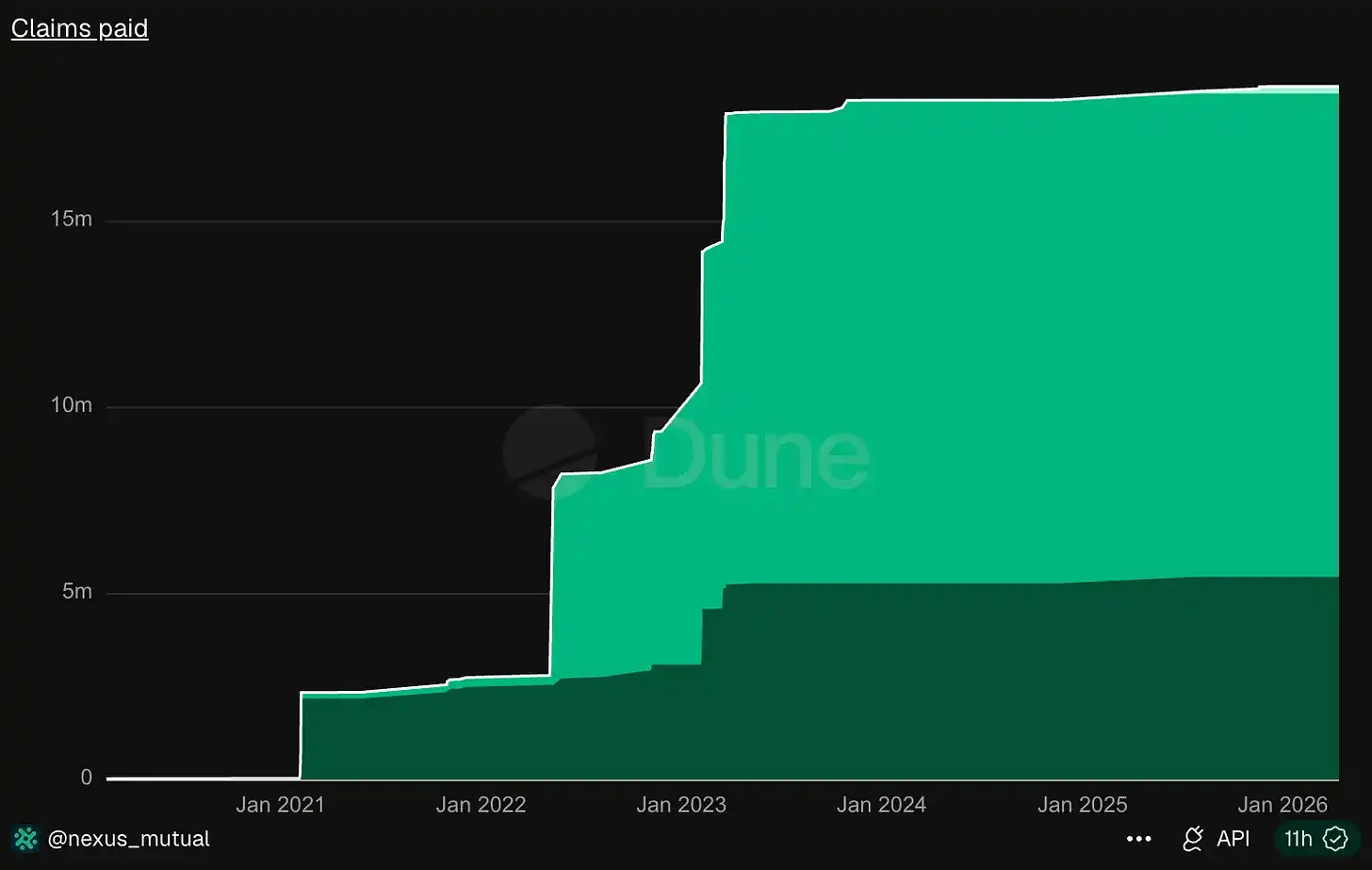
Data source: Dune Analytics

In April 2026, Kelp DAO suffered a hack, resulting in losses as high as $292 million. This single theft amount is equivalent to 16 times the total claims paid by this leading insurance institution over seven years.

This is in stark contrast to the current state of traditional insurance which denies claims aggressively. Traditional insurance collects high premiums but goes out of its way to block payouts; meanwhile, DeFi insurance has meager premium income, rooted in the fact that almost no investors are willing to insure.

Traditional insurance can operate stably because its risks are uncorrelated. One house fire doesn't cause damage to other houses. An insurance company can sell policies to 1 million users; a single fire claim can be covered by the premiums collected from everyone. But DeFi lacks this risk isolation mechanism: security incidents like oracle failures or cross-chain bridge vulnerabilities can have a chain reaction impacting all liquidity pools and lending protocols built on top of that underlying asset. The USDC depeg event in March 2023 affected all protocols using USDC as collateral that day. For DeFi insurance pools, the risks are strongly correlated. Insurers can only bet that losses from security incidents are manageable and that the insurance pool funds are sufficient to cover them.

In March 2023, Euler Finance was hacked for $197 million, and the contagious risk spread rapidly: Angle Protocol lost $17 million due to holding Euler's liquidity tokens, Yield Protocol urgently shut down its business, and several other platforms like Inverse Finance were also affected.

Once a protocol has a security vulnerability, it often affects multiple projects. An extreme one-day incident could even directly deplete an insurance pool's entire reserve for payouts.

I have compiled the current premium rates for Nexus Mutual and InsurAce, comparing them to the native annual yield of the protocols they insure: The annual yield for USDC deposits on Aave V3 is about 3.14%, with insurance premium rates ranging from 1.5% to 2.5%. After deducting premiums, the net return is only 0.6% to 1.6%. Investors take on on-chain security risks, only to end up with a return slightly higher than ordinary bank savings.
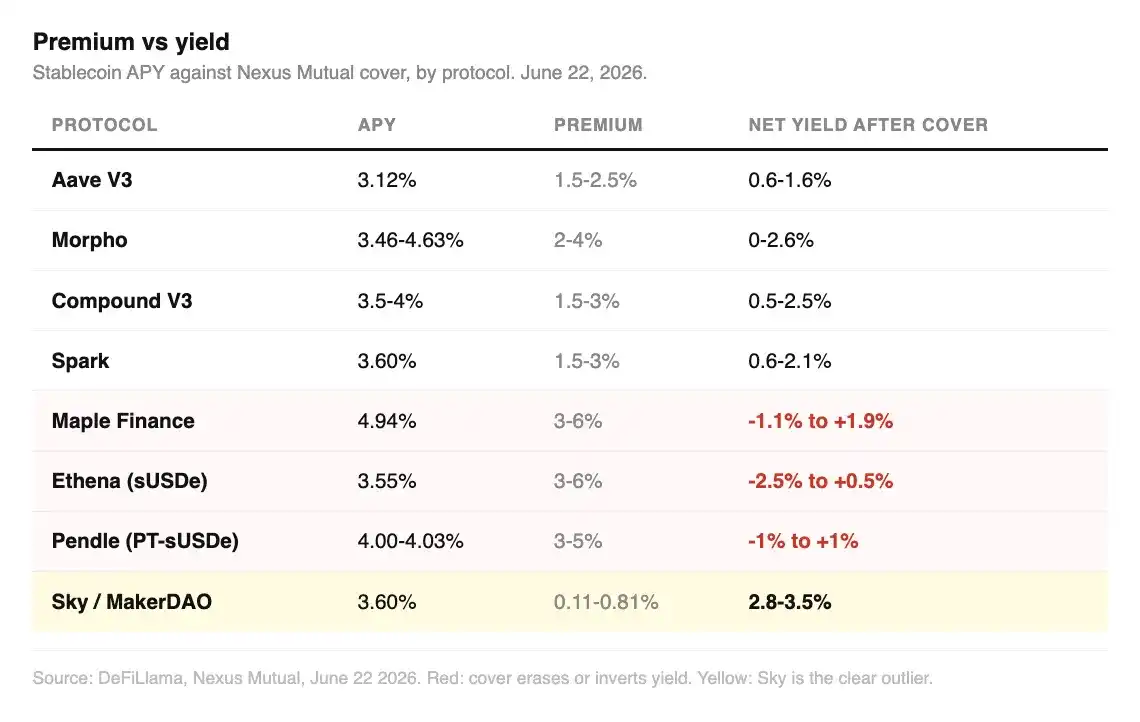
The yield situation is similar for Morpho, Compound, and Spark, with native annual yields of 3.5% to 4%. Premiums eat up one-third to half of the returns. Although there is still a slim profit, the cost-effectiveness is extremely low.

Maple Finance's institutional lending pools offer annual yields of 4.77% to 4.90%, but insurance premium rates are as high as 3% to 6%. The net return after insurance ranges from -1.1% to 1.9%. Ethena staking offers an annual yield of 3.6% to 4%, with premiums also at 3% to 6%, resulting in a net return of -2.4% to 1%. Buying insurance on these two types of platforms could even result in investors losing their principal in extreme cases.

Only the original MakerDAO (Sky) shows impressive performance. Its savings product offers a 3.6% annual yield, with the lowest insurance premium rate being only 0.11%. The market widely recognizes it as the lowest-risk asset in DeFi. After insurance, the net return remains between 2.8% and 3.5%, preserving the majority of the earnings.

Premium pricing strictly corresponds to risk levels, but premiums for emerging platforms are too high, directly consuming the high returns users seek when entering the market.

Crypto investors choose to forgo insurance not out of laziness or recklessness. They understand that in most cases, buying insurance is equivalent to zeroing out their returns. Even if all DeFi depositors collectively decided to purchase full coverage tomorrow, the entire industry would be unable to meet the demand: Nexus Mutual's total pool size is about $81.56 million. The entire industry's effective coverage capacity is at most a few hundred million dollars, while the total value locked (TVL) in major protocols amounts to hundreds of billions. The gap between supply and demand is astronomical.

A major security incident on the scale of Kelp DAO would directly drain the vast majority of the industry's insurance reserves in a single claim.

The historical total claims of $18 million precisely expose the fragility of the industry's capital pools. The entire market has never experienced a major risk event severe enough to break through the underwriting reserves.

After a user submits a claim request to Nexus Mutual, it must be voted on by all token-holding members of the platform to decide whether to pay. Members who vote to approve a claim risk having their own assets directly impaired if the claim is ultimately not paid. This mechanism naturally fosters a tendency to deny claims. Traditional insurance specifically employs underwriters and claims adjusters to balance conflicts, whereas DeFi insurance design merges all responsibilities onto the same group.

Before the 2008 financial crisis, financial risk pricing agencies generally believed a nationwide housing price collapse in the US was impossible, mainly because they had never experienced it. Insurance giant AIG massively sold risk protection contracts, but when the market crisis truly erupted, it was completely unable to pay.

Before the US government introduced FDIC deposit insurance, ordinary depositors had no safety net for their assets. The Great Depression forced the government to mandatorily implement bank insurance, making it a mandatory operating cost for banks.

In the DeFi field, no one can force protocols like Aave or Morpho to buy insurance. Smart contract deployment is completely permissionless; there is no entity that can mandate projects to configure risk coverage. This also leads to a lack of a safety net mechanism to withstand extreme market conditions in the industry.

The three largest claims in Nexus Mutual's history are: approximately $7.3 million paid in two batches for the FTX collapse, $5 million for the TribeDAO hack, and $3.4 million for the Euler Finance hack. The sum of these three amounts is almost equivalent to the platform's seven-year cumulative claims total of $18.6 million.

Now this mutual insurance platform is shifting towards pre-risk prevention. It has partnered with security audit firms like Immunefi, Cantina, and Sherlock to launch bug bounty protection products. Protocols only need to bear 20% of the critical bug bounty, with Nexus Mutual covering the remaining funds, proactively incentivizing white-hat hackers to find vulnerabilities to avoid theft incidents at the source. At the same time, Nexus Mutual is working on compliant insurance securitization, attempting to connect crypto risks to reinsurance capital pools, introducing larger external capital to supplement underwriting capacity.

Cantina went a step further in March 2025, launching an independent native protocol protection product. Even if a vulnerability is not discovered early by bounty hunters, users can still receive payouts if the protocol is hacked.

Both of these transformation moves essentially acknowledge a core reality: On-chain capital is insufficient to cover on-chain risks. Three inherent flaws cannot be eliminated: insurance pools are too small, risks are highly correlated, and the same group that adjudicates claims also provides the capital.

Nexus Mutual has $81.56 million in total value locked according to DeFiLlama, accounting for 85% of the DeFi insurance market share. Other peers continue to shrink: InsurAce peaked at $150 million TVL, now only $132,000 left; after the 2022 UST depeg, it only settled one major claim. Sherlock's pool shrunk from $60 million to $505,000 within a year. Unslashed Finance has millions of dollars trapped in old, un-updated code since late 2024. Other insurance projects have either shut down completely or pivoted to different business models.

A lighthouse warns all ships of hidden reefs, but it cannot charge passing vessels a usage fee, so it's hard for anyone to voluntarily fund its construction. The benefits are shared by all, but the cost is borne solely by the builder.

The value of DeFi insurance lies precisely in preventing the spread of chain-reaction liquidation crises. Assets in the crypto market are highly interconnected. Only when everyone insures simultaneously can overall market stability be maintained. But if everyone expects others to buy insurance as a backstop while they themselves are unwilling to bear the premium cost, ultimately no one will buy insurance, and the risk protection system will be meaningless. Protection without anyone actively providing a safety net ultimately cannot safeguard any assets.

Trend Kriptolar

İlgili Sorular

QWhat are the main reasons why DeFi insurance is not widely purchased by users?

AThe main reasons are: 1) High premiums that drastically erode investment yields, often making the net return unattractive or even negative. 2) Systemic and correlated risks in DeFi, where a single security incident can impact multiple protocols simultaneously, making it difficult for insurance pools to cover catastrophic events. 3) The limited capacity of existing DeFi insurance pools (totaling a few hundred million dollars) compared to the trillions of dollars in total value locked (TVL) across DeFi, creating a massive supply-demand gap. 4) The governance model where the same entities (token holders) who fund the pool also vote on claims, creating an inherent bias against payouts.

QHow does the risk profile in DeFi differ from traditional insurance, and why is this a problem for DeFi insurers?

AIn traditional insurance (e.g., home insurance), risks are largely uncorrelated—one house fire does not cause others to burn down. This allows insurers to pool premiums from many to cover rare, individual events. In DeFi, risks are highly correlated. A single exploit in a core protocol (like an oracle failure or bridge hack) can trigger losses across multiple interconnected platforms and asset pools simultaneously. This systemic nature means a major event can wipe out an entire insurance pool at once, making the business model unstable and requiring prohibitively high premiums.

QAccording to the article, what is the fundamental flaw in the design of platforms like Nexus Mutual regarding claim assessment?

AThe fundamental flaw is the conflation of roles. In platforms like Nexus Mutual, the members (token holders) who provide the capital for the insurance pool are also the ones who vote on whether to approve a claim. Since their own funds are at risk if a claim is paid out, this creates a built-in incentive to vote against approving claims, regardless of their validity. Traditional insurance separates these functions with dedicated underwriters and claims adjusters to balance the interests.

QWhat example does the article give to illustrate the massive mismatch between DeFi insurance capacity and potential losses?

AThe article cites the April 2026 Kelp DAO hack, which resulted in a loss of $292 million. This single incident's loss was 16 times greater than the entire cumulative payout history (around $18 million) of Nexus Mutual, the largest DeFi insurance provider, since its launch in 2019. This starkly highlights how a major security event could easily exhaust the entire industry's insurance reserves.

QWhat potential solutions or shifts in strategy are DeFi insurance projects like Nexus Mutual exploring?

ADeFi insurance projects are exploring strategies that acknowledge the insufficiency of on-chain capital to cover on-chain risks. Examples include: 1) Proactive risk prevention, such as partnering with bug bounty platforms (e.g., Immunefi) to fund preemptive security audits and vulnerability rewards, aiming to stop hacks before they happen. 2) Seeking external capital by creating compliant insurance tranches to connect crypto risks with traditional reinsurance pools, thereby increasing overall coverage capacity.

İlgili Okumalar

Deep Insight: Decentralized Inference is Not Hype, but a Key Track for AI to Break Through Centralized Monopoly

Decentralized Reasoning: Beyond the Hype, a Key to Breaking AI's Centralized Monopoly A future scenario where a powerful AI model is banned by a major government illustrates the core value proposition of decentralized AI: resistance to censorship. The core bet of decentralized inference networks is mitigating this risk, with other benefits like cost being secondary. The path is extremely difficult, involving four key challenges: 1. **Running Massive Models:** Distributing a single model across a decentralized GPU swarm requires sophisticated techniques like pipeline and speculative decoding to overcome crippling network latency, aiming for usable speeds (e.g., 30-40 tokens/second). 2. **Proving Model Integrity:** Verifying that a node runs the correct model is critical. Solutions range from cryptographically secure but slow ZKML to faster, economically-secure methods like statistical fingerprints, deterministic re-execution, or live-weight proofs, each involving trade-offs between integrity, latency, and cost. 3. **Ensuring Prompt Privacy:** Simply sharding a model does not protect user inputs from nodes. Robust solutions currently require trusted hardware (TEEs) or advanced cryptography (FHE), which are not yet widely deployed in consumer swarms. 4. **Building a Real Market:** Identifying the ideal customer is tough. Beyond speculative AI agents, the viable market currently consists of startups embedding AI and projects needing batch processing (e.g., synthetic data generation), where decentralized aggregation can be an advantage over low-latency needs. The article analyzes several projects tackling these problems, such as Dolphin Network (live-weight proofs), Inference.net (statistical verification), Morpheus (TEE-based), and Darkbloom (Apple Secure Enclave). It provides a framework: decentralization is a "tax" for latency-sensitive applications (e.g., chat) but a potential supply-side advantage for throughput-oriented tasks (e.g., batch processing). The long-term vision is a closed data loop where decentralized inference generates valuable data (traces, preferences) to feed decentralized training networks, which in turn produce better open-weight models for the inference networks. A due diligence checklist advises focusing on projects that: are truly decentralized at specific layers; have a credible integrity method; offer real cost benefits; ensure genuine privacy; handle node reliability; have paying users; and are built by teams with deep AI expertise. The ultimate goal should be products that appeal beyond the crypto-native audience, using crypto mechanisms invisibly to deliver better cost, performance, or privacy.

Foresight News9 dk önce

Deep Insight: Decentralized Inference is Not Hype, but a Key Track for AI to Break Through Centralized Monopoly

Foresight News9 dk önce

The Final Piece of Franklin Templeton's Crypto Ambition

Franklin Templeton Completes Crypto Ambition with Acquisition of 250 Digital On June 22, Franklin Templeton announced the acquisition of 250 Digital and established Franklin Crypto, a new division focused on actively managed cryptocurrency strategies for institutional investors. The unit is led by Christopher Perkins and Seth Ginns. This acquisition marks a key piece in Franklin Templeton's multi-year crypto strategy, which began in 2018 with a digital assets team. The firm's crypto product suite now spans three layers: tokenized funds like the blockchain-based money market fund BENJI (~$831M AUM); a series of passive ETFs including Bitcoin (EZBC, ~$368M), Ethereum (EZET), XRP (XRPZ, ~$252M), Solana (SOEZ), and a multi-crypto index fund (EZPZ); and the newly added active management strategies from Franklin Crypto. The company has also expanded its crypto ecosystem through investments in projects like Ethena and Crossmint, and collaborations with blockchains such as Aptos and Sui. With approximately $18B in digital asset AUM and a total firm AUM of ~$1.78T, Franklin Templeton is positioning itself as a comprehensive crypto asset manager for pensions and sovereign wealth funds. In contrast, competitor Fidelity Investments has taken a different path, focusing early on building its own custody and trading infrastructure. Fidelity's Bitcoin ETF (FBTC) holds over $11B, significantly larger than Franklin Templeton's equivalent offering. Both giants' moves underscore the deepening trend of traditional finance entering the crypto space.

Foresight News33 dk önce

The Final Piece of Franklin Templeton's Crypto Ambition

Foresight News33 dk önce

İşlemler

Spot
Futures

Popüler Makaleler

ONE Nasıl Satın Alınır

HTX.com’a hoş geldiniz! Harmony (ONE) satın alma işlemlerini basit ve kullanışlı bir hâle getirdik. Adım adım açıkladığımız rehberimizi takip ederek kripto yolculuğunuza başlayın. 1. Adım: HTX Hesabınızı OluşturunHTX'te ücretsiz bir hesap açmak için e-posta adresinizi veya telefon numaranızı kullanın. Sorunsuzca kaydolun ve tüm özelliklerin kilidini açın. Hesabımı Aç2. Adım: Kripto Satın Al Bölümüne Gidin ve Ödeme Yönteminizi SeçinKredi/Banka Kartı: Visa veya Mastercard'ınızı kullanarak anında Harmony (ONE) satın alın.Bakiye: Sorunsuz bir şekilde işlem yapmak için HTX hesap bakiyenizdeki fonları kullanın.Üçüncü Taraflar: Kullanımı kolaylaştırmak için Google Pay ve Apple Pay gibi popüler ödeme yöntemlerini ekledik.P2P: HTX'teki diğer kullanıcılarla doğrudan işlem yapın.Borsa Dışı (OTC): Yatırımcılar için kişiye özel hizmetler ve rekabetçi döviz kurları sunuyoruz.3. Adım: Harmony (ONE) Varlıklarınızı SaklayınHarmony (ONE) satın aldıktan sonra HTX hesabınızda saklayın. Alternatif olarak, blok zinciri transferi yoluyla başka bir yere gönderebilir veya diğer kripto para birimlerini takas etmek için kullanabilirsiniz.4. Adım: Harmony (ONE) Varlıklarınızla İşlem YapınHTX'in spot piyasasında Harmony (ONE) ile kolayca işlemler yapın.Hesabınıza erişin, işlem çiftinizi seçin, işlemlerinizi gerçekleştirin ve gerçek zamanlı olarak izleyin. Hem yeni başlayanlar hem de deneyimli yatırımcılar için kullanıcı dostu bir deneyim sunuyoruz.

394 Toplam GörüntülenmeYayınlanma 2024.12.12Güncellenme 2026.06.02

ONE Nasıl Satın Alınır

Tartışmalar

HTX Topluluğuna hoş geldiniz. Burada, en son platform gelişmeleri hakkında bilgi sahibi olabilir ve profesyonel piyasa görüşlerine erişebilirsiniz. Kullanıcıların ONE (ONE) fiyatı hakkındaki görüşleri aşağıda sunulmaktadır.

活动图片