Original | Odaily Planet Daily(@OdailyChina)
Author | Asher(@Asher_ 0210)

In the previous article predicting the World Cup quarter-finals, six AIs unanimously favored France, Spain, England, and Argentina to advance. After the four matches, with four semifinal tickets issued, the AIs got every single one right.
France had the most comfortable progression. Although Mbappé missed a penalty, he later contributed a goal and an assist, helping France eliminate Morocco 2-0. Spain delivered another last-gasp victory, with Mikel Merino scoring in the 88th minute for a 2-1 win over Belgium. The other two matches went to extra time: Jude Bellingham scored a brace to help England come from behind to beat Norway 2-1; Argentina, facing a Swiss side reduced to ten men, scored two late goals in extra time for a hard-fought 3-1 victory.
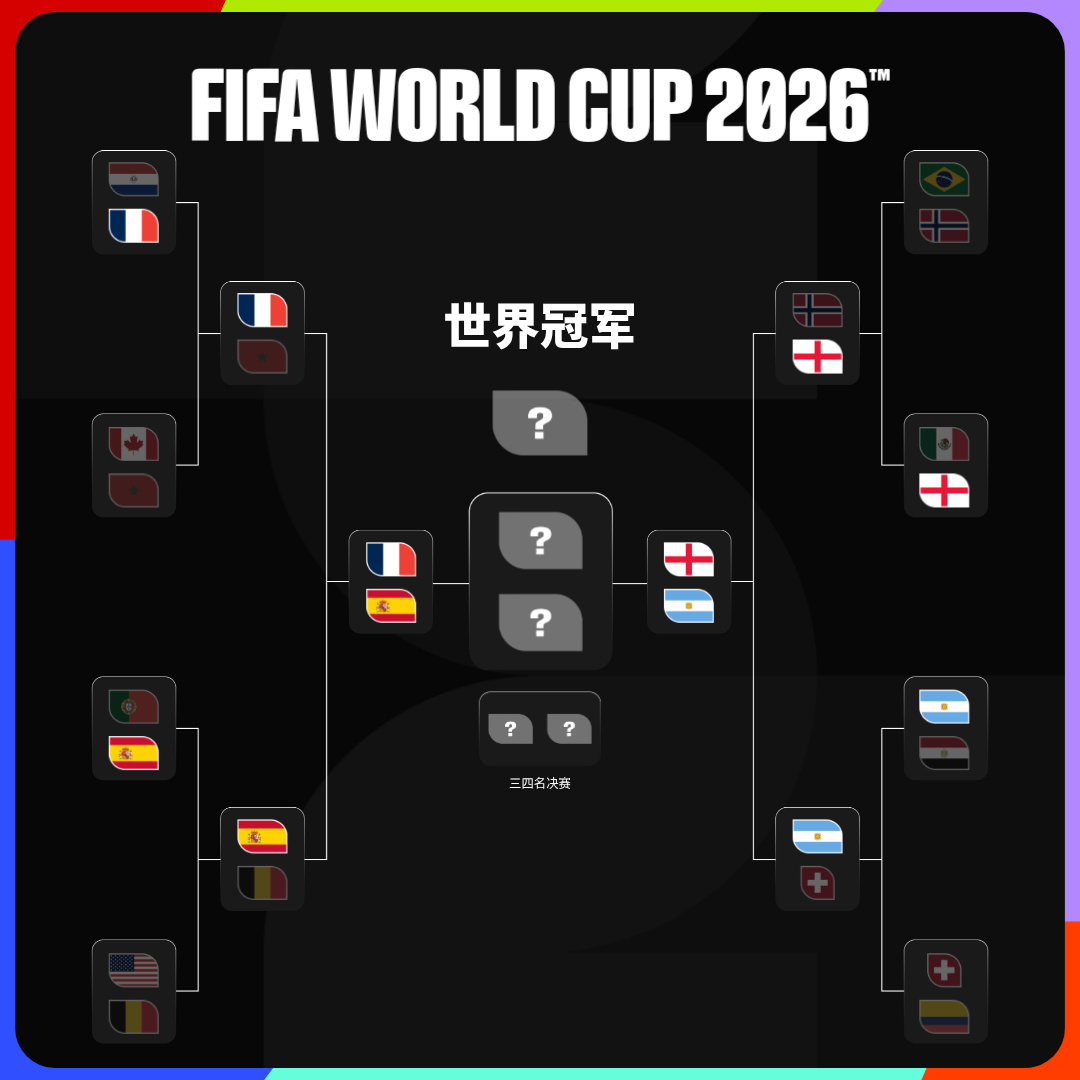
Similarly, to more effectively engage with the prediction markets for the semifinals, I once again asked six AI models—ChatGPT, Claude, Gemini, DeepSeek, Qwen, and Grok—to predict the win/draw/loss results in regular time, the scoreline, and whether the matches would go to extra time or penalties.
However, by the semifinals, the predictions from the six AIs showed significant divergence. For France vs. Spain, five AIs favored France to advance, all predicting a 2-1 scoreline; the England vs. Argentina match saw the greatest split, with three AIs supporting England and the other three backing Argentina. There was also no consensus on whether this match would go to extra time or even penalties.
Five AIs Unanimously Predict France 2-1 over Spain; Only Gemini Stands Alone in Backing Spain
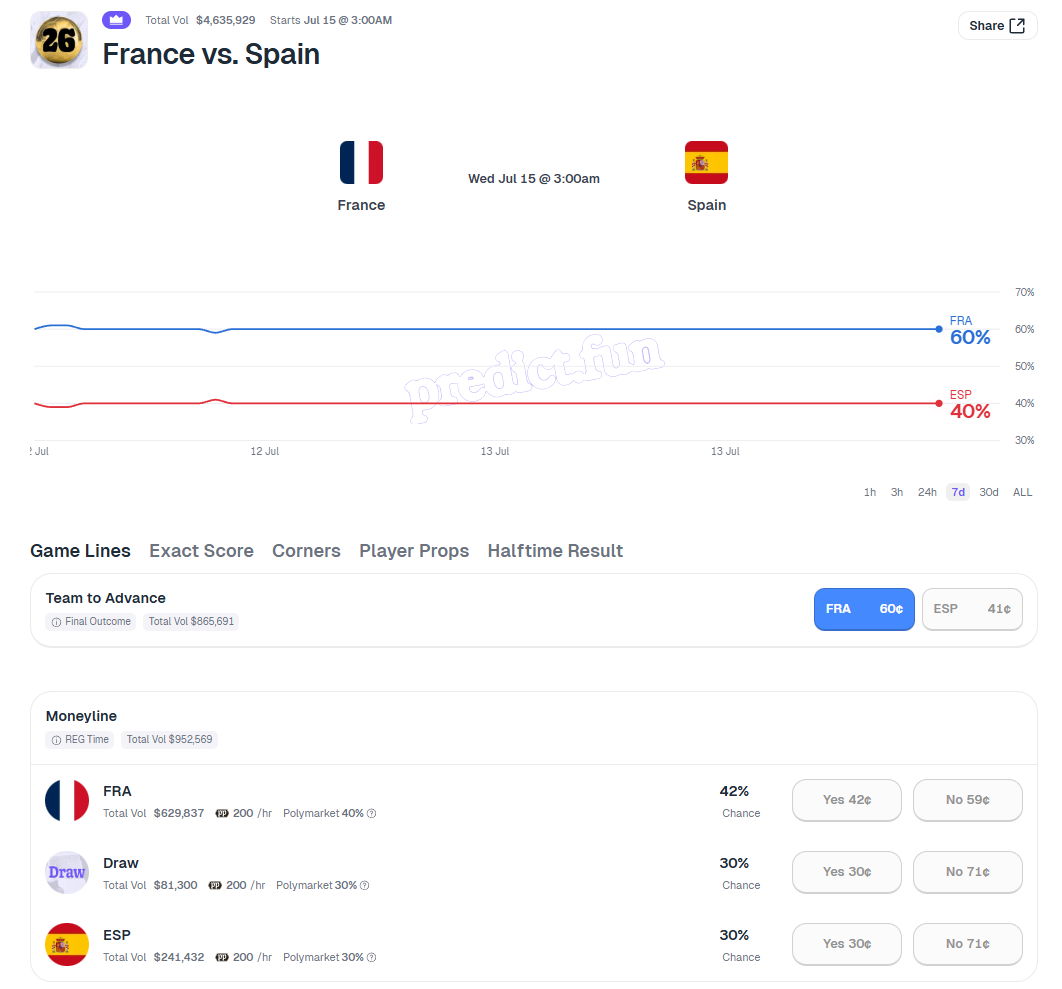
The first semifinal of this World Cup is France vs. Spain, scheduled for 3:00 AM Beijing Time on July 15. According to predict.fun data, in regular time, France has a 42% win probability; a draw is at 30%; and Spain has a 30% win probability. Furthermore, including extra time and penalties, France's advancement probability is 60%, while Spain's is 40%.
This is a clash between the two most defensively solid teams of the tournament. France has yet to concede a goal in the knockout stages, while Spain has only been breached once all competition. However, their ways of winning are completely different. Spain relies on possession and high pressing to control the rhythm, whereas France excels in rapid transitions, using the speed and individual ability of their forwards to create direct threats.
Among the six AIs, ChatGPT, Claude, Grok, DeepSeek, and Qwen all chose France to advance. Moreover, the five models all predicted the same score: France 2-1 Spain. Spain may enjoy more possession, but the space left behind by their marauding full-backs could become a vulnerability. Against Mbappé, Dembélé, and Olise, France doesn't need prolonged sieges; they just need to seize a few counter-attacking opportunities to change the game.
ChatGPT provided a more specific breakdown of the match progression, suggesting France would score first on the counter, Spain would equalize in the second half, continue pressing forward, and then be caught out again by France exploiting the space behind for a late winner. Although Claude acknowledged the possibility of the match going to extra time, it ultimately joined Grok, DeepSeek, and Qwen in predicting a 2-1 victory for France within regular time.
The sole supporter of Spain was Gemini, predicting a 1-1 draw after 120 minutes, with Spain advancing via a penalty shootout. Gemini's reasoning didn't focus on whether Spain could dominate possession and attack, but rather on their ability to maintain sustained ball control, minimizing the number of transition moments in the match and thus suppressing France's greatest strength—the counter-attack.
As long as Spain doesn't concede early, the match has a chance to settle into their familiar rhythm. France, despite having explosive players like Mbappé and Dembélé, will struggle to find much open space against Spain's midfield control. Conversely, with France yet to concede in the knockout stages, Spain will also find it difficult to break them down repeatedly in settled attacks. Therefore, Gemini analyzed that the match could remain a low-scoring affair for long periods, with both sides capitalizing on one opportunity each, leading to a stalemate all the way to penalties.
Thus, whether Gemini becomes the only AI to correctly back Spain's advancement adds another layer of intrigue to this match. In contrast, the divergence for the other semifinal is much greater—for England vs. Argentina, the six AIs couldn't even reach a consensus on the direction of advancement.
Predictions Split Down the Middle for England vs. Argentina; Divergence Even on Extra Time or Penalties
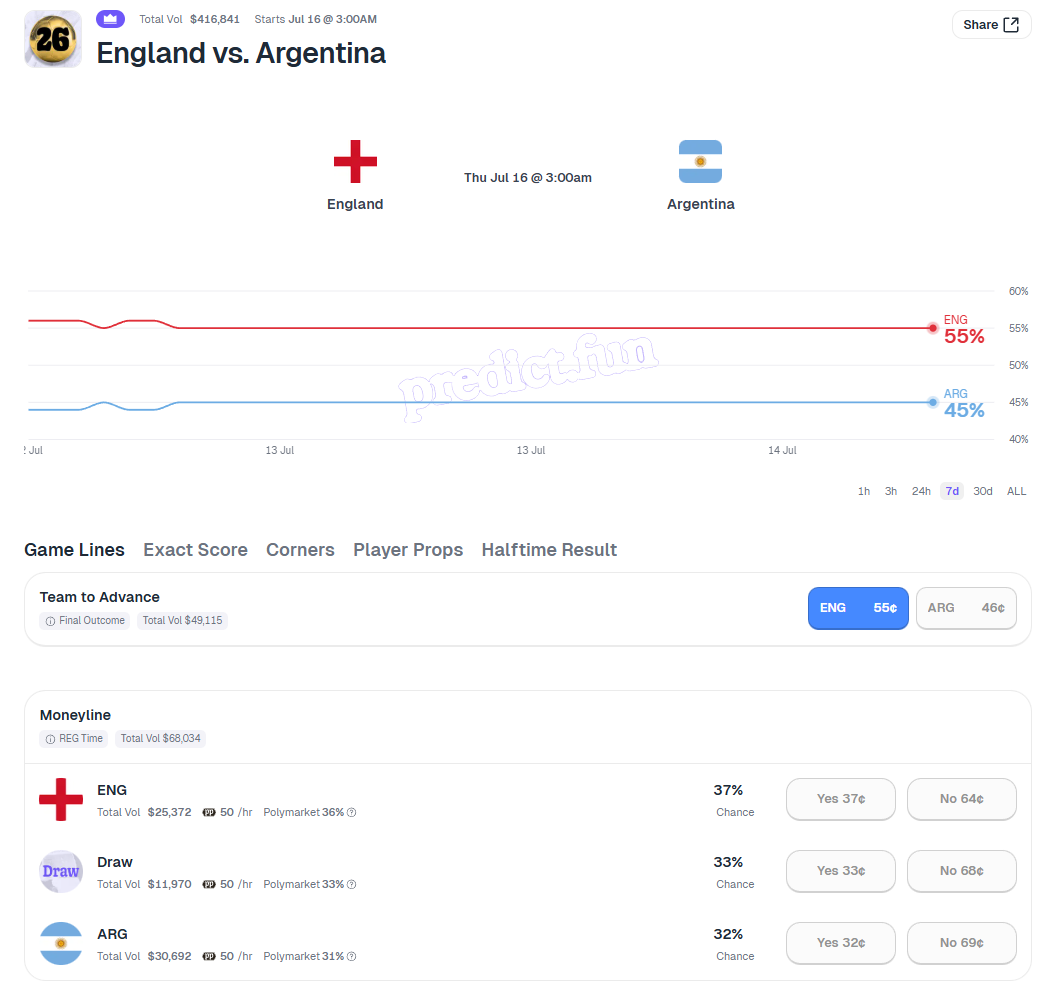
The second semifinal of this World Cup is England vs. Argentina, scheduled for 3:00 AM Beijing Time on July 16. According to predict.fun data, in regular time, England has a 37% win probability; a draw is at 33%; and Argentina has a 32% win probability. Furthermore, including extra time and penalties, England's advancement probability is 55%, while Argentina's is 45%.
Compared to France vs. Spain, this match is harder to call. Both teams played the full 120 minutes in the previous round. England needed extra time to come from behind against Norway, while Argentina also didn't seal victory against Switzerland until late in extra time. Factors like physical exertion, the form of key players, and match tempo could all influence the final outcome.
Regarding the predictions from the six AI models, Grok, DeepSeek, and Qwen support England; ChatGPT, Gemini, and Claude favor Argentina.
Those backing England place greater emphasis on physicality, set-pieces, and direct attacking threat. Both Grok and DeepSeek predicted a 2-1 win for England in regular time, while Qwen offered a more aggressive 2-0 prediction. England's current attacking threat is also highly concentrated in Harry Kane and Jude Bellingham. The duo has accounted for the vast majority of the team's goals, with Bellingham in particular stepping up to decide games in two consecutive knockout rounds. In the view of these models, England can apply sustained pressure through high pressing, crosses, and set-pieces, aiming to settle the match within 90 minutes.
Argentina's supporters put more faith in knockout stage experience. Gemini predicted a 2-1 victory for Argentina in regular time, believing Lionel Messi's playmaking and decisive ability are still sufficient to determine matches of this magnitude. Claude's assessment was more conservative, suggesting the teams could easily get locked in a low-scoring battle, with a 1-1 draw in regular time a distinct possibility. The chance of this match going to extra time was also judged to be significantly higher than in the first semifinal, with Claude ultimately leaning towards Argentina advancing. ChatGPT took its prediction all the way to penalties, forecasting a 1-1 draw in regular time, with neither side daring to overcommit in extra time, leading to Argentina eliminating England 4-3 thanks to Emiliano Martínez and greater penalty shootout experience.
In the previous round, the AIs showed high consensus in their Final Four predictions and ended up getting them all correct. For the semifinals, the predictions have turned into one "consensus match" and one "divisive match." Can France breach Spain's possession-based system? Will England and Argentina battle all the way to penalties? This time, whose predictions are more trustworthy?
Recommended Reading:
"Just Days into the World Cup, Some AI Prediction Models Are Being Hailed, Others Are Crashing"
"Predicting the World Cup Knockouts: How Much Do AI Models Differ in Ability?"
"The World Cup Quarter-Finals Kick Off Soon: Who Did the AIs Give Their Advancement Tickets To?"