Are Dogecoin ETFs Dead On Arrival? Dwindling Volume Suggests Investors Are Not Interest – Details

bitcoinist2025-12-11 tarihinde yayınlandı2025-12-11 tarihinde güncellendi

Özet

Dogecoin ETFs have experienced consistently low demand and dwindling trading volumes since their launch in late November, indicating a lack of institutional interest. Data from SoSoValue shows daily volumes have declined significantly, with only three days reaching seven-figure trades out of twelve. Total net assets for these funds stand at just $6.01 million, far below Grayscale’s Chainlink ETF, which has $77.71 million in assets. Analysts had predicted lower interest for meme coins like DOGE compared to major cryptos, and this is reflected as even newer Solana and XRP ETFs are performing better. DOGE’s status as a meme coin with limited utility is seen as a key reason for its poor ETF uptake. The token’s price also fell over 6% to $0.138 at the time of writing.

The Dogecoin ETFs have continued to record low demand since they launched last month, indicating the lack of interest from institutional investors in the meme coin. Notably, DOGE has also seen the lowest demand through these ETFs among the top coins by market cap.

Dogecoin ETFs Record Dwindling Volume And Inflows

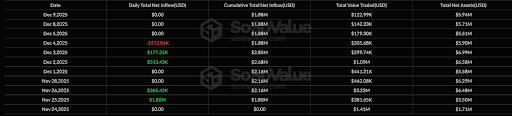
SoSoValue data shows that the Dogecoin ETFs have continued to see their daily volume and inflows decline since they launched last month. On December 10, the Grayscale and Bitwise DOGE ETFs recorded a trading volume of $125,100. Meanwhile, these funds as a group saw a total net inflow of $171,920 on the day.

Further data from SoSo Value shows that the Dogecoin ETFs trading volume has been on a decline since December 2, when they recorded a daily trading volume of $1.09 million. These funds have recorded only three 7-figure trading volume days out of 12 trading days since November 24, when Grayscale’s Dogecoin fund launched.
Source: Chart from SoSoValue on X

This is relatively low and signifies little demand for the DOGE ETFs among institutional investors. For context, Grayscale’s Chainlink ETF, the only LINK fund at the moment, has outperformed the Dogecoin ETFs despite launching at the start of this month. Grayscale’s LINK ETF has a total net asset of $77.71 million, while the DOGE ETFs have total net assets of $6.01 million.

The net flows also highlight the underperformance of these Dogecoin ETFs. Since launching, Bitwise’s DOGE fund has recorded a net outflow of $972,840. Meanwhile, Grayscale’s fund has taken in just over $3 million. The funds, as a group, have recorded net inflows on five of 12 trading days.

Possible Reason For The Underperformance

Bloomberg analyst Eric Balchunas had warned before now that crypto ETFs like the Dogecoin ETFs would record fewer assets given their distance from Bitcoin in terms of market cap. “’The further away you get from BTC, the less asset there will be,’ he said. Notably, DOGE funds have the lowest net assets among the top 10 cryptos by market cap with ETF wrappers.

The Solana and XRP ETFs, which also just launched last month, have outperformed the Dogecoin ETFs, although there are more funds offering SOL and XRP. Meanwhile, Balachunas’ theory hasn’t applied to the LINK ETF, as it has outperformed DOGE funds despite Chainlink having a lower market cap than Dogecoin.

Furthermore, the Hedera and Litecoin ETFs also boast larger net assets than the Dogecoin ETFs, indicating that institutional investors are simply not bullish on DOGE, possibly due to its meme coin status and lack of utility. DOGE is, so far, the only meme coin with an ETF wrapper.

At the time of writing, the DOGE price is trading at around $0.138, down over 6% in the last 24 hours, according to data from CoinMarketCap.

DOGE trading at $0.13 on the 1D chart | Source: DOGEUSDT on Tradingview.com

İlgili Okumalar

Fantasy's Closing Notes: After Two and a Half Years of Trial and Error in SocialFi, What Have We Learned?

"Fantasy Shutdown Notes: Two and a Half Years of SocialFi Trial, What Have We Learned?" Fantasy, a SocialFi/crypto card game, is shutting down. The team is refunding 100% of investments to angel/seed round backers, as operational costs were fully covered by revenue. Over 2.5 years, the project returned approximately $20M to its community. The core reason for failure was building crypto economics on a foundation not designed for it. Traditional card games (Magic, Pokémon) succeed by prioritizing gameplay; financial value is a secondary outcome. Crypto card games invert this, attracting speculators first, not genuine players. This financialization trapped the team into managing a financial instrument instead of developing a game. This is a sector-wide issue. Embedding tokenomics into social products or creator-fan relationships often attracts short-term traders over genuine users, undermining the core value. The article also critiques premature token launches. Most tokens fail because they're issued before product-market fit is proven, diverting team and community focus to price speculation instead of building. Successful examples like Hyperliquid or Jupiter built sustainable businesses first. Fantasy's journey highlights key crypto pitfalls: the distorting effect of upfront financialization in gaming/social apps, and the dangers of launching tokens too early. The team hopes sharing these lessons helps future builders avoid the same traps.

marsbit31 dk önce

Fantasy's Closing Notes: After Two and a Half Years of Trial and Error in SocialFi, What Have We Learned?

marsbit31 dk önce

Two Companies Capture 90% of AI Startup's $80 Billion ARR

The AI startup landscape is highly concentrated, with OpenAI and Anthropic capturing 89% of an estimated $80 billion in annualized revenue among 34 leading companies. OpenAI, with $24-25B in revenue, primarily drives growth through ChatGPT's consumer subscriptions, while Anthropic, exceeding $30B, focuses on enterprise API integration and has rapidly grown its U.S. enterprise market share from under 1% to 34.4% in under two years. The remaining 32 companies share just 11% of the revenue, facing intense pressure as resources, talent, and market attention consolidate around the two giants. This creates a self-reinforcing cycle where higher revenue fuels greater compute investment and model improvement. Despite their dominance, both leaders face challenges. OpenAI is navigating significant legal disputes and partnership tensions, while Anthropic operates under the high expectations of its massive backers like Amazon. Historical parallels in tech infrastructure (e.g., search engines, mobile OS) suggest such oligopolistic tendencies are common due to scale, network effects, and high switching costs, indicating the market could become even more concentrated. However, the rapid pace of AI innovation leaves room for disruption. For other players, the strategic path forward is not direct competition with the giants but specialization in vertical domains where general-purpose models fall short—such as legal, medical, or industrial applications—building indispensable, niche solutions.

marsbit40 dk önce

Two Companies Capture 90% of AI Startup's $80 Billion ARR

marsbit40 dk önce

İşlemler

Spot
Futures
活动图片