Morgan Stanley Research Report Analysis: Google at a 12% Premium, Meta at a 30% Discount - Internet Giants' Valuations Diverge

marsbit2026-08-27 tarihinde yayınlandı2026-08-27 tarihinde güncellendi

Özet

In a volatile end to the summer for internet stocks, Morgan Stanley's latest valuation report highlights a significant divergence in how the market is pricing major tech giants. While the sector's average forward EV/EBITDA multiple trades below historical averages, individual company valuations are splitting, largely driven by perceived AI capabilities. Alphabet (Google) is the standout, trading at a 12% premium to its 3-year average on an EV/EBITDA basis. This premium is attributed to upward revisions for its AI hardware (TPU) sales potential, advancements in its Gemini models, and cloud margin expansion. In stark contrast, Meta trades at a deep 30% discount to its 2-year average, as concerns over social media advertising competition outweigh its progress in AI-powered ad tools. Amazon sits in the middle, trading at a moderate discount. The report notes a broader sector trend: EV/Sales multiples are expanding while EV/EBITDA multiples are contracting, indicating the market is placing a higher premium on profitability over pure revenue growth. Sub-sectors like e-commerce and digital media face the most valuation pressure. Furthermore, adjusting earnings for stock-based compensation (SBC) reveals significantly higher "true" valuation multiples across the board. Morgan Stanley concludes that valuation recovery for the internet sector will depend on upward revisions to profit estimates—driven by catalysts like new AI product cycles and cloud growth stabilization—rather than s...

Written by: Rita

The summer rally in the internet sector concluded amidst volatility. Over the past week, the average performance of internet companies covered by Morgan Stanley fell by 2%, moving in sync with the S&P 500 and Nasdaq indices. However, individual stock performances varied significantly, with Meta dropping approximately 7%, Amazon falling about 2%, and Google remaining largely flat.

On August 25th, Morgan Stanley released a valuation dynamics report for the internet industry, providing a detailed breakdown of the valuation positions of the three giants. Amazon currently trades at 19 times its 2026 estimated P/E ratio, representing a 36% discount to its historical average; Google trades at 17 times, a 36% premium; and Meta trades at 17 times, a 24% discount. Google's valuation premium stands in stark contrast to Meta's deep discount. Morgan Stanley maintains an "Attractive" rating for the internet sector.

This summer, the market's pricing logic for these three companies has seen a fundamental divergence. AI capabilities are becoming the core variable driving valuation differentiation.

Google's Valuation Premium Coexists with Meta's Deep Discount

Google is the only company among the three giants trading above its historical average valuation. On an EV/EBITDA basis, its current multiple of 15.1x represents an 8% premium to the 2-year average and a 12% premium to the 3-year average.
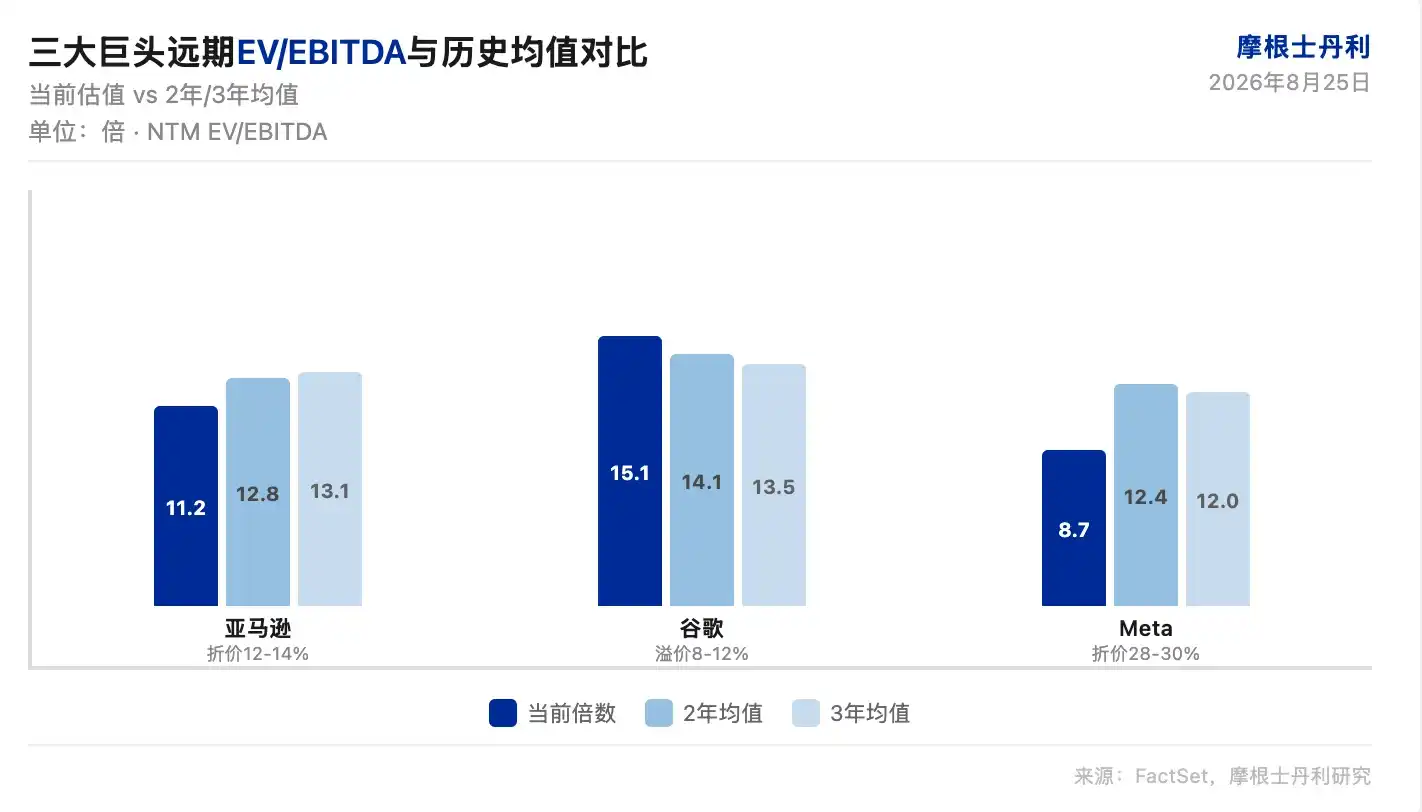
Google's valuation premium stems from the market's reassessment of its AI capabilities. Upward revisions for external TPU sales (Morgan Stanley previously raised its revenue per GW assumption from $20 billion to $27 billion), iterations of the Gemini model, and expanding margins in its cloud business collectively support the valuation. The market is willing to price in AI-driven growth ahead of time.

Meta's valuation is moving in the opposite direction. Its current forward EV/EBITDA multiple of 8.7x represents a 30% discount to the 2-year average and a 28% discount to the 3-year average. Although Meta is making good progress in monetizing its AI advertising tools, market concerns about competition in social media advertising continue to suppress its valuation. Amazon sits in the middle, with a current forward EV/EBITDA of 11.2x, representing discounts of 12% and 14% to the 2-year and 3-year averages, respectively.

Sector Valuations Show Divergence in Pricing for Revenue vs. Profit

Morgan Stanley data shows that the internet sector's current forward EV/EBITDA multiple is 9% below its 5-year average and 16% below its 10-year average. Over the same period, the EV/Sales multiple is 16% above the 5-year average and 17% above the 10-year average. Revenue multiples are expanding while profit multiples are contracting, indicating that the market is raising its requirements for earnings quality.

E-commerce and digital media are the sub-sectors with the most concentrated valuation discounts. The median forward EV/EBITDA for the digital media sub-sector is around 9.6x, with companies like SNAP still operating at a loss. The e-commerce sub-sector's valuation is also under pressure, mainly due to the dual impact of slowing consumer spending and intensifying competition.

SBC Adjustment Reveals True Valuation Pressure

After adjusting for stock-based compensation (SBC) as a cash expense, the true valuation multiples for each sub-sector are significantly higher than the apparent numbers.

The adjusted EV/EBITDA multiple for the digital media sub-sector rises by an average of approximately 36%, the e-commerce sub-sector by about 30%, and the travel & shared economy sub-sector by around 44%. The proportion of SBC in tech companies continues to grow, widening the gap between valuation multiples calculated on cash profits versus those based on reported profits. Solely looking at reported EV/EBITDA may underestimate the true valuation pressure. Recalculating by treating SBC as a cash expense better reflects the actual costs borne by shareholders.

Valuation Recovery Requires Earnings Revisions, Not Just Mean Reversion

Morgan Stanley believes that a recovery in internet sector valuations requires new catalysts. Key variables to monitor in the coming quarters include: the release cadence and market acceptance of Google's Gemini 4, whether Amazon AWS's growth rate stabilizes, Meta's progress in monetizing AI advertising tools, and the ongoing impact of changes in the interest rate environment on high-valuation growth stocks.

In the near term, overall sector valuations are within a reasonable range. Discounts exist in e-commerce and digital media, but the discount itself is not a buy signal. Valuation recovery needs to be driven by upward revisions to earnings expectations, not merely mean reversion.

Disclaimer

This article is Chaoxiang Research's organization and interpretation of a third-party brokerage research report (Morgan Stanley, August 25, 2026), combined with publicly available market information. The ratings, target prices, earnings forecasts, and related judgments cited in the text are the views of that brokerage's analyst, representing solely the position of their affiliated institution. They do not represent the views of Chaoxiang Research nor constitute any investment advice.

The market carries risks; decisions should be made independently. This article should not be used as a basis for trading any securities.


İlgili Sorular

QAccording to Morgan Stanley's report, what are the current valuation premiums/discounts for Google, Meta, and Amazon compared to their historical averages (using the EV/EBITDA metric)?

AAccording to Morgan Stanley's report, Google's current valuation is at a premium: 8% above its 2-year average and 12% above its 3-year average EV/EBITDA. Meta is at a significant discount: 30% below its 2-year average and 28% below its 3-year average. Amazon is at a moderate discount: 12% below its 2-year average and 14% below its 3-year average.

QWhat is identified as the core variable driving the fundamental divergence in the market's pricing logic for the three internet giants?

AThe article identifies AI capability as the core variable driving the fundamental divergence in the market's pricing logic for Google, Meta, and Amazon.

QWhat does the article highlight as a key reason for Google's valuation premium?

AThe article highlights that Google's valuation premium comes from the market's reassessment of its AI capabilities, specifically citing factors like upward revisions for its TPU external sales, iterations of the Gemini model, and margin expansion in its cloud business.

QWhy does the article suggest that looking at reported EV/EBITDA might underestimate true valuation pressure, and what adjustment does it propose?

AThe article suggests that reported EV/EBITDA might underestimate true valuation pressure because it doesn't account for Stock-Based Compensation (SBC) as a cash expense. It proposes adjusting for SBC as a cash outflow to calculate valuation multiples that better reflect the actual cost borne by shareholders.

QAccording to Morgan Stanley's conclusion, what does the valuation repair for the internet sector require, rather than simple mean reversion?

AAccording to Morgan Stanley, valuation repair for the internet sector requires upward revisions in earnings expectations (profit upgrades) to drive it, not just simple mean reversion or the existence of a discount itself.

İlgili Okumalar

Gold Price Achieves Strongest Rally in 46 Years, Tokenized Gold Trading Volume Already Exceeds Full-Year 2025

Gold is experiencing its strongest rally since 1979, with prices reaching a record high near $5,600 per ounce in January. This surge is driven primarily by central banks, not retail investors. In 2025, central banks net purchased 863 tonnes of gold, with a similar increase expected in 2026. Traditional gold investment methods—physical bullion and ETFs—present trade-offs like storage issues, limited access, or management fees. Tokenized gold emerges as a third option: digital tokens representing ownership of physical bars stored in professional vaults. These tokens are globally transferable in seconds, divisible, and redeemable for physical metal. The potential impact mirrors that of dollar stablecoins. Stablecoins digitized the dollar, enabling cheap, instant, global transfers and driving adoption from $27 billion in 2020 to over $3 trillion today. Similarly, tokenized gold solves gold's "form problem"—its lack of divisibility, portability, and accessibility. Adoption is accelerating. In Q1 2026, tokenized gold trading volume hit $90.7 billion, surpassing the $84.6 billion for all of 2025. Its market cap exceeded $6 billion, growing 5.5 times faster than physical gold holdings in the quarter. While concerns about counterparty risk exist, tokenized gold represents a direct claim on allocated bars, with major issuers providing regular attestation reports. Just as stablecoins placed dollars on a digital, global rail, tokenized gold now offers a more practical form for this ancient asset, potentially expanding access to billions.

marsbit3 dk önce

Gold Price Achieves Strongest Rally in 46 Years, Tokenized Gold Trading Volume Already Exceeds Full-Year 2025

marsbit3 dk önce

Japanese Rates Return to 1996 Levels, Can Bitcoin Withstand the September Rate Hike?

Japanese borrowing costs have hit their highest levels since 1996, with yields on 30-year bonds reaching 4.185%. This marks a significant shift for a country long reliant on negative rates. Concurrently, Bitcoin surged 22% past $80,000, seemingly decoupled from the bond market turmoil. Historically, the massive yen carry trade has fueled global risk assets, predicated on near-zero Japanese rates. This assumption is now challenged. A potential rate hike by the Bank of Japan in September could strengthen the yen, forcing carry trade unwinds and potentially triggering a global deleveraging event, as seen in August 2024 when Bitcoin fell sharply. Conversely, if the yen weakens further, Bitcoin could attract Japanese investors as a hedge against currency depreciation and the country's massive debt burden. Institutional adoption in Japan is growing, with regulatory changes paving the way for potential crypto ETFs by 2027. The key variable is the BoJ's September policy signal. If it hints at a rapid tightening cycle to combat inflation and support the yen, risk assets like Bitcoin may face selling pressure from carry trade liquidation. However, if debt sustainability concerns limit its hawkishness, leading to a weaker yen, Bitcoin could benefit. Currently, the market is betting on a slow-motion debt crisis, not a sudden collapse. While Bitcoin shows resilience, its fate remains tied to the direction of the yen and the scale of any carry trade unwind.

marsbit6 dk önce

Japanese Rates Return to 1996 Levels, Can Bitcoin Withstand the September Rate Hike?

marsbit6 dk önce

How Can Bitcoin Resist Quantum Computers? A Comparison of Three Lattice-Based Signature Schemes

"Bitcoin's Quantum Defense: A Comparison of Three Lattice-Based Signature Schemes" by the Blockstream Research Team explores how Bitcoin can transition to quantum-resistant digital signatures, as current schemes like Schnorr and ECDSA are vulnerable to quantum computers. The report evaluates three lattice-based signature candidates—Dilithium, Falcon, and Hawk—against criteria like on-chain cost (key/signature size), implementation complexity, deployment risks, and support for Bitcoin's key derivation standard (BIP-32). The analysis recommends a minimum Security Level 3 for Bitcoin due to its long-term security needs. Dilithium (ML-DSA) is praised for its simplicity and integer-only operations, making it easier to implement securely, but it has the largest signature size (~5.3 KB for Level 3). Falcon (FN-DSA) offers the most compact signatures (e.g., ~3.1 KB for Level 5) and the fastest verification, though its signing requires complex floating-point sampling—a solvable engineering challenge. Hawk, despite its small size, was withdrawn from NIST standardization after a security vulnerability was discovered, highlighting the importance of conservative security margins. Currently, neither Dilithium nor Falcon has a fully viable, production-ready BIP-32 key derivation method. The report concludes that if a lattice-based scheme had to be chosen now, Falcon-1024 would be the preferred option for its balance of size, speed, and mature security assumptions. However, the short-term recommendation remains hash-based signatures (like SPHINCS+) for their lower risk, with a potential future hybrid or full transition to Falcon once its standard (FN-DSA) is finalized and well-supported.

marsbit8 dk önce

How Can Bitcoin Resist Quantum Computers? A Comparison of Three Lattice-Based Signature Schemes

marsbit8 dk önce

İşlemler

Spot
活动图片