The Stock Market Is Hitting New Highs, So Why Are Consumers Growing More Pessimistic?

marsbit2026-05-28 tarihinde yayınlandı2026-05-28 tarihinde güncellendi

Özet

Title: Why Are Consumers More Pessimistic as U.S. Stocks Hit New Highs? Summary: The article explores the apparent contradiction between record-high U.S. stock markets and declining consumer confidence. It attributes this divergence to a "K-shaped" economic recovery, where asset owners benefit from rising prices while others suffer under inflation. The consumer confidence survey itself may be skewed due to sampling changes, now over-representing more pessimistic Democrats. However, a core issue is economic bifurcation: the top 10% of consumers now account for nearly half of all spending, masking weakening conditions for the majority. While low confidence can be a contrarian bullish signal for investors, the mechanisms driving asset gains also exacerbate pressures on the 40% of Americans without investments. The result is a deepening divide where market prosperity increasingly concentrates wealth and masks widespread financial strain.

Editor's Note: While the U.S. stock market continues to hit record highs, consumer confidence has plunged to low levels. These two seemingly contradictory data sets are presenting a classic structural divide in the U.S. economy.

This article does not attempt to explain whether the stock market is detached from fundamentals, but rather explores what the narrative of 'the U.S. consumer remains strong' is actually built upon, at a time when asset price appreciation and a sense of decline for ordinary households are happening simultaneously. The author points out that consumer confidence surveys themselves may have sampling bias, but the more critical issue is that the U.S. economy is becoming increasingly 'K-shaped': those who hold stocks, real estate, and financial assets continue to benefit from rising asset prices; those without investment assets are being left further behind under the pressure of inflation, and rising food and energy costs.

This also explains why aggregate consumption data still appears robust. The top 10% of U.S. consumers now contribute to nearly half of all consumer spending. The continued spending of asset holders, high-income earners, and affluent retirees masks the reality that most households are weakening. In other words, the U.S. economy is not without resilience, but this resilience is increasingly concentrated among a minority.

For investors, low consumer confidence might be a contrarian indicator; but for ordinary people without assets, a rising stock market does not necessarily mean an improved life. The real issue is that the same mechanisms driving asset prices higher may also continue to increase pressure on the asset-less group. This is the sharpest contradiction in the current U.S. economy: the more prosperous the market, the more pronounced the division may become.

The following is the original text:

To the Investors:

One of the most perplexing charts in financial markets is perhaps the one that overlays consumer confidence with the performance of the U.S. stock market. Over the past period, U.S. stocks have been hitting new all-time highs almost daily, yet consumer confidence has been consistently sliding, falling to some of the lowest levels on record.

How can both these things be true at the same time?

First, the quality of the University of Michigan Consumer Sentiment Survey has declined noticeably. Historically, respondents to the survey were roughly 50% Republican and 50% Democrat, but over the last three years this has changed. As the survey methodology has shifted online, the sample composition has also shifted: today's respondents are approximately two-thirds Democrat and one-third Republican.

Given that Democrats currently hold a significantly more pessimistic view of the economy, this over-sampling of one political bloc amplifies negative sentiment in the survey results more than it used to.

That said, I do personally believe a significant portion of Americans hold negative views about the economy and their own financial situations. They are bearing the brunt of currency debasement and the pressures of high inflation from the past few years. Grocery and gasoline bills keep adding up, while wage increases haven't kept pace with rising prices.

Second, people who own stocks feel good about the market rising; but people with no investment assets just feel left further behind as stock prices climb. Thankfully, about 60% of Americans own stocks directly or indirectly, so a decent chunk of the population does benefit from appreciating assets.
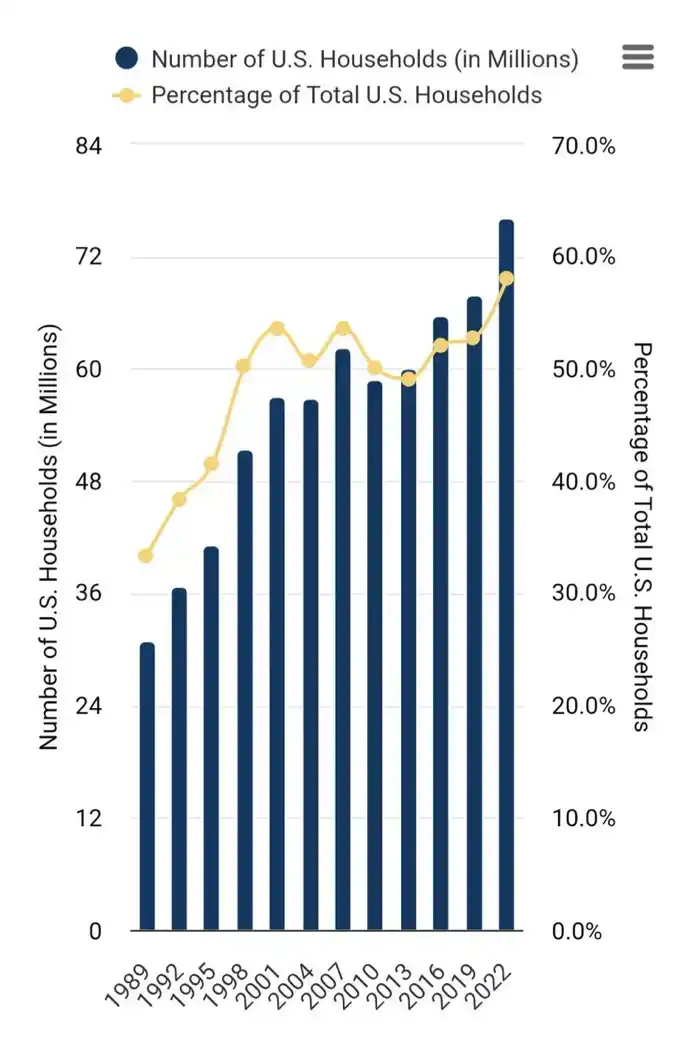
But 40% of Americans are not benefiting. These are typically people who do not appear on national television shows, do not post their views on X or Substack, and may not necessarily articulate the financial pain they are experiencing in the language familiar to economists or investors.

This is why the gap between stock market performance and consumer confidence is widening.

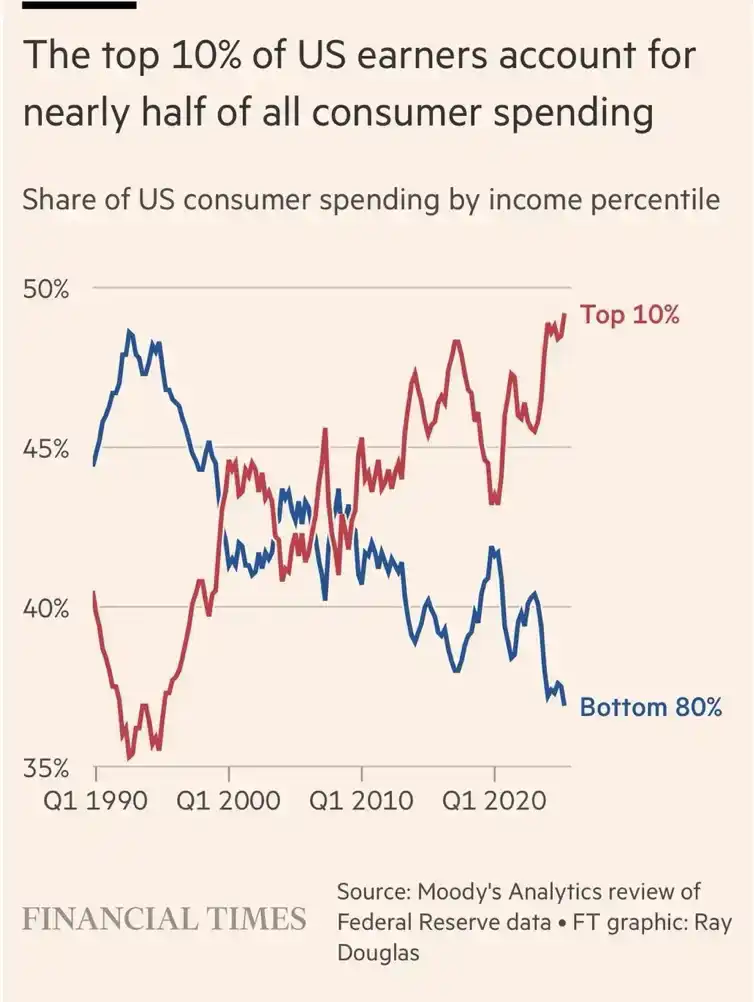
One could argue that consumers are saying one thing but their spending behavior shows another. There is some truth to this, as U.S. consumer spending is indeed still growing. But the detail is this: today, the top 10% of U.S. consumers now account for 50% of the nation's consumer spending.
As my friend SightBringer wrote:

"The U.S. consumption economy is increasingly a demand engine driven by luxury goods and high-income earners, wrapped in a fragile mass-market shell. The cruelty of that chart is that it shows the consumption base being hollowed out. The top 10% now support nearly half of all consumer spending, while the share of the bottom 80% is declining.

This means that, looking at aggregate data, the U.S. consumer appears to be holding strong, but most households are actually weakening. Overall consumption is holding up because asset holders, high-income earners, and affluent retirees are still spending."

If you dig into the data, you'll see a 'K-shaped economy' emerging more and more clearly in consumer spending. This makes the situation complex and confusing, but it makes sense when linked to the slump in consumer confidence.

However, I also bring some good news for investors. Peter Mallouk, CEO of Creative Planning, points out that extremely low consumer sentiment readings tend to be a "very good contrary indicator." He says: "The worse people feel about the future, the better the stock market tends to perform afterwards."
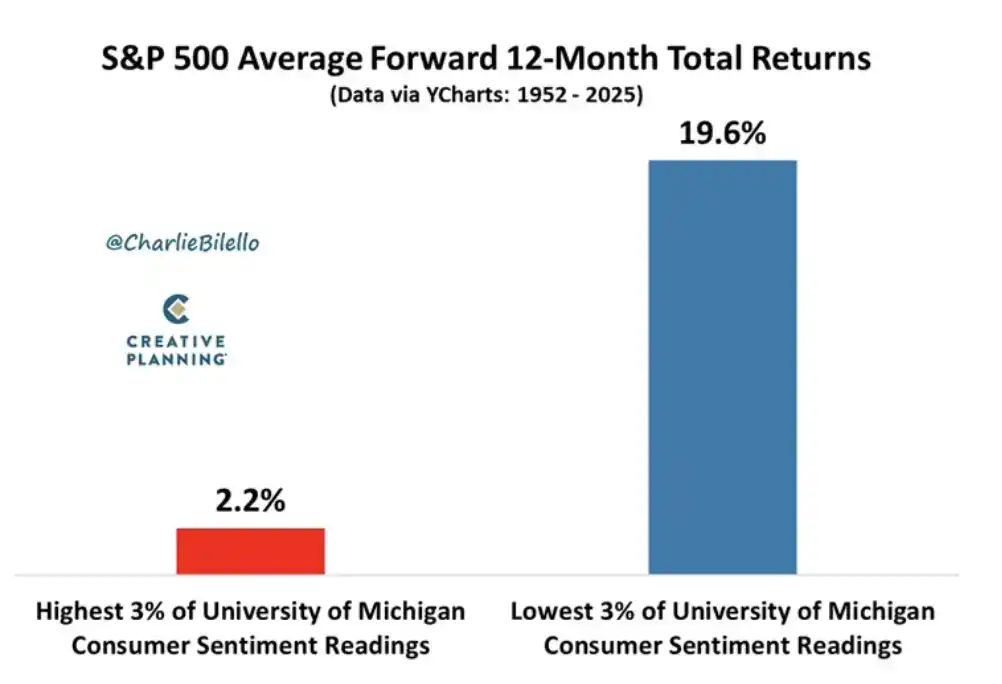
When the University of Michigan Consumer Sentiment Index has fallen into the lowest 3% of all its historical readings, the S&P 500 has delivered an average 12-month return of 19.6%. Given the stark divergence already present between the stock market and consumer confidence, this should offer investors some solace. But the continued strength of the U.S. economy may not truly help the bottom 40% of Americans—they own no investment assets and are still absorbing the impact of higher consumer prices.

This is the most profound binary split of our times.

The rich get richer, while everyone else falls further behind. The very forces driving asset prices higher are also punishing those who most need breathing room. If you want to know what the Federal Reserve, the Treasury, or Washington will ultimately decide, you need only look at which category the people making those decisions belong to.

The wealthy and powerful are navigating the situation with the tools at their disposal. They will try to show empathy. They will look at as much data as possible. I truly believe these people want to do the right thing and help as many people as possible.

The problem is they cannot serve two masters. So, wealthy asset holders will continue to win, and everyone else will continue to sink. All you can do is make sure you're on the right side. Because time is running out, asset prices are still moving higher, and inflation is claiming more victims.

Have a great day. We'll talk again soon.

İlgili Sorular

QWhy is there a divergence between the record-high U.S. stock market and low consumer confidence?

AThe divergence is due to a 'K-shaped' economic recovery. While asset owners benefit from rising stock and property prices, many households without significant investments suffer from inflation, higher food and energy costs, and stagnant wages. Additionally, consumer confidence surveys may be skewed towards more pessimistic Democratic respondents.

QWhat is the 'K-shaped' economic recovery described in the article?

AA 'K-shaped' recovery describes an economy where different groups recover at different rates. One arm of the 'K' represents asset holders and high-income individuals whose wealth and prospects improve with rising markets. The other arm represents lower and middle-income individuals without substantial assets, who face increasing financial pressures and falling behind.

QHow do the spending habits of the top 10% of consumers affect overall economic data?

AThe top 10% of consumers now account for nearly 50% of total consumer spending. Their continued strong spending on goods and services, often luxury items, masks the underlying weakness in spending by the bottom 80% of households, making aggregate consumption data appear resilient while most families are financially strained.

QAccording to the article, why might low consumer confidence be a positive signal for investors?

AHistorically, when the University of Michigan Consumer Sentiment Index falls into its lowest 3% readings, the S&P 500 has delivered an average return of 19.6% over the following 12 months. This suggests extreme consumer pessimism can act as a contrarian indicator, potentially signaling a buying opportunity for stocks.

QWhat is the core conflict or 'binary split' highlighted as the defining issue of our time in the article?

AThe core conflict is that the same monetary and economic policies that drive asset price inflation—benefiting the wealthy who own stocks and property—simultaneously increase the cost of living through general inflation, disproportionately punishing lower-income households without such assets. This deepens wealth and opportunity inequality.

İlgili Okumalar

The Truth About Global Payments, Exposed by Airwallex

Airwallex's founder, Jack Zhang, outlines the three primary paths in the global payments industry and explains why the company chooses the most demanding one: building its own global financial infrastructure. The article begins by highlighting a common industry problem: payment platforms appear homogenized on the surface, offering similar features like global acquiring and multi-currency accounts. However, their underlying capabilities differ vastly. Customers truly care about payment stability, compliance robustness, and reliable market entry support. Zhang identifies three strategic paths: 1. **Bypassing Traditional Systems (Web3/Crypto):** This path promises efficiency via stablecoins and blockchain settlement but struggles with mainstream adoption, significant regulatory friction, and a lack of competitive edge against established players, often leaving it with niche or non-compliant markets. 2. **Packaging Existing Infrastructure:** The most common route, where companies layer a modern interface over legacy banking and partner networks. While enabling fast expansion, it fails to solve core issues like dependency on correspondent banks and intermediary risk, merely postponing the need for solid foundations. 3. **Building Own Global Infrastructure:** The path chosen by Airwallex, Ant International, and others. It involves obtaining local licenses, establishing direct regulatory relationships, building local teams, and controlling the full technology stack. This "heavy" approach is slow and capital-intensive but aims to internalize complexity, providing customers with a "lighter" experience. The core argument is that for business clients, the highest cost isn't transaction fees but hidden risks like frozen accounts, payment delays, and regulatory shocks. By investing heavily in its own infrastructure, Airwallex seeks to absorb these complexities, offering customers greater stability, cost savings (beyond fees), and long-term certainty. This foundational investment, though initially slow, enables compound growth, as evidenced by Airwallex's accelerated revenue scaling. In conclusion, while shortcuts enable faster growth, mastering the most difficult aspects—owning the underlying infrastructure—creates durable value for customers and sustainable advantage for the payment provider.

marsbit2 saat önce

The Truth About Global Payments, Exposed by Airwallex

marsbit2 saat önce

The Truth About Global Payments, Revealed by Airwallex

The article discusses Airwallex's approach to global payments, highlighting the key challenges and different strategic paths in the industry. It begins by addressing common user questions about platform reliability, cryptocurrency payments, and the necessity of Airwallex's "heavy" infrastructure model. The core argument is that while many payment platforms appear similar on the surface—offering features like global acquiring and multi-currency accounts—their underlying capabilities differ drastically. The piece identifies three primary paths for global payment providers: 1. **Bypassing Traditional Infrastructure (Web3/Crypto):** This path promises efficiency through stablecoins and on-chain settlements but faces significant regulatory hurdles and offers little advantage over established players for mainstream use, often serving only niche or non-compliant markets. 2. **Aggregating/Packaging Existing Infrastructure:** The most common route, where companies layer a better user experience over legacy banking and partner networks. While fast to market, this approach does not solve fundamental issues like dependency on intermediaries, correspondent banking risks, and compliance fragility. 3. **Building Proprietary Global Infrastructure:** The path chosen by Airwallex and similar firms. This involves obtaining local licenses, building direct regulatory relationships, establishing local teams, and controlling the compliance and technology stack. This is the most difficult and capital-intensive route but aims to internalize complexity. Airwallex's strategy of "heavy" investment in its own infrastructure is framed not as inefficiency, but as a long-term bet to provide clients with greater stability, cost savings beyond fees, and certainty. The platform's "heaviness" absorbs risk and operational complexity, aiming to deliver a "lighter" experience for business customers. The article concludes that in global payments, while shortcuts enable faster growth, mastering the most difficult aspects—the underlying infrastructure—is what creates durable value for clients and sustainable competitive advantage.

链捕手2 saat önce

The Truth About Global Payments, Revealed by Airwallex

链捕手2 saat önce

İşlemler

Spot
Futures
活动图片