Defending Champions or New Kings? World Cup Final Sees All AIs Backing the Same Side

Odaily星球日报2026-07-17 tarihinde yayınlandı2026-07-17 tarihinde güncellendi

Özet

Will the 2026 World Cup final see Argentina successfully defend their title or a new champion crowned? AI models from various platforms have made their prediction. The final in Buenos Aires pits defending champions Argentina against a resilient Spanish side that has reached this stage with a record of exceptional defensive solidity, conceding only one goal in seven matches. Argentina's path was dramatically different, filled with late comebacks and narrow victories, including a semi-final win over England secured by late goals assisted by the 39-year-old Lionel Messi. A poignant subplot adds narrative weight: a nearly 20-year-old photo shows a young Messi bathing an infant Lamine Yamal, who is now a 19-year-old key player for Spain, symbolizing a potential passing of the torch. In the semi-finals, most AI models incorrectly predicted a French victory over Spain, with only Google's Gemini correctly picking Spain's advancement and also accurately forecasting Argentina's win over England. For the final, however, all six surveyed AIs—ChatGPT, Claude, Gemini, Grok, DeepSeek, and Qwen—unanimously predict a Spanish victory. Their reasoning centers on Spain's superior defense, midfield control, and better physical preparedness after a less strenuous knockout stage journey. While consensus favors Spain as champions, five of the six AIs believe the match will be tightly contested, predicting a draw (1-1 or 0-0) within regular time, with Spain's advantage potentially telling in extr...

Original | Odaily Planet Daily (@OdailyChina)

Author | Asher (@Asher_ 0210)
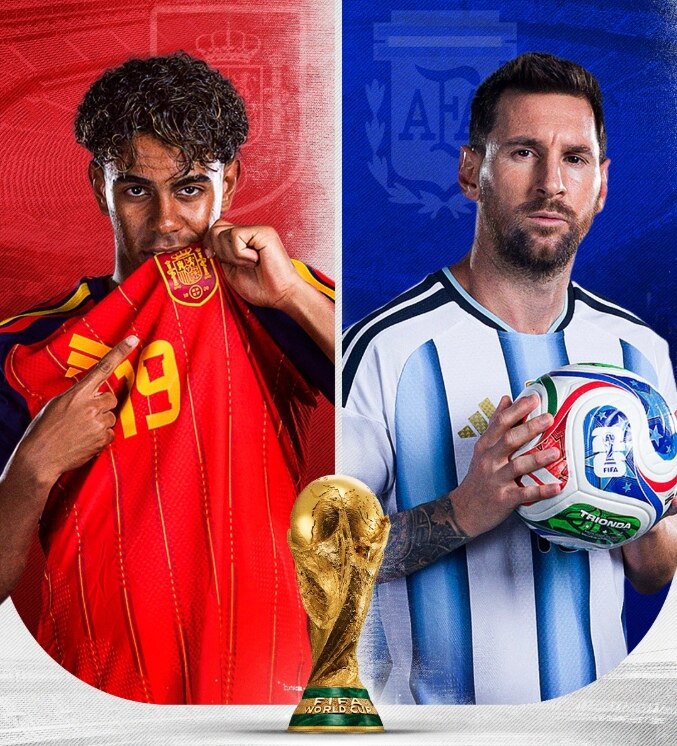
At 3 a.m. Beijing Time on July 20, the 2026 FIFA World Cup will crown its champion between Argentina and Spain. On one side is Argentina, attempting to defend their title and achieve a historic back-to-back World Cup win; on the other is Spain, who have marched steadily to the final with an almost unbreakable defense.

Spain's path to the final has demonstrated remarkable stability. In the knockout stages, they successively defeated Austria, Portugal, Belgium, and France, maintaining tight control of the game rhythm against multiple strong opponents. Particularly in the semi-final against France, Spain allowed little space for counterattacks from the Mbappé-led frontline, ultimately advancing with a 2-0 victory. With only 1 goal conceded and 6 clean sheets in 7 matches, their solid defense and formidable midfield control have been the bedrock of their journey.

Argentina's road, in contrast, has been fraught with danger and comebacks. Since entering the knockout rounds, they have hardly secured a comfortable win. They narrowly defeated Cape Verde and Egypt 3-2 each; in the quarter-final against Switzerland, they only scored consecutive goals deep into extra time; facing England in the semi-final, they were still trailing in the 85th minute before relying on Messi's assists for Enzo and Lautaro to complete a dramatic turnaround.

Furthermore, this final carries a storyline almost worthy of a movie script.

During a charity photoshoot in 2007, a young Lionel Messi was photographed bathing an infant Lamine Yamal. No one could have imagined that nearly two decades later, the two would meet for the first time in their careers on the World Cup final stage.

Now, Messi is 39 years old, while Yamal is just 19. One is potentially playing his final World Cup match; the other stands at the threshold of his own era. This nearly 20-year-old photo adds a layer of symbolic generational transition to this final.

Before delving into which side the AIs predict will lift the trophy, let's review their performance in the two semi-finals (related content can be read here: Semi-final AI Prediction Battle: Is France a Lock? England vs Argentina Hangs in the Balance).

Most Stumbled in Semis, Gemini Nailed Both

In the quarter-finals, all 6 AIs correctly predicted France, Spain, England, and Argentina to advance. However, by the semi-finals, the overall prediction performance of the AIs became somewhat "lackluster."

For France vs. Spain, ChatGPT, Claude, Grok, DeepSeek, and Qwen not only unanimously favored France to advance but also all predicted a 2-1 win for France. These five models reasoned that France could exploit the spaces left by Spain's advancing full-backs to decide the match with swift counterattacks. In reality, France failed to execute the expected counters, were instead controlled by Spain's rhythm, and ultimately exited with a 0-2 loss. Gemini, the sole model to pick Spain, got the advancing team right, but it predicted the match would go to a penalty shootout, thus also missing the exact process.

For England vs. Argentina, the 6 AIs were split down the middle. Grok, DeepSeek, and Qwen supported England, while ChatGPT, Gemini, and Claude backed Argentina. In the end, Argentina completed a 2-1 comeback. The three models supporting Argentina correctly predicted the advancing side, with only Gemini also accurately predicting the final score.

After the two semi-finals, Gemini emerged as the only model to correctly pick both finalists, delivering the most accurate predictions of this round. Yet, as we approach the ultimate championship match, all 6 AIs have once again aligned on the same side.

Consensus Returns for Final, All 6 AIs Favor Spain

Monitoring by prediction market tools shows that in the "World Cup Final Argentina vs Spain" event on predict.fun, the implied probability for an Argentina win is temporarily reported at 27%; a draw at 32%; and a Spain win at 43%. Furthermore, including extra time and penalties, Spain's implied championship probability stands at 59%, compared to Argentina's 41%.
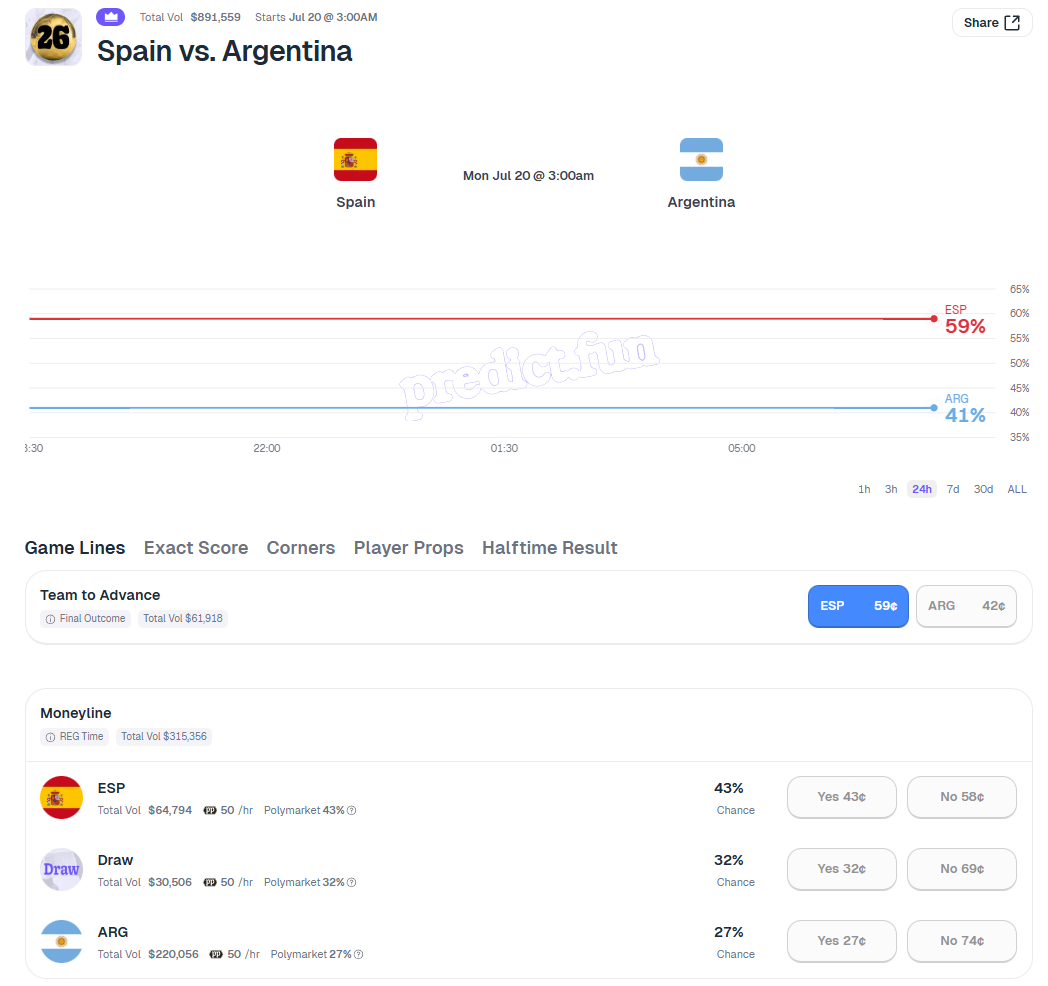
While the prediction market shows a close championship probability, the stance of the 6 AIs is highly unanimous: ChatGPT, Claude, Gemini, Grok, DeepSeek, and Qwen all favor Spain to win the title.

Why Do All AIs Predict a Spanish Victory?

The reasons cited by the AIs for favoring Spain are highly consistent: defense, midfield control, and physical preparedness.

Spain's most compelling advantage is their near-impenetrable defense this tournament. Conceding only 1 goal in the first 7 matches and successively containing Portugal, Belgium, and France in the knockouts. While Argentina possesses greater offensive firepower, facing Spain's compact formation, they are unlikely to find the same open spaces for counterattacks as before.

Midfield control will dictate the pace of the match. Rodri orchestrates the attack, Olmo consistently infiltrates the attacking channels between defenders, and Yamal can continuously stretch Argentina's defense from the wings. Argentina excels at compressing the center and launching rapid attacks through Messi, Álvarez, and Lautaro, but Spain has the ability to reduce transitional play through prolonged possession, making it difficult for Argentina to settle into their preferred rhythm.

Physical preparedness is also a variable widely mentioned by the AIs. Spain finished their semi-final a day earlier than Argentina and had a relatively smoother path; Argentina, meanwhile, played 120 minutes against Switzerland and battled until stoppage time against England. If the match goes into extra time, Spain's younger squad and deeper bench could become decisive advantages.

5 AIs Don't Favor a Spanish Win Within 90 Minutes

Although unanimous on the champion, the 6 models still have different judgments on how Spain might win the match.

Gemini, the top performer in the semis, predicts a 1-1 draw in regulation time, a continued stalemate in extra time, and ultimately a penalty shootout to decide the champion, picking Spain to emerge victorious.

ChatGPT, Grok, and Qwen offer similar predictions, all leaning towards a 1-1 scoreline after 90 minutes. They believe Argentina has the ability to equalize through Messi's playmaking and attacking efficiency, but in extra time, Spain's superior physical conditioning and squad depth will gradually tell, leading to a winning goal in the additional 30 minutes.

Claude does not predict a specific score but believes the match will be locked in a low-scoring range (1-1, 1-0, or 0-0). It emphasizes the cautious atmosphere typical of finals, suggesting the sides may remain evenly matched for long periods until a set piece, counterattack, or individual moment of brilliance breaks the deadlock.

DeepSeek is the only model leaning more towards Spain resolving the match within the 90 minutes. It expects Spain to continue their defensive solidity, limit Argentina's attack, and secure a direct 2-0 or 2-1 victory.

Before the semi-finals, 5 AIs unanimously backed France to advance, only for Spain to deliver a 2-0 masterclass, collectively proving the AIs wrong. This time, will Spain fulfill the promise of their overall strength, or will Argentina once again drag the match into familiar desperate straits and find a path to another miraculous turnaround?


İlgili Sorular

QWhat is the main storyline surrounding the upcoming 2026 World Cup final between Argentina and Spain, according to the article?

AThe main storyline is the potential passing of the torch between two generations, symbolized by a nearly 20-year-old photo of a young Lionel Messi giving a bath to a baby Lamine Yamal. Now, a 39-year-old Messi potentially faces a 19-year-old Yamal in what could be Messi's final World Cup match, representing a symbolic shift of eras.

QWhich was the only AI model to correctly predict both finalists from the semifinals, and what was its performance?

AGemini was the only AI model to correctly predict both finalists. It was the sole model to pick Spain to advance over France (though it predicted a penalty shootout, not a 2-0 win). It also correctly predicted Argentina to beat England and was the only model among those picking Argentina to also get the exact 2-1 scoreline right.

QWhat are the three primary reasons cited by the AI models for unanimously favoring Spain to win the World Cup final?

AThe three primary reasons are: 1) Spain's nearly impenetrable defense, having conceded only 1 goal in 7 matches with 6 clean sheets. 2) Superior midfield control, allowing them to dictate the game's tempo and limit Argentina's preferred fast transitions. 3) Better physical and squad depth, having had an easier path to the final and more rest, which could be decisive if the match goes to extra time.

QHow did the predictions of ChatGPT, Grok, and Qwen (Qianwen) differ from DeepSeek's regarding how Spain would win the final?

AChatGPT, Grok, and Qwen predicted the match would be tied 1-1 in regular time, with Spain's superior fitness allowing them to score a winning goal in extra time. In contrast, DeepSeek was the only model that favored Spain winning within the 90-minute regulation time, predicting a 2-0 or 2-1 victory, citing their strong defense to contain Argentina's attack.

QWhat was the general performance of AI models in the World Cup semifinals compared to the quarterfinals, as described in the article?

AIn the quarterfinals, all six AI models correctly predicted the advancement of France, Spain, England, and Argentina. However, their overall performance was poor ('拉胯') in the semifinals. Five models (ChatGPT, Claude, Grok, DeepSeek, Qwen) incorrectly predicted France would beat Spain 2-1. Only three models (ChatGPT, Gemini, Claude) correctly picked Argentina over England, with only Gemini getting the exact score right for that match.

İlgili Okumalar

Stripe's $53.4 Billion Acquisition of PayPal: The Final Piece of the Stablecoin Empire Puzzle

Stripe has reportedly made a $53.4 billion acquisition offer for PayPal, a move that could signal a major shift in the stablecoin landscape from a "technology race" to a "customer war." Over recent years, Stripe has been quietly building nearly every layer of a stablecoin empire: acquiring the issuance platform Bridge, wallet provider Privy, co-incubating the payments-focused Layer 1 network Tempo with Paradigm, and joining the Open USD (OUSD) alliance stablecoin initiative. What it lacks, however, is a massive direct consumer user base. PayPal, with its hundreds of millions of active accounts, the Venmo app, and its own PYUSD stablecoin, would provide exactly that. The acquisition could create a closed-loop system where Stripe handles the merchant side, PayPal/Venmo serve consumers, and transactions are settled via stablecoins on a blockchain like Tempo, potentially bypassing traditional card networks and their fees. While the deal is not yet finalized and may face hurdles—including potential resistance from PayPal's board or a higher bid—the mere offer suggests Stripe's strategic focus may have evolved. It indicates that having superior infrastructure alone may not be enough; distribution and user access are critical battlegrounds. Questions remain about how PYUSD, OUSD, and Venmo would integrate with Stripe's stack, and whether private equity co-investor Advent International would prioritize such crypto experiments. If successful, this acquisition could significantly boost Tempo's position in the competitive public blockchain space and further push crypto-based payments into the mainstream, potentially fulfilling PayPal's original vision of an internet-native currency through a new, crypto-native infrastructure.

marsbit7 dk önce

Stripe's $53.4 Billion Acquisition of PayPal: The Final Piece of the Stablecoin Empire Puzzle

marsbit7 dk önce

Hyperliquid's "Stock Price" for ChangXin Memory Tech Hits $8.64: How Was This Price Determined Before the IPO?

Title: Hyperliquid's "Stock Price" for CXMT Hits $8.64: How is This Pre-IPO Price Determined? Summary: On Hyperliquid, a derivative contract tracking the pre-IPO value of Chinese chipmaker Changxin Xinqiao (CXMT) has been trading, with its price reaching $8.64. This price is not a real stock price or a direct IPO valuation, but the result of a specific market mechanism. Trade.xyz deployed this "Pre-IPO Perpetual" (IPOP) contract via Hyperliquid's HIP-3 framework. It tracks the expected USD value of one Changxin A-share post-listing. The contract started with an artificial "discretionary reference price" of $5 set by Trade.xyz. Subsequent trading prices are primarily determined by supply and demand on Hyperliquid's on-chain order book. Since there's no tradable现货 before the IPO, the contract price isn't forced to align with the official IPO price of 8.66 RMB (~$1.28). Key mechanics shape the price: 1. **Order Book-Driven**: The actual成交价 comes from limit orders matched on-chain. 2. **Internal Oracle & Smoothing**: An internal oracle, run by Trade.xyz, calculates a smoothed price based on the order book's "impact price" using a 30-minute exponential moving average (EWMA). This oracle price influences funding rates. 3. **Mark Price for Risk**: A separate Mark Price, derived from the median of the internal oracle and other inputs, is used for calculating profit/loss and liquidation. 4. **Discovery Bound (Price护栏)**: A 20% "Discovery Bound" limits how far the price can move from the current reference point. However, if the price hits the bound, the reference price can be re-anchored upward (or downward) up to 7 times. This explains the阶梯状 jumps to $6, $7.2, and $8.64. 5. **Low Funding Rate**: A minimal funding rate (0.005 multiplier) allows positions to be held with low cost before the IPO, but it provides a weak anchor. Post-IPO, the contract is expected to convert to a standard stock perpetual, with its oracle switching to the actual A-share price converted to USD. This transition could cause price jumps and potential liquidations if there's a significant gap between the pre-IPO contract price and the real market price. In essence, the $8.64 price is a composite of: a人为设定的起点 + on-chain order book supply/demand +内部 oracle 平滑 + low funding rate damping + a moving price护栏. It represents a collective bet by specific market participants on the future public market valuation, not the company's current or official IPO price.

marsbit8 dk önce

Hyperliquid's "Stock Price" for ChangXin Memory Tech Hits $8.64: How Was This Price Determined Before the IPO?

marsbit8 dk önce

Prices From the Future Fool the Oracle, Ostium Drained of $24 Million in Five Minutes

Ostium, a perpetual trading platform, suffered a security incident on July 15, resulting in significant losses from its public liquidity vault. Initial analyses from Blockaid, Cyvers, and PeckShield estimate losses of up to $24 million. The exploit occurred over a five-minute window. According to security firms, the core issue was not a missing signature, but a data integrity failure: a registered price oracle (PriceUpKeep) submitted authorized price reports with manipulated future timestamps, creating false trading profits. The protocol’s verification process confirmed the signatures as authorized but did not enforce price sanity checks or timestamp boundaries, allowing the manipulated data to be accepted for settlement. This caused the liquidity vault to pay out on these fraudulent profits. Ostium’s co-founder confirmed the team paused trading within an hour and is collaborating with law enforcement and security experts. The extracted funds were reportedly swapped for ETH, with a portion moved to Tornado Cash. The incident highlights risks in DeFi oracle designs where cryptographic signature verification is insufficient without additional safeguards for data validity, timestamp freshness, and price reasonableness. Ostium's response and planned fixes—including stricter timestamp validation, independent price checks, and circuit breakers—will be critical to preventing similar exploits.

marsbit29 dk önce

Prices From the Future Fool the Oracle, Ostium Drained of $24 Million in Five Minutes

marsbit29 dk önce

İşlemler

Spot
活动图片