Tether's New Business: Helping Small Countries Issue Stablecoins

marsbit2026-05-26 tarihinde yayınlandı2026-05-26 tarihinde güncellendi

Özet

Tether has announced a partnership with the Georgian government to issue GEL₮, a Lari-pegged stablecoin, aiming to reduce costs, accelerate settlements, and promote cross-border payments. This move is part of Tether's broader strategy to establish a replicable, standardized business of issuing sovereign currency-backed stablecoins for smaller nations, alongside its flagship USDT and other regional offerings like MXNT (Mexican Peso) and CNHT (Offshore Yuan). Georgia represents an ideal test case due to its high reliance on remittances (~15% of GDP), established digital asset regulatory framework aligned with U.S. standards, and prior engagement with Tether. The country gains accelerated internationalization of its currency by accessing Tether's global distribution network and liquidity pools, where GEL₮ can be swapped directly with assets like USDT. For Tether, the immediate financial gain from Georgia's small market is minimal. The true value lies in creating a template. Successfully navigating the compliance, reserve, and redemption processes for GEL₮ allows Tether to replicate this model swiftly for other nations with similar profiles, such as Azerbaijan or Nigeria. The deeper strategy involves subtly integrating these national currencies into an informal USDT-anchored dollar system, positioning Tether as the essential routing infrastructure. This partnership highlights a potential new model: the outsourcing of sovereign currency globalization to private stablecoin issue...

Author: Xiaobing, Deep Chao TechFlow

On May 25th, stablecoin issuer Tether announced a collaboration with the Georgian government to issue GEL₮, a stablecoin pegged to the Lari.

The press release is written conventionally: reducing costs, accelerating settlement, promoting cross-border payments. CEO Ardoino reiterated that phrase again, stablecoins are becoming the infrastructure of global finance.

Looking at this announcement within the context of Tether's actions over the past 24 months, what Tether is doing is gradually connecting the issuance interfaces and global distribution channels for the on-chain currencies of small nations, one by one, into its own hands.

Tether's Product Line is Essentially a Business Map for Issuing Currencies on Behalf of Others

Let's lay out Tether's cards: USDT, $189 billion market cap, number one globally, but not usable by US users; USAT, a US dollar stablecoin launched earlier this year for the GENIUS Act-compliant market, essentially a "US version" of USDT; EURT, a Euro stablecoin, forced to retreat by MiCA, will cease redemptions in November 2025; MXNT is for the Mexican Peso; CNHT is for offshore Chinese Yuan, its scale has remained small; GEL₮, the upcoming Lari stablecoin.

Viewed by currency, it seems messy, but the strategic intent is clear. Tether is testing one thing: Outside the main channel of the US dollar, can "issuing national currency stablecoins on behalf of sovereign states" become a replicable, standardized business?

USDT is responsible for holding the position of the global dollar shadow currency. USAT and EURT are attempts at compliance in heavily regulated markets. The common denominators for the rest—MXNT, CNHT, GEL₮—are clear: weak internationalization of the local currency, expensive cross-border payments, high reliance on remittances, but not so severe as to face outright sanctions like Iran or North Korea.

Georgia is the latest blueprint for this strategy.

Why Was Georgia Willing to Sign?

A population of 3.7 million, GDP around $35 billion, smaller than Kunming, but it has three conditions that make it particularly suitable.

It has a pain point. IMF data shows that over the past decade, remittances have accounted for about 15% of Georgia's GDP. For 40-45% of recipient households, monthly income comes from remittances, mainly from Russia, Greece, and the US. The cost and time delay per traditional wire transfer represent real money lost for these families. If an on-chain Lari can work, it's a true benefit for the common people.

The compliance framework is ready. The National Bank of Georgia spent years building a digital asset regulatory framework covering reserves, redemption rights, issuer supervision, AML, and proactively aligning with the US GENIUS Act. This step was intentional, aiming to position itself as a digital asset hub in the Caucasus region.

Preliminary groundwork was laid. Georgia signed an MOU with Tether in 2023, conducted a digital Lari pilot with Ripple the same year, and also signed a collaboration with Hedera. GEL₮ did not appear out of thin air.

The logic is clear: Use Tether's global distribution network in exchange for accelerated internationalization of its own currency.

Georgia could also issue a CBDC itself, but even a fast CBDC only circulates within its own system. By plugging into Tether's network, the Lari can, for the first time, be directly swapped with USDT and USDC in the same liquidity pool, and be held in any crypto wallet. This is equivalent to Georgia using its compliance framework as a bargaining chip to rent Tether's already-established global pipeline.

What Did Tether Gain?

Georgia is too small. The annual remittance market is less than $5 billion. Adding domestic payments, the stablecoin circulation would be at most a few tens of billions, a drop in the bucket compared to USDT's $189 billion.

So Tether's goal is not Georgia itself, but thetemplate.

Each additional country makes the solution of "issuing national currency stablecoins on behalf of sovereign states" more mature. Once the compliance architecture, reserve mechanism, and redemption process for GEL₮ are proven, the next interested country—Azerbaijan, Armenia, Uzbekistan, Kenya, Nigeria—can directly apply the template, compressing the timeline from years to months.

The real moat lies even deeper. When a country's national stablecoin is swapped within the same liquidity network as USDT, that country's currency is quietly connected to an informal dollar system anchored by USDT. Tether doesn't need to fight for decision-making power in these countries' central banks; it only needs to ensure it is the middle router.

The logic resembles London's financial export in the 19th century. London's banks didn't become central banks in colonies; they just layered their clearing, discount, and exchange systems abroad, and then everyone had to use London's rails. The difference is that was one-way colonialism, whereas now it's two-way voluntary.Small countries are happy to sign, unable to wait for SWIFT's transformation; Tether is happy to do it, locking in a key position in the next generation of financial infrastructure.

Outsourcing Sovereign Currency

The digital Euro has been tangled in public consultations for five years by MiCA, ECB, and various national central banks.

Georgia, a country with a GDP smaller than Kunming, bypassed the entire process of "a country issuing its own CBDC" with a contract with a private company, sending its national currency directly onto a global circulation track on par with USDT.

If this happens in ten or twenty small countries over the next three years, it will be the embryo of a new international financial order: the outsourcing of sovereign currency globalization to private stablecoin issuers.

But this path is not without cost.

First is monetary sovereignty risk. If the liquidity, wallet access, and transaction routing of a national stablecoin all depend on Tether, what happens to the visibility and control over currency circulation by the local central bank? There is no clear answer yet.

In the future, if half of Georgian households use GEL₮ to receive remittances, then any reserve crisis Tether faces will not only pressure Tether's balance sheet but also Georgia's social stability.

Second, if all small countries' national stablecoins ultimately enter and exit via swaps through USDT, then superficially it's national currencies going on-chain, but in reality, it might be these countries further connecting to an on-chain dollar system centered on USDT. For countries doing this in a de-dollarization context, this is a paradox worth considering in advance.

The BIS has repeatedly warned about the impact of private stablecoins on monetary sovereignty and financial stability over the past two years, not without reason.

Details of GEL₮'s issuance structure, reserve custodian, and technical chain selection have not been disclosed. These details determine whether it is a true "sovereign-backed stablecoin" or a "regular Tether product with a government name attached."

But there is an observation point more important than details: In the next 12 months, will a second or third country sign a similar template collaboration with Tether?

If so, Tether will transform from a stablecoin issuance company into a cross-sovereign financial infrastructure service provider that issues national currency stablecoins on behalf of sovereign states.

This is a species we haven't had a word for before. It's not a bank, not a central bank, not a payments company, nor an ordinary stablecoin issuer. It's a cross-sovereign, on-chain currency-issuing organization pieced together by regulatory arbitrage, network effects, and technical standardization.

Looking back in three years, the contract signed on May 25, 2026, might be more important than any other crypto news from that week.


İlgili Sorular

QWhat is Tether's new business model with small countries like Georgia, as described in the article?

AThe article describes Tether's new business model as partnering with small sovereign nations to issue and distribute local currency stablecoins on their behalf. Tether provides the technological infrastructure, global distribution network, and operational template. In exchange, countries like Georgia gain access to a faster, cheaper system for cross-border payments and remittances, accelerating their currency's digital and international presence without building a Central Bank Digital Currency (CBDC) from scratch.

QWhy did Georgia agree to partner with Tether to issue the GEL₮ stablecoin?

AGeorgia agreed to partner with Tether due to a combination of three key factors: 1) A clear economic pain point, with remittances making up about 15% of its GDP, where high traditional wire transfer costs hurt citizens. 2) A pre-existing and compliant regulatory framework for digital assets that aligns with standards like the U.S. GENIUS Act, making it a safe jurisdiction. 3) Prior groundwork, including a 2023 Memorandum of Understanding (MOU) with Tether and other digital currency pilots. The deal allows Georgia to leverage Tether's global network for its currency's internationalization.

QWhat does the article suggest is Tether's main strategic goal in these partnerships, beyond the local market size?

AThe article suggests Tether's primary strategic goal is not the immediate market size of a small country's currency but the creation of a replicable 'template' or standardized service for issuing sovereign stablecoins. Each successful partnership refines this model. The deeper goal is to position Tether as the central 'router' in a new financial network, where various local stablecoins are interoperable with USDT. This subtly integrates these countries' currencies into a USDT-anchored, informal dollar system, cementing Tether's role as critical cross-sovereign financial infrastructure.

QWhat are the potential risks for a country that outsources its sovereign currency stablecoin to Tether?

AThe article highlights two main risks for countries: 1) **Monetary Sovereignty Risk**: Outsourcing the issuance and network for its digital currency could reduce the central bank's visibility and control over money flows, making monetary policy and financial stability management more complex. 2) **Systemic Dependency Risk**: If the local economy becomes reliant on the Tether-issued stablecoin (e.g., for remittances), any operational, reserve, or legal crisis at Tether could directly threaten the country's financial stability and social welfare. Additionally, using USDT as the primary swap pair may further embed the country into a dollar-centric system, which could be paradoxical for nations seeking de-dollarization.

QHow does the article characterize the potential long-term significance of Tether's Georgia deal?

AThe article characterizes the Georgia deal as a potential landmark event that could signify the emergence of a new type of financial entity and a shift in the international financial order. If replicated, Tether could evolve from a stablecoin issuer into a 'cross-sovereign chain money minting organization'—a unique hybrid that is not a bank, central bank, or payment company, but a private entity providing sovereign currency globalization as a service through regulatory arbitrage, network effects, and technical standardization. This could represent a form of 'sovereign currency outsourcing' on a global scale.

İlgili Okumalar

The First Encyclical of the New Pope in Rome, to Save the Common People in the AI Era

New Pope's First Encyclical Aims to Safeguard Humanity in the AI Era On May 25th, Pope Leo XIV issued his first encyclical, "Magnifica humanitas," a 40,000-word document addressing the profound challenges posed by Artificial Intelligence. Released on the 135th anniversary of Pope Leo XIII's "Rerum novarum," it positions itself as a guide for the Church's social doctrine in the AI age. The encyclical's central concern is preserving deep humanity amid rapid technological advancement. It argues technology is never neutral, carrying the values of its creators and users, and warns against building a "Tower of Babel" of technological tyranny versus a human-centric community. Pope Leo XIV criticizes the concentrated, opaque power of tech giants and the "new forms of slavery" emerging in the digital economy, where humans risk being reduced to mere instruments. A significant focus is the military use of AI. The Pope declares traditional "just war" theory obsolete, arguing that delegating lethal decisions to opaque algorithms severs moral accountability. He calls for "disarming AI" from military and economic arms races. The document also warns that deepfakes and information manipulation erode societal trust and rational discourse. Anthropic co-founder Chris Olah, present at the Vatican, responded by acknowledging the AI industry's limitations due to commercial and competitive pressures, necessitating external ethical oversight. He emphasized that AI's nature and its interaction with the world are ultimately philosophical and religious questions, not solvable by computer science alone. Olah revealed unsettling findings from his team's research into AI internals, including structures mirroring human neuroscience and evidence of internal states resembling emotions and introspection. The dialogue highlights a pivotal shift: AI is not a passive tool but an entity with emerging "quasi-agency." As creators themselves express unease, science is turning to realms like religion to grapple with fundamental questions about human identity and dignity. The core imperative becomes safeguarding irreducible human qualities—compassion, conscience, free will, and the pursuit of truth—in the face of a potentially more efficient intelligence.

Odaily星球日报1 dk önce

The First Encyclical of the New Pope in Rome, to Save the Common People in the AI Era

Odaily星球日报1 dk önce

On-chain Analyst: Why Are Most Zcash Transactions Still Traceable?

Title: Why Most Zcash Transactions Remain Traceable Zcash, a privacy-focused cryptocurrency launched in 2016, was designed to offer anonymity by hiding transaction details like sender, receiver, and amount using zero-knowledge proof technology (zk-SNARKs). However, in practice, a significant portion of ZEC transactions are still traceable on-chain. The key reason is Zcash's dual-address system. It features transparent addresses (t-addresses), which work like standard Bitcoin addresses with all data public, and shielded addresses (z-addresses) that encrypt transaction details. There are four transaction types with varying privacy levels: fully transparent (t→t), partially shielded (t→z and z→t), and fully private (z→z). Despite its privacy capabilities, most real-world Zcash activity involves transparent addresses, primarily because major exchanges and institutions use them for regulatory compliance. As a result, blockchain analytics platforms like Arkham can track and attribute a substantial volume of Zcash transactions. Arkham reports it has identified entities behind over $420 billion in ZEC transaction volume. Case studies highlight this traceability: the U.S. government holds seized Zcash from a dark web case, visible via its transparent wallet, and individual traders' profitable moves are trackable from purchase to exchange deposit. In conclusion, Zcash's privacy is not inherent but user-dependent. While purely shielded (z→z) transactions remain cryptographically private, the prevalence of transparent address usage makes much of the network's activity traceable. The actual privacy protection offered depends entirely on how users choose to transact.

marsbit47 dk önce

On-chain Analyst: Why Are Most Zcash Transactions Still Traceable?

marsbit47 dk önce

From Power Infrastructure to Token Economy: The 'Seven-Layer Cake' of the AI Industry Chain

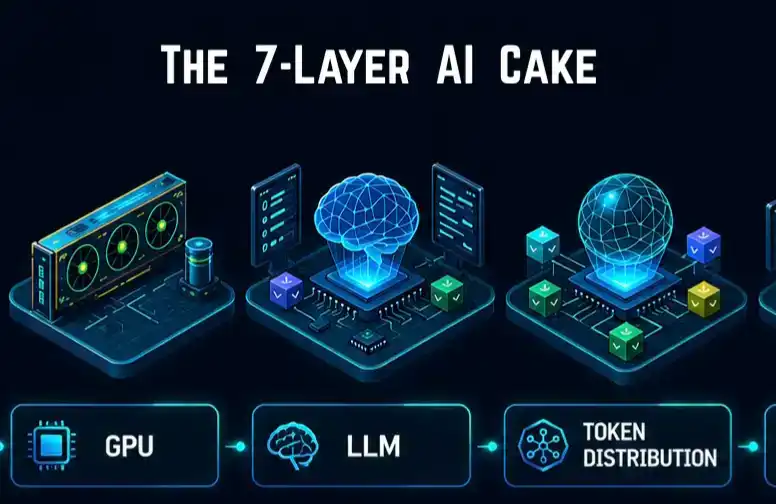
From Power Grid to Token Economy: The AI Industry's "Seven-Layer Cake" The AI industry is shifting from a "model-centric" paradigm focused on massive training to a "token-centric" industrial era driven by inference demand. This new phase revolves around the production, distribution, scheduling, and consumption of tokens—the units of computation used by AI agents for every interaction and task. The article proposes a "seven-layer cake" framework for the AI economy: 1. **Power**: The foundational energy source, with competition shifting to securing stable, low-cost electricity. 2. **AIDC (AI Data Centers)**: Large-scale "Token factories." A trend toward smaller, modular, and regionally deployed AI Factories is emerging for efficiency and proximity to users. 3. **GPU**: The core production hardware for tokens. While NVIDIA dominates, competition exists from AMD, ASIC makers, and Chinese chipmakers, with a growing focus on inference efficiency. 4. **LLMs**: The "engines" that generate tokens. The competition is evolving beyond model size to prioritize factors like token cost, inference efficiency, and operational synergy with infrastructure. 5. **Token Distribution**: The "grid" that allocates and rents out compute resources, led by cloud giants and specialized AI-native platforms. 6. **Token Optimization & Intelligent Scheduling**: The critical "brain" layer that intelligently routes tasks (e.g., to local, cloud, or edge models) for optimal cost, latency, and privacy—maximizing the value of each token. 7. **AI Agents & Models**: The end consumers of tokens. The vision involves billions of AI agents working and interacting concurrently, consuming vast amounts of tokens. Currently, the industry faces fragmentation and inefficiencies between these layers. The true "mass adoption era" of AI will begin only when this seven-layer infrastructure is fully integrated and operates as a cohesive, intelligent network—transforming AI from a software tool into a global industrial system spanning energy, hardware, and compute logistics.

marsbit1 saat önce

From Power Infrastructure to Token Economy: The 'Seven-Layer Cake' of the AI Industry Chain

marsbit1 saat önce

Semiconductors up 78% annually, software down 12% annually: The 'Liquidity Siphon' is playing out within tech stocks

Semiconductor ETFs like SOXX have surged 78.5% year-to-date, while software ETFs like IGV have dropped 12.5%, creating a record performance gap exceeding 90 percentage points. This reflects a major "liquidity suction" within tech stocks, with capital flooding into semiconductors as software faces selling pressure. Driving the semiconductor boom are staggering capital expenditure plans from hyperscalers like Microsoft, Alphabet, Amazon, and Meta, whose combined 2026 capex is projected near $700 billion. This fuels demand for chips, with companies like SanDisk (up 426%), Intel (up 222%), and Micron (up 154%) leading the S&P 500. In contrast, major software firms like Microsoft, Adobe, and Salesforce are all down over 17% year-to-date. The software sector faces a dual challenge: capital is being redirected to semiconductors, and the rise of AI agents like Claude Code threatens traditional SaaS business models, triggering a narrative of AI displacement. Key unanswered questions remain: How long can hyperscalers sustain their massive capex, given potential free cash flow pressures? And will capital eventually rotate back into the deeply oversold software sector? While some analysts warn of a potential semiconductor bubble akin to the dot-com era, the sector's powerful momentum continues, making market timing exceptionally difficult.

marsbit1 saat önce

Semiconductors up 78% annually, software down 12% annually: The 'Liquidity Siphon' is playing out within tech stocks

marsbit1 saat önce

İşlemler

Spot
Futures
活动图片