$3 Billion in August: Bitcoin ETFs Experience Best Month in a Year

cryptonews.ru2026-08-26 tarihinde yayınlandı2026-08-26 tarihinde güncellendi

Özet

Bitcoin ETFs in the US have extended their capital inflow streak to seven consecutive trading days. On August 25th, these funds attracted a net investment of $314.37 million, pushing the total August inflow to $3.03 billion. This marks Bitcoin ETFs' strongest month since October of last year. The funds' total net assets have reached $99.05 billion. While Bitcoin briefly surpassed $80,000 on August 25th, it has since retreated, trading above $79,000. Market sentiment, as measured by the Fear and Greed Index, has cooled slightly but remains in the "Greed" zone. US spot Ethereum ETFs are mirroring the trend, also extending their inflow streak to seven days. They added $179.8 million on Tuesday, bringing their series total to around $1 billion. This synchronized institutional demand for both Bitcoin and Ethereum ETFs suggests a broader recovery of interest. If the current pace continues, August could set a ten-month record for capital inflows. However, machine analysis of the data notes this growth is occurring ahead of the uncertain Fed meeting on September 15-16, which could test investor risk appetite.

Bitcoin ETFs in the US extended their capital inflow streak to seven consecutive trading days — on Tuesday, August 25th, the funds attracted $314.37 million in net investments. Thanks to this streak, the August inflow reached $3.03 billion, leaving the funds just $390 million shy of October 2025's result — with four trading sessions remaining until the end of the month.

August is already becoming the strongest month for Bitcoin ETFs since October of last year. Simultaneously, the funds have more than halved the net outflow deficit since the start of the year — to $2.26 billion. The total net assets of the funds reached $99.05 billion, and the cumulative net inflow since launch has risen to $54.36 billion.

Bitcoin Retreats from $80,000

At the time of publication, Bitcoin was trading above $79,000. On August 25th, the asset briefly surpassed the $80,000 level but failed to hold its position.
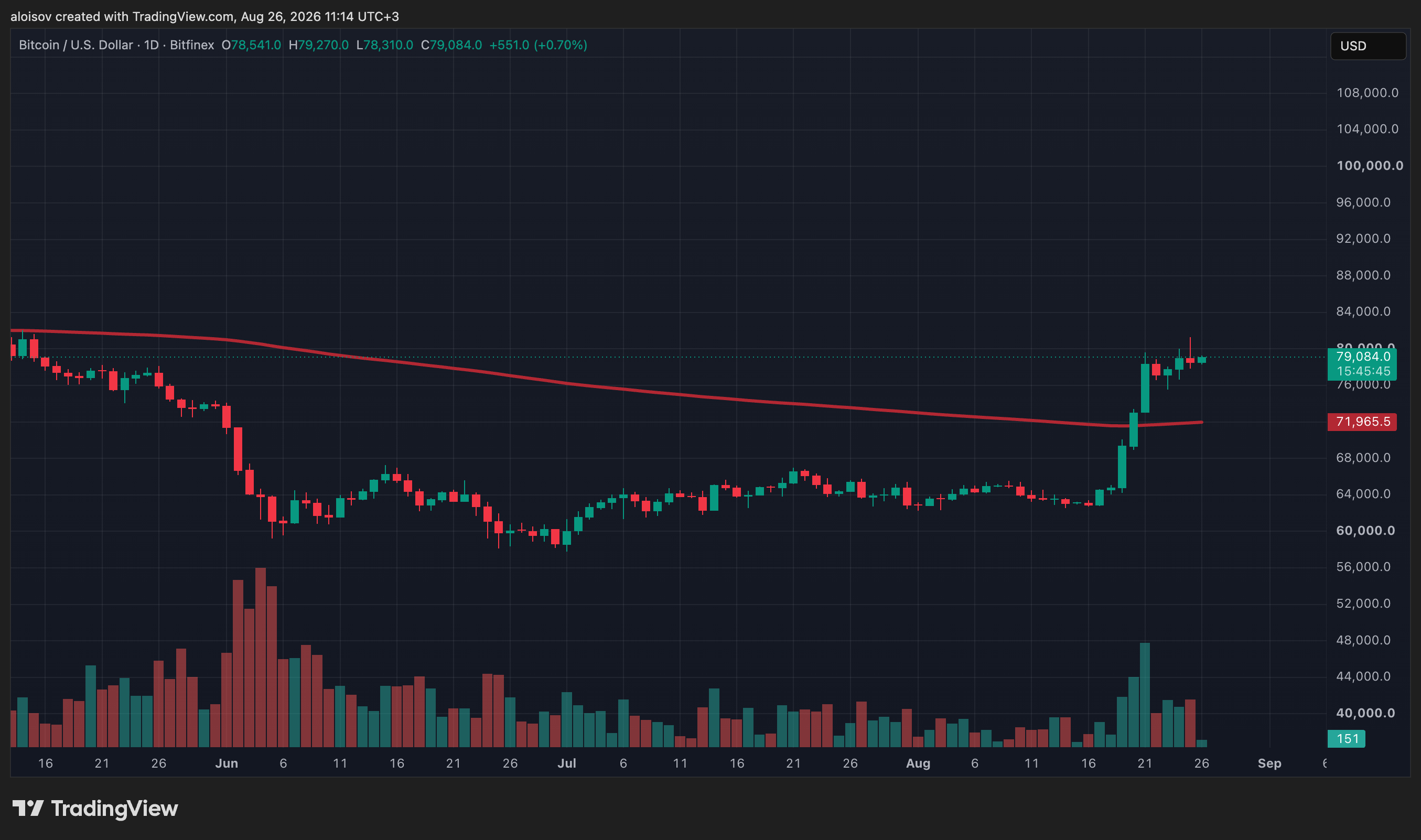
1-day BTC/USD chart and 200EMA. Source: Bitfinex

Market participant sentiment cooled slightly: the Fear and Greed index dropped from 74 to 65 points, remaining in the "Greed" zone.

Ethereum ETFs Mirror Bitcoin's Dynamics

Spot Ethereum ETFs in the US also extended their inflow streak to seven trading days. On Tuesday, the funds added $179.8 million, bringing the total inflow during this period to approximately $1 billion.

  • Bitcoin ETF inflow on Tuesday — $314.37 million

  • Inflow since the start of August — $3.03 billion

  • Bitcoin ETF net assets — $99.05 billion

  • Ethereum ETF inflow on Tuesday — $179.8 million

The synchronous increase in interest in Bitcoin and Ethereum ETFs indicates that institutional demand is recovering in August across both directions. If the current dynamics persist until the end of the month, August could set a new record for capital inflow in the last ten months.

AI Opinion

From the perspective of machine data analysis, the seven-day inflow streak into Bitcoin ETFs is forming against the backdrop of the approaching Fed meeting on September 15-16, the outcome of which markets do not yet assess unambiguously — traders on Kalshi are pricing in about a 67% probability of the current rate being maintained. The Fed rate traditionally determines the strength of the dollar and investor risk appetite, meaning the current capital inflow could face a test even before the end of September.

end-content

İlgili Sorular

QWhat milestone did US Bitcoin-ETFs achieve in August based on the data presented?

AUS Bitcoin-ETFs achieved a net capital inflow of $3.03 billion in August, making it their strongest month since October of the previous year.

QWhat happened to Bitcoin's price on August 25th according to the article?

AOn August 25th, Bitcoin briefly surpassed the $80,000 level but failed to maintain that position and was trading above $79,000 at the time of publication.

QHow have US spot Ethereum-ETFs performed recently in terms of capital inflows?

AUS spot Ethereum-ETFs extended their inflow streak to seven trading days, adding $179.8 million on Tuesday mentioned, with the total inflow for that period reaching about $1 billion.

QWhat potential market event does the article's 'AI Opinion' section suggest could test the current capital inflows into Bitcoin-ETFs?

AThe 'AI Opinion' section suggests that the upcoming Federal Reserve meeting on September 15-16 could test the current inflows, as its outcome regarding interest rates influences the US dollar's strength and investor risk appetite.

QWhat was the total net asset value of Bitcoin-ETFs reported in the article?

AThe total net assets of the Bitcoin-ETFs reached $99.05 billion.

İlgili Okumalar

U.S. Bonds, AI, Inflation: You Can't Have All Three – What's Bitcoin Betting On?

Title: U.S. Treasury Bonds, AI, and Inflation: A Trilemma Facing Washington, and Where BTC Fits In Core Thesis: The U.S. government faces a trilemma: stabilizing the Treasury market, sustaining the AI investment cycle, and controlling inflation. The likely political choice is to prioritize the first two, accepting higher inflation for longer. This creates a sustained tailwind for both gold and Bitcoin by injecting liquidity and shifting duration risk away from the private sector. Key Pressures on Treasuries: * Long-term yields (e.g., 10-year ~4.70%) are near multi-decade highs due to persistent inflation risks, high fiscal supply, weaker demand for long duration, and new competition from AI infrastructure financing. * AI investment, requiring massive capital (estimated ~$300B in investment-grade bond issuance), is now competing directly with the Treasury in long-duration debt markets. * Geopolitical tensions (e.g., Iran conflict) add upward pressure on oil prices and defense spending. Policy Response: The Treasury, under Secretary Besant, is focusing on market stability through measures like supporting the Yen (to prevent forced Japanese Treasury sales), increasing repo operations for long-dated bonds, and potentially shifting issuance toward the short end. This "aggressive Treasury issuance" can function like "stealth QE," easing financial conditions. Impact on Assets: * **Gold** has already benefited (up ~90% from Aug 2024 to Aug 2026), driven by declining trust in the USD, inflation fears, and a "monetary debasement" narrative. * **Bitcoin** is now showing stronger correlation with this theme. Recent outperformance vs. gold (BTC +22.2% vs. Gold +5.9% in late Aug) coincided with Treasury's enhanced repo actions, suggesting the market may be pricing it as a liquidity/ debasement hedge, not just a speculative tech asset. Conclusion: If high inflation, large deficits, and AI capital demands persist, the cost of stabilizing bonds and growth will be shorter debt maturity, constant liquidity support, and tolerance for higher inflation—a favorable environment for gold and BTC. This view would be challenged only by a return to ~2% inflation, credible fiscal consolidation, or AI becoming self-funding.

marsbit7 dk önce

U.S. Bonds, AI, Inflation: You Can't Have All Three – What's Bitcoin Betting On?

marsbit7 dk önce

HBM is Being Redefined

HBM is being redefined as AI-driven demand for computing power shifts the performance bottleneck from processing units to memory bandwidth, making High Bandwidth Memory the critical component for advanced AI hardware. At HotChips 2026, Samsung and SK Hynix unveiled new technical roadmaps for HBM4, moving away from the traditional approach of simply increasing DRAM speed and stacking layers. The focus for HBM4 has shifted from DRAM optimization to a comprehensive system-level redesign of the Base Die. Key innovations include upgrading the Base Die to advanced logic processes (e.g., Samsung's 4nm), adopting hybrid bonding for 3D stacking, and exploring heterogeneous packaging solutions like Intel's EMIB alongside the established CoWoS. This marks HBM's evolution from a simple memory component into an integrated system involving "memory + logic + packaging + IP + EDA." This transition brings benefits like better signal integrity, higher I/O bandwidth (up to 2048-bit), and potential for in-memory computing. However, it also introduces significant complexity. DRAM manufacturers now must deeply collaborate with logic foundries, extending design cycles and increasing supply chain challenges. Furthermore, the industry is moving towards multiple advanced packaging paths, with EMIB emerging as an alternative to CoWoS to alleviate capacity constraints, while hybrid bonding is being developed for future ultra-high (16+ layer) stacks. New core barriers have emerged beyond manufacturing. High-speed PHY/SERDES IP, crucial for HBM4's higher data rates, is concentrated among a few established players, creating an entry barrier for smaller firms. Similarly, the industry lacks mature 3D heterogeneous EDA toolchains capable of co-simulating the coupled electrical, thermal, and mechanical effects across the logic base, memory stacks, and interposer. These "soft" capabilities in IP and EDA are now critical determinants of HBM4's performance and yield. In summary, the HBM industry is entering a new era of systemic competition. The standardized approach is giving way to divergent vendor roadmaps, with multiple technologies coexisting. Success will depend on integrated architecture, packaging, process, and ecosystem capabilities, fundamentally reshaping the competitive landscape for AI memory.

marsbit12 dk önce

HBM is Being Redefined

marsbit12 dk önce

The Era of Earning 200,000 from a 3,000 Investment Is Over; AI Comic Dramas Are Not a Get-Rich-Quick Trend

The era of turning 3,000 yuan into 200,000 yuan is over. AI-generated comic dramas are no longer a low-barrier gold rush. A wave of sudden account suspensions has hit creators in AI comic dramas, AI art, and AI tutorials, primarily triggered by new content and copyright compliance rules implemented by Tomato Novel on August 17. This "last straw" exposed the underlying issues: tightening platform rules, rising copyright requirements, increasing costs, and severe content homogenization. The business model was fundamentally unsustainable for most creators. One creator detailed the math: producing five minutes of content daily cost around 510 yuan in AI computing and editing, while a video with 60,000 views might only earn 45 yuan. While a few early viral hits like "Huo Qubing" and "Zombie Cleaner" achieved high returns with minimal investment, they were exceptions. The reality for most solo creators was barely covering costs or operating at a loss. The new regulations mandate formal authorization from original authors for adaptations, limit video length and the amount of原著 content used, and ban terms like "Episode 1" in titles. This directly dismantled the previous "produce first, authorize later" model. Faced with the inability to afford版权 costs and the threat of penalty, many creators chose to halt updates. While some fans expressed frustration, the rules protect original authors who often faced侵权 with little recourse. The shutdowns signal not the failure of AI technology, but an inevitable industry shift from wild growth to regulated refinement. The previous model prioritized quick cash over quality content, leading to formulaic, "AI-face" saturated dramas that audiences grew tired of. The future belongs to creators who use AI as a tool to serve solid storytelling, not replace it. Some are now seeking formal licenses, a slower but necessary process. Upcoming national regulations further underscore this move towards standardization, weeding out those seeking only fast money and making space for genuine creators.

marsbit13 dk önce

The Era of Earning 200,000 from a 3,000 Investment Is Over; AI Comic Dramas Are Not a Get-Rich-Quick Trend

marsbit13 dk önce

İşlemler

Spot
活动图片