
Dogecoin Liquidation Exceeds $1 Billion! The Largest Liquidation Wave in History is Coming, How Long Can DOGE Retail Investors Hold On?

金色财经2025-12-09 tarihinde yayınlandı2025-12-09 tarihinde güncellendi

Özet

Dogecoin (DOGE) rebounded after hitting $0.140 against the US dollar, though it now faces resistance near $0.1450. Earlier, DOGE recovered from the $0.1350 level, mirroring movements in Bitcoin and Ethereum, and broke through resistance levels at $0.1380 and $0.140. It is currently trading above the 100-hour simple moving average, with a rising trendline forming support around $0.1405 on the hourly chart. If the upward momentum continues, DOGE may test the $0.1450 resistance, which aligns with the 50% Fibonacci retracement level of the recent decline from $0.1532 to $0.1351. Further resistance lies near $0.1490, with a potential push toward $0.1530. A sustained break above this level could open the path to $0.1620 and $0.170, with a key mid-term resistance at $0.1720. However, failure to break above $0.1450 may lead to a pullback. Initial support is at $0.1400 and the trendline, followed by $0.1380. The major support remains at $0.1350; a break below could trigger a decline toward $0.1265 or even $0.1250. Technical indicators show mixed signals: the hourly MACD is in the bullish zone but losing momentum, while the RSI remains below 50, indicating weak short-term momentum.

Dogecoin's exchange rate against the US dollar rebounded after hitting the $0.140 mark, but is currently encountering resistance near $0.1450, facing further upward pressure.

Previously, DOGE gradually recovered from the $0.1350 level, moving in line with Bitcoin and Ethereum, and successively broke through the $0.1380 and $0.140 resistance levels. The price has also moved above $0.1410 and the 100-hour simple moving average. From a technical chart perspective, an upward trend line with support at $0.1405 has formed on the hourly chart of DOGE/USD.

If the price can continue to rebound, it will first challenge the $0.1450 resistance in the short term, a level that also corresponds to the 50% Fibonacci retracement level of the decline from the $0.1532 high to the $0.1351 low. Stronger resistance is located near $0.1490. A break above this could lead to a further test of $0.1530. A sustained close above this level could pave the way for moves toward the $0.1620 and $0.170 areas, with a key mid-term resistance level to watch at $0.1720.
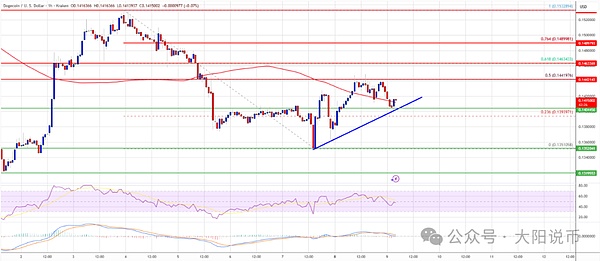
Conversely, if it fails to break through $0.1450 effectively, DOGE could fall again. Initial support is located at $0.1400 and near the trend line, followed by $0.1380. The crucial support level remains at $0.1350. A break below this could lead to a further decline toward $0.1265 or even near $0.1250.

Technical indicators:

The hourly MACD is in the bullish zone, but its momentum is showing signs of weakening; the hourly RSI is currently below the 50 level, reflecting weak short-term momentum.

Key Support: $0.1400, $0.1350

Key Resistance: $0.1450, $0.1530

İlgili Sorular

QWhat is the current resistance level for Dogecoin after its recent rebound?

AThe current resistance level for Dogecoin is near $0.1450 after its rebound from the $0.140 support level.

QWhat key support levels should be monitored if Dogecoin fails to break above $0.1450?

AIf Dogecoin fails to break above $0.1450, key support levels to watch are $0.1400 (and the trend line), $0.1380, and the crucial $0.1350 level. A break below $0.1350 could lead to $0.1265 or even $0.1250.

QWhat technical indicators are signaling weakness for Dogecoin in the short term?

AThe hourly MACD, while in the bullish zone, is showing signs of losing momentum. The hourly RSI is also below the 50 level, indicating weak momentum in the short term.

QWhat are the potential price targets for Dogecoin if it manages to break and hold above the $0.1530 resistance?

AIf Dogecoin breaks and sustains above the $0.1530 resistance, the subsequent price targets could be the $0.1620 and $0.1700 zones, with a key mid-term resistance level at $0.1720.

QWhat significant Fibonacci retracement level coincides with the $0.1450 resistance?

AThe $0.1450 resistance level coincides with the 50% Fibonacci retracement level of the downward move from the $0.1532 high to the $0.1351 low.

İlgili Okumalar

The New Frontier of Privacy Coins: Technology, Prevention, and Regulatory Game

Privacy coins are at a critical juncture, shaped by technological evolution, regulatory pressure, and judicial decisions. In 2024–2025, court rulings, law enforcement actions, and technical adjustments are redefining the boundaries of this sector. Key developments include debates over whether decentralized mixing tools constitute sanctionable property, cross-border crackdowns on anonymous transaction services in Europe and the U.S., and privacy-focused projects adopting more compliant technical designs. Judicially, U.S. courts have issued influential rulings questioning whether immutable smart contracts fit traditional legal frameworks. Meanwhile, European authorities continue to target mixing services accused of facilitating money laundering. Technologically, some privacy projects are incorporating optional privacy features, flexible fee mechanisms, and improved audit interfaces to enhance usability and reduce regulatory friction. Macro-trends show countries advancing comprehensive crypto regulatory frameworks covering custody, trading, stablecoins, and anti-money laundering (AML) standards. Regulatory bodies increasingly demand that high-privacy tools provide verifiable audit trails or compliance-friendly modes to access legal financial services. Looking ahead, three main trajectories are emerging: continued legal clarification around smart contracts and mixer liabilities, a shift in privacy protocols from absolute anonymity toward optional privacy with auditability, and a market reassessment of the regulatory risk associated with privacy assets. This is causing a strategic split within the industry—some communities insist on strong privacy for niche demands, while others pursue “compliance-friendly privacy” models like enterprise-grade confidential transactions or auditable privacy pools. In essence, privacy coins are transitioning from pursuing maximum anonymity to seeking sustainable existence within regulatory boundaries. Future judicial rulings, policies, and protocol upgrades will determine which projects survive market and legal pressures. Those offering meaningful privacy while maintaining legal compliance are most likely to endure.

cointelegraph_中文12 dk önce

The New Frontier of Privacy Coins: Technology, Prevention, and Regulatory Game

cointelegraph_中文12 dk önce

Champion! Huobi HTX Tops the Industry with $583.7M Net Asset Inflow Over the Past 30 Days

In the competitive crypto industry, fund flows reveal true user trust. According to Defillama data on December 5, Huobi HTX recorded a net inflow of $583.7M over the past 30 days, ranking first among all centralized exchanges (CEXs). This reflects growing user confidence in the platform’s security, transparency, and product offerings. Huobi HTX has maintained steady growth in total assets and spot trading volume, forming a positive cycle of asset safety, user growth, and capital inflow. Key factors behind this performance include enhanced asset proof mechanisms—with 38 consecutive months of published Merkle Tree Proof of Reserves (PoR) and 100%+ reserve ratios for major assets—alongside improved C2C trading features such as a "100% compensation" policy and a streamlined user experience. The platform’s earn products, including Huobi Earn, also saw significant growth, with increases in both user participation and asset deposits for tokens like USDD, ETH, and TRX. Users are increasingly choosing Huobi HTX for its reliable yields, ease of use, and strong security measures during market volatility. As a long-established exchange founded in 2013, Huobi HTX has strengthened its compliance and risk management frameworks, reinforcing its reputation for safety and transparency. The net inflow milestone underscores its position as a trusted platform where users choose to securely store and grow their digital assets.

深潮33 dk önce

Champion! Huobi HTX Tops the Industry with $583.7M Net Asset Inflow Over the Past 30 Days

深潮33 dk önce

From 'Stablecoin First Stock' to 'Ankle Cut' in Stock Price: Why Circle Quickly Fell from the Spotlight into a Revaluation Cycle

From "Stablecoin Unicorn" to "Ankle-Cut" Stock Price: Why Circle Quickly Fell from Its Peak into a Revaluation Cycle Circle, the issuer of the USDC stablecoin, experienced a dramatic stock price decline shortly after its IPO in June, dropping from an initial peak of around $260 to approximately $88. This reflects a broader market shift from hype-driven optimism to a more rational reassessment of the stablecoin industry. Multiple factors contributed to this sharp correction. Initially, the stock was significantly overvalued due to market enthusiasm for the "first stablecoin stock" and the high-interest environment that boosted the appeal of its reserve-backed revenue model. As early investors took profits and sentiment cooled, a price correction was inevitable. Increased competition is also pressuring Circle. While USDC is the world's second-largest dollar stablecoin, it faces growing challenges from new stablecoin projects and digital dollar initiatives from traditional financial institutions. The sector is shifting from an oligopoly to intense competition, raising investor concerns about USDC's future growth certainty. Furthermore, macroeconomic interest rate trends pose a fundamental risk to Circle's business model. Its core revenue comes from interest earned on the cash and short-term U.S. Treasuries backing USDC. Expectations that the Federal Reserve may begin a rate-cutting cycle could directly compress this income. Rising operational and distribution costs further squeeze profitability. Analysts hold divergent views on Circle's future. Firms like Mizuho have turned bullish, upgrading the stock and suggesting the sell-off related to its post-IPO lockup expiration may have created a buying opportunity. They point to USDC's continued adoption by mainstream financial institutions. Conversely, analysts at firms like Susquehanna remain pessimistic, maintaining an "Underperform" rating. They warn that lower future interest rates and potential underperformance in USDC growth could continue to pressure the stock price and have lowered their price target. The upcoming end of the post-IPO lockup period, which restricts insiders from selling shares, has added near-term selling pressure, but this is viewed by some as a temporary overhang. Circle's recent Q3 earnings report, which beat expectations for both revenue and profit, shows that these fundamental concerns have not yet materialized, leaving the company's trajectory highly dependent on future interest rates and its ability to maintain and grow USDC's market share amidst fierce competition.

cointelegraph_中文35 dk önce

From 'Stablecoin First Stock' to 'Ankle Cut' in Stock Price: Why Circle Quickly Fell from the Spotlight into a Revaluation Cycle

cointelegraph_中文35 dk önce

İşlemler

Spot
Futures
活动图片