After Marvell's 32% Surge, the Chinese Chip Family Behind It Emerges

marsbit2026-06-03 tarihinde yayınlandı2026-06-03 tarihinde güncellendi

Özet

The stock price of Marvell Technology surged 32.5% on June 2nd, driven by NVIDIA CEO Jensen Huang highlighting its custom ASICs and optical interconnects as core to AI data center architecture. This event brought attention to the Chinese semiconductor family behind Marvell: the Dai siblings. The story centers on three siblings, all UC Berkeley graduates, whose three-decade entrepreneurial journey aligns with major semiconductor industry shifts. In 1995, youngest sister Dai Wei Li co-founded Marvell with her husband Sehat Sutardja and his brother, focusing on storage controllers. Eldest brother Dai Wei Min founded EDA company Ultima, later sold to Cadence, and later founded VeriSilicon (芯原) in China, becoming a leading semiconductor IP provider. Second brother Dai Wei Jin co-founded EDA firm Silicon Perspective (sold to Cadence) and GPU IP company Vivante, later acquired by VeriSilicon. The combined "Dai-Sutardja" family network extends beyond Marvell. Their ventures and investments form a comprehensive ecosystem for the post-Moore's Law, chiplet era. Key holdings include: Dream Big Semiconductor (AI SuperNICs, acquired by Arm), Alphawave (high-speed SerDes IP, acquired by Qualcomm), and Silicon Box (a chiplet advanced packaging foundry). VeriSilicon itself thrives on the AI ASIC and IP boom in China. Collectively, the family's AI infrastructure-related portfolio is estimated at over $22 billion. Their strategy represents a distinct path: building critical components for op...

Author: Ada, Deep Tide TechFlow

On June 2nd, Marvell's stock surged 32.5% in a single day, closing at $290.79, a record high. Over the past 12 months, it has risen 265%. The direct catalyst was Jensen Huang naming Marvell's custom ASICs and optical interconnect as "the core of AI data center architecture" at Computex.

A company being personally endorsed by NVIDIA's CEO at a major conference is rare enough. This company was founded in 1995 by Weili Dai and her husband, Sehat Sutardja, in their living room. Weili Dai is the youngest of the three Dai siblings from Shanghai and one of the driving forces behind this family's thirty-year footprint in the chip industry.

The eldest brother, Weimin Dai, is in Shanghai, serving as the Chairman of VeriSilicon, known as the "first semiconductor IP stock" on the A-share market. Around 2026, VeriSilicon's market cap was approximately 150 billion RMB, with AI ASIC orders hitting record highs for six consecutive quarters. The second brother, Weijin Dai, is currently a director and General Manager of the IP Business Division at VeriSilicon. Vivante, which he founded in 2007, was acquired by VeriSilicon for $57.53 million.

Looking back over the past thirty years, the three Dai siblings founded six companies, with two going public and four being acquired. But that's only half the story. What truly flows beneath is the network woven within the chip industry following the marriage alliance between the "Dai" and "Sutardja" families. From the US to China, from EDA tools to factories or production lines for chiplet advanced packaging, from IP licensing to AI SuperNIC.

Three Siblings Made Six Bets Over Thirty Years, Hitting the Right Timing Each Time

All three Dai siblings graduated with degrees in Electrical Engineering from UC Berkeley. Their entrepreneurial timelines perfectly align with three major paradigm shifts in the semiconductor industry.

1995: Weili Dai, along with her husband Sehat Sutardja and Sehat's brother Pantas Sutardja, founded Marvell in Silicon Valley, focusing on hard drive storage controllers, adopting a pure fabless model. The same year, the eldest brother, Weimin Dai, founded Ultima in Silicon Valley, developing EDA tools. This was the late stage of PC普及 (popularization), where fabless design and the move towards EDA tooling were core features of the semiconductor industry's first major restructuring. The Dai family bet on both trends simultaneously. Ultima was acquired by Cadence in 2000, and Marvell went public in 2000.

1996: Weijin Dai co-founded Silicon Perspective, developing digital implementation EDA, which was acquired by Cadence for approximately $500 million in 2002. Around the same period, the eldest brother, Weimin Dai, turned his attention to China. In 2001, he returned to Shanghai to found VeriSilicon, betting on the "IP licensing + one-stop chip customization" model, providing semi-finished products to nascent SoC design companies in China. That same year, China joined the WTO, and the number of local chip design companies exploded from over 100 to several thousand. VeriSilicon was the ammunition supplier for this wave.

2007: Weijin Dai founded Vivante, focusing on embedded GPU IP, targeting automotive and IoT applications. This was on the eve of the mobile internet boom, a time when all endpoints began requiring graphics capabilities. In 2016, Weimin Dai's VeriSilicon fully acquired Vivante for $57.53 million. Weijin Dai transitioned from CEO of Vivante to General Manager of VeriSilicon's IP Business Division. This internal family merger connected the "China IP leader" and "embedded GPU IP" lines.

2019: Weili Dai embarked on her third venture. After leaving Marvell, she, along with Sehat and former Marvell executive Sohail Syed, founded Dream Big Semiconductor in Silicon Valley, focusing on chip open platforms and AI SuperNICs. In 2021, Weili Dai, Sehat, and Korean semiconductor veteran Han Byung Joon co-founded Silicon Box in Singapore, a chiplet advanced packaging fab. Chiplets represent the only viable industry path to continue boosting single-chip performance as Moore's Law slows, betting on the post-Moore era.

August 2020: Weimin Dai's VeriSilicon went public on the STAR Market, raising 1.862 billion RMB, crowned by the market as the "first semiconductor IP stock." October 2025: Weili Dai's Dream Big was acquired by Arm for $265 million in cash.

Six companies over thirty years, two IPOs, four acquisitions by top-tier buyers. This is an impressive track record, but focusing solely on it misses the real other half of the story.
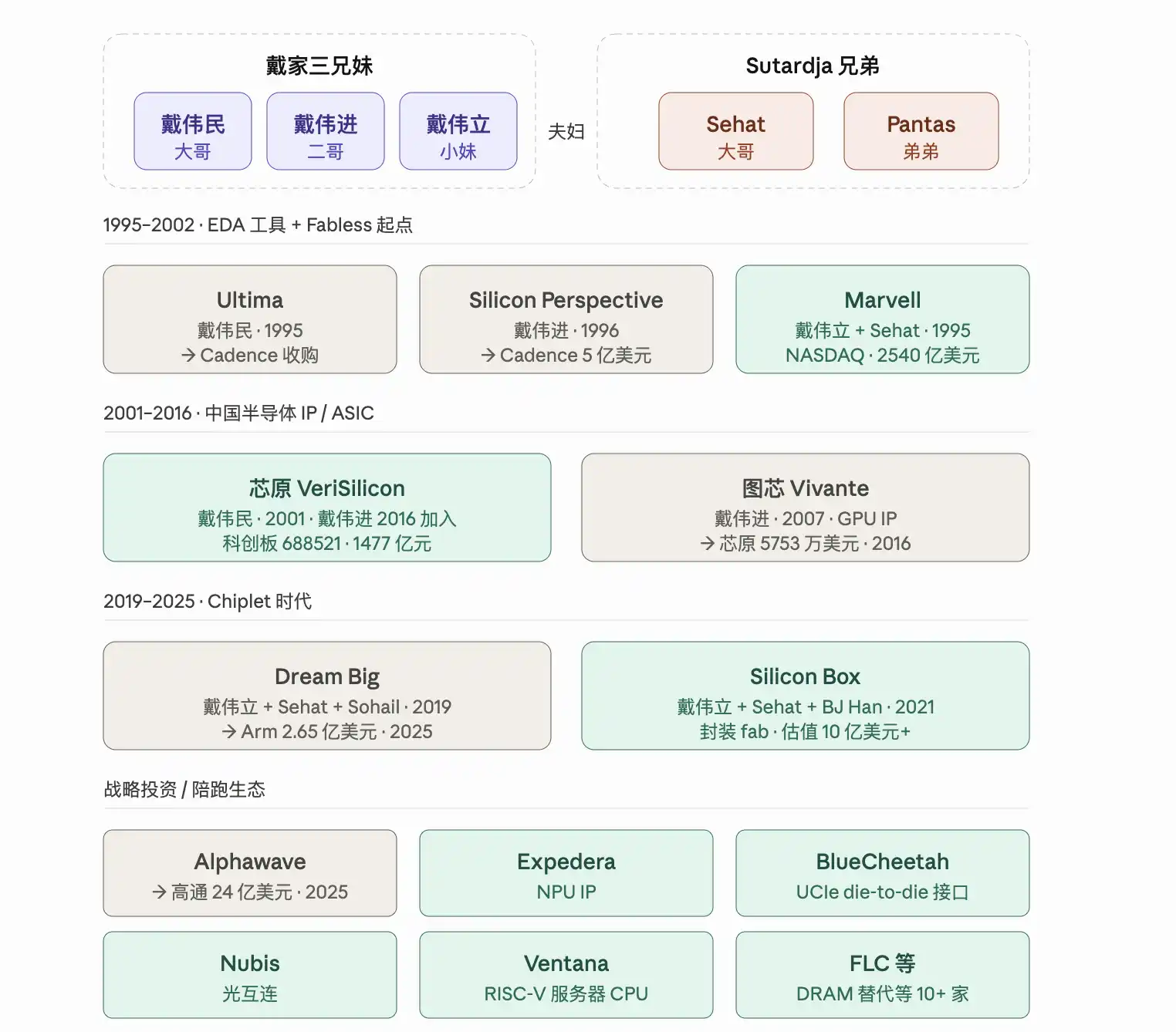
The Industrial Foundation Built by Two Families

The founding trio of Marvell in 1995 was Weili Dai, Sehat Sutardja, and Sehat's brother, Pantas Sutardja. Sehat was born in Jakarta, Indonesia, became a licensed radio technician at 13, and earned his Ph.D. in Electrical Engineering from Berkeley in 1988, where he met and married Weili Dai. Marvell was a product of the collaboration between the "Dai" and "Sutardja" families from day one, not just a husband-and-wife startup.

This advantage has amplified over the thirty years.

The Dai family has deep roots in China's semiconductor ecosystem. The eldest brother, Weimin Dai's VeriSilicon is a leading domestic IP provider. Its cooperation with SMIC and Huahong Grace can be traced back to the founding of SMIC. VeriSilicon's first 0.18-micron standard cell library for SMIC solved the IP export control issues SMIC faced at the time. The second brother, Weijin Dai, from Silicon Perspective to Vivante and back to VeriSilicon, layered networks in EDA, GPU IP, and IoT customers into China's local SoC ecosystem.

Looking at the Sutardja family, starting from the Marvell era, their engineering network extended to Southeast Asia and Europe. In 2021, when Weili Dai and Sehat co-founded Silicon Box in Singapore with Han Byung Joon, the company crossed the unicorn threshold by early 2024. It has a roughly $2 billion advanced semiconductor packaging factory in Tampines, Singapore, and is building a $3.6 billion new factory in Italy. Behind these factories lie industrial policy alignments with Singapore's Economic Development Board and the Italian government. This capacity-scheduling capability across East Asia and Europe is something the Dai family's connections in mainland China alone couldn't unlock.

More significant is the combined investment portfolio of the "Dai + Sutardja" families. Focusing on the chiplet ecosystem, there are at least 15 publicly traceable companies they have invested in or co-founded: Alphawave (high-speed SerDes interconnect IP, acquired by Qualcomm for $2.4 billion in December 2025); Expedera (NPU IP); BlueCheetah (UCIe die interface IP); Nubis (optical interconnect); Ventana (RISC-V server CPUs); FLC (DRAM alternative solutions). These companies, along with the previously mentioned VeriSilicon, Vivante, Dream Big, and Silicon Box, cover nearly every layer needed for the chiplet era: semiconductor IP, interconnect standards, packaging fabs, specialized compute chips. The two families have jointly built an entire industrial foundation for the post-Moore era.

Replicating Marvell's Rise Logic

What is the logic behind Marvell's current surge?

Over the past year, the bottlenecks in AI data centers have been quietly shifting. GPU compute shortages were the story of 2023-2024. By the second half of 2025, as hyper-scale training and inference ramped up, the real bottlenecks became three things: custom ASICs (allowing customers to not constantly buy NVIDIA's general-purpose GPUs), high-speed interconnect between chips, and the advanced packaging capability to pack these into the same package.

Marvell is positioned on the first two. Making custom ASICs like TPUs for Google and Amazon, and using optical communication chips for high-speed transmission. This is the real reason for its 265% rise over the year, and the real reason NVIDIA invested $2 billion in Marvell in March. Jensen Huang himself needs this interconnect thread.

Overlay the same map with the "Dai + Sutardja Family" marker, and the picture changes completely.

Dream Big bets on chiplet platforms and AI SuperNICs (800 Gbps bandwidth for lateral GPU interconnect). When Arm announced the $265 million cash acquisition in October 2025, Arm's intention was clear: to upgrade from selling CPU IP to becoming a "full-stack data center architect," mirroring NVIDIA's 2019 $6.9 billion acquisition of Mellanox.

Alphawave bets on high-speed SerDes interconnect IP, listed in London. On December 18, 2025, Qualcomm completed its $2.4 billion acquisition. The Dai+Sutardja family is Alphawave's second-largest shareholder, with Weili Dai cashing out approximately $237 million from the deal.

VeriSilicon in China operates on "IP + one-stop ASIC customization," similar to what Marvell does in the US, but with a customer structure of Chinese AI chip buyers like Alibaba, ByteDance, and Cambricon. AI compute accounted for 73% of new orders in 2025, and 91% of the 8.24 billion RMB new orders signed in the first four months of 2026. Its market cap is around 147.7 billion RMB ($20.5 billion), about 8% of Marvell's size, but with a steeper growth curve.

Silicon Box bets on chiplet advanced packaging fabs. Its valuation crossed the $1 billion threshold in early 2024. This company doesn't plan to IPO or sell, representing the heaviest piece on the board for the Dai+Sutardja families in the critical AI infrastructure capacity layer.

Additionally, there are over 10 invested/incubated companies like Expedera (NPU IP), BlueCheetah (UCIe die interface IP), Nubis (optical interconnect), Ventana (RISC-V server CPU), FLC (DRAM alternative). Each precisely occupies a position within the previously mentioned "three AI data center bottlenecks."

Adding these assets together, a conservative estimate places the scale of assets directly related to the two families in this AI wave at over $22 billion. This number won't appear on any list because it's dispersed across five jurisdictions, four company types, and over a dozen companies, but it exists.

From the perspective of a family industrial portfolio, the two families have placed at least six independent bets in this AI data center wave, each highly overlapping with the current logic driving Marvell's rise. Marvell is their loudest brand, but far from their only ticket in this round.

The Third Path: Key Components at Standard Transition Points

Currently, there are two mainstream narratives in the AI semiconductor industry.

One is platform-type giants reaping the benefits. NVIDIA sells GPUs + the CUDA ecosystem; Broadcom and Marvell sell custom ASICs + interconnect. This is the track for players with market caps above $150 billion.

The other is independent ASIC startups aiming for IPO. Companies like Tenstorrent, Cerebras, Groq, Etched bypass NVIDIA, focusing on acceleration for specific scenarios, betting on establishing a pole independent of GPUs.

The Dai+Sutardja families have taken a third path: creating key components for open standards, building their own packaging fabs, waiting for acquisition by giants, or becoming the domestic IP leader themselves. This path makes particular sense in the chiplet era because chiplets themselves are the antithesis of closed vertical integration. As long as standards are open, key IP + packaging capacity become scarce commodities, offering a much shorter path than independently building entire ASICs and aiming for IPO.

But the trade-off is clear. This path is destined not to produce the next NVIDIA. It allows founders multiple graceful exits and long-term retention of influence within the industrial ecosystem, but it won't place anyone on the final podium of AI infrastructure.

When Weili Dai and her husband founded Marvell in a Silicon Valley living room in 1995, the company was little-known. Today, Marvell is a $254 billion AI data center star. Although Weili Dai had exited most of her equity from thirty years ago at various points, simultaneously, she and her family still hold stakes in VeriSilicon, Silicon Box, cash from the Alphawave sale, cash from Dream Big's sale to Arm, and equity in over a dozen chiplet ecosystem companies.

Marvell was her most resounding victory, but not her only one, and likely not her last.

İlgili Sorular

QWhat was the direct catalyst for Marvell's single-day surge of 32.5% to a record high on June 2nd?

AThe direct catalyst was Nvidia CEO Jensen Huang's endorsement at Computex, where he highlighted Marvell's custom ASICs and optical interconnects as 'the core of AI data center architecture'.

QWhat is the core business model of the Chinese company VeriSilicon (芯原股份) founded by Dai Weimin?

AVeriSilicon's core business model is 'IP licensing + one-stop custom chip design'. It acts as an ammunition supplier by providing semi-finished products and IP to China's burgeoning SoC design companies.

QWhat are the three key bottlenecks in AI data centers that have emerged in the second half of 2025, according to the article?

AThe three key bottlenecks are: 1) Custom ASICs (to reduce reliance on Nvidia's general-purpose GPUs), 2) High-speed interconnects between chips, and 3) Advanced packaging capabilities to integrate these components.

QDescribe the third strategic path the Dai+Sutardja family has taken in the AI semiconductor industry, distinct from the two mainstream narratives.

AThe third path involves focusing on critical components for open standards (e.g., IP for interconnects, NPUs) and building key manufacturing capacity like advanced packaging fabs (Silicon Box). This strategy relies on acquisition by larger players or achieving leadership in a niche market (like IP in China), rather than building the next full-stack platform like Nvidia or an independent ASIC startup aiming for an IPO.

QWhat is the estimated total asset size related to the current AI wave that the Dai and Sutardja families hold across their portfolio, as per the article?

AThe article provides a conservative estimate that the two families' directly related asset portfolio in this AI wave exceeds $22 billion.

İlgili Okumalar

ETH Bull and Bear Views Compilation: Can Ethereum's Value Flow Back to ETH?

Titled "ETH Bull and Bear Views: Can Ethereum's Value Flow Back to ETH?", this article synthesizes the current heated debate around Ethereum's native token, ETH, following Bankless co-founder David Hoffman's decision to sell his entire ETH holdings. The **bullish case**, represented by figures like Tom Lee (BitMine CEO) and Raoul Pal, argues that ETH's core thesis remains intact. They contend Ethereum is the essential, secure, and neutral foundational layer for future finance—encompassing stablecoins, RWA, DeFi, L2s, and Agentic AI. Bulls bet on ETH's long-term revaluation as institutional adoption of on-chain finance grows, with significant buying activity from entities like BitMine and Consensys cited as evidence. Conversely, the **bearish perspective**, led by Hoffman and analysts like Markus Thielen, questions ETH's value capture mechanism. They acknowledge Ethereum's network success but argue that the value created by L2s, DeFi, and applications does not sufficiently accrue to the ETH token itself. Bears point to ETH's prolonged underperformance versus the broader crypto market, lack of traditional cash flows, weakening "ultrasound money" narrative, and apparent institutional retreat (e.g., Harvard Management Company exiting its ETH ETF position) as key concerns. The debate highlights a pivotal shift: ETH is no longer just a community belief asset. The central question is whether ETH can transition from being a "**used infrastructure**" to a "**continuously bought and held core asset**" as more value enters the Ethereum ecosystem. The market is now critically examining the direct link between network growth and ETH's value.

marsbit16 dk önce

ETH Bull and Bear Views Compilation: Can Ethereum's Value Flow Back to ETH?

marsbit16 dk önce

Crypto is dead, Perps are forever

The crypto industry is shifting from a focus on creating native assets (like altcoins and protocol tokens) to becoming a "global asset pipeline." Native cryptocurrencies, except for Bitcoin, are seen as failing in their value storage and utility promises, with demand driven largely by speculation. Attention and liquidity are now moving toward real-world assets (RWAs) like U.S. stocks, bonds, gold, and oil traded on-chain via perpetual contracts (Perps). Stablecoins like USDT and USDC set the precedent, proving blockchain's core strength is efficient global settlement and transfer, not inventing new monetary systems. Meanwhile, assets like Ethereum and many DeFi tokens struggle as their narratives weaken against tangible traditional assets and the rapid real-world progress of AI. Perpetual contracts have emerged as a pivotal innovation. They simplify trading by offering pure price exposure to any asset, bypassing complexities of ownership, custody, and traditional market hours. Projects like Hyperliquid gained traction by combining CEX-like efficiency with on-chain transparency, capitalizing on post-FTX distrust, macroeconomic volatility, and the surge in demand for 24/7 stock trading. In conclusion, while the era of speculative native "crypto assets" may be over, perpetual contracts persist as the industry's most potent financial instrument—transforming all assets into globally accessible, constantly tradable instruments centered on price speculation.

marsbit22 dk önce

Crypto is dead, Perps are forever

marsbit22 dk önce

Tencent, Alibaba, ByteDance in a Battle for the Skill Store

Skill is becoming a key concept in the AI field, essentially serving as a structured "instruction manual" for AI Agents that specifies tool calls, decision logic, and output standards. This allows Agents to execute predefined tasks. As the number of Skills grows, distribution platforms have emerged. Major tech companies are swiftly entering this space. In March, Tencent, Alibaba, and ByteDance launched Skill stores within their respective Agent platforms. Subsequently, players like Zhipu AI, Meituan, and Xiaohongshu joined the fray. This competition for the "Skill store" is fundamentally a battle for the AI-era user entry point; whoever controls distribution controls the users. While ByteDance's Coze has experimented with paid Skills, most platforms offer them for free. The real value lies not in the stores themselves but in using them to attract and retain users within an ecosystem, driving revenue from services like cloud computing, model calls, or advertising. The landscape features three main player types: 1) **Internet giants** (e.g., Alibaba, ByteDance, Tencent, Meituan), leveraging Skills to drive traffic and monetize through their broader ecosystems (cloud services, transactions, ads). 2) **Large model companies** (e.g., Zhipu AI, Moonshot AI), using Skill stores to increase user engagement and monetize model API calls. 3) **Content platforms** (e.g., Xiaohongshu), treating Skills as a new content format to generate traffic and ad revenue. However, transforming Skill stores into a sustainable business faces significant hurdles. Key challenges include: the **difficulty in pricing Skills** due to inconsistent outputs across different models and contexts; **lack of cost transparency** (varying token consumption); **security risks** like Skill poisoning; and the **absence of standardized protocols** for development and evaluation. Unlike standardized mobile apps, Skills are often personalized workflows resistant to uniformity, which hinders the establishment of a reliable review and monetization system akin to the App Store. While there is genuine user demand for paid Skills—particularly in enterprise (e.g., contract review) and certain personal productivity scenarios—current platforms offer developers limited and unpredictable distribution. The future of Skill stores depends on overcoming these standardization, evaluation, and safety challenges to make acquiring a Skill as straightforward as downloading an app. For now, the stores function more as display shelves than robust marketplaces.

marsbit22 dk önce

Tencent, Alibaba, ByteDance in a Battle for the Skill Store

marsbit22 dk önce

The Crypto Scene Is Dead, Perpetual Swaps Are Eternal

The crypto industry is undergoing a fundamental shift. The era defined by minting novel, native digital assets (altcoins) is fading. These assets, lacking real-world cash flows or clear value, are losing relevance as attention and capital flow elsewhere. Two powerful external forces are reshaping the space. First, traditional assets like U.S. stocks, bonds, gold, and oil are being tokenized and traded on-chain. Second, the explosive growth of AI, with its tangible products, has overshadowed crypto's once-dominant "future narrative." This marks a critical pivot: crypto is transitioning from being a "factory for new assets" to becoming a "global conduit for existing assets." Its validated utility is not complex financial reinvention but efficient global settlement, transfer, and trading—the original promise of blockchain. Stablecoins like USDT and USDC exemplify this, offering faster dollar movement rather than replacing it. Consequently, native ecosystems like Ethereum face profound challenges. While still crucial infrastructure, ETH struggles to capture value as users interact with Layer 2s or trade traditional assets without needing to hold it. DeFi's grand narrative of rebuilding finance has narrowed to core needs like cheap transfers and deep liquidity. The true breakout innovation is the perpetual contract (Perp). It brilliantly bypasses the complexities of direct asset ownership (custody, compliance, dividends) by creating pure price exposure. Users can speculate on the price movement of *any* asset—NVIDIA, gold, oil—24/7, globally, and with leverage. This "price casino" model, while risky and ethically fraught, delivers unmatched liquidity and accessibility. Projects like Hyperliquid succeeded not by inventing new mechanics but by perfecting the timing and execution of this model. Key drivers included making on-chain Perps feel like centralized exchanges, post-FTX trust migration towards transparency, and rising demand to trade macro assets and equities round-the-clock. In conclusion, the crypto world's most enduring successes are the dollar (via stablecoins), Bitcoin, and trading. Its new frontier is not creating alternative assets but providing a seamless, perpetual trading layer—a new API—for the world's existing financial system. The age of native altcoins is over; the age of perpetual synthetic exposure has begun.

Odaily星球日报31 dk önce

The Crypto Scene Is Dead, Perpetual Swaps Are Eternal

Odaily星球日报31 dk önce

İşlemler

Spot
Futures

Popüler Makaleler

CHIP Nasıl Satın Alınır

HTX.com’a hoş geldiniz! USD.AI (CHIP) satın alma işlemlerini basit ve kullanışlı bir hâle getirdik. Adım adım açıkladığımız rehberimizi takip ederek kripto yolculuğunuza başlayın. 1. Adım: HTX Hesabınızı OluşturunHTX'te ücretsiz bir hesap açmak için e-posta adresinizi veya telefon numaranızı kullanın. Sorunsuzca kaydolun ve tüm özelliklerin kilidini açın. Hesabımı Aç2. Adım: Kripto Satın Al Bölümüne Gidin ve Ödeme Yönteminizi SeçinKredi/Banka Kartı: Visa veya Mastercard'ınızı kullanarak anında USD.AI (CHIP) satın alın.Bakiye: Sorunsuz bir şekilde işlem yapmak için HTX hesap bakiyenizdeki fonları kullanın.Üçüncü Taraflar: Kullanımı kolaylaştırmak için Google Pay ve Apple Pay gibi popüler ödeme yöntemlerini ekledik.P2P: HTX'teki diğer kullanıcılarla doğrudan işlem yapın.Borsa Dışı (OTC): Yatırımcılar için kişiye özel hizmetler ve rekabetçi döviz kurları sunuyoruz.3. Adım: USD.AI (CHIP) Varlıklarınızı SaklayınUSD.AI (CHIP) satın aldıktan sonra HTX hesabınızda saklayın. Alternatif olarak, blok zinciri transferi yoluyla başka bir yere gönderebilir veya diğer kripto para birimlerini takas etmek için kullanabilirsiniz.4. Adım: USD.AI (CHIP) Varlıklarınızla İşlem YapınHTX'in spot piyasasında USD.AI (CHIP) ile kolayca işlemler yapın.Hesabınıza erişin, işlem çiftinizi seçin, işlemlerinizi gerçekleştirin ve gerçek zamanlı olarak izleyin. Hem yeni başlayanlar hem de deneyimli yatırımcılar için kullanıcı dostu bir deneyim sunuyoruz.

247 Toplam GörüntülenmeYayınlanma 2026.04.21Güncellenme 2026.06.02

CHIP Nasıl Satın Alınır

Tartışmalar

HTX Topluluğuna hoş geldiniz. Burada, en son platform gelişmeleri hakkında bilgi sahibi olabilir ve profesyonel piyasa görüşlerine erişebilirsiniz. Kullanıcıların CHIP (CHIP) fiyatı hakkındaki görüşleri aşağıda sunulmaktadır.

活动图片