Charity in Name, Family Gain in Reality: How the Trump Family Turns Philanthropy into Profit?

链捕手2026-06-17 tarihinde yayınlandı2026-06-17 tarihinde güncellendi

Özet

Summary: The article examines how the Trump family, particularly Eric Trump, has allegedly leveraged charitable and business ventures for financial gain. It details the operations of Eric's children's cancer charity (now Curetivity), which, despite donating over $25 million to St. Jude, reportedly funneled at least $500,000 back to Trump-owned properties for event costs between 2011-2016. These transactions, often undisclosed, involved clear conflicts of interest with Trump Organization employees on the board. Following media scrutiny and a state investigation, the charity reformed but continued holding costly fundraisers at Trump venues. The piece draws parallels to Eric's role at cryptocurrency company American Bitcoin (ABTC), where he promoted unrealistic mining cost savings. Investigative reporting revealed most Bitcoin was acquired through share dilution, with actual costs far higher than claimed, contributing to a ~90% stock price drop and significant investor losses, while insiders like Eric retained substantial wealth. The pattern identified involves using misleading rhetoric, opaque accounting, and legal strategies to navigate controversies, often deflecting criticism as political attacks before resuming operations with minimal substantive change.

Author: Chloe, ChainCatcher

Last month, just hours before attending a state banquet with King Charles III, Eric Trump, the former president's second son, posted a five-paragraph defense of himself on X. The trigger was a controversy surrounding his involvement in a publicly-traded cryptocurrency company called "American Bitcoin," which he had been pitching to investors as capable of mining Bitcoin at roughly half the market price. A Forbes report had debunked that claim.

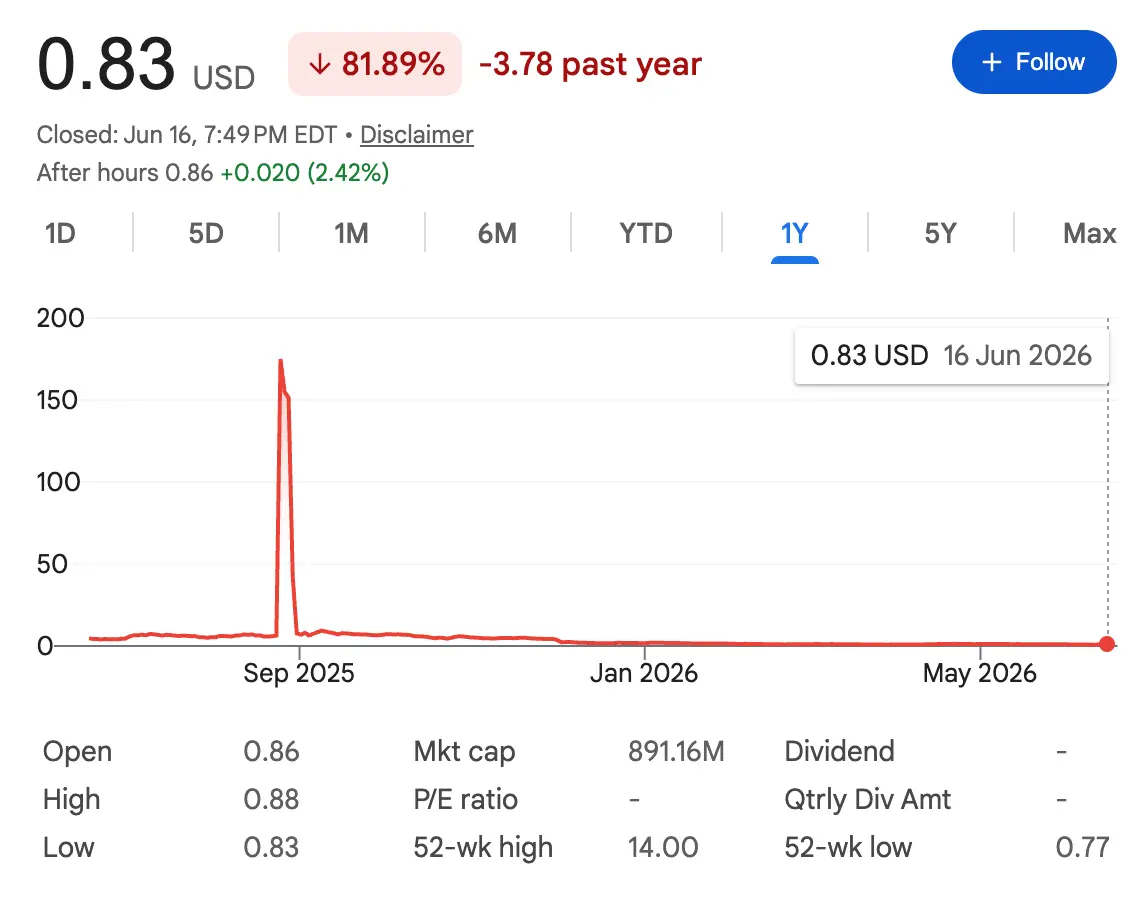
By June 17, 2026, the stock price of American Bitcoin (Nasdaq: ABTC) had fallen to about $0.83, a collapse of roughly 90% from its peak of around $175 at the end of last year and its $14 IPO price.
Then, Eric pivoted in his post to another matter weighing on him for nearly a decade: a 2017 Forbes investigation into his childhood cancer charity foundation. He wrote that the outside attacks were "insanity," as he was merely a young man "trying with all my heart to save dying children."

It is undeniable that he performed good deeds. Over the years, the foundation donated over $25 million to St. Jude Children's Research Hospital in Tennessee, operating with lean overhead, focused on fundraising while outsourcing the complex execution to others. However, its other side involves misleading rhetoric, sloppy accounting, a board entangled with interests, and unapologetic loyalty to Trump. The same playbook is now evident in the crypto industry.

The Trump Family's Habit of Emerging Unscathed from Scandals

Through Freedom of Information Act requests, Forbes obtained thousands of pages of documents revealing that between 2011 and 2016, his foundation directed at least $500,000 in charitable funds back to the family business through a series of transactions, most of which never appeared on tax filings.

These documents also explain why the Trump family consistently emerges unscathed. Their playbook is: first, mount a loud defense on television or social media; then, deploy lawyers to bury paper trails; next, adjust practices just enough to appease regulators and avoid punishment, without fundamentally changing; once the storm passes, re-emerge unabashedly as victims, asking the public for trust again—and there are always plenty willing to believe.

Eric's foundation has played this exact script from start to finish: nine years after the scandal, the renamed entity is still operating, with fundraising expanding annually, annual expenses exceeding $500,000, and events almost exclusively held at Trump-branded venues.

Blatant Conflicts of Interest, Extending Even to the White House

The foundation's origins were indeed well-intentioned. It began with Eric and his wealthy friends wanting to do good. The 2007 application to the IRS even stated: "Our family has three golf courses in New York and New Jersey available for use." The application also promised not to sign leases with any company controlled by its leadership. This held true for the first three years, with annual expenses around $50,000 and fundraising in the hundreds of thousands.

But starting in 2010, Trump Organization employees began joining the board. The following year, expenses surged to $142,000. Former club manager Ian Gillule pointed the finger directly at Trump himself in an interview: in the early days, the foundation used venues for free, and invoices often vanished. Trump was unhappy not with "helping for free," but with donating so much without leaving any paper trail or credit. He then ordered that everyone, including his own son, be charged.

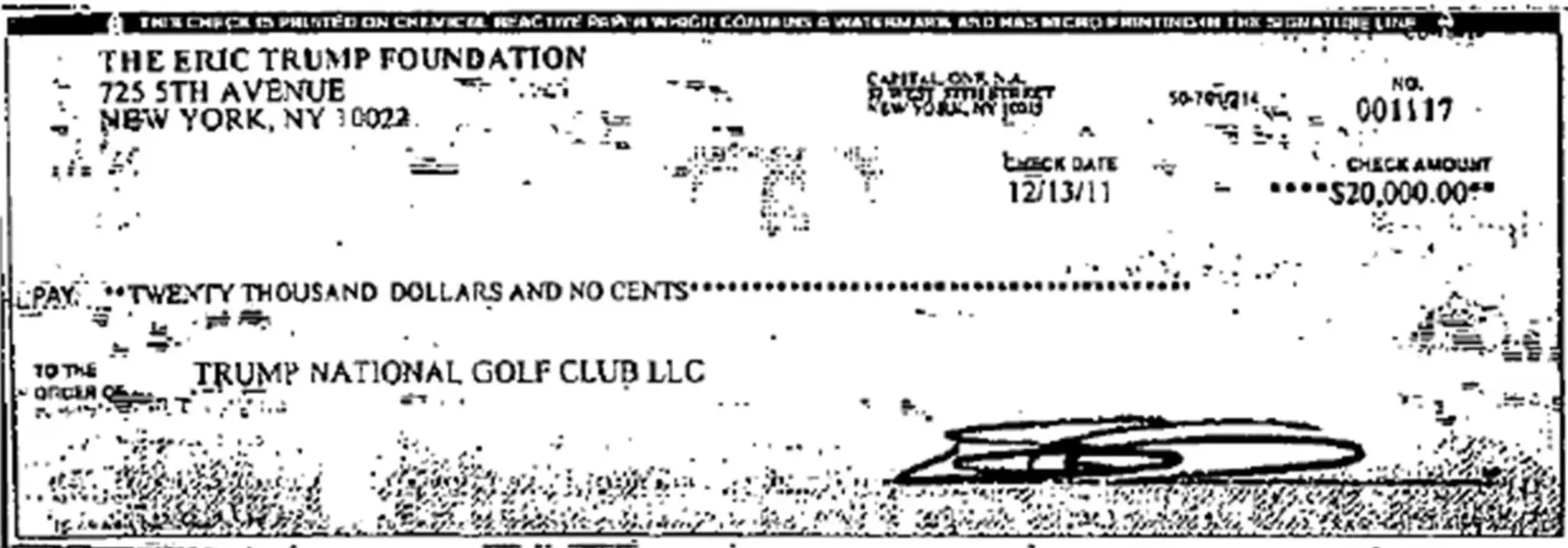
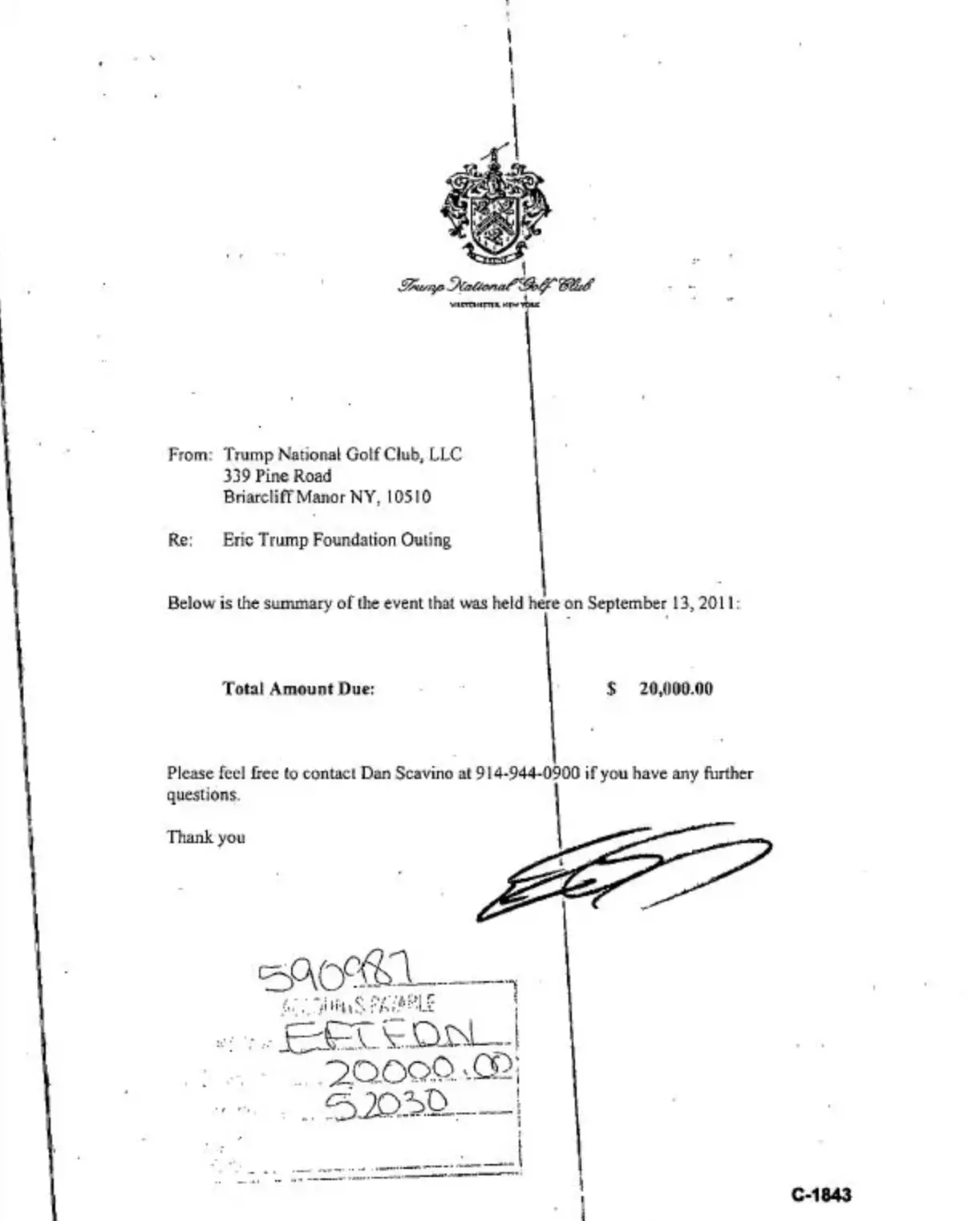
So, everyone got charged. After a 2011 event, Trump National Golf Club billed the foundation $20,000. The copy obtained by Forbes included a note: "If you have any questions, please call Dan Scavino." The conflict of interest was blatant: Dan Scavino, now White House Deputy Chief of Staff, was both the club's general manager and a foundation director at the time. The invoice also bore Eric's signature, though it's unclear in which capacity. Bills kept coming yearly: the club charged $100,000 in 2013, $99,000 in 2016, with Trump SoHo Hotel and Mar-a-Lago also taking a cut.
Toxic Candy Wrapped in Pretty Paper

"Dear Friends," Eric wrote in the 2014 fundraiser gala program, the foundation "boasts one of the lowest expense ratios in the world," insisting on using only Trump-owned venues, full-time volunteers, donated catering, and celebrity performers working pro bono, so that St. Jude received almost all proceeds.

But the books didn't match the rhetoric. The galas featured Hooters waitresses and mini Eric bobblehead dolls. Performers were mostly celebrities from "The Celebrity Apprentice." "They all performed for free," Eric claimed, yet checks he signed for performance fees totaled over $90,000. Auction items were "all donated," but the foundation spent at least $65,000 procuring them. In 2012, it even bought an item for $6,040 that sold for only $3,310. Transportation was another cost, with Sunny's alone charging over $35,000.

Furthermore, hundreds of thousands in donations flowed to other charities, several with closer ties to family interests than to childhood cancer; at least three also held fundraisers at Trump courses. In 2013, Eric even spent $1,600 of foundation funds to buy a decorative copper still and an antique bottle-washing machine near his family's winery. Of course, the foundation did donate large sums to St. Jude, increasing from $220,000 in 2007 to $2.9 million in 2016, the year of Trump's first election victory.

Eric as Victim, Feeling 'No Good Deed Goes Unpunished'

Politics soon thrust the foundation into the spotlight. In late 2016, Daily Beast and The Associated Press exposed its dealings with Trump clubs. The New York Times reported an investment manager bid nearly $60,000 at a fundraiser auction for a coffee with Ivanka Trump. The issues weren't just PR: under New York state and federal law, such related-party transactions required board votes, documentation, and disclosure on tax returns.

So Eric decided to restructure, distancing the foundation from the family: all Trump Organization employees left the board, including himself. He said his father's administration required avoiding "perception problems," and he would not personally fundraise until after his term. The foundation was renamed Curetivity, pledging all donations would go to St. Jude. Superficially, it seemed a return to its roots. But Eric remained unapologetic, telling Forbes a month after the board overhaul: "We use the best venues in the world 100% free, which is why our expense ratio is the lowest in history."

The day the article published, he appeared on Fox News, framing the scrutiny as a political witch hunt, casting himself as a victim. "I raised tens of millions of dollars, and what do I get in return? Hate."

Two days later, the Attorney General's office sent a letter requesting the books. The investigation took a toll: 2017 donations plummeted by over two-thirds, falling below $1 million, while administrative and legal costs soared from near zero to about $50,000 annually. By year-end, the AG's office wrote again, highlighting numerous issues: financial reports not conforming to accounting standards, ignoring related-party transaction rules, misleading marketing, and threatening to revoke its fundraising license.

Thereafter, the books became increasingly opaque. After Eric left the board, the occasional "related party transaction" label disappeared. The "rent/venue fees" line was often left blank. Fundraising expenses dropped from $384,000 in 2016 to $111,000 in 2017. By late 2018, when the AG's office indicated the investigation was shifting to compliance rather than enforcement, Eric re-emerged, returning to promotional materials and eventually being dubbed Curetivity's "founder." Fundraising expenses rebounded, hitting a new high of $392,000 in 2019. How much flowed back to the Trump Organization became unknowable under the murky accounting.

Today, fundraisers continue one after another at Trump-branded venues: $309,000 spent at Mar-a-Lago in 2020, with recent events held at Trump courses in North Carolina and Jupiter, Florida. If charges are similar to before, Curetivity alone could funnel around $200,000 annually into Trump's business empire, totaling over a million in two decades.

The Same Playbook Moved to Crypto

This playbook of "smooth talk, value flowing back to insiders" didn't stop at the charity foundation; it's now almost entirely replicated at American Bitcoin.

Previously, Eric packaged the company as a "money-printing machine," publicly claiming it could mine at a 53% discount to spot prices, with a cost per Bitcoin of about $57,000. It sounds strikingly similar to the foundation's "lowest expense ratio in the world." But just like the charity foundation, the books tell a different story.

The investigation was led by the same Forbes reporter, Dan Alexander, who exposed the foundation nine years ago. He found that about 70% of the company's Bitcoin wasn't mined; it was acquired by continuously issuing new shares and buying on the open market. Factoring in depreciation and SG&A, the all-in cost per coin neared $90,000, far above the $57,000 Eric claimed.

Now, the stock has crashed about 90% from its late-2025 peak of ~$175 and its $14 IPO price. Retail investors are estimated to have lost about $5 billion collectively. Financially, it's bleeding: a net loss of approximately $81.8 million in Q1 2026. Meanwhile, on the insider side, the view is completely different.

The founders originally acquired shares at near-zero cost. Even with the 90% stock drop, Eric's personal stake is still worth about $70 million; during the same period, his estimated net worth rose to around $300 million. The post-scandal script is also familiar. Facing质疑, Eric didn't directly address Forbes's calculated costs and dilution. Instead, he countered with impressive numbers like quarterly revenue growth and holdings exceeding 7,000 Bitcoins, lashing out on X that Forbes had become a political weapon and a disgrace to journalism.

Last September, Eric stood at the center of a party at the Westchester Country Club, hosting Curetivity's 19th fundraiser, surrounded by key business partners. Since his father's re-election, his estimated net worth has skyrocketed from around $40 million in 2024 to $300 million today.


Trend Kriptolar

İlgili Sorular

QWhat were the main findings regarding the financial relationship between Eric Trump's charity foundation and the Trump Organization, according to the article?

AThe article states that through Freedom of Information Act requests, *Forbes* uncovered documents showing that between 2011 and 2016, Eric Trump's foundation diverted at least $500,000 in donations back to Trump family businesses through a series of transactions. These financial flows were largely absent from tax filings. The foundation paid substantial fees to Trump-owned venues like Trump National Golf Club, Trump SoHo hotel, and Mar-a-Lago for hosting its fundraising events.

QHow did Eric Trump respond to the *Forbes* investigation into his American Bitcoin company's mining cost claims?

AIn response to the *Forbes* article that challenged his claims about American Bitcoin's low mining costs, Eric Trump did not directly address the specific calculations regarding costs and share dilution. Instead, he defended the company by highlighting positive metrics like quarterly revenue growth and holdings of over 7,000 bitcoins. He also attacked *Forbes* on social media platform X, calling it a political weapon and a disgrace to journalism.

QWhat actions did the New York Attorney General's office take regarding Eric Trump's charity foundation, and what was the outcome?

AFollowing media reports, the New York Attorney General's office launched an investigation, requesting the foundation's books. The investigation identified several issues, including financial statements not conforming to accounting standards, disregard for rules on related-party transactions, and misleading marketing. The office threatened to revoke the foundation's fundraising license. By the end of 2018, the office informed the foundation that the inquiry was shifting towards compliance rather than enforcement action. Subsequently, Eric Trump returned to a prominent role in the renamed foundation, Curetivity.

QAccording to the article, what is the common pattern or 'playbook' used by the Trump family in handling controversies?

AThe article describes a recurring pattern: first, respond loudly on TV or social media to defend themselves. Then, use lawyers to bury paper records. Next, adjust practices just enough to appease regulators and avoid punishment, without changing the core behavior. Once the controversy subsides, they re-emerge portraying themselves as victims, asking for public trust again—a strategy that often finds a willing audience.

QHow does the article draw a parallel between Eric Trump's charity operations and his involvement in the cryptocurrency company American Bitcoin?

AThe article draws a parallel by stating that the playbook of 'pretty talk and value flowing back to the family' used in the charity foundation was almost copied verbatim into American Bitcoin. Similar to claiming the foundation had 'one of the lowest expense ratios in the world,' Eric Trump promoted the crypto company as a 'money-printing machine' that could mine bitcoin at a significant discount. In both cases, the article claims the actual account books did not match the rosy public claims, with hidden costs and benefits flowing to insiders.

İlgili Okumalar

Full Debut Q&A! Fed Chair Wash: Firmly Adhering to 2% Inflation Target, Establishing Five Special Task Forces, Personally Did Not Submit Dot Plot

Federal Reserve Chair Kevin Warsh delivered his first FOMC press conference, maintaining the federal funds rate at 3.5%-3.75% and emphasizing the Committee's unanimous and explicit commitment to achieving its 2% inflation target. Key announcements included significant changes to Fed communication and operations. The policy statement was significantly shortened and, notably, forward guidance was removed. Chair Warsh broke from precedent by declining to submit his own economic forecasts and "dot plot." He announced the immediate formation of five special working groups focusing on: Fed communication, the balance sheet, data sources, productivity and employment (including AI's impact), and the inflation framework. These groups, which will include external experts, are tasked with recommending improvements by year-end. One key group will review the Fed's $6.7 trillion balance sheet to assess the roles of interest rates versus balance sheet tools in monetary policy. Warsh characterized the current restrictive stance of policy as "uneven," noting its effect on housing but questioning its impact on financial markets where conditions appear less restrictive. He expressed a desire to move away from a "Fed-speak" driven market, arguing that markets should react to economic data rather than Fed commentary to provide better informational signals. On inflation, he stated there is no need to reconsider the 2% target until the Fed re-establishes its commitment and capability to achieve it. Economic projections (SEP) from other officials showed a split on the rate outlook for 2024, with half expecting at least one hike and half forecasting unchanged or lower rates. The median projection saw the federal funds rate at 3.8% by year-end 2024. Following the announcements, risk assets sold off sharply, Treasury yields rose, and the dollar strengthened.

marsbit13 dk önce

Full Debut Q&A! Fed Chair Wash: Firmly Adhering to 2% Inflation Target, Establishing Five Special Task Forces, Personally Did Not Submit Dot Plot

marsbit13 dk önce

Full First Q&A! Fed Chair Warsh: Sticks to 2% Inflation Target, Establishes Five Special Working Groups, Personally Did Not Submit Dot Plot

The Federal Reserve, under new Chair Kevin Warsh, held its first FOMC meeting, maintaining the federal funds rate target range at 3.5% to 3.75%. The central bank issued a significantly shortened policy statement, explicitly removing forward guidance. Chair Warsh delivered a strong, unified commitment to achieving the 2% inflation target, stating the FOMC has the "capability and the commitment" to restore price stability and sees no need to review the target itself at this time. Warsh announced the immediate formation of five special working groups to examine and propose improvements in key areas by year-end: Fed communication, the balance sheet (including a review of the $6.7 trillion portfolio and its role in policy), data sources and methodology, productivity and employment (including AI's impact), and the inflation framework. In a break from tradition, Chair Warsh did not submit his own economic projections or "dot plot." The submitted Summary of Economic Projections (SEP) showed a split among other officials: half anticipate at least one rate hike this year, while half expect rates to remain steady or fall. The median projection sees the federal funds rate at 3.8% by year-end 2026. Warsh characterized the current policy stance as "uneven," noting restrictive effects in sectors like housing but less so in financial markets. He emphasized a desire to move away from a market dynamic overly focused on Fed signaling, advocating for markets to react more to economic data. On AI, he called it potentially the most significant economic change in his adult life, driving clear demand but with uncertain timing and scale on the supply side, creating a "race" between the two.

链捕手15 dk önce

Full First Q&A! Fed Chair Warsh: Sticks to 2% Inflation Target, Establishes Five Special Working Groups, Personally Did Not Submit Dot Plot

链捕手15 dk önce

The DeepSeek Financing Story

DeepSeek's financing round, totaling approximately 3 billion USD, concluded recently, revealing details about the process and key investors. The round was initiated around April with strict initial terms: a minimum commitment of 5 billion RMB, no syndication, and a pure RMB structure. These were later relaxed, with the minimum ticket size reduced to 1.5 billion RMB. A pivotal four-hour online investor meeting in mid-May served as the primary interaction for many backers with DeepSeek's founder, Liang Wenfeng. Despite not being a naturally eloquent speaker, Liang's philosophy deeply resonated. He consistently emphasized the company's singular focus on AGI (Artificial General Intelligence), the principle of "less is more," extreme caution in spending, and the paramount importance of team stability. His notable quotes included describing the team as "ordinary people doing extraordinary things" and stating that "AGI is a big enough thing; everything else is just process." The final investor list featured 10 entities, but underlying fund structures indicate participation from nearly 100 institutions and individuals. Notable lead investors include Monolith Capital (increasing its commitment from 1.5 to 3 billion RMB), Zhenxingu Capital, IDG Capital, and state-affiliated investors like Guozhitou. Conspicuously absent were major firms like Sequoia China and Hillhouse Capital, despite earlier speculation about their involvement. A core condition set by Liang Wenfeng for all investors, whether corporate or venture capital, was a strict prohibition against poaching DeepSeek employees or encouraging them to leave to start ventures. The financing process highlighted DeepSeek's unexpected openness to external capital, surprising many in the investment community. The company's low-profile nature, combined with its ambitious AGI vision and principled approach, fostered a sense of reverence among participating investors, many of whom were reluctant to discuss the deal publicly, preferring to maintain its discreet and purposeful ethos.

链捕手22 dk önce

The DeepSeek Financing Story

链捕手22 dk önce

The DeepSeek Fundraising Story

"The DeepSeek Funding Story: Insights from the $2.15 Billion Round" This article details behind-the-scenes narratives from DeepSeek's recent massive funding round. Key highlights include the legendary four-hour online investor meeting where CEO Liang Wenfeng, despite not being a charismatic speaker, impressed attendees with his focus on AGI and team stability. He emphasized the philosophy of "ordinary people doing extraordinary things" and a steadfast commitment to solely advancing intelligence. The fundraising process, initiated in April, saw initial demands for a minimum investment of 5 billion RMB, no syndication, and a pure RMB structure. These terms were later adjusted to a 1.5 billion RMB minimum to accommodate more investors. A notable absence was the lack of participation from major VC firms Sequoia China and Hillhouse Capital, despite early rumors, making IDG the only established VC in the final lineup. The investor list, while showing 10 entities, actually involved nearly 100 underlying institutions and individuals upon closer examination. Significant participants included Monolith Capital, which doubled its commitment to 3 billion RMB, and Zhenxingu Capital, an unexpected entrant. Liang Wenfeng's paramount condition for all investors was a strict agreement not to poach DeepSeek employees. The article reflects on DeepSeek's unexpected openness to funding and the mix of strategies—synergy, insight, brand alignment, and persistence—that secured investors a stake. The overarching sentiment among participants is one of pride and a shared belief in DeepSeek's potential to become a landmark Chinese company, driven by a profound sense of purpose in the AGI race.

marsbit24 dk önce

The DeepSeek Fundraising Story

marsbit24 dk önce

DAT Companies Take on Side Businesses

The article details the strategic shifts of Digital Asset Treasury (DAT) companies amid a prolonged market downturn. Initially popularized by firms like MicroStrategy, the DAT model—where companies hold cryptocurrencies on their balance sheets—has faced significant pressure as crypto ETFs eroded their investment thesis and bear markets strained finances. Key players are adapting in several ways. Some, like ETHzilla, have abandoned the model entirely. Others are pivoting towards becoming active, revenue-generating participants in the crypto ecosystem rather than passive holders. This evolution is taking two main paths: 1. **Transformation into Institutional Crypto Asset Managers:** Companies like SharpLink Gaming and GameSquare are leveraging their holdings to generate yield, moving beyond simple storage. They employ strategies like 100% ETH staking or using machine learning to optimize DeFi yields, positioning themselves as platforms offering institutional-grade crypto yield products. 2. **Becoming Blockchain Infrastructure Operators:** This is prominent in the Solana ecosystem. Firms like DeFi Development and SOL Strategies are acquiring validator businesses, issuing liquid staking tokens (e.g., dfdvSOL, fwdSOL), and integrating them into DeFi protocols. They generate fee-based revenue from these operations, building network effects. The article notes that successful转型 hinges on building operational expertise and defensible business models around crypto assets, such as technical advantages or deep ecosystem integration. However, these new paths carry risks like smart contract vulnerabilities or ecosystem dependence. Ultimately, this collective shift signals a maturation phase for the DAT movement. It highlights that in crypto, sustainable value is increasingly tied to active participation, cash flow generation, and providing real utility, rather than speculative capital allocation alone.

Foresight News27 dk önce

DAT Companies Take on Side Businesses

Foresight News27 dk önce

İşlemler

Spot
Futures

Popüler Makaleler

GAIN Nasıl Satın Alınır

HTX.com’a hoş geldiniz! GriffinAI (GAIN) satın alma işlemlerini basit ve kullanışlı bir hâle getirdik. Adım adım açıkladığımız rehberimizi takip ederek kripto yolculuğunuza başlayın. 1. Adım: HTX Hesabınızı OluşturunHTX'te ücretsiz bir hesap açmak için e-posta adresinizi veya telefon numaranızı kullanın. Sorunsuzca kaydolun ve tüm özelliklerin kilidini açın. Hesabımı Aç2. Adım: Kripto Satın Al Bölümüne Gidin ve Ödeme Yönteminizi SeçinKredi/Banka Kartı: Visa veya Mastercard'ınızı kullanarak anında GriffinAI (GAIN) satın alın.Bakiye: Sorunsuz bir şekilde işlem yapmak için HTX hesap bakiyenizdeki fonları kullanın.Üçüncü Taraflar: Kullanımı kolaylaştırmak için Google Pay ve Apple Pay gibi popüler ödeme yöntemlerini ekledik.P2P: HTX'teki diğer kullanıcılarla doğrudan işlem yapın.Borsa Dışı (OTC): Yatırımcılar için kişiye özel hizmetler ve rekabetçi döviz kurları sunuyoruz.3. Adım: GriffinAI (GAIN) Varlıklarınızı SaklayınGriffinAI (GAIN) satın aldıktan sonra HTX hesabınızda saklayın. Alternatif olarak, blok zinciri transferi yoluyla başka bir yere gönderebilir veya diğer kripto para birimlerini takas etmek için kullanabilirsiniz.4. Adım: GriffinAI (GAIN) Varlıklarınızla İşlem YapınHTX'in spot piyasasında GriffinAI (GAIN) ile kolayca işlemler yapın.Hesabınıza erişin, işlem çiftinizi seçin, işlemlerinizi gerçekleştirin ve gerçek zamanlı olarak izleyin. Hem yeni başlayanlar hem de deneyimli yatırımcılar için kullanıcı dostu bir deneyim sunuyoruz.

469 Toplam GörüntülenmeYayınlanma 2025.09.24Güncellenme 2026.06.02

GAIN Nasıl Satın Alınır

Tartışmalar

HTX Topluluğuna hoş geldiniz. Burada, en son platform gelişmeleri hakkında bilgi sahibi olabilir ve profesyonel piyasa görüşlerine erişebilirsiniz. Kullanıcıların GAIN (GAIN) fiyatı hakkındaki görüşleri aşağıda sunulmaktadır.

活动图片