Dash Launches ZK-Privacy Based on Zcash

cryptonews.ru2026-07-30 tarihinde yayınlandı2026-07-30 tarihinde güncellendi

Özet

Dash has launched ZK-based privacy features built on Zcash's Orchard protocol. This is now integrated directly into the Dash Platform's consensus (v4.0.0), providing a native, non-custodial privacy model alongside the existing CoinJoin system. It offers optional confidentiality, hiding sender, receiver, amount, and balance within a shielded pool. The implementation adapts Zcash's Orchard protocol (using Halo 2 without a trusted setup) to Dash Platform, handling state transitions, GroveDB storage, fees, and wallet sync. A critical double-spend vulnerability discovered in Orchard prior to release was patched using updated libraries, with Dash adding a SumTree structure for extra security. Users can privately transfer Platform Credits (pegged 1:100 billion to DASH) and move funds to/from the main Dash Core chain. Wallet synchronization, which is required to detect incoming private transactions, took about 21 seconds in testing, noted as significantly faster than a comparable Zcash wallet. Future plans include extending shielded pools to native Platform tokens and NFTs, aiming to combine ZK-privacy with token issuance and direct exchangeability with Dash. Mobile wallet support for the new feature is expected soon.

In February, we wrote about Dash's plans to integrate Orchard. At that time, it was about a future release and the prospect of private user tokens.

Now the first part of the plan has been implemented: in Dash Platform v4.0.0, shielded operations have become part of the consensus. This is not an external mixer, not a custodial service, and not an experimental smart contract — privacy is built directly into the protocol.

For Dash, historically associated with CoinJoin, this is not a replacement for the old mechanism, but a second model of privacy. CoinJoin continues to work on the main network, while Platform uses ZK-proofs instead of mixing rounds with multiple participants. This approach is better suited for fast mobile wallets. At the same time, regular Dash transactions remain transparent: confidentiality is optional.

The shielded pool hides the balance, sender, recipient, and transfer amount within the pool. The network verifies that funds exist, belong to the sender, and are not double-spent, but does so without revealing the operation's contents.

A user can deposit credits into the pool from a transparent Platform address, conduct a private transfer, and return the funds back. For DASH holders, two other routes are more important: ShieldFromAssetLock sends funds to the shielded pool directly from Core, and ShieldedWithdrawal withdraws them to a specified Core address. To avoid linking the withdrawal to previous activity, the wallet must use a new address.
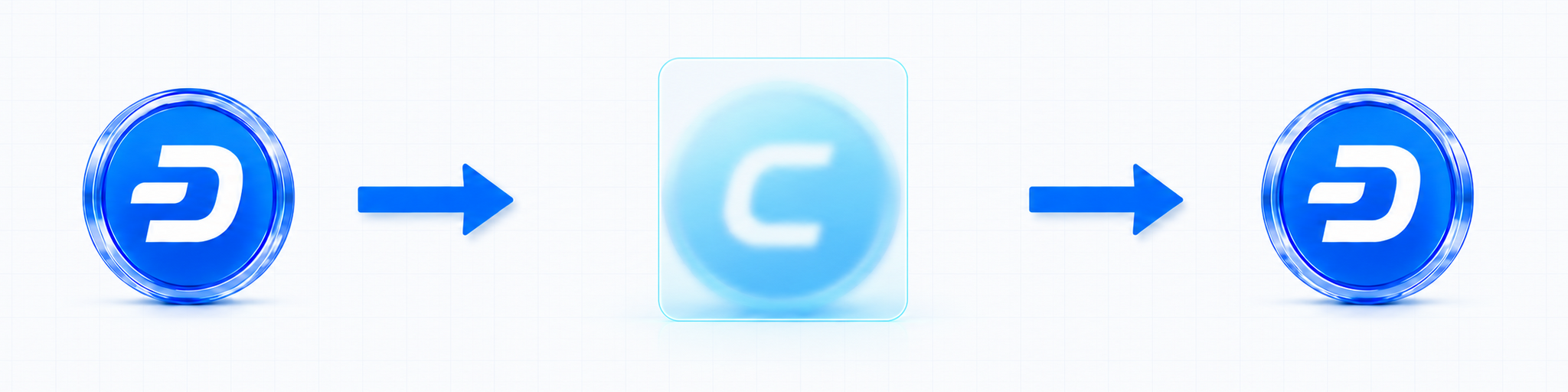
Platform Credits are the internal accounting unit of Dash Platform, linked to Dash by a fixed ratio: one Dash corresponds to 100 billion credits.

How the Privacy Works — Without Unnecessary Math

Dash did not create a new ZK-scheme from scratch. The implementation is based on Orchard, Zcash's shielded protocol built on Halo 2 without a trusted setup. Dash's engineering work involved adapting it to Platform: custom state transitions, storage in GroveDB, fees, wallet synchronization, and the route back to Core.

Shortly before the release, a critical vulnerability was discovered in Orchard, potentially allowing double spending within the pool. The Zcash team fixed the proof scheme, and the Dash Core Group updated its implementation to the revised libraries even before the release of Platform 4.0. An additional layer of control in Dash is provided by SumTree: this structure stores and verifies the pool's state, preventing hidden inflation from going unnoticed.

One of the main problems with shielded systems is wallet synchronization. To detect incoming funds, the application receives encrypted notes and locally checks which ones its key can decrypt. The server does not learn which transfers belong to the user.

In the test version of the application, we created a new wallet and started synchronization: it took about 21 seconds, which is significantly faster than synchronizing the Zodl wallet for ZCash.

The release of mobile wallets supporting the new technology is expected soon.

Currently, the pool only works with Platform Credits. However, Dash has already announced plans to add separate shielded pools for native Platform tokens.

Private user assets are not a new concept. Dash's strength lies in the specific combination of capabilities: ZK-privacy, token and NFT issuance, and the ability to exchange created assets for Dash and back. Thanks to this, each asset gains a direct link to the already established coin, and through it — to the external market.

end-content

Trend Kriptolar

İlgili Sorular

QWhat is the main news about Dash mentioned in the article?

ADash has launched ZK-privacy (shielded operations) built directly into its protocol, specifically in Dash Platform v4.0.0, based on Zcash's Orchard protocol.

QHow does the new shielded privacy model in Dash Platform differ from its previous CoinJoin method?

AThe new model uses Zero-Knowledge (ZK) proofs for privacy, making it better suited for fast mobile wallets. It is built directly into the protocol, unlike CoinJoin which is a mixing service in the main network. Both models coexist, with the new shielded pool offering optional privacy for Platform Credits.

QWhat are the two new transaction routes mentioned for DASH holders to interact with the shielded pool?

AThe two new routes are 'ShieldFromAssetLock', which sends funds into the shielded pool directly from Dash Core, and 'ShieldedWithdrawal', which withdraws funds from the shielded pool to a specified Dash Core address.

QWhat was a key security issue addressed before the launch of Dash Platform v4.0.0?

AA critical vulnerability was discovered in the Orchard protocol that could potentially allow double-spending within the shielded pool. The Zcash team fixed the proof scheme, and the Dash Core Group updated its implementation to the patched libraries before release.

QWhat future development for Dash Platform's shielded pools is announced in the article?

ADash announced plans to add separate shielded pools for native tokens on the Dash Platform, enabling private user-created assets like tokens and NFTs with a direct link to the DASH cryptocurrency and the external market.

İlgili Okumalar

Deep Dive into FWA: An Intriguing Experiment Turning NFTs into "On-Chain Gachapon"

A Deep Dive into FWA: The “On-Chain Gacha” Experiment for NFTs Fake World Assets (FWA), created by TokenWorks, introduces an innovative “NFT gacha machine” fully operating on-chain. Users can deposit eligible NFTs paired with ETH (called Backing) to create a Position, acting as a prize pool. Others can then pay a uniform Acquisition Price for a chance to win a random NFT from the pool. The core mechanism features a reverse probability system: Positions with lower Backing have a higher chance of being selected, serving as common prizes, while high-Backing Positions are rare “jackpots.” The acquisition price is calculated based on the harmonic mean of all Backings, keeping entry costs low. When a Position is won, the purchaser must choose: keep the NFT or accept the Standing Bid (85% of the Backing, claimable in ETH or $FWA tokens), returning the NFT to the original depositor. The protocol involves two main roles. Depositors provide liquidity (NFT + ETH), earning a share of fees from each draw, distributed equally per active Position, plus potential $FWA rewards. Purchasers pay to spin the gacha, receiving $FWA rewards for participation. A special “Crown” reward goes to the Position with the highest Backing. The $FWA token has a fixed supply and is initially obtainable only through protocol participation (depositing or purchasing), with external buying disabled early on to reduce sell pressure. Its value is supported by a built-in buy pressure: when purchasers opt for the $FWA settlement on a Standing Bid, the protocol uses the backing ETH to buy $FWA from the market. Revenue for the protocol comes from a 1% fee on each draw, a 1% settlement fee when an NFT is kept, and the 15% discount from Standing Bid settlements (currently allocated to the protocol). The design cleverly blends Uniswap-style liquidity provision, gacha mechanics, and tokenomics to create a novel, self-regulating marketplace for NFT liquidity and engagement.

marsbit12 dk önce

Deep Dive into FWA: An Intriguing Experiment Turning NFTs into "On-Chain Gachapon"

marsbit12 dk önce

10,000 Scientists Get 1 Year of Free Access: OpenAI Brings the Scientific Research Pipeline into ChatGPT

OpenAI has launched the "ChatGPT for Academic Researchers" program, offering free one-year access to its flagship models for 100,000 university researchers globally, with 10,000 spots available this summer. Selected institutions include prestigious centers like ENS Paris and the IAS at Princeton. The initiative provides an integrated research workspace within ChatGPT, bundling tools like ChatGPT, ChatGPT Work, and Codex, along with expanded Deep Research capabilities, higher usage limits, and specialized tools for life sciences. The suite connects to platforms like Zotero and GitHub, aiming to streamline the entire research workflow from literature review and coding to data analysis and manuscript drafting. OpenAI notes that about 1.3 million people already use ChatGPT weekly for advanced science and math. The program targets building long-term user dependency by embedding these tools into daily research habits. However, access comes with limitations: it does not include API credits or model weights, and eligibility is restricted to verified academic researchers from supported countries. This approach contrasts with Anthropic's "AI for Science" program, which offers API credits but not an integrated workspace. Both companies emphasize preventing misuse by withholding model weights, a point of contention for AI researchers seeking transparency. The core strategy remains clear: provide a powerful, integrated environment to foster user reliance ahead of the post-free period.

marsbit17 dk önce

10,000 Scientists Get 1 Year of Free Access: OpenAI Brings the Scientific Research Pipeline into ChatGPT

marsbit17 dk önce

What's Going On with Gigadevice? Major Shareholder Cashes Out 44 Billion, Then Announces 20 Billion Buyback

Gigadevice Innovation, a leading Chinese memory chip company, has executed a controversial financial maneuver. The company's controlling shareholder and chairman, Zhu Yiming, sold approximately 44 billion RMB worth of his shares between early May and mid-June 2026, capitalizing on a soaring stock price that peaked at 846.66 RMB on June 29th. Following a subsequent stock crash—plummeting to around 350 RMB in 22 trading days and erasing over 330 billion RMB in market value—Zhu announced a combined "market rescue" plan on July 29th. This plan includes his personal commitment to buy back at least 1 billion RMB in shares and a company proposal to repurchase 1 to 2 billion RMB worth of stock. This sequence of high-selling followed by a low-buying plan has confused and unsettled many of the company's 240,000 retail investors. The stock's dramatic decline was attributed to several factors: the successful IPO of its sister company, Changxin Technologies, which ended Gigadevice's status as a primary investment proxy for the domestic memory sector; a Morgan Stanley report warning of a potential peak in the memory chip cycle; and a severe loss of market confidence triggered by the chairman's massive sell-off. While the sell-off was procedurally compliant, its timing has been criticized. The company's fundamentals appear strong, with preliminary H1 2026 results showing revenue up 177% year-on-year to 11.5 billion RMB and net profit skyrocketing 1099% to 6.9 billion RMB, driven by a boom in memory chips and MCU demand. However, a significant portion (2.05 billion RMB) of this profit came from non-recurring gains like securities investment, and the memory industry is notoriously cyclical. Analysts highlight the company's role in the domestic substitution of niche DRAM and NOR Flash memory, with some maintaining bullish price targets. Yet, the recent events underscore key risks: its fabless model creates dependency on foundries like Changxin, and the chairman's actions have raised serious questions about management's alignment with minority shareholders. The promised buybacks cannot commence until December 13th due to a mandatory six-month cooling-off period following an insider sale, leaving the stock vulnerable in the interim.

marsbit17 dk önce

What's Going On with Gigadevice? Major Shareholder Cashes Out 44 Billion, Then Announces 20 Billion Buyback

marsbit17 dk önce

İşlemler

Spot

Popüler Makaleler

DASH Nasıl Satın Alınır

HTX.com’a hoş geldiniz! DASH (DASH) satın alma işlemlerini basit ve kullanışlı bir hâle getirdik. Adım adım açıkladığımız rehberimizi takip ederek kripto yolculuğunuza başlayın. 1. Adım: HTX Hesabınızı OluşturunHTX'te ücretsiz bir hesap açmak için e-posta adresinizi veya telefon numaranızı kullanın. Sorunsuzca kaydolun ve tüm özelliklerin kilidini açın. Hesabımı Aç2. Adım: Kripto Satın Al Bölümüne Gidin ve Ödeme Yönteminizi SeçinKredi/Banka Kartı: Visa veya Mastercard'ınızı kullanarak anında DASH (DASH) satın alın.Bakiye: Sorunsuz bir şekilde işlem yapmak için HTX hesap bakiyenizdeki fonları kullanın.Üçüncü Taraflar: Kullanımı kolaylaştırmak için Google Pay ve Apple Pay gibi popüler ödeme yöntemlerini ekledik.P2P: HTX'teki diğer kullanıcılarla doğrudan işlem yapın.Borsa Dışı (OTC): Yatırımcılar için kişiye özel hizmetler ve rekabetçi döviz kurları sunuyoruz.3. Adım: DASH (DASH) Varlıklarınızı SaklayınDASH (DASH) satın aldıktan sonra HTX hesabınızda saklayın. Alternatif olarak, blok zinciri transferi yoluyla başka bir yere gönderebilir veya diğer kripto para birimlerini takas etmek için kullanabilirsiniz.4. Adım: DASH (DASH) Varlıklarınızla İşlem YapınHTX'in spot piyasasında DASH (DASH) ile kolayca işlemler yapın.Hesabınıza erişin, işlem çiftinizi seçin, işlemlerinizi gerçekleştirin ve gerçek zamanlı olarak izleyin. Hem yeni başlayanlar hem de deneyimli yatırımcılar için kullanıcı dostu bir deneyim sunuyoruz.

257 Toplam GörüntülenmeYayınlanma 2024.12.13Güncellenme 2026.06.02

DASH Nasıl Satın Alınır

Tartışmalar

HTX Topluluğuna hoş geldiniz. Burada, en son platform gelişmeleri hakkında bilgi sahibi olabilir ve profesyonel piyasa görüşlerine erişebilirsiniz. Kullanıcıların DASH (DASH) fiyatı hakkındaki görüşleri aşağıda sunulmaktadır.

活动图片