NVIDIA Chose Unitree but Replaced Its Hands

marsbit2026-06-10 tarihinde yayınlandı2026-06-10 tarihinde güncellendi

Özet

Nvidia selected Unitree, a leading humanoid robotics company, for its Isaac GR00T reference platform but replaced Unitree's own dexterous hand with one from Sharpa, a two-year-old Singapore-based startup with origins in Hesai's robotics team. While Unitree provides the robot body, celebrated for its advanced motion control, the focus shifted to Sharpa's Wave hand. This hand, featuring 22 active degrees of freedom and a high-precision Dynamic Tactile Array (DTA) sensor system for real-time force and texture feedback, demonstrated superior capabilities in complex manipulation tasks like handling playing cards, peeling eggs, and assembling computers. Nvidia's choice highlights a key industry pivot from locomotion to sophisticated, tactile-enabled manipulation. The integration places Sharpa's hardware within Nvidia's Isaac Lab framework, central to simulation and AI training pipelines for embodied intelligence. However, the dexterous hand sector remains highly competitive, with rivals like Lingxin Qiaoshou, Critical Point, and Parxeni Perception rapidly advancing in funding, technology, and product development.

Unitree was selected by NVIDIA, but NVIDIA did not choose Unitree's hands.

While Unitree Technology passed its IPO review on the STAR Market, its H2 Plus robot was also chosen by NVIDIA as the body for NVIDIA's Isaac GR00T reference humanoid robot.
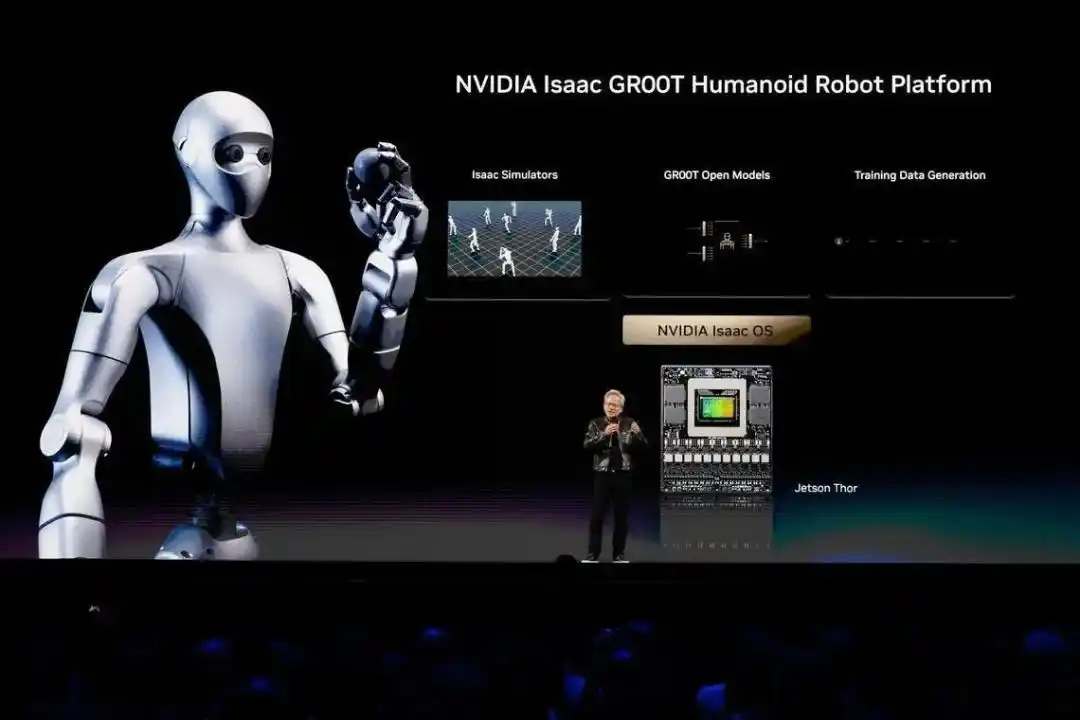
This powerful partnership has ignited excitement in both the Embodied AI and broader AI circles. After all, NVIDIA's leading position in the industry speaks for itself, and Unitree has secured its place in the global top tier of humanoid robots with its outstanding robot locomotion capabilities.

What's truly surprising is that this reference robot does not use Unitree's own dexterous hands; they have been replaced with hands from Sharpa Wave.

Sharpa is a dexterous hand company founded only two years ago, headquartered in Singapore. Its core team originates from the dexterous hand team established by Hesai Technology in 2024. It doesn't have the same high profile as Unitree, nor does it appear frequently in funding news like Lingxin Qiaoshou or Lingjiedian.

Sharpa's dexterous hands also appeared on this year's CCTV Spring Festival Gala in the sketch "My Most Unforgettable Night" featuring Shen Teng and Ma Li. However, within the niche dexterous hand sector, it remains a very low-key player.
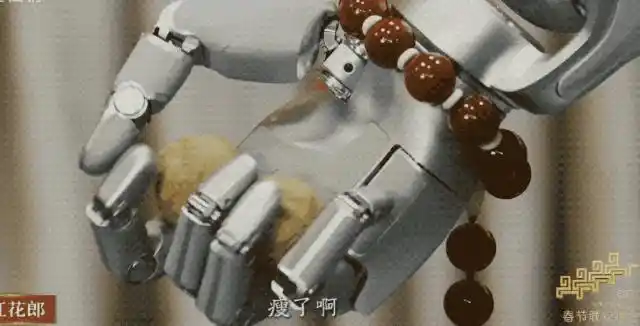
Now, however, it stands alongside Unitree at NVIDIA's embodied AI table.

One is responsible for the body, the other for the hands.

The question is, what makes a two-year-old dexterous hand company worthy of NVIDIA's attention?

Unitree's Hands Lost This Time

In reality, Unitree does have its own dexterous hands.

Judging from its public product lineup, Unitree has already launched the Dex series of dexterous hands, ranging from three-finger to five-finger configurations, and their performance is not bad.

But what NVIDIA wanted this time might not just be "hands that can be mounted on a humanoid robot."

From a technical perspective, Sharpa's dexterous hands indeed have their advantages.

In 2024, Hesai Technology formed a dexterous hand team, which became the predecessor of Sharpa. Transitioning from Hesai's LiDAR for autonomous driving to dexterous hands seems like quite a "crossover" move for Sharpa.

To many, autonomous driving and robotics are two completely different industries.

But for a company like Hesai, there is some common technical accumulation between the two fields.

Autonomous driving requires machines to perceive, understand, and make decisions in real-time within complex environments, demanding high sensor accuracy, system reliability, and engineering capabilities. Robots face similar problems when entering the real world to perform tasks.

The difference lies in that autonomous driving solves "how the vehicle sees the world," while dexterous hands solve "how the robot touches the world."

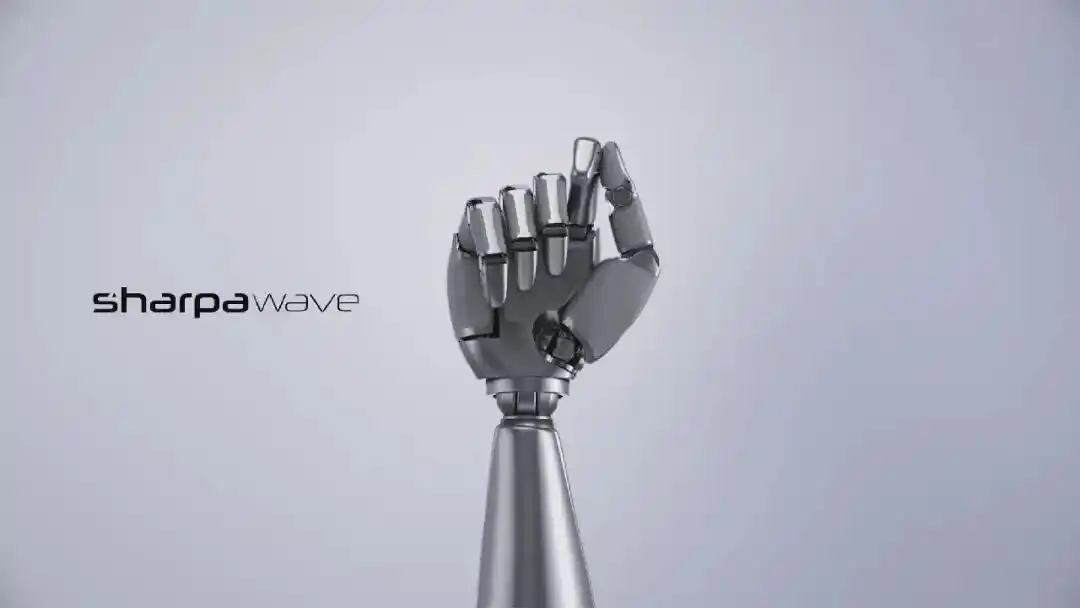
It is precisely because of this that Sharpa migrated its past capabilities to another track. Soon after its founding, Sharpa launched its flagship product, the Sharpa Wave dexterous hand.
In the field of dexterous hands, a long-standing contradiction exists: performance and mass production are often difficult to achieve simultaneously.

Some products use underactuated designs, controlling multiple joints with fewer motors, which lowers costs but limits flexibility and control precision. Others pursue capabilities close to the human hand, resulting in complex structures, high prices, and difficulty in large-scale deployment.

Sharpa chose a middle path.

The Sharpa Wave features 22 active degrees of freedom, with overall dimensions close to a 1:1 ratio with the human hand. To achieve higher control precision, it employs a direct-drive transmission architecture, enhancing joint responsiveness and motion control capability.

However, more crucial than the number of degrees of freedom is Sharpa's investment in its tactile sensing system.

In the humanoid robot industry, an increasingly clear trend is that vision alone is insufficient to meet complex manipulation needs.

Sharpa developed a tactile system called the Dynamic Tactile Array (DTA). It integrates micro-cameras and over 1,000 tactile sensing units inside each fingertip, allowing the robot to perceive pressure changes, recognize textures, slipping, and contact states, thereby gaining a form of "tactile feedback" similar to human fingertips.

According to data disclosed by Sharpa, its tactile sensing precision can reach the 0.005N level, with a refresh rate of 180Hz; the control frequency for the entire hand reaches 500Hz, and the output force of a single fingertip exceeds 20N.

These specifications all point toward the same goal: to truly enable robots to handle objects in the real world.

This is not entirely the same direction as Unitree's own dexterous hands.

Unitree's Dex series is more closely aligned with its own integrated robot system. Whether it's the three-finger or five-finger configuration, the focus is on enabling the robot to perform grasping and manipulation within its own body, locomotion control, and development ecosystem.

In other words, it's not that Unitree's hands are inferior; it's just that for NVIDIA's reference robot, Sharpa's hands better meet the requirements.

Therefore, the value of Sharpa Wave lies in turning "touching the world" into a data entry point that robots can perceive, provide feedback on, and train with.

But specifications are just specifications. To prove that a dexterous hand truly has the ability to "touch the world," it must be demonstrated through specific tasks.

And the reason Sharpa has gained market attention is precisely because it has translated these specifications into a series of operational demonstrations that have caught the eye of its peers.

Sexy Dexterous Hand, Dealing Cards Online

At the IROS 2025 (International Conference on Intelligent Robots and Systems) product exhibition, a demonstration by Sharpa left a deep impression on the industry: a Sharpa dexterous hand drew a single playing card from a deck held in another hand and placed it on a table.
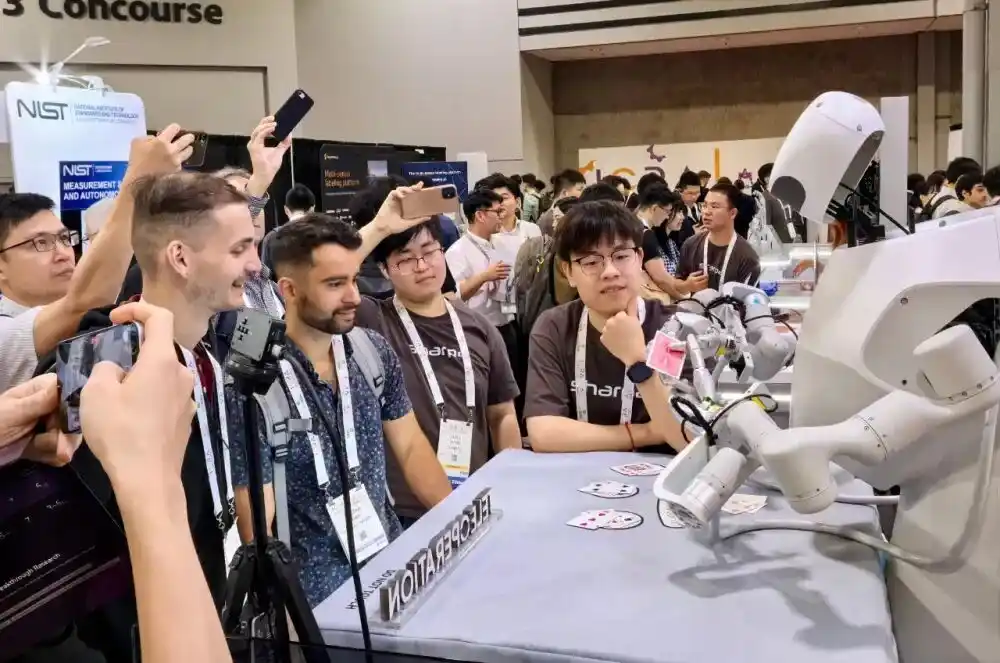
The reason it was so impressive lies in the fact that the action of dealing a playing card places extremely high demands on the force control precision of the dexterous hand and its predictive capability regarding the sliding and extraction of the card.

Furthermore, Sharpa has released a series of demonstration videos: autonomously peeling an eggshell, peeling an apple, dealing playing cards, folding paper pinwheels, and even assembling a computer case—including precisely inserting a graphics card and tightening the securing screws.

These tasks might seem like fun demos, but for the robotics industry, they represent entirely different levels of technical difficulty. Because grasping an object is not difficult; what's truly challenging is controlling the contact process.

A robot can easily pick up an egg but might not know when to increase or decrease force; it can recognize a playing card but may struggle to prevent the paper from slipping or deforming.

Many of the capabilities demonstrated by Sharpa essentially point to the same question: Can a robot adjust its actions in real-time through tactile feedback, just like a human?

This is where the DTA tactile system comes into play.

When the robot makes contact with an object, its fingertips can perceive pressure changes, friction states, and object slipping trends in real-time and feed this back to the control system for dynamic adjustment. Objects like eggs, paper, and fruit—soft or fragile—precisely highlight the value of this system.

At the same time, Sharpa is not content with being just a supplier of dexterous hands. In 2026, the company officially released its first full-body humanoid robot: Sharpa North.

At CES 2026, North demonstrated tasks such as playing table tennis, taking photos with a selfie stick, and dealing playing cards. However, the most representative demonstration was the autonomous assembly of a paper pinwheel, a task involving over 30 steps.

The entire process, from identifying parts and grasping materials to folding, assembling, and final completion, lasted several minutes and involved a large amount of bimanual coordination and sequential action planning. This indicates that the Sharpa robot possesses the potential to complete long-sequence, multi-step tasks.

From dexterous hands to humanoid robots, from a hardware supplier to a full-stack system developer, Sharpa's path is becoming increasingly clear:

It is not satisfied with being just a component of a robot. What it truly aims to do is become part of the next-generation embodied intelligence platform.

And "platform" is also a key word for NVIDIA's reference robot this time.

If the previous demonstrations proved that Sharpa's hands can perform complex manipulations, then the next, more crucial question is: What can such hands bring to NVIDIA?

Peers Are Racing to Flip the Table

For Sharpa, being chosen by NVIDIA is undoubtedly a landmark moment.

But the more critical point is that within this reference robot system, Sharpa occupies a rather pivotal position.

Because NVIDIA's goal with the "reference robot" is to build a reusable development foundation for the embodied intelligence industry, enabling developers, research institutions, and robotics companies to conduct training, verification, and development based on this framework.

In this framework, Unitree provides the body. With its locomotion control capabilities, Unitree solves the problem of how a robot stands up, walks, and moves.

What Sharpa adds is how the robot actually reaches out and does work once it stands in front of an object.

But for NVIDIA, this is not the whole story.

More importantly, Sharpa's product has been integrated into Isaac Lab. This is the most core open-source simulation training framework within NVIDIA's robotics ecosystem.

In the teleoperation phase, a human operator can control the 22-DOF dexterous hand using a data glove, mapping hand movements in real-time to robot joint movements. These recorded movements then become data for imitation learning and policy training, turning into samples that can be trained, reused, and expanded upon later.

Precisely because of this, Sharpa has secured more than just an ordinary hardware seat. It has inserted itself into NVIDIA's entire workflow, from teleoperation data collection, simulation training, policy evaluation, to real-world deployment. This is the core value of its collaboration with NVIDIA.

Of course, being favored by NVIDIA doesn't mean Sharpa has already secured victory, as the dexterous hand sector is evolving rapidly.

Over the past year or so, capital has been chasing this "hand" forward: companies like Lingxin Qiaoshou, Lingjiedian, InSight Robotics, AII Technology, Paxon Perception, etc., are all accelerating iteration around high degrees of freedom, tactile feedback, force control precision, and mass production capabilities.

Some are competing on funding speed and product deployment.

For example, Lingxin Qiaoshou has completed multiple rounds of funding since 2025, with its valuation reportedly reaching $3 billion after its B+ round in 2026, and its target valuation for the next round rumored to be as high as $6 billion. InSight Robotics also completed C1 and C2 funding rounds totaling hundreds of millions of RMB in 2026, continuing to focus on R&D for dexterous manipulation technology, innovation in core components, and product delivery capabilities.

Others are competing on tactile sensing.

Paxon Perception's product line already covers multi-dimensional tactile sensors, the DexH series of tactile dexterous hands, the humanoid robot TORA, and completed a B+ round of over 1 billion RMB in funding in March 2026.

AII Technology's new-generation dexterous hand also prominently features high-density array tactile sensors, pressure sensing capability from 0.1N to 25N, and other selling points.

This means that today's specifications—22 DOF, DTA tactile system, and NVIDIA reference design—could be surpassed tomorrow by new hands with lower costs, higher stability, or stronger data-closing capabilities.

But at least for this moment, NVIDIA has made its judgment clear:

As the industry shifts from "who can make the robot walk" to "who can make the robot work," a pair of sufficiently smart hands has become as important as its legs.

This article is from the WeChat public account "Blue Character Plan," author: Chester

İlgili Sorular

QWhy did NVIDIA choose Unitree's H2 Plus robot as the reference humanoid body for its NVIDIA Isaac GR00T platform, but then replace its hands?

ANVIDIA selected Unitree's H2 Plus for its excellent locomotion and full-body control capabilities, which placed it in the global first tier of humanoid robots. However, NVIDIA replaced Unitree's own Dex-series dexterous hands with Sharpa Wave hands because Sharpa's hands, with their 22 active degrees of freedom, high-precision direct-drive architecture, and advanced Dynamic Tactile Array (DTA) system, were deemed better suited for the complex manipulation tasks and data-collection needs of the reference platform.

QWhat are the key technological features of Sharpa's Wave dexterous hand that distinguished it for NVIDIA's selection?

ASharpa Wave's key features include: 22 active degrees of freedom in a human 1:1 scale, a direct-drive transmission architecture for high-speed response and control precision, and its proprietary Dynamic Tactile Array (DTA) system. The DTA integrates micro-cameras and over 1,000 tactile sensing units in each fingertip, providing high-frequency (180Hz) and high-precision (0.005N) force/tactile feedback. This allows the hand to perceive texture, slippage, and contact states, enabling complex, real-world manipulation tasks.

QHow does Sharpa's background at Hesai Technology relate to its development of advanced robotic hands?

ASharpa's core team originated from the dexterous hand team formed by Hesai Technology (a leading LiDAR company for autonomous vehicles) in 2024. While autonomous driving and robotics seem different, they share common technical challenges: high demands for sensor precision, system reliability, and engineering capabilities in complex, real-world environments. Sharpa leveraged Hesai's expertise in these areas, transferring capabilities from solving 'how vehicles see the world' to solving 'how robots touch and interact with the world.'

QWhat is the strategic significance of Sharpa Wave being integrated into NVIDIA's Isaac Lab framework?

AIntegration into NVIDIA's Isaac Lab—the core open-source simulation training framework for robotics—positions Sharpa not just as a hardware supplier but as a key part of NVIDIA's embodied AI development stack. In this framework, human operators can use data gloves to control the 22-DoF hand for teleoperation, generating real-time manipulation data. This data then becomes foundational for imitation learning and policy training within Isaac Lab, creating a closed-loop from data collection and simulation to real-world deployment. This gives Sharpa a crucial role in NVIDIA's platform ecosystem.

QWhat does NVIDIA's choice of Sharpa over Unitree's own hand signify about the current priorities in the humanoid robotics industry?

ANVIDIA's choice signals a shift in industry focus from 'who can make the robot walk and move' to 'who can make the robot perform useful work.' While stable locomotion (Unitree's strength) remains foundational, advanced manipulation capabilities are now considered equally critical for practical application. The selection highlights the growing importance of high-fidelity tactile sensing, precise force control, and the ability to handle complex, long-horizon manipulation tasks as key differentiators for next-generation embodied intelligence platforms.

İlgili Okumalar

12.9 Million Candidates: The First Summer of Fate in the Hands of AI

The 2026 Chinese college entrance exam, or Gaokao, saw a novel phenomenon: AI aggressively entering the college application advice arena before results were even released. Major tech companies like Alibaba, Tencent, Baidu, and others launched free AI-powered "agents" and tools designed to generate personalized university and major recommendations for over 12.9 million candidates. For years, a lucrative industry thrived on the "information gap" in college applications, with personalized consulting services costing families thousands of dollars. AI is now disrupting this by providing similar, data-driven analysis for free. These tools process standardized data—scores, rankings, historical admission trends—to create tailored application strategies, offering a form of information parity previously unavailable, especially to students from rural or less-resourced backgrounds. This shift represents more than just a marketing trend; it signifies AI's first large-scale entry into a critical, high-stakes life decision for millions of Chinese families. The Gaokao application, with its clear inputs and outputs, is an ideal scenario for AI. Its involvement begins to level the informational playing field, potentially reducing the advantage held by families with greater social capital or access to expensive consultants. However, the article raises a profound question: while AI can optimize choices for employability and financial return based on cold data, it risks promoting a homogenized, utilitarian path. It might steer a passionate student away from a less lucrative field like literature or archaeology toward supposedly "safer" options like computer science. The core dilemma remains: as AI flattens information disparities, does it also flatten the diversity of life choices and the freedom to make—and learn from—mistakes? Ultimately, 2026 may be remembered not for exam questions, but as the year AI began formally influencing the life trajectories of ordinary Chinese people. The real test lies not in the algorithm's recommendations, but in whether individuals will retain the courage to make their own choices and bear the consequences in an increasingly algorithmic age.

marsbit23 dk önce

12.9 Million Candidates: The First Summer of Fate in the Hands of AI

marsbit23 dk önce

IC3 Top Universities Collaborative Analysis: Is AI x Crypto the Real Future or Just a Narrative Bubble?

IC3 researchers from leading universities analyze the convergence of AI and crypto. They argue meaningful integration is still nascent, with hype often outstripping progress. The report frames AI as a "translation middleware" making blockchain accessible, while crypto serves as a "trust middleware" via tools like ZK proofs and TEEs for integrity, availability, and confidentiality. Two main directions are examined: 1) **Crypto x AI**: Using AI to enhance blockchain via analysis (fraud detection), algorithmic design, and AI oracles (with accuracy varying by task). New risks include AI-driven malicious smart contracts. 2) **AI x Crypto**: Using crypto to enhance AI via decentralized infrastructure (DePIN), data markets, agent micropayments, governance, and securing AI pipelines (training/federated learning, secure inference). The "Protected Pipeline" (Props) framework combines oracles and trusted computation for secure use of private data. Key challenges are highlighted: The industry must rigorously prove decentralized AI's cost competitiveness and crypto's utility for agent payments. Major research gaps include providing systemic security for autonomous agents and addressing novel threats like unstoppable AI agents. The report concludes by debunking five common misconceptions: blockchain cannot inherently detect AI content, solve algorithmic bias, grant true AI autonomy, ensure AI trustworthiness through mere transparency, or guarantee that decentralization is always cheaper for AI tasks. The field remains in an early, evidence-seeking phase.

marsbit1 saat önce

IC3 Top Universities Collaborative Analysis: Is AI x Crypto the Real Future or Just a Narrative Bubble?

marsbit1 saat önce

Anthropic Released the "Most Powerful Model," But Most People Can't Use It

In April, Anthropic launched a preview of its "Mythos" model, which was not publicly released due to its exceptional ability to autonomously discover high-risk zero-day vulnerabilities, posing a security threat if misused. It was restricted to a trusted group of security partners under "Project Glasswing." On June 10, Anthropic officially released Fable 5 and Mythos 5. They share the same underlying model but are distributed under different rules. Fable 5 is for general users, while Mythos 5 remains locked for trusted security partners. Benchmarks show Fable 5 leading in software engineering and long-task execution, with significant improvements in generating production-ready code. However, Fable 5 includes a safety classifier that automatically downgrades requests related to cybersecurity, biochemistry, or model distillation to the weaker Opus 4.8 model. This mechanism, while intended for safety, can affect the user experience and has faced criticism for being overly conservative. Pricing is another key point. Fable 5's API costs are double that of Opus 4.8. Furthermore, after a free trial period ending June 23, it will be removed from standard subscription plans, requiring users to purchase additional credits for access. This shift signals a move towards pay-as-you-go pricing for the most advanced capabilities. The strategy highlights a growing divergence in the AI industry: while some players like DeepSeek are drastically cutting prices, Anthropic is increasing them for its top-tier model, using cost as a filter for high-value users. The article suggests the AI market is stratifying, with commoditized capabilities becoming cheaper while premium, cutting-edge models command a significant price premium.

marsbit1 saat önce

Anthropic Released the "Most Powerful Model," But Most People Can't Use It

marsbit1 saat önce

İşlemler

Spot
Futures

Popüler Makaleler

$S$ Nedir

SPERO'yu Anlamak: Kapsamlı Bir Genel Bakış SPERO'ya Giriş İnovasyonun manzarası gelişmeye devam ederken, web3 teknolojilerinin ve kripto para projelerinin ortaya çıkışı dijital geleceği şekillendirmede önemli bir rol oynamaktadır. Bu dinamik alanda dikkat çeken projelerden biri SPERO, $$s$$ olarak adlandırılmaktadır. Bu makale, SPERO hakkında ayrıntılı bilgi toplamak ve sunmak amacıyla, meraklılar ve yatırımcıların web3 ve kripto alanlarındaki temellerini, hedeflerini ve yeniliklerini anlamalarına yardımcı olmayı amaçlamaktadır. SPERO,$$s$$ Nedir? SPERO,$$s$$, kripto alanında merkeziyetsizlik ve blok zinciri teknolojisi ilkelerini kullanarak etkileşimi, faydayı ve finansal kapsayıcılığı teşvik eden bir ekosistem yaratmayı amaçlayan benzersiz bir projedir. Proje, kullanıcıların yenilikçi finansal çözümler ve hizmetler sunarak eşler arası etkileşimleri yeni yollarla kolaylaştırmayı hedeflemektedir. SPERO,$$s$$'nin temel amacı, bireyleri güçlendirmek ve kripto para alanındaki kullanıcı deneyimini artıran araçlar ve platformlar sağlamaktır. Bu, daha esnek işlem yöntemlerini mümkün kılmayı, topluluk odaklı girişimleri teşvik etmeyi ve merkeziyetsiz uygulamalar (dApp'ler) aracılığıyla finansal fırsatlar yaratmayı içermektedir. SPERO,$$s$$'nin temel vizyonu kapsayıcılık etrafında dönmekte olup, geleneksel finansal sistemlerdeki boşlukları kapatmayı ve blok zinciri teknolojisinin faydalarından yararlanmayı hedeflemektedir. SPERO,$$s$$'nin Yaratıcısı Kimdir? SPERO,$$s$$'nin yaratıcısının kimliği bir miktar belirsizdir, çünkü kurucusu(ları) hakkında ayrıntılı arka plan bilgisi sağlayan sınırlı kamuya açık kaynaklar bulunmaktadır. Bu şeffaflık eksikliği, projenin merkeziyetsizlik taahhüdünden kaynaklanabilir—birçok web3 projesinin paylaştığı bir etik anlayışı, bireysel tanınmanın yerine kolektif katkıları önceliklendirmektedir. Topluluk ve onun kolektif hedefleri etrafında tartışmaları merkezileştirerek, SPERO,$$s$$, belirli bireyleri öne çıkarmadan güçlendirme özünü taşımaktadır. Bu nedenle, SPERO'nun etik anlayışını ve misyonunu anlamak, tek bir yaratıcının kimliğini belirlemekten daha önemlidir. SPERO,$$s$$'nin Yatırımcıları Kimlerdir? SPERO,$$s$$, kripto sektöründe yeniliği teşvik etmeye adanmış girişim sermayedarlarından melek yatırımcılara kadar çeşitli yatırımcılar tarafından desteklenmektedir. Bu yatırımcıların odak noktası genellikle SPERO'nun misyonuyla uyumlu olup, toplumsal teknolojik ilerlemeyi, finansal kapsayıcılığı ve merkeziyetsiz yönetimi vaat eden projeleri önceliklendirmektedir. Bu yatırımcı temelleri, yalnızca yenilikçi ürünler sunan projelere değil, aynı zamanda blok zinciri topluluğuna ve ekosistemlerine olumlu katkılarda bulunan projelere de ilgi duymaktadır. Bu yatırımcıların desteği, SPERO,$$s$$'yi hızla gelişen kripto projeleri alanında dikkate değer bir rakip haline getirmektedir. SPERO,$$s$$ Nasıl Çalışır? SPERO,$$s$$, onu geleneksel kripto para projelerinden ayıran çok yönlü bir çerçeve kullanmaktadır. İşte benzersizliğini ve yeniliğini vurgulayan bazı temel özellikler: Merkeziyetsiz Yönetim: SPERO,$$s$$, kullanıcıların projenin geleceğiyle ilgili karar alma süreçlerine aktif olarak katılmalarını sağlayan merkeziyetsiz yönetim modellerini entegre etmektedir. Bu yaklaşım, topluluk üyeleri arasında sahiplik ve hesap verebilirlik duygusunu teşvik etmektedir. Token Kullanımı: SPERO,$$s$$, ekosistem içinde çeşitli işlevler sunmak üzere tasarlanmış kendi kripto para token'ını kullanmaktadır. Bu token'lar, işlemleri, ödülleri ve platformda sunulan hizmetlerin kolaylaştırılmasını sağlayarak genel etkileşimi ve faydayı artırmaktadır. Katmanlı Mimari: SPERO,$$s$$'nin teknik mimarisi, modülerlik ve ölçeklenebilirliği destekleyerek projenin evrimi sırasında ek özelliklerin ve uygulamaların sorunsuz bir şekilde entegrasyonuna olanak tanımaktadır. Bu uyum sağlama yeteneği, sürekli değişen kripto manzarasında geçerliliği sürdürmek için hayati öneme sahiptir. Topluluk Katılımı: Proje, işbirliği ve geri bildirim teşvik eden mekanizmalar kullanarak topluluk odaklı girişimlere vurgu yapmaktadır. Güçlü bir topluluk oluşturarak, SPERO,$$s$$, kullanıcı ihtiyaçlarını daha iyi karşılayabilir ve piyasa trendlerine uyum sağlayabilir. Kapsayıcılığa Odaklanma: Düşük işlem ücretleri ve kullanıcı dostu arayüzler sunarak, SPERO,$$s$$, daha önce kripto alanında yer almamış bireyler de dahil olmak üzere çeşitli bir kullanıcı tabanını çekmeyi hedeflemektedir. Bu kapsayıcılık taahhüdü, erişilebilirlik yoluyla güçlendirme misyonuyla uyumludur. SPERO,$$s$$ Zaman Çizelgesi Bir projenin tarihini anlamak, gelişim yolculuğu ve kilometre taşları hakkında kritik bilgiler sağlar. Aşağıda, SPERO,$$s$$'nin evriminde önemli olayları haritalayan önerilen bir zaman çizelgesi bulunmaktadır: Kavram Geliştirme ve Fikir Aşaması: SPERO,$$s$$'nin temelini oluşturan ilk fikirler, blok zinciri endüstrisindeki merkeziyetsizlik ve topluluk odaklılık ilkeleriyle yakından uyumlu olarak geliştirildi. Proje Beyaz Kağıdının Yayınlanması: Kavramsal aşamayı takiben, SPERO,$$s$$'nin vizyonunu, hedeflerini ve teknolojik altyapısını ayrıntılı bir şekilde açıklayan kapsamlı bir beyaz kağıt yayımlandı ve topluluk ilgisini ve geri bildirimini toplamak amacıyla sunuldu. Topluluk Oluşturma ve Erken Katılımlar: Projenin hedefleri etrafında tartışmalar yürüterek destek toplamak ve erken benimseyenler ile potansiyel yatırımcılar için bir topluluk oluşturmak amacıyla aktif iletişim çabaları gerçekleştirildi. Token Üretim Etkinliği: SPERO,$$s$$, yerel token'larını erken destekçilere dağıtmak ve ekosistem içinde başlangıç likiditesini sağlamak amacıyla bir token üretim etkinliği (TGE) gerçekleştirdi. İlk dApp'in Yayınlanması: SPERO,$$s$$ ile ilişkili ilk merkeziyetsiz uygulama (dApp) faaliyete geçti ve kullanıcıların platformun temel işlevleriyle etkileşimde bulunmalarını sağladı. Sürekli Gelişim ve Ortaklıklar: Projenin tekliflerine sürekli güncellemeler ve iyileştirmeler yapılmakta olup, blok zinciri alanındaki diğer oyuncularla stratejik ortaklıklar, SPERO,$$s$$'yi rekabetçi ve gelişen bir oyuncu haline getirmiştir. Sonuç SPERO,$$s$$, web3 ve kripto paranın finansal sistemleri devrim niteliğinde dönüştürme ve bireyleri güçlendirme potansiyelinin bir kanıtıdır. Merkeziyetsiz yönetime, topluluk katılımına ve yenilikçi tasarlanmış işlevselliğe olan bağlılığıyla, daha kapsayıcı bir finansal manzaraya doğru bir yol açmaktadır. Hızla gelişen kripto alanındaki herhangi bir yatırımda olduğu gibi, potansiyel yatırımcılar ve kullanıcılar, SPERO,$$s$$ içindeki devam eden gelişmelerle ilgili olarak kapsamlı bir araştırma yapmaları ve düşünceli bir şekilde katılmaları teşvik edilmektedir. Proje, kripto endüstrisinin yenilikçi ruhunu sergileyerek, sayısız olasılığını keşfetmeye davet etmektedir. SPERO,$$s$$'nin yolculuğu hala devam ederken, temel ilkeleri, teknoloji, finans ve birbirimizle etkileşim biçimimizi etkileyebilir.

89 Toplam GörüntülenmeYayınlanma 2024.12.17Güncellenme 2024.12.17

$S$ Nedir

AGENT S Nedir

Agent S: Web3'te Otonom Etkileşimin Geleceği Giriş Web3 ve kripto para dünyasında sürekli gelişen manzarada, yenilikler bireylerin dijital platformlarla etkileşim biçimlerini sürekli olarak yeniden tanımlıyor. Bu tür öncü projelerden biri olan Agent S, açık ajans çerçevesi aracılığıyla insan-bilgisayar etkileşimini devrim niteliğinde değiştirmeyi vaat ediyor. Otonom etkileşimlerin yolunu açarak, Agent S karmaşık görevleri basitleştirmeyi ve yapay zeka (AI) alanında dönüştürücü uygulamalar sunmayı hedefliyor. Bu detaylı inceleme, projenin karmaşıklıklarına, benzersiz özelliklerine ve kripto para alanındaki etkilerine dalacaktır. Agent S Nedir? Agent S, bilgisayar görevlerinin otomasyonunda üç temel zorluğu ele almak üzere özel olarak tasarlanmış çığır açıcı bir açık ajans çerçevesidir: Alan Spesifik Bilgi Edinimi: Çerçeve, çeşitli dış bilgi kaynaklarından ve iç deneyimlerden akıllıca öğrenir. Bu çift yönlü yaklaşım, alan spesifik bilgi açısından zengin bir veri havuzu oluşturmasını sağlar ve görev yürütmedeki performansını artırır. Uzun Görev Ufukları Üzerinde Planlama: Agent S, karmaşık görevlerin verimli bir şekilde parçalanmasını ve yürütülmesini kolaylaştıran deneyim artırımlı hiyerarşik planlama kullanır. Bu özellik, çoklu alt görevleri etkili ve verimli bir şekilde yönetme yeteneğini önemli ölçüde artırır. Dinamik, Homojen Olmayan Arayüzlerle Başlama: Proje, ajanlar ve kullanıcılar arasındaki etkileşimi geliştiren yenilikçi bir çözüm olan Ajan-Bilgisayar Arayüzü'ni (ACI) tanıtmaktadır. Çok Modlu Büyük Dil Modellerini (MLLM'ler) kullanarak, Agent S çeşitli grafik kullanıcı arayüzlerini sorunsuz bir şekilde gezinebilir ve manipüle edebilir. Bu öncü özellikler aracılığıyla, Agent S, makinelerle insan etkileşimini otomatikleştirmede karşılaşılan karmaşıklıkları ele alan sağlam bir çerçeve sunarak, AI ve ötesinde birçok uygulama için zemin hazırlıyor. Agent S'nin Yaratıcısı Kimdir? Agent S'nin kavramı temelde yenilikçi olsa da, yaratıcısı hakkında spesifik bilgiler belirsizliğini koruyor. Yaratıcı şu anda bilinmiyor, bu da projenin yeni aşamasını veya kurucu üyeleri gizli tutma stratejik tercihini vurguluyor. Anonimlikten bağımsız olarak, odak çerçevenin yetenekleri ve potansiyeli üzerinde kalıyor. Agent S'nin Yatırımcıları Kimlerdir? Agent S, kriptografik ekosistemde oldukça yeni olduğundan, yatırımcıları ve finansal destekçileri hakkında ayrıntılı bilgiler açıkça belgelenmemiştir. Projeyi destekleyen yatırım temelleri veya organizasyonları hakkında kamuya açık bilgilerdeki eksiklik, finansman yapısı ve gelişim yol haritası hakkında sorular doğuruyor. Destekleyicilerin anlaşılması, projenin sürdürülebilirliğini ve potansiyel pazar etkisini değerlendirmek için kritik öneme sahiptir. Agent S Nasıl Çalışır? Agent S'nin temelinde, çeşitli ortamlarda etkili bir şekilde çalışmasını sağlayan son teknoloji bir sistem yatmaktadır. İşleyiş modeli birkaç ana özellik etrafında inşa edilmiştir: İnsan Benzeri Bilgisayar Etkileşimi: Çerçeve, bilgisayarlarla etkileşimleri daha sezgisel hale getirmeyi amaçlayan gelişmiş AI planlaması sunar. Görev yürütmedeki insan davranışını taklit ederek, kullanıcı deneyimlerini yükseltmeyi vaat eder. Anlatı Belleği: Yüksek düzeyde deneyimlerden yararlanmak için kullanılan Agent S, görev geçmişlerini takip etmek amacıyla anlatı belleğini kullanarak karar verme süreçlerini geliştirir. Episodik Bellek: Bu özellik, kullanıcılara adım adım rehberlik sağlayarak, çerçevenin görevler gelişirken bağlamsal destek sunmasına olanak tanır. OpenACI Desteği: Yerel olarak çalışabilme yeteneği ile Agent S, kullanıcıların etkileşimleri ve iş akışları üzerinde kontrol sağlamasına olanak tanır ve Web3'ün merkeziyetsiz felsefesiyle uyumlu hale gelir. Dış API'lerle Kolay Entegrasyon: Çeşitli AI platformlarıyla uyumluluğu ve çok yönlülüğü, Agent S'nin mevcut teknolojik ekosistemlere sorunsuz bir şekilde entegre olmasını sağlar ve geliştiriciler ile organizasyonlar için cazip bir seçenek haline getirir. Bu işlevsellikler, Agent S'nin kripto alanındaki benzersiz konumuna katkıda bulunarak, karmaşık, çok aşamalı görevleri minimum insan müdahalesi ile otomatikleştirir. Proje geliştikçe, Web3'teki potansiyel uygulamaları dijital etkileşimlerin nasıl gelişeceğini yeniden tanımlayabilir. Agent S'nin Zaman Çizelgesi Agent S'nin gelişimi ve kilometre taşları, önemli olaylarını vurgulayan bir zaman çizelgesinde özetlenebilir: 27 Eylül 2024: Agent S'nin kavramı, “Bilgisayarları İnsan Gibi Kullanan Açık Bir Ajans Çerçevesi” başlıklı kapsamlı bir araştırma makalesi ile tanıtıldı ve projenin temelini sergiledi. 10 Ekim 2024: Araştırma makalesi arXiv'de kamuya açık olarak yayınlandı ve çerçevenin derinlemesine bir incelemesini ve OSWorld benchmark'ına dayalı performans değerlendirmesini sundu. 12 Ekim 2024: Agent S'nin yetenekleri ve özellikleri hakkında görsel bir içgörü sağlayan bir video sunumu yayımlandı ve potansiyel kullanıcılar ve yatırımcılarla daha fazla etkileşim sağlandı. Bu zaman çizelgesindeki işaretler, sadece Agent S'nin ilerlemesini değil, aynı zamanda şeffaflık ve topluluk katılımına olan bağlılığını da göstermektedir. Agent S Hakkında Ana Noktalar Agent S çerçevesi gelişmeye devam ederken, birkaç ana özellik öne çıkmakta ve yenilikçi doğasını ve potansiyelini vurgulamaktadır: Yenilikçi Çerçeve: İnsan etkileşimine benzer bir bilgisayar kullanımı sağlamak üzere tasarlanan Agent S, görev otomasyonuna yeni bir yaklaşım getiriyor. Otonom Etkileşim: GUI aracılığıyla bilgisayarlarla otonom olarak etkileşim kurabilme yeteneği, daha akıllı ve verimli hesaplama çözümlerine doğru bir sıçrama anlamına geliyor. Karmaşık Görev Otomasyonu: Sağlam metodolojisi ile karmaşık, çok aşamalı görevleri otomatikleştirerek süreçleri daha hızlı ve daha az hata payı ile gerçekleştirebilir. Sürekli İyileştirme: Öğrenme mekanizmaları, Agent S'nin geçmiş deneyimlerden öğrenmesini sağlar ve sürekli olarak performansını ve etkinliğini artırır. Çok Yönlülük: OSWorld ve WindowsAgentArena gibi farklı işletim ortamlarında uyumlu olması, geniş bir uygulama yelpazesine hizmet edebilmesini sağlar. Agent S, Web3 ve kripto alanında kendini konumlandırırken, etkileşim yeteneklerini artırma ve süreçleri otomatikleştirme potansiyeli, AI teknolojilerinde önemli bir ilerlemeyi temsil etmektedir. Yenilikçi çerçevesi aracılığıyla, Agent S dijital etkileşimlerin geleceğini örneklemekte ve çeşitli sektörlerde kullanıcılar için daha sorunsuz ve verimli bir deneyim vaat etmektedir. Sonuç Agent S, AI ve Web3'ün birleşiminde cesur bir sıçramayı temsil ediyor ve teknoloji ile etkileşim biçimimizi yeniden tanımlama kapasitesine sahip. Henüz erken aşamalarında olmasına rağmen, uygulama olanakları geniş ve çekici. Kritik zorlukları ele alan kapsamlı çerçevesi ile Agent S, otonom etkileşimleri dijital deneyimin ön plana çıkmasına taşımayı hedefliyor. Kripto para ve merkeziyetsizlik alanlarına daha derinlemesine girdikçe, Agent S gibi projelerin teknoloji ve insan-bilgisayar işbirliğinin geleceğini şekillendirmede önemli bir rol oynayacağı kesin.

576 Toplam GörüntülenmeYayınlanma 2025.01.14Güncellenme 2025.01.14

AGENT S Nedir

S Nasıl Satın Alınır

HTX.com’a hoş geldiniz! Sonic (S) satın alma işlemlerini basit ve kullanışlı bir hâle getirdik. Adım adım açıkladığımız rehberimizi takip ederek kripto yolculuğunuza başlayın. 1. Adım: HTX Hesabınızı OluşturunHTX'te ücretsiz bir hesap açmak için e-posta adresinizi veya telefon numaranızı kullanın. Sorunsuzca kaydolun ve tüm özelliklerin kilidini açın. Hesabımı Aç2. Adım: Kripto Satın Al Bölümüne Gidin ve Ödeme Yönteminizi SeçinKredi/Banka Kartı: Visa veya Mastercard'ınızı kullanarak anında Sonic (S) satın alın.Bakiye: Sorunsuz bir şekilde işlem yapmak için HTX hesap bakiyenizdeki fonları kullanın.Üçüncü Taraflar: Kullanımı kolaylaştırmak için Google Pay ve Apple Pay gibi popüler ödeme yöntemlerini ekledik.P2P: HTX'teki diğer kullanıcılarla doğrudan işlem yapın.Borsa Dışı (OTC): Yatırımcılar için kişiye özel hizmetler ve rekabetçi döviz kurları sunuyoruz.3. Adım: Sonic (S) Varlıklarınızı SaklayınSonic (S) satın aldıktan sonra HTX hesabınızda saklayın. Alternatif olarak, blok zinciri transferi yoluyla başka bir yere gönderebilir veya diğer kripto para birimlerini takas etmek için kullanabilirsiniz.4. Adım: Sonic (S) Varlıklarınızla İşlem YapınHTX'in spot piyasasında Sonic (S) ile kolayca işlemler yapın.Hesabınıza erişin, işlem çiftinizi seçin, işlemlerinizi gerçekleştirin ve gerçek zamanlı olarak izleyin. Hem yeni başlayanlar hem de deneyimli yatırımcılar için kullanıcı dostu bir deneyim sunuyoruz.

1.6k Toplam GörüntülenmeYayınlanma 2025.01.15Güncellenme 2026.06.02

S Nasıl Satın Alınır

Tartışmalar

HTX Topluluğuna hoş geldiniz. Burada, en son platform gelişmeleri hakkında bilgi sahibi olabilir ve profesyonel piyasa görüşlerine erişebilirsiniz. Kullanıcıların S (S) fiyatı hakkındaki görüşleri aşağıda sunulmaktadır.

活动图片