Crypto speculation at 2024 lows as TradFi leveraged ETFs hit record $239B

cointelegraph2025-12-12 tarihinde yayınlandı2025-12-12 tarihinde güncellendi

Özet

Crypto speculative activity has hit a near two-year low in 2024, with memecoin dominance falling significantly, according to CryptoQuant. In contrast, traditional finance leveraged ETFs reached a record $239 billion in assets under management in Q3 2025. This shift indicates declining interest in high-risk digital assets and a move toward regulated TradFi products. Crypto investor sentiment remains in "Fear" territory following the October market crash, and smart money traders are betting against memecoins while showing more interest in assets like Ether and tokens with real utility. The memecoin market is described as "dead," with concerns around fair launches and liquidity further dampening interest. A strong catalyst would be needed to revive retail speculation.

Traditional finance leveraged investment products are at a record high, but the appetite for speculative assets remains muted in the cryptocurrency market.

Speculative appetite is cooling among crypto investors, with memecoin dominance vs altcoins hitting a near two-year low last seen in February 2024, according to crypto data platform CryptoQuant.

“Memecoin markets are dead,” wrote CryptoQuant co-founder and CEO, Ki Young Ji, in a Thursday X post.
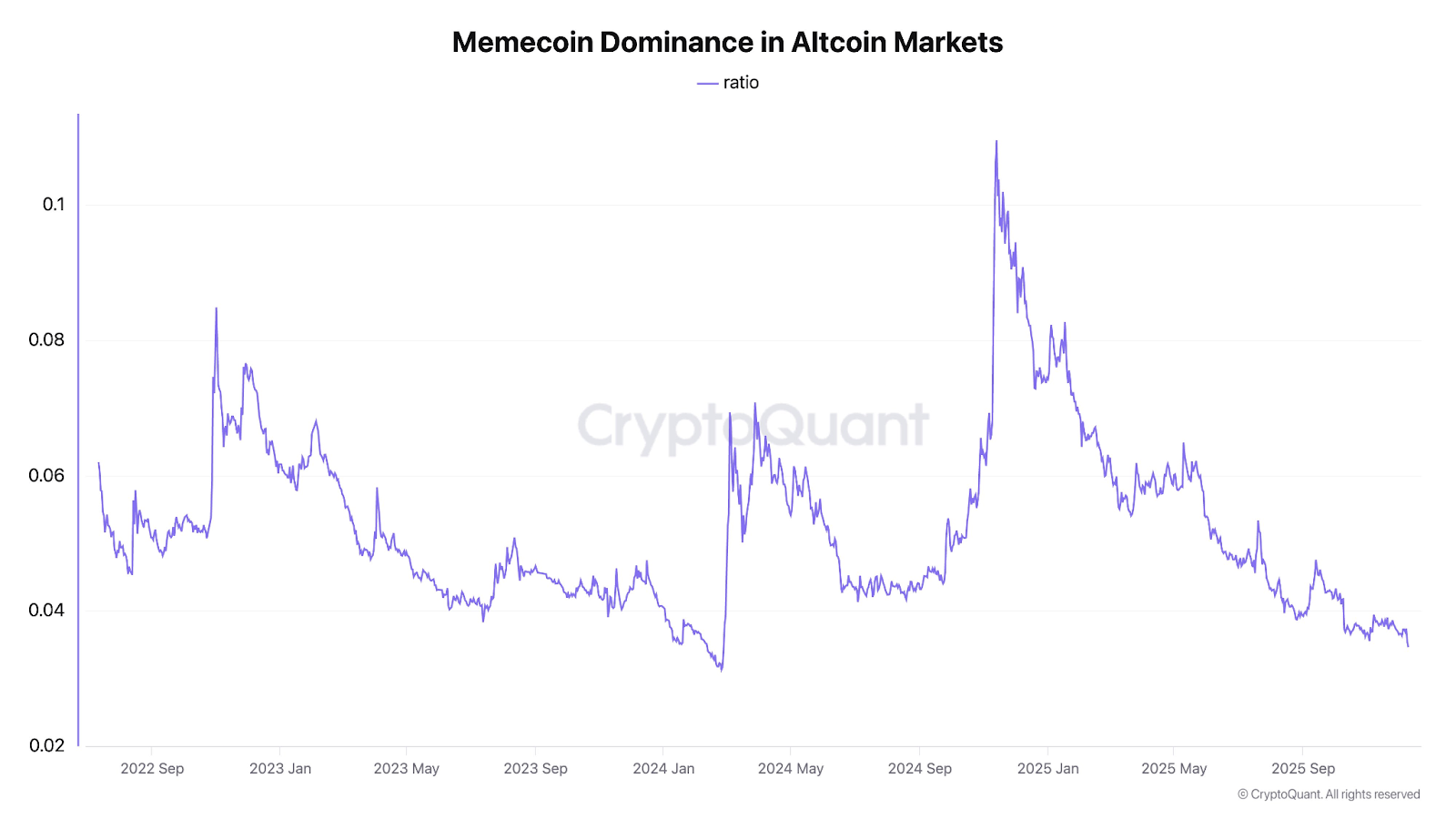
Memecoin dominance in altcoin markets. Source: Ki Young Ju

In contrast, speculative appetite is soaring among equities investors, as traditional leveraged exchange-traded funds (ETFs) hit a new all-time high of $239 billion in assets under management during the third quarter of 2025, according to Bloomberg data shared by Barchart.

The dynamic signals a waning enthusiasm for high-risk digital assets, as speculative appetite is recalibrating to regulated, TradFi leveraged products in less volatile equity markets.
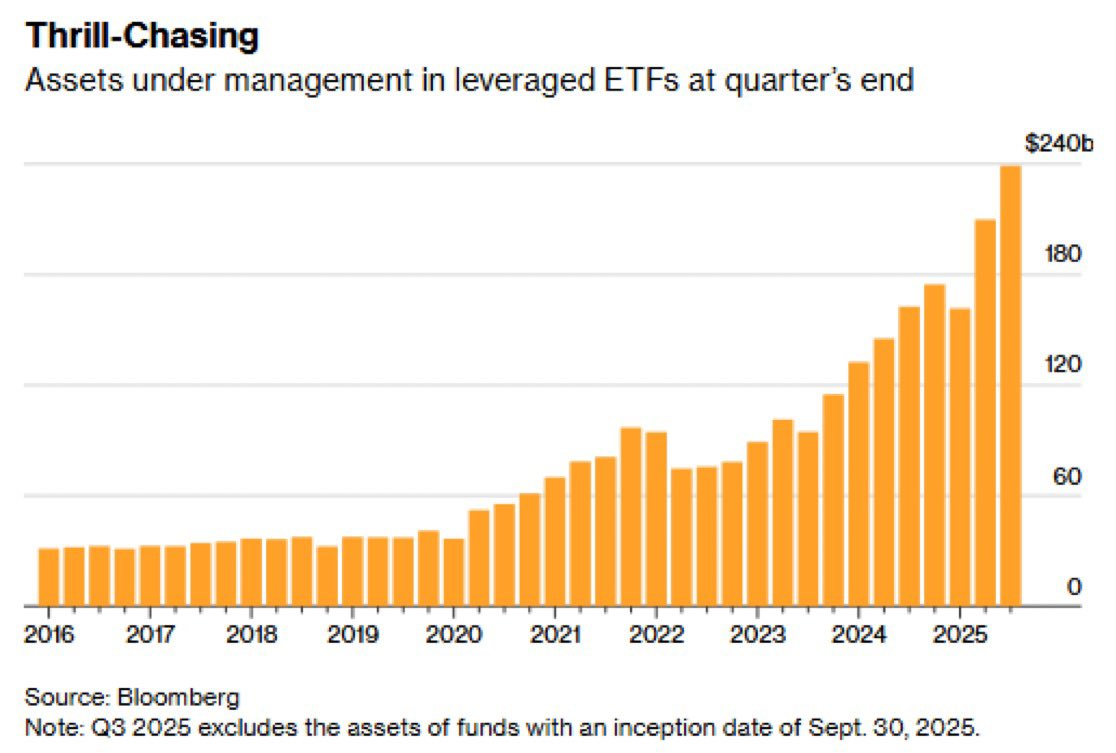
Source: Bloomberg/Barchart

The market dynamic signals a maturation in crypto and equities markets, as risk-taking is “expressed through regulated, familiar products with defined safeguards,” not memecoins that suffer from “thin” liquidity and regulatory uncertainty, Lacie Zhang, market analyst at Bitget Wallet, told Cointelegraph.

”A revival would likely require a strong catalyst — such as a new viral narrative, major exchange listings, or decisive price action — to reignite retail interest.”

Related: Bitcoin treasuries stall in Q4, but largest holders keep stacking sats

Crypto investor sentiment yet to recover from October market crash

The appetite of crypto investors remains muted for most cryptocurrencies since the record market crash at the beginning of October, not just for memecoins.

Crypto investor sentiment saw a small recovery from the “Extreme Fear” of 10 recorded on Nov. 23, but the current 29 reading still signals “Fear,” and remains far below the 62 “Greed” level from Oct. 7, before the $19 billion crypto market crash occurred, according to CoinMarketCap's Fear & Greed Index.
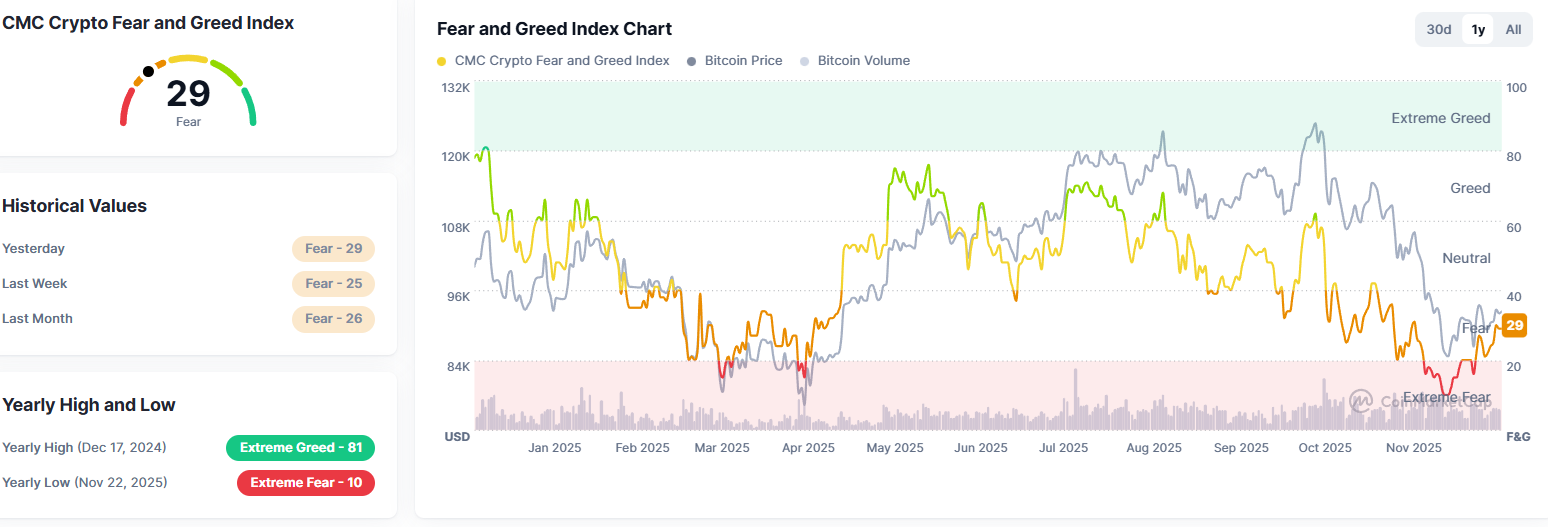
Crypto Fear & Greed Index, 1-year chart. Source: CoinMarketCap

Meanwhile, the crypto industry’s best-performing traders by returns, who are tracked as “smart money” traders on Nansen’s blockchain intelligence platform, are betting on the decline of the leading memecoins and most cryptocurrencies.

Smart money was net short on Fartcoin (FART) for $3.5 million and net short on the Pump.fun (PUMP) token for $1.5 million, Nansen data shows.

However, the cohort is betting on more upside for Ether (ETH) and decentralized exchange Hyperliquid’s (HYPE) token, signaling a preference for tokens with real revenue-generating blockchain protocols.
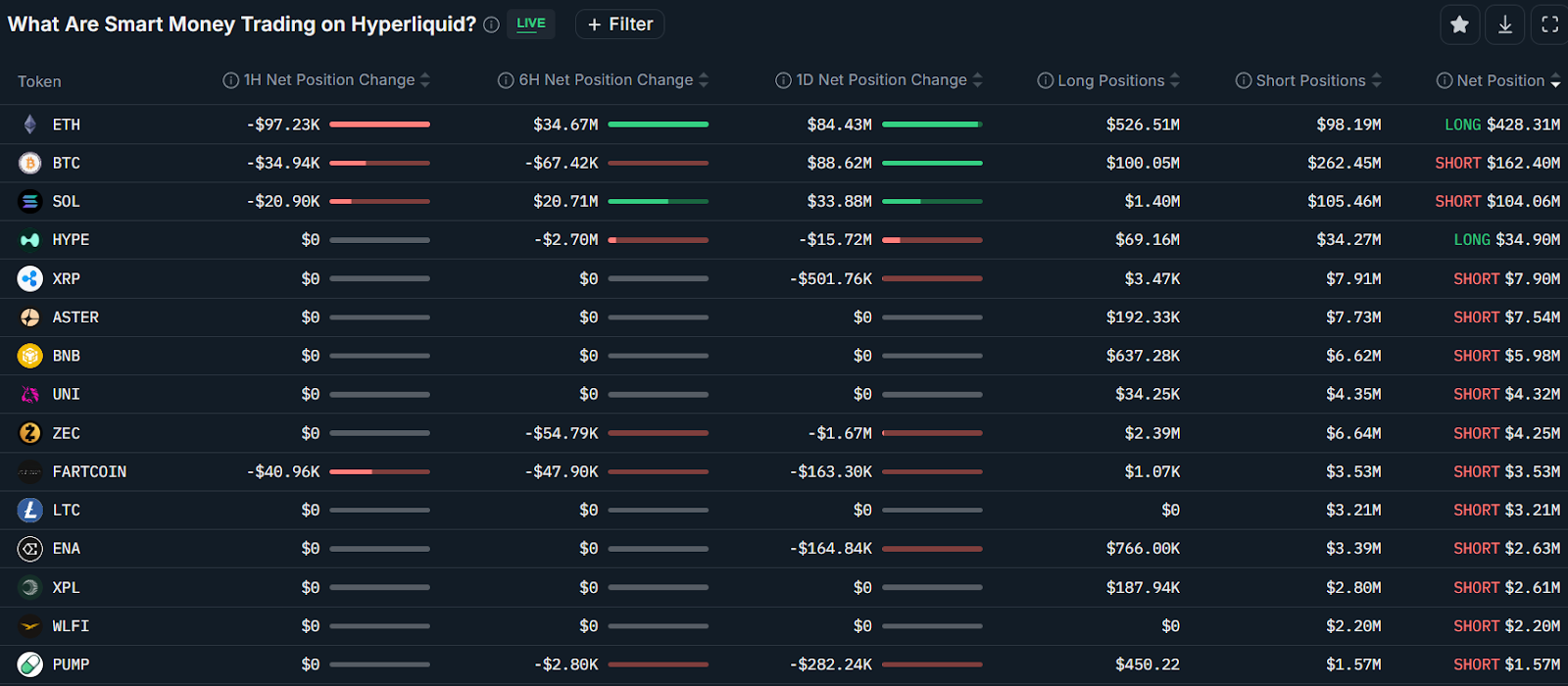
Smart money traders top perpetual futures positions on Hyperliquid. Source: Nansen

Related: Crypto nears its ‘Netscape moment’ as industry approaches inflection point

The positioning from this cohort may also signal investor fatigue with the memecoin launches of the past cycle, as troubling data is emerging about some of these coins.

On Thursday, blockchain data from Bubblemaps claimed that about 30% of the Pepe (PEPE) token’s genesis supply was bundled under an entity that sold $2 million a day after the coin’s debut, casting doubt on the memecoin’s fair-launch premise.

Magazine: Memecoin degeneracy is funding groundbreaking anti-aging research
İlgili Okumalar

A Comprehensive Analysis of On-Chain Pre-IPO: Why is the Pricing Power of SpaceX and OpenAI Moving On-Chain?

This podcast episode explores the rise of on-chain pre-IPO price discovery and trading, focusing on companies like SpaceX, OpenAI, and Anthropic. Key trends include the recent launch of a SpaceX pre-IPO perpetual contract on Hyperliquid, the secondary market trading of AI company shares, and a new partnership between Nasdaq Private Market and Polymarket. Dio Casares explains why AI companies like OpenAI and Anthropic actively deny the legitimacy of secondary trades. Primary reasons are to protect their primary funding rounds (as secondary trades don't provide cash to the company) and to avoid complex legal and administrative responsibilities associated with settling these transactions. He argues that on-chain **derivatives** (like perpetuals) are a more viable solution than **tokenized spot markets**, as they better navigate U.S. regulatory holding period requirements, provide effective hedging, and avoid antagonizing the companies themselves by competing with their primary raises. The discussion covers the risks and methods of gaining pre-IPO exposure, from direct investments and SPVs to riskier, layered structures that can lead to legal complications and settlement issues. Casares also maps the landscape of key players, differentiating between traditional secondary brokers (like Forge, Hiive, and Setter) and on-chain derivatives protocols (like Trade.xyz/Ventuals on Hyperliquid) and tokenization platforms (often on Solana). He positions Patagon as a facilitator for access to private market deals but clarifies it avoids on-chain tokenization to maintain good relations with portfolio companies. Looking ahead, the convergence of a historic IPO pipeline (with potential trillion-dollar valuations), the 24/7 nature of crypto markets, and the strategic use of pre-market perpetuals as a "loss leader" suggest continued growth and competition in the on-chain pre-IPO space.

marsbit20 dk önce

A Comprehensive Analysis of On-Chain Pre-IPO: Why is the Pricing Power of SpaceX and OpenAI Moving On-Chain?

marsbit20 dk önce

Token Packages Are Here, Are Telecom Operators in a Hurry?

Major Chinese telecom operators are launching token-based AI computing packages, sparking public debate and highlighting a strategic shift amid slowing traditional revenue growth. In May, Shanghai Telecom introduced token plans (e.g., 9.9 RMB for 10 million tokens), quickly followed by nationwide offerings from China Telecom, China Mobile, and China Unicom. While priced higher than major AI firms like DeepSeek, these packages allow users to access multiple AI models via API using their phone bills, similar to purchasing universal mobile data. The move reflects operators' anxiety as traditional voice, SMS, and data services stagnate. With revenue growth hitting multi-year lows in 2025, AI and computing power represent a critical new frontier. However, current C端 offerings, such as AI photo editing or virtual pets, are seen as non-essential and highlight operators' role as "pipes" or integrators rather than creators of compelling AI products. Beyond consumer packages, operators aim to become key infrastructure players in China’s national computing power network. They position themselves as the "power grid" delivering AI算力, leveraging their vast network of base stations to ensure low-latency, reliable coverage, especially for applications like autonomous driving. This infrastructure role, coupled with unified national调度, could make算力 a ubiquitous utility, driving new consumption scenarios even if mass adoption of token packages remains uncertain.

marsbit24 dk önce

Token Packages Are Here, Are Telecom Operators in a Hurry?

marsbit24 dk önce

The Five Value Logics Behind Enterprises Selling Bitcoin

"Five Value Logics Behind Corporate Bitcoin Sell-offs" Recent news of Strategy company considering selling part of its bitcoin holdings to meet operational goals sparked market discussions, challenging its previous "never sell" stance. While long-term holding aligns with crypto investment philosophy, selling bitcoin can be a rational corporate decision aimed at maximizing shareholder value, unlike personal sales for life improvements. For instance, in Q1 2026, miners sold 25,376 BTC to fund a pivot into AI, deeming it a higher-return investment. For treasury-holding firms like Strategy, selling bitcoin can create value through five key logics: 1. **Increasing Bitcoin Per Share:** The core metric is bitcoin per share. If a company's stock trades below its bitcoin asset value, selling BTC to buy back shares can increase this ratio, as the reduction in shares outstanding outweighs the BTC sold. Similarly, using BTC proceeds to cover fixed costs like dividends during stock undervaluation minimizes the dilution of bitcoin per share. 2. **Optimizing Capital Structure & Lowering Financing Costs:** Credit ratings significantly influence financing costs. Rating agencies like S&P value cash reserves. By selling bitcoin to boost cash, companies can meet capital market expectations, secure better ratings, and issue debt at lower costs. Reducing debt through BTC sales also improves the appeal of preferred stock. Lower interest rates compound over time, boosting profits. 3. **Legitimate Tax Planning:** The US currently has no wash-sale rules for bitcoin. Companies can sell to realize a book loss, immediately repurchase at a lower cost basis, and use the loss to offset taxes—a strategy Strategy used in 2022's bear market. This can be combined with stock buybacks or debt repayment for multiple benefits. 4. **Dispelling Market FUD (Fear, Uncertainty, Doubt):** Negative narratives claim large corporate BTC sales could crash the market or invalidate the treasury model. A controlled sale (e.g., 50,000 BTC) without causing major market or stock price volatility could debunk such myths, helping the market accept bitcoin as a corporate asset. This reason is the most subjective of the five. 5. **Buying Back Preferred Stock at a Discount:** This lesser-known strategy involves repurchasing a company's own floating-rate preferred stock when it trades significantly below its par value. For example, if a $100-par security like STRC trades at $82, selling bitcoin to buy it back yields an $18 per-share, tax-free profit. Price drops may occur due to leveraged trading cascades, unrelated to BTC's price. Repurchasing avoids future increased dividend costs. In conclusion, corporate bitcoin sales should not be automatically viewed as bearish. In many scenarios, they protect the interests of the company and its shareholders. Bitcoin's monetary properties offer flexible capital allocation; using the asset rationally unlocks its maximum value.

marsbit24 dk önce

The Five Value Logics Behind Enterprises Selling Bitcoin

marsbit24 dk önce

I Tested with $10,000: Zero Wear, 8% APY, and Earn Points (Full Tutorial + Screenshots Included)

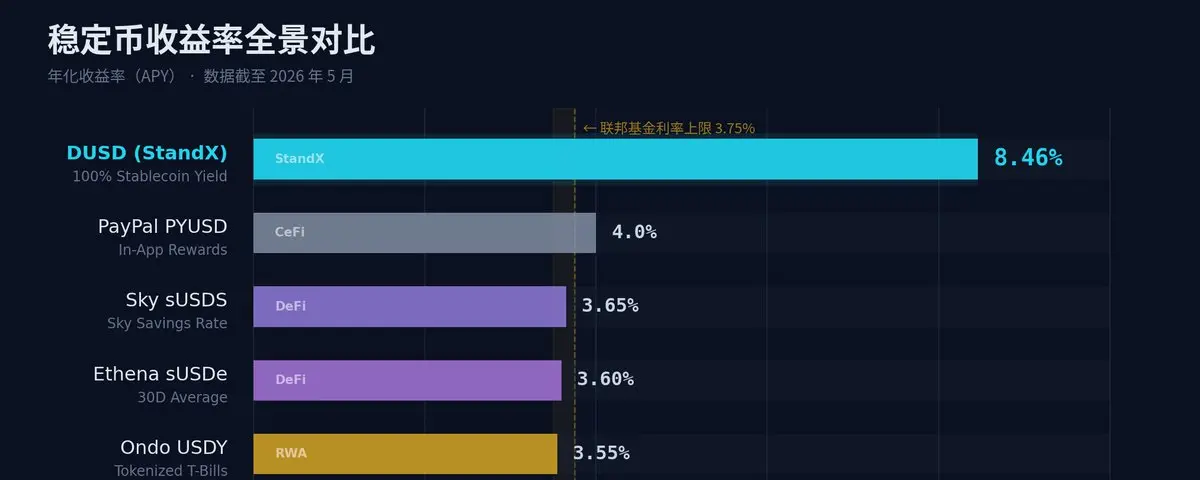
**Title:** My $10,000 Real-World Test: Zero Wear-and-Tear, ~8% APY, Plus Earning Points (Full Guide + Screenshots Included) **Summary:** This article details a personal experiment with $10,000 on the StandX platform to verify its advertised ~8% APY for its stablecoin, DUSD, while earning trading points. The author created two accounts, each depositing $5,000 worth of DUSD, and used StandX's unique "Block Trade" feature to open perfectly offsetting long and short BTC positions (2x leverage each). This neutralized directional market risk. **Key Results (Over 8 Days):** * **Total Profit:** $16.91 (~7.8% annualized). * **Zero Net Directional P&L:** BTC price movements canceled out. * **Zero Wear-and-Tear:** No losses from fees, slippage, or gas from frequent trading. * **Points Earned:** 380+ trading points. **Source of the ~8.46% APY:** The yield is composed of three layers, all paid in DUSD (real USD value, not governance tokens): 1. **DUSD Base (~1.27%):** Derived from funding rates (similar to Ethena's USDe). 2. **SIP-2 Position Boost (~2.27%):** A protocol revenue-sharing mechanism. Users providing liquidity (via open positions) earn a share of platform trading fees. Leverage acts as a multiplier on this yield. 3. **SIP-3 Universal Fee Share (~4.92%):** A portion of all platform trading fees is distributed to *every* DUSD holder, regardless of whether they trade. **Sustainability Claim:** The author argues this yield is more sustainable than pure funding-rate models (e.g., Ethena) because over 7% of it comes from transaction fees (SIP-2 + SIP-3), which are less dependent on market cycles. **Step-by-Step Strategy:** A concise 3-step guide is provided for replicating the zero-risk strategy using two wallets and StandX's Block Trade to create matched long/short positions. **Risk Disclosures:** The article notes standard DeFi risks: smart contract vulnerability and yield fluctuation (Base yield varies with funding rates; SIP-2/3 yields depend on platform trading volume). **Author's Note:** The author discloses their role in Growth at StandX. The piece is presented as personal testing and analysis, not investment advice.

链捕手58 dk önce

I Tested with $10,000: Zero Wear, 8% APY, and Earn Points (Full Tutorial + Screenshots Included)

链捕手58 dk önce

Senior Analyst Dialogue: What Powell's Departure and Warsh's Appointment Mean for Crypto?

The podcast episode "Powell Is Out, Warsh Is In: What It Means for Crypto" features an analysis by Noelle Acheson on the macro-economic landscape and its implications for crypto. Key discussion points include: * **Equity-Bond Divergence:** Acheson highlights a significant and growing disconnect between stock and bond markets. While bond yields rise globally, signaling tighter financial conditions, equities are driven by AI-related hype and speculation, reminiscent of the 1999 dot-com bubble. * **'Bliss Trade' and Systemic Fragility:** The discussion explores the concept of a structural, cross-party government expectation to provide fiscal support ("Bliss Trade"), which underpins risk asset valuations and carries its own systemic vulnerabilities. * **Inflation Outlook:** Acheson argues that inflation is not meaningfully declining, citing core CPI stagnation and attributing the trend to de-globalization, tariffs, and geopolitical tensions like the Strait of Hormuz crisis. * **Powell's Legacy:** Powell's tenure receives mixed marks. While his defense of Fed independence is noted, he is also criticized for overseeing the "de-banking" of crypto firms in 2023 and initially misjudging inflation. * **Outlook for Warsh:** Expectations for the incoming Fed Chair, Kevin Warsh, are measured. While he may aim to reduce Fed balance sheet size and forward guidance, market realities and the FOMC will likely constrain his ability to enact significant policy shifts, particularly rate cuts. * **Crypto as a Macro Asset:** Bitcoin's role is framed as a hedge against currency debasement, benefiting from expectations of monetary stimulus. However, its maturation as a macro asset means it now competes with other high-volatility investments like AI stocks, potentially limiting near-term price catalysts. * **Market Structure & Tokenization:** The potential Clarity Act is seen as more beneficial for assets like Ethereum than Bitcoin, which already has relative regulatory clarity. Concerns are raised about "innovation exemptions" for tokenization if they enable third-party derivatives that encourage pure speculation over capital formation. In conclusion, the analysis suggests crypto markets lack a near-term positive catalyst and are caught between competing macro narratives, with significant underlying fragilities in traditional markets.

marsbit1 saat önce

Senior Analyst Dialogue: What Powell's Departure and Warsh's Appointment Mean for Crypto?

marsbit1 saat önce

İşlemler

Spot
Futures
活动图片