The First Step to Becoming an On-Chain Bank: Polymarket Launches Native Stablecoin

marsbit2026-04-07 tarihinde yayınlandı2026-04-07 tarihinde güncellendi

Özet

Polymarket, a leading prediction market platform, has announced a major upgrade involving the replacement of its current collateral, USDC.e, with its own native stablecoin, Polymarket USD (pegged 1:1 to USDC). This transition, expected within 2-3 weeks, is designed to be seamless for most users. The introduction of its own stablecoin allows Polymarket to consolidate user funds within its own ecosystem, transforming from merely facilitating trades to holding and managing the underlying capital. This shift enables the platform to potentially generate significant revenue from the yield on the reserve assets (USDC), estimated to be tens of millions annually from its current ~$400M in open interest. This moves its business model beyond transaction fees, which recently surpassed $1M daily, towards earning "interest" on deposited funds. Furthermore, controlling a large pool of stablecoins grants Polymarket greater leverage in its relationship with Circle (issuer of USDC) and could pave the way for future financial services. This strategic upgrade signifies Polymarket's evolution from a prediction market ("casino logic") into a more comprehensive financial entity with banking-like capabilities ("bank logic"), significantly deepening its competitive moat.

Original | Odaily Planet Daily (@OdailyChina)

Author | Golem (@web3_golem)
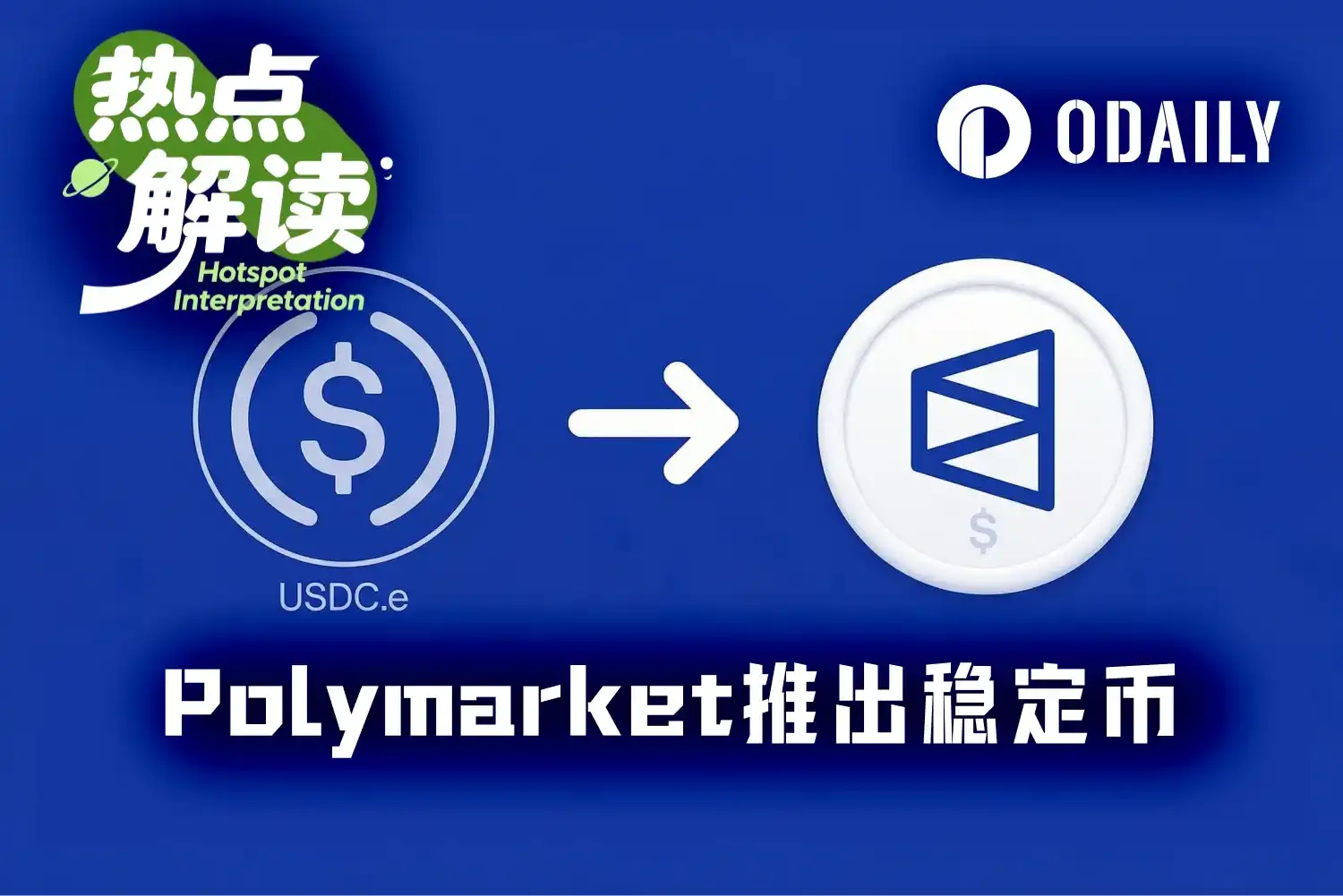
On April 6, Polymarket announced a major upgrade to the platform in the next 2 to 3 weeks, including upgrading both CTF and CLOB to V2, and replacing the platform collateral from USDC.e to the native stablecoin Polymarket USD.

According to the official introduction, Polymarket USD is 1:1 backed by USDC. For most users, the transition from USDC.e to Polymarket USD is seamless, with the frontend handling it automatically—users only need to confirm once. For advanced users and API-only traders, the transition process might be a bit more complex but still not difficult; they need to wrap their USDC or USDC.e into Polymarket USD through the wrap() function of the collateral access contract.

On the surface, it seems like Polymarket is just changing the trading collateral in the backend. As the platform grows, continuing to use USDC.e is indeed a potential risk. Back in February, Circle and Polymarket had already announced plans to migrate from bridged USDC.e to native USDC, and this is just a normal progression of that cooperation.

However, Polymarket did not choose to directly introduce native USDC to replace USDC.e; instead, it added an extra layer, aiming to pool USDC into its own fund pool. This layer is called Polymarket USD. Therefore, the emergence of Polymarket USD is definitely a "One more thing"(Odaily Note: "One more thing" is a classic tradition of Apple keynotes, now symbolizing a company's finale, industry-disrupting moves, etc.).

Polymarket Gains the Right to Mint Currency

The first layer of significance is that Polymarket can pool user funds.

Previously, the money users deposited into Polymarket would be converted into USDC.e. You can think of it as Polymarket being a huge trading venue—it only handles matching, pricing, and清算; the money flows through it, but the money itself does not belong to its system. Polymarket is not a treasury.

But that's about to change. When USDC.e is replaced with Polymarket USD, Polymarket can reach out to that money which was merely "passing through." As Polymarket officially stated, the daily user experience is unaffected, but the actual on-chain settlement path behind the scenes has been altered. This transformation is no less significant than an exchange transitioning from relying on third-party清算机构 to building its own清算 center.

Polymarket USD is 1:1 backed by USDC, meaning that in the future, for every Polymarket USD in the market, there will be a corresponding USDC in Polymarket's fund pool. Currently, every Yes/No share pair on Polymarket is backed by USDC.e. When players place bets or settle, USDC.e also moves on-chain. But after switching to Polymarket USD, although it will also flow on-chain with user operations, the USDC in Polymarket's fund pool won't move accordingly. Therefore, as long as users don't come to redeem, this money is essentially Polymarket's.

Polymarket has transformed from a use case for stablecoins to an entity that holds the on-chain minting right. Polymarket USD diverts user assets from the "open sea" to Polymarket's "internal lake." Once funds begin to pool, Polymarket is no longer just a prediction trading platform, and its business model no longer relies solely on trading fees, because it can start playing the oldest "money makes money" game in the financial markets.

Increasing Polymarket's Revenue Channels

The second layer of significance is the expansion of Polymarket's business.

The current business model of prediction markets is simple: charging transaction fees. After Polymarket adjusted its fee mechanism on March 30(Odaily Note: Expanding the taker fee scope to include Finance, Politics, Economics, Culture, Weather, and other market categories, in addition to the original Crypto and Sports categories), its daily fee income has exceeded $1 million.
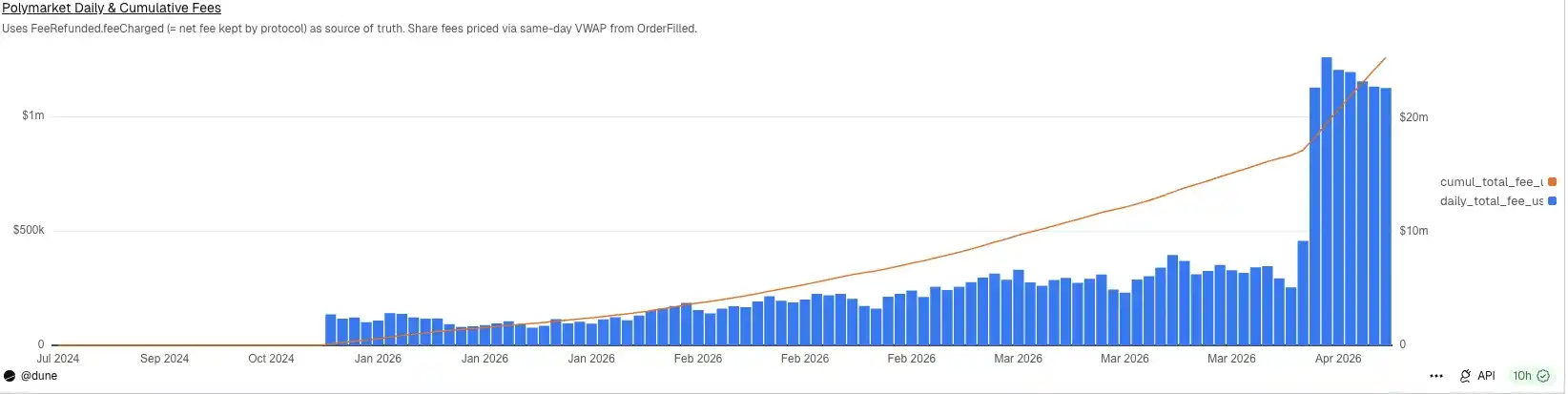
Polymarket's Daily Fee Income

Although impressive, it's not enough to satisfy Polymarket's ambitions. Prediction markets are currently the most sought-after赛道, but the business model ceiling isn't very high, the project's moat is relatively单一 (regulatory approval), and user stickiness isn't exceptionally strong. In the current landscape where everyone is doing prediction markets, how can Polymarket ensure it won't be surpassed by competitors in the future?

The answer it gives now is: I don't just match trades; I can also put players' money to work.

From a business essence perspective, the most attractive aspect of stablecoins over the years has never been fast payments and transfers, but the低调 yet highly profitable money-printing machine behind them—reserve asset yield. In 2025, the vast majority of Circle's income still came from reserve income. Polymarket understood this model, hence it launched Polymarket USD.

According to Dune data, the value of open interest on the Polymarket platform has exceeded $400 million. If all this money is converted into Polymarket USD, Polymarket simply needs to deposit the underlying collateral USDC into Circle's institutional account or place it in a U.S. Treasury protocol. At a risk-free rate of 4%-5%, it could earn tens of millions of dollars in "interest tax" annually just by sitting back.

Defillama founder 0xngmi even directly stated that Polymarket user wallets hold approximately $1.25 billion. If they keep this interest income, at current rates, they would gain an additional $54 million in annual revenue. Polymarket could even participate in DeFi wealth management with higher APYs, turning the idle funds on the prediction platform into active leverage and returning the到期收益 to users, effectively providing a hedge for users.
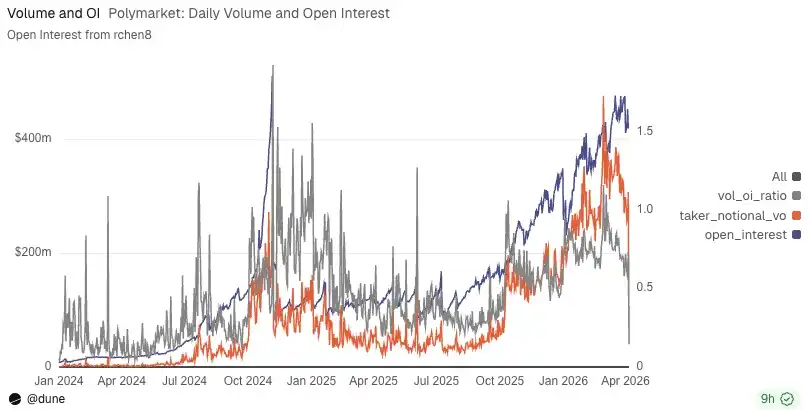
Polymarket's Daily OI and Trading Volume Curve

Prediction markets naturally have two characteristics: fund滞留 and high-frequency reallocation driven by events. Users' money doesn't truly enter and exit instantly like in a casino; it's either already in positions or sitting in accounts waiting for the next event, the next odds change. This type of money is most suitable for financial reprocessing, and for users, there's also a beautiful excuse: improving capital efficiency.

Of course, Polymarket hasn't publicly stated yet that it will definitely engage in yield extraction or on-chain wealth management after launching the stablecoin. But this path is almost a natural next step. As long as the scale of Polymarket USD grows larger in the future, it naturally gains the space to manage yields, expand collateral, and create financial combinations within the platform.

Some time ago, the《CLARITY Act》faced resistance for potentially prohibiting crypto companies from offering interest on stablecoins to users. If the outcome of the dispute remains a prohibition, all the above演绎 of Polymarket USD's potential would come to naught. But on April 6, according to U.S. media reports, the core disagreement between the U.S. crypto industry and banking over stablecoin yield mechanisms may be nearing resolution. Although details have not been disclosed, overall expectations are optimistic, and the《CLARITY Act》may enter the deliberation stage in committee in late April.

So, don't think Polymarket is far from this.

Polymarket Gains USDC Distribution Rights

The launch of the stablecoin by Polymarket has a third layer of significance: gaining USDC distribution rights.

As of today, Polymarket is still a major distribution scenario within the USDC ecosystem. Circle provides native USDC, Polymarket distributes USDC, and both sides are harmonious. Polymarket is currently experiencing strong growth momentum. Undoubtedly, the amount of USDC reserves沉淀 within its platform will grow larger in the future, potentially even becoming a distribution channel as important as Coinbase. When that time truly comes, the relationship between Polymarket and Circle might also change.

A reality in the stablecoin world is that distribution rights are as important as issuance rights, which is why Coinbase can take away over half of Circle's reserve income. Therefore, in the future, when Polymarket becomes a significant distributor of USDC, it will inevitably also gain bargaining power and be entitled to a large share of the reserve income. Furthermore, when Polymarket USD matures sufficiently, it could even explore multi-collateral backed stablecoins, not just relying solely on USDC.

This is also why I believe Polymarket USD is not an ordinary upgrade for Polymarket, but an identity update. Polymarket will evolve from "a platform collecting fees based on event volatility" to one that also兼具 "a platform organizing and清算 around the dollar".

The former is casino logic, while the latter is bank logic.

Polymarket's moat has thus gained another layer. It still maintains the beautiful narrative of information as the market and pricing facts early. But in terms of its business model, it is quietly moving itself to a more important position—no longer satisfied with being surface-level market traffic, no longer satisfied with仅仅 attracting users with odds, and no longer satisfied with continuing to cede the fattest part of the industry chain (asset reserve income) to others.

İlgili Sorular

QWhat is the primary reason Polymarket is introducing its native stablecoin, Polymarket USD?

APolymarket is introducing Polymarket USD to transition from using USDC.e as collateral to a native stablecoin that is 1:1 backed by USDC. This allows Polymarket to settle user funds within its own ecosystem, effectively enabling it to hold and potentially generate revenue from the underlying USDC reserves.

QHow does the introduction of Polymarket USD change the platform's business model beyond transaction fees?

ABeyond transaction fees, Polymarket USD enables Polymarket to generate revenue from the idle USDC reserves backing the stablecoin. By investing these reserves in low-risk assets like U.S. Treasury bonds or Circle's institutional accounts, Polymarket could earn significant interest income, estimated at tens of millions of dollars annually.

QWhat are the potential benefits for users in the transition to Polymarket USD, according to the article?

AFor most users, the transition to Polymarket USD is seamless and requires only a single confirmation on the front end. The change also opens the possibility for Polymarket to improve capital efficiency for users by leveraging idle funds for yield-generating activities, potentially offering returns that act as a hedge.

QHow does the article describe the strategic shift in Polymarket's role within the stablecoin ecosystem?

AThe article describes the shift as Polymarket evolving from a prediction market platform that relies on external stablecoins to one that controls the issuance and distribution of its own stablecoin. This grants Polymarket greater negotiating power with partners like Circle and positions it as a key distributor of USDC, similar to Coinbase.

QWhat regulatory consideration is mentioned regarding Polymarket's ability to generate yield from stablecoin reserves?

AThe article mentions the U.S. CLARITY Act, which initially proposed banning crypto companies from offering interest on stablecoin holdings. However, recent reports suggest that disagreements between crypto and banking sectors are nearing resolution, with expectations leaning towards allowing such practices, which would enable Polymarket to pursue yield generation.

İlgili Okumalar

Arthur Hayes' New Article: It's 'No-Trade Zone' Time

Arthur Hayes argues that the current market is in a "no-trade zone," a period of high uncertainty created by two converging forces: the deflationary shock from AI and the inflationary shock from geopolitics. AI agents are rapidly displacing knowledge workers, eroding their incomes and creditworthiness, which will eventually trigger a deflationary financial crisis in consumer credit-dependent Western economies. Simultaneously, the war in the Middle East, particularly the potential disruption to shipping through the Strait of Hormuz, threatens global energy supplies and could force nations to abandon the dollar system. Hayes outlines three main scenarios: 1) A return to normalcy, where the deflationary AI shock remains the primary concern; 2) The "Tehran Toll Booth," where Iran controls the Strait and demands payment in gold or yuan, accelerating the end of dollar hegemony; and 3) "Empire Strikes Back," where the US destroys Iran's capabilities but risks a catastrophic regional war that sends commodity prices soaring. In all but the most extreme scenarios, Hayes posits that the key driver for Bitcoin's price will be the *quantity* of money, not its price (interest rates). He expects that governments, forced to fund wars and stockpile resources, will have to print money, expanding the money supply. This would be bullish for fixed-supply assets like Bitcoin, even if it occurs alongside rising rates. However, he cautions that until this liquidity is explicitly unleashed (e.g., when bond market volatility spikes), the risk/reward for new long positions is poor. His current strategy is to wait for a clear signal of monetary expansion before deploying capital, preferring to hold gold and select crypto assets in the meantime.

marsbit2 saat önce

Arthur Hayes' New Article: It's 'No-Trade Zone' Time

marsbit2 saat önce

İşlemler

Spot
Futures

Popüler Makaleler

$BANK Nedir

Bank AI: Bankacılıkta Devrimsel Bir Adım Giriş Teknolojideki hızlı ilerlemelerin damgasını vurduğu bir çağda, Bank AI, yapay zeka (AI) ve bankacılık hizmetleri kesişiminde yer almaktadır. Bu yenilikçi proje, finansal manzarayı yeniden tanımlamayı, operasyonel verimliliği, güvenlik önlemlerini ve müşteri deneyimlerini AI'nin gücüyle geliştirmeyi hedefliyor. Bank AI yolculuğuna çıkarken, projenin içeriğine, operasyonel dinamiklerine, tarihsel bağlamına ve önemli kilometre taşlarına dalacağız. Bank AI Nedir? Bank AI, yapay zekanın çeşitli bankacılık operasyonlarına entegrasyonunu hedefleyen dönüştürücü bir girişimi temsil etmektedir. Bu proje, süreçleri otomatikleştirmek, risk yönetimi protokollerini geliştirmek ve kişiselleştirilmiş hizmetler aracılığıyla müşteri etkileşimini artırmak için AI'nin yeteneklerinden yararlanmaktadır. Bank AI'nin temel hedefleri şunlardır: Bankacılık Fonksiyonlarının Otomasyonu: AI teknolojilerini kullanarak, Bank AI rutin görevleri otomatikleştirmeyi, insan kaynakları üzerindeki yükü azaltmayı ve verimliliği artırmayı amaçlamaktadır. Geliştirilmiş Risk Yönetimi: Proje, dolandırıcılık ve diğer tehditlere karşı güvenlik önlemlerini güçlendirerek riski tahmin edip tanımlamak için AI algoritmalarını kullanmaktadır. Bankacılık Hizmetlerinin Kişiselleştirilmesi: Bank AI, müşteri verilerini ve davranışlarını analiz ederek, özel finansal ürünler ve hizmetler sunmaya odaklanmaktadır. Müşteri Deneyimini İyileştirme: Chatbotlar ve sanal asistanlar gibi AI destekli çözümlerin uygulanması, kullanıcıların daha insana yakın etkileşimler yaşamasını sağlamayı hedeflemekte, bankalarla etkileşim biçimlerini devrim niteliğinde değiştirmektedir. Bu hedeflerle, Bank AI, bankacılığı daha verimli, güvenli ve kullanıcı odaklı hale getiren önemli bir oyuncu olarak kendini konumlandırmaktadır. Bank AI'nin Yaratıcısı Kimdir? Bank AI'nin yaratıcısı hakkında detaylar bilinmemektedir. Bu nedenle, mevcut bilgilerde belirli bir kişi veya organizasyon tanımlanmamıştır. Projenin başlangıcı etrafındaki anonimlik soruları gündeme getirse de, bunun iddialı vizyonu ve hedefleri üzerinde bir olumsuz etkisi yoktur. Bank AI'nin Yatırımcıları Kimlerdir? Proje yaratıcılarında olduğu gibi, Bank AI'nin yatırımcıları veya destekleyen organizasyonları hakkında da özel bilgiler açıklanmamıştır. Bu bilgiler olmadan, projenin ilerlemesini destekleyen finansal destek ve kurumsal destek hakkında bir çerçeve çizmek zordur. Yine de, böyle yenilikçi bir alanda gelişimi sürdürmek için sağlam bir yatırım temelinin önemi büyüktür. Bank AI Nasıl Çalışır? Bank AI, geleneksel bankacılık çerçevelerinden ayıran benzersiz faktörlere odaklanarak birden fazla yenilikçi alanda faaliyet göstermektedir. İşte temel operasyonel özellikler: Otomasyon: Makine öğrenimi algoritmalarını uygulayarak, Bank AI bankalar içindeki çeşitli manuel süreçleri otomatikleştirir. Bu, operasyonel maliyetleri azaltır ve insan çalışanların daha stratejik faaliyetlere yönelmelerini sağlar. Gelişmiş Risk Yönetimi: Risk yönetimi uygulamalarına AI entegrasyonu, bankaların dolandırıcılık gibi potansiyel tehditleri doğru bir şekilde tahmin etme araçlarıyla donatılmasını sağlar, böylece müşteri bilgileri ve varlıkları güvence altına alınır. Özelleştirilmiş Finansal Tavsiyeler: Müşteri etkileşimlerinden sürekli olarak öğrenerek, AI sistemleri kullanıcı ihtiyaçlarının daha iyi anlaşılmasını sağlar ve finansal kararlar hakkında özelleştirilmiş tavsiyeler sunar. Geliştirilmiş Müşteri Etkileşimleri: AI destekli chatbotlar ve sanal asistanlar kullanarak, Bank AI daha etkileşimli bir müşteri deneyimi sunar, kullanıcıların sorularını hızlı bir şekilde çözmelerine imkan tanır, bekleme sürelerini azaltır ve memnuniyet seviyelerini artırır. Bu operasyonel özellikler, Bank AI'yi bankacılık sektöründe bir öncü olarak konumlandırmakta ve hizmet sunumu ile operasyonel mükemmeliyet için yeni standartlar belirlemektedir. Bank AI Zaman Çizelgesi Bank AI'nin gidişatını anlamak için tarihsel bağlamına bir göz atmak gerekmektedir. Aşağıda önemli kilometre taşlarını ve gelişmeleri vurgulayan bir zaman çizelgesi bulunmaktadır: 2010'ların Başları: AI entegrasyonunun bankacılık hizmetlerine olan ilgisi arttı, bankacılık kurumları potansiyel faydalarını tanımaya başladılar. 2018: Bankaların temel müşteri hizmetleri ve geliştirilmiş güvenlik yönetimi için risk yönetim sistemlerinde chatbotlar gibi AI araçları kullanmaya başlamasıyla AI teknolojilerinin uygulanmasında belirgin bir artış yaşandı. 2023: AI'nin karmaşıklığı artmaya devam etti ve belge işleme ile gerçek zamanlı yatırım analizi gibi daha karmaşık görevler için üretken AI devreye alındı. Bu yıl, AI teknolojisi sayesinde bankaların sahip olduğu yeteneklerde önemli bir sıçrama yaşandı. 2024-Güncel Durum: Bu yıl itibarıyla, Bank AI yükselişte, devam eden araştırmalar ve geliştirmeler bankacılık operasyonlarındaki yetenekleri daha da artırmaya hazırlanıyor. AI uygulamalarının sürekli araştırılması, heyecan verici gelişmelere işaret etmektedir. Bank AI Hakkında Anahtar Noktalar Bankacılıkta AI Entegrasyonu: Bank AI, bankacılık süreçlerini kolaylaştırmak ve kullanıcı deneyimlerini geliştirmek için yapay zekanın benimsenmesine odaklanmaktadır. Otomasyon ve Risk Yönetimi Vurgusu: Proje, rutin görevlerin yükünü azaltmayı amaçlarken, tahmine dayalı analizlerle güvenlik çerçevelerini geliştirmeye büyük önem vermektedir. Kişiselleştirilmiş Bankacılık Çözümleri: Müşteri verilerinden yararlanarak, Bank AI bireysel kullanıcı ihtiyaçlarına yönelik özelleştirilmiş bankacılık hizmetleri sunar. Gelişime Bağlılık: Bank AI, teknolojinin sürekli evrimi ile uyumlu olmasını sağlamak ve güncel kalmak için sürekli araştırma ve geliştirme çabalarına bağlı kalmaktadır. Sonuç Özetle, Bank AI bankacılık endüstrisinde önemli bir adımı temsil etmekte, yapay zekayı kullanarak operasyonel paradigmaları yeniden şekillendirmekte, güvenliği artırmakta ve müşteri memnuniyetini teşvik etmektedir. Yaratıcı ve yatırımcılar hakkındaki bilgi eksikliklerine rağmen, Bank AI'nin net hedefleri ve işlevsel mekanizmaları, devam eden evrimi için güçlü bir temel sunmaktadır. AI teknolojisi gelişmeye ve bankacılık sektörüyle birleşmeye devam ettikçe, Bank AI finansal hizmetlerin geleceğini önemli ölçüde etkilemeye hazır durumda, bankacılıkla olan anlayışımızı ve etkileşim biçimlerimizi geliştirmektedir.

145 Toplam GörüntülenmeYayınlanma 2024.04.06Güncellenme 2024.12.03

$BANK Nedir

BANK Nasıl Satın Alınır

HTX.com’a hoş geldiniz! Lorenzo Protocol (BANK) satın alma işlemlerini basit ve kullanışlı bir hâle getirdik. Adım adım açıkladığımız rehberimizi takip ederek kripto yolculuğunuza başlayın. 1. Adım: HTX Hesabınızı OluşturunHTX'te ücretsiz bir hesap açmak için e-posta adresinizi veya telefon numaranızı kullanın. Sorunsuzca kaydolun ve tüm özelliklerin kilidini açın. Hesabımı Aç2. Adım: Kripto Satın Al Bölümüne Gidin ve Ödeme Yönteminizi SeçinKredi/Banka Kartı: Visa veya Mastercard'ınızı kullanarak anında Lorenzo Protocol (BANK) satın alın.Bakiye: Sorunsuz bir şekilde işlem yapmak için HTX hesap bakiyenizdeki fonları kullanın.Üçüncü Taraflar: Kullanımı kolaylaştırmak için Google Pay ve Apple Pay gibi popüler ödeme yöntemlerini ekledik.P2P: HTX'teki diğer kullanıcılarla doğrudan işlem yapın.Borsa Dışı (OTC): Yatırımcılar için kişiye özel hizmetler ve rekabetçi döviz kurları sunuyoruz.3. Adım: Lorenzo Protocol (BANK) Varlıklarınızı SaklayınLorenzo Protocol (BANK) satın aldıktan sonra HTX hesabınızda saklayın. Alternatif olarak, blok zinciri transferi yoluyla başka bir yere gönderebilir veya diğer kripto para birimlerini takas etmek için kullanabilirsiniz.4. Adım: Lorenzo Protocol (BANK) Varlıklarınızla İşlem YapınHTX'in spot piyasasında Lorenzo Protocol (BANK) ile kolayca işlemler yapın.Hesabınıza erişin, işlem çiftinizi seçin, işlemlerinizi gerçekleştirin ve gerçek zamanlı olarak izleyin. Hem yeni başlayanlar hem de deneyimli yatırımcılar için kullanıcı dostu bir deneyim sunuyoruz.

658 Toplam GörüntülenmeYayınlanma 2025.05.09Güncellenme 2025.05.09

BANK Nasıl Satın Alınır

Tartışmalar

HTX Topluluğuna hoş geldiniz. Burada, en son platform gelişmeleri hakkında bilgi sahibi olabilir ve profesyonel piyasa görüşlerine erişebilirsiniz. Kullanıcıların BANK (BANK) fiyatı hakkındaki görüşleri aşağıda sunulmaktadır.

活动图片