Kalshi's Daily Stock Open Interest Hits Record High of $17.98 Million

cryptonews.ru2026-08-14 tarihinde yayınlandı2026-08-14 tarihinde güncellendi

Özet

Kalshi's daily open interest for its perpetual futures product hit a record $17.98 million on August 12th, just over two months after its launch. The CFTC-approved platform, which began with Bitcoin and Ethereum contracts in early June, now lists 13 crypto assets. Open interest remained below $5 million initially, saw mid-June spikes to $13-14 million, stabilized around $6-7 million, and has steadily climbed since July, consistently holding above $12 million in recent weeks. This growth indicates sustained trader engagement on a platform that recently offered only short-term binary contracts. Despite this rapid growth, Kalshi's total crypto perpetuals portfolio is small in scale, representing about 0.15% of rival Hyperliquid's $11.7 billion daily open interest. The comparison is structurally limited: each Kalshi contract requires federal regulatory pre-approval, resulting in a small list, whereas permissionless platforms like Hyperliquid support hundreds of pairs. The concentrated open interest on Kalshi's few approved contracts signals strong demand within its specific niche. Analysts suggest Kalshi is not cannibalizing existing decentralized exchange volume but is tapping a previously underserved pool of U.S.-based traders who lacked a legal, leveraged crypto platform. The true size of this new user pool remains unknown. While a market downturn could disrupt the trend, the open interest chart has so far shown consistent upward momentum.

Kalshi's perpetual futures product launched on June 3rd, with BTCPERP becoming the first perpetual contract approved by the CFTC for traders from the US. Ether launched on June 4th, XRP on June 10th, and now the list covers 13 crypto assets. This week, on August 12th, daily open interest for perpetual futures closed at $17.98 million, a historic high for a product that didn't exist three months ago.
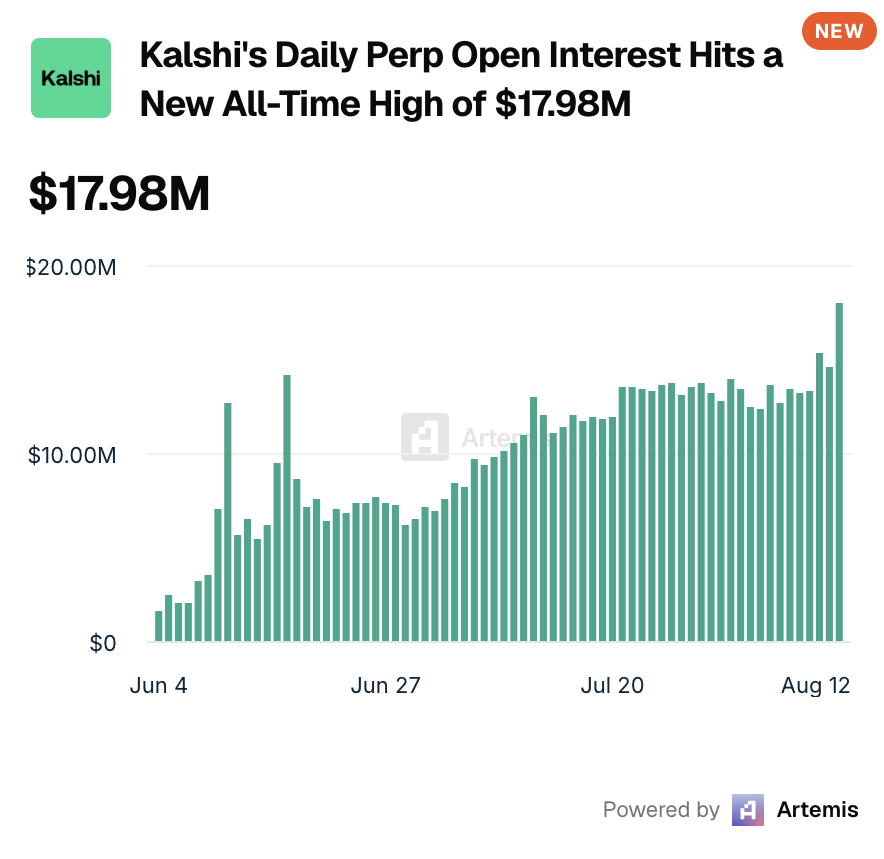
Source: Artemis

Open interest was under $5 million during the first week of June, with two peaks reaching $13 and $14 million mid-month, then dropped to the $6-7 million range where it stayed until the end of June. The following month, specifically in the second week of July, there was a jump as daily bars closed above $10 million, holding in the $12-14 million range for the last three weeks.

Interest Rate Hike More Important Than Election Results

A single large option on the new platform typically indicates several large positions that could have been closed over a few days. However, the chart doesn't show this. The lower bound of the range continues to rise, meaning traders are holding risk on a platform that just ten weeks ago only offered short-term binary contracts.

There is certainly demand for Kalshi's services, and another telling sign is sales volume. The notional value of Kalshi's services surpassed $1 billion within a week of launch. Compared to contracts on the events the platform built its reputation on, it took 40 months to reach that figure.

$17.98 Million Next to $11.7 Billion

Despite Kalshi Perps' impressive performance since launch, it's important to keep perspective. According to DefiLlama, Hyperliquid's 24-hour open interest is $11.7 billion with a daily trading volume of $7.17 billion. Kalshi's entire Perps portfolio is roughly 0.15% of that amount. Individual large players on Hyperliquid have positions exceeding Kalshi's total open interest across all its crypto markets combined.

The difference isn't just size. CoinGecko states Hyperliquid offers 377 perpetual trading pairs. Its HIP-3 segment, covering non-crypto markets created by a single developer, has over $4 billion in open interest. This is just one segment of one developer's markets and is more than 200 times larger than Kalshi's total markets.

Every New Stock Listing on Kalshi Starts with an Application

Kalshi's small contract list is for structural reasons. Every contract it lists must be vetted by a federal regulator before a single trade can be made. Hyperliquid deploys markets permissionlessly, so it can support 377 pairs and add new ones at a user's whim.

This is also a fair assessment of the $17.98 million figure. This number isn't low due to lack of demand. It's low because there's almost nothing to trade, and what there is took months of work with regulators to get on the exchange. Concentrating this much open interest on so few contracts is a very different signal than spreading it across hundreds.

In any case, the comparison everyone makes is wrong. Kalshi isn't taking flow from Hyperliquid. It's taking flow from US traders who previously had no legal venue at all to use crypto leverage, and who were either offshore, using a VPN, or just sitting on the sidelines. This pool is separate, and no one knows how large it is.

A period of stagnant or falling prices through the end of August could disrupt this trend. So far, the chart hasn't shown it.

end-content

Trend Kriptolar

İlgili Sorular

QWhat is the significance of Kalshi's daily open interest reaching $17.98 million according to the article?

AThe $17.98 million daily open interest for Kalshi's perpetual futures is a historical high for a product that didn't exist three months prior. It signifies strong initial growth and sustained trader interest in the regulated platform.

QHow does Kalshi's open interest and volume compare to a platform like Hyperliquid?

AKalshi's entire perpetuals portfolio of approximately $17.98 million in open interest is about 0.15% of Hyperliquid's $11.7 billion 24-hour open interest. Individual large positions on Hyperliquid can exceed Kalshi's total crypto open interest.

QWhat key structural difference between Kalshi and platforms like Hyperliquid limits Kalshi's number of contracts?

AEach contract on Kalshi must be approved by federal regulators (CFTC) before trading can begin. In contrast, platforms like Hyperliquid deploy markets permissionlessly, allowing them to support hundreds of trading pairs.

QAccording to the article, where is Kalshi primarily drawing its trading volume from?

AKalshi is drawing volume primarily from US-based traders who previously had no legally compliant platform to use leverage for crypto trading. These traders were either trading overseas, using VPNs, or not trading at all.

QWhat does the article suggest about the nature of the open interest growth on Kalshi, based on the chart data?

AThe chart shows that the lower bound of the open interest range has been consistently rising. This indicates traders are maintaining risk positions over time, rather than the growth being driven by a few large, short-term option positions.

İlgili Okumalar

Has It Already Cozied Up to SK Hynix? With Photovoltaic Main Business Liabilities at 93%, Huamin Shares Chooses to Burn Cash Betting on Semiconductors as Its Second Growth Curve. Is This Reliable?

In the context of deep losses across the entire photovoltaic (PV) industry chain, Huamin Co., Ltd. is attempting to pivot towards the semiconductor sector as a second growth curve. Its latest financial report reveals significant challenges: H1 revenue fell 35.54% year-on-year to 294 million yuan, with a net loss of 125 million yuan. The company's debt-to-asset ratio has surged to 93.11%, with short-term debt constituting 95.03% of total debt. Its core PV business, contributing 85.11% of revenue, reported a gross margin of -25.78%. In stark contrast, the nascent semiconductor business generated 2.91 million yuan in revenue with a high gross margin of 62.14%. The company recently entered the semiconductor silicon parts market for etching equipment through a strategic partnership with Huachuan Semiconductor, a Sino-Korean joint venture and supplier to SK Hynix. While the technical transition from PV-grade to semiconductor-grade silicon is feasible, the entry barriers are substantially higher, with the global market dominated by overseas giants. The lengthy and stringent customer qualification process, often taking 18 to 36 months, poses a critical timing challenge. Analysts highlight a severe "second-curve timing mismatch." The cash-burning PV business is deteriorating faster than the semiconductor unit can generate profits. Even if semiconductor revenue meets internal targets (60 million yuan by 2026, 300 million yuan by 2027), the resulting gross profit would be insufficient to offset the massive losses from the PV division in the near term. The company's immediate survival hinges on managing its pressing short-term debt burden, potentially through extensions or debt-for-equity swaps, while accelerating customer certifications for its semiconductor products. The success of its transformation hinges on navigating this precarious balance between a promising long-term strategic shift and an acute near-term liquidity crisis.

marsbit1 saat önce

Has It Already Cozied Up to SK Hynix? With Photovoltaic Main Business Liabilities at 93%, Huamin Shares Chooses to Burn Cash Betting on Semiconductors as Its Second Growth Curve. Is This Reliable?

marsbit1 saat önce

The Economy Grows, Work Disappears: Three AI Scenarios from Anthropic

Anthropic outlines three scenarios for AI's impact on the US economy by 2030, emphasizing these are models, not forecasts. **Modest Scenario:** AI's effect resembles the internet's diffusion. US GDP reaches $34.1 trillion (in 2025 dollars), just 1.6% above the baseline without AI. Unemployment stays around 3.8-3.9%. **Baseline Scenario:** AI autonomously performs half of intellectual work by 2030. GDP reaches $36.3 trillion (8.3% above baseline), roughly doubling growth rates. Unemployment rises moderately. **Extreme Scenario:** AI surpasses humans in most intellectual tasks, operates autonomously, and creates few new jobs. US GDP growth reaches ~15% annually, with the economy doubling every ~4.5 years. GDP hits $44.4 trillion (32.4% above baseline). While society becomes wealthier overall, unemployment for intellectual workers soars to 17.9%, with overall unemployment reaching ~11.9%. Labor's share of income falls to 45.2%. In transformative scenarios, many intellectual workers (like programmers, call-center staff) would need to transition to less automatable roles (e.g., electricians, nurses), facing challenging adaptation periods. A 2026 survey found most Americans anticipate outcomes close to the baseline scenario, with about 10% expecting the extreme outcome. The key factor across all scenarios is not just AI's speed but the labor market's and workers' ability to adapt. Historical precedent shows automation can create jobs after a lag, raising the question of whether AI's rapid adoption can close this gap or if a disruption is inevitable.

cryptonews.ru1 saat önce

The Economy Grows, Work Disappears: Three AI Scenarios from Anthropic

cryptonews.ru1 saat önce

Building Semiconductors in Space: This Company Has Begun Testing

Startup Besxar, founded by ex-OpenAI staff, is pioneering semiconductor manufacturing in space to leverage its natural vacuum and microgravity, aiming to surpass Earth's costly cleanroom environments. Recently, Besxar began prototype testing via SpaceX Falcon 9 flights. The core logic is to operate where physics is favorable. Space offers ultra-pure vacuum and microgravity, eliminating thermal convection and buoyancy, potentially yielding compound semiconductor crystals 10 to 100 times more efficient than Earth-made ones. In October 2025, the company partnered with SpaceX for validation flights. Its first mission in July 2026, "Mission Asimov," involved two prototype "Fabship" modules on a Falcon 9 booster suborbital flight, carrying GaAs and AlInAsSb wafer samples. Post-flight analysis showed the samples emerged cleaner and less contaminated than Earth-based counterparts. Besxar's roadmap involves progressively complex orbital experiments: heating wafers, depositing single then multiple materials, eventually targeting larger-scale production on SpaceX's Starship. The goal is supplying high-purity wafers for power semiconductors in data centers, robotics, and EVs, avoiding direct competition with giants like TSMC in logic chips. Other players like Space Forge and United Semiconductors are also exploring space-based semiconductor production. Besxar has raised $14 million and secured defense contracts. However, significant challenges remain: adapting manufacturing equipment for space, ensuring stable material supply, managing return logistics to Earth, and mitigating space radiation effects. While radiation may be less critical for manufacturing than for long-term operation, thermal management and transport are major hurdles. The ultimate vision might be a closed-loop space economy where chips are made and used in orbit, as hinted by projects like Musk's Terafab targeting space-based AI data centers. In the near term, the most viable path is producing high-value, small-volume compound semiconductors in space, not full logic chip fabrication.

marsbit3 saat önce

Building Semiconductors in Space: This Company Has Begun Testing

marsbit3 saat önce

İşlemler

Spot

Popüler Makaleler

T Nasıl Satın Alınır

HTX.com’a hoş geldiniz! Threshold Network Token (T) satın alma işlemlerini basit ve kullanışlı bir hâle getirdik. Adım adım açıkladığımız rehberimizi takip ederek kripto yolculuğunuza başlayın. 1. Adım: HTX Hesabınızı OluşturunHTX'te ücretsiz bir hesap açmak için e-posta adresinizi veya telefon numaranızı kullanın. Sorunsuzca kaydolun ve tüm özelliklerin kilidini açın. Hesabımı Aç2. Adım: Kripto Satın Al Bölümüne Gidin ve Ödeme Yönteminizi SeçinKredi/Banka Kartı: Visa veya Mastercard'ınızı kullanarak anında Threshold Network Token (T) satın alın.Bakiye: Sorunsuz bir şekilde işlem yapmak için HTX hesap bakiyenizdeki fonları kullanın.Üçüncü Taraflar: Kullanımı kolaylaştırmak için Google Pay ve Apple Pay gibi popüler ödeme yöntemlerini ekledik.P2P: HTX'teki diğer kullanıcılarla doğrudan işlem yapın.Borsa Dışı (OTC): Yatırımcılar için kişiye özel hizmetler ve rekabetçi döviz kurları sunuyoruz.3. Adım: Threshold Network Token (T) Varlıklarınızı SaklayınThreshold Network Token (T) satın aldıktan sonra HTX hesabınızda saklayın. Alternatif olarak, blok zinciri transferi yoluyla başka bir yere gönderebilir veya diğer kripto para birimlerini takas etmek için kullanabilirsiniz.4. Adım: Threshold Network Token (T) Varlıklarınızla İşlem YapınHTX'in spot piyasasında Threshold Network Token (T) ile kolayca işlemler yapın.Hesabınıza erişin, işlem çiftinizi seçin, işlemlerinizi gerçekleştirin ve gerçek zamanlı olarak izleyin. Hem yeni başlayanlar hem de deneyimli yatırımcılar için kullanıcı dostu bir deneyim sunuyoruz.

957 Toplam GörüntülenmeYayınlanma 2024.12.10Güncellenme 2026.06.02

T Nasıl Satın Alınır

Tartışmalar

HTX Topluluğuna hoş geldiniz. Burada, en son platform gelişmeleri hakkında bilgi sahibi olabilir ve profesyonel piyasa görüşlerine erişebilirsiniz. Kullanıcıların T (T) fiyatı hakkındaki görüşleri aşağıda sunulmaktadır.

活动图片