| |
|
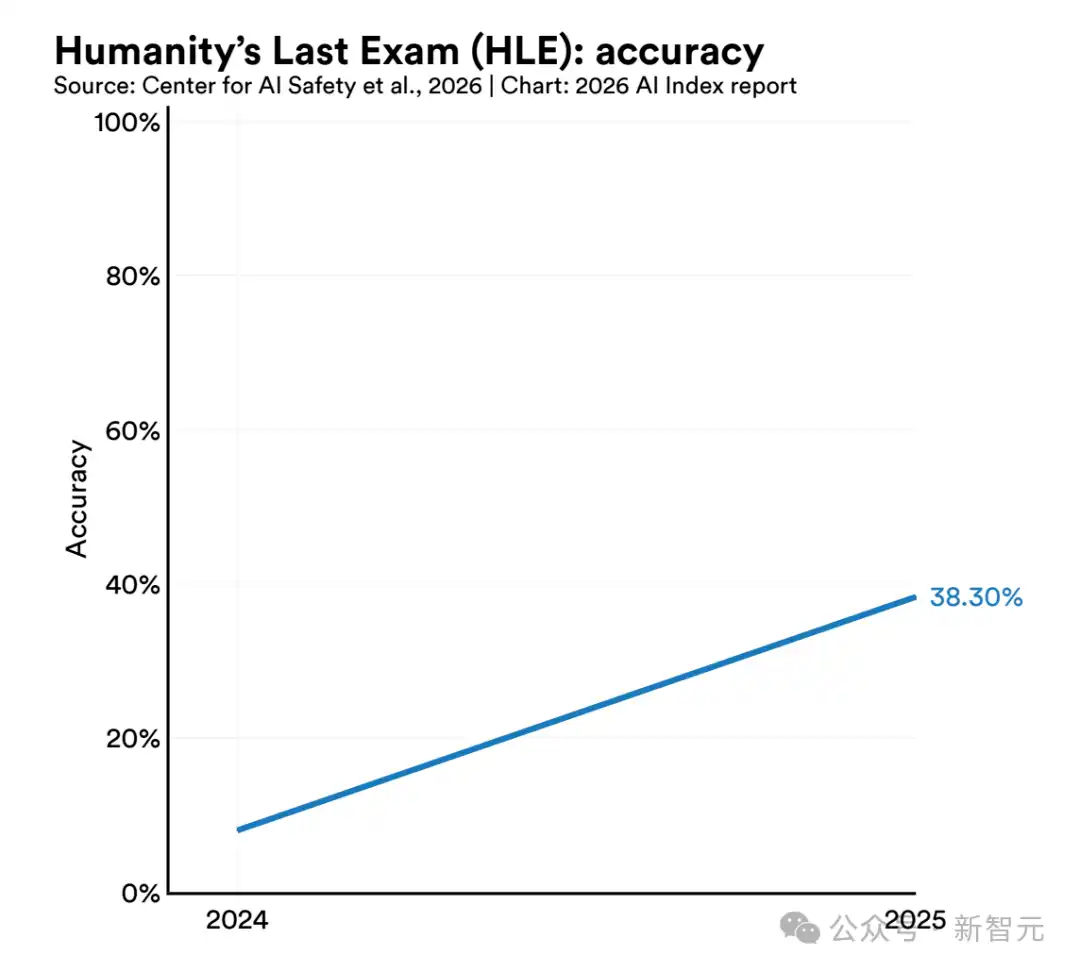
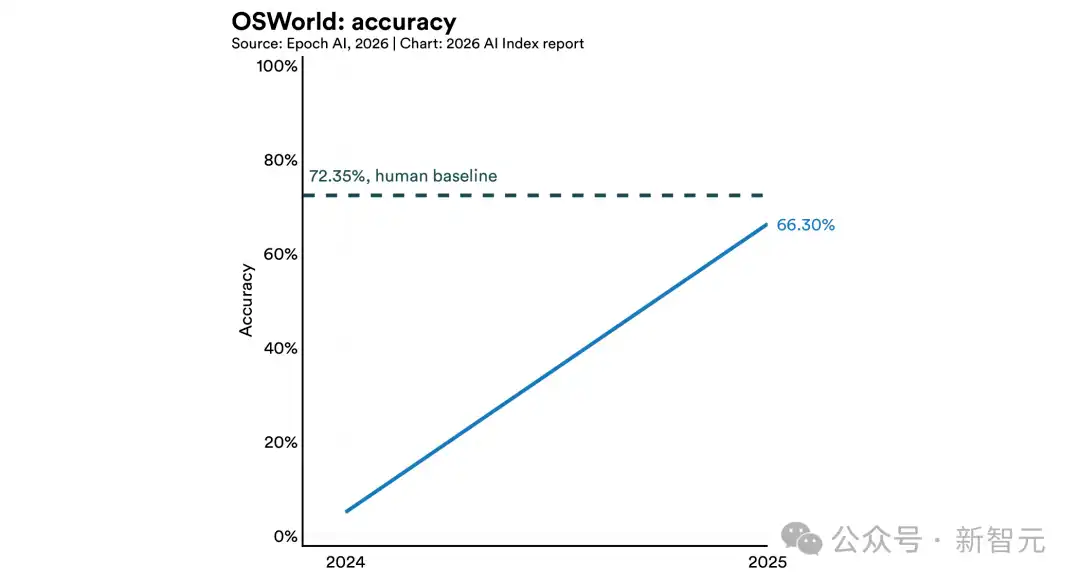
Also, in agent tasks, in the OSWorld test, frontier AI strength (66.3%) is approaching the human baseline.
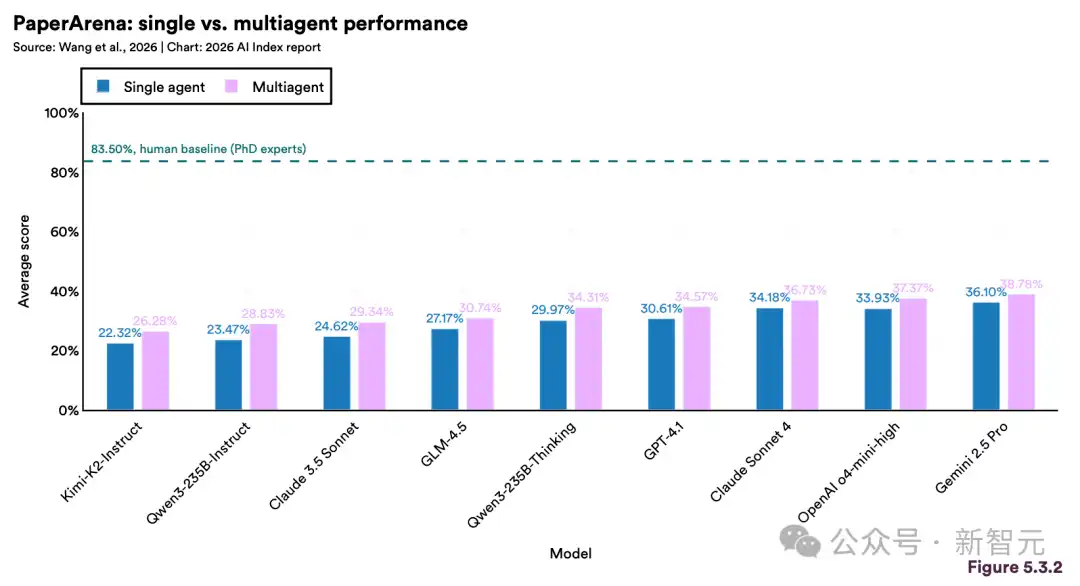
However, in the PaperArena test专门评估科研逻辑, the strongest AI-powered Agent scored only 39%, half the capability of a PhD student.
But this unevenness doesn't stop companies from integrating AI into production lines.
Another number from the AI Index is that the global enterprise AI adoption rate has reached 88%. Ninety percent of companies have integrated AI into some workflow.
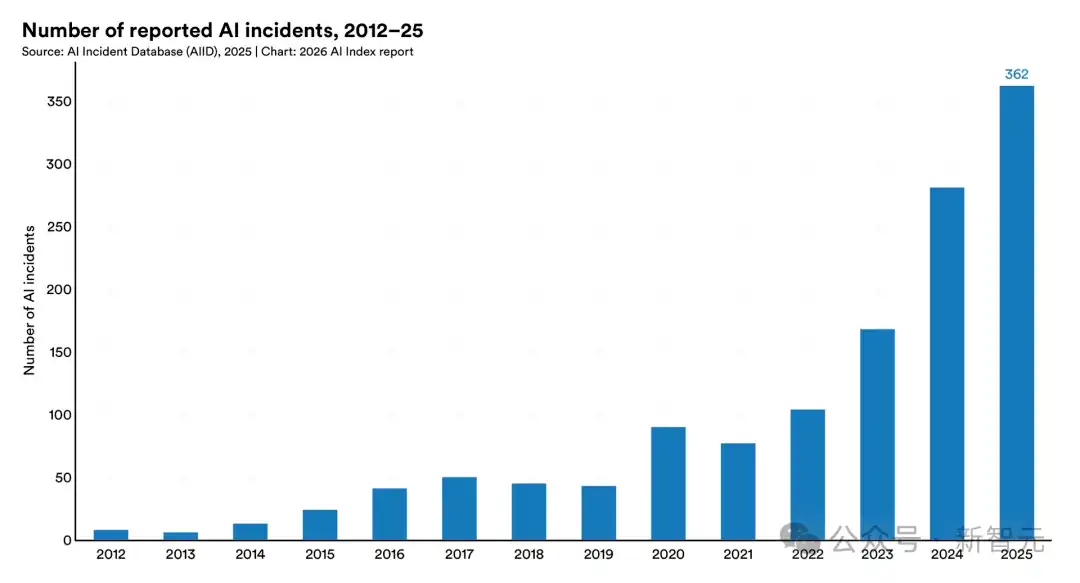
The cost is rising simultaneously. Recorded AI-related incidents increased from 233 in 2024 to 362.
Money is Accelerating: $581.7 Billion Poured into AI
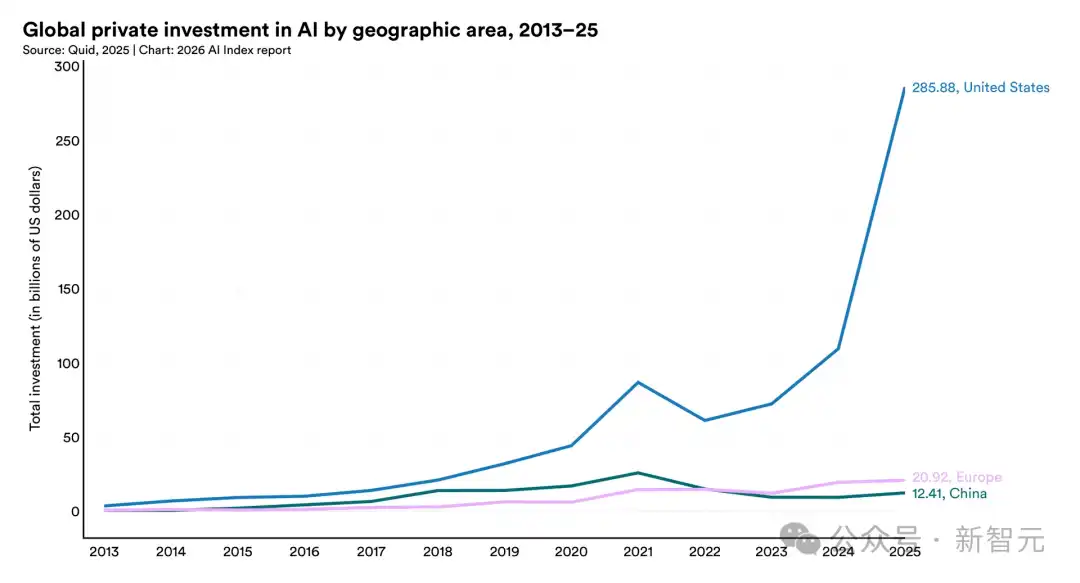
Global corporate AI investment in 2025 reached $581.7 billion, a year-on-year increase of 130%.其中, private investment was $344.7 billion, up 127.5% year-on-year.
Both curves almost doubled.
By country, the US is in a league of its own. US private AI investment in 2025 was $285.9 billion. And it added 1,953 AI startups in one year, also more than 10 times the number of the second-ranked country.
Money is accelerating into the US. But another core US resource is moving in the opposite direction.
People are Flowing Out: AI Researchers Entering the US Fell 89%
There's a set of numbers that makes one pause.
From 2017 to now, the number of AI researchers and developers entering the US has fallen by 89%.
More critically, this decline is accelerating. In the past year alone, the drop was 80%.
The US still has the highest density of AI researchers globally, but the inflow tap is tightening.
The curves of money and people are starting to反向. This is a situation not seen in the past decade.
Computing Power Rose 30-Fold in 3 Years, Lifelines in One Company's Hands
The AI capability curve is accelerating, but the computing power curve behind it is running even faster.
From 2021 to now, global AI computing power has increased 30-fold. Over the past three years, it has tripled every year.
This curve is supported by a few companies.
NVIDIA's GPUs alone account for over 60% of the world's AI computing power. Amazon and Google rank second and third with their own chips, but combined they are far behind NVIDIA.
And almost all these chips come from one foundry, TSMC. The steeper the computing power curve, the narrower the lifeline.
Meanwhile, the cost is also increasing.
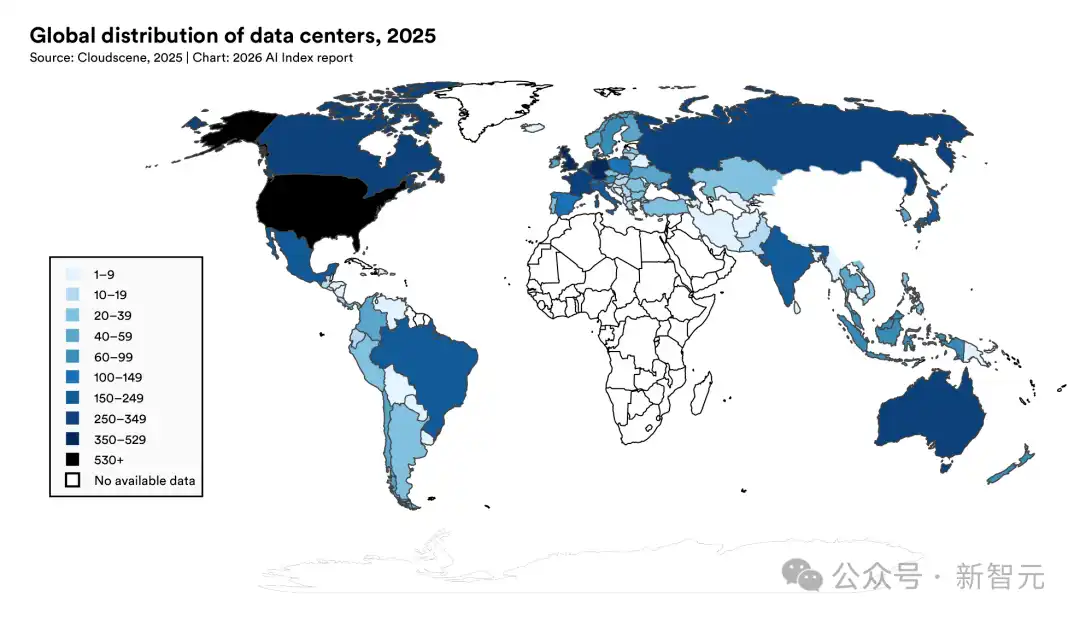
The total power of global AI data centers has reached 29.6 GW, equivalent to New York State's entire peak electricity demand. The estimated carbon emission for one training run of xAI Grok 4 is 72,816 tons of CO2 equivalent, equal to the tailpipe emissions of 17,000 cars driving for a year.
Where data centers are built, where electricity comes from, where chips are produced—these three questions have become the most headache-inducing issues on every AI company CEO's desk this year.
Generative AI Penetrated 53% in Three Years, Chinese Workplace Usage Exceeds 80%
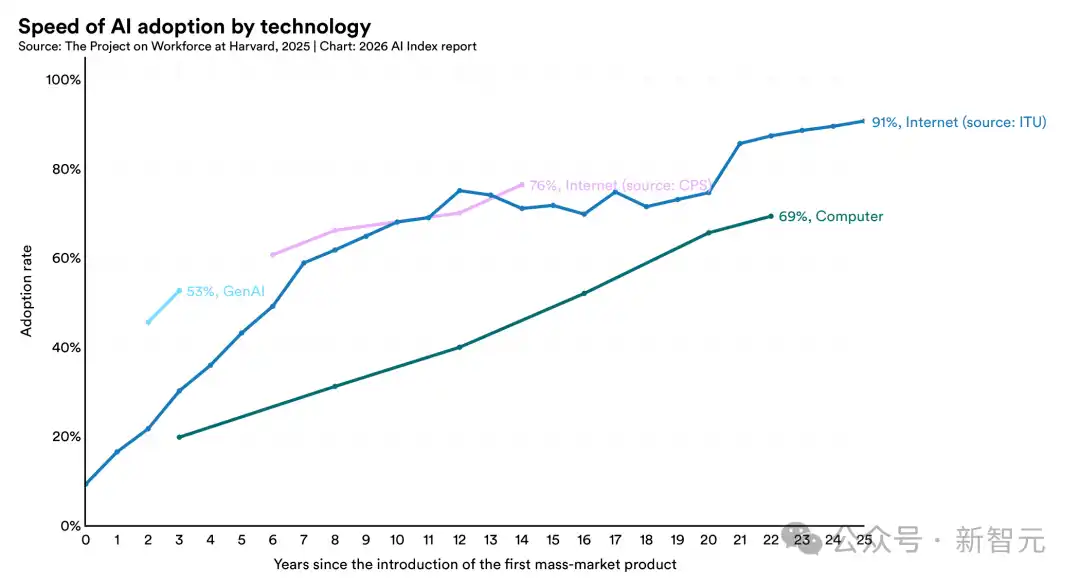
Generative AI reached a global population penetration rate of 53% within three years.
This speed is faster than personal computers, faster than the internet.
But penetration speed is highly correlated with country. Singapore 61%, UAE 54%, both ahead of the US. The US ranks only 24th among the surveyed countries, with a penetration rate of 28.3%.
If we change the dimension from consumers to the workplace, the contrast is greater.
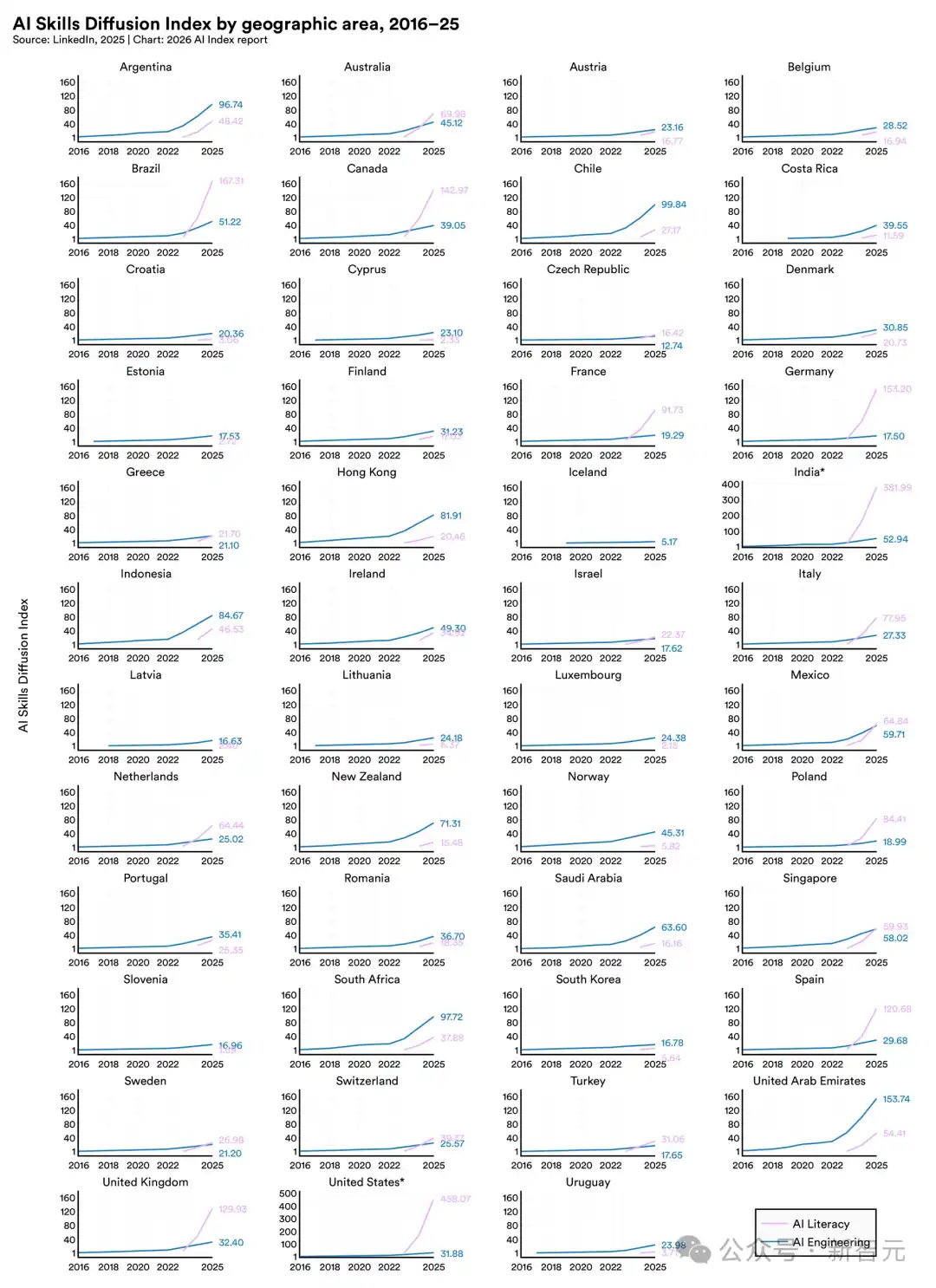
Another set of data in the report shows that in 2025, 58% of employees globally had already started using AI regularly at work. But in five countries—China, India, Nigeria, UAE, Saudi Arabia—this proportion exceeded 80%.
China's workplace AI penetration rate is already more than 20 percentage points higher than the global average.
Even more interesting is consumer value.
AI Index estimates that by early 2026, generative AI tools create $172 billion in value annually for US consumers. From 2025 to 2026, the median value per user tripled.
The vast majority of users are still using the free version.
Entry-Level Positions Sharply Reduced, 22-25 Year-Old Dev Jobs Slashed 20%
The part of the entire AI Index that might be most沉默 for Chinese readers is probably the section on youth employment.
The number of employed software developers aged 22 to 25 has fallen by about 20% since 2024.
During the same period, older peer groups actually grew.
Not just development roles. Other high-AI-exposure industries like customer service are also showing the same pattern.
More worrying are the results of corporate surveys. Respondent executives generally expect future layoffs to be larger than in the past few months.
This isn't about the macro unemployment rate; it's about entry-level positions being precisely cut off.
If the first job is gone, the entire career ladder loses a rung. The long-term impact of this is something no one can calculate yet.
AI is Rewriting the Way Science is Done
If the employment section is cold, the science section is hot.
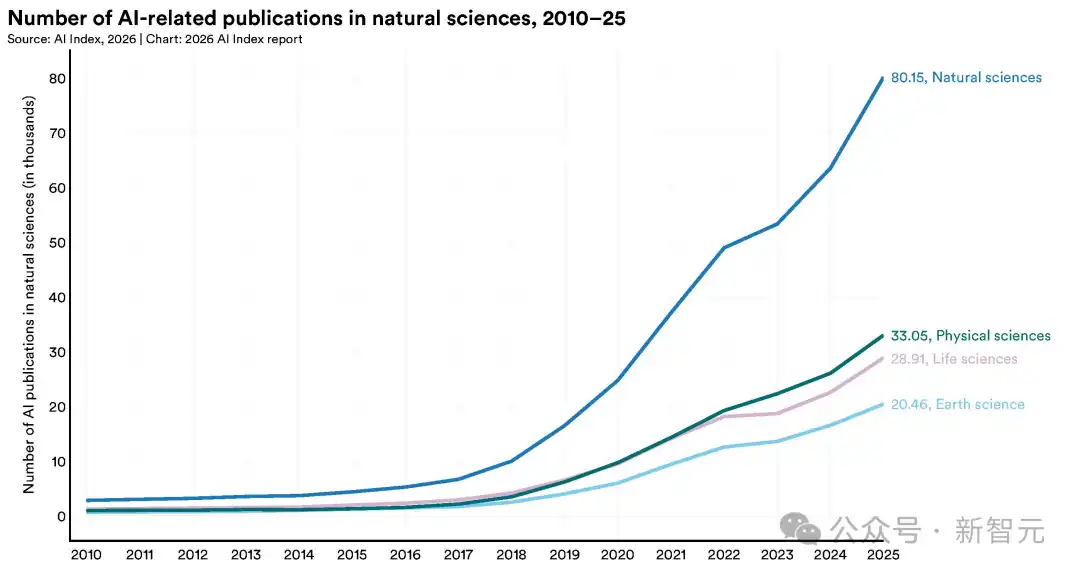
AI-related papers in natural sciences, physical sciences, and life sciences grew by 26% to 28% year-on-year in 2025.
Specifically in application, this year for the first time an AI completely ran an end-to-end weather forecasting process. From raw meteorological observation data directly outputting final forecasts for temperature, wind speed, humidity, with no traditional numerical models介入.
AI is moving from "helping you write papers" "helping you calculate numbers" to "making discoveries itself".
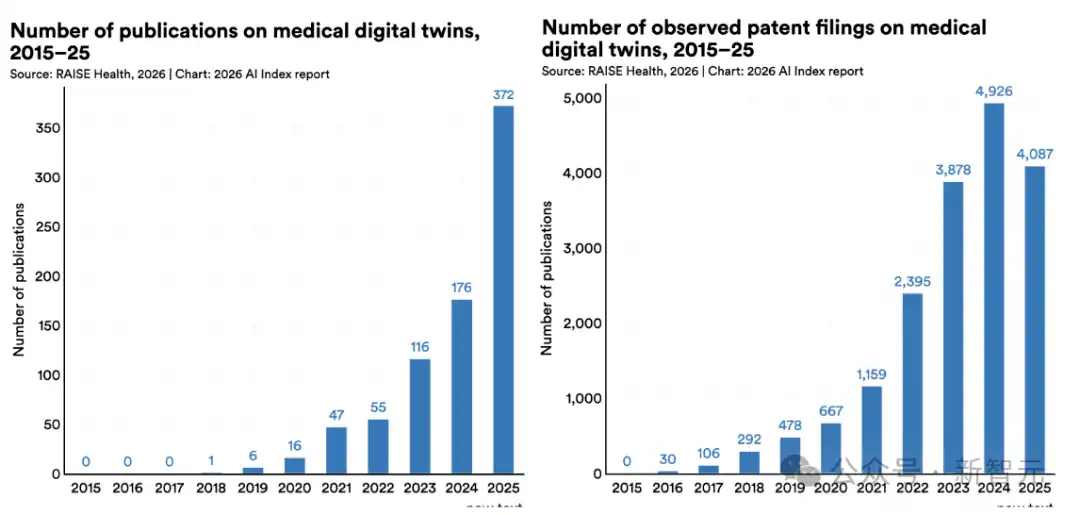
It's the same in hospitals. In 2025, many hospitals began deploying AI tools that can automatically generate clinical records from consultation dialogues. Doctors in multiple hospital systems reported that time spent writing medical records was reduced by up to 83%, with significant decreases in burnout.
But the same index pours cold water on medical AI. A review of over 500 clinical AI studies found that nearly half relied on exam-style datasets, and only 5% used real clinical data.
AI can reduce doctors' typing time, that's certain. AI's clinical value on real patients currently has many question marks.
Self-Learning Wave Explodes Globally, Formal Education Has Fallen Behind
Formal education can't keep up with AI.
4/5 of US high school and college students now use AI to complete school assignments. But only half of secondary schools have AI usage policies, and only 6% of teachers think these policies are clear.
Students are running ahead, teachers are still in place, rules haven't appeared yet.
While formal education falls behind, the self-learning wave is exploding globally. It says the three countries with the fastest growth in learning AI engineering skills are the UAE, Chile, and South Africa.
Not the US, not Europe.
The steepest part of the skill curve is growing in places no one is looking.
Strongest Models Become the Most Opaque, Experts and Public are分裂
The strongest models are becoming the most opaque models.
The Foundation Model Transparency Index's average score fell from 58 last year to 40 this year. The AI Index directly点名, Google, Anthropic, OpenAI have all stopped公开 the training data scale and training duration of their latest models.
Of the 95 most representative models released last year, 80 did not公开 training code.
Public sentiment has also become more complex.
Globally, the proportion believing AI's benefits outweigh the risks rose from 52% to 59%. But during the same period, the proportion feeling nervous about AI rose from 50% to 52%.
Both directions are growing simultaneously.
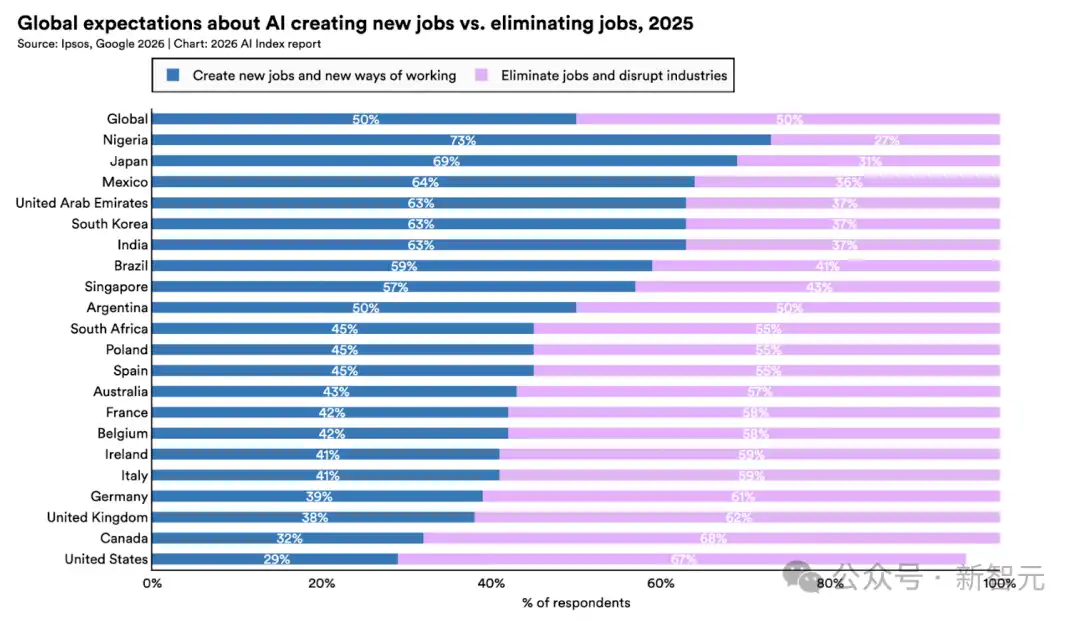
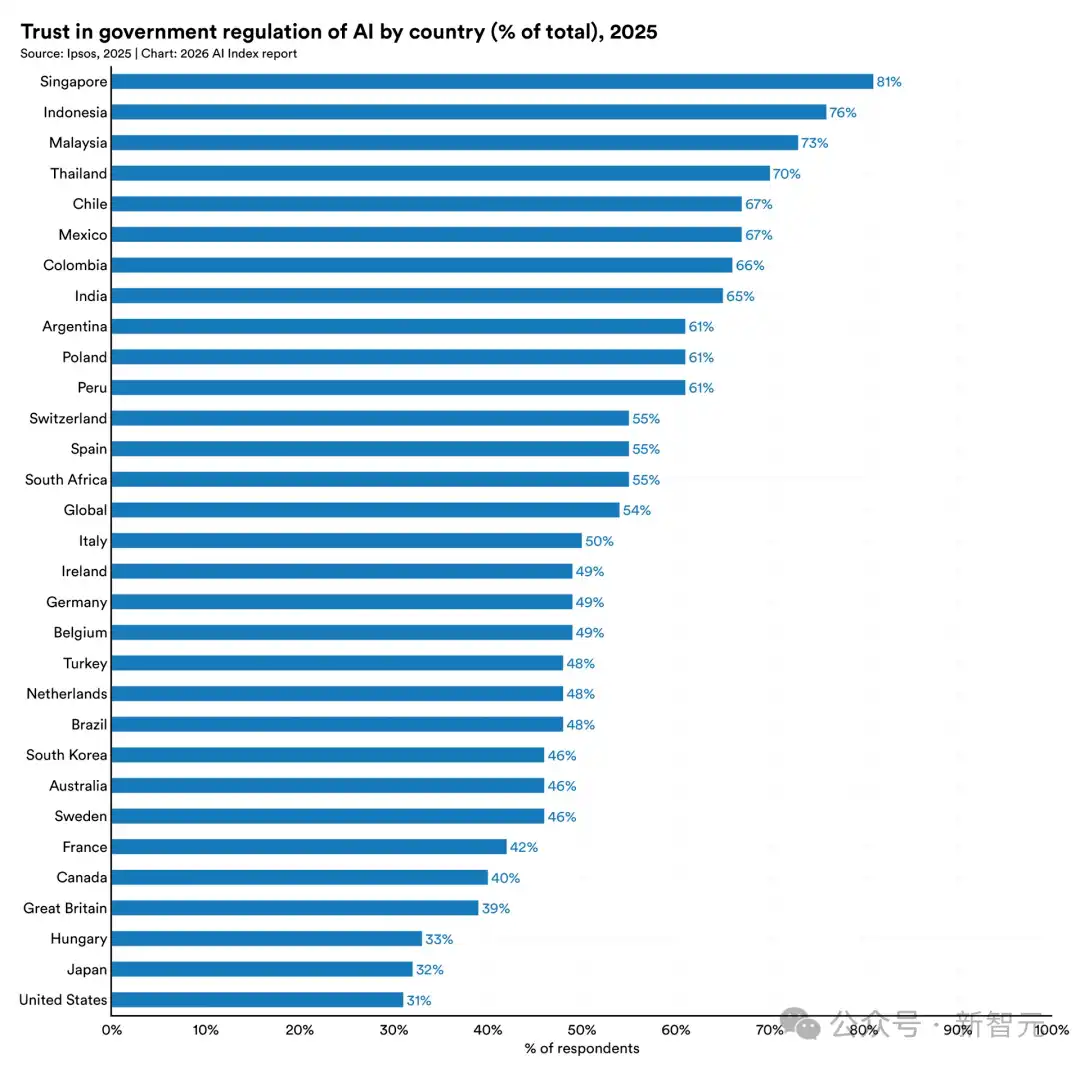
The most分裂 is the US. Only 33% of Americans think AI will make their jobs better, the global average is 40%. Americans' trust in their own government to regulate AI is the lowest among surveyed countries, 31%.
Singaporeans' trust in their government to regulate AI is 81%.
After the recent incident at Sam Altman's house was袭击, Silicon Valley insiders were "surprised to find" that ordinary people in the Instagram comments were not sympathetic, some even felt "it should be more intense".
They didn't realize things had gotten this bad.
The Pew and Ipsos data cited in the report show that the perception gap between experts and the public on the impact of AI on employment, healthcare, economy, etc.,普遍 exceeds 30 percentage points, with the largest gap reaching 50 percentage points.
On one side, the curves in the lab are soaring; on the other, ordinary people's unease is accumulating.
There is no bridge in between.
In Conclusion
The 423-page report has hundreds of charts, but it really only draws one picture.
The horizontal axis is time, the vertical axis is capability.
The model capability curve is flying, the computing power curve is flying, the investment curve is flying, the adoption rate curve is flying. Everything else is stagnating or moving downward.
This is the entire content of the 2026 AI Index.
AI is accelerating. Everything else is decoupling.
If you are in this industry, the question to ask now is not "what will the future be like", but "which curve are you standing on".
İlgili Sorular
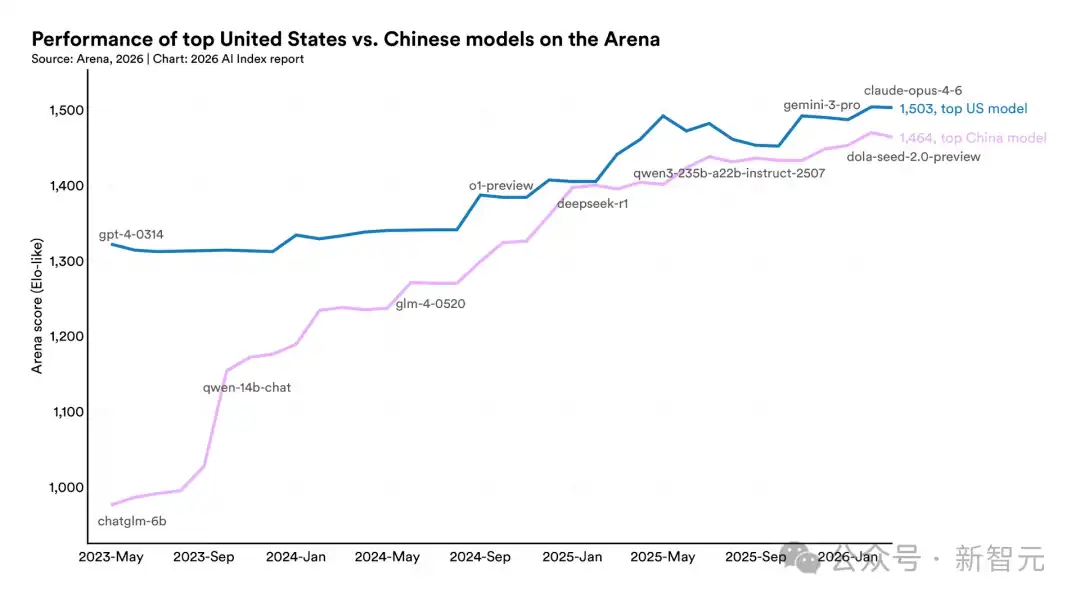
QWhat is the performance gap between the top AI models of the US and China according to the Stanford AI Index Report 2026?
AThe performance gap between the top AI models of the US and China has narrowed to just 2.7%.
QWhich Chinese institutions or companies are ranked in the global top 10 for AI models?
AAlibaba, DeepSeek, Tsinghua University, and ByteDance are the Chinese institutions and companies ranked in the global top 10.
QWhat percentage of the world's top AI models in the past year came from industry rather than academia?
AOver 90% of the world's top AI models in the past year came from industry, not academia or government labs.
QWhat significant negative impact on employment is highlighted in the report, particularly for a specific age group?
AEmployment for software developers aged 22-25 has decreased by approximately 20% since 2024, as entry-level positions are being disproportionately affected.
QWhat is the term used in the report to describe the uneven and inconsistent development of AI capabilities?
AThe term used to describe the uneven development of AI capabilities is 'jagged frontier' (锯齿前沿).
İlgili Okumalar
You Bet on the News, the Pros Read the Rules: The True Cognitive Gap in Losing Money on Polymarket
The article explains that the key to profiting on Polymarket, a prediction market platform, lies not just predicting real-world events correctly, but in meticulously understanding the specific rules that govern how each market will be resolved.
It illustrates this with examples, such as a market on Venezuela's 2026 leader, where the official rules defining "officially holds" the office overruled the intuitive answer of who was in practical control. Other examples include debates over the definition of a "token" or what constitutes an "agreement."
The core argument is that a "reality vs. rules" gap creates pricing discrepancies that savvy traders ("车头" or "whales") exploit. The platform has a formal dispute resolution process managed by UMA token holders to settle ambiguous outcomes. This process involves proposal submission, a challenge window, a discussion period, and a final vote.
However, the article highlights a critical flaw in this system compared to a traditional court: the lack of separation between the arbiters (UMA voters) and the interested parties (traders with financial stakes in the outcome). This conflict of interest undermines the discussion phase, leads to herd mentality, and results in opaque final decisions without explanatory rulings. Consequently, the system lacks a body of precedent, making it difficult for users to learn from past disputes. The ultimate takeaway is that success on Polymarket requires a lawyer-like scrutiny of the rules to identify and capitalize on the cognitive gap between how events appear and how they are contractually defined for settlement.
marsbit11 dk önce

marsbit11 dk önce
Will Solana Flip Ethereum Soon? SOL Takes First Step Toward Total Domination
Solana has significantly closed the gap with Ethereum, particularly in transaction volume, processing 9 billion transactions last month compared to Ethereum's 69 million. It has also surpassed Ethereum in cumulative lifetime transactions. This highlights Solana's high-throughput, low-cost architecture designed for real-time usage. Major partnerships, such as with Visa for stablecoin settlements and Western Union's upcoming stablecoin launch, underscore its growing institutional adoption. Solana has even overtaken Ethereum in real-world asset (RWA) holders. However, a complete "flippening" depends on broader factors like capital inflows, developer activity, and network confidence. While Solana's smaller market cap suggests greater growth potential, Ethereum's Layer-2 scaling strategy strengthens its ecosystem. The outcome remains uncertain, with trade-offs on both sides.
bitcoinist17 dk önce
bitcoinist17 dk önce
Spending $200 to Buy Stars, Scamming VCs Out of Tens of Millions: The Entire GitHub Fake Star Industry Exposed
A peer-reviewed study from Carnegie Mellon University (CMU) reveals that GitHub hosts approximately 6 million fake Stars, involving 18,600 repositories and 301,000 accounts, with AI/LLM projects being the largest non-malicious category for fake engagement. The fake Star market has exploded, with prices as low as $0.03 per Star.
Research shows that venture capital firms, such as Redpoint Ventures, use GitHub Star counts as a key metric for evaluating startups, with median Stars at 2,850 for seed-stage funding. For less than $200, a project can artificially meet this threshold, distorting investment landscape.
Over a dozen websites openly sell GitHub Stars, and fake Star activity saw explosive growth in 2024. AI-related repositories were among the most heavily affected. Despite GitHub’s policies against fake engagement, enforcement remains inconsistent: while 90% of flagged repositories were deleted, only 57% of involved accounts were suspended.
The report highlights how purchased Stars can manipulate GitHub’s Trending algorithm and influence VC funding decisions, creating a cycle where artificial metrics attract real investment.
marsbit20 dk önce
marsbit20 dk önce
Will the Fed Still Cut Interest Rates? Tonight's Data Is Crucial
The core debate surrounding the Federal Reserve's potential interest rate cuts is intensifying amid geopolitical conflict and rebounding inflation. The key question is whether high energy prices will cause persistent inflation or weaken consumer demand enough to force the Fed to cut rates.
Citigroup presents a bullish case for cuts, arguing that oil supply disruptions from the Strait of Hormuz are temporary and will not lead to lasting inflationary pressure. They point to receding bond yields and oil prices as evidence the market is pricing in a short-lived shock. Citi's data also shows tightening financial conditions, a stabilizing labor market, and healthy tax returns, supporting their view that the path to lower rates remains open.
Conversely, Deutsche Bank offers a starkly contrasting, more hawkish outlook. They argue the Fed's current policy is already neutral and expect rates to remain unchanged indefinitely. Their view is based on stalled disinflation progress and a shift toward more hawkish rhetoric from key Fed officials like Waller, who cited risks from prolonged Middle East conflict and tariffs. Other officials, including Williams and Hammack, signaled rates would likely stay on hold for a "considerable time." The market pricing has shifted dramatically, now forecasting zero cuts in 2026.
The imminent release of the March retail sales "control group" data is highlighted as a critical test. This metric, which excludes gas station sales, will reveal if high gasoline prices are eroding consumer spending in other areas. A weak reading could support the case for imminent rate cuts, while a strong one would bolster the argument for the Fed to hold steady. This data is pivotal for determining the near-term policy path.
marsbit31 dk önce

marsbit31 dk önce
The Second Half of Macro Influencer Fu Peng's Career
Fu Peng, a prominent Chinese macroeconomist and former chief economist of Northeast Securities, has joined Hong Kong-based digital asset management firm Bitfire Group (formerly New Huo Group) as its chief economist. This move, announced in April 2026, triggered an 11% surge in Bitfire's stock price.
Fu, known for his accessible macroeconomic commentary and large social media following, will focus on integrating digital assets into global asset allocation frameworks, particularly combining FICC (fixed income, currencies, and commodities) with cryptocurrencies for institutional clients.
His career includes roles at Lehman Brothers and Solomon International, with significant influence gained through public communication. However, in late 2024, Fu faced temporary social media bans after a controversial private speech at HSBC on China's economic challenges, though he denied regulatory sanctions. He later left Northeast Securities citing health reasons.
Bitfire, a licensed virtual asset manager serving high-net-worth clients, seeks to build trust and attract traditional capital through Fu’s expertise and credibility. The partnership represents a strategic shift for both: Fu enters the crypto sector after a traditional finance peak, while Bitfire aims to leverage his macro framework for institutional adoption. Outcomes remain uncertain regarding capital inflows and compatibility within corporate structure.
marsbit1 saat önce

marsbit1 saat önce
Popüler Makaleler
SPERO'yu Anlamak: Kapsamlı Bir Genel Bakış SPERO'ya Giriş İnovasyonun manzarası gelişmeye devam ederken, web3 teknolojilerinin ve kripto para projelerinin ortaya çıkışı dijital geleceği şekillendirmede önemli bir rol oynamaktadır. Bu dinamik alanda dikkat çeken projelerden biri SPERO, $$s$$ olarak adlandırılmaktadır. Bu makale, SPERO hakkında ayrıntılı bilgi toplamak ve sunmak amacıyla, meraklılar ve yatırımcıların web3 ve kripto alanlarındaki temellerini, hedeflerini ve yeniliklerini anlamalarına yardımcı olmayı amaçlamaktadır. SPERO,$$s$$ Nedir? SPERO,$$s$$, kripto alanında merkeziyetsizlik ve blok zinciri teknolojisi ilkelerini kullanarak etkileşimi, faydayı ve finansal kapsayıcılığı teşvik eden bir ekosistem yaratmayı amaçlayan benzersiz bir projedir. Proje, kullanıcıların yenilikçi finansal çözümler ve hizmetler sunarak eşler arası etkileşimleri yeni yollarla kolaylaştırmayı hedeflemektedir. SPERO,$$s$$'nin temel amacı, bireyleri güçlendirmek ve kripto para alanındaki kullanıcı deneyimini artıran araçlar ve platformlar sağlamaktır. Bu, daha esnek işlem yöntemlerini mümkün kılmayı, topluluk odaklı girişimleri teşvik etmeyi ve merkeziyetsiz uygulamalar (dApp'ler) aracılığıyla finansal fırsatlar yaratmayı içermektedir. SPERO,$$s$$'nin temel vizyonu kapsayıcılık etrafında dönmekte olup, geleneksel finansal sistemlerdeki boşlukları kapatmayı ve blok zinciri teknolojisinin faydalarından yararlanmayı hedeflemektedir. SPERO,$$s$$'nin Yaratıcısı Kimdir? SPERO,$$s$$'nin yaratıcısının kimliği bir miktar belirsizdir, çünkü kurucusu(ları) hakkında ayrıntılı arka plan bilgisi sağlayan sınırlı kamuya açık kaynaklar bulunmaktadır. Bu şeffaflık eksikliği, projenin merkeziyetsizlik taahhüdünden kaynaklanabilir—birçok web3 projesinin paylaştığı bir etik anlayışı, bireysel tanınmanın yerine kolektif katkıları önceliklendirmektedir. Topluluk ve onun kolektif hedefleri etrafında tartışmaları merkezileştirerek, SPERO,$$s$$, belirli bireyleri öne çıkarmadan güçlendirme özünü taşımaktadır. Bu nedenle, SPERO'nun etik anlayışını ve misyonunu anlamak, tek bir yaratıcının kimliğini belirlemekten daha önemlidir. SPERO,$$s$$'nin Yatırımcıları Kimlerdir? SPERO,$$s$$, kripto sektöründe yeniliği teşvik etmeye adanmış girişim sermayedarlarından melek yatırımcılara kadar çeşitli yatırımcılar tarafından desteklenmektedir. Bu yatırımcıların odak noktası genellikle SPERO'nun misyonuyla uyumlu olup, toplumsal teknolojik ilerlemeyi, finansal kapsayıcılığı ve merkeziyetsiz yönetimi vaat eden projeleri önceliklendirmektedir. Bu yatırımcı temelleri, yalnızca yenilikçi ürünler sunan projelere değil, aynı zamanda blok zinciri topluluğuna ve ekosistemlerine olumlu katkılarda bulunan projelere de ilgi duymaktadır. Bu yatırımcıların desteği, SPERO,$$s$$'yi hızla gelişen kripto projeleri alanında dikkate değer bir rakip haline getirmektedir. SPERO,$$s$$ Nasıl Çalışır? SPERO,$$s$$, onu geleneksel kripto para projelerinden ayıran çok yönlü bir çerçeve kullanmaktadır. İşte benzersizliğini ve yeniliğini vurgulayan bazı temel özellikler: Merkeziyetsiz Yönetim: SPERO,$$s$$, kullanıcıların projenin geleceğiyle ilgili karar alma süreçlerine aktif olarak katılmalarını sağlayan merkeziyetsiz yönetim modellerini entegre etmektedir. Bu yaklaşım, topluluk üyeleri arasında sahiplik ve hesap verebilirlik duygusunu teşvik etmektedir. Token Kullanımı: SPERO,$$s$$, ekosistem içinde çeşitli işlevler sunmak üzere tasarlanmış kendi kripto para token'ını kullanmaktadır. Bu token'lar, işlemleri, ödülleri ve platformda sunulan hizmetlerin kolaylaştırılmasını sağlayarak genel etkileşimi ve faydayı artırmaktadır. Katmanlı Mimari: SPERO,$$s$$'nin teknik mimarisi, modülerlik ve ölçeklenebilirliği destekleyerek projenin evrimi sırasında ek özelliklerin ve uygulamaların sorunsuz bir şekilde entegrasyonuna olanak tanımaktadır. Bu uyum sağlama yeteneği, sürekli değişen kripto manzarasında geçerliliği sürdürmek için hayati öneme sahiptir. Topluluk Katılımı: Proje, işbirliği ve geri bildirim teşvik eden mekanizmalar kullanarak topluluk odaklı girişimlere vurgu yapmaktadır. Güçlü bir topluluk oluşturarak, SPERO,$$s$$, kullanıcı ihtiyaçlarını daha iyi karşılayabilir ve piyasa trendlerine uyum sağlayabilir. Kapsayıcılığa Odaklanma: Düşük işlem ücretleri ve kullanıcı dostu arayüzler sunarak, SPERO,$$s$$, daha önce kripto alanında yer almamış bireyler de dahil olmak üzere çeşitli bir kullanıcı tabanını çekmeyi hedeflemektedir. Bu kapsayıcılık taahhüdü, erişilebilirlik yoluyla güçlendirme misyonuyla uyumludur. SPERO,$$s$$ Zaman Çizelgesi Bir projenin tarihini anlamak, gelişim yolculuğu ve kilometre taşları hakkında kritik bilgiler sağlar. Aşağıda, SPERO,$$s$$'nin evriminde önemli olayları haritalayan önerilen bir zaman çizelgesi bulunmaktadır: Kavram Geliştirme ve Fikir Aşaması: SPERO,$$s$$'nin temelini oluşturan ilk fikirler, blok zinciri endüstrisindeki merkeziyetsizlik ve topluluk odaklılık ilkeleriyle yakından uyumlu olarak geliştirildi. Proje Beyaz Kağıdının Yayınlanması: Kavramsal aşamayı takiben, SPERO,$$s$$'nin vizyonunu, hedeflerini ve teknolojik altyapısını ayrıntılı bir şekilde açıklayan kapsamlı bir beyaz kağıt yayımlandı ve topluluk ilgisini ve geri bildirimini toplamak amacıyla sunuldu. Topluluk Oluşturma ve Erken Katılımlar: Projenin hedefleri etrafında tartışmalar yürüterek destek toplamak ve erken benimseyenler ile potansiyel yatırımcılar için bir topluluk oluşturmak amacıyla aktif iletişim çabaları gerçekleştirildi. Token Üretim Etkinliği: SPERO,$$s$$, yerel token'larını erken destekçilere dağıtmak ve ekosistem içinde başlangıç likiditesini sağlamak amacıyla bir token üretim etkinliği (TGE) gerçekleştirdi. İlk dApp'in Yayınlanması: SPERO,$$s$$ ile ilişkili ilk merkeziyetsiz uygulama (dApp) faaliyete geçti ve kullanıcıların platformun temel işlevleriyle etkileşimde bulunmalarını sağladı. Sürekli Gelişim ve Ortaklıklar: Projenin tekliflerine sürekli güncellemeler ve iyileştirmeler yapılmakta olup, blok zinciri alanındaki diğer oyuncularla stratejik ortaklıklar, SPERO,$$s$$'yi rekabetçi ve gelişen bir oyuncu haline getirmiştir. Sonuç SPERO,$$s$$, web3 ve kripto paranın finansal sistemleri devrim niteliğinde dönüştürme ve bireyleri güçlendirme potansiyelinin bir kanıtıdır. Merkeziyetsiz yönetime, topluluk katılımına ve yenilikçi tasarlanmış işlevselliğe olan bağlılığıyla, daha kapsayıcı bir finansal manzaraya doğru bir yol açmaktadır. Hızla gelişen kripto alanındaki herhangi bir yatırımda olduğu gibi, potansiyel yatırımcılar ve kullanıcılar, SPERO,$$s$$ içindeki devam eden gelişmelerle ilgili olarak kapsamlı bir araştırma yapmaları ve düşünceli bir şekilde katılmaları teşvik edilmektedir. Proje, kripto endüstrisinin yenilikçi ruhunu sergileyerek, sayısız olasılığını keşfetmeye davet etmektedir. SPERO,$$s$$'nin yolculuğu hala devam ederken, temel ilkeleri, teknoloji, finans ve birbirimizle etkileşim biçimimizi etkileyebilir.
89 Toplam GörüntülenmeYayınlanma 2024.12.17Güncellenme 2024.12.17

Agent S: Web3'te Otonom Etkileşimin Geleceği Giriş Web3 ve kripto para dünyasında sürekli gelişen manzarada, yenilikler bireylerin dijital platformlarla etkileşim biçimlerini sürekli olarak yeniden tanımlıyor. Bu tür öncü projelerden biri olan Agent S, açık ajans çerçevesi aracılığıyla insan-bilgisayar etkileşimini devrim niteliğinde değiştirmeyi vaat ediyor. Otonom etkileşimlerin yolunu açarak, Agent S karmaşık görevleri basitleştirmeyi ve yapay zeka (AI) alanında dönüştürücü uygulamalar sunmayı hedefliyor. Bu detaylı inceleme, projenin karmaşıklıklarına, benzersiz özelliklerine ve kripto para alanındaki etkilerine dalacaktır. Agent S Nedir? Agent S, bilgisayar görevlerinin otomasyonunda üç temel zorluğu ele almak üzere özel olarak tasarlanmış çığır açıcı bir açık ajans çerçevesidir: Alan Spesifik Bilgi Edinimi: Çerçeve, çeşitli dış bilgi kaynaklarından ve iç deneyimlerden akıllıca öğrenir. Bu çift yönlü yaklaşım, alan spesifik bilgi açısından zengin bir veri havuzu oluşturmasını sağlar ve görev yürütmedeki performansını artırır. Uzun Görev Ufukları Üzerinde Planlama: Agent S, karmaşık görevlerin verimli bir şekilde parçalanmasını ve yürütülmesini kolaylaştıran deneyim artırımlı hiyerarşik planlama kullanır. Bu özellik, çoklu alt görevleri etkili ve verimli bir şekilde yönetme yeteneğini önemli ölçüde artırır. Dinamik, Homojen Olmayan Arayüzlerle Başlama: Proje, ajanlar ve kullanıcılar arasındaki etkileşimi geliştiren yenilikçi bir çözüm olan Ajan-Bilgisayar Arayüzü'ni (ACI) tanıtmaktadır. Çok Modlu Büyük Dil Modellerini (MLLM'ler) kullanarak, Agent S çeşitli grafik kullanıcı arayüzlerini sorunsuz bir şekilde gezinebilir ve manipüle edebilir. Bu öncü özellikler aracılığıyla, Agent S, makinelerle insan etkileşimini otomatikleştirmede karşılaşılan karmaşıklıkları ele alan sağlam bir çerçeve sunarak, AI ve ötesinde birçok uygulama için zemin hazırlıyor. Agent S'nin Yaratıcısı Kimdir? Agent S'nin kavramı temelde yenilikçi olsa da, yaratıcısı hakkında spesifik bilgiler belirsizliğini koruyor. Yaratıcı şu anda bilinmiyor, bu da projenin yeni aşamasını veya kurucu üyeleri gizli tutma stratejik tercihini vurguluyor. Anonimlikten bağımsız olarak, odak çerçevenin yetenekleri ve potansiyeli üzerinde kalıyor. Agent S'nin Yatırımcıları Kimlerdir? Agent S, kriptografik ekosistemde oldukça yeni olduğundan, yatırımcıları ve finansal destekçileri hakkında ayrıntılı bilgiler açıkça belgelenmemiştir. Projeyi destekleyen yatırım temelleri veya organizasyonları hakkında kamuya açık bilgilerdeki eksiklik, finansman yapısı ve gelişim yol haritası hakkında sorular doğuruyor. Destekleyicilerin anlaşılması, projenin sürdürülebilirliğini ve potansiyel pazar etkisini değerlendirmek için kritik öneme sahiptir. Agent S Nasıl Çalışır? Agent S'nin temelinde, çeşitli ortamlarda etkili bir şekilde çalışmasını sağlayan son teknoloji bir sistem yatmaktadır. İşleyiş modeli birkaç ana özellik etrafında inşa edilmiştir: İnsan Benzeri Bilgisayar Etkileşimi: Çerçeve, bilgisayarlarla etkileşimleri daha sezgisel hale getirmeyi amaçlayan gelişmiş AI planlaması sunar. Görev yürütmedeki insan davranışını taklit ederek, kullanıcı deneyimlerini yükseltmeyi vaat eder. Anlatı Belleği: Yüksek düzeyde deneyimlerden yararlanmak için kullanılan Agent S, görev geçmişlerini takip etmek amacıyla anlatı belleğini kullanarak karar verme süreçlerini geliştirir. Episodik Bellek: Bu özellik, kullanıcılara adım adım rehberlik sağlayarak, çerçevenin görevler gelişirken bağlamsal destek sunmasına olanak tanır. OpenACI Desteği: Yerel olarak çalışabilme yeteneği ile Agent S, kullanıcıların etkileşimleri ve iş akışları üzerinde kontrol sağlamasına olanak tanır ve Web3'ün merkeziyetsiz felsefesiyle uyumlu hale gelir. Dış API'lerle Kolay Entegrasyon: Çeşitli AI platformlarıyla uyumluluğu ve çok yönlülüğü, Agent S'nin mevcut teknolojik ekosistemlere sorunsuz bir şekilde entegre olmasını sağlar ve geliştiriciler ile organizasyonlar için cazip bir seçenek haline getirir. Bu işlevsellikler, Agent S'nin kripto alanındaki benzersiz konumuna katkıda bulunarak, karmaşık, çok aşamalı görevleri minimum insan müdahalesi ile otomatikleştirir. Proje geliştikçe, Web3'teki potansiyel uygulamaları dijital etkileşimlerin nasıl gelişeceğini yeniden tanımlayabilir. Agent S'nin Zaman Çizelgesi Agent S'nin gelişimi ve kilometre taşları, önemli olaylarını vurgulayan bir zaman çizelgesinde özetlenebilir: 27 Eylül 2024: Agent S'nin kavramı, “Bilgisayarları İnsan Gibi Kullanan Açık Bir Ajans Çerçevesi” başlıklı kapsamlı bir araştırma makalesi ile tanıtıldı ve projenin temelini sergiledi. 10 Ekim 2024: Araştırma makalesi arXiv'de kamuya açık olarak yayınlandı ve çerçevenin derinlemesine bir incelemesini ve OSWorld benchmark'ına dayalı performans değerlendirmesini sundu. 12 Ekim 2024: Agent S'nin yetenekleri ve özellikleri hakkında görsel bir içgörü sağlayan bir video sunumu yayımlandı ve potansiyel kullanıcılar ve yatırımcılarla daha fazla etkileşim sağlandı. Bu zaman çizelgesindeki işaretler, sadece Agent S'nin ilerlemesini değil, aynı zamanda şeffaflık ve topluluk katılımına olan bağlılığını da göstermektedir. Agent S Hakkında Ana Noktalar Agent S çerçevesi gelişmeye devam ederken, birkaç ana özellik öne çıkmakta ve yenilikçi doğasını ve potansiyelini vurgulamaktadır: Yenilikçi Çerçeve: İnsan etkileşimine benzer bir bilgisayar kullanımı sağlamak üzere tasarlanan Agent S, görev otomasyonuna yeni bir yaklaşım getiriyor. Otonom Etkileşim: GUI aracılığıyla bilgisayarlarla otonom olarak etkileşim kurabilme yeteneği, daha akıllı ve verimli hesaplama çözümlerine doğru bir sıçrama anlamına geliyor. Karmaşık Görev Otomasyonu: Sağlam metodolojisi ile karmaşık, çok aşamalı görevleri otomatikleştirerek süreçleri daha hızlı ve daha az hata payı ile gerçekleştirebilir. Sürekli İyileştirme: Öğrenme mekanizmaları, Agent S'nin geçmiş deneyimlerden öğrenmesini sağlar ve sürekli olarak performansını ve etkinliğini artırır. Çok Yönlülük: OSWorld ve WindowsAgentArena gibi farklı işletim ortamlarında uyumlu olması, geniş bir uygulama yelpazesine hizmet edebilmesini sağlar. Agent S, Web3 ve kripto alanında kendini konumlandırırken, etkileşim yeteneklerini artırma ve süreçleri otomatikleştirme potansiyeli, AI teknolojilerinde önemli bir ilerlemeyi temsil etmektedir. Yenilikçi çerçevesi aracılığıyla, Agent S dijital etkileşimlerin geleceğini örneklemekte ve çeşitli sektörlerde kullanıcılar için daha sorunsuz ve verimli bir deneyim vaat etmektedir. Sonuç Agent S, AI ve Web3'ün birleşiminde cesur bir sıçramayı temsil ediyor ve teknoloji ile etkileşim biçimimizi yeniden tanımlama kapasitesine sahip. Henüz erken aşamalarında olmasına rağmen, uygulama olanakları geniş ve çekici. Kritik zorlukları ele alan kapsamlı çerçevesi ile Agent S, otonom etkileşimleri dijital deneyimin ön plana çıkmasına taşımayı hedefliyor. Kripto para ve merkeziyetsizlik alanlarına daha derinlemesine girdikçe, Agent S gibi projelerin teknoloji ve insan-bilgisayar işbirliğinin geleceğini şekillendirmede önemli bir rol oynayacağı kesin.
418 Toplam GörüntülenmeYayınlanma 2025.01.14Güncellenme 2025.01.14
HTX.com’a hoş geldiniz! Sonic (S) satın alma işlemlerini basit ve kullanışlı bir hâle getirdik. Adım adım açıkladığımız rehberimizi takip ederek kripto yolculuğunuza başlayın. 1. Adım: HTX Hesabınızı OluşturunHTX'te ücretsiz bir hesap açmak için e-posta adresinizi veya telefon numaranızı kullanın. Sorunsuzca kaydolun ve tüm özelliklerin kilidini açın. Hesabımı Aç2. Adım: Kripto Satın Al Bölümüne Gidin ve Ödeme Yönteminizi SeçinKredi/Banka Kartı: Visa veya Mastercard'ınızı kullanarak anında Sonic (S) satın alın.Bakiye: Sorunsuz bir şekilde işlem yapmak için HTX hesap bakiyenizdeki fonları kullanın.Üçüncü Taraflar: Kullanımı kolaylaştırmak için Google Pay ve Apple Pay gibi popüler ödeme yöntemlerini ekledik.P2P: HTX'teki diğer kullanıcılarla doğrudan işlem yapın.Borsa Dışı (OTC): Yatırımcılar için kişiye özel hizmetler ve rekabetçi döviz kurları sunuyoruz.3. Adım: Sonic (S) Varlıklarınızı SaklayınSonic (S) satın aldıktan sonra HTX hesabınızda saklayın. Alternatif olarak, blok zinciri transferi yoluyla başka bir yere gönderebilir veya diğer kripto para birimlerini takas etmek için kullanabilirsiniz.4. Adım: Sonic (S) Varlıklarınızla İşlem YapınHTX'in spot piyasasında Sonic (S) ile kolayca işlemler yapın.Hesabınıza erişin, işlem çiftinizi seçin, işlemlerinizi gerçekleştirin ve gerçek zamanlı olarak izleyin. Hem yeni başlayanlar hem de deneyimli yatırımcılar için kullanıcı dostu bir deneyim sunuyoruz.
1.3k Toplam GörüntülenmeYayınlanma 2025.01.15Güncellenme 2025.03.21