By Shadow Memorandum
Recently, Tencent announced testing of WeChat AI Agents, planning to deploy a WeChat super Agent. Upon the news, Tencent's market value surged by approximately 360 billion yuan in a single day.
On the same day, Alibaba's Qianwen announced full opening of its Brand Agent and Skill features, with Luckin Coffee, KFC, and Mixue Ice Cream & Tea being among the first to join; ByteDance's Coze version 3.0 was also launched simultaneously, supporting multi-person and multi-Agent collaborative operations.
The three companies made their moves almost within the same time window. While they appear to be fighting their own battles, they are actually competing for the same thing: dominance over the entry point in the AI era.
Everyone understands one principle: whoever controls the Agent entry point controls the traffic distribution power in the AI era.
But the question is, how exactly are these three companies strategizing? What are their respective "killer apps"? What commercial logic lies behind this battle for the entry point?
Alibaba: Closing the Loop with One Hand, Opening Up with the Other
Alibaba's AI trajectory in recent years can be summed up in one word: "transformation"—from hesitation to decisiveness, from technological reserves to heavy investment in the consumer end (C-end).
At the start of 2026, Alibaba played a trump card on the "super entry point" table: fully integrating the Qianwen App into Alibaba's ecosystem businesses like Taobao, Alipay, Taobao Flash Sales, Fliggy, Amap, etc.
The upgraded Qianwen App is becoming a super Agent capable of coordinating multiple applications within the Alibaba ecosystem with a single instruction.
At the launch event on January 15 this year, Alibaba announced that the Qianwen model had already been integrated into over 20 business lines including Taobao and Alipay, launching more than 400 new features.
Users can complete the entire process from product search to transaction fulfillment through natural language instructions, such as ordering milk tea by voice or intelligently planning travel routes.
Qianwen achieved over 100 million monthly active C-end users within less than two months of its launch in November 2025, clearly demonstrating Alibaba's determination. CEO Wu Yongming referred to Qianwen's C-end development as "fighting a great and successful battle."
But Alibaba's real ambition extends beyond this.
In March this year, Alibaba announced the establishment of a new entity, Alibaba Token Hub, consolidating the vast AI-related business and development work within the group under a single organization, personally led by CEO Wu Yongming.
This new department will oversee products like DingTalk and Quark and launch an enterprise AI agent called "Wukong." Wu Yongming stated plainly in an internal memo: the mission of Alibaba Token Hub is to "create tokens, deliver tokens, and apply tokens."
Dual-Wheel Driven C-End Strategy
Alibaba's C-end approach can be described as a clear "dual-star" layout: Quark focuses on intelligent information acquisition for young people, while Qianwen focuses on executing complex life tasks. Both "stars" point towards the same ultimate form: the super Agent entry point, albeit through different paths.
Last year, Quark was internally regarded as the core carrier for the group's AI flagship application transformation.
Alibaba positioned Quark as the group's flagship AI application, even incorporating the hardware team from Tmall Genie and the Tongyi App into the "AI to C" strategic sector. Wu Jia was personally appointed by Jack Ma and reports directly to CEO Wu Yongming.
The final evolutionary direction for Quark is the "AI Super Box," where users input instructions, and the Quark intelligent hub automatically identifies intent, mobilizing different models and Agent modules to help users complete tasks.
Quark currently covers multiple scenarios including AI search, AI writing, AI image generation, AI PPT, academic research, AI problem solving, AI health Q&A, and travel planning.
However, Quark's transformation has not been smooth sailing. Data shows that despite having a daily active user base in the tens of millions, the usage rate of its AI features is less than 20%; users still primarily use its traditional tools like cloud storage and scanning.
This may be precisely why Alibaba is shifting focus towards Qianwen—Qianwen possesses stronger "task execution" capabilities, enabling it to truly close the transaction loop.
Differentiated Offensive in the B-End
On the business end (B-end), Alibaba quietly launched an enterprise AI agent platform called "Wukong" in early 2026, focusing on automation and multi-agent collaboration.
It can coordinate multiple AI agents within a single interface to handle complex business tasks such as document editing, spreadsheet updates, and meeting transcription. DingTalk CEO Chen Hang introduced a rather imaginative concept at the launch event: the "One-Person AI Company":
Individual workers like lawyers, restaurateurs, and designers can leverage the capabilities of AI agents to efficiently run an entire business operation as a single person.
However, at this point in time, Alibaba's Agent entry point strategy is actually undergoing a critical shift—from "closed-loop within its own ecosystem" to "open ecosystem integration."
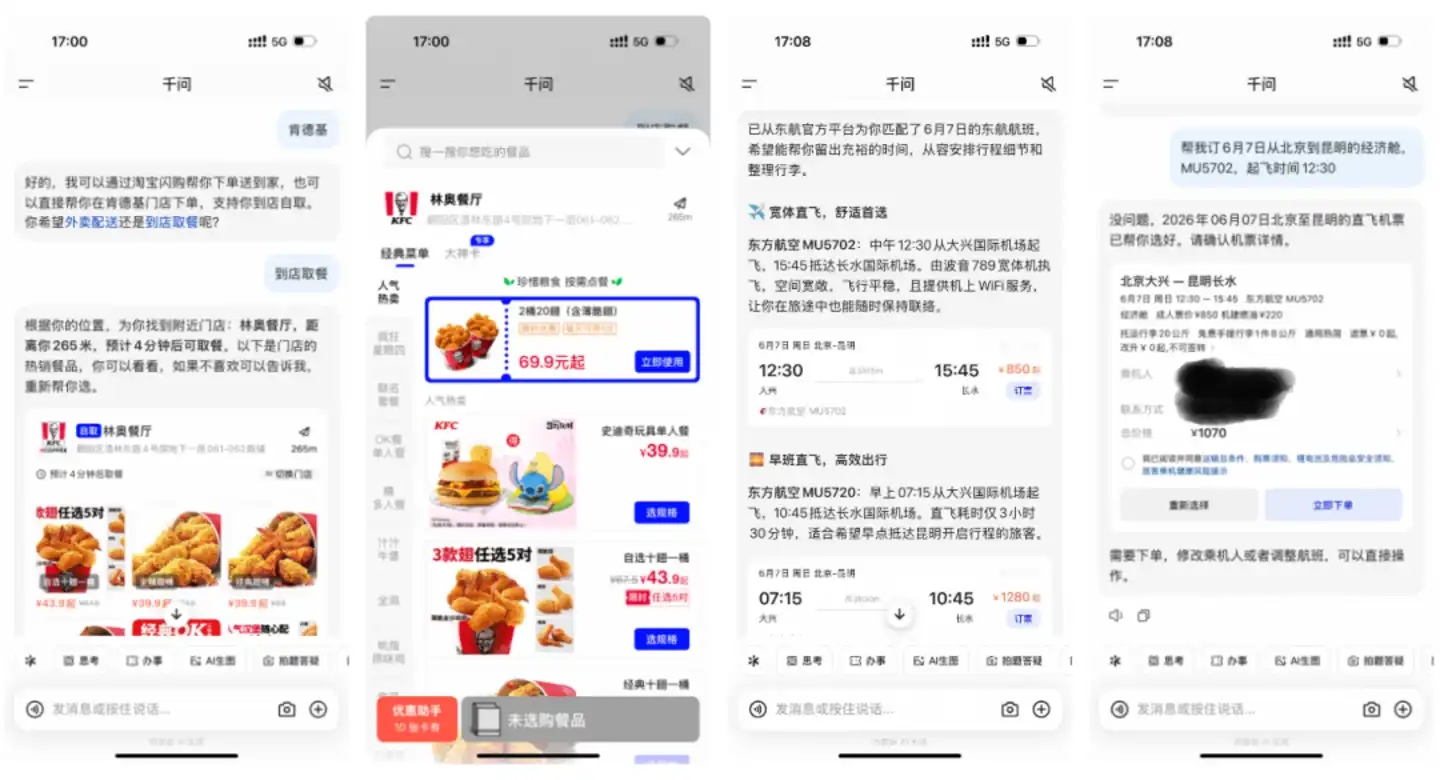
Just this week, Qianwen announced the full opening of Brand Agents and Skills to enterprises, with Luckin Coffee, KFC, and Mixue Ice Cream & Tea being the first to join.
This means Alibaba is evolving from an "AI assistant within Alibaba" into a genuine "AI service platform." It no longer just helps users order products from the Alibaba ecosystem but connects users with all the brands that have joined. Alibaba clearly realizes that a true AI entry point cannot survive solely on its own ecosystem; it must attract external brands to join.
ByteDance's Integration of Software and Hardware: Making Doubao Omnipresent
If Alibaba's approach is "expansion from the inside out," then ByteDance's strategy resembles a comprehensive "campaign of permeation"—Doubao is everywhere, dominating both software and hardware.
ByteDance's most staggering data has put immense pressure on its peers: to date, Doubao's monthly active users have exceeded 300 million.
In comparison, Tencent's Yuanbao had only 57.35 million monthly active users during the same period. That's a fivefold difference; one Doubao is almost equivalent to five Yuanbao.
ByteDance's Agent entry point strategy can be broken down into two levels.
Software Layer: The "Super Dual-Engine" of Doubao × Coze
The Doubao App itself is a well-known AI entry point for a massive user base. When users open Doubao and input instructions, ByteDance's intent is not just to "answer questions" but to become the default AI entry point for your daily life.
Over 8 million intelligent agents have been created on Doubao. In June 2026, Doubao is expected to launch a paid version. In the third quarter, it will integrate e-commerce functionalities to perfect the paid scenario and drive traffic to Douyin Mall through targeted subsidies. This is a critical step from "free use" to "monetization."
But ByteDance's real ace is not Doubao, but the underlying Coze platform.
The industry generally refers to Coze as an "AI application development platform"; a more通俗的说法 is an "assembly factory for intelligent agents."
It provides visual workflow orchestration, rich plugins, and knowledge base tools, allowing users to assemble agents for specific tasks like building blocks.
A more intuitive analogy: Doubao is the "AI department store" ByteDance operates for consumers; Coze is the "AI parts warehouse" and "power plant" for developers and creators.
Coze has now iterated to version 3.0. The biggest breakthrough in 3.0 is support for flexible combination modes of "one person + multiple Agents" and "multiple people + multiple Agents," while also enhancing cross-device synchronization and integration with the local ecosystem.
This means Coze is not just a tool but a management platform where a person in the AI era can "hire" multiple intelligent agents to work simultaneously.
ByteDance's three-layer structure is essentially established—the model layer is the Doubao large model, the platform layer is Coze and Volcano Engine, and the application layer is the Doubao App and various intelligent agents.
Hardware Layer: From "Assistant in the Phone" to "Doubao Everywhere"
ByteDance's aggressiveness in hardware has also drawn attention from the industry. In December last year, ByteDance partnered with ZTE to launch the AI phone Nubia M153 to validate the feasibility of "on-device large model + system-level Agent" technology.
This phone is equipped with the Doubao large model and UITARS model, enabling automated cross-app execution.
Simultaneously, Doubao smart glasses have entered the shipment preparation stage, with an initial batch planned for around 100,000 units, primarily targeting seasoned Doubao users.
This series of moves reveals a clear direction: ByteDance wants to transform Doubao from "an App in the phone" into an "omnipresent" underlying intelligent system.
Just as Android used its open-source ecosystem to cover countless phone manufacturers back in the day, ByteDance wants to establish Doubao's presence in both software and hardware simultaneously. This isn't for anything else but to preemptively capture users at all touchpoints.
This is especially evident in ByteDance's strategy: from Doubao to Coze, from Volcano Engine to hardware terminals, from the domestic C-end to overseas exports, every move ByteDance makes involves simultaneous coverage across markets and scenarios.
ByteDance's logic is clear: it primarily wants the entry point for the AI era—entry into users' mindsets, habits, and pathways. Whoever can get users to use AI services the fastest and most conveniently wins.
It's worth noting that last year, a public "war of words" occurred between Doubao and Alibaba's Qianwen regarding "who is the true super entry point."
Although the debate eventually fizzled out, it sent a clear signal: ByteDance wants to confront Alibaba head-on for the C-end entry point.

Tencent: Quietly Concealing Its Biggest Card for Nine Years
If Alibaba and ByteDance are likened to warriors charging forward, Tencent's strategy resembles a silent Tai Chi master, rarely publicizing, but striking with lethal precision when it does.
Over the past year, Tencent's AI-native app Yuanbao, facing attacks from both Doubao and Qianwen, has been largely in a passive catch-up state. But Tencent's true killer app has never been Yuanbao.
WeChat Agents: The "Ultimate Trump Card" Hidden in the National App
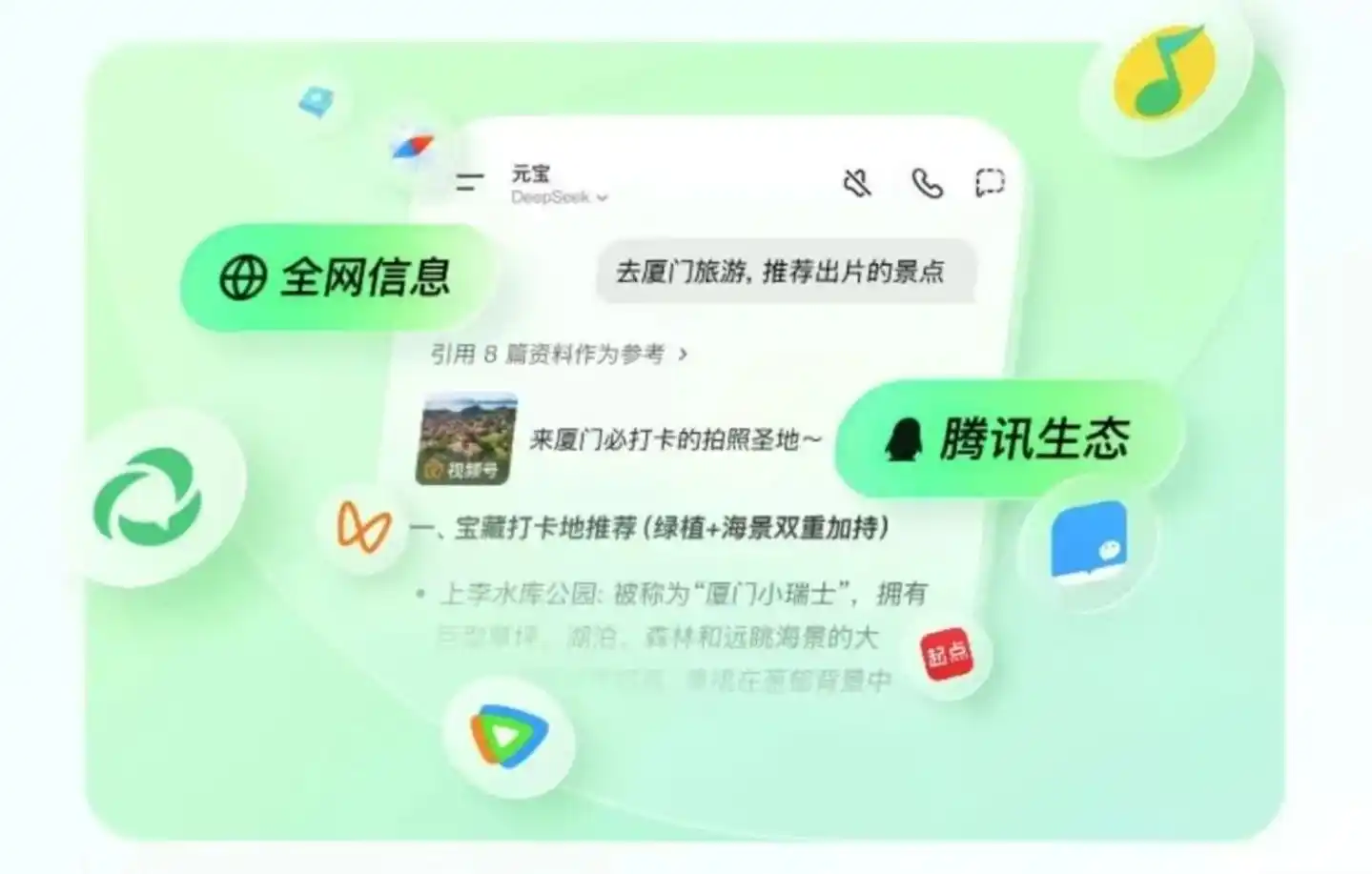
The news in early June sent shockwaves through the industry: Tencent is testing an AI Agent within the WeChat ecosystem. Sources revealed that users need only swipe right on the main WeChat interface to bring up the AI Agent's chat window.
After inputting instructions, the AI Agent can automatically call upon millions of Mini Programs within WeChat to complete various tasks, such as finding a coffee shop based on taste and price requirements and placing an order directly.
Let's pause here. This "right swipe" is far more significant than ordinary people might imagine. WeChat currently carries about 1.4 billion users, with millions of Mini Programs covering almost all aspects of life: transportation, shopping, work, travel, gaming, etc.
This new AI Agent is fundamentally different from the existing in-WeChat robot "Yuanbao." Yuanbao only has search and Q&A functions, whereas the new Agent can directly perform cross-application operations, deeply integrated with the WeChat service ecosystem centered on Mini Programs.
Simply put: Yuanbao shows you the way; the new AI directly does the work for you. Currently, this project has been designated as Tencent's top strategic priority.
Even more noteworthy is the management's perspective on this. Tencent President Martin Lau stated clearly in the May analyst earnings call:
"Beyond foundational large models, AI agents with autonomous execution capabilities have demonstrated breakthrough application value. The WeChat platform inherently possesses multiple advantages for carrying AI agents."
Pony Ma (Ma Huateng) went further at the shareholder meeting: "The WeChat ecosystem itself possesses a large number of Mini Programs, which is a great leverage point. Our most appropriate positioning is to provide platforms, tools, and connectivity capabilities, letting them develop on their own."
This statement reveals an important fact: Tencent's ambition is not to create a specific super entry point but to make WeChat itself a "service operating system," where AI understands user needs, and then Agents directly call Mini Programs to fulfill them.
In the past, users opened Mini Programs themselves, manually searched for services, and completed transactions; in the future, Agents will understand needs and directly call Mini Programs to complete tasks.
WeChat possesses the unique "execution network" of the Mini Program ecosystem. The imagination space here far exceeds the daily active user data of any single AI App.
Tencent's Entry Will Completely Reshape the Battlefield
An important detail: The development of the WeChat AI Agent began at least in the first half of 2025. This means Tencent has spent at least a year refining it, with almost no one in the industry noticing.
Tencent's understanding of the AI entry point is fundamentally different from Alibaba's and ByteDance's—it's not about creating something new, but about embedding AI into the 13-year-old WeChat ecosystem.
From a competitive industry perspective, the implementation of WeChat Agents may become the biggest variable in the entire AI Agent entry point battle. On the surface, the rapid user growth of Doubao and Qianwen put pressure on Tencent, forcing it to accelerate the launch of its self-developed AI Agent.
Conversely, once WeChat truly launches its AI Agent, facing a traffic entry point of 1.4 billion users, the competitive difficulty for Doubao and Qianwen will increase significantly.
Once Tencent goes live, the low barrier of "swipe right to get things done" could be enough to shift large numbers of users from third-party AI Apps back to the native WeChat ecosystem. After all, users already have WeChat on their phones; they don't need to download other Apps to order food, search for guides, or book tickets.
The underlying data also speaks volumes. Tencent Vice President and President of Tencent Cloud, Qiu Yuepeng, stated that Tencent's Hunyuan large model already has over 50,000 derivative models in the open-source community, covering more than 60 vertical industries including e-commerce, finance, and healthcare.
This set of numbers reveals Tencent's differentiated approach: it aims not only to be a C-end super entry point but also a B-end "AI toolkit."
From transportation to work to e-commerce, Tencent wants to get users to "use AI" rather than just "talk about AI" through practical applications in every vertical scenario. This is the true underlying logic for Tencent.
Traffic Distribution Power Is Shifting from "Human" Hands to "Agent" Control
The three companies are demonstrating their capabilities in the Agent entry point space, but the core of their competition actually focuses on the same issue:
In the AI era, the power to distribute traffic is shifting from "user-initiated clicks" to "Agent-assisted decision-making."
The commercial logic change behind this is far more valuable to explore than the specific products.
From "Grabbing User Time" to "Fulfilling Needs in the Shortest Time"
Over the past fifteen years, the business models of internet companies were built on "how to make users spend more time." Algorithmic recommendations led to endless scrolling, and various notification dots kept people clicking. But in the Agent era, this logic is being overturned.
One view is direct: the business model shifts from prioritizing duration in the "attention economy" to prioritizing efficiency in the "intent economy."
Future product pricing will shift from "pay-per-head" to "pay-for-results."
In the past, internet giants competed over "who could retain the user's gaze"; in the future, they will compete over "who can fulfill the user's needs the fastest and most accurately."
Duration is no longer the KPI; results are.
This shift may be more profound than the advent of ChatGPT itself—because it fundamentally changes the way value is created.
AI Becomes the Internet's New "Native"
The renowned venture capital firm a16z gave a core judgment in its annual prediction report that is shaking the industry: the internet's "native inhabitants" are changing from humans to AI agents.
This shift will completely end the attention economy centered on "screen time" and "click-through rates."
Future "users" active on the internet may not only be humans but also a large number of intelligent agents.
Enterprises that once optimized "human click-through rates" will now need to optimize "machine readability."
If a company's data cannot be understood by intelligent agents, it will become a digital island in the new world.
This is both a challenge and a new proposition all enterprises must face.
Lessons from the Mini Program Era: Entry Points and Services Can Be Separated
Looking at the essence of the competition among the three—this is a war over "who becomes the default execution layer."
When WeChat launched Mini Programs in 2017, the internet industry already underwent a profound transformation:
Meituan could be opened within WeChat; the entry point (WeChat) and the service (Meituan) belonged to different entities.
The user's choice remained unchanged; humans still actively decided to open Meituan. But in the Agent era, this step is taken over by AI.
A user says, "Help me order a Luckin latte." In the past, they had to find the Luckin Mini Program themselves; now, AI does it. If Luckin hasn't integrated with this AI platform, the user's instruction might return, "Not currently supported, recommending XX for you."
Fundamentally, this is a fierce competition for "service access rights." Alibaba, ByteDance, and Tencent are all vying to be the "first recipient" of user needs, then deciding who fulfills that need.
The old traffic battle was "will users come to my place?"; the new battle is "will my Agent be chosen by users to call upon whom?"
This change completely alters the rules of competition. Therefore, service providers no longer just compete on brand awareness; they also compete on who integrates into AI platform Agent ecosystems earlier and whose APIs are more compatible.
From a more macro perspective, global cloud services are evolving from "AI integration" to "AI autonomy."
According to analysis from the China Academy of Information and Communications Technology, mainstream cloud vendors have almost simultaneously recognized that the primary consumers of cloud are shifting from humans to intelligent agents.
This consensus has given rise to the entirely new technical paradigm of the Agentic Cloud, marking the transition of cloud services from providing "resources" to exporting "capabilities."
This explains why Alibaba wants to make Qianwen a super Agent, ByteDance wants Doubao to be omnipresent, and Tencent wants WeChat Agents to directly perform tasks. It's because the "consumers" of cloud services are changing; in the future, what flows is not "user traffic" but "Token traffic."
Whoever becomes the preferred execution layer for AI calls will have exponential commercial ecological value.
Of course, Tencent still faces a severe problem with compute power supply.
According to internal feedback, while the WeChat Agent prototype can already smoothly complete tasks, there is still a significant gap in the computing power required to support usage by the entire user base.
Tencent's early chip reserves were relatively conservative. Faced with the instantaneous concurrency of WeChat's 1.4 billion users, the compute power bottleneck may become its biggest "Achilles' heel."
In contrast, Alibaba and ByteDance have laid more solid and earlier groundwork in compute power and chips. Currently, Alibaba Cloud holds over 35% share of China's AI cloud market, and ByteDance's Volcano Engine compute power share already ranks second domestically.
If Tencent doesn't accelerate infrastructure development, the WeChat Agent might face the awkward situation of being a "good-looking trial product but difficult to use as a mass-market product."
Who Can Redefine How Users Connect with the World?
The Agent entry point strategies of Alibaba, ByteDance, and Tencent reflect the three companies' different visions for the AI era:
Alibaba wants a centralized super Agent that "expands from Alibaba to everything external," using Qianwen to connect its own ecosystem first, then employing open Agent/Skill interfaces to attract external brands, achieving expansion from "within Alibaba" to "beyond Alibaba."
ByteDance wants an "omnipresent" system-level AI entry point, installing Doubao on phones, glasses, headphones, tablets, cars, etc., forming a seamless closed loop from models to applications.
Tencent wants a decentralized intelligent agent network "rooted in the national app," starting from WeChat, executing via Mini Programs, with 1.4 billion users as the base, making WeChat Agents the "default window" for everyone in the AI era.
In the AI era, every user operation is essentially packaged as an "intent," and whoever masters the first touchpoint for this intent masters the future commercial initiative.
Brands will no longer compete over how many times users see them, but over how many times the AI is willing to "recommend" them to users.
This explains why the three giants are simultaneously doubling down on Agent entry point strategies at this time window. This isn't an iteration of a product; it's a transition of an era.
From webpages in the PC era, to Apps in the mobile era, to Agents in the AI era, the form of the entry point has always been changing, but one rule has remained constant:
Every time the entry point changes, it's a moment for reshuffling the deck and an opportunity for a new king to ascend.
Now, the reshuffling is in progress...