Japan's AI Dark Horse Emerges: How a 7B Small Model Challenges Fable and Mythos?

marsbit2026-06-22 tarihinde yayınlandı2026-06-22 tarihinde güncellendi

Özet

In June 2026, Sakana AI's new model Fugu caused a stir in the AI community. Its Fugu Ultra variant achieved scores of 73.7 on SWE-Bench Pro and 82.1 on TerminalBench 2.1, surpassing GPT-5.5 and Claude Opus 4.8, and was claimed to be comparable to export-restricted models like Fable 5 and Mythos Preview. Remarkably, the core of this high-performance system is not a massive model, but a small 7B-parameter RL Conductor model. Fugu operates as a multi-agent orchestrator: the 7B model acts as a "foreman," dynamically analyzing user tasks and delegating subtasks to a pool of top-tier global models (e.g., GPT-5, Gemini 3.1 Pro). It then synthesizes and verifies their outputs. This architecture represents a paradigm shift from monolithic models to an expert-team approach. It enhances performance in complex, multi-step engineering tasks like code review and security testing by enabling cross-validation from specialized models, improving long-session stability and token efficiency. However, Fugu's strengths come with trade-offs: it faces inherent latency due to multiple API calls, relies heavily on underlying US model APIs (creating dependency risks), and its benchmark comparisons with Fable/Mythos are based on reported scores, not head-to-head testing. For Japan's AI ecosystem, which lacks the massive compute and data resources of the US or China, Fugu exemplifies an "asymmetric breakthrough" strategy. Instead of competing directly in parameter scale, it focuses on intelligent orche...

June 22, 2026 — The new model "Fugu" released by Sakana AI sent shockwaves through the AI community. In the rigorous SWE-Bench Pro and TerminalBench benchmark tests, Fugu Ultra scored 73.7 and 82.1 points respectively, surpassing GPT-5.5 and Claude Opus 4.8, and even claimed to be on par with the export-controlled Fable 5 and Mythos Preview. Surprisingly, the core of this system, which topped the charts in engineering and reasoning capabilities, is not a massive model with hundreds of billions of parameters, but a model with only 7B parameters. It doesn't do the work itself; instead, it acts as a "project manager," dynamically orchestrating top global large models. This counter-intuitive architecture not only shatters the myth of "parameters equal justice" but also reflects Japan's path to AI breakthroughs amidst constrained computing resources.

The 7B "Project Manager": The Counter-Intuitive Architecture of Fugu

To understand the peculiarities of Fugu, one must first look at its origins. Sakana AI was founded in Tokyo in 2023 by Llion Jones, a co-author of the Transformer paper, and former Google researcher David Ha. From its inception, the company carried the "nature-inspired" gene, dedicated to solving AI problems with evolutionary algorithms and natural swarm intelligence. In 2025, Sakana AI secured investments from giants like NVIDIA and Google, valuing the company at over $25 billion. However, despite backing from these giants, Japan still lacks the massive computing infrastructure and data pools found in China and the US. Under these resource constraints, Sakana AI did not choose to compete head-on with trillion-parameter models but instead took an "orchestration" route.

Fugu is officially positioned as "a multi-agent orchestration system acting as a single foundational model." In traditional AI architecture, a large model is a "monolithic beast." A user inputs a prompt, and the model calculates from the first neural network layer to the last, outputting the result. This mode is extremely efficient for simple problems but often leads to hallucinations or logical breakdowns when facing complex, multi-step engineering tasks.
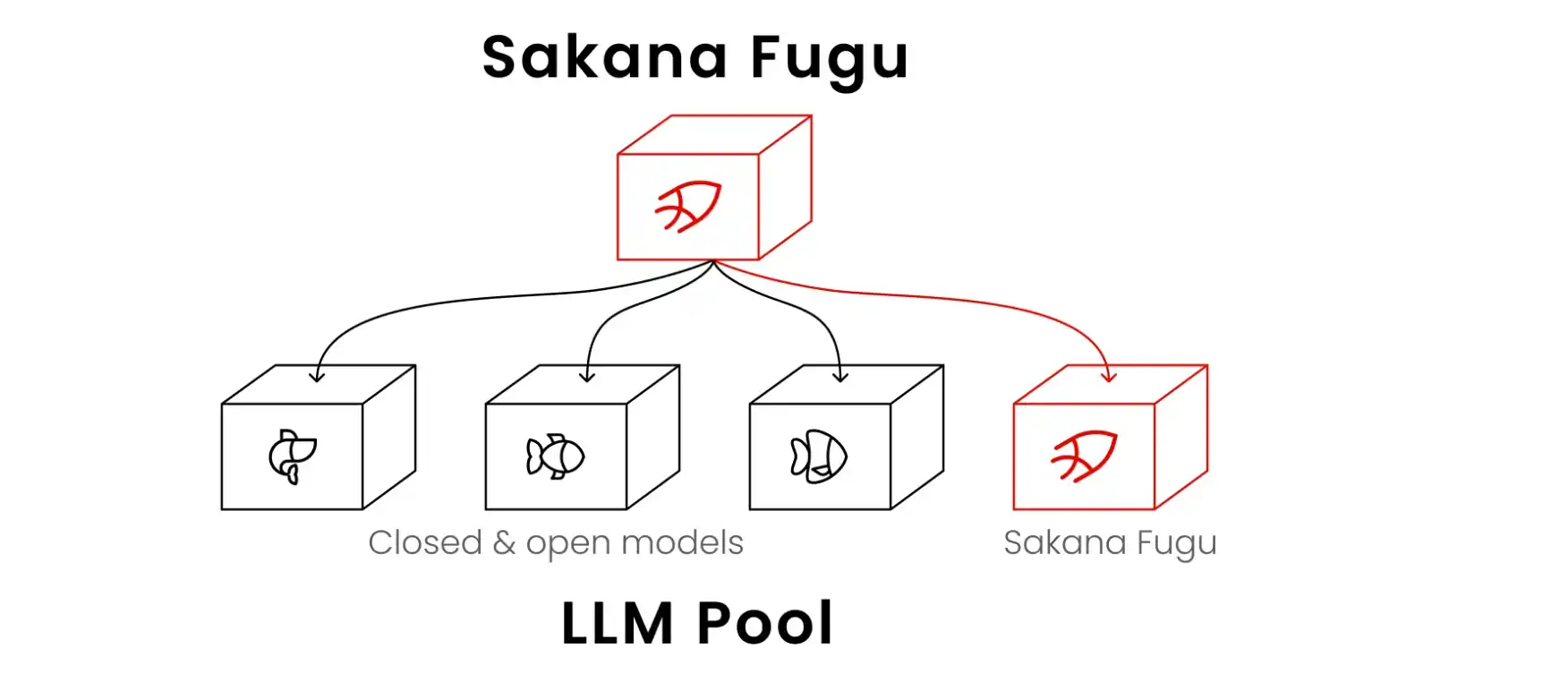
Fugu fundamentally changed this paradigm. Its core is a 7B-parameter model trained with reinforcement learning, called the RL Conductor. This 7B model does not directly generate the final answer; instead, it plays the role of a "project manager." When a user submits a task through a single OpenAI-compatible API, the RL Conductor dynamically analyzes the task type and then assigns subtasks to top global models in its agent pool, such as GPT-5, Gemini 3.1 Pro, or Claude Opus 4.8. It is responsible for scheduling, verifying, and synthesizing the outputs of these models, ultimately providing a result that has undergone multiple rounds of verification.

The theoretical underpinning for this architecture comes from two papers at ICLR 2026: "TRINITY: An Evolved LLM Coordinator" and "Learning to Orchestrate Agents in Natural Language with the Conductor." The papers detail how a small-parameter model can "conduct" large models through reinforcement learning. This changes the paradigm of "Test-time scaling." In the past, computing power was primarily used for deep inference within the model, making the model "struggle" for an answer. Now, computing power is used for external scheduling, verification, and synthesis. Traditional large models are monolithic all-rounders, while Fugu is a team of experts. The 7B RL Conductor proves that model parameter size is no longer the sole determinant of capability; knowing how to call tools and external agents can also lead to performance leaps.

The Truth Behind the Scores: Matching Fable and Surpassing GPT-5.5

The immediate reason for Fugu's sensation is its benchmark scores in rigorous tests. In the AI industry, benchmark scores are the hard currency for measuring model capabilities, but different benchmarks focus on entirely different aspects. The SWE-Bench Pro and TerminalBench 2.1 chosen by Sakana AI are both "tough nuts" biased towards real-world engineering environments.

SWE-Bench Pro focuses on software engineering capabilities, requiring models to locate and fix bugs in real codebases. According to data published in the Sakana AI console, Fugu Ultra scored 73.7 on SWE-Bench Pro. For comparison, Claude Opus 4.8 scored 69.2, GPT-5.5 scored 58.6, and Gemini 3.1 Pro scored 54.2. On TerminalBench 2.1, another test for system operation capabilities, Fugu Ultra scored 82.1, surpassing GPT-5.5's 78.2 and Opus 4.8's 74.6. These two tests not only examine a model's code generation ability but also its logical stability and tool-calling capability in multi-step, long-chain tasks. Fugu Ultra's lead means it experiences fewer mid-process crashes or deviations from goals when handling complex engineering problems compared to monolithic models.
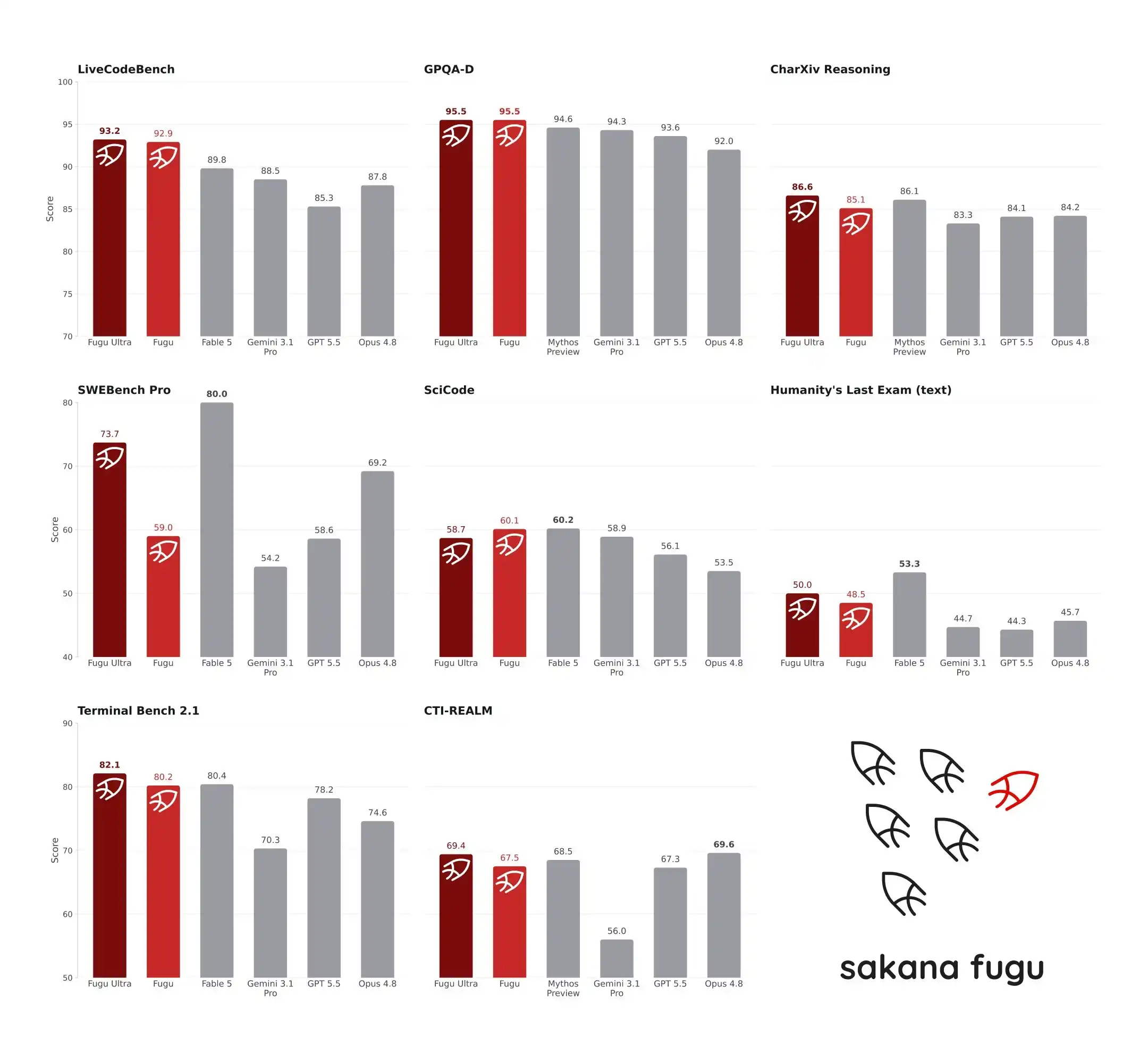
More attention was paid to the comparison between Fugu and Fable 5/Mythos Preview. Anthropic's Fable series and another frontier lab's Mythos series represent the pinnacle of current AI reasoning capabilities. However, due to export controls or incomplete public release, these two models are not part of Fugu's agent pool. Sakana AI officially claims that Fugu Ultra is "on par" with Fable 5 and Mythos Preview on engineering and science benchmarks. It must be clarified, however, that this comparison is not based on head-to-head testing in the same pool. Fugu's scores are based on actual runs of its own system, while Fable and Mythos data are based on report scores publicly released by their respective vendors.

This comparison methodology has sparked some controversy in the developer community. Some argue that test conditions across different systems and environments are difficult to align perfectly, making direct score comparisons unfair. However, other developers point out that referencing vendor-reported data is industry practice in the absence of a unified testing environment. Setting aside the controversy with Fable and Mythos, Fugu Ultra's surpassing of GPT-5.5 and Opus 4.8 on SWE-Bench Pro and TerminalBench 2.1 is a real, like-for-like comparison. This surpassing is not because Fugu's underlying model is smarter than GPT-5.5, but because the RL Conductor performs task decomposition and expert scheduling more precisely. In experiments requiring multiple rounds of reasoning and verification, such as AutoResearch, Rubik's Cube solving, and mechanical design, Fugu consistently showed advantages. This indicates that in handling "long, messy, multi-step" real-world workflows, the multi-agent orchestration architecture indeed offers more resilience than monolithic models.

Real Development Scenario Tests: Code Review and Long Session Stability

For developers and AI tool users, benchmark scores are only references. What truly determines a model's usefulness is its performance in real work scenarios. Fugu underwent beta testing with nearly 500 early users before release. Their feedback revealed Fugu's unique value in practical applications.

Code review is one of the most common AI scenarios for developers. Traditional monolithic models often only find superficial syntax errors or common logic bugs when reviewing code. In beta testing, some developers reported that Fugu demonstrated unusually detailed performance in code reviews, capable of uncovering deep architectural bugs, while other tools often found only a few surface-level issues. This difference stems from Fugu's architecture. Upon receiving a code review task, the RL Conductor can call models specializing in static analysis, logical reasoning, and security auditing respectively to conduct cross-validation on the same piece of code from multiple angles. This "expert consultation" model naturally uncovers more hidden problems than the "solo effort" of a single model.

Another frequently mentioned advantage is long-session stability. When building AI Agent products, one of developers' biggest headaches is the model's "persona drift" in long conversations. As the number of dialogue rounds increases, monolithic models often forget the initial setup or deviate in instruction following. After testing, some enterprise executives reported that Fugu's Persona in long conversations is exceptionally stable, with almost no drift. This is because the RL Conductor itself is not responsible for maintaining long-text memory; it only selects the most appropriate underlying model to generate a response in each dialogue round based on the current context. This architecture of "separation of control and generation" greatly improves Agent stability during long-running sessions.

In the field of cybersecurity, Fugu also demonstrated end-to-end practical capability. In tests, Fugu could independently complete the entire workflow from reconnaissance, XSS/SQLi vulnerability detection to authentication review, and generate a complete penetration test report, strictly adhering to instructions not to cross boundaries and damage systems. This level of completion for complex tasks relies on the RL Conductor's precise orchestration of security toolchains and the capabilities of different large models.

In addition, token efficiency is a major highlight of Fugu. Traditional large models often generate lengthy chains of thought, consuming a large number of tokens when dealing with complex problems. Fugu's RL Conductor avoids wasteful long CoT consumption through precise routing. Official data and early testing show it can significantly reduce waste of ineffective tokens. For developers billed by tokens, this means not only cost reduction but also improved response speed.

The Achilles' Heel of Underlying Dependency: The Cost of Multi-Agent Orchestration

Although Fugu shines in architecture and benchmark scores, as a tool for practical work, it is not without weaknesses. The multi-agent orchestration architecture, while bringing performance breakthroughs, also introduces significant risks and limitations.

The core issue is underlying dependency risk. Fugu's agent pool heavily relies on underlying APIs from US giants like GPT, Claude, and Gemini. Although the RL Conductor has dynamic routing capabilities and can switch to other models if one fails or is rate-limited, this only mitigates single-supplier risk. It does not and cannot detach from the entire US AI infrastructure ecosystem. If these underlying models collectively raise prices, impose large-scale rate limits, or change API terms, Fugu's cost structure and stability will be directly impacted. This "parasitic" mode, living atop others' infrastructure, has inherent fragility in commercialization and long-term stability.

Next is the trade-off between latency and cost structure. While the RL Conductor saves on ineffective token consumption through precise routing, multi-agent orchestration inevitably involves multiple API calls and inter-model communication. For real-time interaction scenarios requiring extremely low latency, such as real-time voice conversations or high-frequency trading assistance, Fugu Ultra's "deep thinking and scheduling" time may be longer than directly calling a monolithic model. In scenarios where response speed is paramount, Fugu's architectural advantage could become a drag on user experience.

Furthermore, controversies over fairness of comparison persist. As mentioned, Fugu claims parity with Fable and Mythos, but the latter two are not in its agent pool. In the developer community, some voices question whether comparisons based on vendor-reported data have practical reference value. After all, model performance can vary greatly across different task distributions, and simple aggregate score comparisons might mask specific strengths and weaknesses. For developers needing precise model capability assessments, the lack of head-to-head test data means they must remain cautious during selection.

Not Competing on Compute, but on Orchestration: Japan's Asymmetric Breakthrough in Large Models

Looking beyond the specific product review, Fugu's birth carries deeper implications for Japan's large model ecosystem. In the global AI arms race, Japan is in an awkward position. It lacks both the continuous influx of top-tier computing power and frontier algorithm accumulation of the US, and the massive data pools and fiercely competitive market environment of China. More critically, Japan also faces export control risks from US frontier models (like Fable/Mythos). Against this backdrop, Sakana AI's "evolutionary algorithm" and "multi-agent orchestration" route showcase the logic of "asymmetric breakthrough" for a resource-constrained nation.

Japan does have domestic large model players. NTT released tsuzumi, and institutions like ELYZA, Rinna, and LLM-jp are also working hard to train local language models. However, most follow the traditional "train from scratch" route, struggling to compete with top US and Chinese models in parameter scale and general capabilities. Sakana AI is the only Japanese lab with global frontier influence that champions an "asymmetric architecture."

Fugu's dynamic routing capability essentially helps Japanese companies and institutions establish "AI Sovereignty." Under limited computing resources, instead of spending huge sums to train a hundred-billion-parameter model that is inferior to GPT-5.5 in all aspects, it's better to train a clever 7B "project manager." This manager can flexibly connect to the world's best models based on task needs. If one day a US model faces export controls or supply cuts, the RL Conductor can quickly route tasks to other available models, even connecting to Japan's domestic specialized models. This architecture gives Japan a degree of autonomy and risk resilience in utilizing AI capabilities.

Observing the global AI tool ecosystem, OmniTools notes that large model capabilities are gradually leveling, and the main battleground of competition is shifting from mere parameter stacking to toolchains and landing scenarios. The emergence of Fugu precisely confirms this trend. It no longer pursues perfection in a single model but pursues optimality at the system level. This thinking holds significant reference value for nations and regions lacking advantages in compute and data.

Of course, this "asymmetric breakthrough" has its ceiling. As long as the core technology of underlying models remains in the hands of a few giants, the capability ceiling of orchestration systems will be limited by those underlying models. Fugu proves a 7B model can be an excellent conductor, but it cannot magically create capabilities that the underlying models lack. For Japan's large models to truly achieve a breakthrough, beyond architectural innovation in orchestration, continued investment in underlying computing power, core algorithms, and high-quality data is still necessary. Fugu is an ingenious system-level innovation, but it's not a panacea. For developers and enterprise users, Fugu provides a highly competitive new option in complex engineering scenarios. However, when using it, one must also be clear-eyed about its underlying dependency vulnerabilities and the latency-cost trade-offs.


Trend Kriptolar

İlgili Sorular

QWhat is the core innovation and role of the 7B-parameter model in Sakana AI's Fugu system?

AThe core innovation is a 7B-parameter model called the RL Conductor, which acts as a 'foreman' or intelligent orchestrator. It does not directly generate final answers but dynamically analyzes user tasks and dispatches subtasks to a pool of top-tier global foundation models like GPT-5 or Claude Opus. It is responsible for scheduling, verifying, and synthesizing these models' outputs.

QOn which two benchmark tests did Fugu Ultra outperform models like GPT-5.5 and Claude Opus 4.8, and what do these tests evaluate?

AFugu Ultra outperformed competitors on SWE-Bench Pro and TerminalBench 2.1. SWE-Bench Pro evaluates software engineering capabilities, specifically locating and fixing bugs in real codebases. TerminalBench 2.1 tests system operation capabilities, focusing on multi-step tasks in real-world engineering environments.

QAccording to the article, what are two key practical advantages of Fugu's architecture reported by early beta testers?

ATwo key practical advantages are: 1) Superior code review capabilities, where Fugu's multi-agent 'expert consultation' approach finds deeper architectural bugs compared to single models. 2) Exceptional long-session stability, where the RL Conductor's 'control-generation separation' architecture prevents persona drift over long conversations by selecting the best model for each turn based on context.

QWhat are the main weaknesses or risks associated with Fugu's multi-agent orchestration architecture?

AThe main weaknesses are: 1) Underlying dependency risk, as Fugu's agent pool relies on APIs from major US AI providers, making it vulnerable to collective price changes, rate limits, or policy shifts. 2) Latency trade-offs, where the orchestration process involving multiple API calls can introduce higher latency unsuitable for real-time interaction scenarios.

QHow does the Fugu system represent a 'non-symmetric breakthrough' strategy for Japan's AI industry, according to the article?

AIt represents a 'non-symmetric breakthrough' by circumventing Japan's limitations in compute power and data. Instead of expensively training a massive general-purpose model that can't compete with US/China leaders, Japan focused on training a smart, small 'foreman' model (the RL Conductor) that orchestrates the world's best models. This grants a degree of AI sovereignty and risk resilience, allowing flexible routing if certain US models become unavailable, though ultimate capability is still bounded by the underlying models.

İlgili Okumalar

Report Interpretation: J.P. Morgan Details Micron's Pre-Earnings Sentiment, Current Hardware Sector Dynamics

Morgan Stanley analyst Joshua Meyers' report (June 21, 2026) highlights key trends in the hardware and semiconductor sector ahead of Micron's earnings. The core takeaways are: 1. **Micron & Memory:** Memory remains a high-conviction long theme, driven by strong AI demand and rising ASPs. However, investor focus is shifting to the sustainability of Micron's >80% gross margins and the specifics of potential new long-term supply agreements (SCAs). 2. **Hardware Supply Chain:** AI-related demand for servers, networking, and storage remains robust, but company performance is diverging. Celestica (CLS) shows improved margin confidence, Western Digital and Seagate benefit from pricing, Fabrinet (FN) sees predictable AI optics growth, and Teradyne (TER) anticipates a new Google customer. 3. **AI Capex & WFE Forecasts:** JPMorgan increased its Wafer Fab Equipment (WFE) market growth forecasts to 28% in 2026 and 29% in 2027. AI infrastructure financing is evolving, with higher project-level debt reducing constraints on capex expansion. The report signals that while the AI-driven hardware cycle is strong, the market is entering a phase focused on execution verification (e.g., Micron's SCA details, Fabrinet's ramp with Amazon) and valuation sustainability. Key near-term signals include Micron's guidance, Arista Networks' outlook, and the pace of demand normalization post potential tariff-related pull-ins.

marsbit1 saat önce

Report Interpretation: J.P. Morgan Details Micron's Pre-Earnings Sentiment, Current Hardware Sector Dynamics

marsbit1 saat önce

Research Report Analysis: The Fed's New Chair's Debut – New Leader, But Same Script?

Report Analysis: Federal Reserve's New Chair Debut – A New Captain, But the Same Script? Morgan Stanley's chief global economist Seth B. Carpenter analyzes the first FOMC meeting under new Fed Chair Kevin Warsh in a June 21 report. Warsh deliberately avoided providing forward guidance on interest rates, aligning with his philosophy. However, market expectations for a rate hike this year were reinforced. Key signals lie elsewhere: inflation may fall more than expected, and quantitative tightening (QT) could be more aggressive than anticipated. The FOMC's "dot plot" suggests only one rate hike in 2026. Carpenter argues that if inflation undershoots forecasts, the logic for even a single hike weakens, especially as projections indicate potential rate cuts in 2027. On QT, Warsh's stance is clear. Carpenter notes that measures like halving the Treasury's account balance could shrink the Fed's balance sheet by around $500 billion with minimal market impact. Combined with adjustments to reserve interest and liquidity rules, the ultimate QT scale may exceed expectations, though its market effect might be less disruptive unless the Fed actively sells Mortgage-Backed Securities (MBS). While Warsh initiated a review of the Fed's policy framework, the 2% inflation target remains intact for now. The report concludes that the market may be overestimating the significance of reduced forward guidance and the near-term rate hike risk, while potentially underestimating the scope and manageable nature of the coming balance sheet reduction. The key debates will hinge on upcoming core PCE data, the specifics of the QT path, and the framework review's findings.

marsbit2 saat önce

Research Report Analysis: The Fed's New Chair's Debut – New Leader, But Same Script?

marsbit2 saat önce

Critical Game Week: BTC Retracement Confirmation vs. HYPE Support Battle | Guest Analysis

This weekly analysis outlines a critical juncture for BTC and HYPE markets, focusing on key price level confirmations. **BTC Analysis:** BTC is at a pivotal point after a five-wave rally from the June 5th low of $59,100. The price has broken below a short-term rising channel's lower boundary, with the current move seen as a pullback to test this breakdown. Failure to reclaim this level could lead to a retest of the $59,000-$60,000 support zone. The core scenario hinges on this channel retest outcome. * **Key Levels:** Resistance at $64,500-$65,000 (channel boundary) and $69,500-$70,500. Support at $59,000-$60,000 and $55,000. * **Strategy:** A core bearish stance is maintained (20% short from last week), with short-term plans for tactical trades. Three detailed contingency plans (A/B/C) are provided for short positions on resistance tests or breakdowns, emphasizing strict stop-loss discipline. **HYPE Analysis:** HYPE shows strong momentum but is currently in a corrective phase after hitting a new high of $76.94. The price is retesting the crucial $64-$66 support area. * **Key Levels:** Resistance near $77 and $80-$82. Support at $64-$66 and $52-$54. * **Strategy:** The short-term approach is "buy on dips, avoid chasing rallies." A long position is considered only if clear stabilization signals appear at the $64-$66 or deeper $52-$54 support zones, with tight risk controls. **General Risk Management:** A standardized trailing stop-loss protocol is emphasized: set initial stop, breakeven at +1% profit, then trail stops upward to lock in gains. *Disclaimer: All analysis is presented as a personal trading framework, not investment advice. Market conditions are complex and require dynamic adjustment.*

marsbit2 saat önce

Critical Game Week: BTC Retracement Confirmation vs. HYPE Support Battle | Guest Analysis

marsbit2 saat önce

Research Report Interpretation: Citi Attends AWS Summit, Bullish on Cloud Business Acceleration but Data Governance Remains Key Variable

Citi analyst Tyler Radke's team attended the AWS New York Summit (June 17-18), engaging with over 10 clients and partners. In a June 19 report, they highlighted the summit's focus on scaling agent AI for enterprise deployment. Citi maintains a "Buy" rating on Amazon, forecasting AWS revenue growth to accelerate to 37% in FY27 from 30% in FY26, noting this estimate may be conservative. Key takeaways: 1. **AWS Strategy Shift:** AWS is moving from proof-of-concepts to scalable deployment. New offerings like AWS Context (building enterprise knowledge graphs), Amazon Quick (cross-application AI assistant), and security tool Continuum address core enterprise pain points for AI adoption. 2. **Data Infrastructure Beneficiaries:** Data infrastructure companies like Snowflake, Elastic, Oracle, and ClickHouse are seen as direct beneficiaries of scaling AI workloads, as evidenced by strong growth and use cases presented. 3. **Critical Role of Data Governance:** As AI agents scale from hundreds to thousands, effective data governance becomes the key variable for deploying AI in core business processes. AWS Context represents AWS's strategic extension from providing compute/models to offering a data governance infrastructure layer. The report emphasizes that without solving data governance, AI will remain confined to pilot projects. The investment thesis focuses on AWS revenue acceleration and data infrastructure vendors' growth, while monitoring signals like AWS's quarterly revenue growth, Bedrock AgentCore task volume, and pricing impacts on companies like Elastic.

marsbit2 saat önce

Research Report Interpretation: Citi Attends AWS Summit, Bullish on Cloud Business Acceleration but Data Governance Remains Key Variable

marsbit2 saat önce

İşlemler

Spot
Futures

Popüler Makaleler

$S$ Nedir

SPERO'yu Anlamak: Kapsamlı Bir Genel Bakış SPERO'ya Giriş İnovasyonun manzarası gelişmeye devam ederken, web3 teknolojilerinin ve kripto para projelerinin ortaya çıkışı dijital geleceği şekillendirmede önemli bir rol oynamaktadır. Bu dinamik alanda dikkat çeken projelerden biri SPERO, $$s$$ olarak adlandırılmaktadır. Bu makale, SPERO hakkında ayrıntılı bilgi toplamak ve sunmak amacıyla, meraklılar ve yatırımcıların web3 ve kripto alanlarındaki temellerini, hedeflerini ve yeniliklerini anlamalarına yardımcı olmayı amaçlamaktadır. SPERO,$$s$$ Nedir? SPERO,$$s$$, kripto alanında merkeziyetsizlik ve blok zinciri teknolojisi ilkelerini kullanarak etkileşimi, faydayı ve finansal kapsayıcılığı teşvik eden bir ekosistem yaratmayı amaçlayan benzersiz bir projedir. Proje, kullanıcıların yenilikçi finansal çözümler ve hizmetler sunarak eşler arası etkileşimleri yeni yollarla kolaylaştırmayı hedeflemektedir. SPERO,$$s$$'nin temel amacı, bireyleri güçlendirmek ve kripto para alanındaki kullanıcı deneyimini artıran araçlar ve platformlar sağlamaktır. Bu, daha esnek işlem yöntemlerini mümkün kılmayı, topluluk odaklı girişimleri teşvik etmeyi ve merkeziyetsiz uygulamalar (dApp'ler) aracılığıyla finansal fırsatlar yaratmayı içermektedir. SPERO,$$s$$'nin temel vizyonu kapsayıcılık etrafında dönmekte olup, geleneksel finansal sistemlerdeki boşlukları kapatmayı ve blok zinciri teknolojisinin faydalarından yararlanmayı hedeflemektedir. SPERO,$$s$$'nin Yaratıcısı Kimdir? SPERO,$$s$$'nin yaratıcısının kimliği bir miktar belirsizdir, çünkü kurucusu(ları) hakkında ayrıntılı arka plan bilgisi sağlayan sınırlı kamuya açık kaynaklar bulunmaktadır. Bu şeffaflık eksikliği, projenin merkeziyetsizlik taahhüdünden kaynaklanabilir—birçok web3 projesinin paylaştığı bir etik anlayışı, bireysel tanınmanın yerine kolektif katkıları önceliklendirmektedir. Topluluk ve onun kolektif hedefleri etrafında tartışmaları merkezileştirerek, SPERO,$$s$$, belirli bireyleri öne çıkarmadan güçlendirme özünü taşımaktadır. Bu nedenle, SPERO'nun etik anlayışını ve misyonunu anlamak, tek bir yaratıcının kimliğini belirlemekten daha önemlidir. SPERO,$$s$$'nin Yatırımcıları Kimlerdir? SPERO,$$s$$, kripto sektöründe yeniliği teşvik etmeye adanmış girişim sermayedarlarından melek yatırımcılara kadar çeşitli yatırımcılar tarafından desteklenmektedir. Bu yatırımcıların odak noktası genellikle SPERO'nun misyonuyla uyumlu olup, toplumsal teknolojik ilerlemeyi, finansal kapsayıcılığı ve merkeziyetsiz yönetimi vaat eden projeleri önceliklendirmektedir. Bu yatırımcı temelleri, yalnızca yenilikçi ürünler sunan projelere değil, aynı zamanda blok zinciri topluluğuna ve ekosistemlerine olumlu katkılarda bulunan projelere de ilgi duymaktadır. Bu yatırımcıların desteği, SPERO,$$s$$'yi hızla gelişen kripto projeleri alanında dikkate değer bir rakip haline getirmektedir. SPERO,$$s$$ Nasıl Çalışır? SPERO,$$s$$, onu geleneksel kripto para projelerinden ayıran çok yönlü bir çerçeve kullanmaktadır. İşte benzersizliğini ve yeniliğini vurgulayan bazı temel özellikler: Merkeziyetsiz Yönetim: SPERO,$$s$$, kullanıcıların projenin geleceğiyle ilgili karar alma süreçlerine aktif olarak katılmalarını sağlayan merkeziyetsiz yönetim modellerini entegre etmektedir. Bu yaklaşım, topluluk üyeleri arasında sahiplik ve hesap verebilirlik duygusunu teşvik etmektedir. Token Kullanımı: SPERO,$$s$$, ekosistem içinde çeşitli işlevler sunmak üzere tasarlanmış kendi kripto para token'ını kullanmaktadır. Bu token'lar, işlemleri, ödülleri ve platformda sunulan hizmetlerin kolaylaştırılmasını sağlayarak genel etkileşimi ve faydayı artırmaktadır. Katmanlı Mimari: SPERO,$$s$$'nin teknik mimarisi, modülerlik ve ölçeklenebilirliği destekleyerek projenin evrimi sırasında ek özelliklerin ve uygulamaların sorunsuz bir şekilde entegrasyonuna olanak tanımaktadır. Bu uyum sağlama yeteneği, sürekli değişen kripto manzarasında geçerliliği sürdürmek için hayati öneme sahiptir. Topluluk Katılımı: Proje, işbirliği ve geri bildirim teşvik eden mekanizmalar kullanarak topluluk odaklı girişimlere vurgu yapmaktadır. Güçlü bir topluluk oluşturarak, SPERO,$$s$$, kullanıcı ihtiyaçlarını daha iyi karşılayabilir ve piyasa trendlerine uyum sağlayabilir. Kapsayıcılığa Odaklanma: Düşük işlem ücretleri ve kullanıcı dostu arayüzler sunarak, SPERO,$$s$$, daha önce kripto alanında yer almamış bireyler de dahil olmak üzere çeşitli bir kullanıcı tabanını çekmeyi hedeflemektedir. Bu kapsayıcılık taahhüdü, erişilebilirlik yoluyla güçlendirme misyonuyla uyumludur. SPERO,$$s$$ Zaman Çizelgesi Bir projenin tarihini anlamak, gelişim yolculuğu ve kilometre taşları hakkında kritik bilgiler sağlar. Aşağıda, SPERO,$$s$$'nin evriminde önemli olayları haritalayan önerilen bir zaman çizelgesi bulunmaktadır: Kavram Geliştirme ve Fikir Aşaması: SPERO,$$s$$'nin temelini oluşturan ilk fikirler, blok zinciri endüstrisindeki merkeziyetsizlik ve topluluk odaklılık ilkeleriyle yakından uyumlu olarak geliştirildi. Proje Beyaz Kağıdının Yayınlanması: Kavramsal aşamayı takiben, SPERO,$$s$$'nin vizyonunu, hedeflerini ve teknolojik altyapısını ayrıntılı bir şekilde açıklayan kapsamlı bir beyaz kağıt yayımlandı ve topluluk ilgisini ve geri bildirimini toplamak amacıyla sunuldu. Topluluk Oluşturma ve Erken Katılımlar: Projenin hedefleri etrafında tartışmalar yürüterek destek toplamak ve erken benimseyenler ile potansiyel yatırımcılar için bir topluluk oluşturmak amacıyla aktif iletişim çabaları gerçekleştirildi. Token Üretim Etkinliği: SPERO,$$s$$, yerel token'larını erken destekçilere dağıtmak ve ekosistem içinde başlangıç likiditesini sağlamak amacıyla bir token üretim etkinliği (TGE) gerçekleştirdi. İlk dApp'in Yayınlanması: SPERO,$$s$$ ile ilişkili ilk merkeziyetsiz uygulama (dApp) faaliyete geçti ve kullanıcıların platformun temel işlevleriyle etkileşimde bulunmalarını sağladı. Sürekli Gelişim ve Ortaklıklar: Projenin tekliflerine sürekli güncellemeler ve iyileştirmeler yapılmakta olup, blok zinciri alanındaki diğer oyuncularla stratejik ortaklıklar, SPERO,$$s$$'yi rekabetçi ve gelişen bir oyuncu haline getirmiştir. Sonuç SPERO,$$s$$, web3 ve kripto paranın finansal sistemleri devrim niteliğinde dönüştürme ve bireyleri güçlendirme potansiyelinin bir kanıtıdır. Merkeziyetsiz yönetime, topluluk katılımına ve yenilikçi tasarlanmış işlevselliğe olan bağlılığıyla, daha kapsayıcı bir finansal manzaraya doğru bir yol açmaktadır. Hızla gelişen kripto alanındaki herhangi bir yatırımda olduğu gibi, potansiyel yatırımcılar ve kullanıcılar, SPERO,$$s$$ içindeki devam eden gelişmelerle ilgili olarak kapsamlı bir araştırma yapmaları ve düşünceli bir şekilde katılmaları teşvik edilmektedir. Proje, kripto endüstrisinin yenilikçi ruhunu sergileyerek, sayısız olasılığını keşfetmeye davet etmektedir. SPERO,$$s$$'nin yolculuğu hala devam ederken, temel ilkeleri, teknoloji, finans ve birbirimizle etkileşim biçimimizi etkileyebilir.

102 Toplam GörüntülenmeYayınlanma 2024.12.17Güncellenme 2024.12.17

$S$ Nedir

AGENT S Nedir

Agent S: Web3'te Otonom Etkileşimin Geleceği Giriş Web3 ve kripto para dünyasında sürekli gelişen manzarada, yenilikler bireylerin dijital platformlarla etkileşim biçimlerini sürekli olarak yeniden tanımlıyor. Bu tür öncü projelerden biri olan Agent S, açık ajans çerçevesi aracılığıyla insan-bilgisayar etkileşimini devrim niteliğinde değiştirmeyi vaat ediyor. Otonom etkileşimlerin yolunu açarak, Agent S karmaşık görevleri basitleştirmeyi ve yapay zeka (AI) alanında dönüştürücü uygulamalar sunmayı hedefliyor. Bu detaylı inceleme, projenin karmaşıklıklarına, benzersiz özelliklerine ve kripto para alanındaki etkilerine dalacaktır. Agent S Nedir? Agent S, bilgisayar görevlerinin otomasyonunda üç temel zorluğu ele almak üzere özel olarak tasarlanmış çığır açıcı bir açık ajans çerçevesidir: Alan Spesifik Bilgi Edinimi: Çerçeve, çeşitli dış bilgi kaynaklarından ve iç deneyimlerden akıllıca öğrenir. Bu çift yönlü yaklaşım, alan spesifik bilgi açısından zengin bir veri havuzu oluşturmasını sağlar ve görev yürütmedeki performansını artırır. Uzun Görev Ufukları Üzerinde Planlama: Agent S, karmaşık görevlerin verimli bir şekilde parçalanmasını ve yürütülmesini kolaylaştıran deneyim artırımlı hiyerarşik planlama kullanır. Bu özellik, çoklu alt görevleri etkili ve verimli bir şekilde yönetme yeteneğini önemli ölçüde artırır. Dinamik, Homojen Olmayan Arayüzlerle Başlama: Proje, ajanlar ve kullanıcılar arasındaki etkileşimi geliştiren yenilikçi bir çözüm olan Ajan-Bilgisayar Arayüzü'ni (ACI) tanıtmaktadır. Çok Modlu Büyük Dil Modellerini (MLLM'ler) kullanarak, Agent S çeşitli grafik kullanıcı arayüzlerini sorunsuz bir şekilde gezinebilir ve manipüle edebilir. Bu öncü özellikler aracılığıyla, Agent S, makinelerle insan etkileşimini otomatikleştirmede karşılaşılan karmaşıklıkları ele alan sağlam bir çerçeve sunarak, AI ve ötesinde birçok uygulama için zemin hazırlıyor. Agent S'nin Yaratıcısı Kimdir? Agent S'nin kavramı temelde yenilikçi olsa da, yaratıcısı hakkında spesifik bilgiler belirsizliğini koruyor. Yaratıcı şu anda bilinmiyor, bu da projenin yeni aşamasını veya kurucu üyeleri gizli tutma stratejik tercihini vurguluyor. Anonimlikten bağımsız olarak, odak çerçevenin yetenekleri ve potansiyeli üzerinde kalıyor. Agent S'nin Yatırımcıları Kimlerdir? Agent S, kriptografik ekosistemde oldukça yeni olduğundan, yatırımcıları ve finansal destekçileri hakkında ayrıntılı bilgiler açıkça belgelenmemiştir. Projeyi destekleyen yatırım temelleri veya organizasyonları hakkında kamuya açık bilgilerdeki eksiklik, finansman yapısı ve gelişim yol haritası hakkında sorular doğuruyor. Destekleyicilerin anlaşılması, projenin sürdürülebilirliğini ve potansiyel pazar etkisini değerlendirmek için kritik öneme sahiptir. Agent S Nasıl Çalışır? Agent S'nin temelinde, çeşitli ortamlarda etkili bir şekilde çalışmasını sağlayan son teknoloji bir sistem yatmaktadır. İşleyiş modeli birkaç ana özellik etrafında inşa edilmiştir: İnsan Benzeri Bilgisayar Etkileşimi: Çerçeve, bilgisayarlarla etkileşimleri daha sezgisel hale getirmeyi amaçlayan gelişmiş AI planlaması sunar. Görev yürütmedeki insan davranışını taklit ederek, kullanıcı deneyimlerini yükseltmeyi vaat eder. Anlatı Belleği: Yüksek düzeyde deneyimlerden yararlanmak için kullanılan Agent S, görev geçmişlerini takip etmek amacıyla anlatı belleğini kullanarak karar verme süreçlerini geliştirir. Episodik Bellek: Bu özellik, kullanıcılara adım adım rehberlik sağlayarak, çerçevenin görevler gelişirken bağlamsal destek sunmasına olanak tanır. OpenACI Desteği: Yerel olarak çalışabilme yeteneği ile Agent S, kullanıcıların etkileşimleri ve iş akışları üzerinde kontrol sağlamasına olanak tanır ve Web3'ün merkeziyetsiz felsefesiyle uyumlu hale gelir. Dış API'lerle Kolay Entegrasyon: Çeşitli AI platformlarıyla uyumluluğu ve çok yönlülüğü, Agent S'nin mevcut teknolojik ekosistemlere sorunsuz bir şekilde entegre olmasını sağlar ve geliştiriciler ile organizasyonlar için cazip bir seçenek haline getirir. Bu işlevsellikler, Agent S'nin kripto alanındaki benzersiz konumuna katkıda bulunarak, karmaşık, çok aşamalı görevleri minimum insan müdahalesi ile otomatikleştirir. Proje geliştikçe, Web3'teki potansiyel uygulamaları dijital etkileşimlerin nasıl gelişeceğini yeniden tanımlayabilir. Agent S'nin Zaman Çizelgesi Agent S'nin gelişimi ve kilometre taşları, önemli olaylarını vurgulayan bir zaman çizelgesinde özetlenebilir: 27 Eylül 2024: Agent S'nin kavramı, “Bilgisayarları İnsan Gibi Kullanan Açık Bir Ajans Çerçevesi” başlıklı kapsamlı bir araştırma makalesi ile tanıtıldı ve projenin temelini sergiledi. 10 Ekim 2024: Araştırma makalesi arXiv'de kamuya açık olarak yayınlandı ve çerçevenin derinlemesine bir incelemesini ve OSWorld benchmark'ına dayalı performans değerlendirmesini sundu. 12 Ekim 2024: Agent S'nin yetenekleri ve özellikleri hakkında görsel bir içgörü sağlayan bir video sunumu yayımlandı ve potansiyel kullanıcılar ve yatırımcılarla daha fazla etkileşim sağlandı. Bu zaman çizelgesindeki işaretler, sadece Agent S'nin ilerlemesini değil, aynı zamanda şeffaflık ve topluluk katılımına olan bağlılığını da göstermektedir. Agent S Hakkında Ana Noktalar Agent S çerçevesi gelişmeye devam ederken, birkaç ana özellik öne çıkmakta ve yenilikçi doğasını ve potansiyelini vurgulamaktadır: Yenilikçi Çerçeve: İnsan etkileşimine benzer bir bilgisayar kullanımı sağlamak üzere tasarlanan Agent S, görev otomasyonuna yeni bir yaklaşım getiriyor. Otonom Etkileşim: GUI aracılığıyla bilgisayarlarla otonom olarak etkileşim kurabilme yeteneği, daha akıllı ve verimli hesaplama çözümlerine doğru bir sıçrama anlamına geliyor. Karmaşık Görev Otomasyonu: Sağlam metodolojisi ile karmaşık, çok aşamalı görevleri otomatikleştirerek süreçleri daha hızlı ve daha az hata payı ile gerçekleştirebilir. Sürekli İyileştirme: Öğrenme mekanizmaları, Agent S'nin geçmiş deneyimlerden öğrenmesini sağlar ve sürekli olarak performansını ve etkinliğini artırır. Çok Yönlülük: OSWorld ve WindowsAgentArena gibi farklı işletim ortamlarında uyumlu olması, geniş bir uygulama yelpazesine hizmet edebilmesini sağlar. Agent S, Web3 ve kripto alanında kendini konumlandırırken, etkileşim yeteneklerini artırma ve süreçleri otomatikleştirme potansiyeli, AI teknolojilerinde önemli bir ilerlemeyi temsil etmektedir. Yenilikçi çerçevesi aracılığıyla, Agent S dijital etkileşimlerin geleceğini örneklemekte ve çeşitli sektörlerde kullanıcılar için daha sorunsuz ve verimli bir deneyim vaat etmektedir. Sonuç Agent S, AI ve Web3'ün birleşiminde cesur bir sıçramayı temsil ediyor ve teknoloji ile etkileşim biçimimizi yeniden tanımlama kapasitesine sahip. Henüz erken aşamalarında olmasına rağmen, uygulama olanakları geniş ve çekici. Kritik zorlukları ele alan kapsamlı çerçevesi ile Agent S, otonom etkileşimleri dijital deneyimin ön plana çıkmasına taşımayı hedefliyor. Kripto para ve merkeziyetsizlik alanlarına daha derinlemesine girdikçe, Agent S gibi projelerin teknoloji ve insan-bilgisayar işbirliğinin geleceğini şekillendirmede önemli bir rol oynayacağı kesin.

593 Toplam GörüntülenmeYayınlanma 2025.01.14Güncellenme 2025.01.14

AGENT S Nedir

S Nasıl Satın Alınır

HTX.com’a hoş geldiniz! Sonic (S) satın alma işlemlerini basit ve kullanışlı bir hâle getirdik. Adım adım açıkladığımız rehberimizi takip ederek kripto yolculuğunuza başlayın. 1. Adım: HTX Hesabınızı OluşturunHTX'te ücretsiz bir hesap açmak için e-posta adresinizi veya telefon numaranızı kullanın. Sorunsuzca kaydolun ve tüm özelliklerin kilidini açın. Hesabımı Aç2. Adım: Kripto Satın Al Bölümüne Gidin ve Ödeme Yönteminizi SeçinKredi/Banka Kartı: Visa veya Mastercard'ınızı kullanarak anında Sonic (S) satın alın.Bakiye: Sorunsuz bir şekilde işlem yapmak için HTX hesap bakiyenizdeki fonları kullanın.Üçüncü Taraflar: Kullanımı kolaylaştırmak için Google Pay ve Apple Pay gibi popüler ödeme yöntemlerini ekledik.P2P: HTX'teki diğer kullanıcılarla doğrudan işlem yapın.Borsa Dışı (OTC): Yatırımcılar için kişiye özel hizmetler ve rekabetçi döviz kurları sunuyoruz.3. Adım: Sonic (S) Varlıklarınızı SaklayınSonic (S) satın aldıktan sonra HTX hesabınızda saklayın. Alternatif olarak, blok zinciri transferi yoluyla başka bir yere gönderebilir veya diğer kripto para birimlerini takas etmek için kullanabilirsiniz.4. Adım: Sonic (S) Varlıklarınızla İşlem YapınHTX'in spot piyasasında Sonic (S) ile kolayca işlemler yapın.Hesabınıza erişin, işlem çiftinizi seçin, işlemlerinizi gerçekleştirin ve gerçek zamanlı olarak izleyin. Hem yeni başlayanlar hem de deneyimli yatırımcılar için kullanıcı dostu bir deneyim sunuyoruz.

1.6k Toplam GörüntülenmeYayınlanma 2025.01.15Güncellenme 2026.06.02

S Nasıl Satın Alınır

Tartışmalar

HTX Topluluğuna hoş geldiniz. Burada, en son platform gelişmeleri hakkında bilgi sahibi olabilir ve profesyonel piyasa görüşlerine erişebilirsiniz. Kullanıcıların S (S) fiyatı hakkındaki görüşleri aşağıda sunulmaktadır.

活动图片