Author: Hu Tao, ChainCatcher
In the crypto industry, "listing" once meant the birth of another wealth creation myth, but now, it may just be a prelude to a prolonged clearing process.
On March 18, Binance announced it would cease trading and delist 8 tokens, including Ampleforth (FORTH), Hooked Protocol (HOOK), IDEX (IDEX), Loopring (LRC), Neutron (NTRN), Radiant Capital (RDNT), and others.
On March 16, Coinbase announced the delisting of 25 contract trading pairs, including REZ-PERP, BABY-PERP, GMX-PERP, T-PERP, YB-PERP, HOME-PERP, CATI-PERP, DOGS-PERP, DRIFT-PERP, and others.
On March 12, Binance Alpha announced it would remove over 21 tokens, including DGC (DecentralGPT), BNB Card (BNB Card), PFVS (Puffverse), RDO (Reddio), MILK (MilkyWay), TAT (Tell A Tale), and others.
Earlier in January, OKX announced the delisting of 7 tokens, including ULTI, GEAR, VRA, DAO, CXT, RDNT, and ELON. Additionally, Bithumb and Upbit also announced the delisting of multiple tokens.
This "delisting storm" spanning both spot and derivatives markets sends a cold and clear signal to the outside world: top-tier cryptocurrency exchanges are undergoing a paradigm shift from an "expansion phase" to a "contraction phase" in assets.
They are reassessing asset targets, establishing new token listing and delisting mechanisms based on the liquidity, quality, transparency, etc., of tokens/projects. This serves as a deterrent to other listed or potential listing projects while better protecting investor interests.
I. "Zombified" Survival Under a Glossy Exterior
It is lamentable that the "cleanup" list includes promising stars of their time, such as LRC, FORTH, NTRN, RDNT, and others.
Among them, Loopring (LRC) became a rising star in the DeFi track with its "Layer2 scaling + decentralized exchange" narrative, as well as a shining example of Chinese projects; ELON became a hot meme coin subject due to the Musk IP effect, with its market value rapidly climbing in a short time; MilkyWay (MILK) once secured $5 million in funding with the label of a Celestia liquid staking solution, backed by well-known institutions such as Polychain and Hack VC.
The crypto market in a bull market has never been short of glossy narratives. Tracks like DeFi, NFT, meme, InfoFi, and RWA have taken turns on stage. A slogan, a white paper could easily raise tens of millions in funding; a brand-new concept could support a valuation of hundreds of millions and gain favor from various top-tier exchanges.
But these seemingly glamorous projects mostly share the same fatal problem—a lack of core technology for implementation and a sustainable business model. When market heat fades and narratives are gradually disproven, the shortcomings of these projects are infinitely magnified.
For exchanges, maintaining these projects that have lost community momentum not only means huge compliance costs but also an invisible drain on platform credibility. In an era of存量博弈 (stock game), exchanges are no longer tolerating "air assets" occupying precious liquidity resources for a long time, which is also an inevitable result of the past野蛮发展 (barbaric development) stage.
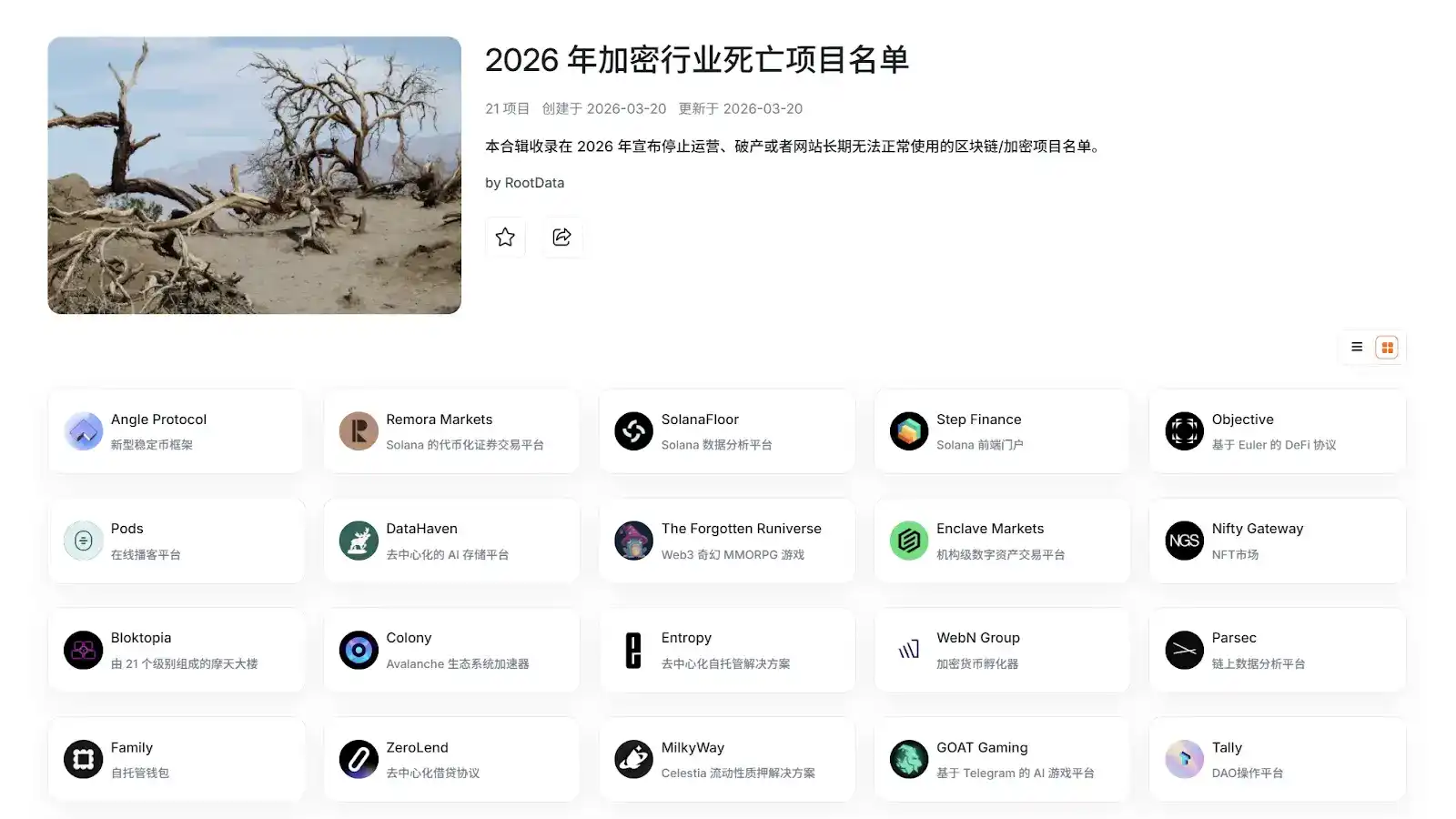
Looking at these delisted projects, DeFi and gaming are the hardest-hit areas, while also covering Layer1, DAO, and other fields, which corresponds to the changes in mainstream industry narratives. More serious than delisting is that many projects have publicly announced they are no longer operating. According to RootData statistics, these include the decentralized storage platform DataHaven, DeFi options protocol Polynomial, DAO governance platform Tally, metaverse Bloktopia, incubator Colony, data analysis platform Parsec, and others.
At the same time, cryptocurrency exchanges have successively shifted their listing focus to tokenized stocks. These assets have clear business models and market competitiveness while solving the problem of limited trading hours in traditional stock exchanges. Binance, Kraken, OKX, Bitget, Bybit, Gate, and other exchanges have already supported the trading of such assets, with the latter three supporting over 100 stock assets within months, showing strong strategic ambition.
II. Transparency is Becoming a Red Line
In addition to insufficient industry momentum, lack of transparency is also a major reason for the delisting of many projects.
As regulatory efforts in the crypto industry continue to strengthen and investor risk awareness increases, exchanges' requirements for token project transparency are becoming increasingly strict. According to official news, Binance has clearly incorporated "the level of public communication, community engagement, and transparency of the project team" and "the team's commitment to the project" into the evaluation conditions for token health.
This means that having clear team and roadmap information, a sound information disclosure mechanism, and active community communication channels are crucial for any token. But for many projects, the摆烂 (slacking off) state of "lying flat after listing" has become an awkward and harsh reality.
According to the transparency score recently launched by RootData, most of the tokens delisted by Binance and other exchanges in this round have a transparency score below 70%, with varying degrees of problems such as insufficient disclosure of project progress and missing team members. Stagnant community communication has become the norm, which leads to a significant weakening of user attention to the project and even trading willingness, forming a vicious cycle of insufficient trading volume and liquidity.
Taking Ultiverse, invested in by YZi Labs, as an example, the project has hardly posted any tweets since January, only reposting a few messages, and several core team members have done the same.
This "black box" operation not only challenges the risk defense line of exchanges but also directly harms the right to know of retail investors. The collective "great clearance" by exchanges is essentially a supply-side reform targeting "bad money," allocating more resources to assets with high transparency and solid competitiveness. In this way, exchanges are forming an institutional deterrent to on-platform projects: transparency is no longer a soft "bonus point" but a must-have for survival.
Against the backdrop of accelerated penetration by traditional capital and the gradual clarification of global regulatory frameworks, the competitive dimension of exchanges has undergone a qualitative change. The focus is no longer on trading scale and user numbers but on the quality of asset targets and the compliance of the platform. The synchronized steps of top exchanges like Binance, Coinbase, and OKX预示 (foreshadow) that a "dehydration" cycle to squeeze out the泡沫 (bubble) has already begun.