Why Is Nvidia Borrowing $20 Billion When It's Not Short of Cash?

marsbit2026-06-15 tarihinde yayınlandı2026-06-15 tarihinde güncellendi

Özet

Nvidia's recent announcement to issue at least $20 billion in senior notes, despite holding a strong cash position with over $48.6 billion in free cash flow last quarter, is not a sign of financial need. Instead, it represents a strategic move to leverage its high credit rating (recently upgraded to AA by S&P) to secure low-cost, long-term debt. This capital will support long-term AI infrastructure investments, data centers, R&D, supply chain prepayments, and strategic investments, while allowing the company to continue aggressive shareholder returns through stock buybacks and dividends. The decision reflects a mature capital management strategy: using debt to finance long-term growth assets is more efficient and less dilutive to shareholders than equity financing. It signals that Nvidia, like other tech giants (Alphabet, Meta, Amazon), is entering a new phase of heavy AI capital expenditure, shifting from a pure growth story to a story about capital allocation, credit strength, and long-term ecosystem positioning. The key question for investors is whether Nvidia can maintain its high cash flow generation and ensure that returns from these AI investments justify the cost of capital over the long term. The bond issuance amplifies its expansion capabilities but also ties its valuation more closely to the broader AI investment cycle's sustainability and profitability.

TL;DR

Nvidia's latest bond issuance is most easily misread as a simple question: with so much cash on hand, why does it need to borrow money?

According to the company's most recent quarterly data, for FY2027 Q1 ending April 26, 2026, Nvidia's revenue reached $81.6 billion, with free cash flow around $48.6 billion. At the same time, the company added $80 billion in stock repurchase authorization and raised its quarterly dividend from $0.01 to $0.25. In other words, this is not a company with tight cash flow needing the bond market to stay afloat.

But it's precisely because of this that the market is particularly sensitive to its plan to issue at least $20 billion in senior notes. The bond maturities range from 2 to 30 years, with proceeds intended for general corporate purposes, refinancing, AI data center and infrastructure, R&D, supply chain prepayments, and strategic investments. For investors, the real question worth asking is not "Does Nvidia have money?" but rather: When the biggest AI cash cow also starts systematically using long-term debt, has the AI capital expenditure narrative entered a new phase?

The core of this matter is not that Nvidia suddenly needs money, but that it is converting its cash flow and credit rating into another form of expansion capability.

The Stronger the Cash, the More Qualified to Borrow Long-Term

The average investor seeing "bond issuance" often first thinks the company is short of money. But for mature large companies, borrowing is often not a passive plea for help, but an active choice of a cheaper, less shareholder-dilutive financing method.

Nvidia plans to issue senior notes (corporate IOUs), essentially borrowing money from bond investors, paying periodic interest and repaying principal at maturity. The biggest difference from issuing new shares is that issuing debt does not carve out a piece of the company's ownership. As long as the company's future returns exceed the debt cost, existing shareholders can retain more earnings.

This is the paradox of this transaction. Nvidia's free cash flow in the last quarter was about $48.6 billion, its single-quarter cash generation capacity already significantly exceeding the scale of this proposed financing. The company is also simultaneously conducting massive buybacks and raising dividends, indicating the bond issuance cannot be simply understood as "not having enough cash."
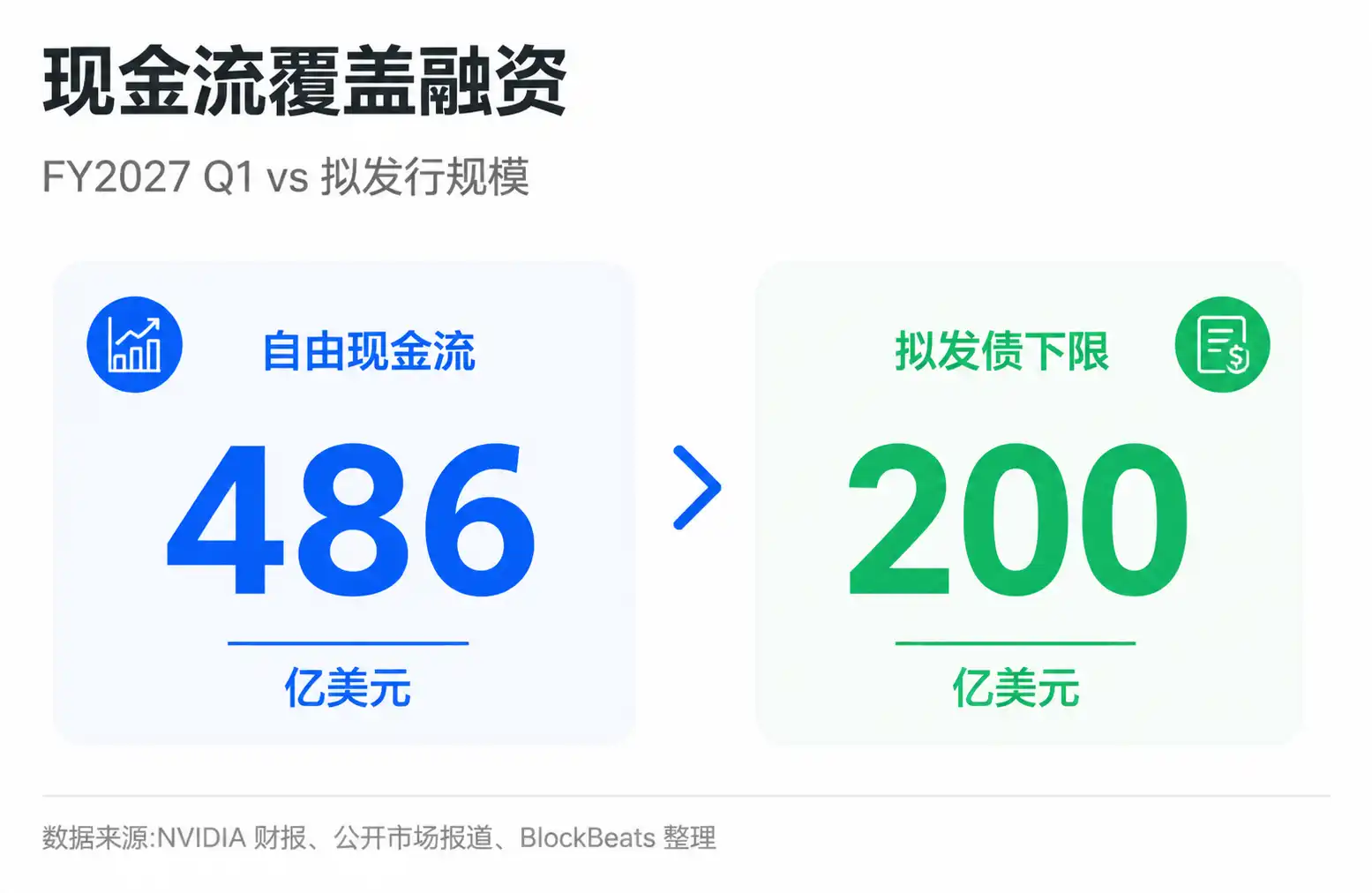
A more reasonable explanation is that Nvidia is locking in a source of long-term funding when its credit is strongest and the market is most willing to lend to it. For a company in an AI infrastructure expansion cycle, data centers, supply chain prepayments, ecosystem investments, and R&D spending are not short-term projects. Their payback periods may span years, even a decade or more. Matching long-term assets with 30-year debt is closer to mature capital management than relying entirely on short-term operating cash flow.

This is also the plain meaning of "capital structure optimization": the company uses not just cash on hand but also appropriately pairs it with low-cost debt. As long as the long-term return generated by the borrowed money is higher than the interest cost, debt is not just a burden; it can also be a tool to improve capital efficiency.

AA Rating Turns Bonds into AI Ammunition

That Nvidia can do this relies on the bond market being willing to lend to it at a low enough cost. The most important variable behind this is the credit rating.

S&P Global Ratings recently upgraded Nvidia to AA, citing reasons including competitive advantages from AI demand, strong cash flow generation capacity, and a robust balance sheet. An AA rating can be understood as a high-credit label in the bond market: investors believe the company has an extremely low default risk, therefore willing to accept lower spreads and longer maturities.

This is key. Bond issuance isn't just about "getting money"; what truly determines the transaction's value is "at what cost, for how long, and in what market window." When a company is in a phase of credit upgrades, rapidly expanding cash flow, and the AI theme is still favored by institutional funds, its bargaining power for long-term funding significantly strengthens.

This also explains why Nvidia is acting at this moment. It's not waiting until cash flow weakens or expansion pressure increases to raise funds; instead, it's reducing future financing uncertainty in advance when the market most recognizes its credit quality. For shareholders, this is more attractive than being forced to finance in a worse environment in the future.

The listed uses of the bond proceeds are also worth considering together: refinancing, AI data center and infrastructure, R&D, supply chain prepayments, strategic investment. Refinancing leans towards financial management, infrastructure and supply chain towards expansion security, and strategic investment towards ecosystem positioning. They collectively point to one fact: Nvidia's capital needs are no longer just about "producing more chips," but about maintaining its position within the entire AI ecosystem.
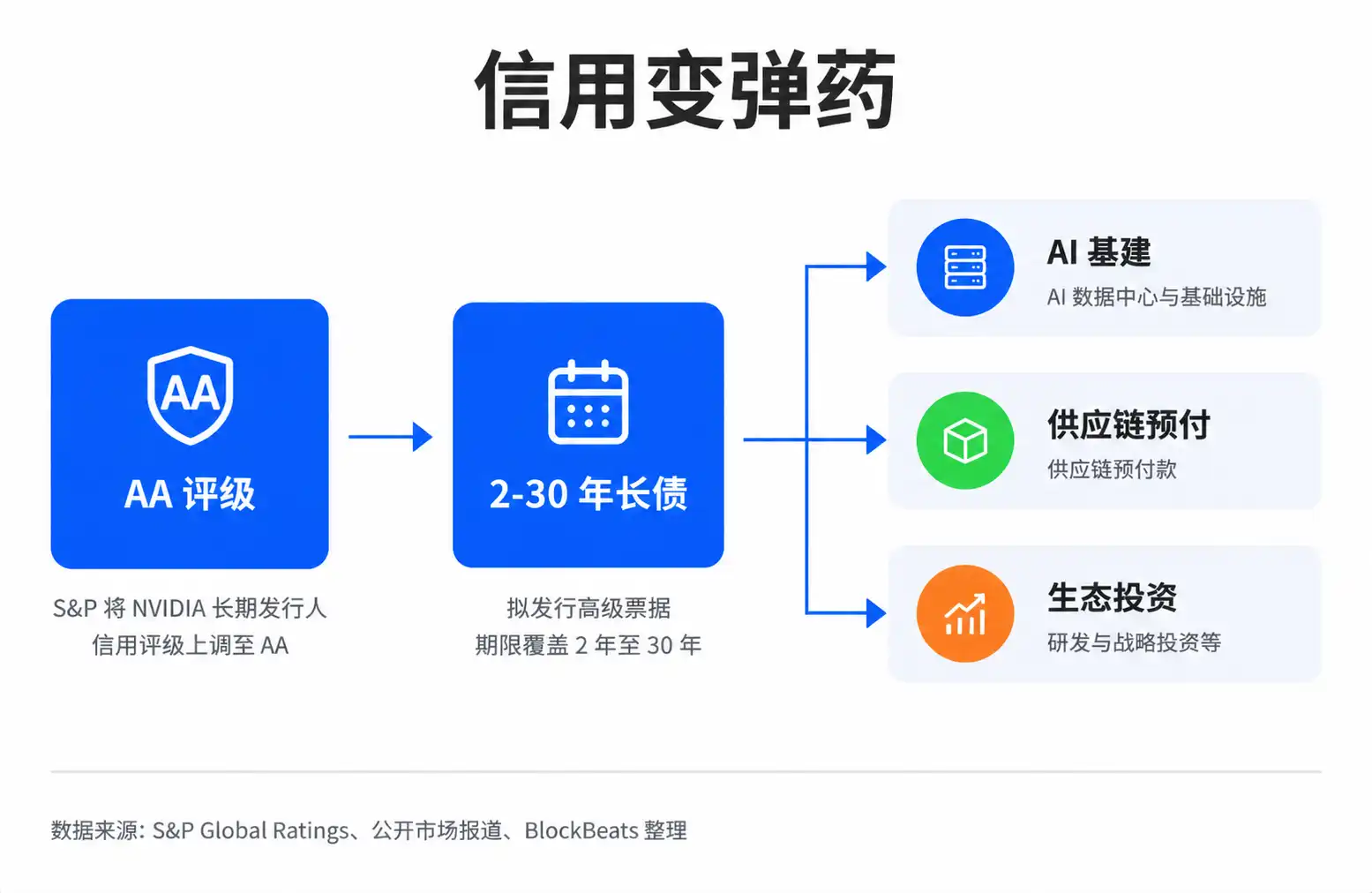
Nvidia sells the most critical computing power tools of the AI era, but it also needs to ensure its customers, supply chain, infrastructure, and ecosystem partners can keep up. The more important this role becomes, the more its capital allocation resembles a platform company, not just a hardware company.

Borrowing Is More Aligned with Shareholder Interests Than Issuing Shares

For NVDA shareholders, this bond issuance has another direct implication: the company is reserving ammunition for long-term expansion while maintaining shareholder returns.

Nvidia's last quarter not only had strong cash flow but also added $80 billion in buyback authorization and raised its dividend. Buybacks and dividends represent the company returning cash directly to shareholders; issuing debt represents using external long-term funds to support future investments. Looking at them together conveys not an "either-or" but the company's attempt to maintain two lines simultaneously: rewarding existing shareholders while not slowing down AI expansion.

If Nvidia chose to raise funds by issuing new shares, existing shareholders would be diluted. Even if the company continues to grow, earnings per share would be reduced. In contrast, the cost of debt is clearer: interest and principal. For a company with extremely strong free cash flow and a high credit rating, this cost is easier to manage.

Of course, this doesn't mean bond issuance is necessarily positive. Debt increases fixed expenses and raises market expectations for capital allocation efficiency. The reason Nvidia can get investors to accept this debt today is that the market believes its future cash flow can cover the interest and that AI infrastructure investments will ultimately translate into revenue and profit. If these two premises change, debt could shift from an efficiency tool to a valuation pressure.

Therefore, what this bond issuance truly changes is how investors observe Nvidia. In the past, the market focused more on GPU demand, gross margins, and revenue growth; now, it must also pay attention to how cash flow is allocated: how much for buybacks and dividends, how much for supply chain and infrastructure, how much for ecosystem investment, and how much is locked in early through debt.

This will make NVDA's valuation anchor more complex. It's no longer just a "profit growth story"; it's also beginning to feature characteristics of a "credit asset" and a "long-term capital allocation platform."

The AI Financing Template for Large Tech Companies Is Taking Shape

Nvidia is not the only company doing this. Alphabet completed a $20 billion bond issuance in February 2026, with maturities also covering multiple series, reportedly with orders once exceeding $100 billion. Meta, Amazon, and other large tech companies are also using debt financing during the AI investment cycle as one tool to support infrastructure spending.
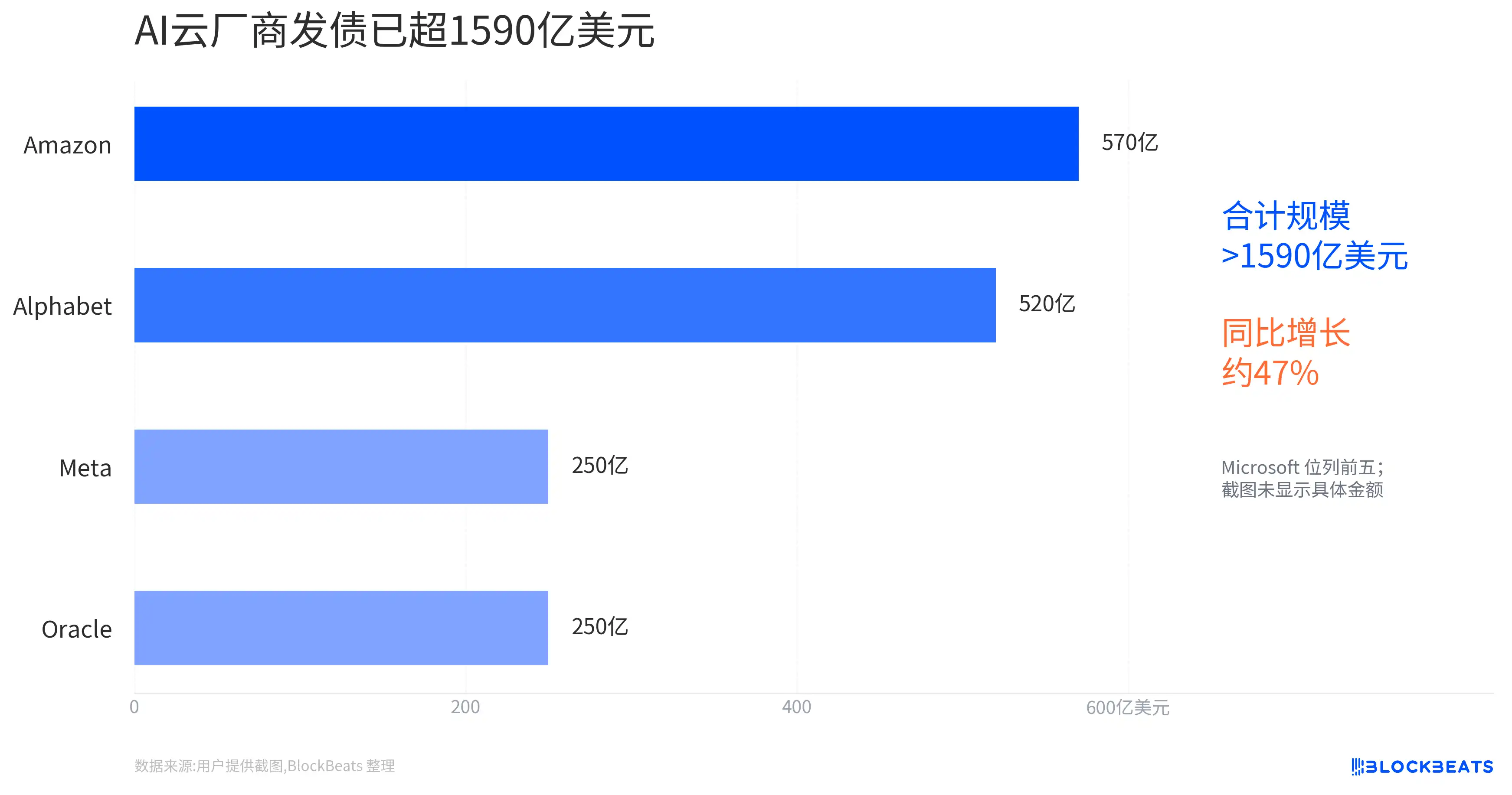
These cases cannot be simply written off as "tech giants are all short of money." A more accurate description is: AI infrastructure has shifted from a light-asset software growth story to a heavy-asset cycle involving data centers, power, chips, networks, and the supply chain. The company that can obtain funds at lower costs and for longer periods will have more room to maneuver in this expansion.

This has two implications for market pricing.

First, debt financing extends the endurance of AI capex (capital expenditure). As long as the bond market is willing to buy, large tech companies don't have to rely entirely on current cash flow to pay for long-term construction. This will support demand expectations for data centers, power, optical communications, semiconductor supply chains, and other areas.

Second, debt financing will also make investors more attentive to the payback period. In the past, the market was willing to pay a high valuation for AI investments because the growth speed was fast enough. But as investments become heavier and financing terms longer, the question becomes: When will these infrastructures generate sufficient returns? If AI application revenue materializes slower than expected, or the commercial return per unit of computing power declines, the market will re-examine whether these debt-supported expansions are too aggressive.

Nvidia's special position is that it sits at the upstream of the AI capital expenditure chain. The more customers invest, the more it benefits; but if the investment returns of the entire industry are questioned, it cannot remain completely insulated. Therefore, this bond issuance both reinforces the market's recognition of its credit and cash flow and embeds it deeper into the narrative of long-cycle AI capital expenditure.

What Remains to Be Tested Is Whether Pricing and Returns Can Coexist

The most important caveat at present is: this is still a "proposed issuance of at least $20 billion"; the final issuance size, coupon, spread, and order book strength remain to be confirmed. Only after the transaction closes can the market more accurately judge at what low cost and for how long bond investors are willing to fund Nvidia.

If the final pricing shows strong demand and long-term spreads remain low, this will further prove that Nvidia is turning its AA credit into an expansion tool. It can not only profit from customers' AI spending but also finance its own long-term positioning at lower costs in the capital market.

But the more important verification later lies not in the bonds themselves, but in the next phase of earnings reports and capital expenditure data. Investors need to see whether Nvidia can continue to maintain strong free cash flow while advancing AI infrastructure, supply chain prepayments, ecosystem investment, and shareholder returns. If these variables can still progress in parallel, bond issuance becomes an amplifier of capital efficiency.

Conversely, if the payback period for future AI infrastructure lengthens, or the company increasingly relies on external financing to sustain expansion, the market's understanding of such debt will change. Then the question will no longer be "Is Nvidia short of cash?" but "Is the return rate on long-cycle AI investments sufficient to support the expectations being front-loaded by today's low-cost funds?"


Trend Kriptolar

İlgili Sorular

QWhy is Nvidia raising $20 billion through debt issuance despite having very strong cash flow?

ANvidia is issuing debt not because it lacks cash, but as an active capital management strategy to optimize its capital structure. With its strong AA credit rating and robust cash flow, it can lock in low-cost, long-term funding now to support its long-term AI infrastructure expansion, data center build-out, R&D, supply chain prepayments, and strategic investments. Using debt is a cheaper and more shareholder-friendly way to finance these long-duration assets compared to diluting equity, allowing the company to simultaneously fund growth and maintain shareholder returns through buybacks and dividends.

QWhat are the potential benefits for shareholders from Nvidia's debt issuance instead of issuing more stock?

AIssuing debt instead of equity prevents dilution of existing shareholders' ownership. This means current shareholders retain a larger share of the company's future earnings. For a company like Nvidia with strong projected returns and low borrowing costs, using debt is seen as a more efficient way to finance growth. It also allows the company to continue its significant stock buyback program and increased dividends while still funding large-scale, long-term investments, thus balancing shareholder rewards with expansion.

QWhat does the timing of Nvidia's bond issuance indicate about the broader AI investment cycle?

AThe timing signals that the AI capital expenditure (capex) narrative may be entering a new, more mature stage. Large technology firms are shifting from light-asset, software-driven growth to a heavy-asset cycle involving data centers, power, chips, and supply chains. Nvidia, along with other giants like Alphabet and Meta using debt, shows that securing low-cost, long-term capital is becoming a strategic imperative to fuel and extend this infrastructure build-out, making debt financing a key tool for competitive advantage in the AI arms race.

QWhat is the significance of Nvidia's AA credit rating for its recent bond offering?

ANvidia's recent upgrade to an AA credit rating by S&P Global is crucial. It acts as a 'high-credit label' in the bond market, indicating extremely low perceived default risk. This allows Nvidia to borrow large sums at very low interest rates and with long maturities (like 30-year bonds). The strong rating means investors are willing to accept lower returns for the perceived safety, giving Nvidia significant pricing power and the ability to secure favorable long-term funding to support its strategic, multi-year AI investments.

QWhat are the key risks or future tests associated with Nvidia's use of long-term debt to fund AI expansion?

AThe main risk is whether the future returns from AI infrastructure investments will justify the current use of cheap, long-term debt. If AI application revenue grows slower than expected, or if the return on invested capital for these heavy assets declines, the debt could become a burden rather than an efficiency tool. The market will closely watch Nvidia's ability to maintain its strong free cash flow while executing its expansion plans. The key test is whether the AI capex cycle's actual profitability can support the growth expectations that are being pre-funded by the bond market.

İlgili Okumalar

Why Is the World Nervous About Japan Raising Interest Rates?

In June 2026, the Bank of Japan raised its policy rate to 1%, marking its first hike to this level since 1995. While this rate remains low compared to global peers like the US and Europe, the move signals a profound shift for a nation that has been a global source of ultra-cheap funding for decades. Japan's long-standing near-zero or negative interest rates had facilitated massive "yen carry trades," where international investors borrowed low-cost yen to invest in higher-yielding assets worldwide, such as US tech stocks and emerging market bonds. This made Japan a critical, often overlooked, source of global liquidity. Japan's ultra-loose policy stemmed from structural challenges post-1990s asset bubble: aging demographics, chronic low inflation/deflation, and high public debt. Recent shifts, including sustained wage growth (exceeding 5% in recent years) and inflation consistently above the 2% target, have created a "wage-price spiral" possibility, prompting the policy normalization. The global market's concern lies not in the absolute rate but in the potential unwinding of the yen carry trade. As Japanese borrowing costs rise, the economics of these leveraged global investments change, potentially triggering deleveraging and capital outflows from risk assets. Market anxiety focuses on the end of a thirty-year consensus that Japan would perpetually provide cheap funding. Ultimately, the global impact will depend on the interplay with US monetary policy. While Japan is tightening, the significant interest rate differential with the US remains. The key future dynamic is whether simultaneous Japanese hikes and eventual US rate cuts will narrow this gap, forcing a major recalibration of global capital flows and asset pricing built on an era of abundant, cheap yen liquidity.

marsbit1 saat önce

Why Is the World Nervous About Japan Raising Interest Rates?

marsbit1 saat önce

Research Report Analysis: MRVL's Optical AI Booming, Why High Valuation Keeps Morgan Stanley's Star Analyst Sidelined?

Report Recap: MRVL Optical AI Boom - Why High Valuation Led Morgan Stanley's Star Analyst to Stay Neutral? Morgan Stanley analyst Joseph Moore maintained an "Equal-weight" (Neutral) rating on Marvell Technology (MRVL) on May 28, raising the price target from $172 to $195, below the trading price. This stance comes despite Marvell reporting a record quarter and significantly raising its full-year outlook (FY27 revenue ~$11.5B, up ~40%). Moore's neutral view is based on valuation. The $195 target implies ~40x CY2027 P/E. He contrasts MRVL with NVDA: both trade near ~$200, but Nvidia's forward EPS is more than double Marvell's. For MRVL's valuation to hold, it needs consistent earnings upgrades, proof of networking market share gains, or certainty on large-scale custom AI chip shipments—none of which are confirmed yet. Growth is driven by two pillars: **1) Optical Interconnect** (the faster runner): Moore raised FY27 growth expectations to >70%, with the optical module product line nearing a $1B annualized run rate. **2) Custom AI Chips** (the climber): Confidence in FY28 is growing, but a major new customer project only ramps in FY28, with no current revenue visibility. Key risks are the underperforming Storage, Enterprise, and legacy Networking segments. Moore acknowledges the real AI opportunity but believes the current price already reflects it. For the stock to work from here, investors need to see the optical business hit its targets, custom chips ramp as planned, and a recovery in the weaker business units.

marsbit2 saat önce

Research Report Analysis: MRVL's Optical AI Booming, Why High Valuation Keeps Morgan Stanley's Star Analyst Sidelined?

marsbit2 saat önce

qinbaFrank: Review and Outlook of the AI Computing Power Wave — From the Three Debates on NVIDIA to Optical Interconnect and SpaceX IPO, How is Capital Rotating?

**Summary: Retrospective and Outlook on the AI Computing Wave - A Framework for Capital Rotation** Based on a presentation by investor qinbaFrank, this analysis reviews the AI computing market trajectory since 2023 and outlines a forward-looking framework. **Key Phases and Market Debates:** The AI bull market progressed through three major debates: 1) The necessity of massive capital expenditure (late 2023). 2) The sustainability of tech giants' spending (early 2024-early 2025). 3) Potential overestimation of compute needs (early 2025). Consensus solidified in late 2025 as model capabilities and utility demonstrably improved. **Core Thesis: Penetration Rate Drives Commercialization.** Unlike the 2000 dot-com bubble, the current AI wave benefits from mature digital infrastructure, enabling faster adoption. The critical threshold is 10% penetration; surpassing it (with recent enterprise intent surveys showing ~18%) indicates entry into a rapid growth "golden period" where user scale and willingness to pay increase simultaneously. **AI vs. Internet: A Fundamental Difference.** While the internet enhanced connection efficiency, AI directly substitutes human cognition and labor. Once AI performance exceeds the "societal average" human level, its commercial value scales exponentially as payment shifts from human labor costs to AI service fees. **Investment Logic Evolution in the Compute Chain.** The focus has expanded from GPUs to a systemic re-rating of the entire hardware stack: storage/HBM, CPUs, interconnects, power, and advanced packaging. The framework is: **short-term "scarcity pricing," mid-term "upgrade pricing" (e.g., optical interconnects, power networks), and long-term "Physical AI" pricing** (edge computing, robotics). **Market Focus Shift and Adjustment Framework.** The market is transitioning from "hardware scarcity" to "commercialization validation." The ultimate anchor for the narrative is sustained high growth in model providers' Annual Recurring Revenue (ARR) and cloud business revenue, which justifies continued capital expenditure. Adjustments are categorized into three levels: * **L1 (Minor):** Driven by valuation compression or macro noise (e.g., single CPI print). Fundamentals intact. * **L2 (Moderate):** Triggered by significant macro events requiring risk repricing. Requires new data for confidence restoration. * **L3 (Major):** Involves a reset of the core industrial narrative or macro regime (e.g., AI commercialization growth stalling). The **crucial dividing line** is whether AI commercialization growth slows. Without a slowdown, pullbacks are likely L1/L2 "repricing" events. A genuine growth deceleration would signal an L2/L3 narrative reset. **Conclusion: A Foundational Civilizational Leap.** AI represents a foundational upgrade to "intelligence" itself—akin to humanity mastering fire—rather than a single-point industrial revolution. This底层能力跃迁 (underlying capability leap) will spawn successive waves of innovation (Agent, robotics, industry workflow重构). The journey will be波浪式的 (wavelike), driven by cycles of scarcity, technological upgrades, and远期兑现 (long-term realization).

marsbit2 saat önce

qinbaFrank: Review and Outlook of the AI Computing Power Wave — From the Three Debates on NVIDIA to Optical Interconnect and SpaceX IPO, How is Capital Rotating?

marsbit2 saat önce

A Country That Mined Bitcoin for 8 Years Has Built Its Own Dedicated Crypto Bank

A country that has been mining Bitcoin for eight years has established its own dedicated crypto bank. DK Bank, located in Bhutan's newly developed GMC special administrative zone, aims to fill the significant banking service gap for the cryptocurrency industry. Its CEO, Zheng YD, explained that most banks avoid crypto businesses due to a lack of risk management frameworks for decentralized and anonymous protocols. Operating under a unique "one country, two systems" governance model separate from mainland Bhutan, GMC aspires to become a financial hub for South Asia. DK Bank differentiates itself by offering integrated multi-currency accounts where users can manage both fiat currencies and stablecoins like USDT and USDC in one place, alongside services like Bitcoin-backed loans. The bank faces technical challenges in merging traditional banking systems with 24/7 crypto markets and implements rigorous on-chain and off-chain transaction monitoring for risk control. GMC's regulatory framework draws from Singaporean common law and Abu Dhabi's ADGM rules, offering a fast-track licensing process for already licensed firms while maintaining high standards. The initiative is part of Bhutan's longer-term crypto strategy, which includes Bitcoin mining since 2018. The focus, however, is on building a diversified institutional-grade crypto ecosystem—including custody and asset management—rather than retail speculative tokens. Proponents argue such sovereign crypto infrastructure is necessary, and Bhutan's early, measured approach exemplifies the thoughtful integration needed in global finance.

Foresight News2 saat önce

A Country That Mined Bitcoin for 8 Years Has Built Its Own Dedicated Crypto Bank

Foresight News2 saat önce

İşlemler

Spot
Futures

Popüler Makaleler

$S$ Nedir

SPERO'yu Anlamak: Kapsamlı Bir Genel Bakış SPERO'ya Giriş İnovasyonun manzarası gelişmeye devam ederken, web3 teknolojilerinin ve kripto para projelerinin ortaya çıkışı dijital geleceği şekillendirmede önemli bir rol oynamaktadır. Bu dinamik alanda dikkat çeken projelerden biri SPERO, $$s$$ olarak adlandırılmaktadır. Bu makale, SPERO hakkında ayrıntılı bilgi toplamak ve sunmak amacıyla, meraklılar ve yatırımcıların web3 ve kripto alanlarındaki temellerini, hedeflerini ve yeniliklerini anlamalarına yardımcı olmayı amaçlamaktadır. SPERO,$$s$$ Nedir? SPERO,$$s$$, kripto alanında merkeziyetsizlik ve blok zinciri teknolojisi ilkelerini kullanarak etkileşimi, faydayı ve finansal kapsayıcılığı teşvik eden bir ekosistem yaratmayı amaçlayan benzersiz bir projedir. Proje, kullanıcıların yenilikçi finansal çözümler ve hizmetler sunarak eşler arası etkileşimleri yeni yollarla kolaylaştırmayı hedeflemektedir. SPERO,$$s$$'nin temel amacı, bireyleri güçlendirmek ve kripto para alanındaki kullanıcı deneyimini artıran araçlar ve platformlar sağlamaktır. Bu, daha esnek işlem yöntemlerini mümkün kılmayı, topluluk odaklı girişimleri teşvik etmeyi ve merkeziyetsiz uygulamalar (dApp'ler) aracılığıyla finansal fırsatlar yaratmayı içermektedir. SPERO,$$s$$'nin temel vizyonu kapsayıcılık etrafında dönmekte olup, geleneksel finansal sistemlerdeki boşlukları kapatmayı ve blok zinciri teknolojisinin faydalarından yararlanmayı hedeflemektedir. SPERO,$$s$$'nin Yaratıcısı Kimdir? SPERO,$$s$$'nin yaratıcısının kimliği bir miktar belirsizdir, çünkü kurucusu(ları) hakkında ayrıntılı arka plan bilgisi sağlayan sınırlı kamuya açık kaynaklar bulunmaktadır. Bu şeffaflık eksikliği, projenin merkeziyetsizlik taahhüdünden kaynaklanabilir—birçok web3 projesinin paylaştığı bir etik anlayışı, bireysel tanınmanın yerine kolektif katkıları önceliklendirmektedir. Topluluk ve onun kolektif hedefleri etrafında tartışmaları merkezileştirerek, SPERO,$$s$$, belirli bireyleri öne çıkarmadan güçlendirme özünü taşımaktadır. Bu nedenle, SPERO'nun etik anlayışını ve misyonunu anlamak, tek bir yaratıcının kimliğini belirlemekten daha önemlidir. SPERO,$$s$$'nin Yatırımcıları Kimlerdir? SPERO,$$s$$, kripto sektöründe yeniliği teşvik etmeye adanmış girişim sermayedarlarından melek yatırımcılara kadar çeşitli yatırımcılar tarafından desteklenmektedir. Bu yatırımcıların odak noktası genellikle SPERO'nun misyonuyla uyumlu olup, toplumsal teknolojik ilerlemeyi, finansal kapsayıcılığı ve merkeziyetsiz yönetimi vaat eden projeleri önceliklendirmektedir. Bu yatırımcı temelleri, yalnızca yenilikçi ürünler sunan projelere değil, aynı zamanda blok zinciri topluluğuna ve ekosistemlerine olumlu katkılarda bulunan projelere de ilgi duymaktadır. Bu yatırımcıların desteği, SPERO,$$s$$'yi hızla gelişen kripto projeleri alanında dikkate değer bir rakip haline getirmektedir. SPERO,$$s$$ Nasıl Çalışır? SPERO,$$s$$, onu geleneksel kripto para projelerinden ayıran çok yönlü bir çerçeve kullanmaktadır. İşte benzersizliğini ve yeniliğini vurgulayan bazı temel özellikler: Merkeziyetsiz Yönetim: SPERO,$$s$$, kullanıcıların projenin geleceğiyle ilgili karar alma süreçlerine aktif olarak katılmalarını sağlayan merkeziyetsiz yönetim modellerini entegre etmektedir. Bu yaklaşım, topluluk üyeleri arasında sahiplik ve hesap verebilirlik duygusunu teşvik etmektedir. Token Kullanımı: SPERO,$$s$$, ekosistem içinde çeşitli işlevler sunmak üzere tasarlanmış kendi kripto para token'ını kullanmaktadır. Bu token'lar, işlemleri, ödülleri ve platformda sunulan hizmetlerin kolaylaştırılmasını sağlayarak genel etkileşimi ve faydayı artırmaktadır. Katmanlı Mimari: SPERO,$$s$$'nin teknik mimarisi, modülerlik ve ölçeklenebilirliği destekleyerek projenin evrimi sırasında ek özelliklerin ve uygulamaların sorunsuz bir şekilde entegrasyonuna olanak tanımaktadır. Bu uyum sağlama yeteneği, sürekli değişen kripto manzarasında geçerliliği sürdürmek için hayati öneme sahiptir. Topluluk Katılımı: Proje, işbirliği ve geri bildirim teşvik eden mekanizmalar kullanarak topluluk odaklı girişimlere vurgu yapmaktadır. Güçlü bir topluluk oluşturarak, SPERO,$$s$$, kullanıcı ihtiyaçlarını daha iyi karşılayabilir ve piyasa trendlerine uyum sağlayabilir. Kapsayıcılığa Odaklanma: Düşük işlem ücretleri ve kullanıcı dostu arayüzler sunarak, SPERO,$$s$$, daha önce kripto alanında yer almamış bireyler de dahil olmak üzere çeşitli bir kullanıcı tabanını çekmeyi hedeflemektedir. Bu kapsayıcılık taahhüdü, erişilebilirlik yoluyla güçlendirme misyonuyla uyumludur. SPERO,$$s$$ Zaman Çizelgesi Bir projenin tarihini anlamak, gelişim yolculuğu ve kilometre taşları hakkında kritik bilgiler sağlar. Aşağıda, SPERO,$$s$$'nin evriminde önemli olayları haritalayan önerilen bir zaman çizelgesi bulunmaktadır: Kavram Geliştirme ve Fikir Aşaması: SPERO,$$s$$'nin temelini oluşturan ilk fikirler, blok zinciri endüstrisindeki merkeziyetsizlik ve topluluk odaklılık ilkeleriyle yakından uyumlu olarak geliştirildi. Proje Beyaz Kağıdının Yayınlanması: Kavramsal aşamayı takiben, SPERO,$$s$$'nin vizyonunu, hedeflerini ve teknolojik altyapısını ayrıntılı bir şekilde açıklayan kapsamlı bir beyaz kağıt yayımlandı ve topluluk ilgisini ve geri bildirimini toplamak amacıyla sunuldu. Topluluk Oluşturma ve Erken Katılımlar: Projenin hedefleri etrafında tartışmalar yürüterek destek toplamak ve erken benimseyenler ile potansiyel yatırımcılar için bir topluluk oluşturmak amacıyla aktif iletişim çabaları gerçekleştirildi. Token Üretim Etkinliği: SPERO,$$s$$, yerel token'larını erken destekçilere dağıtmak ve ekosistem içinde başlangıç likiditesini sağlamak amacıyla bir token üretim etkinliği (TGE) gerçekleştirdi. İlk dApp'in Yayınlanması: SPERO,$$s$$ ile ilişkili ilk merkeziyetsiz uygulama (dApp) faaliyete geçti ve kullanıcıların platformun temel işlevleriyle etkileşimde bulunmalarını sağladı. Sürekli Gelişim ve Ortaklıklar: Projenin tekliflerine sürekli güncellemeler ve iyileştirmeler yapılmakta olup, blok zinciri alanındaki diğer oyuncularla stratejik ortaklıklar, SPERO,$$s$$'yi rekabetçi ve gelişen bir oyuncu haline getirmiştir. Sonuç SPERO,$$s$$, web3 ve kripto paranın finansal sistemleri devrim niteliğinde dönüştürme ve bireyleri güçlendirme potansiyelinin bir kanıtıdır. Merkeziyetsiz yönetime, topluluk katılımına ve yenilikçi tasarlanmış işlevselliğe olan bağlılığıyla, daha kapsayıcı bir finansal manzaraya doğru bir yol açmaktadır. Hızla gelişen kripto alanındaki herhangi bir yatırımda olduğu gibi, potansiyel yatırımcılar ve kullanıcılar, SPERO,$$s$$ içindeki devam eden gelişmelerle ilgili olarak kapsamlı bir araştırma yapmaları ve düşünceli bir şekilde katılmaları teşvik edilmektedir. Proje, kripto endüstrisinin yenilikçi ruhunu sergileyerek, sayısız olasılığını keşfetmeye davet etmektedir. SPERO,$$s$$'nin yolculuğu hala devam ederken, temel ilkeleri, teknoloji, finans ve birbirimizle etkileşim biçimimizi etkileyebilir.

90 Toplam GörüntülenmeYayınlanma 2024.12.17Güncellenme 2024.12.17

$S$ Nedir

AGENT S Nedir

Agent S: Web3'te Otonom Etkileşimin Geleceği Giriş Web3 ve kripto para dünyasında sürekli gelişen manzarada, yenilikler bireylerin dijital platformlarla etkileşim biçimlerini sürekli olarak yeniden tanımlıyor. Bu tür öncü projelerden biri olan Agent S, açık ajans çerçevesi aracılığıyla insan-bilgisayar etkileşimini devrim niteliğinde değiştirmeyi vaat ediyor. Otonom etkileşimlerin yolunu açarak, Agent S karmaşık görevleri basitleştirmeyi ve yapay zeka (AI) alanında dönüştürücü uygulamalar sunmayı hedefliyor. Bu detaylı inceleme, projenin karmaşıklıklarına, benzersiz özelliklerine ve kripto para alanındaki etkilerine dalacaktır. Agent S Nedir? Agent S, bilgisayar görevlerinin otomasyonunda üç temel zorluğu ele almak üzere özel olarak tasarlanmış çığır açıcı bir açık ajans çerçevesidir: Alan Spesifik Bilgi Edinimi: Çerçeve, çeşitli dış bilgi kaynaklarından ve iç deneyimlerden akıllıca öğrenir. Bu çift yönlü yaklaşım, alan spesifik bilgi açısından zengin bir veri havuzu oluşturmasını sağlar ve görev yürütmedeki performansını artırır. Uzun Görev Ufukları Üzerinde Planlama: Agent S, karmaşık görevlerin verimli bir şekilde parçalanmasını ve yürütülmesini kolaylaştıran deneyim artırımlı hiyerarşik planlama kullanır. Bu özellik, çoklu alt görevleri etkili ve verimli bir şekilde yönetme yeteneğini önemli ölçüde artırır. Dinamik, Homojen Olmayan Arayüzlerle Başlama: Proje, ajanlar ve kullanıcılar arasındaki etkileşimi geliştiren yenilikçi bir çözüm olan Ajan-Bilgisayar Arayüzü'ni (ACI) tanıtmaktadır. Çok Modlu Büyük Dil Modellerini (MLLM'ler) kullanarak, Agent S çeşitli grafik kullanıcı arayüzlerini sorunsuz bir şekilde gezinebilir ve manipüle edebilir. Bu öncü özellikler aracılığıyla, Agent S, makinelerle insan etkileşimini otomatikleştirmede karşılaşılan karmaşıklıkları ele alan sağlam bir çerçeve sunarak, AI ve ötesinde birçok uygulama için zemin hazırlıyor. Agent S'nin Yaratıcısı Kimdir? Agent S'nin kavramı temelde yenilikçi olsa da, yaratıcısı hakkında spesifik bilgiler belirsizliğini koruyor. Yaratıcı şu anda bilinmiyor, bu da projenin yeni aşamasını veya kurucu üyeleri gizli tutma stratejik tercihini vurguluyor. Anonimlikten bağımsız olarak, odak çerçevenin yetenekleri ve potansiyeli üzerinde kalıyor. Agent S'nin Yatırımcıları Kimlerdir? Agent S, kriptografik ekosistemde oldukça yeni olduğundan, yatırımcıları ve finansal destekçileri hakkında ayrıntılı bilgiler açıkça belgelenmemiştir. Projeyi destekleyen yatırım temelleri veya organizasyonları hakkında kamuya açık bilgilerdeki eksiklik, finansman yapısı ve gelişim yol haritası hakkında sorular doğuruyor. Destekleyicilerin anlaşılması, projenin sürdürülebilirliğini ve potansiyel pazar etkisini değerlendirmek için kritik öneme sahiptir. Agent S Nasıl Çalışır? Agent S'nin temelinde, çeşitli ortamlarda etkili bir şekilde çalışmasını sağlayan son teknoloji bir sistem yatmaktadır. İşleyiş modeli birkaç ana özellik etrafında inşa edilmiştir: İnsan Benzeri Bilgisayar Etkileşimi: Çerçeve, bilgisayarlarla etkileşimleri daha sezgisel hale getirmeyi amaçlayan gelişmiş AI planlaması sunar. Görev yürütmedeki insan davranışını taklit ederek, kullanıcı deneyimlerini yükseltmeyi vaat eder. Anlatı Belleği: Yüksek düzeyde deneyimlerden yararlanmak için kullanılan Agent S, görev geçmişlerini takip etmek amacıyla anlatı belleğini kullanarak karar verme süreçlerini geliştirir. Episodik Bellek: Bu özellik, kullanıcılara adım adım rehberlik sağlayarak, çerçevenin görevler gelişirken bağlamsal destek sunmasına olanak tanır. OpenACI Desteği: Yerel olarak çalışabilme yeteneği ile Agent S, kullanıcıların etkileşimleri ve iş akışları üzerinde kontrol sağlamasına olanak tanır ve Web3'ün merkeziyetsiz felsefesiyle uyumlu hale gelir. Dış API'lerle Kolay Entegrasyon: Çeşitli AI platformlarıyla uyumluluğu ve çok yönlülüğü, Agent S'nin mevcut teknolojik ekosistemlere sorunsuz bir şekilde entegre olmasını sağlar ve geliştiriciler ile organizasyonlar için cazip bir seçenek haline getirir. Bu işlevsellikler, Agent S'nin kripto alanındaki benzersiz konumuna katkıda bulunarak, karmaşık, çok aşamalı görevleri minimum insan müdahalesi ile otomatikleştirir. Proje geliştikçe, Web3'teki potansiyel uygulamaları dijital etkileşimlerin nasıl gelişeceğini yeniden tanımlayabilir. Agent S'nin Zaman Çizelgesi Agent S'nin gelişimi ve kilometre taşları, önemli olaylarını vurgulayan bir zaman çizelgesinde özetlenebilir: 27 Eylül 2024: Agent S'nin kavramı, “Bilgisayarları İnsan Gibi Kullanan Açık Bir Ajans Çerçevesi” başlıklı kapsamlı bir araştırma makalesi ile tanıtıldı ve projenin temelini sergiledi. 10 Ekim 2024: Araştırma makalesi arXiv'de kamuya açık olarak yayınlandı ve çerçevenin derinlemesine bir incelemesini ve OSWorld benchmark'ına dayalı performans değerlendirmesini sundu. 12 Ekim 2024: Agent S'nin yetenekleri ve özellikleri hakkında görsel bir içgörü sağlayan bir video sunumu yayımlandı ve potansiyel kullanıcılar ve yatırımcılarla daha fazla etkileşim sağlandı. Bu zaman çizelgesindeki işaretler, sadece Agent S'nin ilerlemesini değil, aynı zamanda şeffaflık ve topluluk katılımına olan bağlılığını da göstermektedir. Agent S Hakkında Ana Noktalar Agent S çerçevesi gelişmeye devam ederken, birkaç ana özellik öne çıkmakta ve yenilikçi doğasını ve potansiyelini vurgulamaktadır: Yenilikçi Çerçeve: İnsan etkileşimine benzer bir bilgisayar kullanımı sağlamak üzere tasarlanan Agent S, görev otomasyonuna yeni bir yaklaşım getiriyor. Otonom Etkileşim: GUI aracılığıyla bilgisayarlarla otonom olarak etkileşim kurabilme yeteneği, daha akıllı ve verimli hesaplama çözümlerine doğru bir sıçrama anlamına geliyor. Karmaşık Görev Otomasyonu: Sağlam metodolojisi ile karmaşık, çok aşamalı görevleri otomatikleştirerek süreçleri daha hızlı ve daha az hata payı ile gerçekleştirebilir. Sürekli İyileştirme: Öğrenme mekanizmaları, Agent S'nin geçmiş deneyimlerden öğrenmesini sağlar ve sürekli olarak performansını ve etkinliğini artırır. Çok Yönlülük: OSWorld ve WindowsAgentArena gibi farklı işletim ortamlarında uyumlu olması, geniş bir uygulama yelpazesine hizmet edebilmesini sağlar. Agent S, Web3 ve kripto alanında kendini konumlandırırken, etkileşim yeteneklerini artırma ve süreçleri otomatikleştirme potansiyeli, AI teknolojilerinde önemli bir ilerlemeyi temsil etmektedir. Yenilikçi çerçevesi aracılığıyla, Agent S dijital etkileşimlerin geleceğini örneklemekte ve çeşitli sektörlerde kullanıcılar için daha sorunsuz ve verimli bir deneyim vaat etmektedir. Sonuç Agent S, AI ve Web3'ün birleşiminde cesur bir sıçramayı temsil ediyor ve teknoloji ile etkileşim biçimimizi yeniden tanımlama kapasitesine sahip. Henüz erken aşamalarında olmasına rağmen, uygulama olanakları geniş ve çekici. Kritik zorlukları ele alan kapsamlı çerçevesi ile Agent S, otonom etkileşimleri dijital deneyimin ön plana çıkmasına taşımayı hedefliyor. Kripto para ve merkeziyetsizlik alanlarına daha derinlemesine girdikçe, Agent S gibi projelerin teknoloji ve insan-bilgisayar işbirliğinin geleceğini şekillendirmede önemli bir rol oynayacağı kesin.

582 Toplam GörüntülenmeYayınlanma 2025.01.14Güncellenme 2025.01.14

AGENT S Nedir

S Nasıl Satın Alınır

HTX.com’a hoş geldiniz! Sonic (S) satın alma işlemlerini basit ve kullanışlı bir hâle getirdik. Adım adım açıkladığımız rehberimizi takip ederek kripto yolculuğunuza başlayın. 1. Adım: HTX Hesabınızı OluşturunHTX'te ücretsiz bir hesap açmak için e-posta adresinizi veya telefon numaranızı kullanın. Sorunsuzca kaydolun ve tüm özelliklerin kilidini açın. Hesabımı Aç2. Adım: Kripto Satın Al Bölümüne Gidin ve Ödeme Yönteminizi SeçinKredi/Banka Kartı: Visa veya Mastercard'ınızı kullanarak anında Sonic (S) satın alın.Bakiye: Sorunsuz bir şekilde işlem yapmak için HTX hesap bakiyenizdeki fonları kullanın.Üçüncü Taraflar: Kullanımı kolaylaştırmak için Google Pay ve Apple Pay gibi popüler ödeme yöntemlerini ekledik.P2P: HTX'teki diğer kullanıcılarla doğrudan işlem yapın.Borsa Dışı (OTC): Yatırımcılar için kişiye özel hizmetler ve rekabetçi döviz kurları sunuyoruz.3. Adım: Sonic (S) Varlıklarınızı SaklayınSonic (S) satın aldıktan sonra HTX hesabınızda saklayın. Alternatif olarak, blok zinciri transferi yoluyla başka bir yere gönderebilir veya diğer kripto para birimlerini takas etmek için kullanabilirsiniz.4. Adım: Sonic (S) Varlıklarınızla İşlem YapınHTX'in spot piyasasında Sonic (S) ile kolayca işlemler yapın.Hesabınıza erişin, işlem çiftinizi seçin, işlemlerinizi gerçekleştirin ve gerçek zamanlı olarak izleyin. Hem yeni başlayanlar hem de deneyimli yatırımcılar için kullanıcı dostu bir deneyim sunuyoruz.

1.6k Toplam GörüntülenmeYayınlanma 2025.01.15Güncellenme 2026.06.02

S Nasıl Satın Alınır

Tartışmalar

HTX Topluluğuna hoş geldiniz. Burada, en son platform gelişmeleri hakkında bilgi sahibi olabilir ve profesyonel piyasa görüşlerine erişebilirsiniz. Kullanıcıların S (S) fiyatı hakkındaki görüşleri aşağıda sunulmaktadır.

活动图片