The Arrival of 'Tokenpocalypse': When Costs Outweigh Productivity Gains, Who Pays the Bill?

marsbit2026-06-10 tarihinde yayınlandı2026-06-10 tarihinde güncellendi

Özet

The article discusses the emergence of the term "Tokenpocalypse" (Token Doomsday), triggered by Microsoft's shift to a token-based pricing model for GitHub Copilot on June 1st. This change introduces significant cost multipliers between different AI models, with some premium models becoming up to 60 times more expensive per token. As leading AI companies like Anthropic and OpenAI prepare for IPOs, increasing profit pressures may lead more vendors to raise prices. This creates a dilemma for enterprises. Companies that once encouraged or mandated high AI token usage to boost productivity now face budget overruns under the new pricing. The lack of granular per-employee token limits means a single developer could exhaust a company's monthly budget. This forces a paradoxical situation where employees are criticized for both using too little and too much AI. The piece cites Uber as a case study, where AI budget depletion led to rapid implementation of usage caps. It highlights the growing disconnect between AI utility and cost, noting that even initial pricing for services like ChatGPT Plus was somewhat arbitrary. The industry now grapples with balancing AI's productivity gains against its escalating expenses. Ultimately, the article suggests the focus is shifting from fears of "AI replacing jobs" to the reality of "AI consuming budgets." The mental overhead and operational hours spent managing token costs are beginning to undermine the very productivity benefits AI promises. Th...

A new term has recently sparked widespread discussion: "Tokenpocalypse."

The trigger was Microsoft's pricing restructuring for GitHub Copilot. Starting June 1st, Copilot has fully transitioned to a token-based billing model. The token cost multipliers differ drastically between various models, with some models costing 60 times more per token than others.

And the advanced models widely regarded by users as "truly effective" are precisely the ones experiencing the most severe price hikes.

As leading AI companies like Anthropic and OpenAI prepare for IPOs, AI firms will face increasingly intense profitability pressures, which may compel more vendors to follow suit with price increases.

The cost of using AI is an inevitable issue for enterprises expanding productivity. The recent "tokenmaxxing" trend, driven by competition over employee token usage, is approaching its end as Tokenpocalypse looms.

"The entire tokenmaxxxing craze, from rise to peak to disdain, lasted just six months."

The Corporate Dilemma

A developer from a large corporation described an absurd predicament: the company had long mandated employee use of AI tools, and using too few tokens would result in a meeting. But with the new pricing, using too many tokens now also leads to a meeting.
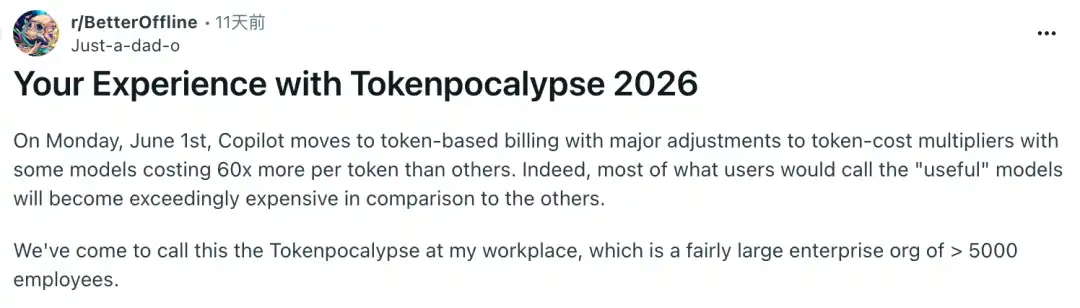
More critically, the Copilot team has yet to launch an "employee-level token quota" feature. This means that under the new billing model, a single employee could potentially exhaust the company's entire monthly token budget in one day.

"My job is no longer about using software to solve business problems," the developer wrote. "My job has become solving the token usage problem."

The comments section offers even more gems. One user summarized it: "Company policy became: 'Use AI for everything, but be careful not to use too much, because if the LLM consumes too many tokens you'll be deactivated, and then you'll be criticized for not using AI for the rest of the month.'"

A company's excessive focus on AI productivity can also be a double-edged sword.

An information director from a major law firm even "boasted" at an AI seminar: after their AI system crashed, the lawyers were essentially at a standstill, as they could no longer work without AI.

"A person trained for years in a specialized field freely admits they can't work without an AI chatbox? I'd be so ashamed I'd start re-evaluating my entire career."

The Uber Overspend Incident: An Industry Microcosm

Most AI models now have usage packages, but the issue of budget control becomes more severe as tokens increasingly trend towards pay-as-you-go pricing.

Uber completed a full arc in just one and a half months: first discovering that "the AI budget was burning much faster than anticipated," then urgently implementing usage caps and employee restrictions.

"Imagine a company as heavily reliant on AI as Uber hitting a wall this quickly," was discussed on a TechCrunch podcast. "The question is: Can AI labs bring costs down to meet customers' willingness to pay?"

A little-known fact: When ChatGPT Plus was initially priced at $20/month, there wasn't much strategic consideration; "they just threw out a number." The entire industry is still paying for that starting point.

"Your Job Won't Be Replaced by AI, But Your Budget Might"

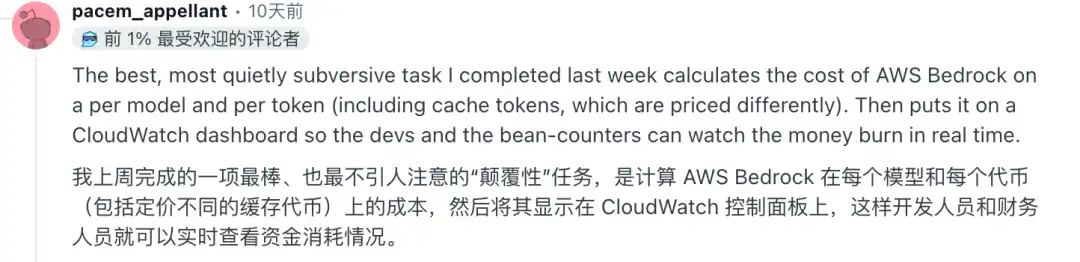
There are more thought-provoking details on Reddit. Someone built an AWS Bedrock cost monitoring dashboard at their company, displaying real-time spending per model and per token (including cached tokens) on CloudWatch, "so developers and finance can watch the money burn together." The comment section's reaction was: "Congratulations, you just gave them a new KPI."
Another large company has already faced similar tightening: after AI credits ran out, everyone was forcibly downgraded to GPT-4.2, losing even the VSCode integration.

An observer from outside the tech industry voiced a sentiment shared by many: "The mental energy and actual man-hours this whole thing consumes have already started impacting the delivery of work that actually makes the company money."

While the entire industry remains immersed in the narrative that "AI will replace everything," a more realistic question has surfaced: the bill for compute power must ultimately be paid. And "Tokenpocalypse" might just be the beginning of this reckoning.


İlgili Sorular

QWhat is 'Tokenpocalypse' and what event triggered its discussion?

A'Tokenpocalypse' or 'Token Doomsday' refers to a scenario where the rising costs of using AI tokens begin to outweigh their productivity benefits. The discussion was triggered by Microsoft's pricing overhaul for GitHub Copilot, which, starting June 1, shifted entirely to a token-based billing model with significant cost disparities between models.

QWhat is the 'absurd dilemma' faced by enterprises regarding AI tool usage as described in the article?

AThe article describes an absurd dilemma where companies have previously mandated employees to use AI tools, reprimanding those who used too few tokens. However, with the new pricing model, employees are now also reprimanded for using too many tokens, putting them in a 'damned if you do, damned if you don't' situation.

QWhat key functionality does GitHub Copilot currently lack, according to the article, and what is its potential consequence under the new pricing?

AAccording to the article, GitHub Copilot's team has not yet implemented an 'employee-level token limit' feature. This means that under the new pay-per-use model, a single employee could potentially exhaust the company's entire monthly token budget in one day.

QHow does the Uber case illustrate a broader industry problem with AI costs?

AThe Uber case serves as an industry microcosm. The company discovered its AI budget was being depleted much faster than anticipated within just a month and a half, forcing it to hastily implement usage caps and employee restrictions. This highlights the challenge of unpredictable and escalating AI operational costs even for large, tech-savvy companies.

QAccording to the article's conclusion, what is the more immediate and realistic threat compared to the narrative of 'AI replacing everything'?

AThe article concludes that a more immediate and realistic threat than 'AI replacing everything' is the financial burden of the compute bill. The 'Tokenpocalypse' represents the beginning of a financial reckoning where someone ultimately has to pay for the computational power, potentially impacting budgets and work delivery more directly than job replacement.

İlgili Okumalar

The Value Distribution of Stablecoins

**Summary: The Value Distribution of Stablecoins** The article argues that stablecoins are evolving from mere trading tools into broader channels for dollar access. It divides the stablecoin ecosystem into four layers to analyze how value is distributed: 1. **Issuance Layer:** Mints stablecoins, holds reserve assets, and captures the spread between reserve yield and user costs (e.g., Tether, Circle). This layer currently earns the largest profit margin. 2. **Infrastructure Layer:** Connects stablecoins to the traditional financial system, handling fiat on/off-ramps, banking integration, compliance (KYC/AML), and asset management (e.g., Bridge, BVNK). This is the "unglamorous" but critical work, building the essential bridges between crypto and real-world finance. 3. **Acquiring/Distribution Layer:** Integrates stablecoins into merchant systems, manages payment flows, and provides enterprise financial software (e.g., Stripe, Coinbase). They act as the access point for businesses. 4. **Application Layer:** The end-users and businesses that ultimately use stablecoins for payments, settlements, or as a store of value. They benefit from convenience but have little pricing power. The core thesis is that while the issuance layer currently dominates profits, the often-overlooked **infrastructure layer holds significant long-term potential**. The real challenge and barrier to mass adoption is not the on-chain transfer of stablecoins (which is simple), but the complex "last mile" integration into existing business workflows, banking systems, and regulatory frameworks across different countries. Companies in this layer are currently in a "land grab" phase, investing heavily to build networks, secure bank partnerships, and establish compliance pathways. While their position is currently pressured by the profitable issuers above and distribution platforms below, the article suggests that if stablecoins become a default financial rail for businesses, the infrastructure providers who have done the hard work of integration will ultimately gain strong pricing power and become entrenched, essential players.

marsbit26 dk önce

The Value Distribution of Stablecoins

marsbit26 dk önce

The Value Distribution of Stablecoins

The Value Distribution of Stablecoins The article argues that stablecoins are evolving from a mere trading tool into a broad "dollar channel." It analyzes the industry's value chain through four layers: 1. **Issuance Layer (e.g., Tether, Circle):** The top layer that mints stablecoins, holds reserve assets, and captures the thickest interest rate spread. 2. **Infrastructure Layer (e.g., Bridge, BVNK):** Connects stablecoins to the traditional financial system, handling critical but complex "dirty work" like fiat on/off-ramps, banking integration, compliance (KYC/AML), and cross-border settlement. 3. **Acquiring/Distribution Layer (e.g., Stripe, Coinbase):** Embeds stablecoins into merchant systems, manages payment flows, and integrates with enterprise software. 4. **Application Layer:** End-users and businesses that ultimately use stablecoins for payments, settlement, or storing value. The author posits that while the issuance layer currently captures the most profit, the most overlooked and potentially critical layer is infrastructure. The core challenge for stablecoin adoption isn't the on-chain transfer (which is simple), but bridging the gap between blockchain and the real-world financial system. This involves solving practical problems for businesses: fiat conversion, reconciliation, tax handling, and user onboarding. Infrastructure companies are currently in a difficult "land-grab" phase—building networks, securing banking relationships, and achieving compliance country-by-country. They face pressure from both the profitable issuance layer above and distribution platforms below. However, the author suggests this layer is building a crucial moat. Once stablecoins become a default business rail, the infrastructure players who have done the hard work of integration may gain significant, durable value and pricing power.

链捕手30 dk önce

The Value Distribution of Stablecoins

链捕手30 dk önce

How to Do Research Well: Deliberately Practice the Real Skills That Matter

No one truly teaches you how to do research. You're often given a desk, a pre-selected problem, and vague instructions to "create something new." Consequently, many people reverse-engineer the job based on visible outputs—papers, posts, announcements—learning only how to *appear* like a researcher rather than how to *become* one. True research capability is built from stacking small, trainable skills, nearly all of which can be developed through deliberate practice. **Pick Your Own Problem:** Most researchers absorb problems from advisors or trends, lacking the underlying reasoning. Choosing a problem you genuinely care about, as John Schulman advises, leads to original work. Develop "taste" like a muscle: predict experiment outcomes, guess paper results from methods, and track which findings remain important over time. **Upgrade Your Inputs:** Relying on shared reading lists (arXiv hot lists, filtered group chats) leads to unoriginal conclusions. Undervalued old literature often holds crucial insights (e.g., MoE, LSTM, backpropagation). Richard Sutton's "The Bitter Lesson" or Claude Shannon's 1952 talk on creative thinking are more predictive than lengthy modern surveys. Breadth matters as much as depth: draw from neuroscience, mechanism design, hardware knowledge, and honest statistics. Read papers directly, especially appendices and limitations sections. **Write Everything Down:** As Paul Graham noted, writing exposes flaws in seemingly mature ideas. Writing is the cheapest defense against self-deception. Following Feynman's principle, Darwin programmatically wrote down facts contradicting his theory to combat memory bias. Maintain a detailed log of hypotheses, setups, predictions, results, and updated understandings. Reviewing past logs fosters essential humility.

marsbit2 saat önce

How to Do Research Well: Deliberately Practice the Real Skills That Matter

marsbit2 saat önce

İşlemler

Spot
Futures

Popüler Makaleler

BILL Nasıl Satın Alınır

HTX.com’a hoş geldiniz! Billions Network (BILL) satın alma işlemlerini basit ve kullanışlı bir hâle getirdik. Adım adım açıkladığımız rehberimizi takip ederek kripto yolculuğunuza başlayın. 1. Adım: HTX Hesabınızı OluşturunHTX'te ücretsiz bir hesap açmak için e-posta adresinizi veya telefon numaranızı kullanın. Sorunsuzca kaydolun ve tüm özelliklerin kilidini açın. Hesabımı Aç2. Adım: Kripto Satın Al Bölümüne Gidin ve Ödeme Yönteminizi SeçinKredi/Banka Kartı: Visa veya Mastercard'ınızı kullanarak anında Billions Network (BILL) satın alın.Bakiye: Sorunsuz bir şekilde işlem yapmak için HTX hesap bakiyenizdeki fonları kullanın.Üçüncü Taraflar: Kullanımı kolaylaştırmak için Google Pay ve Apple Pay gibi popüler ödeme yöntemlerini ekledik.P2P: HTX'teki diğer kullanıcılarla doğrudan işlem yapın.Borsa Dışı (OTC): Yatırımcılar için kişiye özel hizmetler ve rekabetçi döviz kurları sunuyoruz.3. Adım: Billions Network (BILL) Varlıklarınızı SaklayınBillions Network (BILL) satın aldıktan sonra HTX hesabınızda saklayın. Alternatif olarak, blok zinciri transferi yoluyla başka bir yere gönderebilir veya diğer kripto para birimlerini takas etmek için kullanabilirsiniz.4. Adım: Billions Network (BILL) Varlıklarınızla İşlem YapınHTX'in spot piyasasında Billions Network (BILL) ile kolayca işlemler yapın.Hesabınıza erişin, işlem çiftinizi seçin, işlemlerinizi gerçekleştirin ve gerçek zamanlı olarak izleyin. Hem yeni başlayanlar hem de deneyimli yatırımcılar için kullanıcı dostu bir deneyim sunuyoruz.

293 Toplam GörüntülenmeYayınlanma 2026.05.07Güncellenme 2026.06.02

BILL Nasıl Satın Alınır

Tartışmalar

HTX Topluluğuna hoş geldiniz. Burada, en son platform gelişmeleri hakkında bilgi sahibi olabilir ve profesyonel piyasa görüşlerine erişebilirsiniz. Kullanıcıların BILL (BILL) fiyatı hakkındaki görüşleri aşağıda sunulmaktadır.

活动图片