K2.6 is Yang Zhilin's First Roadshow

marsbit2026-04-22 tarihinde yayınlandı2026-04-22 tarihinde güncellendi

Özet

K2.6 is Yang Zhilin's first roadshow for Moonshot AI's upcoming IPO. The release of K2.6 marks a strategic shift from a developer-focused approach to one aimed at investors and enterprise clients. Key changes include a 58% price increase for API inputs, structured to favor locked-in enterprise users over casual customers. The model is positioned against previous-generation international models like GPT-5.4 rather than the latest competitors, framing it as "first-tier." It also introduces large-scale Agent clusters (300+ agents) and open-source offerings, targeting enterprise automation scenarios. These moves are seen as preparations for K3, a anticipated 3-4 trillion parameter model. With Moonshot's valuation rising to $18 billion, K2.6 is a crucial step to demonstrate commercial viability and market positioning ahead of a potential late-2026 IPO.

By Xiang Xianzhi

The night before last, Moonshot AI released Kimi K2.6 and raised the API input price from $0.60 per million tokens to $0.95 per million tokens.

A 58% increase. The first price hike since the K2 series launched.

But it seems no one is paying attention to this.

Four months ago, in an internal letter on the last day of 2025, Yang Zhilin wrote that Moonshot AI was "not in a hurry for an IPO in the short term." At that time, Zhipu and MiniMax had already submitted their prospectuses to the Hong Kong Stock Exchange. This was clearly a deliberate positioning strategy.

He also wrote in that letter that the company's cash reserves exceeded $1.4 billion, and the Series C round of $500 million was oversubscribed—the subtext being that the potential of the primary market had not been fully utilized, and there was no rush for the secondary market.

Three months later, Bloomberg reported that he had begun talks with CICC and Goldman Sachs. Three weeks after that, K2.6 was launched.

A person who dislikes "rushing" did in four months what he previously said he wouldn't do.

K2.6 is certainly not the last product release before Moonshot AI's IPO. But this version release is Yang Zhilin's first roadshow after Moonshot AI planned to go public.

Kimi Has Never Released a Model Version Like This Before

Kimi had a set routine for releasing models in the past.

Publish a technical report, open-source the weights, top the HuggingFace leaderboard, and then await scrutiny from the tech community. K1.5 countered o1 with a reasoning methodology, with technical details outweighing benchmark numbers; K2 Thinking directly dumped the weights on HuggingFace, letting developers run their own tests. These moves were aimed at developers and researchers.

The rhetoric was also from the tech community: what problem did we solve, why is our method better, welcome to reproduce.

K2.6's moves are somewhat different.

First, the price increase. In RMB terms, the input price for K2.6 is 6.5 yuan per million tokens (cache miss), compared to 4 yuan for K2.5. The output price increased from 21 yuan to 27 yuan. The cache hit price is 1.1 yuan.

This is a structured price increase. Superficially, all tiers are increasing, but the cache hit tier has the smallest increase—from 0.7 yuan to 1.1 yuan, which is $0.16 per million tokens in USD.

This $0.16 is the key to understanding this price hike.

For enterprise users who repeatedly call the same system prompt: code assistants, Agent orchestration frameworks, smart customer service—their prefix is highly reusable, and cache hit rates can reach 75% to 83%. Moonshot AI left a nearly flat price for these customers.

For scattered customers who use it occasionally with different prompts each time, this price increase falls squarely on them.

This is a friendly price adjustment for "enterprises already tied to Kimi" and an unfriendly one for "scattered customers still comparing prices". The former are the "enterprise locked-in clients" in the IPO story, the latter are the "long-tail users" that won't appear on the roadshow PPT. Moonshot AI knows very well who its valuation assets are.

The compute structure of the Agent era is different from the chat era. Chat models are dozens of tokens back and forth, Agents are thousands of tool calls and hundreds of thousands of token consumption. Official K2.6 use cases—Mac local deployment Qwen3.5 model calling tools over 4000 times, running for 12 hours; refactoring the open-source matching engine exchange-core, 1000+ tool calls over 13 hours; more extreme, 5 days of autonomous operation monitoring alerts, fault response—the token consumption for these single tasks is hundreds or even thousands of times that of chat scenarios in the K2.5 era.

Of course, these cases are meant to illustrate long-range reasoning capabilities, but coupled with K2.6's 300-agent cluster, the token consumption must be staggering.

At the old price of $0.60, this kind of Agent task might lose money per call. At $0.95, it barely covers the inference cost.

So the price increase isn't confidence, it's necessity. Moonshot AI has raised $2.5 billion cumulatively, with $1.4 billion cash reserve from Series C to C+, but if the next-gen K3 is truly a 3-4 trillion parameter scale, a single pre-training run might eat up half of that.

Without a price increase, the gross margin data for the last few quarters before the IPO would look bad. The prospectus must disclose gross margin.
This could have been explained openly—the Agent era requires a new pricing model. But Moonshot AI didn't. Because C-end users just came from the free era of K2 Thinking, and telling them "I raised prices" now is not a good product narrative.

It's a story for another audience—Kimi already has a group of enterprise clients who can't leave it, and they'll use it even if it's more expensive. (Like myself)

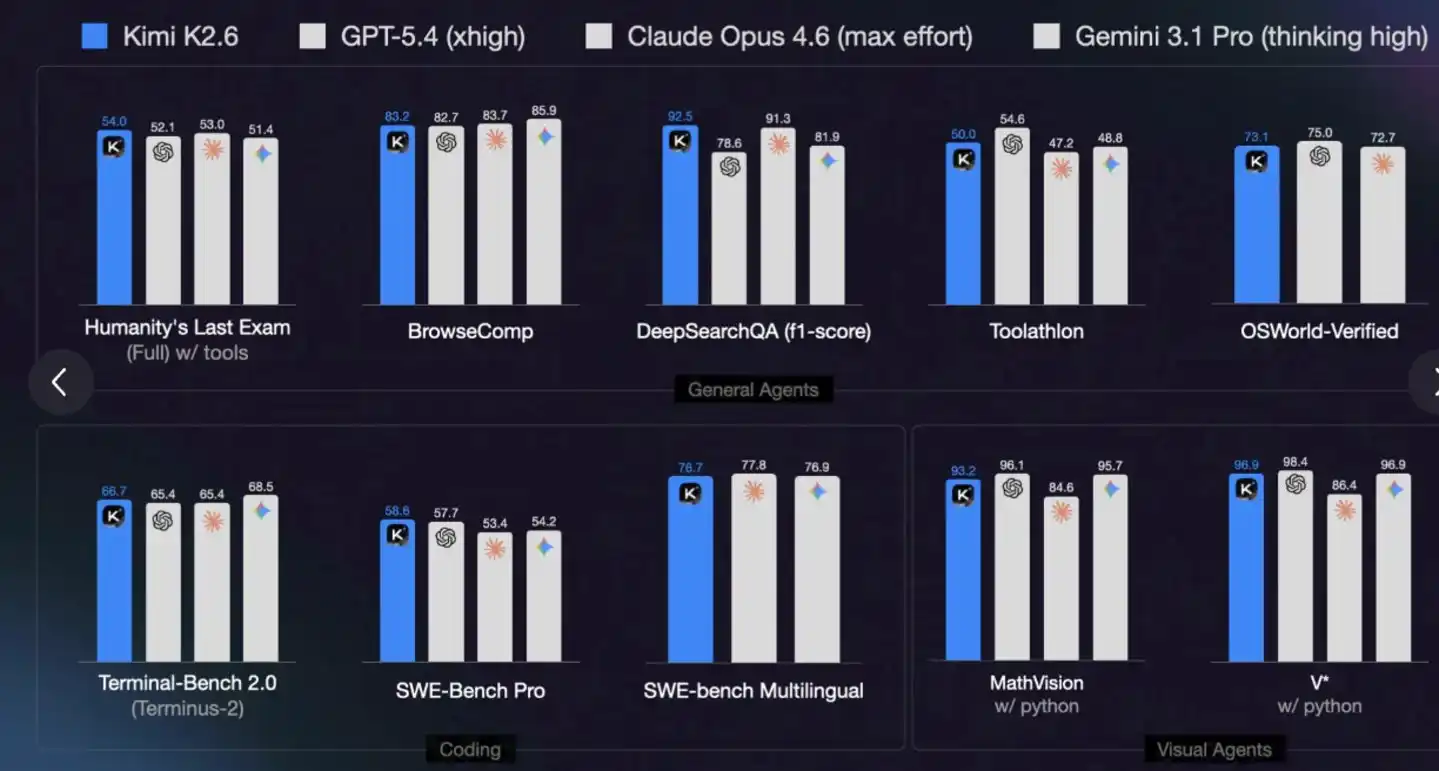
The second thing is benchmark comparisons. K2.6's official chosen references are GPT-5.4, Claude Opus 4.6, Gemini 3.1 Pro. All three are previous-generation flagships.

The same week, Anthropic released Claude Mythos, and Opus 4.7 just launched—both are a generation stronger than Opus 4.6. K2.6 didn't benchmark against them.

This is actually an active choice. Benchmarking against Mythos, K2.6 falls into the "catch-up" position; benchmarking against Opus 4.6, K2.6 falls into the "first tier" position. An $18 billion valuation needs the latter.

Kimi didn't really do this in the past. When K2 Thinking was released, the official ran full benchmarks, good and bad results, all released for developers to judge for themselves. That was the tech community's way—the community understands where you are strong and weak, and is willing to accept a model with obvious shortcomings but a clear roadmap.

Roadshow PPTs are not. Roadshow PPTs need a conclusion a fund manager can understand in 30 seconds: "on par with or superior to top international closed-source models." This sentence is verbatim from the K2.6 official blog.

The third thing is the Agent cluster and open-source dual track. K2.6 upgraded something called Claw Groups—a heterogeneous Agent ecosystem where Agents with different devices, different models, and different toolchains run in a collaborative space, with K2.6 acting as the scheduler. 300 sub-Agents in parallel, 4000 steps of collaboration, 5 days of autonomous operation.

These numbers are written for enterprise clients. Not for developers. For a developer, "300 Agents in parallel" has no practical meaning—they won't run 300 Agents in a local project. This configuration only makes sense for one type of client: large enterprises that need an Agent matrix to automate entire operational processes.

It's targeting the Salesforce story, not the HuggingFace story.

Meanwhile, K2.6 is fully open-sourced. Yang Zhilin said at the Zhongguancun Forum on March 26th that open source will be an absolute victory.

Open source + enterprise Agent clusters—this is a position between DeepSeek and Anthropic, half and half of both models. It sounds like a good story. But occupying both ends means having to prove both.

The capital market doesn't really care if these questions have answers. It only requires you to have a story for each line.

Price increase, benchmarking, Agent cluster—these three things together have an反常的共同点 (abnormal common point). None are for the tech community.

Kimi's underlying logic for releasing models in the past was—if developers like us, enterprise clients will eventually follow, and the capital market will follow even later. This playbook has a name: technical sincerity.

K2.6 isn't waiting. The price increase is a direct declaration of B-end pricing power; benchmarking against GPT-5.4 is preemptively securing a valuation position; Agent clusters and Claw Groups are the showroom for the enterprise service story.

Each thing corresponds to a question on the roadshow PPT: What is your commercialization capability? What is your benchmark position? What is your B-end moat?

Compressing the time from Preview to GA to 8 days is also this logic. Previous versions of the K2 series all went through 2-3 month preview periods, letting the community test enough, provide feedback, and iterate enough. K2.6 didn't give itself this space. It's not that the technology matured faster; the window won't wait.

An IPO in the second half of 2026 requires 4 to 6 months for filing, inquiry, hearing, roadshow, pricing, and cooling-off period according to HKEX procedures. Starting the roadshow in September means the product must be ready by April.

If GA isn't released in April, there's no window later.

K3 is the Real Grand Finale

But K2.6 is also not the strongest card Moonshot AI can play.

There is a very restrained sentence in the official blog—K2.6 is the "runway prepared for K3".

12-hour long-range coding, 300-Agent cluster, context compressor—these are not the final form of the K2 series; they are the execution layer infrastructure that a larger base model can support. Moonshot AI wouldn't spend effort making this work unless it was certain a larger model would consume these capabilities.

Rumors about K3 leaked on Reddit earlier, targeting a parameter scale of 3-4 trillion. Compared to the trillion-scale of the K2 series, this is a base leap.

If K3 can be released during the roadshow window—that is the real answer sheet. The runway paved by K2.6 allows K3 to take off.

The question is whether it can make it. How long does it take to train a 3-4 trillion parameter model? GPT-5 and Claude Opus 4.6 both had roughly 6-9 month pre-training cycles, plus several months for post-training and safety evaluation. Can Moonshot AI's existing compute—judging from the Alibaba Cloud cooperation and current cash reserves—compress this cycle to 5-6 months?

This bet is placed on K2.6.

Eight days from Preview to GA, Agent cluster expanding from 100 to 300 in one go, long-range execution stretching from hundreds of steps to 4000 steps—every move compresses time, making room for the possibility of K3.

If K3 can be released before August or September—that's the grand finale on the roadshow.

If it doesn't make it—K3 becomes a "model that can only be released after the IPO," and K2.6 has to shoulder the entire valuation narrative alone.

Moonshot AI is betting it can be done.

What Does the $18 Billion Valuation Anchor?

Back to valuation.

Three months ago, Moonshot AI was valued at $4.3 billion; two months ago, $5.5 billion; now, $18 billion.

It's not that Moonshot AI became four times stronger in these three months. It's that Zhipu and MiniMax went public and rose 4x, pushing the ceiling of the entire sector up. Zhipu's HK market cap is HK$305 billion, MiniMax's is HK$309.2 billion—both exceeding SenseTime's historical peak.

The valuation logic for these two is not "what the next-gen technology can do," but "how much AI assets can be priced in the Hong Kong market pool."

Moonshot AI's $18 billion valuation anchors the same thing. It is no longer proving it is the strongest Chinese AI company; it is proving it is a priceable Chinese AI company.

All of K2.6's moves—price increase, benchmarking, Agent cluster, open-source dual track—respond to this proposition.

But there is one thing K2.6 has not yet proven. Will Kimi's C-end users be willing to pay for the more expensive K2.6? Will paying subscribers churn to DeepSeek or MiniMax? How many enterprise clients are actually running Claw Groups, and how many just signed a POC?

These are numbers investors will definitely ask during the roadshow. K2.6 can only put the product out now. Whether it turns into numbers depends on the next three months.

When Zhipu went public, it submitted a prospectus where profits weren't yet positive; MiniMax did too. Investors accepted this story because the grand narrative of "Chinese AI assets" had just opened. Moonshot AI is half a year late. For the same question, Zhipu and MiniMax could say "we are validating," Moonshot AI must say "we are monetizing."

This pressure falls entirely on the three months between K2.6 and K3.

So back to the initial question—Is K2.6 Moonshot AI's final roadshow before the IPO?

No.

If K3 catches the roadshow window, K3 is the real grand finale. K2.6 is just the runway paved for it. If K3 misses the roadshow window, K2.6 has to carry the entire IPO narrative. Then it is Yang Zhilin's被迫提前开讲的第一场 (first, forced-to-start-early one).

Neither outcome was what Yang Zhilin wanted four months ago.

But everything that happened in these four months—Zhipu MiniMax IPO, valuation ceiling pushed up, window period compressed—forced a person who dislikes "rushing" to have to rush.

When K3 is released, it will be the second act.

İlgili Sorular

QWhat is the significance of the K2.6 model release for Moonshot AI's IPO plans?

AThe K2.6 model release is Yang Zhilin's first roadshow for Moonshot AI's planned IPO. It is a strategic move to demonstrate the company metrics crucial for valuation, such as enterprise pricing power, competitive positioning, and B2B capabilities, ahead of a potential listing in the second half of 2026.

QHow did Moonshot AI adjust its API pricing with the K2.6 release, and what was the strategic reason?

AMoonshot AI raised its API input price from $0.60 to $0.95 per million tokens, a 58% increase. This was a structured price hike designed to be friendly to enterprise clients with high cache hit rates (who saw a smaller increase) while passing the full increase to more casual, price-comparing users. The move was necessary to improve gross margin figures for the IPO prospectus and to align pricing with the high token consumption of the new Agent era.

QWhy did the K2.6 benchmark choose to compare itself to older models like GPT-5.4 instead of the latest ones?

AK2.6 was benchmarked against previous-generation flagship models like GPT-5.4 and Claude Opus 4.6 rather than the newer, stronger contemporaries (e.g., Claude Mythos) to position itself in the 'first tier' of models for its roadshow narrative. This creates a more favorable comparison for fund managers, supporting a valuation story of being 'on par with or superior to top international closed-source models'.

QWhat is the 'Claw Groups' feature in K2.6, and which audience is it targeting?

AClaw Groups is a feature for heterogeneous Agent ecosystems, allowing up to 300 different Agents across various devices, models, and toolchains to operate collaboratively with K2.6 as the scheduler. This targets enterprise clients, not developers, as it demonstrates a solution for large corporations seeking to automate full-process operations with an Agent matrix, akin to a Salesforce enterprise story.

QWhat is the relationship between the K2.6 release and the anticipated K3 model?

AK2.6 is described as the 'runway' for the much larger K3 model (rumored to be 3-4 trillion parameters). Features like long-context execution and the Agent cluster infrastructure are built to be consumed by a more powerful base model. The rushed 8-day preview-to-GA cycle for K2.6 is a bet that K3 can be ready in time to be the centerpiece of the IPO roadshow; if not, K2.6 must carry the entire valuation narrative alone.

İlgili Okumalar

Warsh Hearing Concludes: What Are the Notable Signals for the Crypto Industry?

The Senate Banking Committee held a confirmation hearing for Judy Shelton, a Federal Reserve nominee, who faced intense questioning regarding her ability to maintain the central bank's independence amid pressure from President Trump to lower interest rates. Shelton denied any pre-arranged commitments on rate cuts and emphasized her independence, though Democrats remained skeptical, citing contradictions with Trump's public statements. Shelton characterized post-pandemic inflation as a major policy failure and called for a "regime change" in the Fed’s approach, including reforms to inflation measurement and communication strategies. She criticized the current practice of Fed officials frequently signaling future rate moves and did not commit to maintaining post-meeting press conferences, suggesting potential reductions in transparency. Regarding crypto markets, Shelton’s extensive investments in digital asset companies—including Solana, DeFi, and blockchain infrastructure—were noted, though she has pledged to divest these holdings due to ethics rules. Her familiarity with the crypto industry and deregulatory leanings may signal a more open, though cautious, stance toward digital assets. However, concerns were raised about potential conflicts of interest, especially given Trump family involvement in crypto-financial ventures. The timing of her confirmation remains uncertain, pending a Justice Department investigation into current Chair Powell. Shelton’s potential leadership could lead to a more hawkish, productivity-focused Fed with tighter policy communication—factors that may significantly influence liquidity conditions and macro narratives for crypto markets.

marsbit1 saat önce

Warsh Hearing Concludes: What Are the Notable Signals for the Crypto Industry?

marsbit1 saat önce

İşlemler

Spot
Futures

Popüler Makaleler

$S$ Nedir

SPERO'yu Anlamak: Kapsamlı Bir Genel Bakış SPERO'ya Giriş İnovasyonun manzarası gelişmeye devam ederken, web3 teknolojilerinin ve kripto para projelerinin ortaya çıkışı dijital geleceği şekillendirmede önemli bir rol oynamaktadır. Bu dinamik alanda dikkat çeken projelerden biri SPERO, $$s$$ olarak adlandırılmaktadır. Bu makale, SPERO hakkında ayrıntılı bilgi toplamak ve sunmak amacıyla, meraklılar ve yatırımcıların web3 ve kripto alanlarındaki temellerini, hedeflerini ve yeniliklerini anlamalarına yardımcı olmayı amaçlamaktadır. SPERO,$$s$$ Nedir? SPERO,$$s$$, kripto alanında merkeziyetsizlik ve blok zinciri teknolojisi ilkelerini kullanarak etkileşimi, faydayı ve finansal kapsayıcılığı teşvik eden bir ekosistem yaratmayı amaçlayan benzersiz bir projedir. Proje, kullanıcıların yenilikçi finansal çözümler ve hizmetler sunarak eşler arası etkileşimleri yeni yollarla kolaylaştırmayı hedeflemektedir. SPERO,$$s$$'nin temel amacı, bireyleri güçlendirmek ve kripto para alanındaki kullanıcı deneyimini artıran araçlar ve platformlar sağlamaktır. Bu, daha esnek işlem yöntemlerini mümkün kılmayı, topluluk odaklı girişimleri teşvik etmeyi ve merkeziyetsiz uygulamalar (dApp'ler) aracılığıyla finansal fırsatlar yaratmayı içermektedir. SPERO,$$s$$'nin temel vizyonu kapsayıcılık etrafında dönmekte olup, geleneksel finansal sistemlerdeki boşlukları kapatmayı ve blok zinciri teknolojisinin faydalarından yararlanmayı hedeflemektedir. SPERO,$$s$$'nin Yaratıcısı Kimdir? SPERO,$$s$$'nin yaratıcısının kimliği bir miktar belirsizdir, çünkü kurucusu(ları) hakkında ayrıntılı arka plan bilgisi sağlayan sınırlı kamuya açık kaynaklar bulunmaktadır. Bu şeffaflık eksikliği, projenin merkeziyetsizlik taahhüdünden kaynaklanabilir—birçok web3 projesinin paylaştığı bir etik anlayışı, bireysel tanınmanın yerine kolektif katkıları önceliklendirmektedir. Topluluk ve onun kolektif hedefleri etrafında tartışmaları merkezileştirerek, SPERO,$$s$$, belirli bireyleri öne çıkarmadan güçlendirme özünü taşımaktadır. Bu nedenle, SPERO'nun etik anlayışını ve misyonunu anlamak, tek bir yaratıcının kimliğini belirlemekten daha önemlidir. SPERO,$$s$$'nin Yatırımcıları Kimlerdir? SPERO,$$s$$, kripto sektöründe yeniliği teşvik etmeye adanmış girişim sermayedarlarından melek yatırımcılara kadar çeşitli yatırımcılar tarafından desteklenmektedir. Bu yatırımcıların odak noktası genellikle SPERO'nun misyonuyla uyumlu olup, toplumsal teknolojik ilerlemeyi, finansal kapsayıcılığı ve merkeziyetsiz yönetimi vaat eden projeleri önceliklendirmektedir. Bu yatırımcı temelleri, yalnızca yenilikçi ürünler sunan projelere değil, aynı zamanda blok zinciri topluluğuna ve ekosistemlerine olumlu katkılarda bulunan projelere de ilgi duymaktadır. Bu yatırımcıların desteği, SPERO,$$s$$'yi hızla gelişen kripto projeleri alanında dikkate değer bir rakip haline getirmektedir. SPERO,$$s$$ Nasıl Çalışır? SPERO,$$s$$, onu geleneksel kripto para projelerinden ayıran çok yönlü bir çerçeve kullanmaktadır. İşte benzersizliğini ve yeniliğini vurgulayan bazı temel özellikler: Merkeziyetsiz Yönetim: SPERO,$$s$$, kullanıcıların projenin geleceğiyle ilgili karar alma süreçlerine aktif olarak katılmalarını sağlayan merkeziyetsiz yönetim modellerini entegre etmektedir. Bu yaklaşım, topluluk üyeleri arasında sahiplik ve hesap verebilirlik duygusunu teşvik etmektedir. Token Kullanımı: SPERO,$$s$$, ekosistem içinde çeşitli işlevler sunmak üzere tasarlanmış kendi kripto para token'ını kullanmaktadır. Bu token'lar, işlemleri, ödülleri ve platformda sunulan hizmetlerin kolaylaştırılmasını sağlayarak genel etkileşimi ve faydayı artırmaktadır. Katmanlı Mimari: SPERO,$$s$$'nin teknik mimarisi, modülerlik ve ölçeklenebilirliği destekleyerek projenin evrimi sırasında ek özelliklerin ve uygulamaların sorunsuz bir şekilde entegrasyonuna olanak tanımaktadır. Bu uyum sağlama yeteneği, sürekli değişen kripto manzarasında geçerliliği sürdürmek için hayati öneme sahiptir. Topluluk Katılımı: Proje, işbirliği ve geri bildirim teşvik eden mekanizmalar kullanarak topluluk odaklı girişimlere vurgu yapmaktadır. Güçlü bir topluluk oluşturarak, SPERO,$$s$$, kullanıcı ihtiyaçlarını daha iyi karşılayabilir ve piyasa trendlerine uyum sağlayabilir. Kapsayıcılığa Odaklanma: Düşük işlem ücretleri ve kullanıcı dostu arayüzler sunarak, SPERO,$$s$$, daha önce kripto alanında yer almamış bireyler de dahil olmak üzere çeşitli bir kullanıcı tabanını çekmeyi hedeflemektedir. Bu kapsayıcılık taahhüdü, erişilebilirlik yoluyla güçlendirme misyonuyla uyumludur. SPERO,$$s$$ Zaman Çizelgesi Bir projenin tarihini anlamak, gelişim yolculuğu ve kilometre taşları hakkında kritik bilgiler sağlar. Aşağıda, SPERO,$$s$$'nin evriminde önemli olayları haritalayan önerilen bir zaman çizelgesi bulunmaktadır: Kavram Geliştirme ve Fikir Aşaması: SPERO,$$s$$'nin temelini oluşturan ilk fikirler, blok zinciri endüstrisindeki merkeziyetsizlik ve topluluk odaklılık ilkeleriyle yakından uyumlu olarak geliştirildi. Proje Beyaz Kağıdının Yayınlanması: Kavramsal aşamayı takiben, SPERO,$$s$$'nin vizyonunu, hedeflerini ve teknolojik altyapısını ayrıntılı bir şekilde açıklayan kapsamlı bir beyaz kağıt yayımlandı ve topluluk ilgisini ve geri bildirimini toplamak amacıyla sunuldu. Topluluk Oluşturma ve Erken Katılımlar: Projenin hedefleri etrafında tartışmalar yürüterek destek toplamak ve erken benimseyenler ile potansiyel yatırımcılar için bir topluluk oluşturmak amacıyla aktif iletişim çabaları gerçekleştirildi. Token Üretim Etkinliği: SPERO,$$s$$, yerel token'larını erken destekçilere dağıtmak ve ekosistem içinde başlangıç likiditesini sağlamak amacıyla bir token üretim etkinliği (TGE) gerçekleştirdi. İlk dApp'in Yayınlanması: SPERO,$$s$$ ile ilişkili ilk merkeziyetsiz uygulama (dApp) faaliyete geçti ve kullanıcıların platformun temel işlevleriyle etkileşimde bulunmalarını sağladı. Sürekli Gelişim ve Ortaklıklar: Projenin tekliflerine sürekli güncellemeler ve iyileştirmeler yapılmakta olup, blok zinciri alanındaki diğer oyuncularla stratejik ortaklıklar, SPERO,$$s$$'yi rekabetçi ve gelişen bir oyuncu haline getirmiştir. Sonuç SPERO,$$s$$, web3 ve kripto paranın finansal sistemleri devrim niteliğinde dönüştürme ve bireyleri güçlendirme potansiyelinin bir kanıtıdır. Merkeziyetsiz yönetime, topluluk katılımına ve yenilikçi tasarlanmış işlevselliğe olan bağlılığıyla, daha kapsayıcı bir finansal manzaraya doğru bir yol açmaktadır. Hızla gelişen kripto alanındaki herhangi bir yatırımda olduğu gibi, potansiyel yatırımcılar ve kullanıcılar, SPERO,$$s$$ içindeki devam eden gelişmelerle ilgili olarak kapsamlı bir araştırma yapmaları ve düşünceli bir şekilde katılmaları teşvik edilmektedir. Proje, kripto endüstrisinin yenilikçi ruhunu sergileyerek, sayısız olasılığını keşfetmeye davet etmektedir. SPERO,$$s$$'nin yolculuğu hala devam ederken, temel ilkeleri, teknoloji, finans ve birbirimizle etkileşim biçimimizi etkileyebilir.

89 Toplam GörüntülenmeYayınlanma 2024.12.17Güncellenme 2024.12.17

$S$ Nedir

AGENT S Nedir

Agent S: Web3'te Otonom Etkileşimin Geleceği Giriş Web3 ve kripto para dünyasında sürekli gelişen manzarada, yenilikler bireylerin dijital platformlarla etkileşim biçimlerini sürekli olarak yeniden tanımlıyor. Bu tür öncü projelerden biri olan Agent S, açık ajans çerçevesi aracılığıyla insan-bilgisayar etkileşimini devrim niteliğinde değiştirmeyi vaat ediyor. Otonom etkileşimlerin yolunu açarak, Agent S karmaşık görevleri basitleştirmeyi ve yapay zeka (AI) alanında dönüştürücü uygulamalar sunmayı hedefliyor. Bu detaylı inceleme, projenin karmaşıklıklarına, benzersiz özelliklerine ve kripto para alanındaki etkilerine dalacaktır. Agent S Nedir? Agent S, bilgisayar görevlerinin otomasyonunda üç temel zorluğu ele almak üzere özel olarak tasarlanmış çığır açıcı bir açık ajans çerçevesidir: Alan Spesifik Bilgi Edinimi: Çerçeve, çeşitli dış bilgi kaynaklarından ve iç deneyimlerden akıllıca öğrenir. Bu çift yönlü yaklaşım, alan spesifik bilgi açısından zengin bir veri havuzu oluşturmasını sağlar ve görev yürütmedeki performansını artırır. Uzun Görev Ufukları Üzerinde Planlama: Agent S, karmaşık görevlerin verimli bir şekilde parçalanmasını ve yürütülmesini kolaylaştıran deneyim artırımlı hiyerarşik planlama kullanır. Bu özellik, çoklu alt görevleri etkili ve verimli bir şekilde yönetme yeteneğini önemli ölçüde artırır. Dinamik, Homojen Olmayan Arayüzlerle Başlama: Proje, ajanlar ve kullanıcılar arasındaki etkileşimi geliştiren yenilikçi bir çözüm olan Ajan-Bilgisayar Arayüzü'ni (ACI) tanıtmaktadır. Çok Modlu Büyük Dil Modellerini (MLLM'ler) kullanarak, Agent S çeşitli grafik kullanıcı arayüzlerini sorunsuz bir şekilde gezinebilir ve manipüle edebilir. Bu öncü özellikler aracılığıyla, Agent S, makinelerle insan etkileşimini otomatikleştirmede karşılaşılan karmaşıklıkları ele alan sağlam bir çerçeve sunarak, AI ve ötesinde birçok uygulama için zemin hazırlıyor. Agent S'nin Yaratıcısı Kimdir? Agent S'nin kavramı temelde yenilikçi olsa da, yaratıcısı hakkında spesifik bilgiler belirsizliğini koruyor. Yaratıcı şu anda bilinmiyor, bu da projenin yeni aşamasını veya kurucu üyeleri gizli tutma stratejik tercihini vurguluyor. Anonimlikten bağımsız olarak, odak çerçevenin yetenekleri ve potansiyeli üzerinde kalıyor. Agent S'nin Yatırımcıları Kimlerdir? Agent S, kriptografik ekosistemde oldukça yeni olduğundan, yatırımcıları ve finansal destekçileri hakkında ayrıntılı bilgiler açıkça belgelenmemiştir. Projeyi destekleyen yatırım temelleri veya organizasyonları hakkında kamuya açık bilgilerdeki eksiklik, finansman yapısı ve gelişim yol haritası hakkında sorular doğuruyor. Destekleyicilerin anlaşılması, projenin sürdürülebilirliğini ve potansiyel pazar etkisini değerlendirmek için kritik öneme sahiptir. Agent S Nasıl Çalışır? Agent S'nin temelinde, çeşitli ortamlarda etkili bir şekilde çalışmasını sağlayan son teknoloji bir sistem yatmaktadır. İşleyiş modeli birkaç ana özellik etrafında inşa edilmiştir: İnsan Benzeri Bilgisayar Etkileşimi: Çerçeve, bilgisayarlarla etkileşimleri daha sezgisel hale getirmeyi amaçlayan gelişmiş AI planlaması sunar. Görev yürütmedeki insan davranışını taklit ederek, kullanıcı deneyimlerini yükseltmeyi vaat eder. Anlatı Belleği: Yüksek düzeyde deneyimlerden yararlanmak için kullanılan Agent S, görev geçmişlerini takip etmek amacıyla anlatı belleğini kullanarak karar verme süreçlerini geliştirir. Episodik Bellek: Bu özellik, kullanıcılara adım adım rehberlik sağlayarak, çerçevenin görevler gelişirken bağlamsal destek sunmasına olanak tanır. OpenACI Desteği: Yerel olarak çalışabilme yeteneği ile Agent S, kullanıcıların etkileşimleri ve iş akışları üzerinde kontrol sağlamasına olanak tanır ve Web3'ün merkeziyetsiz felsefesiyle uyumlu hale gelir. Dış API'lerle Kolay Entegrasyon: Çeşitli AI platformlarıyla uyumluluğu ve çok yönlülüğü, Agent S'nin mevcut teknolojik ekosistemlere sorunsuz bir şekilde entegre olmasını sağlar ve geliştiriciler ile organizasyonlar için cazip bir seçenek haline getirir. Bu işlevsellikler, Agent S'nin kripto alanındaki benzersiz konumuna katkıda bulunarak, karmaşık, çok aşamalı görevleri minimum insan müdahalesi ile otomatikleştirir. Proje geliştikçe, Web3'teki potansiyel uygulamaları dijital etkileşimlerin nasıl gelişeceğini yeniden tanımlayabilir. Agent S'nin Zaman Çizelgesi Agent S'nin gelişimi ve kilometre taşları, önemli olaylarını vurgulayan bir zaman çizelgesinde özetlenebilir: 27 Eylül 2024: Agent S'nin kavramı, “Bilgisayarları İnsan Gibi Kullanan Açık Bir Ajans Çerçevesi” başlıklı kapsamlı bir araştırma makalesi ile tanıtıldı ve projenin temelini sergiledi. 10 Ekim 2024: Araştırma makalesi arXiv'de kamuya açık olarak yayınlandı ve çerçevenin derinlemesine bir incelemesini ve OSWorld benchmark'ına dayalı performans değerlendirmesini sundu. 12 Ekim 2024: Agent S'nin yetenekleri ve özellikleri hakkında görsel bir içgörü sağlayan bir video sunumu yayımlandı ve potansiyel kullanıcılar ve yatırımcılarla daha fazla etkileşim sağlandı. Bu zaman çizelgesindeki işaretler, sadece Agent S'nin ilerlemesini değil, aynı zamanda şeffaflık ve topluluk katılımına olan bağlılığını da göstermektedir. Agent S Hakkında Ana Noktalar Agent S çerçevesi gelişmeye devam ederken, birkaç ana özellik öne çıkmakta ve yenilikçi doğasını ve potansiyelini vurgulamaktadır: Yenilikçi Çerçeve: İnsan etkileşimine benzer bir bilgisayar kullanımı sağlamak üzere tasarlanan Agent S, görev otomasyonuna yeni bir yaklaşım getiriyor. Otonom Etkileşim: GUI aracılığıyla bilgisayarlarla otonom olarak etkileşim kurabilme yeteneği, daha akıllı ve verimli hesaplama çözümlerine doğru bir sıçrama anlamına geliyor. Karmaşık Görev Otomasyonu: Sağlam metodolojisi ile karmaşık, çok aşamalı görevleri otomatikleştirerek süreçleri daha hızlı ve daha az hata payı ile gerçekleştirebilir. Sürekli İyileştirme: Öğrenme mekanizmaları, Agent S'nin geçmiş deneyimlerden öğrenmesini sağlar ve sürekli olarak performansını ve etkinliğini artırır. Çok Yönlülük: OSWorld ve WindowsAgentArena gibi farklı işletim ortamlarında uyumlu olması, geniş bir uygulama yelpazesine hizmet edebilmesini sağlar. Agent S, Web3 ve kripto alanında kendini konumlandırırken, etkileşim yeteneklerini artırma ve süreçleri otomatikleştirme potansiyeli, AI teknolojilerinde önemli bir ilerlemeyi temsil etmektedir. Yenilikçi çerçevesi aracılığıyla, Agent S dijital etkileşimlerin geleceğini örneklemekte ve çeşitli sektörlerde kullanıcılar için daha sorunsuz ve verimli bir deneyim vaat etmektedir. Sonuç Agent S, AI ve Web3'ün birleşiminde cesur bir sıçramayı temsil ediyor ve teknoloji ile etkileşim biçimimizi yeniden tanımlama kapasitesine sahip. Henüz erken aşamalarında olmasına rağmen, uygulama olanakları geniş ve çekici. Kritik zorlukları ele alan kapsamlı çerçevesi ile Agent S, otonom etkileşimleri dijital deneyimin ön plana çıkmasına taşımayı hedefliyor. Kripto para ve merkeziyetsizlik alanlarına daha derinlemesine girdikçe, Agent S gibi projelerin teknoloji ve insan-bilgisayar işbirliğinin geleceğini şekillendirmede önemli bir rol oynayacağı kesin.

429 Toplam GörüntülenmeYayınlanma 2025.01.14Güncellenme 2025.01.14

AGENT S Nedir

S Nasıl Satın Alınır

HTX.com’a hoş geldiniz! Sonic (S) satın alma işlemlerini basit ve kullanışlı bir hâle getirdik. Adım adım açıkladığımız rehberimizi takip ederek kripto yolculuğunuza başlayın. 1. Adım: HTX Hesabınızı OluşturunHTX'te ücretsiz bir hesap açmak için e-posta adresinizi veya telefon numaranızı kullanın. Sorunsuzca kaydolun ve tüm özelliklerin kilidini açın. Hesabımı Aç2. Adım: Kripto Satın Al Bölümüne Gidin ve Ödeme Yönteminizi SeçinKredi/Banka Kartı: Visa veya Mastercard'ınızı kullanarak anında Sonic (S) satın alın.Bakiye: Sorunsuz bir şekilde işlem yapmak için HTX hesap bakiyenizdeki fonları kullanın.Üçüncü Taraflar: Kullanımı kolaylaştırmak için Google Pay ve Apple Pay gibi popüler ödeme yöntemlerini ekledik.P2P: HTX'teki diğer kullanıcılarla doğrudan işlem yapın.Borsa Dışı (OTC): Yatırımcılar için kişiye özel hizmetler ve rekabetçi döviz kurları sunuyoruz.3. Adım: Sonic (S) Varlıklarınızı SaklayınSonic (S) satın aldıktan sonra HTX hesabınızda saklayın. Alternatif olarak, blok zinciri transferi yoluyla başka bir yere gönderebilir veya diğer kripto para birimlerini takas etmek için kullanabilirsiniz.4. Adım: Sonic (S) Varlıklarınızla İşlem YapınHTX'in spot piyasasında Sonic (S) ile kolayca işlemler yapın.Hesabınıza erişin, işlem çiftinizi seçin, işlemlerinizi gerçekleştirin ve gerçek zamanlı olarak izleyin. Hem yeni başlayanlar hem de deneyimli yatırımcılar için kullanıcı dostu bir deneyim sunuyoruz.

1.3k Toplam GörüntülenmeYayınlanma 2025.01.15Güncellenme 2025.03.21

S Nasıl Satın Alınır

Tartışmalar

HTX Topluluğuna hoş geldiniz. Burada, en son platform gelişmeleri hakkında bilgi sahibi olabilir ve profesyonel piyasa görüşlerine erişebilirsiniz. Kullanıcıların S (S) fiyatı hakkındaki görüşleri aşağıda sunulmaktadır.

活动图片