SaaS Battle Royale: The Survivors Who Win All Share One Common Trait

marsbit2026-06-03 tarihinde yayınlandı2026-06-03 tarihinde güncellendi

Özet

**Summary** The AI revolution has triggered a "SaaS apocalypse," forcing a brutal market shakeout. The key dividing line is the pricing model. Companies like Snowflake and Datadog, which charge based on consumption (e.g., data processed or compute used), are thriving. AI workloads actively *generate* more demand for their services, fueling growth. Datadog's accelerating revenue is a prime example. Microsoft and Palantir, as platform/ecosystem players, also benefit by acting as essential channels for AI deployment. In contrast, traditional SaaS firms built on per-seat or per-task licensing (e.g., Intuit, Adobe) face direct pressure, as AI threatens to automate the very human tasks their software supports. Companies like Salesforce, a per-seat giant, are caught in the middle. While showing strong AI monetization (e.g., its Agentforce platform) and experimenting with consumption-based "Flex Credits," its stock remains under pressure, illustrating that the market rewards *completed* transitions, not just the intent. The recent Microsoft Build conference underscored key trends: AI is evolving from an assistant to an autonomous "agent," and platform providers like Microsoft are consolidating their control. The market's recovery is highly selective, focused on identifying which companies are "fed by AI" versus "eaten by AI." Future focus will be on the diffusion of this recovery to transforming companies and the real-world adoption data of AI agents like Microsoft Copilot.

Author: Seeking Counsel on Stock Trends, Tide Research

Today, Microsoft's annual Build developer conference kicked off at Fort Mason in San Francisco. The key message from Nadella's keynote was just one: AI is no longer an assistant that answers questions; it's now an employee that does the work for you.

The timing of this conference is interesting. Over the past five months, the US software sector has experienced a battle royale.

The market has dubbed this massacre the "SaaSpocalypse." From the beginning of the year to mid-May, Salesforce fell 33%, Intuit dropped nearly 30%, and even Workday and Adobe weren't spared. The panic logic is simple: if an AI agent can do the work of ten people, then companies don't need to buy software seats for ten people. The per-seat billing model that has underpinned the entire SaaS industry for twenty years has had its foundation pulled out.

But just last week, a group stood up amidst this slaughter.

On May 28th, Snowflake soared 36.5% in a single day, its biggest daily gain since listing. Datadog's stock price doubled year-to-date, hitting a new all-time high on May 29th. On the same day, MongoDB rose 10%, Palantir climbed 8%, with the three major indices hitting new highs.

Another group is still down. Intuit plunged 19% at one point after earnings. Although Salesforce's EPS crushed expectations by 24%, its stock still fell post-earnings and remains down about 28% year-to-date.

In the same battle royale, some have doubled while others have been halved. What's the difference?

The Spark Lit by Snowflake

Why could Snowflake light this spark? Because of its pricing model.

The core market fear over the past five months has been something very specific: per-seat pricing. The logic is simple: if an AI agent can do the work of ten people, then companies don't need software seats for ten people. Atlassian reported its first-ever decline in enterprise seat count this year, giving this fear real data support.

Snowflake happens to stand on the opposite side of this fear. It doesn't charge per seat; it charges for the computing power and data processing volume you consume. AI hasn't reduced its consumption; instead, it's furiously driving consumption: AI accounts on the platform grew from 9,100 to 13,600 in a quarter, product revenue grew 34% year-over-year, the company raised its full-year guidance, and announced a $6 billion AWS compute purchase.

Datadog tells the other side of the same story. Snowflake proved "AI is feeding volume to data platforms," Datadog proves "AI is feeding volume to monitoring platforms." Q1 revenue exceeded $1 billion for the first time, up 32% year-over-year, with growth accelerating for three consecutive quarters (from 25% to 29% to 32%). Full-year guidance was raised to $4.3-$4.34 billion. The logic is simple: the more AI workloads a business deploys, the more things need monitoring and debugging, and Datadog's consumption-based meter spins faster. Its RPO (Remaining Performance Obligations) grew 51% year-over-year to $3.48 billion, indicating customers are not only using more but also signing longer-term contracts. Its stock price doubled year-to-date, hitting a record high on May 29th.

One sentence can summarize the logic of this rebound: AI is creating more workload for certain platforms, not replacing them. Snowflake and Datadog are two of the cleanest examples.

The Market's Other Face in the Same Week

If you only look at Snowflake and shout "software stocks are saved," you'll fall into another trap.

Salesforce, which also reported Q1 earnings the same week, tells a story far more complex than just "weak guidance."

First, the good side: Q1 revenue of $11.13 billion, up 13% year-over-year, beat expectations; adjusted EPS of $3.88, 24% higher than the Wall Street consensus of $3.12; the most crucial metric, Agentforce (its AI agent platform) reached $1.2 billion in Annual Recurring Revenue (ARR), growing over 200% year-over-year. The company processed 380 million agent work units and 286 trillion AI tokens in a quarter. This is real AI monetization, not just PPT.

Salesforce is even proactively moving towards "consumption-based" billing. It launched "Flex Credits," charging not just per seat but based on the workload completed by its agents. Six of its top ten Q1 deals included Flex Credits from the start. The company is desperately trying to cross the dividing line between "per seat" and "per consumption."

Now look at the market reaction: after earnings were released, the stock still fell in after-hours trading. As of last Friday, Salesforce was still down about 28% year-to-date. The reasons were a Q2 guidance slightly below the most optimistic expectations and weaker performance in Tableau and Commerce Cloud.

What does this indicate? It shows that dividing line is real, but crossing it takes time. The market is willing to give a 36% single-day gain to a company already on the consumption side (Snowflake), but it's not willing to give credit to a company trying hard to cross over (Salesforce). Willingness to transform does not equal completion of transformation.

Intuit is another counter-example. Its stock opened down about 19% after earnings. Products like its TurboTax, which is task-based and oriented towards individuals for tax filing, are the most direct targets of the "AI replacing human labor" fear.

Build Conference: Three Signals Worth Watching

The Build conference is ongoing, and there are more noteworthy things than expected.

Signal One: Microsoft is cutting its OpenAI dependency.

Project Polaris, announced at Build, is Microsoft's in-house AI programming model. It will replace GPT-4 as GitHub Copilot's default engine in August this year. This model runs on Microsoft's own Maia AI accelerator, meaning Microsoft is bringing the entire chain—from model to chips to developer tools—back in-house. The relationship between OpenAI and Microsoft has always had commercial awkwardness, with two companies sharing overlapping user interests. Polaris is Microsoft's formal answer to this issue.

Signal Two: Agents are no longer demos; they're becoming part of the operating system.

Agent Mode has become the default for Office 365 Copilot. Open Word, Excel, PowerPoint, and the AI runs as an "agent," capable of planning and executing multi-step tasks. The Windows Agent Framework has been open-sourced (MIT license), the Windows Agent Store offers 85% revenue share to developers, with Adobe and Zoom among the first partners. Nadella's exact words: AI has gone from a "synchronous assistant" to an "asynchronous colleague capable of independently executing cross-domain, long-term tasks."

Signal Three: The $9.7 billion Pentagon contract.

Just the day before Build, the Pentagon announced a $9.7 billion, five-year software consolidation contract, bringing Microsoft 365 subscriptions scattered across various military branches, intelligence agencies, and the Coast Guard under one agreement. This money isn't new spending; it's consolidating previously disparate purchases for renegotiation. But the signal it sends is clear: at the world's largest single software buyer, Microsoft's seat-based model is not being weakened by AI; instead, it's being further locked in.

Where Exactly Is That Dividing Line?

Back to the core question. Who is this rebound rewarding, and who is it overlooking?

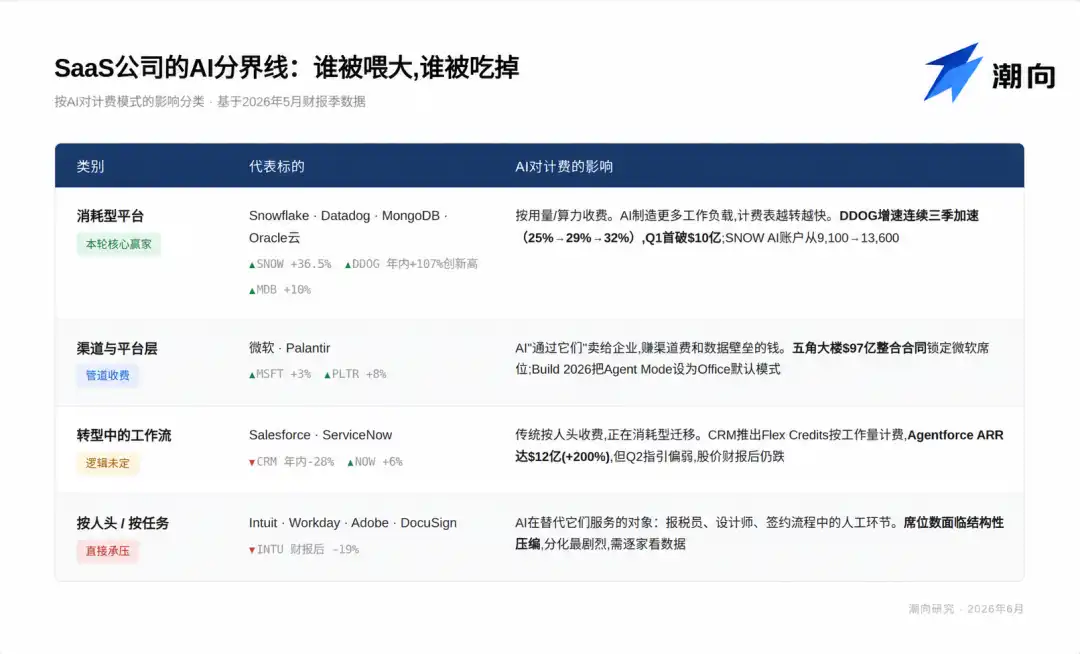
Software companies can be divided into four categories:

Category 1: Consumption-based platforms. Representatives: Snowflake, Datadog, MongoDB, Oracle Cloud business. AI creates more data processing, monitoring, and compute demands; their billing meters spin faster. Datadog is especially worth a separate look. Its growth is accelerating, from 25% to 29% to 32%, which is extremely rare among large-scale SaaS companies and makes it a core winner of this rebound.

Category 2: Channels and platform layers. Representatives: Microsoft and Palantir. AI is sold to enterprises "through them"; they earn channel fees and benefit from data barriers. Microsoft's $9.7 billion Pentagon contract, Copilot Studio, Azure AI Foundry are all reinforcing this position.

Category 3: Workflow companies in transition. Representatives: ServiceNow and Salesforce. Their traditional model is per-seat, but they are migrating towards value/consumption-based billing. Salesforce's Flex Credits is such an attempt. These companies have rebounded partly, but the market is still waiting for them to prove their transformation is fast enough.

Category 4: Directly pressured per-seat/per-task companies. Representatives: Intuit, Workday, Adobe, DocuSign. AI is replacing the objects of their services (tax preparers, designers, human steps in contracting processes). These companies face the most direct pressure, and differentiation is most intense, requiring scrutiny of seat data company by company.
What to Watch Next?

The peak of panic is over, but this isn't a signal to buy blindly. Three things are worth continuous tracking:

First, will the dividing line diffuse or narrow? Will the rebound spread from consumption-based platforms to companies that can provide hard evidence of "AI increasing per-seat value"? If it diffuses, it indicates the sector is broadly healing. If it stays only with the Snowflakes, it means the market has just adopted stricter screening criteria.

Second, can Salesforce's Flex Credits and Agentforce sustain acceleration? This is the largest single sample of "whether per-seat companies can successfully cross over." The $1.2 billion ARR proves the direction, but the drag from Tableau and Commerce Cloud shows old businesses are still consuming transformation momentum. The next earnings report (Sept 2) will reveal if Agentforce ARR can reach $1.5 billion and the proportion of Flex Credits in new contracts.

Third, enterprise adoption data for Microsoft Copilot post-Build. After Agent Mode becomes the default, changes in paid seat counts and token consumption will directly test the core hypothesis: "Are agents feeding platform revenue, or are they replacing human seats?"

The market has moved from "Will AI kill software?" into the differentiation stage of "Who is fed by AI, and who is eaten by AI?" Seeing clearly where that dividing line is matters more than chasing any single gain.

This article is an independent analysis by Tide Research based on publicly available information. The stocks and views mentioned are for research reference only and do not constitute any investment advice. The market carries risks; decision-making should be independent.

Data sources: Snowflake Q1 FY2027 Earnings · Salesforce Q1 FY2027 Earnings & SEC Filings · Microsoft Build 2026 Official Announcements · ChatForest Build 2026 Recap · CNBC · Reuters · Seeking Alpha


İlgili Sorular

QAccording to the article, what is the key characteristic of the SaaS companies that have emerged as winners from the 'SaaSpocalypse'?

AThe article states that the winning SaaS companies have a business model based on 'consumption-based' or 'usage-based' pricing. Unlike the traditional per-seat model, their revenue increases as AI generates more demand for their services (like data processing, monitoring, and computing).

QHow did Snowflake and Datadog's recent performance illustrate a positive impact from AI, and what is their primary metric for charging customers?

ASnowflake and Datadog saw their stock prices surge (Snowflake up 36.5%, Datadog doubling YTD) because AI is creating more workload for their platforms, not replacing them. Snowflake charges based on data processing/compute consumption, and Datadog charges based on monitoring consumption. Their revenue grows as AI usage increases.

QWhat is the 'line' or 'dividing line' the article repeatedly mentions that determines how the market is evaluating different SaaS companies in the age of AI?

AThe dividing line is the shift from a 'per-seat' or 'per-task' pricing model to a 'consumption-based' or 'usage-based' pricing model. The market is rewarding companies already on the consumption side and scrutinizing those whose traditional models might be replaced or disrupted by AI automation.

QDespite strong earnings, why did Salesforce's stock price not react positively, and what key initiative is it taking to address this market concern?

ASalesforce's stock did not rise despite beating EPS estimates because its forward guidance was slightly weak and its traditional per-seat business model faces market fears from AI. To address this, Salesforce is introducing 'Flex Credits,' a consumption-based pricing option for its AI Agentforce platform, aiming to shift towards usage-based revenue.

QBased on the article's classification, what are the four categories of software companies in the current AI-driven market, and can you name a representative for each?

A1. **Consumption-based Platforms:** Snowflake, Datadog, MongoDB. 2. **Channels & Platform Layers:** Microsoft, Palantir. 3. **Workflow Companies in Transition:** ServiceNow, Salesforce. 4. **Per-Seat/Per-Task Companies Under Direct Pressure:** Intuit, Workday, Adobe, DocuSign.

İlgili Okumalar

HYPE Spot ETF Continuously Accumulates 1% in 14 Days: Is the $75 New High Just the Starting Point?

Hyperliquid (HYPE) has surged to a new all-time high of $75 amid strong institutional and ETF-driven buying pressure. The article highlights several key bullish factors. First, the HYPE spot ETFs from 21Shares and Bitwise have seen 14 consecutive days of net inflows, totaling over $136 million and absorbing nearly 1% of HYPE's market cap—a faster initial pace than BTC or ETH ETFs. This ETF demand provides a solid price floor. Second, the protocol's own Assistance Fund (AF) mechanism, which uses 99% of fees to buy back and burn HYPE, has already removed over $1.1 billion worth of tokens, creating a dual support system alongside ETF inflows. This combined buying power is expected to counter potential selling pressure from upcoming team token unlocks. Institutionally, venture firm a16z is now considered one of the largest external holders of HYPE, with multiple addresses accumulating millions of tokens. Galaxy Digital is also actively buying. Analysts and firms like Bitwise and Grayscale are framing HYPE not as a mere meme coin but as a "second-generation" crypto with real value capture and infrastructure potential. Furthermore, Hyperliquid Strategies (PURR), a publicly traded company holding a large HYPE treasury, is set to join the Russell 3000 Index, potentially unlocking further passive investment flows. The ongoing feud between prominent backers like Arthur Hayes (pro-HYPE) and Kyle Samani (pro-SOL) underscores the intense market debate, with Hayes famously betting HYPE will outperform all top-ten crypto assets this year.

Odaily星球日报7 dk önce

HYPE Spot ETF Continuously Accumulates 1% in 14 Days: Is the $75 New High Just the Starting Point?

Odaily星球日报7 dk önce

ETH Bull and Bear Views Compilation: Can Ethereum's Value Flow Back to ETH?

Titled "ETH Bull and Bear Views: Can Ethereum's Value Flow Back to ETH?", this article synthesizes the current heated debate around Ethereum's native token, ETH, following Bankless co-founder David Hoffman's decision to sell his entire ETH holdings. The **bullish case**, represented by figures like Tom Lee (BitMine CEO) and Raoul Pal, argues that ETH's core thesis remains intact. They contend Ethereum is the essential, secure, and neutral foundational layer for future finance—encompassing stablecoins, RWA, DeFi, L2s, and Agentic AI. Bulls bet on ETH's long-term revaluation as institutional adoption of on-chain finance grows, with significant buying activity from entities like BitMine and Consensys cited as evidence. Conversely, the **bearish perspective**, led by Hoffman and analysts like Markus Thielen, questions ETH's value capture mechanism. They acknowledge Ethereum's network success but argue that the value created by L2s, DeFi, and applications does not sufficiently accrue to the ETH token itself. Bears point to ETH's prolonged underperformance versus the broader crypto market, lack of traditional cash flows, weakening "ultrasound money" narrative, and apparent institutional retreat (e.g., Harvard Management Company exiting its ETH ETF position) as key concerns. The debate highlights a pivotal shift: ETH is no longer just a community belief asset. The central question is whether ETH can transition from being a "**used infrastructure**" to a "**continuously bought and held core asset**" as more value enters the Ethereum ecosystem. The market is now critically examining the direct link between network growth and ETH's value.

marsbit54 dk önce

ETH Bull and Bear Views Compilation: Can Ethereum's Value Flow Back to ETH?

marsbit54 dk önce

Crypto is dead, Perps are forever

The crypto industry is shifting from a focus on creating native assets (like altcoins and protocol tokens) to becoming a "global asset pipeline." Native cryptocurrencies, except for Bitcoin, are seen as failing in their value storage and utility promises, with demand driven largely by speculation. Attention and liquidity are now moving toward real-world assets (RWAs) like U.S. stocks, bonds, gold, and oil traded on-chain via perpetual contracts (Perps). Stablecoins like USDT and USDC set the precedent, proving blockchain's core strength is efficient global settlement and transfer, not inventing new monetary systems. Meanwhile, assets like Ethereum and many DeFi tokens struggle as their narratives weaken against tangible traditional assets and the rapid real-world progress of AI. Perpetual contracts have emerged as a pivotal innovation. They simplify trading by offering pure price exposure to any asset, bypassing complexities of ownership, custody, and traditional market hours. Projects like Hyperliquid gained traction by combining CEX-like efficiency with on-chain transparency, capitalizing on post-FTX distrust, macroeconomic volatility, and the surge in demand for 24/7 stock trading. In conclusion, while the era of speculative native "crypto assets" may be over, perpetual contracts persist as the industry's most potent financial instrument—transforming all assets into globally accessible, constantly tradable instruments centered on price speculation.

marsbit1 saat önce

Crypto is dead, Perps are forever

marsbit1 saat önce

Tencent, Alibaba, ByteDance in a Battle for the Skill Store

Skill is becoming a key concept in the AI field, essentially serving as a structured "instruction manual" for AI Agents that specifies tool calls, decision logic, and output standards. This allows Agents to execute predefined tasks. As the number of Skills grows, distribution platforms have emerged. Major tech companies are swiftly entering this space. In March, Tencent, Alibaba, and ByteDance launched Skill stores within their respective Agent platforms. Subsequently, players like Zhipu AI, Meituan, and Xiaohongshu joined the fray. This competition for the "Skill store" is fundamentally a battle for the AI-era user entry point; whoever controls distribution controls the users. While ByteDance's Coze has experimented with paid Skills, most platforms offer them for free. The real value lies not in the stores themselves but in using them to attract and retain users within an ecosystem, driving revenue from services like cloud computing, model calls, or advertising. The landscape features three main player types: 1) **Internet giants** (e.g., Alibaba, ByteDance, Tencent, Meituan), leveraging Skills to drive traffic and monetize through their broader ecosystems (cloud services, transactions, ads). 2) **Large model companies** (e.g., Zhipu AI, Moonshot AI), using Skill stores to increase user engagement and monetize model API calls. 3) **Content platforms** (e.g., Xiaohongshu), treating Skills as a new content format to generate traffic and ad revenue. However, transforming Skill stores into a sustainable business faces significant hurdles. Key challenges include: the **difficulty in pricing Skills** due to inconsistent outputs across different models and contexts; **lack of cost transparency** (varying token consumption); **security risks** like Skill poisoning; and the **absence of standardized protocols** for development and evaluation. Unlike standardized mobile apps, Skills are often personalized workflows resistant to uniformity, which hinders the establishment of a reliable review and monetization system akin to the App Store. While there is genuine user demand for paid Skills—particularly in enterprise (e.g., contract review) and certain personal productivity scenarios—current platforms offer developers limited and unpredictable distribution. The future of Skill stores depends on overcoming these standardization, evaluation, and safety challenges to make acquiring a Skill as straightforward as downloading an app. For now, the stores function more as display shelves than robust marketplaces.

marsbit1 saat önce

Tencent, Alibaba, ByteDance in a Battle for the Skill Store

marsbit1 saat önce

İşlemler

Spot
Futures

Popüler Makaleler

ONE Nasıl Satın Alınır

HTX.com’a hoş geldiniz! Harmony (ONE) satın alma işlemlerini basit ve kullanışlı bir hâle getirdik. Adım adım açıkladığımız rehberimizi takip ederek kripto yolculuğunuza başlayın. 1. Adım: HTX Hesabınızı OluşturunHTX'te ücretsiz bir hesap açmak için e-posta adresinizi veya telefon numaranızı kullanın. Sorunsuzca kaydolun ve tüm özelliklerin kilidini açın. Hesabımı Aç2. Adım: Kripto Satın Al Bölümüne Gidin ve Ödeme Yönteminizi SeçinKredi/Banka Kartı: Visa veya Mastercard'ınızı kullanarak anında Harmony (ONE) satın alın.Bakiye: Sorunsuz bir şekilde işlem yapmak için HTX hesap bakiyenizdeki fonları kullanın.Üçüncü Taraflar: Kullanımı kolaylaştırmak için Google Pay ve Apple Pay gibi popüler ödeme yöntemlerini ekledik.P2P: HTX'teki diğer kullanıcılarla doğrudan işlem yapın.Borsa Dışı (OTC): Yatırımcılar için kişiye özel hizmetler ve rekabetçi döviz kurları sunuyoruz.3. Adım: Harmony (ONE) Varlıklarınızı SaklayınHarmony (ONE) satın aldıktan sonra HTX hesabınızda saklayın. Alternatif olarak, blok zinciri transferi yoluyla başka bir yere gönderebilir veya diğer kripto para birimlerini takas etmek için kullanabilirsiniz.4. Adım: Harmony (ONE) Varlıklarınızla İşlem YapınHTX'in spot piyasasında Harmony (ONE) ile kolayca işlemler yapın.Hesabınıza erişin, işlem çiftinizi seçin, işlemlerinizi gerçekleştirin ve gerçek zamanlı olarak izleyin. Hem yeni başlayanlar hem de deneyimli yatırımcılar için kullanıcı dostu bir deneyim sunuyoruz.

364 Toplam GörüntülenmeYayınlanma 2024.12.12Güncellenme 2026.06.02

ONE Nasıl Satın Alınır

Tartışmalar

HTX Topluluğuna hoş geldiniz. Burada, en son platform gelişmeleri hakkında bilgi sahibi olabilir ve profesyonel piyasa görüşlerine erişebilirsiniz. Kullanıcıların ONE (ONE) fiyatı hakkındaki görüşleri aşağıda sunulmaktadır.

活动图片