NVIDIA Earnings Countdown: Beating Expectations Is a Near Certainty, but Wall Street Is Most Concerned About These Five Questions

marsbit2026-05-20 tarihinde yayınlandı2026-05-20 tarihinde güncellendi

Özet

NVIDIA Earnings Countdown: Beating Expectations is a Given, but Wall Street Cares Most About These Five Issues The upcoming NVIDIA Q1 earnings report is expected to easily surpass the consensus revenue estimate of ~$78.7B. However, Wall Street's focus has shifted from the numbers themselves to five key strategic questions. **1. Shareholder Returns: Will "Frugality" Change?** Despite being the S&P 500's largest company, NVIDIA's shareholder returns (dividends + buybacks) averaged only 47% of its free cash flow from 2022-2025, far below the 80% peer average and its own historical norm. Its 0.02% dividend yield also lags the peer average of 0.89%. This low cash return, partly due to investments in AI ecosystem partners, is cited as a core reason for NVIDIA's valuation discount compared to other "Magnificent 7" stocks. Increasing returns could attract long-term income funds and be a catalyst. **2. Vera Rubin: The Next-Gen Chip Timeline** Analysts expect the next-generation Vera Rubin (R200) platform to ramp in the second half of 2026, following the current Blackwell series. It will use TSMC's 3nm process and share Blackwell Ultra's "Oberon" rack architecture, suggesting a smooth transition with limited gross margin impact. The market also awaits any update on NVIDIA's $1 trillion cumulative revenue forecast for 2025-2027. **3. Gross Margin: Can the 75% Level Hold?** Gross margin, a key valuation support, is expected to stabilize in the near term due to the shared architecture...

Original Author: Long Yue

Original Source: Wall Street News

NVIDIA earnings season—the most important thing is no longer the numbers themselves.

On May 18, Bank of America Securities analyst Vivek Arya's team released a preview report for NVIDIA's Q1 earnings, which will be announced after the U.S. market close on Wednesday, May 20.

According to NVIDIA's historical pattern over the past ten quarters, actual revenue has averaged 7% to 8% above management guidance. Management previously provided F1Q27 revenue guidance of $78 billion. Based on this calculation, actual revenue is highly likely to fall in the range of $83 billion to $84 billion, while the current market consensus is only $78.7 billion.

In other words, 'beating expectations' is almost a foregone conclusion. But analysts believe what will truly move the market's nerve after the earnings release are the following five questions.

Cash Return: Can NVIDIA Change Its 'Stinginess'?

This is the most discussed topic in the report and is considered by them to be the core reason for NVIDIA's long-term valuation discount.

NVIDIA is currently the largest company by market cap in the S&P 500, accounting for a high weight of 8.3% in the index, exceeding the historical peaks of Apple (7.9%) and Microsoft (7.2%). However, the problem is that NVIDIA's shareholder return efforts are severely mismatched with its size.

The data is straightforward: from 2022 to 2025, NVIDIA's free cash flow payout ratio (dividends + buybacks) averaged only 47%, while the average for comparable peers in the same period was 80%. Even NVIDIA's own average over the previous ten years was 80%.

Meanwhile, NVIDIA's current dividend yield is only 0.02%, while the peer average is 0.89%. Among equity income funds, NVIDIA is held by only 16% of funds, while Microsoft is held by 57% and Apple by 32%.
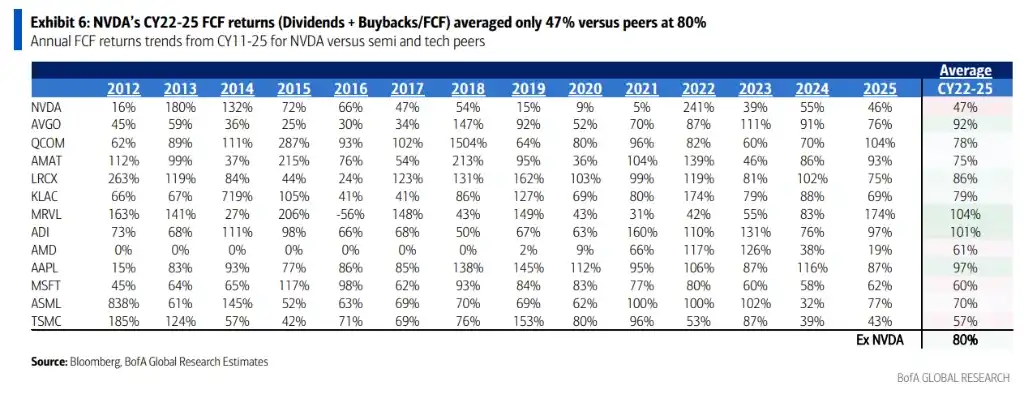
Where is the money going? Analysts point out that NVIDIA is investing heavily in the ecosystem—OpenAI, Anthropic, technology partners. These investments are seen as controversial by some outsiders, with voices suggesting it's "round-trip financing"—NVIDIA lends money to customers, who then use that money to buy NVIDIA's chips.

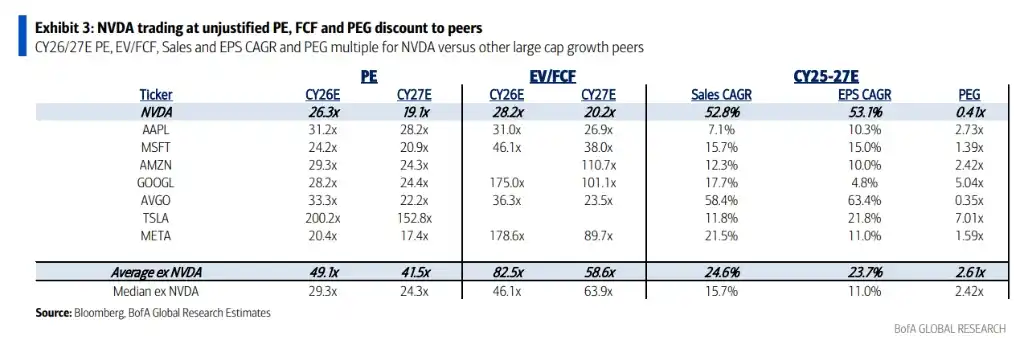
How large is the valuation discount? Data shows that NVIDIA's forward P/E ratio for 2026/2027 is 26x/19x, while the mean for other 'Magnificent Seven' members is 49x/42x, representing a discount of nearly 50%.

A more specific comparison: analysts predict NVIDIA's combined free cash flow for 2026+2027 will exceed $430 billion, higher than the combined ~$375 billion for Apple and Microsoft. However, NVIDIA's market cap is approximately $5.46 trillion, about 28% lower than the combined $7.5 trillion for Apple and Microsoft.
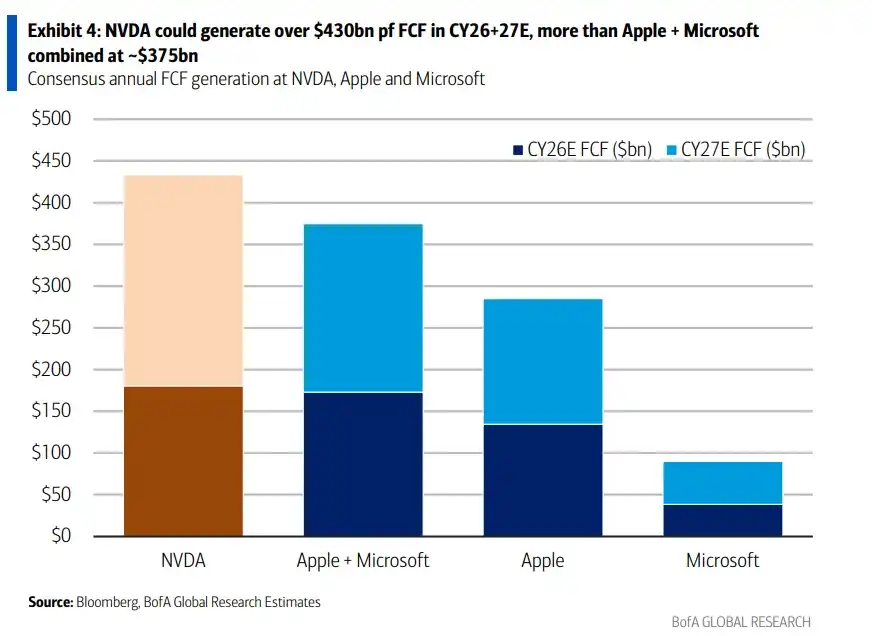
Analysts believe that if NVIDIA increases its dividend and buyback efforts, it could attract more long-term funds that prefer income, narrowing the valuation discount while also dispelling concerns about "round-trip financing." They list this change as a "potential catalyst for the second half of the year."

Vera Rubin: When Will the Next-Generation Chip Arrive?

NVIDIA's current main products are the Blackwell series. The market is concerned: when will the next-generation Vera Rubin platform officially ramp up?

The bank's judgment is the second half of 2026. Vera Rubin (codenamed R200) uses TSMC's 3nm process and shares the "Oberon" rack architecture with Blackwell Ultra, making the product transition relatively smooth, with limited expected impact on gross margins.

Looking further ahead, Vera Rubin Ultra (codenamed VR300) will be launched in the second half of 2027, featuring a completely new "Kyber" rack architecture, while the cost proportion of High Bandwidth Memory (HBM) will also further increase.
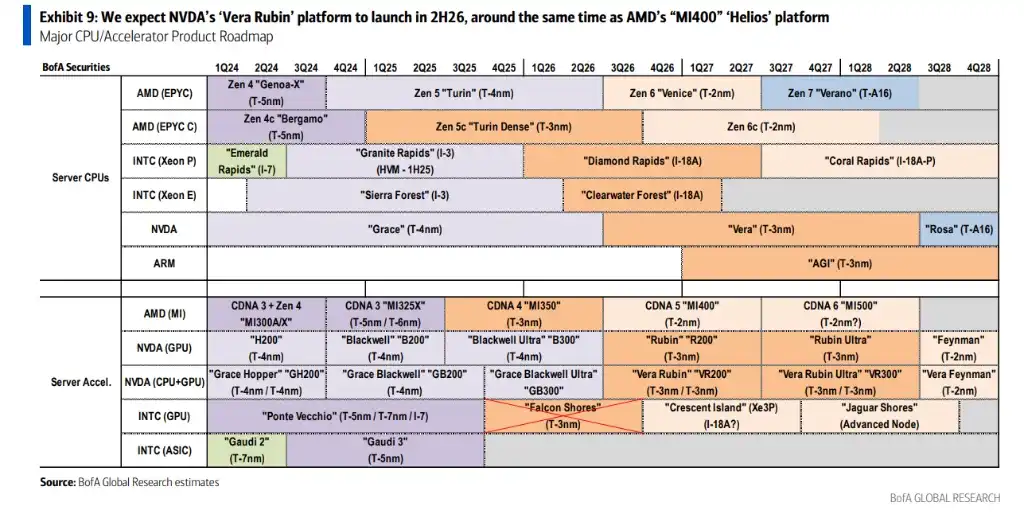
The market also wants to hear NVIDIA's latest stance on the "trillion-dollar revenue forecast" during the earnings call—NVIDIA previously gave an outlook for cumulative revenue of $1 trillion from 2025 to 2027, but contributions from LPU (Language Processing Unit) racks, CPUs, and Vera Rubin Ultra have not yet been included. Will this be updated this time?

Gross Margin: Can the 75% Defense Line Hold?

Gross margin is one of the core supports of NVIDIA's valuation.

Analysts judge: in the short term, because Vera Rubin reuses Blackwell's rack architecture, gross margins are relatively stable during the product transition period. However, in the medium to long term, the rising proportion of HBM memory costs is a persistent pressure source.
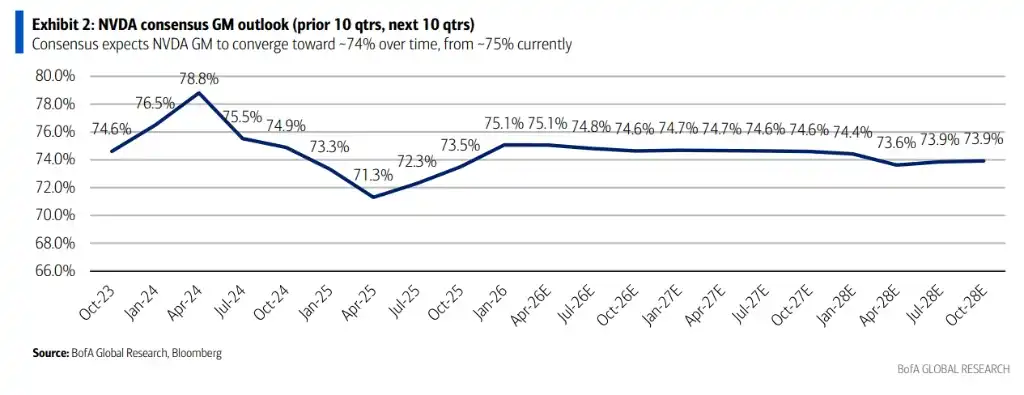
Market consensus shows NVIDIA's gross margin fluctuating within the 74% to 75% range. The bank has no disagreement with this but emphasizes that any better-than-expected gross margin performance will be a positive catalyst.

How Will the AI Accelerator Market Size Forecast Be Updated?

Bank of America previously provided NVIDIA's "trillion-dollar" prediction framework for the AI market from 2025 to 2027. This earnings report, the market is focused on whether NVIDIA will update this forecast, especially by incorporating three new growth drivers previously not counted:

  1. LPU (Language Processing Unit) racks
  2. Vera CPU (NVIDIA's self-developed server CPU)
  3. Vera Rubin Ultra

The bank expects that by 2030, the overall AI accelerator market size will reach approximately $1.17 trillion, with NVIDIA maintaining about 68% to 70% market share.
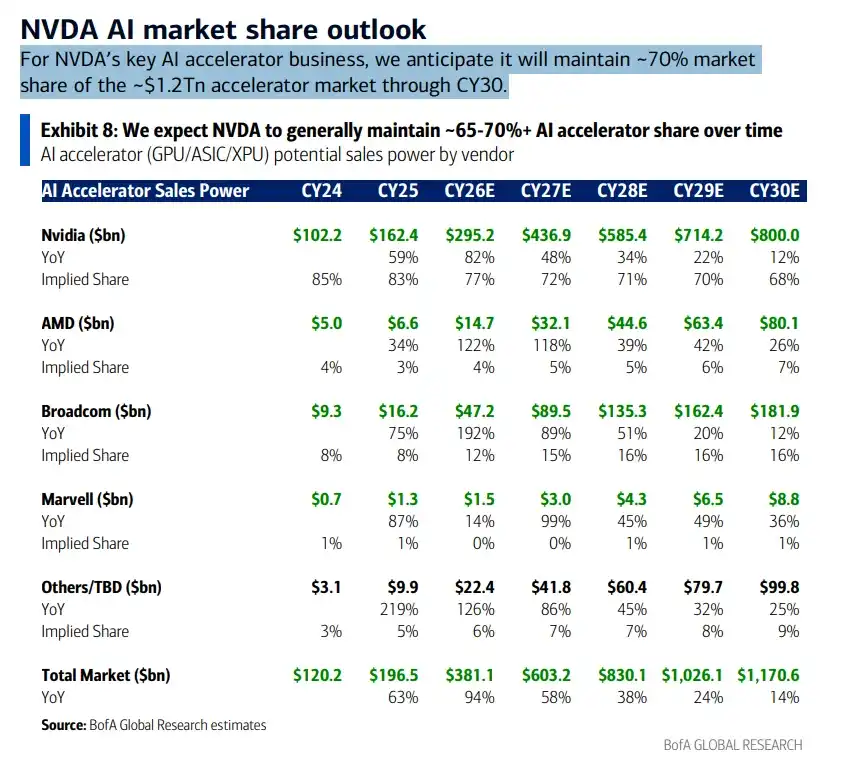
Specifically, NVIDIA's AI accelerator revenue is expected to grow from $102.2 billion in 2024 to $800 billion in 2030, AMD from $5 billion to $80.1 billion over the same period, and Broadcom from $9.3 billion to $181.9 billion.

Is the Competitive Threat from Google TPU and CPU Exaggerated?

A narrative has been circulating in the market recently: as AI enters the "Agentic AI" era, the importance of CPUs will surpass that of GPUs, thus threatening NVIDIA's moat.

The bank clearly disagrees with this, providing two reasons:

First, NVIDIA's self-developed "Vera CPU" will have new progress disclosed at the upcoming Computex conference, and its competitiveness in the standalone CPU market should not be underestimated.

Second, in already large-scale deployments of Blackwell and TPU clusters, the CPU-to-GPU ratio is already 1:2, which does not align with the narrative that "Agentic AI requires more CPUs."

The conclusion is: while the CPU market is large, there are many competitors (with strong contenders in both x86 and ARM architectures). NVIDIA's dominant position in the GPU/AI accelerator field is difficult to shake in the short term. It is estimated that by 2030, NVIDIA will maintain approximately 70% revenue share in a total addressable AI market exceeding $1.7 trillion.

Valuation: A 'Tech Leader' at a 50% Discount

Finally, back to valuation. The report uses a set of data to directly highlight NVIDIA's current valuation paradox.

Based on CY26/27 forward P/E ratios, NVIDIA is at 26x/19x, while the "Magnificent Seven" (Mag-7) average is 49x/42x—NVIDIA is at a nearly 50% discount.

Based on EV/FCF (Enterprise Value/Free Cash Flow), NVIDIA is at 28x/20x, while the Mag-7 average is 83x/59x—a discount exceeding 66%.

Based on PEG (Price/Earnings to Growth ratio), NVIDIA is at 0.41x, while the Mag-7 average is 2.61x, and the S&P 500 overall is above 1.3x.
Bank of America maintains a "Buy" rating with a price target of $320, based on a CY27 forward P/E ratio of 28x (excluding cash), which is at the mid-to-low end of NVIDIA's historical valuation range of 25x to 56x.

İlgili Sorular

QAccording to the report, what is the core reason for NVIDIA's valuation discount relative to its 'Magnificent 7' peers?

AThe core reason is NVIDIA's relatively low shareholder return rate (dividends + buybacks). Its average free cash flow return rate from 2022-2025 is only 47%, compared to an industry average and its own ten-year historical average of 80%. Its low dividend yield of 0.02% (vs. peer avg. 0.89%) means fewer income-focused funds hold its stock, contributing to the valuation gap.

QWhen does Bank of America's analyst team expect NVIDIA's next-generation Vera Rubin platform to ramp up in volume?

AThe analyst team expects the Vera Rubin platform (code R200) to ramp up in volume in the second half of 2026.

QWhat are the three new growth areas that could be included in an update to NVIDIA's 'trillion-dollar revenue' forecast?

AThe three new growth areas are: 1) LPU (Language Processing Unit) racks, 2) Vera CPU (NVIDIA's self-developed server CPU), and 3) Vera Rubin Ultra.

QWhat two reasons does the report give for downplaying the competitive threat from CPUs (like Google's TPU) to NVIDIA?

A1) NVIDIA's self-developed 'Vera CPU' is a competitive contender in the standalone CPU market, with new details expected at Computex. 2) In already deployed large-scale Blackwell and TPU clusters, the CPU-to-GPU ratio is already 1:2, which doesn't support the narrative that 'Agentic AI' requires significantly more CPUs.

QWhat is Bank of America's price target for NVIDIA and what is the valuation metric used to derive it?

ABank of America maintains a 'Buy' rating with a $320 price target. This target is based on a CY27 estimated P/E of 28x (excluding cash), which is at the low-to-mid range of NVIDIA's historical valuation range of 25x to 56x.

İlgili Okumalar

Learn Codex with the "Morning Briefing": Six Replicable Levels of Use

This article introduces a "Morning Briefing" as a simple, progressive framework for learning to effectively use Codex (an AI assistant), moving from basic information gathering to a more sophisticated, autonomous work partner. It outlines six actionable levels: **Level 1: Basic Information Query.** Start by simply asking Codex to check your Slack, Gmail, and Calendar to summarize what needs your attention today. **Level 2: Personalization with an Agents File.** Create a persistent file containing your default preferences for the briefing's format and content, so it's consistently useful. **Level 3: Automation.** Set the briefing to run automatically every weekday morning, creating a reliable starting point for your day. **Level 4: Project-Specific Briefings.** Instead of one overwhelming summary, create separate, dedicated threads for different projects (e.g., a launch, recruitment), each with its own focused briefing. **Level 5: Drafting Follow-Up Actions.** Elevate the briefing from a summary to an action starter by having it draft replies, prepare meeting notes, or highlight stalled decisions—ready for your review. **Level 6: Building a Memory System (Vault).** Integrate a knowledge vault (a structured file system) where important recurring information (project statuses, key people, decisions) is stored and updated. The briefing consults this vault to provide richer context and learns over time. The approach's strength is its incremental nature. Each level teaches a core Codex capability (connectors, personalization, automation, project context, assisted work, persistent memory) within a familiar, practical workflow, avoiding overwhelming theoretical concepts. It transforms a simple daily check-in into a personalized, evolving work operating system.

marsbit16 dk önce

Learn Codex with the "Morning Briefing": Six Replicable Levels of Use

marsbit16 dk önce

Can Alibaba Cloud Rewrite Itself?

Over the past five months, Alibaba Cloud's MaaS (Model as a Service) revenue has surged 15x, marking a strategic overhaul where the company is shifting its 17-year-old system designed for "humans using cloud" to a new paradigm centered on "Agents consuming Tokens." At its recent summit, Alibaba Cloud announced a full-stack upgrade encompassing "chip-cloud-model-inference," all optimized for AI Agents. Key launches include the new AI product portal "QianWen Cloud," hyper-node servers powered by the in-house AI chip Zhenwu M890, and the latest flagship model, Qwen3.7-Max. Senior VP Liu Weiguang described this as building "China's largest AI factory," where chips are raw materials, the cloud is the workshop, models are machines, and the inference platform is the assembly line, with Tokens as the final product. The company is now emphasizing its chip strategy, unveiling the Zhenwu M890 and a two-year roadmap for future chips. With over 560,000 chips deployed across 400+ clients, Alibaba Cloud aims to control the marginal cost per Token, mirroring Google's integration of TPU and Gemini for optimal cost-performance. The cloud infrastructure itself is being rewritten. Traditional cloud interfaces are being transformed into standardized, Agent-callable Skills. A new scheduling logic focuses on "task scheduling" over "resource scheduling" to handle the unpredictable, elastic workloads of Agents. Liu noted that AI applications now automatically provision cloud resources, with one customer's daily automated provisioning equaling two weeks of manual work. For models, the focus has shifted from conversational prowess to execution capability. Qwen3.7-Max demonstrated this by autonomously writing and optimizing a production-grade AI compute kernel for the new Zhenwu M890 chip over 35 hours, achieving a 10x performance improvement. The underlying Bailian platform was upgraded for efficiency, and it maintains an open ecosystem, hosting third-party models. This restructuring extends beyond technology to sales, organization, and metrics. Alibaba Cloud has established dedicated MaaS sales teams, separated from traditional IaaS, with new KPIs focusing on high-quality Tokens that solve real problems, the number of core business systems integrated with models, and the efficiency of Agent task completion. The underlying bet is clear: AI represents an opportunity orders of magnitude larger than before. Despite the uncertainty, Alibaba Cloud is aggressively rebuilding its entire system, betting on an AI-driven future where Tokens could become its largest product line.

marsbit1 saat önce

Can Alibaba Cloud Rewrite Itself?

marsbit1 saat önce

İşlemler

Spot
Futures
活动图片