Dogecoin ETFs lose their bite as Bitcoin, Ethereum big dogs lead the pack

cointelegraph2025-12-09 tarihinde yayınlandı2025-12-09 tarihinde güncellendi

Özet

US spot Dogecoin ETFs are experiencing a significant decline in trading activity, with total value traded (TVT) dropping to a record low of $142,000, far below the peak of over $3 million seen in late November. This cooling demand contrasts sharply with Dogecoin's strong performance in the broader crypto market, where it maintains over $1.1 billion in daily spot trading volume and a $22.6 billion market cap. The discrepancy suggests investors prefer accessing DOGE directly through exchanges rather than via ETFs. Meanwhile, Bitcoin and Ethereum ETFs continue to dominate the market, with TVTs of $3.1 billion and $1.3 billion respectively, underscoring their dominance in the regulated crypto ETF space. Other altcoin ETFs, including those for Solana and XRP, trail significantly behind in trading volume.

US spot Dogecoin exchange-traded funds (ETFs) are showing early signs of cooling demand, as total value traded (TVT) has fallen to its lowest level since launch.

SoSoValue data shows that on Monday, Dogecoin ETFs’ TVT fell to just $142,000, the lowest since launch. This marks a sharp retreat from late November, when the funds saw days where value traded topped $3.23 million.

Total value traded refers to the total dollar amount of ETF shares bought and sold over a given period. It serves as a gauge of market activity and practical liquidity, indicating the amount of money that has moved through the funds.
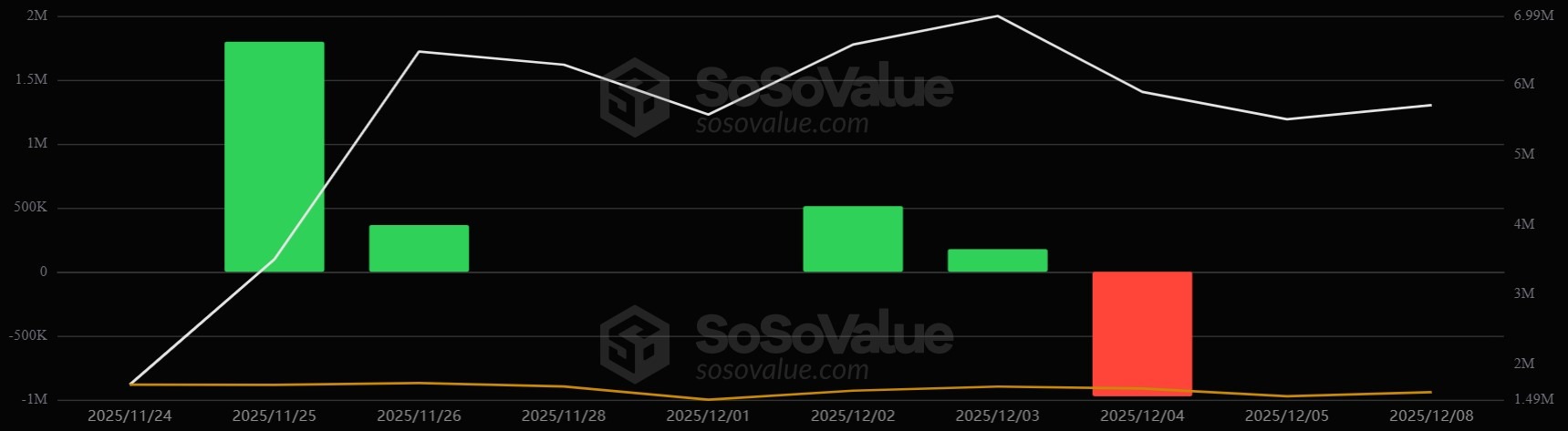
Daily spot ETF net inflows and total net assets. Source: SoSoValue

The contrast is stark when compared to Dogecoin (DOGE) activity in the broader crypto market. CoinGecko data shows that in the last 24 hours, DOGE recorded over $1.1 billion in spot trading volume and has a market capitalization of $22.6 billion.

This shows that the underlying asset remains highly liquid, but not through its ETF wrappers. This discrepancy suggests that traders are accessing DOGE directly through exchanges rather than traditional market vehicles.

Grayscale’s Dogecoin ETF made its debut in November but fell well short of initial volume expectations. ETF analyst Eric Balchunas predicted at the time that the ETFs would get at least $12 million in volume. However, the ETF only saw $1.4 million on its first day.

Related: BlackRock files with SEC for listing of staked Ether ETF

Bitcoin and Ether dominate ETF trading as alt-ETFs trail behind

On Dec. 8, ETF trading activity remained concentrated on Bitcoin (BTC) and Ether (ETH)-based products. According to SoSoValue, Bitcoin ETFs posted $3.1 billion in TVT, while Ether ETFs recorded $1.3 billion.

Solana (SOL) ETFs saw $22 million in value traded, while XRP products recorded $21 million in value traded. Further down the curve, the recently-launched Chainlink ETFs recorded a $3.1 million TVT on the same day, while Canary’s Litecoin (LTC) ETF had about $526,000.

The data suggests that ETF capital still overwhelmingly flows toward the two largest digital assets, continuing their lead as the core liquidity centers of regulated crypto exchange-traded products.

In terms of inflows, XRP (XRP) remains strong. On Monday, XRP ETFs’ inflow streak remains unbroken since its launch. Meanwhile, Solana ETFs, which first had their inflow streak broken in November, are on a three-day inflow streak after seeing $32 million in outflows on Dec. 3.

Magazine: Bitcoin whale Metaplanet ‘underwater’ but eyeing more BTC: Asia Express


İlgili Okumalar

Bitcoin Hits New High Since Mid-November. What About Other Cryptocurrencies?

On the evening of December 9th, Bitcoin (BTC) reached $94.4k, marking its highest price since mid-November. As of the next day, it was trading around $92.6k with a 2.5% daily gain. The total cryptocurrency market cap grew 2.8% to $3.16 trillion. Ethereum (ETH) saw a significant rise of 6.4%, trading near $3.3k. Other top-10 cryptocurrencies also advanced, with Cardano (ADA) leading the group with an 8.6% surge. The top gainer in the top-100 was FET, up 10.5%, while Bitcoin Cash (BCH) was the biggest loser, down 1.8%. U.S. spot Bitcoin ETFs recorded a net inflow of $151 million on December 9th, the largest for December so far, while Ethereum funds attracted $177 million, a high since late October. These inflows are seen as a potential signal of returning liquidity to the crypto market, with some analysts viewing it as a catalyst for Bitcoin to reach around $100k by year-end, though others are more cautious, expecting growth no earlier than next year. The Crypto Fear and Greed Index improved from 22 to 26, moving out of "extreme fear" into "fear," indicating reduced panic but a market still inclined to sell. Analysts at Wintermute noted that cryptocurrencies have recently shown resilience to negative factors. Key upcoming events that could determine market direction include the U.S. Fed's and the Bank of Japan's interest rate decisions on December 10th and 19th, respectively.

RBK-crypto8 dk önce

Bitcoin Hits New High Since Mid-November. What About Other Cryptocurrencies?

RBK-crypto8 dk önce

Everyone is MicroStrategy: When JPMorgan Starts Accepting BTC as Collateral, Will You Still Sell Your Coins?

The article discusses a major shift on Wall Street, where major banks like JPMorgan, Citi, and Bank of America have reportedly begun accepting Bitcoin as collateral for cash loans. This move, revealed by MicroStrategy's Michael Saylor, signifies Bitcoin's evolution into a "pristine collateral" asset, comparable to U.S. Treasuries or gold. It allows holders to access liquidity without selling their Bitcoin, avoiding capital gains taxes and maintaining exposure to potential price appreciation. This development effectively democratizes the "Buy, Borrow, Die" strategy previously accessible only to large institutions and the ultra-wealthy. It is framed as a critical step in Bitcoin's monetary evolution, enabling credit creation. A "credit flywheel" is described: rising BTC prices increase collateral value, allowing for larger loans, which can be used to purchase more assets, potentially driving prices higher. This shift also suggests a weakening of restrictive regulations like the SEC's SAB 121, transferring power from crypto-native exchanges to traditional financial institutions. The article concludes with a warning about the risks of leverage, as price drops could trigger mass, forced liquidations. It offers advice for investors: adopt a "debt mindset" to use loans for expenses while holding assets, cautiously manage loan-to-value ratios to avoid margin calls, and watch for a resurgence of regulated, compliant CeFi platforms.

marsbit24 dk önce

Everyone is MicroStrategy: When JPMorgan Starts Accepting BTC as Collateral, Will You Still Sell Your Coins?

marsbit24 dk önce

İşlemler

Spot
Futures
活动图片