Privacy Coin Crisis of Confidence! ZEC Plunges Over 56% in a Single Day

链捕手2026-06-05 tarihinde yayınlandı2026-06-05 tarihinde güncellendi

Özet

Zcash (ZEC), a leading privacy-focused cryptocurrency, experienced a severe crash on June 5th, plummeting over 56% in a single day and erasing nearly two months of gains. The flash crash was triggered by the disclosure of a critical zero-knowledge proof vulnerability within Zcash's Orchard privacy pool, which had existed since the pool's launch in May 2022. The flaw theoretically allowed an attacker to forge unlimited ZEC undetectably due to the pool's privacy features. The vulnerability was discovered on May 29th by independent security researcher Taylor Hornby during a proactive audit commissioned by Shielded Labs, utilizing AI-assisted analysis. The Zcash development team responded swiftly, implementing an emergency soft fork to disable Orchard transactions on June 2nd and executing a permanent hard fork fix (NU6.2) on June 3rd. Despite the technical fix, a major crisis of confidence emerged. The core issue is that Orchard's privacy design makes it cryptographically impossible to prove whether the vulnerability was exploited over the past four years, casting permanent doubt on the historical supply integrity of ZEC. While Shielded Labs argues exploitation was unlikely, the inability to provide definitive proof has severely damaged market trust. This sentiment was exacerbated when BitMEX co-founder Arthur Hayes, a prominent ZEC supporter, announced he was selling his entire position. He stated that privacy assets require "perfect security" rather than "probable safety." ...

Author: Zhou, ChainCatcher

On June 5th, the leading privacy coin ZEC experienced a maximum intraday drop exceeding 56%, erasing nearly two months of gains, with its market cap shedding approximately $5 billion at one point.

Data shows that the total ZEC contract liquidations across all platforms reached about $100 million in the past 24 hours, with long position liquidations exceeding $76 million, second only to BTC and ETH in liquidation volume.
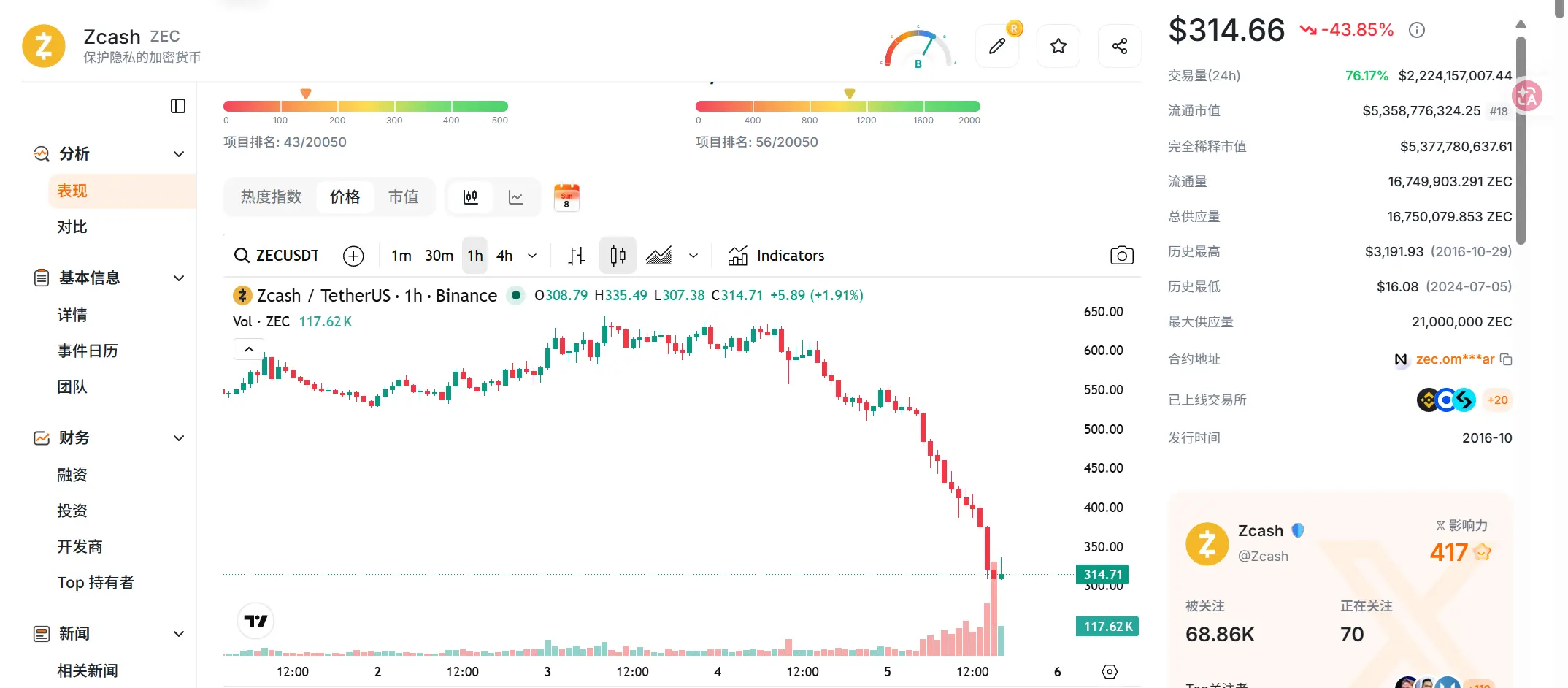
Image Source: RootData

The crash was triggered by a zero-knowledge proof vulnerability that had been latent for four years in Zcash's latest privacy transaction pool, Orchard. Theoretically, it allowed attackers to forge infinite ZEC under privacy protection, making detection extremely difficult.

The good news is the vulnerability was permanently fixed via a hard fork on June 3rd. The bad news is, due to the privacy features of the Orchard pool, no one can cryptographically prove that this vulnerability was never exploited over the past four years, leading to market doubts about ZEC's supply integrity during that period.

BitMEX co-founder Arthur Hayes announced he had liquidated all his ZEC holdings, on-chain whales profited handsomely from short positions, and market confidence was visibly shaken.

How the Vulnerability Arose and Was Discovered

The Orchard pool is Zcash's third-generation privacy transaction layer launched in May 2022. Due to insufficiently strict constraint conditions on one circuit element, attackers could input false values in elliptic curve multiplication operations yet still pass circuit verification, thereby generating unlimited forged ZEC within the pool. Because of Orchard's inherent privacy design, this forgery would leave no detectable on-chain trace.

The vulnerability was discovered by independent security researcher Taylor Hornby on May 29th. In April this year, the Zcash ecosystem independent security organization Shielded Labs had commissioned him to conduct a targeted security audit of the Zcash protocol, aiming to find potential vulnerabilities before attackers.

On May 28th, Anthropic released the Claude Opus 4.8 model. The next day, Hornby integrated it into his customized AI audit framework to conduct targeted analysis of the Orchard circuit, pinpointing the vulnerability that very day. He wrote a complete exploit program in a local test environment, verifying the technical feasibility of infinite minting. That evening, he responsibly disclosed the issue to the Zcash Open Developer Laboratory (ZODL).

ZODL engineers confirmed the vulnerability within hours and immediately activated emergency procedures. In the early hours of June 2nd, Zcash pushed an emergency soft fork via Zebra 4.5.3, temporarily disabling all Orchard transactions. On June 3rd, at 12:05 Beijing time, the mainnet completed the NU6.2 hard fork at block height 3,364,600, deploying the patched circuit and permanently closing the vulnerability.

From discovery to hard fork completion took about five days. The Zcash Foundation stated this was only the second time in Zcash's history since its 2016 launch that a protocol upgrade was triggered by a security issue. No known exploits occurred throughout the process, network total supply safeguarding mechanisms confirmed the total supply remained intact, and user privacy along with Sapling and transparent transactions were unaffected.
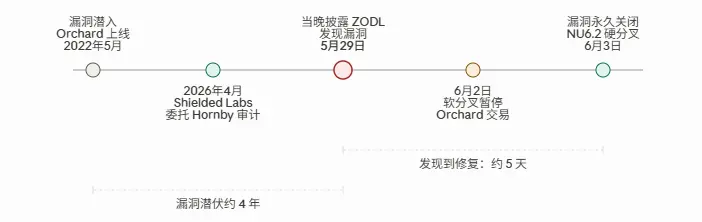
Image Source: Claude

After the Fix, Doubts Remain

Due to Orchard's privacy design, if an attacker never transfers forged tokens to the transparent pool, no existing mechanism can detect anomalies on-chain. This means the conclusion of an 'intact total supply' is based on currently observable data, not strict cryptographic proof. The vulnerability has existed since May 2022, and no one can rule out the possibility it was exploited over the past four years.

Shielded Labs believes the likelihood of exploitation is low, citing three reasons: the fact it remained undiscovered for four years indicates an extremely high technical barrier; its discovery resulted from a proactive targeted audit, not a passive exposure; and the short window from discovery to fix gave attackers very limited time to exploit. However, this very explanation itself shows the problem cannot be completely disproven.

To address this gap, Shielded Labs is collaborating with various developers to explore a new network upgrade proposal. The plan is to deploy a new privacy pool and enforce mandatory turnstile accounting scrutiny for all tokens migrating out of Orchard, allowing anyone to publicly verify supply integrity. The specific proposal is expected to be announced next week and will still need to go through community governance processes.

Crypto investor Simon Dedic pointed out that this event reveals two concurrent shifts in perception: privacy is not always an advantage; it can also be a risk in protocol design. The involvement of AI tools means vulnerabilities of similar scale can now be discovered with a lower barrier to entry, increasing the security audit pressure faced by the entire crypto industry.

On-chain analyst Haotian described the core issue of this event as 'unclearable.' Even if Shielded Labs introduces a new turnstile audit scheme, it can only prove the current supply is less than the total amount that entered the pool, still failing to cover potential historical hidden depreciation. He also noted the inherent contradiction between verifiable supply and privacy black boxes is a structural dilemma ZEC struggles to circumvent.

Concentrated Release of Market Panic

Although the technical crisis has passed, the market has not fully digested the true nature of the vulnerability.

This morning, Zcash founder Zooko Wilcox, Shielded Labs, and Taylor Hornby jointly published a detailed article comprehensively disclosing the exploitability of the vulnerability, the technical feasibility of infinite ZEC forgery, and the fact that 'cryptographic proof of historical non-exploitation is impossible' due to Orchard's privacy features, which truly ignited market panic.

On the same day, Arthur Hayes announced liquidating all his ZEC holdings, stating that while the probability of malicious minting is extremely low, it cannot be formally excluded at the cryptographic level. The value proposition of the privacy narrative demands 'perfect security,' not 'probable safety.' Hayes also indicated he might consider buying back at lower prices if subsequent assumptions are disproven.

Hayes was previously one of ZEC's most prominent public supporters, even listing it as his second-largest personal holding. He once stated ZEC should reach 10% of BTC's price, with the current rally 'having plenty of upside left.' His public departure now inevitably impacts market sentiment.

The combination of these two events caused ZEC's price to plummet rapidly. According to on-chain analyst monitoring, when ZEC fell below $400, the leveraged short position opened at $626.47 by 'insider whale' Garrett Jin resulted in floating profits reaching tens of millions of dollars.

However, some hold the view that the sharp price drop was not solely driven by the vulnerability. Crypto KOL OzLion pointed out that ZEC's previous rally already showed signs of large capital involvement. The vulnerability news might have merely provided an exit timing, with a massive influx of spot sell-offs on the day being a more direct price driver. He lamented that a 'strong-consensus blue-chip' with a $12 billion market cap losing $6 billion in a single day shows that building consensus in the crypto world is difficult, breaking it is easy, and repairing it is an even longer process.


Trend Kriptolar

İlgili Sorular

QWhat was the main event that triggered the price crash of ZEC on June 5th?

AThe main trigger was the public disclosure of a zero-knowledge proof vulnerability in the Orchard privacy pool, which theoretically allowed unlimited undetectable minting of ZEC for four years, severely damaging market confidence.

QWhat is the core dilemma highlighted by the ZEC incident regarding privacy features?

AThe incident highlights the inherent contradiction between verifiable supply integrity and the privacy features of 'black box' systems. While privacy is a core value proposition, it creates a scenario where past exploits or supply inflation cannot be cryptographically proven or disproven, undermining trust.

QHow did Arthur Hayes' actions impact the market following the vulnerability disclosure?

AArthur Hayes, a prominent public supporter of ZEC, announced he was liquidating his entire ZEC holdings. He stated that while the probability of malicious minting was low, it couldn't be cryptographically ruled out, and 'perfect security' is required for a privacy narrative. His departure significantly impacted market sentiment and contributed to the sell-off.

QWhat was the role of AI in the discovery and handling of the Zcash vulnerability?

ASecurity researcher Taylor Hornby integrated the newly released Claude Opus 4.8 AI model into a customized audit framework. This AI-assisted analysis targeted the Orchard circuit and located the critical vulnerability within a single day on May 29th, demonstrating how AI tools can lower the barrier for discovering complex vulnerabilities.

QWhat measures are being proposed to address the trust issue after the ZEC vulnerability was fixed?

AShielded Labs is exploring a new network upgrade proposal. The plan involves deploying a new privacy pool and implementing a mandatory 'revolving door' accounting review for all funds migrating out of the Orchard pool. This would allow public verification of supply integrity going forward, though it cannot retroactively prove the historical supply was untouched.

İlgili Okumalar

The Truth Behind Digital Banking: The Fragile Ecosystem Supporting 1.46 Billion Users

The article "The Truth About Digital Banks: The Fragile Ecosystem Behind 1.46 Billion Users" provides a data-driven analysis of the digital banking sector based on a verified list of 368 active neobanks as of July 2026. While these platforms collectively serve 1.46 billion users, with Asia (817 million users) and institutions like WeBank and Nubank dominating the landscape, the sector faces significant structural vulnerabilities. A key finding is that only 127 of the 368 neobanks hold full banking licenses. The majority operate atop third-party infrastructure providers like Banking-as-a-Service (BaaS) platforms, creating systemic risk where the failure of a single provider, as seen in past cases like Wirecard and Synapse, can jeopardize multiple consumer brands. Furthermore, the industry experiences a steady, quiet stream of failures, mergers, and shutdowns that often go unreported. The analysis also examines the adoption of artificial intelligence (AI), finding only 67 platforms (18%) have deployed AI at scale, with many innovators based in emerging markets like Nigeria and the Philippines. The infrastructure layer is highly concentrated, with 106 providers supporting the entire ecosystem of 368 consumer-facing brands. The article concludes with three predictions: the unlicensed gap will close through acquisitions or exits; an AI credit model is likely to fail in the next economic downturn; and a nascent but significant trend is the emergence of financial services designed for AI agents rather than humans.

marsbit4 dk önce

The Truth Behind Digital Banking: The Fragile Ecosystem Supporting 1.46 Billion Users

marsbit4 dk önce

Digital Asset Trading Platform Uphold Cuts 17% of Global Workforce Amid 'Crypto Winter'

Cryptocurrency trading platform Uphold has laid off approximately 17% of its global workforce, affecting 85 full-time employees and contractors. The cuts are part of a strategic shift to reallocate resources towards its rapidly growing corporate services business, as retail cryptocurrency trading activity has declined amid the ongoing market downturn. CEO Simon McLaughlin stated the company is restructuring after years of significant growth and remains confident in the long-term prospects of digital assets and blockchain technology. Founded in 2015, Uphold offers trading and custody services for cryptocurrencies, fiat, stocks, and precious metals. It has recently expanded to provide infrastructure for banks, fintech firms, and broker-dealers to integrate crypto services. The layoffs occur against a backdrop of a prolonged crypto market slump, with total market capitalization falling to around $2.1 trillion by Q2 2024. Factors include weakened trading volumes, reduced retail participation, interest rate hikes, geopolitical uncertainty, and net outflows from U.S. spot Bitcoin ETFs. Uphold clarified it is not shutting down its UK operations or any international offices. The company highlighted strong growth in its corporate platform and announced plans to evolve its consumer app into a broader blockchain-based financial assistant by 2026, offering U.S. stocks, tokenized securities, lending, credit cards, and DeFi yield opportunities.

cryptonews.ru4 dk önce

Digital Asset Trading Platform Uphold Cuts 17% of Global Workforce Amid 'Crypto Winter'

cryptonews.ru4 dk önce

Has the Crypto Utopia Collapsed? The Industry Reaches an Inflection Point After the Frenzy Subsides

Has the crypto utopia collapsed? The industry is at an inflection point as the hype fades. The prevailing view is that crypto has become an outlet for excess liquidity, with many participants leaving as financial returns have fallen short of past-decade expectations. The 2021 boom has been revealed as an illusion, placing the industry in the "trough of disillusionment" on Gartner's Hype Cycle. This forces a return to first principles: re-evaluating token value, securing DeFi protocols, and finding real-world applications. The core failure is a repetitive cycle of reflexive speculation, driven by the premature liquidity of tokens. The industry's incentives prioritized short-term gains over genuine innovation. While curiosity drives invention, recent DeFi hacks signal a need for engineering and iteration, including token models. The culture is shifting; the industry is no longer in its early stages. Positioned at a turning point on the technology adoption curve, crypto faces the immense challenge of rebuilding finance from scratch, a process of inevitable iteration and failure. Regarding crypto VC, claims of its death are overstated. The exceptional returns of 2016-2021 were an anomaly. The initial crypto-anarchist ethos has largely been co-opted by Wall Street and regulators. The utopian vision is over; the industry is being assimilated into the existing system, becoming a business. Current viable project categories include stablecoins, prediction markets, tokenized assets/RWA, perpetual contracts, and AI/agent integration. Crypto is converging with fintech, far from the envisioned DeFi revolution, and must find killer apps within regulatory boundaries. A reconciliation is possible: cryptocurrency may change value storage and transfer in subtle, imperceptible ways that integrate into existing systems, rather than through revolutionary fanfare. True creativity often emerges from adversity. There remains much to build for those driven by genuine curiosity.

marsbit19 dk önce

Has the Crypto Utopia Collapsed? The Industry Reaches an Inflection Point After the Frenzy Subsides

marsbit19 dk önce

Lei Jun Earns 7 Billion in One Day from CXMT's IPO? Xiaomi Executive Responds

On July 28th, Changxin Technology's stock price on the Sci-Tech Innovation Board experienced minor fluctuations. The company had made a historic market debut the previous day, becoming the first A-share stock to record a single-day trading volume exceeding 1 trillion yuan. This led to significant paper gains for its strategic investors. Among them, Xiaomi's wholly-owned subsidiary was allocated 18.24 million shares with an initial investment of approximately 158 million yuan. Reports estimated a paper profit of 717 million yuan for Xiaomi founder Lei Jun based on his shareholding structure. However, a Xiaomi executive clarified that this was a corporate investment and should not be conflated with personal wealth. Other major beneficiaries included Alibaba and Nio. Alibaba, an early investor, held nearly a 5% stake through two entities, with an estimated paper gain exceeding 160 billion yuan. Nio, participating in the strategic placement, also saw substantial paper returns. Additionally, state-owned banks and insurance institutions that invested in Changxin recorded potential gains in the hundreds of billions. Conversely, companies like Country Garden reportedly missed out on nearly 50 billion yuan in potential gains after divesting their stakes before the IPO due to liquidity pressures. The article notes that these are paper profits based on the listing price, as the allocated shares are subject to lock-up periods, and final realized gains will depend on future stock performance. An employee from Changxin Technology commented that ordinary staff remain focused on their salaries and benefits rather than the market hype.

marsbit28 dk önce

Lei Jun Earns 7 Billion in One Day from CXMT's IPO? Xiaomi Executive Responds

marsbit28 dk önce

İşlemler

Spot

Popüler Makaleler

ZEC Nasıl Satın Alınır

HTX.com’a hoş geldiniz! Zcash (ZEC) satın alma işlemlerini basit ve kullanışlı bir hâle getirdik. Adım adım açıkladığımız rehberimizi takip ederek kripto yolculuğunuza başlayın. 1. Adım: HTX Hesabınızı OluşturunHTX'te ücretsiz bir hesap açmak için e-posta adresinizi veya telefon numaranızı kullanın. Sorunsuzca kaydolun ve tüm özelliklerin kilidini açın. Hesabımı Aç2. Adım: Kripto Satın Al Bölümüne Gidin ve Ödeme Yönteminizi SeçinKredi/Banka Kartı: Visa veya Mastercard'ınızı kullanarak anında Zcash (ZEC) satın alın.Bakiye: Sorunsuz bir şekilde işlem yapmak için HTX hesap bakiyenizdeki fonları kullanın.Üçüncü Taraflar: Kullanımı kolaylaştırmak için Google Pay ve Apple Pay gibi popüler ödeme yöntemlerini ekledik.P2P: HTX'teki diğer kullanıcılarla doğrudan işlem yapın.Borsa Dışı (OTC): Yatırımcılar için kişiye özel hizmetler ve rekabetçi döviz kurları sunuyoruz.3. Adım: Zcash (ZEC) Varlıklarınızı SaklayınZcash (ZEC) satın aldıktan sonra HTX hesabınızda saklayın. Alternatif olarak, blok zinciri transferi yoluyla başka bir yere gönderebilir veya diğer kripto para birimlerini takas etmek için kullanabilirsiniz.4. Adım: Zcash (ZEC) Varlıklarınızla İşlem YapınHTX'in spot piyasasında Zcash (ZEC) ile kolayca işlemler yapın.Hesabınıza erişin, işlem çiftinizi seçin, işlemlerinizi gerçekleştirin ve gerçek zamanlı olarak izleyin. Hem yeni başlayanlar hem de deneyimli yatırımcılar için kullanıcı dostu bir deneyim sunuyoruz.

636 Toplam GörüntülenmeYayınlanma 2024.12.12Güncellenme 2026.06.02

ZEC Nasıl Satın Alınır

Tartışmalar

HTX Topluluğuna hoş geldiniz. Burada, en son platform gelişmeleri hakkında bilgi sahibi olabilir ve profesyonel piyasa görüşlerine erişebilirsiniz. Kullanıcıların ZEC (ZEC) fiyatı hakkındaki görüşleri aşağıda sunulmaktadır.

活动图片