WSJ: Fake Websites, Fake Trades, Real Promotion: Polymarket's Traffic Scam

marsbit2026-06-23 tarihinde yayınlandı2026-06-23 tarihinde güncellendi

Özet

The Wall Street Journal investigation reveals that prediction market platform Polymarket hired dozens of creators, primarily students, to produce and disseminate deceptive promotional content on social media. These creators used fake, near-identical clone websites (like "poiymarket.com") to simulate placing bets and winning large sums—totaling $1.9 million in fake wagers and nearly $900,000 in fake winnings across over 1,100 analyzed videos—without disclosing their paid partnership with Polymarket, as required by federal advertising regulations. The videos, often promoting unrealistic "free money" claims, were amplified by a coordinated "army" of social media accounts managed by a marketing contractor to target U.S. users, despite Polymarket's crypto platform being barred from serving the U.S. since a 2022 settlement. Polymarket stated it is committed to fair and transparent markets and plans a comprehensive audit of its promotional content. The article also notes internal discussions about potentially overturning the 2022 settlement to reintroduce its crypto platform in the U.S.

Original article from WSJ, by Katherine Long, Caitlin Ostroff, Neil Mehta and Brenna T. Smith

Compiled by|Odaily Planet Daily Qin Xiaofeng(@QinXiaofeng 888 )
Editor's Note: A recent Wall Street Journal investigation found that prediction market platform Polymarket paid dozens of creators to make fake trades and profit videos on simulated websites, and used social media "water armies" for viral marketing to attract U.S. users. None of these videos disclosed the paid relationships as required by federal regulations, and the "handsome returns" shown were entirely fabricated. Polymarket stated it is committed to maintaining accurate, fair, and transparent markets and plans to conduct a comprehensive audit of its promotional content.

The following is the WSJ investigation article, compiled by Odaily Planet Daily. Enjoy~

————————

From George Makihara's videos, it appeared he had a lucrative side hustle: placing bets on Polymarket.

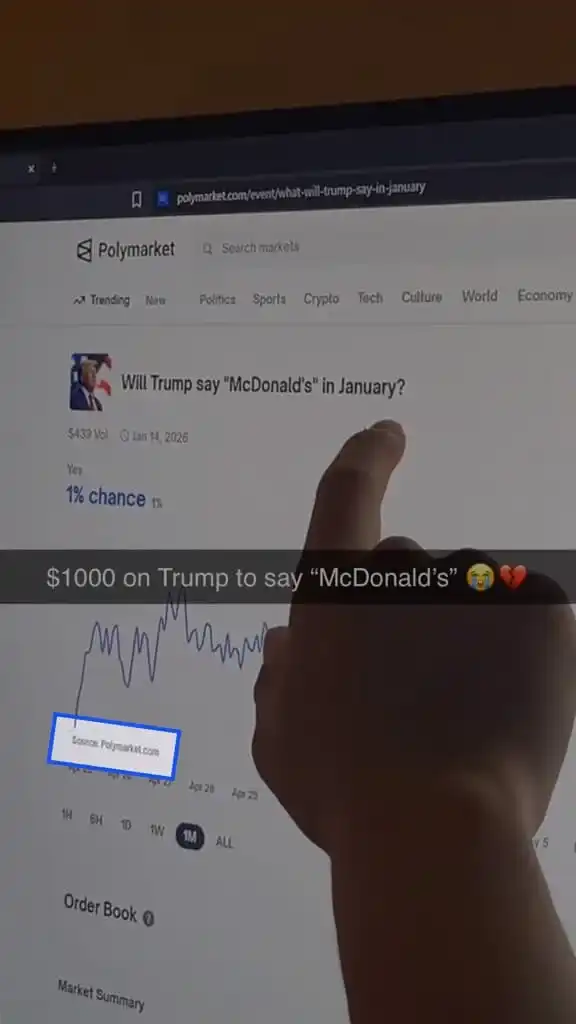
In January of this year, this college student posted a video showing he won $100,000 by betting that President Trump would publicly say the word "McDonald's" that month.

According to his videos, from January to mid-May, George Makihara seemingly placed 145 bets on the Polymarket website – with a total amount close to $410,000.

But according to a Wall Street Journal investigation, none of those trades were real.

George Makihara jumps when Trump says the word "McDonald's"; however, Trump never publicly said that phrase that month, this video was filmed two months ago

Based on the Journal's analysis of over 1,100 videos, related instructional materials, and interviews with creators who have worked with the company, George Makihara is one of dozens of creators paid by Polymarket, mostly college students, who film themselves making fake trades and sometimes showcasing fake profits. George Makihara declined to comment.

Public data shows that on Polymarket's actual website in January, over 50 accounts participated in the "McDonald's" bet. All of these accounts lost money.

To attract users to its unregulated platform, Polymarket flooded social media with videos like George Makihara's that appear genuine at first glance. In reality, Polymarket created near-perfect clones of its website and then instructed creators to make simulated trades on these virtual sites, while concealing that they were paid by Polymarket.

To make the videos go viral, Polymarket recruited a social media "army" to duplicate and repost the creators' content. Even though this New York-based company has been banned from offering its core crypto platform services in the U.S. since 2022, these social media creators, paid for their work, specifically targeted U.S. users – who can still access the site via virtual private networks (VPNs).

Polymarket said in a statement, "the company is committed to maintaining accurate, fair, and transparent markets. We are part of a fast-growing industry and are constantly evaluating how to improve how we engage and earn the trust of our audience." The company said it plans to conduct a comprehensive review of its existing promotional content.

Polymarket hired and worked closely with a marketing contractor to promote the site. In a message reviewed by the Journal, the contractor told its social media "army" to focus on reposting content from 10 Polymarket creators, including George Makihara. These creators initially did not label themselves as paid partners of Polymarket, though one provided a $20 referral code in their social media bio. After the Journal began asking the company about the marketing operation, these creators started adding "@polymarket partner" labels to their bios.

The Journal reviewed 1,105 videos posted between late December 2025 and mid-May by 10 creators endorsed by Polymarket's contractor. In 70% of the videos, the creators placed bets; clues in the videos indicate all these bets – totaling $1.9 million – were fake. Most videos just showed the betting process, but 118 videos showed creators reacting to winning, collectively winning nearly $900,000 in prizes – actually from fake trades; if you had actually placed those bets, you would have lost over $166,000.(Note: Polymarket has a data partnership with Dow Jones & Company, publisher of the Wall Street Journal. The Journal used only public data in this analysis.)

According to creators who have worked with the company, Polymarket instructed creators not to disclose they were paid. They said compensation typically accumulated to between $2,000 and $3,000 per month.

Investigating Fake Trades

One of the earliest videos showing signs of fake trades was posted to social media in June 2025, filmed at Polymarket's New York office. Someone placed a $100,000 bet that Powell would say "good afternoon" at a press conference, with a caption calling the bet a "valid manhood test."

The Journal investigation found over a dozen differences between the real Polymarket website and the simulated one.
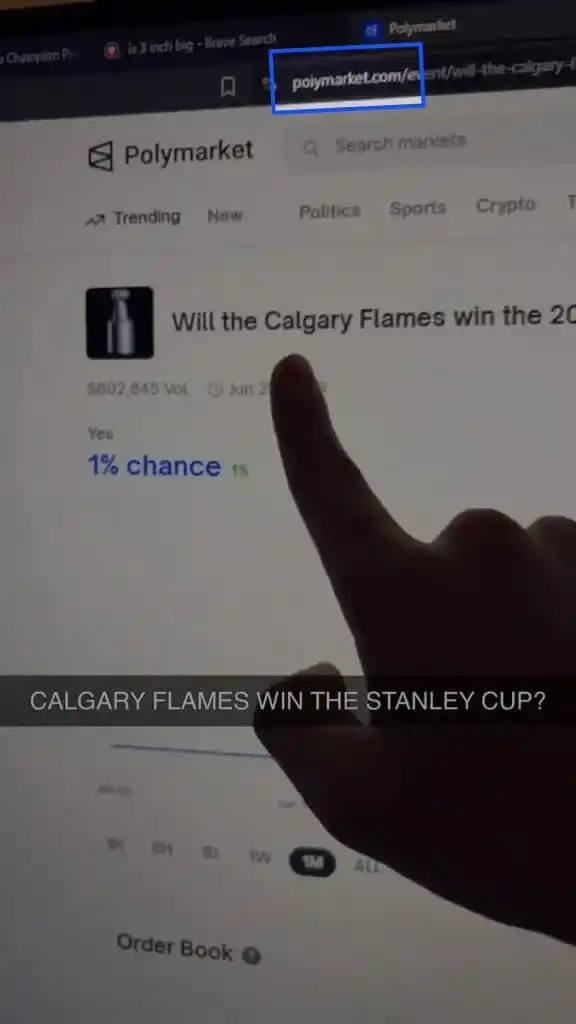
The fake simulated website was called "poiymarket.com"; when the "i" was capitalized, it was indistinguishable from polymarket.com. According to a person familiar with the matter, the site was built by Polymarket. Price charts on the site were labeled as sourced from "Polymarket.com." But Polymarket's real official website does not display any source information.
Additionally, the fake website sometimes had errors. For example, buttons would show "YES" and "NIR," while the real site has "YES" and "NO."
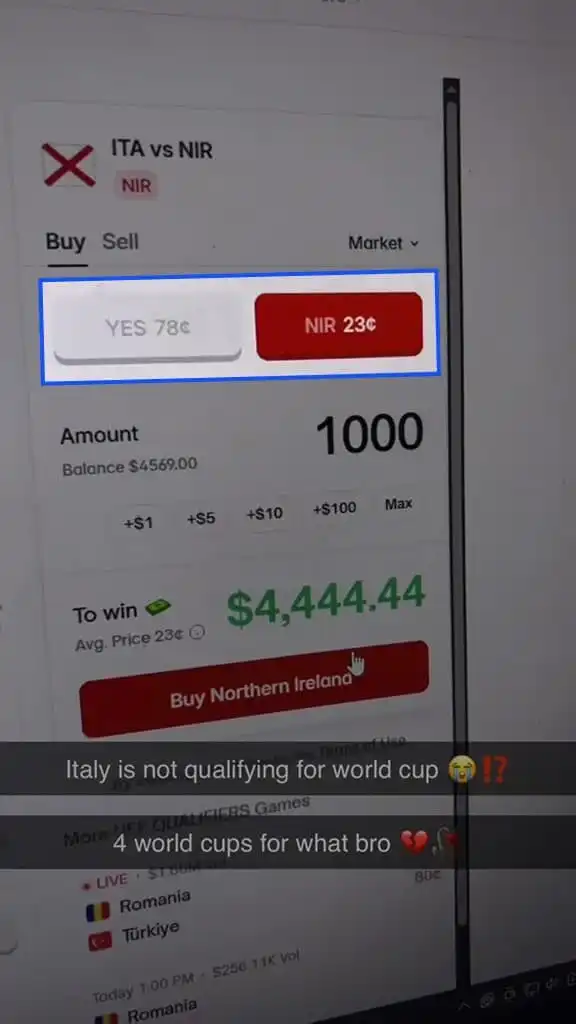
Several videos reviewed by the Journal also briefly flashed URL addresses, revealing the sites were test environments for Polymarket engineers. After the Journal contacted Polymarket for comment, the fake "poiymarket" website was taken down.

Federal advertising law requires brands to make truthful claims in their promotions and requires individuals paid to endorse products to disclose their connections; though there remains some gray area about what is permissible. Commodity laws governing prediction markets also prohibit deceptive and misleading conduct.

A spokesperson for the Federal Trade Commission, which enforces advertising laws, declined to comment on the Journal's findings, citing the agency's policy of not commenting on potential investigations.

Razeen Khan, a California college student who worked as a Polymarket creator for several months until March, compared the videos to fast-food commercials – where the food looks more appealing than it actually is.

"We're showing what actually happens," he said. "You're still going to buy that burger."

Creators said they would send finished videos to Polymarket for approval. If a video wasn't engaging enough or was obviously fake, Polymarket would ask for a reshoot.

Haian Nguyen was one of Polymarket's top-performing creators, filming her trades on the platform from a bedroom in San Francisco. In a video posted to Instagram, Haian Nguyen celebrated winning $60,000 after betting Trump would say "Olympics."

In another video of her dancing on a beach by the Golden Gate Bridge, the text overlay read "Polymarket funds my life."

Haian Nguyen declined to comment and cleared all videos from her profile after the Journal contacted her.

These promotional videos all followed the same template: the creator opens Polymarket, places a bet, and calls the profit "free money." Dozens of social media creators posted videos in nearly identical formats. According to creators who have worked with the company and a recruitment site, Polymarket sent creators bullet-pointed talking points.

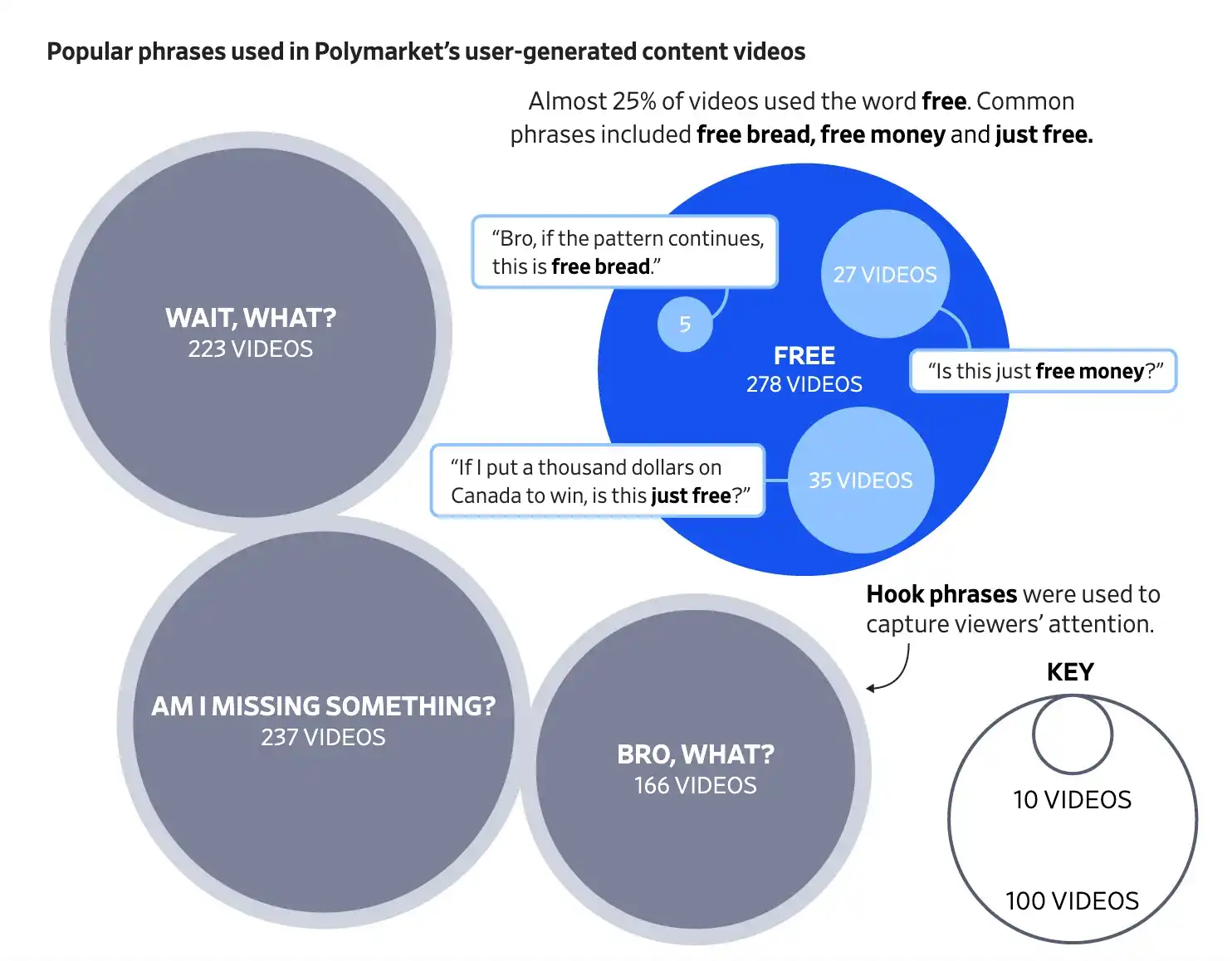
Common catchphrases in Polymarket user-generated content videos were:

Nearly 25% of videos used the word "free." Common phrases included "free bread," "free money," and "just free."

  • "Bro, if this trend continues, this is free bread." – 27 videos
  • "Wait, what?" – 223 videos
  • Free – 278 videos
  • "Isn't this free money?"
  • "If I bet a thousand dollars on Canada to win, isn't this free?" – 35 videos
  • "Am I missing something?" – 237 videos
  • "Bro, what?" – 166 videos
  • "Wait" – 100 videos

Source: Wall Street Journal analysis of 1,105 Polymarket creator videos on TikTok

The U.S. Commodity Futures Trading Commission (CFTC), which regulates prediction markets, has previously taken enforcement actions against companies using simulated trades to market products and making unrealistic profit promises.

The Trump administration has taken a permissive stance on regulating prediction markets. The CFTC has filed multiple lawsuits to stop states from regulating and taxing prediction markets. Trump recently posted on Truth Social that it is "critical" the CFTC has exclusive jurisdiction over prediction markets so they can flourish, calling politicians who want states to regulate them "scum." Trump's son, Donald Trump Jr., is an investor in Polymarket and a paid adviser to rival Kalshi.

A White House spokesperson said there was no conflict of interest and that Trump's actions were in the best interest of the American public. A CFTC spokesperson, in response to the Journal's reporting, said it is important to bring offshore prediction markets back to the U.S. so regulators can oversee them more effectively.

The Hype Machine

For Polymarket, virality is everything.

According to two people familiar with his thinking, founder Shayne Coplan told Polymarket's growth team to make the company impossible to ignore online. His close friend since high school, Matthew Modabber, oversees Polymarket's growth as chief marketing officer.

In 2024, Matthew Modabber (left) with Polymarket founder Shayne Coplan (right)

Polymarket is striving to attract more trading volume than its main competitor – the U.S.-regulated prediction market Kalshi. Polymarket was initially ahead; for most of 2025, both grew in sync; but in recent months, Kalshi has taken the lead. According to data provider The Block, last month Kalshi's trading volume was roughly double that of Polymarket.
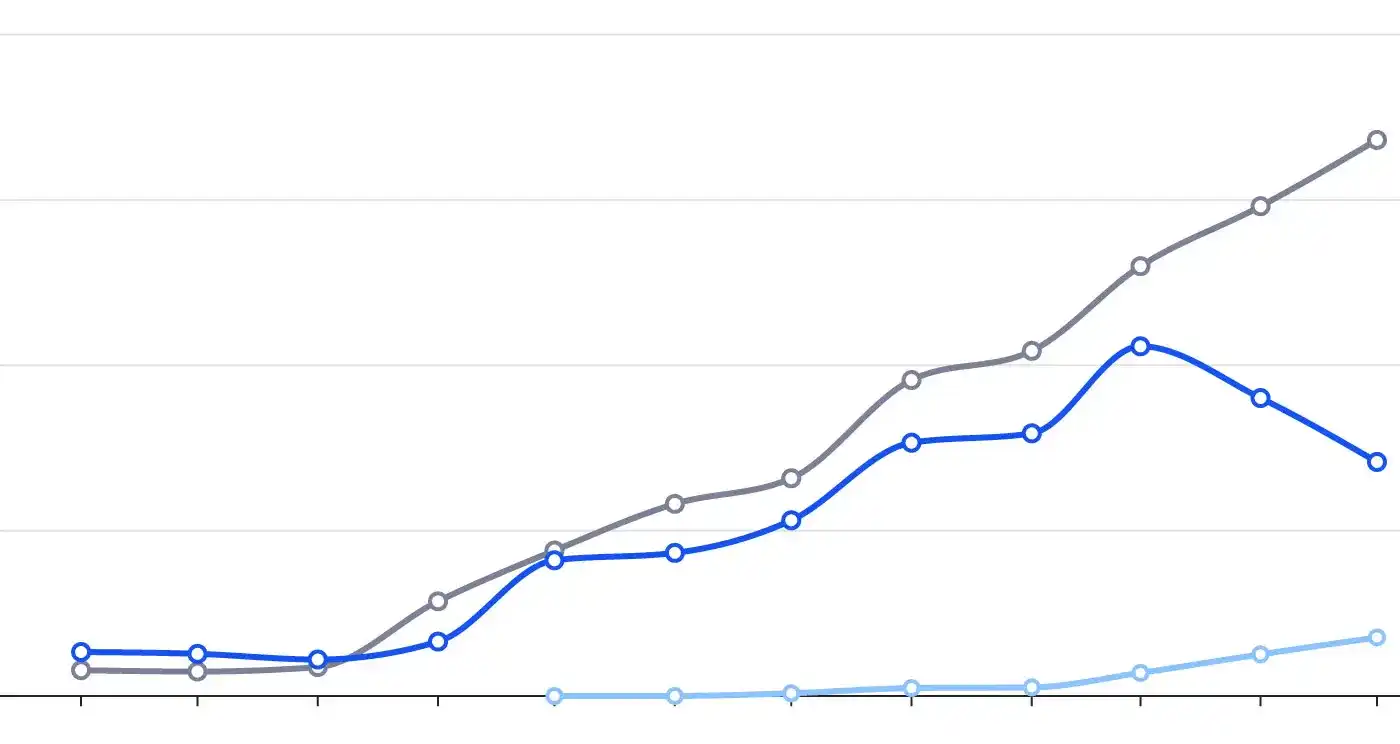
Monthly Trading Volume of Prediction Markets, data as of end of May 2026; Source: The Block

In 2022, Polymarket settled allegations of operating an unregistered options exchange, agreeing to stop offering its crypto-based trading services to U.S. customers and formally re-registering in Panama. Late last year, it launched a regulated U.S. version, available only as a mobile app. The app's trading volume is only a fraction of the offshore crypto exchange.

According to a person familiar with the matter, Polymarket is now seeking to overturn the outcome of the 2022 settlement and bring its crypto platform back to the U.S.

In the meantime, it is turning to social media to draw Americans to Polymarket.

Polymarket's Social Media "Army"

Polymarket's strategy leverages three groups of social media producers to portray the platform as a source of quick, easy money, gaining viral attention.

  • Streamers: Online personalities stream for hours on platforms like Twitch and Kick, discussing Polymarket and sometimes trading.
  • Creators: Social media users, mostly college students, make short videos talking about or trading on Polymarket.
  • Editors (known domestically as "slicers"): People around the world – especially teens in Asia – repost videos from streamers and creators.
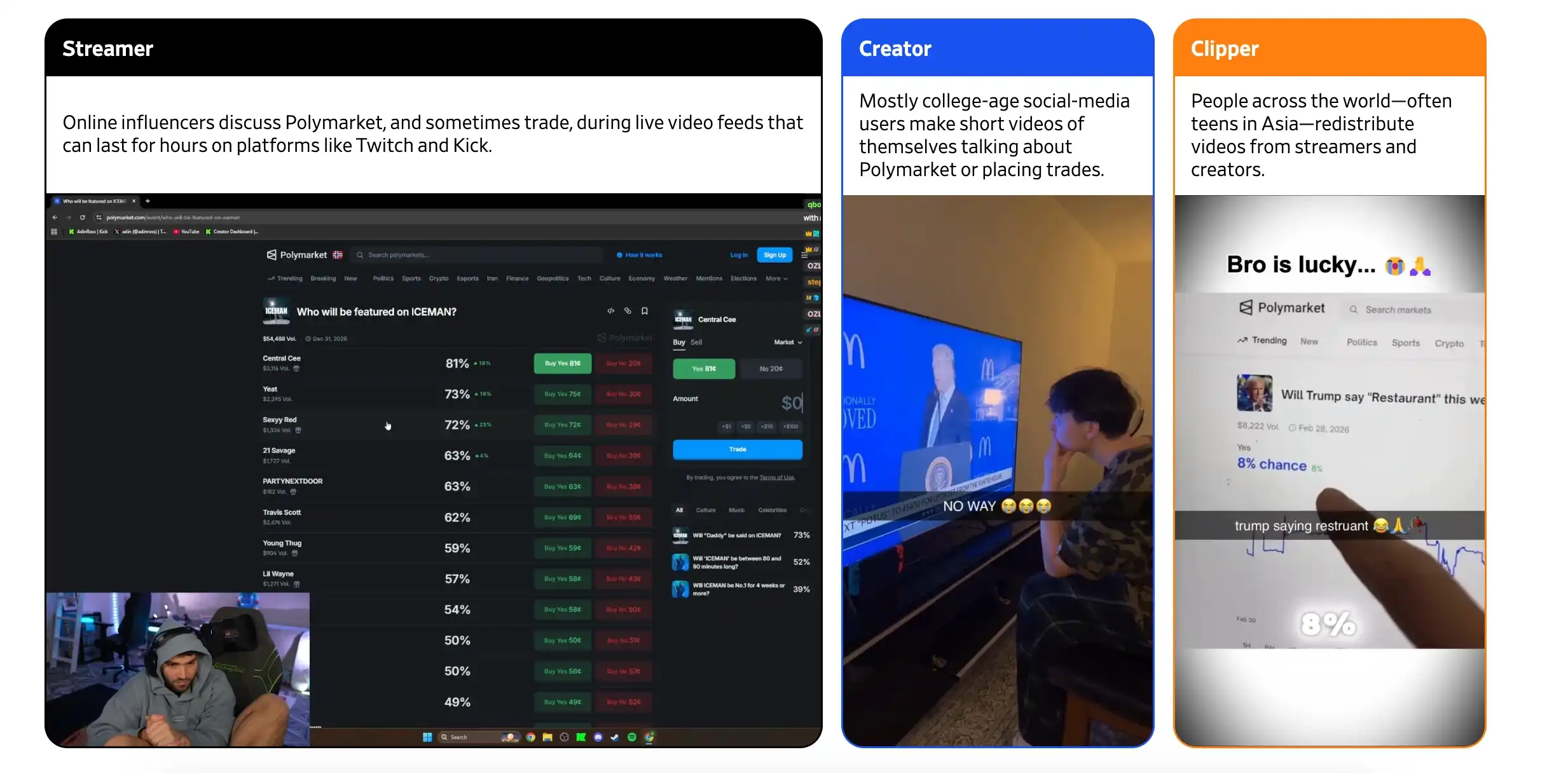
Polymarket hired marketing company Virality to manage the "slicer" team. Their promotional campaigns targeted Americans: according to instructional materials, as of early June, the slicer team could only get paid if at least 60% of their audience was U.S.-based.

Polymarket publicly distances itself from these ads. Based on the Journal's review of nearly 20,000 messages in a chat group for Polymarket's online content creator contractors, as well as instructional files and videos prepared for them, Virality asked the slicer team's posts to look "personal and natural."

"Everyone, if your account name contains 'Polymarket,' please rename and delete as soon as possible," a Virality employee told a group of slicers in the group chat. "Continued use would violate our guidelines and could lead to submissions being rejected. Not even 'poly' is allowed, change that too." Virality declined to comment.

Virality's editing promotion campaigns brought significant results.

A video posted by a Polymarket creator on TikTok had only received 151 views by mid-May. The slicer team reposted his video using secondary accounts, but most reposts were virtually unnoticed, with minimal view counts. But Polymarket works with many video editors to increase the odds of its videos going viral. Eventually, one video would always break through.

According to analytics provider Tubular, Polymarket's viral editing promotion campaigns have accumulated over 140 million views on TikTok, YouTube, and Instagram combined.

A TikTok U.S. spokesperson said several accounts identified by the Journal and other related accounts had been restricted for violating platform rules. A YouTube spokesperson said creators and brands must comply with legal obligations, otherwise YouTube may take action against them. A Meta spokesperson said while the platform requires creators to disclose if they are paid to promote or endorse products, it could not confirm if these specific contents violated its policies, as it had not independently verified whether these creators were paid by Polymarket.

Influencer Livestream Endorsements

Polymarket and Virality targeted dozens of videos by Adin Ross for promotion. Ross is a 25-year-old "manosphere" influencer with millions of followers. According to a person familiar with the negotiations, Ross has a multi-million dollar deal with Polymarket, averaging about half an hour per week browsing Polymarket and commenting on potential trades during his livestreams.

In at least five videos, Ross pointed out how he could trade on the platform using inside information.

In one promotional video, Ross said he could easily use inside information to trade on the release date of rapper Drake's (an acquaintance of Ross) upcoming new album.

Representatives for Ross and Drake declined to comment.

Internal materials show Polymarket and Virality promoted videos showcasing how easy it is to engage in insider trading on the platform. Polymarket has paid editors to promote at least 19 videos discussing opportunities to manipulate the market using insider information or other means.

Polymarket stated it "prohibits trading based on information obtained through theft, unlawful insider information, or in breach of trust, confidentiality, or other legal obligations." It added, "Polymarket's market integrity framework includes trade monitoring, on-chain transparency, reporting channels, and escalation processes to detect, review, and respond to suspicious activity. Where appropriate, we cooperate with regulators and law enforcement to maintain the integrity of our markets."

As the World Cup approached, some of Polymarket's creators turned to filming themselves trading on the company's newly launched, CFTC-regulated U.S. app.

Initially, these trades also looked legitimate. The app interface shown in social media videos was almost identical to that of Polymarket's U.S. app.

But a closer look revealed differences. For example, a market on the official app was "26 World Cup," while on the simulated Polymarket U.S. app it was "2026 FIFA World Cup."

The fake simulated trades continued.

Trend Kriptolar

İlgili Sorular

QAccording to the WSJ investigation, how did Polymarket attract U.S. users to its platform despite being barred from the U.S. market?

APolymarket hired dozens of creators, mostly college students, to create videos showing fake trades and profits on simulated websites. These videos were then virally promoted by a social media army, specifically targeting U.S. audiences who could still access the site via VPN.

QWhat were some of the key differences between the fake 'poiymarket' simulation website and the real Polymarket website as identified in the article?

AKey differences included the fake URL (poiymarket.com vs polymarket.com), the fake site attributing price charts to 'Polymarket.com' (whereas the real site showed no source), occasional typos on buttons like 'NIR' instead of 'NO', and the fake site sometimes showing URLs for test environments used by Polymarket engineers.

QWhat actions did Polymarket announce it would take in response to the WSJ's findings about its promotional activities?

APolymarket stated it was committed to maintaining accurate, fair, and transparent markets and announced plans to conduct a comprehensive audit of its existing promotional content.

QHow much fake winnings and losses were shown in the 1105 videos analyzed by The Wall Street Journal, and what was the actual outcome for those bets if placed on the real platform?

AThe videos showed creators placing fake bets totaling $1.9 million, with 118 videos depicting fake wins of nearly $900,000. If those bets had actually been placed on the real Polymarket platform, they would have resulted in losses of over $166,000.

QWhat was the role of the marketing firm Virality in Polymarket's promotional strategy, and what specific requirement did it have for the 'slicer' team's content?

AVirality was hired by Polymarket to manage a 'slicer' team that reposted and promoted creator videos. Virality required that the slicer team's posts appear 'personal and natural' and specifically mandated that their accounts must not contain 'Polymarket' or even 'poly' in the username. Furthermore, to get paid, the slicers' content needed to have an audience with at least 60% U.S. users.

İlgili Okumalar

The Final Piece of Franklin Templeton's Crypto Ambition

Franklin Templeton Completes Crypto Ambition with Acquisition of 250 Digital On June 22, Franklin Templeton announced the acquisition of 250 Digital and established Franklin Crypto, a new division focused on actively managed cryptocurrency strategies for institutional investors. The unit is led by Christopher Perkins and Seth Ginns. This acquisition marks a key piece in Franklin Templeton's multi-year crypto strategy, which began in 2018 with a digital assets team. The firm's crypto product suite now spans three layers: tokenized funds like the blockchain-based money market fund BENJI (~$831M AUM); a series of passive ETFs including Bitcoin (EZBC, ~$368M), Ethereum (EZET), XRP (XRPZ, ~$252M), Solana (SOEZ), and a multi-crypto index fund (EZPZ); and the newly added active management strategies from Franklin Crypto. The company has also expanded its crypto ecosystem through investments in projects like Ethena and Crossmint, and collaborations with blockchains such as Aptos and Sui. With approximately $18B in digital asset AUM and a total firm AUM of ~$1.78T, Franklin Templeton is positioning itself as a comprehensive crypto asset manager for pensions and sovereign wealth funds. In contrast, competitor Fidelity Investments has taken a different path, focusing early on building its own custody and trading infrastructure. Fidelity's Bitcoin ETF (FBTC) holds over $11B, significantly larger than Franklin Templeton's equivalent offering. Both giants' moves underscore the deepening trend of traditional finance entering the crypto space.

Foresight News9 dk önce

The Final Piece of Franklin Templeton's Crypto Ambition

Foresight News9 dk önce

Black Tuesday in Japanese and Korean Stock Markets: South Korea Triggers Circuit Breaker, Nikkei Plummets, AI Boom Undergoes Phased Adjustment

"Black Tuesday" for Asian Markets: Korean Stocks Halted by Circuit Breaker, Nikkei Plunges as AI Rally Undergoes Correction Asian stock markets experienced severe turbulence on Tuesday, with South Korea's benchmark KOSPI index plummeting nearly 10% after triggering a market-wide trading halt when its losses exceeded 8%. Japan's Nikkei 225 index also fell sharply by approximately 3.5%, ending an eight-day winning streak. The sell-off was heavily concentrated in the technology and semiconductor sectors, with giants like Samsung Electronics and SK Hynix leading the declines. The plunge reflected a rapid reversal from recent highs, with the KOSPI having retreated over 12% from its mid-June peak. Analysts attribute the sharp correction to multiple converging factors. The direct trigger was weakness in U.S. tech stocks, which fueled profit-taking in overbought Asian markets. Furthermore, stronger-than-expected U.S. jobs data has reinforced expectations that the Federal Reserve will maintain or even raise interest rates, putting pressure on rate-sensitive growth stocks. Structural vulnerabilities also played a role, particularly in South Korea, where the market is highly concentrated in a few semiconductor heavyweights, making it susceptible to shifts in global AI demand and foreign capital outflows. Despite the short-term volatility, the long-term narrative for AI and semiconductors remains intact. Industry forecasts still point to massive growth in global AI capital expenditure over the coming years. South Korean firms like SK Hynix maintain a dominant position in critical segments like High Bandwidth Memory (HBM), with long-term orders secured well into 2027. While near-term fluctuations are expected to continue, driven by U.S. monetary policy signals and upcoming corporate earnings, the current correction may present a buying opportunity for quality assets tied to the enduring AI infrastructure build-out.

marsbit25 dk önce

Black Tuesday in Japanese and Korean Stock Markets: South Korea Triggers Circuit Breaker, Nikkei Plummets, AI Boom Undergoes Phased Adjustment

marsbit25 dk önce

İşlemler

Spot
Futures

Popüler Makaleler

$S$ Nedir

SPERO'yu Anlamak: Kapsamlı Bir Genel Bakış SPERO'ya Giriş İnovasyonun manzarası gelişmeye devam ederken, web3 teknolojilerinin ve kripto para projelerinin ortaya çıkışı dijital geleceği şekillendirmede önemli bir rol oynamaktadır. Bu dinamik alanda dikkat çeken projelerden biri SPERO, $$s$$ olarak adlandırılmaktadır. Bu makale, SPERO hakkında ayrıntılı bilgi toplamak ve sunmak amacıyla, meraklılar ve yatırımcıların web3 ve kripto alanlarındaki temellerini, hedeflerini ve yeniliklerini anlamalarına yardımcı olmayı amaçlamaktadır. SPERO,$$s$$ Nedir? SPERO,$$s$$, kripto alanında merkeziyetsizlik ve blok zinciri teknolojisi ilkelerini kullanarak etkileşimi, faydayı ve finansal kapsayıcılığı teşvik eden bir ekosistem yaratmayı amaçlayan benzersiz bir projedir. Proje, kullanıcıların yenilikçi finansal çözümler ve hizmetler sunarak eşler arası etkileşimleri yeni yollarla kolaylaştırmayı hedeflemektedir. SPERO,$$s$$'nin temel amacı, bireyleri güçlendirmek ve kripto para alanındaki kullanıcı deneyimini artıran araçlar ve platformlar sağlamaktır. Bu, daha esnek işlem yöntemlerini mümkün kılmayı, topluluk odaklı girişimleri teşvik etmeyi ve merkeziyetsiz uygulamalar (dApp'ler) aracılığıyla finansal fırsatlar yaratmayı içermektedir. SPERO,$$s$$'nin temel vizyonu kapsayıcılık etrafında dönmekte olup, geleneksel finansal sistemlerdeki boşlukları kapatmayı ve blok zinciri teknolojisinin faydalarından yararlanmayı hedeflemektedir. SPERO,$$s$$'nin Yaratıcısı Kimdir? SPERO,$$s$$'nin yaratıcısının kimliği bir miktar belirsizdir, çünkü kurucusu(ları) hakkında ayrıntılı arka plan bilgisi sağlayan sınırlı kamuya açık kaynaklar bulunmaktadır. Bu şeffaflık eksikliği, projenin merkeziyetsizlik taahhüdünden kaynaklanabilir—birçok web3 projesinin paylaştığı bir etik anlayışı, bireysel tanınmanın yerine kolektif katkıları önceliklendirmektedir. Topluluk ve onun kolektif hedefleri etrafında tartışmaları merkezileştirerek, SPERO,$$s$$, belirli bireyleri öne çıkarmadan güçlendirme özünü taşımaktadır. Bu nedenle, SPERO'nun etik anlayışını ve misyonunu anlamak, tek bir yaratıcının kimliğini belirlemekten daha önemlidir. SPERO,$$s$$'nin Yatırımcıları Kimlerdir? SPERO,$$s$$, kripto sektöründe yeniliği teşvik etmeye adanmış girişim sermayedarlarından melek yatırımcılara kadar çeşitli yatırımcılar tarafından desteklenmektedir. Bu yatırımcıların odak noktası genellikle SPERO'nun misyonuyla uyumlu olup, toplumsal teknolojik ilerlemeyi, finansal kapsayıcılığı ve merkeziyetsiz yönetimi vaat eden projeleri önceliklendirmektedir. Bu yatırımcı temelleri, yalnızca yenilikçi ürünler sunan projelere değil, aynı zamanda blok zinciri topluluğuna ve ekosistemlerine olumlu katkılarda bulunan projelere de ilgi duymaktadır. Bu yatırımcıların desteği, SPERO,$$s$$'yi hızla gelişen kripto projeleri alanında dikkate değer bir rakip haline getirmektedir. SPERO,$$s$$ Nasıl Çalışır? SPERO,$$s$$, onu geleneksel kripto para projelerinden ayıran çok yönlü bir çerçeve kullanmaktadır. İşte benzersizliğini ve yeniliğini vurgulayan bazı temel özellikler: Merkeziyetsiz Yönetim: SPERO,$$s$$, kullanıcıların projenin geleceğiyle ilgili karar alma süreçlerine aktif olarak katılmalarını sağlayan merkeziyetsiz yönetim modellerini entegre etmektedir. Bu yaklaşım, topluluk üyeleri arasında sahiplik ve hesap verebilirlik duygusunu teşvik etmektedir. Token Kullanımı: SPERO,$$s$$, ekosistem içinde çeşitli işlevler sunmak üzere tasarlanmış kendi kripto para token'ını kullanmaktadır. Bu token'lar, işlemleri, ödülleri ve platformda sunulan hizmetlerin kolaylaştırılmasını sağlayarak genel etkileşimi ve faydayı artırmaktadır. Katmanlı Mimari: SPERO,$$s$$'nin teknik mimarisi, modülerlik ve ölçeklenebilirliği destekleyerek projenin evrimi sırasında ek özelliklerin ve uygulamaların sorunsuz bir şekilde entegrasyonuna olanak tanımaktadır. Bu uyum sağlama yeteneği, sürekli değişen kripto manzarasında geçerliliği sürdürmek için hayati öneme sahiptir. Topluluk Katılımı: Proje, işbirliği ve geri bildirim teşvik eden mekanizmalar kullanarak topluluk odaklı girişimlere vurgu yapmaktadır. Güçlü bir topluluk oluşturarak, SPERO,$$s$$, kullanıcı ihtiyaçlarını daha iyi karşılayabilir ve piyasa trendlerine uyum sağlayabilir. Kapsayıcılığa Odaklanma: Düşük işlem ücretleri ve kullanıcı dostu arayüzler sunarak, SPERO,$$s$$, daha önce kripto alanında yer almamış bireyler de dahil olmak üzere çeşitli bir kullanıcı tabanını çekmeyi hedeflemektedir. Bu kapsayıcılık taahhüdü, erişilebilirlik yoluyla güçlendirme misyonuyla uyumludur. SPERO,$$s$$ Zaman Çizelgesi Bir projenin tarihini anlamak, gelişim yolculuğu ve kilometre taşları hakkında kritik bilgiler sağlar. Aşağıda, SPERO,$$s$$'nin evriminde önemli olayları haritalayan önerilen bir zaman çizelgesi bulunmaktadır: Kavram Geliştirme ve Fikir Aşaması: SPERO,$$s$$'nin temelini oluşturan ilk fikirler, blok zinciri endüstrisindeki merkeziyetsizlik ve topluluk odaklılık ilkeleriyle yakından uyumlu olarak geliştirildi. Proje Beyaz Kağıdının Yayınlanması: Kavramsal aşamayı takiben, SPERO,$$s$$'nin vizyonunu, hedeflerini ve teknolojik altyapısını ayrıntılı bir şekilde açıklayan kapsamlı bir beyaz kağıt yayımlandı ve topluluk ilgisini ve geri bildirimini toplamak amacıyla sunuldu. Topluluk Oluşturma ve Erken Katılımlar: Projenin hedefleri etrafında tartışmalar yürüterek destek toplamak ve erken benimseyenler ile potansiyel yatırımcılar için bir topluluk oluşturmak amacıyla aktif iletişim çabaları gerçekleştirildi. Token Üretim Etkinliği: SPERO,$$s$$, yerel token'larını erken destekçilere dağıtmak ve ekosistem içinde başlangıç likiditesini sağlamak amacıyla bir token üretim etkinliği (TGE) gerçekleştirdi. İlk dApp'in Yayınlanması: SPERO,$$s$$ ile ilişkili ilk merkeziyetsiz uygulama (dApp) faaliyete geçti ve kullanıcıların platformun temel işlevleriyle etkileşimde bulunmalarını sağladı. Sürekli Gelişim ve Ortaklıklar: Projenin tekliflerine sürekli güncellemeler ve iyileştirmeler yapılmakta olup, blok zinciri alanındaki diğer oyuncularla stratejik ortaklıklar, SPERO,$$s$$'yi rekabetçi ve gelişen bir oyuncu haline getirmiştir. Sonuç SPERO,$$s$$, web3 ve kripto paranın finansal sistemleri devrim niteliğinde dönüştürme ve bireyleri güçlendirme potansiyelinin bir kanıtıdır. Merkeziyetsiz yönetime, topluluk katılımına ve yenilikçi tasarlanmış işlevselliğe olan bağlılığıyla, daha kapsayıcı bir finansal manzaraya doğru bir yol açmaktadır. Hızla gelişen kripto alanındaki herhangi bir yatırımda olduğu gibi, potansiyel yatırımcılar ve kullanıcılar, SPERO,$$s$$ içindeki devam eden gelişmelerle ilgili olarak kapsamlı bir araştırma yapmaları ve düşünceli bir şekilde katılmaları teşvik edilmektedir. Proje, kripto endüstrisinin yenilikçi ruhunu sergileyerek, sayısız olasılığını keşfetmeye davet etmektedir. SPERO,$$s$$'nin yolculuğu hala devam ederken, temel ilkeleri, teknoloji, finans ve birbirimizle etkileşim biçimimizi etkileyebilir.

102 Toplam GörüntülenmeYayınlanma 2024.12.17Güncellenme 2024.12.17

$S$ Nedir

AGENT S Nedir

Agent S: Web3'te Otonom Etkileşimin Geleceği Giriş Web3 ve kripto para dünyasında sürekli gelişen manzarada, yenilikler bireylerin dijital platformlarla etkileşim biçimlerini sürekli olarak yeniden tanımlıyor. Bu tür öncü projelerden biri olan Agent S, açık ajans çerçevesi aracılığıyla insan-bilgisayar etkileşimini devrim niteliğinde değiştirmeyi vaat ediyor. Otonom etkileşimlerin yolunu açarak, Agent S karmaşık görevleri basitleştirmeyi ve yapay zeka (AI) alanında dönüştürücü uygulamalar sunmayı hedefliyor. Bu detaylı inceleme, projenin karmaşıklıklarına, benzersiz özelliklerine ve kripto para alanındaki etkilerine dalacaktır. Agent S Nedir? Agent S, bilgisayar görevlerinin otomasyonunda üç temel zorluğu ele almak üzere özel olarak tasarlanmış çığır açıcı bir açık ajans çerçevesidir: Alan Spesifik Bilgi Edinimi: Çerçeve, çeşitli dış bilgi kaynaklarından ve iç deneyimlerden akıllıca öğrenir. Bu çift yönlü yaklaşım, alan spesifik bilgi açısından zengin bir veri havuzu oluşturmasını sağlar ve görev yürütmedeki performansını artırır. Uzun Görev Ufukları Üzerinde Planlama: Agent S, karmaşık görevlerin verimli bir şekilde parçalanmasını ve yürütülmesini kolaylaştıran deneyim artırımlı hiyerarşik planlama kullanır. Bu özellik, çoklu alt görevleri etkili ve verimli bir şekilde yönetme yeteneğini önemli ölçüde artırır. Dinamik, Homojen Olmayan Arayüzlerle Başlama: Proje, ajanlar ve kullanıcılar arasındaki etkileşimi geliştiren yenilikçi bir çözüm olan Ajan-Bilgisayar Arayüzü'ni (ACI) tanıtmaktadır. Çok Modlu Büyük Dil Modellerini (MLLM'ler) kullanarak, Agent S çeşitli grafik kullanıcı arayüzlerini sorunsuz bir şekilde gezinebilir ve manipüle edebilir. Bu öncü özellikler aracılığıyla, Agent S, makinelerle insan etkileşimini otomatikleştirmede karşılaşılan karmaşıklıkları ele alan sağlam bir çerçeve sunarak, AI ve ötesinde birçok uygulama için zemin hazırlıyor. Agent S'nin Yaratıcısı Kimdir? Agent S'nin kavramı temelde yenilikçi olsa da, yaratıcısı hakkında spesifik bilgiler belirsizliğini koruyor. Yaratıcı şu anda bilinmiyor, bu da projenin yeni aşamasını veya kurucu üyeleri gizli tutma stratejik tercihini vurguluyor. Anonimlikten bağımsız olarak, odak çerçevenin yetenekleri ve potansiyeli üzerinde kalıyor. Agent S'nin Yatırımcıları Kimlerdir? Agent S, kriptografik ekosistemde oldukça yeni olduğundan, yatırımcıları ve finansal destekçileri hakkında ayrıntılı bilgiler açıkça belgelenmemiştir. Projeyi destekleyen yatırım temelleri veya organizasyonları hakkında kamuya açık bilgilerdeki eksiklik, finansman yapısı ve gelişim yol haritası hakkında sorular doğuruyor. Destekleyicilerin anlaşılması, projenin sürdürülebilirliğini ve potansiyel pazar etkisini değerlendirmek için kritik öneme sahiptir. Agent S Nasıl Çalışır? Agent S'nin temelinde, çeşitli ortamlarda etkili bir şekilde çalışmasını sağlayan son teknoloji bir sistem yatmaktadır. İşleyiş modeli birkaç ana özellik etrafında inşa edilmiştir: İnsan Benzeri Bilgisayar Etkileşimi: Çerçeve, bilgisayarlarla etkileşimleri daha sezgisel hale getirmeyi amaçlayan gelişmiş AI planlaması sunar. Görev yürütmedeki insan davranışını taklit ederek, kullanıcı deneyimlerini yükseltmeyi vaat eder. Anlatı Belleği: Yüksek düzeyde deneyimlerden yararlanmak için kullanılan Agent S, görev geçmişlerini takip etmek amacıyla anlatı belleğini kullanarak karar verme süreçlerini geliştirir. Episodik Bellek: Bu özellik, kullanıcılara adım adım rehberlik sağlayarak, çerçevenin görevler gelişirken bağlamsal destek sunmasına olanak tanır. OpenACI Desteği: Yerel olarak çalışabilme yeteneği ile Agent S, kullanıcıların etkileşimleri ve iş akışları üzerinde kontrol sağlamasına olanak tanır ve Web3'ün merkeziyetsiz felsefesiyle uyumlu hale gelir. Dış API'lerle Kolay Entegrasyon: Çeşitli AI platformlarıyla uyumluluğu ve çok yönlülüğü, Agent S'nin mevcut teknolojik ekosistemlere sorunsuz bir şekilde entegre olmasını sağlar ve geliştiriciler ile organizasyonlar için cazip bir seçenek haline getirir. Bu işlevsellikler, Agent S'nin kripto alanındaki benzersiz konumuna katkıda bulunarak, karmaşık, çok aşamalı görevleri minimum insan müdahalesi ile otomatikleştirir. Proje geliştikçe, Web3'teki potansiyel uygulamaları dijital etkileşimlerin nasıl gelişeceğini yeniden tanımlayabilir. Agent S'nin Zaman Çizelgesi Agent S'nin gelişimi ve kilometre taşları, önemli olaylarını vurgulayan bir zaman çizelgesinde özetlenebilir: 27 Eylül 2024: Agent S'nin kavramı, “Bilgisayarları İnsan Gibi Kullanan Açık Bir Ajans Çerçevesi” başlıklı kapsamlı bir araştırma makalesi ile tanıtıldı ve projenin temelini sergiledi. 10 Ekim 2024: Araştırma makalesi arXiv'de kamuya açık olarak yayınlandı ve çerçevenin derinlemesine bir incelemesini ve OSWorld benchmark'ına dayalı performans değerlendirmesini sundu. 12 Ekim 2024: Agent S'nin yetenekleri ve özellikleri hakkında görsel bir içgörü sağlayan bir video sunumu yayımlandı ve potansiyel kullanıcılar ve yatırımcılarla daha fazla etkileşim sağlandı. Bu zaman çizelgesindeki işaretler, sadece Agent S'nin ilerlemesini değil, aynı zamanda şeffaflık ve topluluk katılımına olan bağlılığını da göstermektedir. Agent S Hakkında Ana Noktalar Agent S çerçevesi gelişmeye devam ederken, birkaç ana özellik öne çıkmakta ve yenilikçi doğasını ve potansiyelini vurgulamaktadır: Yenilikçi Çerçeve: İnsan etkileşimine benzer bir bilgisayar kullanımı sağlamak üzere tasarlanan Agent S, görev otomasyonuna yeni bir yaklaşım getiriyor. Otonom Etkileşim: GUI aracılığıyla bilgisayarlarla otonom olarak etkileşim kurabilme yeteneği, daha akıllı ve verimli hesaplama çözümlerine doğru bir sıçrama anlamına geliyor. Karmaşık Görev Otomasyonu: Sağlam metodolojisi ile karmaşık, çok aşamalı görevleri otomatikleştirerek süreçleri daha hızlı ve daha az hata payı ile gerçekleştirebilir. Sürekli İyileştirme: Öğrenme mekanizmaları, Agent S'nin geçmiş deneyimlerden öğrenmesini sağlar ve sürekli olarak performansını ve etkinliğini artırır. Çok Yönlülük: OSWorld ve WindowsAgentArena gibi farklı işletim ortamlarında uyumlu olması, geniş bir uygulama yelpazesine hizmet edebilmesini sağlar. Agent S, Web3 ve kripto alanında kendini konumlandırırken, etkileşim yeteneklerini artırma ve süreçleri otomatikleştirme potansiyeli, AI teknolojilerinde önemli bir ilerlemeyi temsil etmektedir. Yenilikçi çerçevesi aracılığıyla, Agent S dijital etkileşimlerin geleceğini örneklemekte ve çeşitli sektörlerde kullanıcılar için daha sorunsuz ve verimli bir deneyim vaat etmektedir. Sonuç Agent S, AI ve Web3'ün birleşiminde cesur bir sıçramayı temsil ediyor ve teknoloji ile etkileşim biçimimizi yeniden tanımlama kapasitesine sahip. Henüz erken aşamalarında olmasına rağmen, uygulama olanakları geniş ve çekici. Kritik zorlukları ele alan kapsamlı çerçevesi ile Agent S, otonom etkileşimleri dijital deneyimin ön plana çıkmasına taşımayı hedefliyor. Kripto para ve merkeziyetsizlik alanlarına daha derinlemesine girdikçe, Agent S gibi projelerin teknoloji ve insan-bilgisayar işbirliğinin geleceğini şekillendirmede önemli bir rol oynayacağı kesin.

593 Toplam GörüntülenmeYayınlanma 2025.01.14Güncellenme 2025.01.14

AGENT S Nedir

S Nasıl Satın Alınır

HTX.com’a hoş geldiniz! Sonic (S) satın alma işlemlerini basit ve kullanışlı bir hâle getirdik. Adım adım açıkladığımız rehberimizi takip ederek kripto yolculuğunuza başlayın. 1. Adım: HTX Hesabınızı OluşturunHTX'te ücretsiz bir hesap açmak için e-posta adresinizi veya telefon numaranızı kullanın. Sorunsuzca kaydolun ve tüm özelliklerin kilidini açın. Hesabımı Aç2. Adım: Kripto Satın Al Bölümüne Gidin ve Ödeme Yönteminizi SeçinKredi/Banka Kartı: Visa veya Mastercard'ınızı kullanarak anında Sonic (S) satın alın.Bakiye: Sorunsuz bir şekilde işlem yapmak için HTX hesap bakiyenizdeki fonları kullanın.Üçüncü Taraflar: Kullanımı kolaylaştırmak için Google Pay ve Apple Pay gibi popüler ödeme yöntemlerini ekledik.P2P: HTX'teki diğer kullanıcılarla doğrudan işlem yapın.Borsa Dışı (OTC): Yatırımcılar için kişiye özel hizmetler ve rekabetçi döviz kurları sunuyoruz.3. Adım: Sonic (S) Varlıklarınızı SaklayınSonic (S) satın aldıktan sonra HTX hesabınızda saklayın. Alternatif olarak, blok zinciri transferi yoluyla başka bir yere gönderebilir veya diğer kripto para birimlerini takas etmek için kullanabilirsiniz.4. Adım: Sonic (S) Varlıklarınızla İşlem YapınHTX'in spot piyasasında Sonic (S) ile kolayca işlemler yapın.Hesabınıza erişin, işlem çiftinizi seçin, işlemlerinizi gerçekleştirin ve gerçek zamanlı olarak izleyin. Hem yeni başlayanlar hem de deneyimli yatırımcılar için kullanıcı dostu bir deneyim sunuyoruz.

1.6k Toplam GörüntülenmeYayınlanma 2025.01.15Güncellenme 2026.06.02

S Nasıl Satın Alınır

Tartışmalar

HTX Topluluğuna hoş geldiniz. Burada, en son platform gelişmeleri hakkında bilgi sahibi olabilir ve profesyonel piyasa görüşlerine erişebilirsiniz. Kullanıcıların S (S) fiyatı hakkındaki görüşleri aşağıda sunulmaktadır.

活动图片