Earnings Beat Expectations, $222 Million Chain Launch: Can Circle Escape the 'Interest Stock' Valuation Narrative?

marsbit2026-05-12 tarihinde yayınlandı2026-05-12 tarihinde güncellendi

Özet

Circle released its Q1 2026 financial results, with revenue of $6.94 billion missing expectations but adjusted EPS of $0.21 beating forecasts. USDC circulation grew 28% to $770 billion, and on-chain transaction volume surged 263% to $21.5 trillion. The same day, Circle announced it raised $222 million in a token pre-sale for its new Arc blockchain at a $3 billion valuation, led by a16z. It also unveiled Agent Stack, a suite of tools for AI agents to autonomously hold and transact in USDC. CEO Jeremy Allaire stated the company is evolving into a broader internet platform and operating system business. CRCL's stock price rose 16% on the news. Analysts are divided, with some viewing the strategic moves as an effort to shift Circle's valuation narrative away from reliance on USDC interest income and towards being an infrastructure platform and gateway to the AI agent economy. The success of this transition hinges on Arc's adoption and Agent Stack's competitiveness.

Author: Claude, Shenchao TechFlow

Shenchao Introduction: Circle released its Q1 2026 earnings, reporting adjusted EPS of $0.21 which beat expectations, but revenue of $694 million missed estimates. USDC circulation reached $77 billion, and on-chain transaction volume surged 263% to $215 trillion. On the same day, it announced the completion of a $222 million token pre-sale for the Arc blockchain at a $3 billion valuation, with a16z leading a $75 million investment and participation from BlackRock, Apollo, and others. The company also released the Agent Stack toolkit, enabling AI agents to autonomously hold USDC, initiate payments, and call services. CRCL stock soared 16% to $131.76 on the day, bringing year-to-date gains to 66%.

Circle is experiencing its most intense wave of strategic moves since its IPO.

On May 11th, the issuer of the world's second-largest stablecoin, USDC, simultaneously dropped three bombshells: Q1 2026 earnings, the completion of the Arc blockchain token pre-sale, and a new infrastructure toolkit for AI agents called Agent Stack. According to Cointelegraph, CRCL stock closed up nearly 16% at $131.76, hitting its highest level since March 18th and expanding year-to-date gains to 66%, with a market cap of approximately $35 billion.

Circle CEO Jeremy Allaire told CNBC, "We are becoming a broader internet platform company, we're getting into the operating systems business." He positioned Arc as a multi-stakeholder distributed network, analogous to mobile operating systems and cloud platforms.

Viewed together, these three events point to the same conclusion: Circle is attempting to escape the valuation narrative of being a 'one-trick pony' reliant on USDC interest income, and is pivoting towards becoming an infrastructure platform company.

Earnings: Revenue Misses, Profit Beats, USDC Transaction Volume Grows 263%

According to CoinDesk, Circle's Q1 2026 revenue was $694 million, up 20% year-over-year, but below Wall Street's consensus estimate of about $715 million. Adjusted earnings per share were $0.21, beating analyst expectations of $0.17. Adjusted EBITDA was $151 million, a 24% increase year-over-year. Net income was $55 million, down 15% mainly due to post-IPO equity incentive expenses and a 76% increase in operating expenses.

However, key operational metrics showed strong performance.
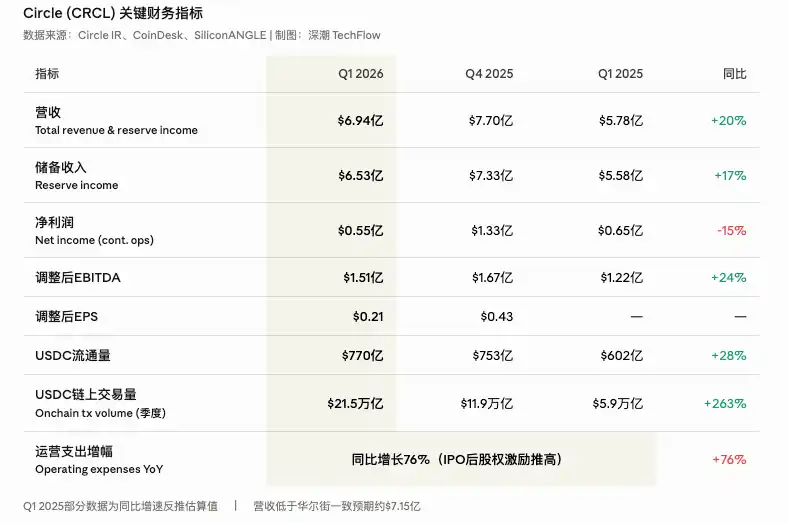
As of the end of Q1, USDC circulation reached $77 billion, up 28% year-over-year. More notably, on-chain USDC transaction volume reached $215 trillion for the quarter, skyrocketing 263% year-over-year. According to a Mizuho analyst report, adjusted USDC transaction volume for 2026 to date is approximately $2.2 trillion, surpassing Tether's USDT (approximately $1.3 trillion), capturing about 64% of adjusted stablecoin transaction volume to take the top spot. This is the first time USDC has led in this metric since 2019.

But the core reason for the revenue miss is clear: interest rates. Over 95% of Circle's revenue comes from interest income on USDC reserve assets. Q1 reserve revenue was $653 million, up 17% year-over-year. In Q4 2025, the reserve yield had already fallen 68 basis points year-over-year to 3.8%. The dampening effect of the interest rate cutting cycle on Circle's revenue is gradually becoming apparent. Even as USDC circulation continues to expand, declining rates remain a sword hanging overhead. This is precisely the underlying motivation for Circle's urgency in crafting its 'second growth curve' story.

Arc Token Pre-Sale: Building Its Own Blockchain, $3 Billion Valuation

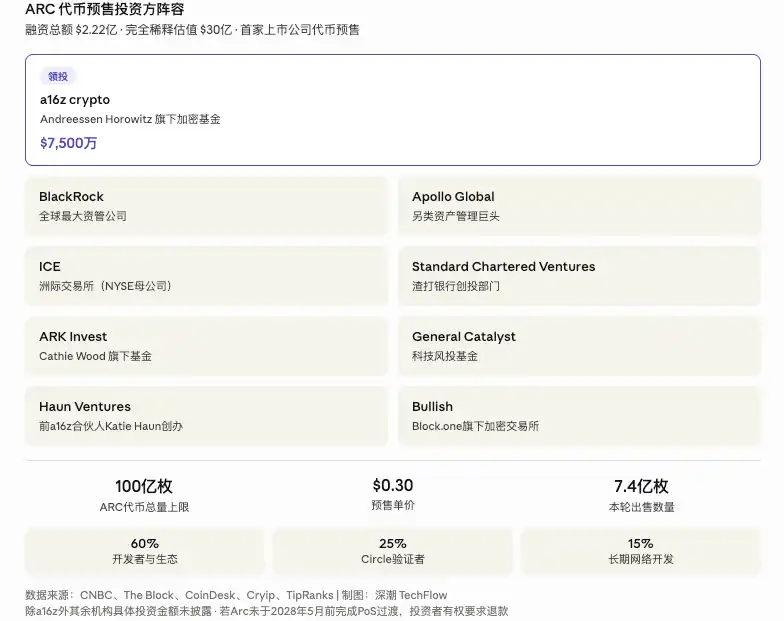
Disclosed alongside the earnings was the heavyweight news of the completion of the Arc blockchain token pre-sale. According to an exclusive CNBC report, Circle sold 740 million ARC tokens at a price of $0.30 per token, raising $222 million at a fully diluted valuation of $3 billion. This marks the first token pre-sale conducted by a publicly listed company.

a16z crypto led the round with a $75 million investment. Other participating investors formed a formidable lineup: BlackRock, Apollo Global Management, Intercontinental Exchange (ICE), Standard Chartered Ventures, ARK Invest, General Catalyst, Haun Ventures, and Bullish.
Currently, USDC heavily relies on third-party networks like Ethereum and Solana for settlement and on distributors like Coinbase to reach users. Building its own blockchain signifies Circle's desire to control more of the underlying infrastructure on which USDC operates. From a defensive perspective, with the GENIUS Act signed into law and the CLARITY Act scheduled for a preliminary vote in the Senate Banking Committee this week, the legalization of stablecoin regulation is lowering industry barriers to entry, potentially allowing banks and fintech companies to launch their own dollar tokens. By building its own network, Circle is attempting to lock in a first-mover advantage at the infrastructure layer before this competitive landscape fully materializes.

Circle explicitly stated in its earnings report that current performance guidance does not yet include "future Arc-related revenue streams," hinting that Arc could become an independent revenue source alongside USDC.

Agent Stack: When AI Agents Become the 'Customer'

The third card played on the same day was the Circle Agent Stack, a suite of financial infrastructure tools designed for AI agents.

According to Decrypt, Agent Stack consists of four core components: Agent Wallets allow AI agents to autonomously hold assets; Circle CLI allows developers and AI agents to build applications on the Circle platform; Agent Marketplace enables AI agents to browse, evaluate, and pay for services offered by other agents; Nanopayments, based on Circle Gateway, support gas-free USDC transfers as low as $0.000001.

Allaire stated in the press release, "Financial infrastructure has historically been built for humans, with manual onboarding flows, approvals, and payment flows. It was never designed for software that runs autonomously. Agent Stack is our first full-service suite built for AI agents themselves as customers, not just developers and enterprises."

Circle is betting on a future of machine-to-machine payments: AI agents autonomously transacting with each other, hiring each other's services, settling instantly on-demand, all conducted in USDC.

But Circle is not the only player; recently, Amazon partnered with Coinbase and Stripe, Google Cloud with the Solana Foundation, and MoonPay have all launched similar AI agent stablecoin payment solutions.

$35 Billion Valuation: Can It Hold?

CRCL's current market capitalization is approximately $35 billion, with a forward P/E ratio of about 135x, far above the industry median of around 33x. Citi analyst Peter Christiansen has a $243 price target, Bernstein's Gautam Chhugani has a $190 target, and all 12 analysts tracked by TipRanks give a 'Buy' rating, with a consensus target price of $138.50.

But some are applying the brakes. Compass Point downgraded CRCL to 'Sell' in April, warning that gross margins are narrowing in the first half of 2026 due to USDC supply shifting to lower-margin areas. Even per management guidance, non-reserve revenue (full-year $150-170 million) remains negligible compared to the reserve revenue engine. Whether Arc can transition from a whitepaper to a business line that genuinely contributes revenue is a core validation point for the second half of 2026.

William Blair analyst Andrew Jeffrey told clients that Circle stock "could remain volatile" in the near term, but the company has multiple positive catalysts stemming from its "significant stablecoin commercial advantages."

CRCL had already surged nearly 20% on May 4th when the bipartisan compromise version of the CLARITY Act was finalized. This week's preliminary vote in the Senate Banking Committee will be the next catalytic event. Analysts believe the Act essentially provides Circle with a "regulatory shield": compliance restrictions mean Circle is not required to distribute USDC reserve earnings to users, effectively preserving its profit margins under regulatory cover.

Having played its three cards, Circle's valuation narrative has shifted from a 'stablecoin interest income stock' to an 'infrastructure platform + AI agent economy gateway.' Whether this narrative materializes depends on the actual adoption of the Arc mainnet after its launch and Agent Stack's competitive performance in the machine-to-machine payments arena.


İlgili Sorular

QWhat were the key highlights of Circle's Q1 2026 financial results, and what is the main concern regarding its revenue?

ACircle's Q1 2026 revenue was $6.94 billion, missing analyst estimates, but adjusted EPS of $0.21 exceeded expectations. USDC circulation reached $770 billion, and on-chain transaction volume surged 263% to $21.5 trillion. The main concern is that over 95% of revenue comes from interest on USDC reserves. With interest rates declining, this poses a significant risk to future revenue, driving Circle's need to develop new growth areas.

QWhat is the significance of Circle's Arc blockchain token presale, and which major investors participated?

AThe Arc blockchain token presale raised $222 million at a $3 billion fully diluted valuation. This marks the first token presale by a publicly traded company. Major investors include a16z crypto (leading $75 million), BlackRock, Apollo Global Management, ICE, Standard Chartered Ventures, ARK Invest, General Catalyst, Haun Ventures, and Bullish. Arc aims to give Circle more control over the underlying infrastructure for USDC and create a new, independent revenue stream beyond stablecoin interest.

QWhat is Circle Agent Stack, and what future trend does it represent for the company?

ACircle Agent Stack is a financial infrastructure toolkit designed for AI agents. Its core components include Agent Wallets for autonomous asset holding, a CLI for development, an Agent Marketplace for AI-to-AI service transactions, and Nanopayments for tiny, gasless USDC transfers. It represents Circle's bet on a future of machine-to-machine (M2M) payments, where AI agents autonomously trade, hire services, and settle transactions instantly using USDC, positioning Circle as an entry point to the AI agent economy.

QWhat is the current market valuation and analyst sentiment for Circle (CRCL), and what are the opposing views?

ACircle's market capitalization is approximately $35 billion, with a forward P/E ratio of about 135, significantly higher than the industry median. Analysts are generally bullish, with Citi setting a $243 price target and Bernstein at $190. TipRanks shows all 12 tracked analysts give a 'Buy' rating. However, Compass Point downgraded CRCL to 'Sell', citing narrowing gross margins and the still-insignificant contribution of non-reserve revenue compared to the core interest income business.

QHow is Circle attempting to change its valuation narrative, and what does its success depend on?

ACircle is attempting to shift its valuation narrative from being a 'stablecoin interest income stock' to an 'infrastructure platform + AI agent economy gateway.' This strategic pivot is driven by the launch of the Arc blockchain and the Agent Stack toolkit. The success of this new narrative depends on the actual adoption of the Arc mainnet after its launch and Circle's competitive performance in the emerging machine-to-machine payment sector against rivals like Amazon/Coinbase and Google Cloud/Solana.

İlgili Okumalar

The Essence of AI Layoffs: Why More AI Adoption Leads to More Corporate Anxiety?

The author, awaiting potential inclusion on an 8000-person layoff list, analyzes the true nature of recent "AI-driven" layoffs. They argue that while AI use, particularly tools like Claude for code generation, has skyrocketed and boosted developer output (e.g., 2-5x more code commits), this has not translated into proportional business growth or revenue. The core issue is a misalignment between increased "Input" (code) and tangible "Outcomes" (user value, revenue). AI acts as a costly B2B SaaS, inflating operational expenses without guaranteed returns. Two key problems emerge: 1) The friction that once filtered out bad ideas is gone, as AI allows cheap pursuit of even weak concepts. 2) Organizational "alignment tax"—the difficulty of coordinating across teams—becomes crippling when development velocity outpaces consensus-building. Thus, layoffs serve two immediate purposes: 1) To offset ballooning AI costs (Token consumption) and maintain cash flow, as rising input costs without outcome growth destroys unit economics. 2) To reduce organizational bloat and alignment friction by simply removing teams, thereby speeding up execution in the short term. Therefore, these layoffs are fundamentally caused by AI, even if AI doesn't directly replace roles. They represent a painful correction until companies learn to convert AI-driven productivity into real business outcomes and streamline organizational coordination to match the new pace of work. The cycle will continue until this learning curve is mastered.

marsbit1 saat önce

The Essence of AI Layoffs: Why More AI Adoption Leads to More Corporate Anxiety?

marsbit1 saat önce

Can the Solana Foundation and Google's Collaboration on Pay.sh Bridge the Payment Link Between Web2 and Web3 in the Agent Economy?

Solana Foundation, in collaboration with Google Cloud, has launched Pay.sh, a payment gateway designed to bridge the gap between AI agents and enterprise-grade service infrastructure. The initiative aims to solve a key bottleneck in the "agent economy": existing payment systems are ill-suited for autonomous AI agents. Traditional methods like credit cards require human verification, while newer on-chain protocols like x402 and MPP create a separate, Web3-native system that raises barriers for service providers. Pay.sh functions as a universal payment layer. It allows users to fund a Solana wallet via credit card or stablecoin, which then acts as an identity and payment proxy for AI agents. When an agent needs to access a paid API service (e.g., Google Cloud, Alibaba Cloud), Pay.sh handles the transaction seamlessly. It leverages the HTTP 402 status code ("Payment Required") to initiate payments, intelligently choosing between one-time transfers (x402-style) or session-based authorizations (MPC-style) based on the service's billing model. This spares agents from manual account registration and API key management. A key feature for service providers is low integration effort. They can adopt Pay.sh by providing a declarative configuration file, enabling features like tiered pricing, free tiers, and automatic revenue splitting to multiple addresses (e.g., for royalties, cloud costs). Providers can also list their APIs in a central Pay Skill Registry for agent discovery. The collaboration with Google Cloud provides crucial infrastructure for API proxying, traffic routing, and compliance logging, aiming to keep agent activities within regulated boundaries. By connecting Web2 services with Web3 payment rails, Pay.sh positions the Solana wallet as a foundational identity and payment tool for AI agents, potentially driving more transaction volume to the Solana ecosystem. However, the report notes challenges. The service registry currently lacks robust vetting, risking exposure to unauthorized or malicious third-party APIs. Pay.sh also inherits security and compatibility risks from its underlying payment protocols (x402, MPC). Furthermore, adoption may be hindered by varying regional data privacy and payment compliance regulations among API providers. Despite these hurdles, Pay.sh represents a significant step towards integrating Web2 and Web3 for autonomous agent commerce.

marsbit1 saat önce

Can the Solana Foundation and Google's Collaboration on Pay.sh Bridge the Payment Link Between Web2 and Web3 in the Agent Economy?

marsbit1 saat önce

Bitcoin's Bull-Bear Cycle Indicator Turns Positive for the First Time in 7 Months: End of Bear Market or False Breakout?

Bitcoin's "Bull-Bear Market Cycle Indicator" from CryptoQuant has turned positive for the first time since October 2025. This gauge, based on the P&L Index relative to its 365-day moving average, suggests a potential shift from a bear market phase. Concurrently, the Bull Score Index rose to a neutral reading of 50 in late April. The indicator's move into positive territory follows a roughly 35% price rebound from a low near $60,000 in February to above $81,000. The recovery over approximately three months was faster than the 12-month period observed during the 2022 bear market. However, analysts caution against premature optimism, citing a historical precedent from March 2022. Back then, the Bull Score Index briefly hit 50, but it proved to be a false signal as Bitcoin's price subsequently plunged further. Structural differences exist in the current cycle, including consistent inflows into spot Bitcoin ETFs and an increase in large holder addresses. Yet, some models, referencing the four-year halving cycle, suggest a potential deeper bottom near $50,000 might still be possible around late 2026. In summary, while on-chain data shows marked improvement and the worst panic may be over, market participants remain cautious. A convincing trend reversal confirmation likely requires Bitcoin to sustainably break above key resistance, such as the 200-day moving average near $82,000.

marsbit1 saat önce

Bitcoin's Bull-Bear Cycle Indicator Turns Positive for the First Time in 7 Months: End of Bear Market or False Breakout?

marsbit1 saat önce

İşlemler

Spot
Futures

Popüler Makaleler

BEAT Nasıl Satın Alınır

HTX.com’a hoş geldiniz! Audiera (BEAT) satın alma işlemlerini basit ve kullanışlı bir hâle getirdik. Adım adım açıkladığımız rehberimizi takip ederek kripto yolculuğunuza başlayın. 1. Adım: HTX Hesabınızı OluşturunHTX'te ücretsiz bir hesap açmak için e-posta adresinizi veya telefon numaranızı kullanın. Sorunsuzca kaydolun ve tüm özelliklerin kilidini açın. Hesabımı Aç2. Adım: Kripto Satın Al Bölümüne Gidin ve Ödeme Yönteminizi SeçinKredi/Banka Kartı: Visa veya Mastercard'ınızı kullanarak anında Audiera (BEAT) satın alın.Bakiye: Sorunsuz bir şekilde işlem yapmak için HTX hesap bakiyenizdeki fonları kullanın.Üçüncü Taraflar: Kullanımı kolaylaştırmak için Google Pay ve Apple Pay gibi popüler ödeme yöntemlerini ekledik.P2P: HTX'teki diğer kullanıcılarla doğrudan işlem yapın.Borsa Dışı (OTC): Yatırımcılar için kişiye özel hizmetler ve rekabetçi döviz kurları sunuyoruz.3. Adım: Audiera (BEAT) Varlıklarınızı SaklayınAudiera (BEAT) satın aldıktan sonra HTX hesabınızda saklayın. Alternatif olarak, blok zinciri transferi yoluyla başka bir yere gönderebilir veya diğer kripto para birimlerini takas etmek için kullanabilirsiniz.4. Adım: Audiera (BEAT) Varlıklarınızla İşlem YapınHTX'in spot piyasasında Audiera (BEAT) ile kolayca işlemler yapın.Hesabınıza erişin, işlem çiftinizi seçin, işlemlerinizi gerçekleştirin ve gerçek zamanlı olarak izleyin. Hem yeni başlayanlar hem de deneyimli yatırımcılar için kullanıcı dostu bir deneyim sunuyoruz.

144 Toplam GörüntülenmeYayınlanma 2026.01.22Güncellenme 2026.01.22

BEAT Nasıl Satın Alınır

Tartışmalar

HTX Topluluğuna hoş geldiniz. Burada, en son platform gelişmeleri hakkında bilgi sahibi olabilir ve profesyonel piyasa görüşlerine erişebilirsiniz. Kullanıcıların BEAT (BEAT) fiyatı hakkındaki görüşleri aşağıda sunulmaktadır.

活动图片