Base MCP, The Next Step for x402

marsbit2026-05-28 tarihinde yayınlandı2026-05-28 tarihinde güncellendi

Özet

Base has officially launched Base MCP, allowing users to connect their Base Account to AI Agents to perform actions like swaps, transfers, portfolio tracking, and transaction history queries through conversational commands. This move aligns with Base's strategic focus on AI, driven by the broader competition in the emerging Agent-to-Agent payment sector. The evolution of Agent payments has accelerated. In late 2024, the primary method involved insecure browser automation. By 2025, solutions like Coinbase's x402 (providing crypto wallets for Agents), Google's AP2, and Visa's token-based system emerged. x402 has since processed 176 million transactions totaling over $70 million, with a median value between $0.01 and $0.10. Stablecoins, particularly USDC, dominate these settlements due to their negligible transaction costs compared to traditional payment fees, which are prohibitive for micro-payments. Coinbase faces competition from Stripe, which has built a comparable infrastructure for Agent payments with its Tempo blockchain, Privy wallets, Bridge routing (acquired for $1.1B), and the recently launched MPP protocol. Both companies are now competing at the application layer. The core reason AI is central to Base's strategy is to expand the scenarios for Agent payments, ensuring more transactions occur on its network. By securing a dominant position and scale advantage in this nascent field, Coinbase aims to capture the future commercial potential of Agent-driven payments. T...

Yesterday, Base officially launched Base MCP. By connecting Base Account to AI Agent through Base MCP, you can use colloquial language, like chatting, to have the Agent perform operations such as Swap, transfers, position tracking, and transaction history queries.

Players familiar with Base know that the main focus on the Base chain right now is AI, so such an update from Base doesn't come as a surprise. Some players even anticipate new gameplay on the Base chain, similar to the AI meme coin $SHIT on Ethereum before, where they could directly use Base MCP to let an Agent participate in chain-based token launches through chat.

But if we step back from the perspective of a chain degen and look at the competition in Agent-to-Agent payments, we might find a new answer as to why AI has become the main focus for Base.

Rapidly Developing Agent Payments

Let's rewind to September 2024. Back then, if you wanted an AI Agent to complete a payment for something, humans basically had only one choice: use browser automation tools (like headless browsers such as Playwright, Selenium) to let the AI Agent simulate human actions and complete the checkout process on a webpage.

Since this required providing payment credentials (like full credit/debit card numbers, CVV, expiration dates, etc.) to the AI Agent, this sole option was not secure.

By May 2025, Coinbase launched x402, providing an AI Agent with a crypto wallet and solving this problem in a crypto-native way. But Coinbase wasn't the only one to recognize this as a potential market, and the solutions weren't limited to just crypto-native ones. In 2025, Google launched AP2, allowing users to authorize spending permissions to an Agent. Visa expanded its existing card payment channels, launching Visa Intelligent Commerce, which doesn't give the Agent sensitive information like credit card numbers or CVV, but instead provides the Agent with specific, limited tokens to complete payments.

Today, x402 has processed 176 million transactions from AI Agents, with a total transaction volume exceeding $70 million. This amount might not seem huge, but neither Coinbase nor the traditional giants are taking this emerging payment competition lightly:

- On January 22, 2026, Capital One, the sixth-largest bank in the US with $470 billion in assets, $330 billion in deposits, and the third-largest credit card issuer in the nation, announced the acquisition of Brex for $5.15 billion to enhance AI payment capabilities.

- In March 2026, Mastercard acquired the stablecoin infrastructure company BVNK for $1.8 billion.

- In February 2025, Stripe acquired the stablecoin payment platform Bridge for $1.1 billion.

While they haven't explicitly stated it, acquiring stablecoin-related companies is likely a move to prepare for the upcoming era of Agent payments. Stablecoins are indeed crucial for Agent payments.

Why Are Stablecoins Important for Agent Payments?

According to data statistics from Keyrock, the median transaction amount for Agent transactions processed on x402 so far is between $0.01 and $0.10, with 76% of transactions being under $0.30.
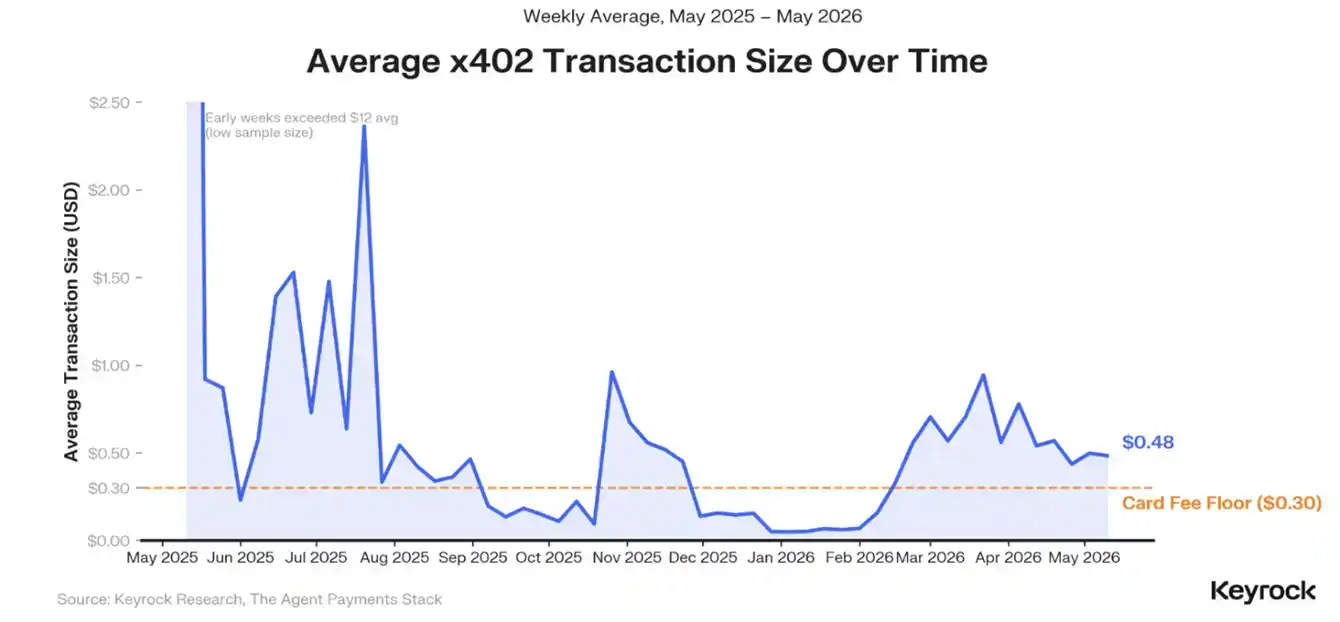
$0.30 is the most common flat fee per transaction in the US and many major markets. This fee is like a wall, making micropayments under $1 very uneconomical. For example, for a 3-cent API call, a $0.30 fee is 10 times the call cost; if an Agent pays with a credit card, the cumulative cost would be prohibitively high.

Blockchain solves this problem well. On Base, the transaction settlement cost is $0.0001. With this immense advantage, stablecoins have almost naturally won the competition against traditional payment giants in the realm of Agent payments.

Of the 176 million Agent transactions processed by x402, 98.6% were settled in USDC. Given the close relationship between Coinbase and Circle, it's fair to say Coinbase is also a big winner at the settlement layer.

But the settlement layer is just one layer in Agent payments. In the track of solving Agent payments via crypto-native means, Coinbase has a competitor—Stripe.

The Challenge from Stripe

This March, Stripe launched the Agent Payment Protocol MPP, which has brought Stripe's architecture map for Agent payments almost on par with Coinbase's.

- From the settlement layer: Coinbase has Base, Stripe has Tempo.

- From the wallet layer: Coinbase has Agent Wallet, Stripe has Privy.

- From the routing layer: Coinbase has built-in routing facilities, Stripe has Bridge, acquired for $1.1 billion.

- From the payment protocol: Coinbase has x402, Stripe has MPP.

Now let's return to the Base MCP mentioned at the beginning of the article. Since both competing sides now have these four layers of supporting infrastructure, the next battlefront is naturally the application layer.

This is the core reason why AI can become Base's main focus—Base needs to ensure that AI (at least in the cryptocurrency space) happens on Base. This is not actually about providing a perspective for degens on the Base chain, but about broadening the scenarios for Agent payments, enabling more Agents to conduct more transactions for more applications, thereby securing its leading position in the Agent payment track.

Once a dominant scale advantage is established, when Agent payments enter the commercial domain in the future, Coinbase stands to win even bigger.

Looking at the launch of Base MCP from this angle, one can sense that this is just a small step in Coinbase's grand ambition.

İlgili Sorular

QWhat is Base MCP and what key functionality does it enable for AI Agents?

ABase MCP is a protocol recently launched by Base. It allows users to connect their Base Account to an AI Agent. Once connected, users can use natural, conversational language to instruct the Agent to perform actions such as executing token swaps, making transfers, tracking portfolio positions, and querying transaction history.

QAccording to the article, why are stablecoins considered crucial for Agent payments?

AStablecoins are crucial for Agent payments because they enable micro-transactions economically. Traditional payment methods often have fixed fees around $0.30 per transaction, which makes small payments (e.g., a few cents for an API call) prohibitively expensive. In contrast, settlement costs on Base are around $0.0001, allowing stablecoins like USDC to facilitate vast numbers of small-value transactions efficiently, as evidenced by 98.6% of x402 transactions being settled in USDC.

QHow does the article contrast Coinbase's and Stripe's approaches to the Agent payment infrastructure?

AThe article contrasts their approaches by outlining the similar four-layer infrastructure both companies have built: Settlement Layer (Coinbase has Base, Stripe has Tempo), Wallet Layer (Coinbase has Agent Wallet, Stripe has Privy), Routing Layer (Coinbase has internal routing, Stripe acquired Bridge), and Payment Protocol Layer (Coinbase has x402, Stripe has MPP). This positions them as direct competitors in the Agent payment space.

QWhat strategic reason does the article suggest is behind Base making AI its main narrative?

AThe article suggests that Base's strategic focus on AI is not primarily for on-chain 'degen' activities but to expand the scenarios for Agent payments. By ensuring more AI activity (at least in the crypto space) happens on Base, Coinbase aims to generate more Agent-driven transactions across more applications. This builds a dominant scale advantage, securing Coinbase's leading position in the emerging Agent payment competition for future commercial applications.

QWhat does the median transaction amount on x402 indicate about the nature of Agent payments?

AThe median transaction amount on x402 falls between $0.01 and $0.10, with 76% of transactions being under $0.30. This data indicates that Agent payments are predominantly micro-transactions, involving very small sums of money per transaction.

İlgili Okumalar

a16z: RWA Has Passed the Proof of Concept, but the Real Challenges Are Just Beginning

a16z highlights that the tokenized real-world asset (RWA) market, excluding stablecoins, has grown tenfold in under two years to roughly $340 billion. This surge is primarily driven by US Treasury bonds and gold, offering investors yield on idle stablecoins and providing institutions with more efficient settlement and collateral flows. However, the core insight is that most tokenized assets today are simply digital certificates for off-chain holdings—used for ownership and transfer but not deeply integrated into DeFi as composable financial building blocks. For instance, only about 5% of tokenized bonds ($8B) are actively used in DeFi protocols. Smaller categories like reinsurance tokens show much higher DeFi utilization (84%), indicating they were designed for on-chain composability from the start. The market remains concentrated, with US Treasuries and commodities comprising two-thirds of the total. Gold dominates the commodities segment. While Ethereum holds over half the market, activity is spreading across multiple chains like BNB Chain and Solana. Predictions for the market's future size vary widely (from $2 trillion to over $30 trillion by 2030/2034), reflecting different definitions of what constitutes tokenization. All agree on significant growth. The current market is minuscule compared to traditional finance (e.g., tokenized bonds are 0.01% of the global bond market). The key takeaway is that the initial "proof-of-concept" phase for moving familiar assets on-chain is proving successful. The next, harder challenge is moving more complex financial instruments onto blockchains and enabling true on-chain composability, where these assets become programmable components within a native digital financial system, rather than just digitized records.

marsbit36 dk önce

a16z: RWA Has Passed the Proof of Concept, but the Real Challenges Are Just Beginning

marsbit36 dk önce

The Wind of 'Proactive' AI Blows into Silicon Valley: Hark Secures $700 Million in Funding

Hark, an AI startup founded in late 2025, has raised $700 million in Series A funding at a $6 billion valuation. Led by Parkway Venture Capital with participation from NVIDIA, AMD Ventures, Intel Capital, Qualcomm Ventures, and Salesforce Ventures, the company aims to develop next-generation human-computer interfaces using a combination of proprietary foundational models and custom-built AI-native hardware. Founded by serial entrepreneur Brett Adcock, Hark envisions a system of multimodal devices equipped with agentic capabilities, end-to-end voice models, and personalized memory. This "active" AI approach seeks to move beyond passive chatbots, creating collaborative companions that anticipate needs and interact naturally within the real world. Adcock's experience with Figure, a humanoid robotics company, informs this hardware-focused venture. The article argues that while current AI is powerful, it remains confined to screens and traditional interfaces like chat. The next paradigm shift requires dedicated hardware that is always-on, possesses persistent memory, and enables intuitive interaction, potentially rivaling the impact of the iPhone. Hark is assembling a team with talent from Apple, Meta, Google, and Tesla to tackle this complex engineering challenge across models, hardware, and interaction design. Finally, the piece suggests Chinese startups may have an advantage in this "active" AI hardware space due to strong manufacturing ecosystems, a vast domestic market, and supportive government policies, framing the competition as one that requires integrated progress in models, operating systems, and devices.

marsbit40 dk önce

The Wind of 'Proactive' AI Blows into Silicon Valley: Hark Secures $700 Million in Funding

marsbit40 dk önce

Competitors Going Public, Kimi Can't Sit Still

Competitors Go Public, Kimi Feels the Pressure Yue Zhi An Mian (Moonshot AI), the company behind the AI assistant Kimi, has begun dismantling its VIE and red-chip structure, clearing a key obstacle for a potential Hong Kong IPO. This marks a significant shift from six months ago when founder Yang Zhilin stated the company was in "no hurry" to list. The move comes as rivals like Zhipu AI and MiniMax have successfully listed on the Hong Kong Stock Exchange in early 2026, experiencing massive surges in market value. This has reset valuation logic for AI companies, turning "going public" from an end goal into a competitive necessity. Analysts suggest Kimi is both seizing a favorable market window and responding to competitive pressure. Kimi's valuation has skyrocketed from around $3 billion at its 2023 founding to over $20 billion by May 2026. Capital is betting on its potential as a future AI platform and gateway, though some caution this "emotional valuation" depends on sustained technological leadership and successful commercialization. Traditionally focused on core model R&D over user growth, Kimi has recently pivoted strategy. While its monthly active users declined through 2025, it shifted focus to Agent development and reducing marketing spend. The release of its K2.5 model in early 2026 reportedly generated substantial revenue, with annual recurring revenue reaching $200 million by April, driven by subscriptions and API services. A $2 billion D-round financing in May signaled investor approval of this commercial shift. However, listing will bring new pressures. Experts predict a listed Kimi would face stricter scrutiny on financial controls, compliance, and R&D efficiency. The narrative must evolve from pure technological breakthroughs to demonstrating clear commercialization paths, sustainable income, and a defensible valuation, balancing model superiority with business performance.

marsbit1 saat önce

Competitors Going Public, Kimi Can't Sit Still

marsbit1 saat önce

İşlemler

Spot
Futures
活动图片