The More Proficient AI Becomes at Answering, Why Do Humans Need Deep Thinking More? Fudan Releases the 2026 Blue Book on Intelligent Development in Humanities and Social Sciences

marsbit2026-07-14 tarihinde yayınlandı2026-07-14 tarihinde güncellendi

Özet

As AI capabilities rapidly expand, particularly in generating sophisticated text, analyzing data, and automating complex tasks, the need for human deep thinking becomes more critical, not less. The "2026 Blue Paper on Intelligent Development for Humanities and Social Sciences" from Fudan University argues that the relationship between AI and these fields is shifting from "one-way empowerment" to "bidirectional fusion." While AI transforms research methodologies, the humanities must guide its purpose, application, and governance. The core challenge is no longer processing vast information, but defining worthwhile problems, establishing genuine causal mechanisms, and constructing verifiable evidence chains. AI excels at producing coherent, fluent outputs but risks oversimplifying complex social realities into standardized formats it can easily process. For instance, in areas like climate-society systems, the difficulty lies not in handling more variables, but in understanding the fundamental mismatches between natural and social systems. Similarly, in automated research, AI can efficiently search for statistically significant results or generate papers quickly, potentially masking flawed assumptions or "packaging" statistical noise as discovery. The speed of paper production does not equate to the speed of genuine knowledge advancement. This underscores the non-transferable human responsibility for judgment. Deep thinking must be embedded into research workflows, governance s...

Once, our expectations of AI were quite simple: writing emails, translating papers, being a chat buddy... Back then, AI was like a green intern, doing exactly as told but often spouting nonsense with a straight face.

In recent years, AI development has surged forward like a tidal wave.

It is no longer content with just writing a few paragraphs for people; it has started taking over entire workflows: writing code, researching information, conducting analysis, generating proposals, and even breaking down tasks, calling tools, arranging steps, and checking results on its own.

Along with this came many amusing and ironic changes. The AI developed by programmers began taking over some of the work originally done by programmers themselves; many white-collar positions also found AI sitting at the desk next door.

The situation in academia is even more interesting. AI has greatly lowered the barrier to writing academic papers. Without needing to understand academic ideals, it can format papers with impressive solemnity.

Thus, some have begun mass-producing papers and mass-submitting them. Overworked reviewers use AI to assist in reviewing; authors, discovering this, embed prompts in their papers that are easily recognized only by machines, hoping the review AI will give positive evaluations. All participants save time, but whether knowledge itself has increased remains a matter of debate.

But the problem lies precisely here: Are we getting more knowledge, or more things that merely look like knowledge? As more and more work can be handed over to AI, what is left for humans?

The 2026 Blue Book on Intelligent Development in Humanities and Social Sciences released by Fudan University attempts to address these very questions.

Compared to the first edition, which primarily observed how AI empowers humanities and social sciences, this edition focuses on the theme of "Rediscovering the Value of Deep Thinking." It further proposes that the relationship between AI and the humanities/social sciences is moving from "one-way empowerment" to "two-way integration": AI changes how humanities and social sciences conduct research, while humanities and social sciences must participate in determining why AI is used, for what purposes, and what constraints it should be subject to.

As a special supporting unit of this book, the Shanghai Institute for Science of Intelligence is also collaborating with Fudan University to continuously explore the path of deep integration between AI and humanities/social sciences.

Why Stronger AI Makes Deep Thinking More Important

After calculators became widespread, people no longer needed to perform complex calculations by hand; after navigation appeared, people no longer needed to remember every route. Following this logic, perhaps after AI can analyze data and generate conclusions, humans could also think a little less.

Unfortunately, social problems are not arithmetic problems.

Taking the climate-society system coupling as an example, the Blue Book points out that the real difficulty is not handling more variables, but understanding the mismatches between natural and social systems in structure, variables, and scale. A model being able to compute does not mean it has understood the problem.
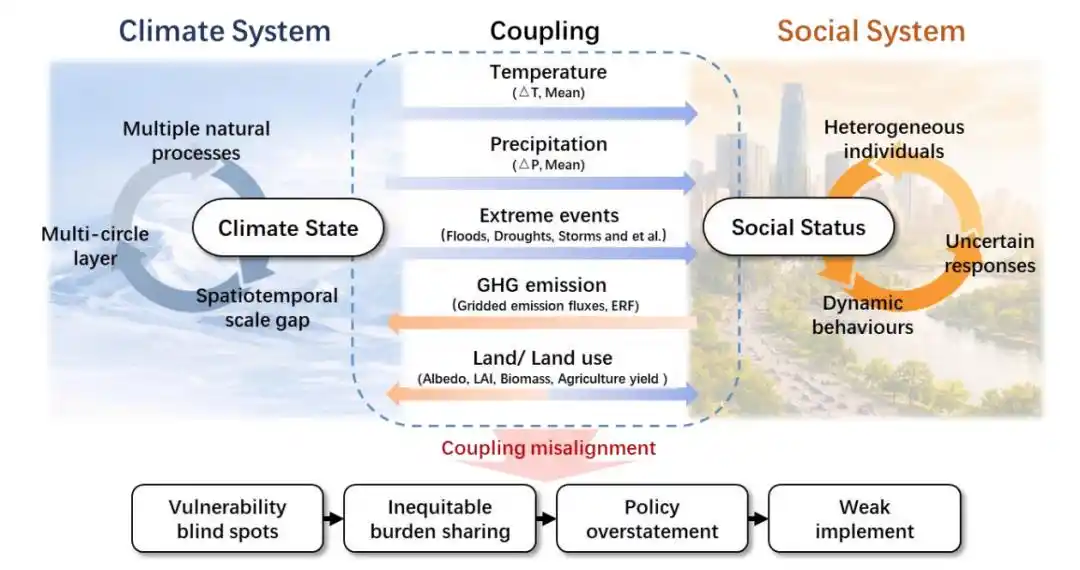
Three types of mismatches in climate-society system coupling: structure, variables, and scale.

Arithmetic problems only require judging if the answer is correct, but knowledge production and public decision-making must continue to ask: Is the reasoning process reliable? Are the underlying assumptions reasonable? Are potential risks controllable? And does the question itself have value in guiding the future?

The Blue Book argues that the research bottleneck is shifting: The past problem was whether we could process enough material; the current problem is whether we can ask good questions, establish real mechanisms, and form verifiable chains of evidence.

Judgments about what questions are worth researching, how observed patterns should be interpreted, whether a certain outcome is fair and just, and what biases are omitted or reinforced in research—these cannot be completely automated. The more capable AI becomes, the greater the human responsibility for judgment.

AI Seems Capable of Everything, But Can It Do Everything Well?

AI is becoming increasingly proficient at speaking, reasoning, and using tools, making it seem more and more like a collaborative "research partner." But is it truly understanding, or is it simulating understanding in a highly sophisticated way?

Over forty years ago, Searle used the "Chinese Room" thought experiment to question whether pure syntactic operations could produce semantic understanding. Today, large language models bring this question to everyone: How do we judge what large models actually understand and what they miss?

An important judgment in the Blue Book is that human intelligence is not a simple "input-output" process. Humans understand the world because perception and attention organize external stimuli into contexts; memory and cognitive maps organize past experiences into structures that can be transferred and reasoned about; emotions and values determine which information is more important and which goals are more worth pursuing.

The first step in human-AI collaboration is not to let AI do the work, but to first clarify the division of labor between humans and AI. AI can help us identify objects, retrieve information, and generate text, but it easily rewrites complex social experience into formats it can easily handle, turning problems that truly require understanding into problems that merely appear answered. We need to move from object recognition to contextual understanding, from information storage to experience organization, from generation to value judgment and self-reflection.

Cognitive science thus becomes particularly important. It tells us that deep thinking is not an ability opposed to AI, but an ability that needs to be more actively activated in human-machine collaboration. Truly valuable cognitive AI should not just provide a single, fluent, definitive answer, but should help people pose questions, compare evidence, and maintain the initiative in judgment.

Papers Are Written Faster and Faster, Who Ensures They Are Credible?

After AI entered scientific research, the most noticeable change is speed. Literature review, data cleaning, code generation, chart creation, and first drafts of papers can all be completed in a very short time. Researchers have no obligation to expend precious time on repetitive labor; whether a scholar has ideas should not be proven by how many times they manually adjusted a reference format.

But the speed of research and the speed of knowledge are not the same. Papers can be generated quickly, but that does not mean concepts have been clarified, data has been understood, or causal relationships have been established. Language models are especially good at organizing scattered materials into coherent narratives, and the most dangerous moment in academic research is often when the narrative appears overly coherent.

Risks also hide in seemingly "technical" steps. Choices like which variables to select, how to construct indicators, which year to start the sample from, and which cases to include all involve theoretical judgment.

The machine, of course, has no conspiracy; it only needs to make a small error in the first step and remain confident throughout the next twenty steps.

Another risk comes from automated model searching. AI can continuously try different variable combinations, parameter settings, and sample ranges until it finds results with stronger significance, better fit, and prettier charts. In the past, "trying until significance is found" was limited by time and energy; now, AI agents can search tirelessly. With increased efficiency, statistical flukes can be more efficiently packaged as theoretical discoveries.

The real challenge of automated research is not just whether machines make mistakes, but whether mistakes can be detected in time, whether the research process can be traced back, and whether final conclusions can be re-evaluated.

When AI Makes Decisions, Who Is Responsible?

AI's ability to recognize and categorize humans is rapidly increasing. It can identify claims, assess risks, review materials, match policies, and provide decision-making references for staff.

The appeal of such systems is obvious: they are faster than humans, do not get tired, and do not change their processing pace due to pressure or emotional fluctuations.

However, not getting tired is not the same as being fair.

Research cited in the Blue Book found that when analyzing health forum posts and international student interviews, human researchers could identify subtle nuances like doctor-patient interaction and cultural responsibility, while large models tended to generalize them into more ordinary, standardized categories.

The model is not completely devoid of understanding. It is just very good at rewriting things it doesn't easily understand into forms it can easily handle.

In public governance, such simplification can directly affect people's rights and treatment. The Blue Book thus distinguishes between two modes of AI embedding.

One is the "agentic" mode. The algorithm becomes the actor, moving from information input all the way to decision output, with humans reappearing only in case of system failure or appeals. The other is the "assistive" mode. AI is responsible for retrieval, calculation, risk alerts, and generating options, but the final decision is made by a human.

The difference between the two modes lies not in how much technology is used, but in whether power has been transferred.

Of course, having "human-in-the-loop" written in policy documents does not guarantee a human is actually in the loop. If staff can only click "confirm" after the algorithm's conclusion, so-called human review is merely using a human finger to execute the machine's decision.

The human role must possess the rights to intervene, correct, and explain. Otherwise, human review becomes a performance of accountability.

When AI begins to affect people's rights, the question cannot stop at "Is the model accurate?" It must also clarify who deploys, who reviews, who explains, who accepts appeals, and who bears ultimate responsibility.

Responsibilities can be divided, but they cannot evaporate simply because the division is too fine.

Deep Thinking: More Than Just "Thinking a Little Longer"

"Deep thinking" sounds like a personal virtue: faced with a problem, don't rush to answer, think a little longer. But truly meaningful deep thinking must be integrated into research processes, governance procedures, and organizational systems. It requires not only greater individual caution but also systems that preserve conditions for caution, questioning, and correction.

AI Can Help, But the Evidence Chain Cannot Be Omitted

Deep thinking does not mean rejecting AI. There is no need to insist on personally sorting through thousands of documents or spending a whole day adjusting reference formats just to prove human dignity.

The key is, work can be delegated to AI, but the evidence chain cannot be delegated along with it. AI can retrieve literature, process data, run code, but researchers still need to judge whether a question is worth asking, whether concepts are accurately translated into indicators, whether data relationships support causal explanations, and to what scope conclusions apply.

The STRIDES framework introduced in the Blue Book attempts to break down complex research into stages like theory, method, data, execution, and review, setting up checkpoints at key nodes: assumptions need to be stated, evidence must be traceable, data and code retain version records, and high-risk or low-confidence conclusions are re-submitted for human judgment.
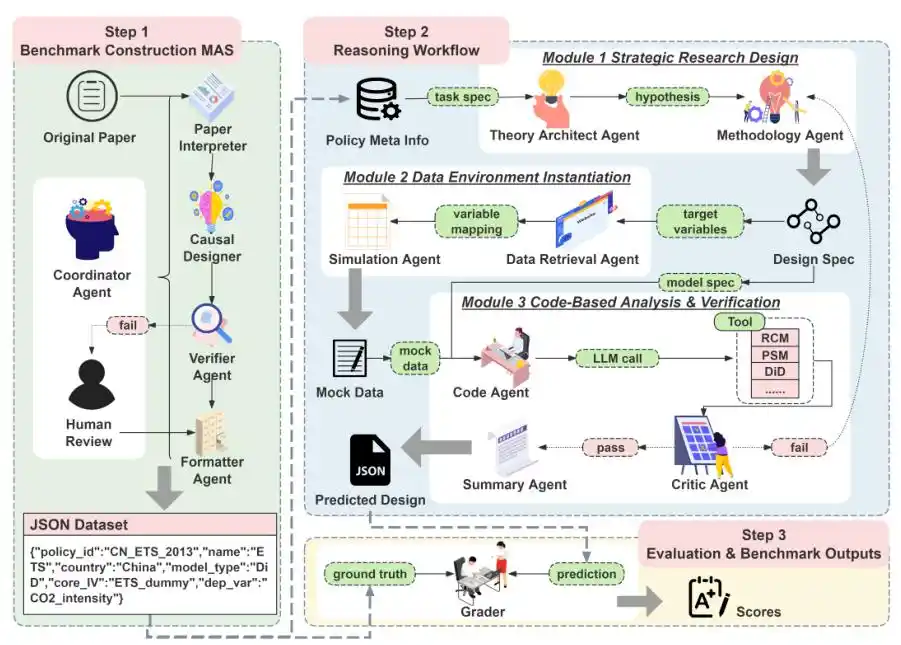
STRIDES System Overview: A workflow closed loop from research design to adversarial review.

After AI participates in research, the research output should not be just a final paper. The research question, data dictionary, analysis scripts, execution logs, review comments, and human adjudications should also be preserved, allowing others to see where results came from, at which step errors might occur, and what modifications were made.

Science is credible not because conclusions come quickly, but because others can retrace the chain of evidence.

In an interview, the team gave a simple self-check: After turning off the model, can you explain in your own words what the problem is, where the evidence comes from, what assumptions the conclusion relies on, what possible counterexamples exist, and what its boundaries of applicability are?

If you can only say "it sounds very reasonable" but cannot explain why; if the problem is gradually transformed into one the model can easily answer; if the writing becomes more fluent while your own viewpoint becomes fuzzier, then AI has likely shifted from being an expression assistant to a judgment agent.

Rules Cannot Be Just Written in Slogans

Regarding AI governance, many correct principles have been proposed: fairness, transparency, safety, human-centricity, privacy protection, accountability.

The problem is, if principles cannot be turned into procedures, they easily only exist in meetings and documents.

A system with only principles and no implementation mechanisms is like a person with only ideals and no alarm clock. They plan to do the right thing every day, but simply never wake up at the right time.

The Blue Book emphasizes that AI governance must cover the entire lifecycle of a system: assessing risks and applicable boundaries before deployment; recording key decisions, monitoring anomalies, and preserving avenues for human intervention during operation; and enabling review, correction, and accountability when problems arise.

Systems with different risk levels should not be governed identically. Ordinary information retrieval and text organization can have lower thresholds; systems involving public safety, important rights, and critical decisions should be subject to stricter testing, auditing, and deployment requirements.

Governance also cannot stop at "informed." Affected individuals should know on what basis decisions are made, what they can challenge, to whom they should raise objections, be able to request human review, and receive actual redress when errors occur. Otherwise, the duty to inform can easily become a technical document nobody understands, and appeal channels may be reduced to a mere webpage.

Of course, governance is not about putting the brakes on technology. It is more like building roads: where can speed be increased, where must it be limited, where are guardrails needed, and who is responsible after an accident. A road without rules does not represent freedom; it usually only means the strong drive faster, and everyone else must look out for themselves.

AI Can Organize Answers, But Humans Must Still Decide Direction

AI is very good at answering questions that have already been posed. But the truly difficult questions in society are often not ones without answers, but ones without a single standard answer everyone agrees on.

When efficiency conflicts with fairness, which should be prioritized? When technological innovation brings overall benefits but makes some bear greater costs, what is considered reasonable? Where should the boundary be drawn when public interest clashes with individual rights?

These problems will not disappear automatically by scaling up parameters.

The Blue Book concretely summarizes the "reverse empowerment" of AI by humanities and social sciences: It is not about standing next to technology and offering abstract moral opinions, but about transforming value conflicts into analyzable trade-offs, social consequences into measurable indicators, and providing a more directional and explanatory knowledge framework for technological development.

Models can tell us the possible consequences of different choices, but they cannot, by themselves, decide which group of people should pay the price for overall efficiency, nor can they decide if a certain price is worth paying.

The early Chinese civilization large model discussed in the Blue Book is an example. Historical documents, excavated texts, artifact images, site information, and geographical data were previously scattered across different archive systems and expert knowledge; multimodal models can organize them into the same knowledge space, allowing evidence from different sources to cross-reference each other.

Its significance lies not only in improving retrieval efficiency but in changing how evidence is organized. However, the more materials are connected, the more experts need to judge: which connections have historical significance, and which are merely superficial similarities; which narratives are built on reliable evidence, and which are merely made more fluent by the model.

This is precisely why humanities and social sciences cannot be reduced to "finding faults in AI." They are responsible not only for pointing out biases, risks, and flaws, but also for explaining value conflicts, analyzing systemic consequences, understanding specific human situations, and helping society form judgments it can collectively bear.

Technology solves "what can be done"; humanities and social sciences continue to ask "why should it be done," "to what extent should it be done," and "who bears the cost."

Relying on a Few Teams Is Not Enough

When discussing the integration of AI and humanities/social sciences, people easily think of a few labs, some star achievements, and a handful of researchers who understand both technology and social science.

This is, of course, important, but it cannot rely solely on these.

For a field to develop long-term capacity, it requires support from data, computing power, models, toolchains, talent cultivation, organizational collaboration, and evaluation systems. The Blue Book specifically reminds that AI4SSH infrastructure is not about buying more machines or putting several models on the same webpage, but the holistic construction of a multimodal data foundation, computing environment, domain-specific models, agents, toolchains, and collaboration mechanisms.

Buying computing power is relatively easy; establishing common data rules is hard. Releasing a model is relatively easy; making different disciplines truly understand each other's problems is hard. The real challenge is transforming scattered projects into sustainable organizational capabilities.

More importantly, emerging disciplines like cognitive science also need joint planning. Cognitive science connects philosophy, psychology, neuroscience, computing science, linguistics, and social sciences. It helps us understand human intelligence and also helps us reflect on and calibrate machine intelligence. For universities, building such foundational disciplines may not immediately correspond to a demonstrable application, but it determines whether future human-AI collaboration can move from tool use to paradigm innovation.

The Blue Book thus constructs the "Chinese Universities AI4SSH Index", expanding from three dimensions: core research capability, innovative development potential, and social dissemination capability, including 3 first-level indicators, 7 second-level indicators, and 10 third-level indicators.
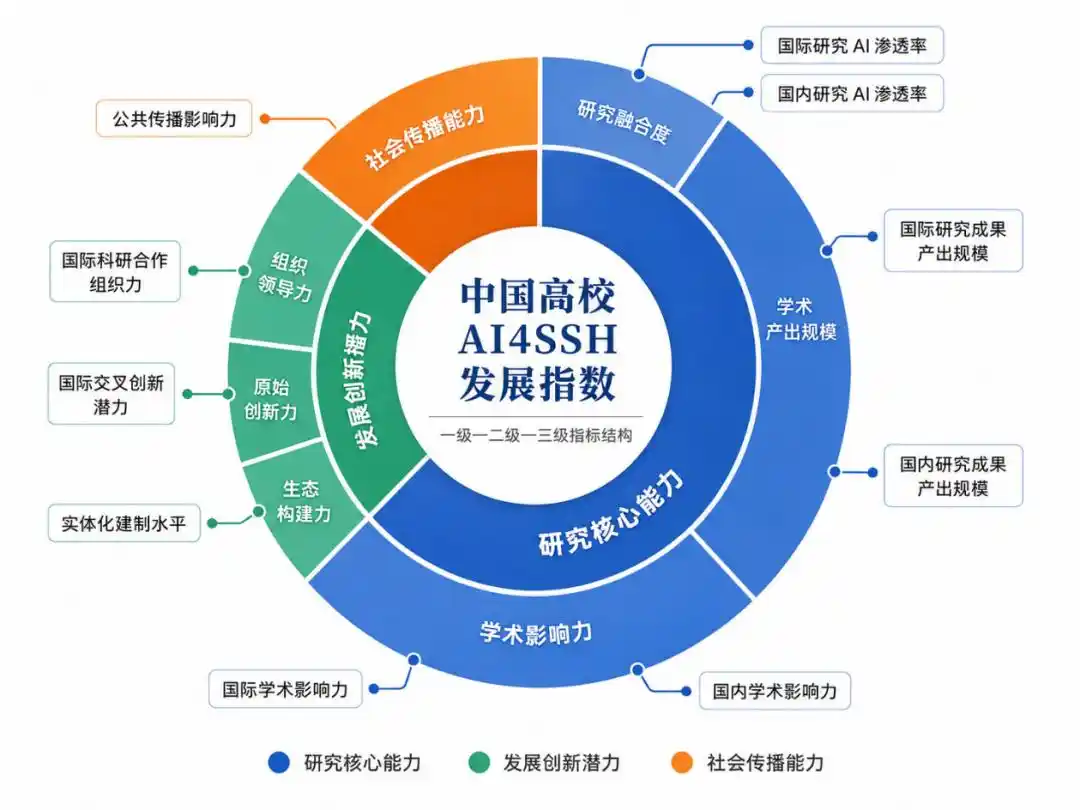
Chinese Universities AI4SSH Index Framework

It provides a structured observation window: which universities have formed stable interdisciplinary research systems, which remain at scattered project stages; which have research output but lack institutional support; which have academic achievements but have not yet translated them into public impact and social service.

The Blue Book's overall judgment is that the development of AI4SSH in Chinese universities presents a pattern of "initial system construction, distinct tiers." Research output and local integration progress relatively quickly, but international academic influence, source innovation, institutional support, and social service transformation still have shortcomings.

Therefore, measuring AI4SSH development cannot rely solely on model, paper, and project counts. One must also examine whether data, tools, norms, talent, and collaboration mechanisms can operate long-term. Technology can upgrade rapidly, but systems and organizations can only learn slowly; what truly determines how far AI and humanities/social sciences can go are precisely these parts less easily turned into demo videos.

Conclusion: The More Proficient AI Becomes at Answering, the More Humans Need to Know What to Ask

In the foreword to the Blue Book, Qiu Xin, Party Committee Secretary of Fudan University, writes to readers: in the intelligent era, we should "always safeguard thought, hone thinking, retain the composure and steadfastness for independent contemplation, rational judgment, inquiry into values, and discerning choices, guiding the transformation of intelligence with the depth of thought."

This is also the attitude this Blue Book hopes to convey. It is not merely an observation of a wave of technological change, but also a collective reflection by Fudan's humanities in facing the intelligent age.

What truly matters is judging what questions are worth posing before automatic generation; continuing to question whether evidence is credible after a model gives conclusions; clarifying its boundaries and responsibilities before technology enters society; and preserving human value judgments and directional choices among many possible futures.

We no longer need to prove in which tasks humans are faster than machines, but to reaffirm the non-transferable judgment and responsibility of humans in knowledge production and social operation.

Machines can help us reach many places. As for why we set out, where we should go, and what kind of life we want to live upon arrival—these things probably still cannot be entirely entrusted to it.

The Blue Book will be officially released on July 17 at the WAIC 2026 "Global AI Governance and Sustainable Development" forum. For the full text download, please follow the official account of the Fudan University National Development and Intelligent Governance Comprehensive Laboratory.

This article is from the WeChat public account "Almost Human" (ID: almosthuman2014), author: Focus on AI.


Trend Kriptolar

İlgili Sorular

QAccording to the 2026 Humanities and Social Sciences Intelligent Development Blue Paper by Fudan University, why is deep thinking becoming more important as AI becomes more capable of answering questions?

AThe Blue Paper argues that as AI takes over more procedural and information-processing tasks, the core research bottleneck shifts from handling materials to posing good questions, establishing authentic mechanisms, and forming verifiable evidence chains. Social problems are not arithmetic exercises. Tasks like judging what problems are worth studying, interpreting observed patterns, assessing the fairness of outcomes, and identifying biases or omissions in research cannot be fully automated. Therefore, the stronger AI becomes, the greater the human responsibility for judgment and direction-setting becomes, making deep thinking more critical.

QWhat are the two modes of AI embedding in public governance discussed in the Blue Paper, and what is their key difference?

AThe Blue Paper distinguishes between 'Agent-Type' and 'Assistive-Type' modes of AI embedding. The key difference is not the amount of technology used, but whether power transfer occurs. In the 'Agent-Type' mode, the algorithm acts as the decision-maker from input to output, with humans intervening only in case of system failures or appeals. In the 'Assistive-Type' mode, AI handles tasks like retrieval, calculation, risk prompting, and generating options, but the final decision is made by a human. The paper warns that simply having a human 'in the loop' on paper is not enough if they can only click 'confirm' on the algorithm's conclusion.

QWhat is the STRIDES framework mentioned in the article, and what is its main purpose in AI-assisted research?

AThe STRIDES framework is introduced as a system to decompose complex research into stages like theory, methodology, data, execution, and review. Its main purpose is to embed checks at key nodes within the research workflow. It requires explicit hypotheses, traceable evidence, versioned data and code, and mandates that high-risk or low-confidence conclusions be re-submitted for human judgment. The goal is to ensure that while work can be delegated to AI, the evidence chain and critical reasoning cannot be. It aims to preserve research integrity and verifiability in an automated context.

QHow does the Blue Paper define the 'reverse empowerment' of humanities and social sciences on AI development?

AThe 'reverse empowerment' is defined not as offering abstract moral opinions on technology, but as concretely transforming value conflicts into analyzable trade-offs, translating social consequences into measurable indicators, and providing a more directional and explanatory knowledge framework for technological development. It involves humanities and social sciences addressing fundamental questions that AI cannot answer on its own, such as 'why to do something,' 'how far it should go,' and 'who bears the costs,' thereby guiding the purpose and boundaries of AI application.

QWhat is the significance of the 'China University AI4SSH Index' constructed in the Blue Paper?

AThe 'China University AI4SSH Index' provides a structured observation framework to assess the development of AI for Social Sciences and Humanities (AI4SSH) in Chinese universities. It evaluates institutions across three dimensions: core research capability, developmental innovation potential, and social dissemination capacity, using multiple tiers of indicators. Its significance lies in moving beyond counting models, papers, or projects to reveal which universities have built sustainable interdisciplinary systems, robust institutional support, and the ability to convert academic成果 into public impact. It highlights that long-term progress depends on foundational elements like data, tools, norms, talent, and collaboration mechanisms, not just technological demonstrations.

İlgili Okumalar

Tensions in the Strait of Hormuz Escalate, Bitcoin Plunges to $61,700 Amid Safe-Haven Selling

Bitcoin fell sharply to around $61,700 on Monday, July 13th, as geopolitical tensions in the Strait of Hormuz triggered a broad shift toward risk-off sentiment across global markets. The decline of roughly 4% mirrored weaker performances in major U.S. stock indices. Market analysts attributed the sell-off to a confluence of factors stemming from the heightened U.S.-Iran tensions. These tensions reignited inflation concerns, reduced expectations for near-term Federal Reserve rate cuts, and prompted investors to reduce exposure to risk assets like Bitcoin. Additional pressure came from slowed institutional ETF inflows, Bitcoin's failure to breach a key resistance level, and a wave of liquidations for leveraged long positions. Despite the drop, analysts largely viewed the move as a typical macro-driven correction within a healthy long-term cycle. They emphasized that Bitcoin's underlying growth trajectory remains intact. The sell-off was seen more as a liquidation event targeting over-leveraged longs rather than a structural loss of confidence. Attention now turns to the upcoming U.S. Consumer Price Index (CPI) report. A higher-than-expected inflation reading could further delay Fed rate cuts, making safer assets like bonds more attractive and continuing to pressure volatile assets like Bitcoin. The consensus is that the current volatility reflects short-term macro and geopolitical shocks, not a fundamental breakdown in Bitcoin's long-term proposition.

Foresight News5 dk önce

Tensions in the Strait of Hormuz Escalate, Bitcoin Plunges to $61,700 Amid Safe-Haven Selling

Foresight News5 dk önce

BitMart Research Institute Weekly Highlights: Rising Rate Hike Expectations, Crypto Market Stabilizes Amid Fluctuations

BitMart Research Weekly Market Review: Rate Hike Expectations Rise, Crypto Market Stabilizes Macro & Traditional Markets: U.S. stocks weakened with tech and semiconductors leading losses (Nasdaq down 1.55%, Philly Semi Index down 4.78%), while Apple bucked the trend. Brent oil surged 9.3% after Middle East ceasefire破裂, but gold fell 1% as美元 strengthened. The Fed's June FOMC纪要 was hawkish, shifting market expectations toward potential rate hikes, pushing the 10-year Treasury yield to 4.56%. Crypto Market Overview: BTC saw a slight 0.2% weekly gain, trading between ~$61.3K and $64.7K and settling near $64K. ETH outperformed, rising 1.2%. Market fear eased slightly but remained in "Fear" territory. Altcoin performance was mixed, with gains concentrated in large-cap assets. Key Developments: U.S. spot Bitcoin ETFs ended an 8-week outflow streak with a $197.4M net inflow, aiding price stabilization. On-chain, stablecoin growth was minimal. Robinhood Chain's TVL surpassed $132M within two weeks, largely driven by institutional stablecoin deposits. MicroStrategy executed its first major BTC sale (3,588 BTC for $216M) to fund dividends, while maintaining a large BTC reserve. Institutional infrastructure advanced with Swift's blockchain pilot for tokenized deposits and growing Asia-Pacific stablecoin initiatives. *This is market analysis, not investment advice. Cryptocurrency investment is high-risk; assess your risk tolerance and implement strict risk management.*

marsbit55 dk önce

BitMart Research Institute Weekly Highlights: Rising Rate Hike Expectations, Crypto Market Stabilizes Amid Fluctuations

marsbit55 dk önce

İşlemler

Spot

Popüler Makaleler

GROK AI Nedir

Grok AI: Web3 Döneminde Konuşma Teknolojisini Devrim Niteliğinde Yenilik Giriş Hızla gelişen yapay zeka alanında, Grok AI, ileri teknoloji ve kullanıcı etkileşimi alanlarını birleştiren dikkate değer bir proje olarak öne çıkıyor. Ünlü girişimci Elon Musk'ın liderliğindeki xAI tarafından geliştirilen Grok AI, yapay zeka ile etkileşim şeklimizi yeniden tanımlamayı hedefliyor. Web3 hareketi devam ederken, Grok AI, karmaşık sorgulara yanıt vermek için konuşma yapay zekasının gücünden yararlanmayı amaçlıyor ve kullanıcılara sadece bilgilendirici değil, aynı zamanda eğlenceli bir deneyim sunuyor. Grok AI Nedir? Grok AI, kullanıcılarla dinamik bir şekilde etkileşimde bulunmak üzere tasarlanmış sofistike bir konuşma yapay zeka sohbet botudur. Birçok geleneksel yapay zeka sisteminin aksine, Grok AI, genellikle uygunsuz veya standart yanıtların dışında kabul edilen daha geniş bir sorgu yelpazesini benimsemektedir. Projenin temel hedefleri şunlardır: Güvenilir Akıl Yürütme: Grok AI, bağlamsal anlayışa dayalı mantıklı yanıtlar sağlamak için sağduyu akıl yürütmeyi vurgular. Ölçeklenebilir Denetim: Araç yardımı entegrasyonu, kullanıcı etkileşimlerinin hem izlenmesini hem de kalite için optimize edilmesini sağlar. Resmi Doğrulama: Güvenlik en önemli önceliktir; Grok AI, çıktılarının güvenilirliğini artırmak için resmi doğrulama yöntemlerini entegre eder. Uzun Bağlam Anlayışı: AI modeli, kapsamlı konuşma geçmişini saklama ve hatırlama konusunda mükemmel bir performans sergileyerek anlamlı ve bağlamsal olarak farkında tartışmaların yapılmasını kolaylaştırır. Saldırgan Dayanıklılık: Manipüle edilmiş veya kötü niyetli girdilere karşı savunmalarını geliştirmeye odaklanarak, Grok AI kullanıcı etkileşimlerinin bütünlüğünü korumayı hedefler. Özünde, Grok AI sadece bir bilgi alma cihazı değil; dinamik diyalogu teşvik eden, etkileyici bir konuşma partneridir. Grok AI'nın Yaratıcısı Grok AI'nın arkasındaki beyin, otomotiv, uzay yolculuğu ve teknoloji gibi çeşitli alanlarda yenilikle özdeşleşen Elon Musk'tır. Yapay zeka teknolojisini faydalı yollarla geliştirmeye odaklanan xAI çatısı altında, Musk'ın vizyonu, yapay zeka etkileşimlerinin anlaşılmasını yeniden şekillendirmeyi amaçlıyor. Liderlik ve temel etik, Musk'ın teknolojik sınırları zorlamaya olan bağlılığı tarafından derinden etkilenmektedir. Grok AI'nın Yatırımcıları Grok AI'yi destekleyen yatırımcılarla ilgili spesifik detaylar sınırlı kalmakla birlikte, projenin kuluçka merkezi olan xAI'nin, esasen Elon Musk tarafından kurulduğu ve desteklendiği kamuya açık bir şekilde kabul edilmektedir. Musk'ın önceki girişimleri ve mülkleri, Grok AI'nın güvenilirliğini ve büyüme potansiyelini daha da artıran sağlam bir destek sağlar. Ancak, şu anda Grok AI'yı destekleyen ek yatırım fonları veya kuruluşlarıyla ilgili bilgiye kolayca erişim sağlanamamaktadır; bu da potansiyel gelecekteki keşif alanını işaret etmektedir. Grok AI Nasıl Çalışır? Grok AI'nın operasyonel mekanikleri, kavramsal çerçevesi kadar yenilikçidir. Proje, benzersiz işlevselliklerini kolaylaştıran birkaç son teknoloji ürünü teknolojiyi entegre eder: Sağlam Altyapı: Grok AI, konteyner orkestrasyonu için Kubernetes, performans ve güvenlik için Rust ve yüksek performanslı sayısal hesaplama için JAX kullanılarak inşa edilmiştir. Bu üçlü, sohbet botunun verimli çalışmasını, etkili bir şekilde ölçeklenmesini ve kullanıcılara zamanında hizmet vermesini sağlar. Gerçek Zamanlı Bilgi Erişimi: Grok AI'nın ayırt edici özelliklerinden biri, X platformu (önceden Twitter olarak biliniyordu) aracılığıyla gerçek zamanlı verilere erişim yeteneğidir. Bu yetenek, yapay zekaya en son bilgilere erişim sağlar ve diğer yapay zeka modellerinin gözden kaçırabileceği zamanında yanıtlar ve öneriler sunmasına olanak tanır. İki Etkileşim Modu: Grok AI, kullanıcılara “Eğlenceli Mod” ve “Normal Mod” arasında seçim yapma imkanı sunar. Eğlenceli Mod, daha eğlenceli ve mizahi bir etkileşim tarzı sağlarken, Normal Mod, kesin ve doğru yanıtlar vermeye odaklanır. Bu çok yönlülük, çeşitli kullanıcı tercihlerine hitap eden özelleştirilmiş bir deneyim sağlar. Özünde, Grok AI performansı etkileşimle birleştirerek, hem zenginleştirici hem de eğlenceli bir deneyim yaratmaktadır. Grok AI'nın Zaman Çizelgesi Grok AI'nın yolculuğu, gelişim ve dağıtım aşamalarını yansıtan önemli dönüm noktalarıyla işaretlenmiştir: İlk Geliştirme: Grok AI'nın temel aşaması, modelin ilk eğitim ve ince ayarının yapıldığı yaklaşık iki ay boyunca gerçekleşmiştir. Grok-2 Beta Yayını: Önemli bir ilerleme olarak, Grok-2 beta duyurulmuştur. Bu sürüm, sohbet etme, kodlama ve akıl yürütme yetenekleriyle donatılmış iki versiyon—Grok-2 ve Grok-2 mini—sunmuştur. Halka Açık Erişim: Beta geliştirmesinin ardından, Grok AI X platformu kullanıcılarına sunulmuştur. Telefon numarasıyla doğrulanan ve en az yedi gün aktif olan hesap sahipleri, sınırlı bir versiyona erişim sağlayarak teknolojiyi daha geniş bir kitleye ulaştırmaktadır. Bu zaman çizelgesi, Grok AI'nın kuruluşundan kamu etkileşimine kadar sistematik büyümesini kapsar ve sürekli iyileştirme ve kullanıcı etkileşimine olan bağlılığını vurgular. Grok AI'nın Ana Özellikleri Grok AI, yenilikçi kimliğine katkıda bulunan birkaç ana özelliği kapsamaktadır: Gerçek Zamanlı Bilgi Entegrasyonu: Güncel ve ilgili bilgilere erişim, Grok AI'yı birçok statik modelden ayırarak, etkileyici ve doğru bir kullanıcı deneyimi sağlar. Çeşitli Etkileşim Tarzları: Farklı etkileşim modları sunarak, Grok AI çeşitli kullanıcı tercihlerine hitap eder ve yapay zeka ile konuşurken yaratıcılığı ve kişiselleştirmeyi teşvik eder. Gelişmiş Teknolojik Altyapı: Kubernetes, Rust ve JAX kullanımı, projeye güvenilirlik ve optimal performans sağlamak için sağlam bir çerçeve sunar. Etik Tartışma Dikkati: Görüntü üreten bir işlevin dahil edilmesi, projenin yenilikçi ruhunu sergiler. Ancak, aynı zamanda tanınabilir figürlerin saygılı bir şekilde tasvir edilmesi ve telif hakkı ile ilgili etik konuları da gündeme getirir—bu, yapay zeka topluluğunda süregelen bir tartışmadır. Sonuç Konuşma yapay zekası alanında öncü bir varlık olarak Grok AI, dijital çağda dönüştürücü kullanıcı deneyimlerinin potansiyelini kapsar. xAI tarafından geliştirilen ve Elon Musk'ın vizyoner yaklaşımıyla yönlendirilen Grok AI, gerçek zamanlı bilgiyi gelişmiş etkileşim yetenekleriyle birleştirir. Yapay zekanın neler başarabileceği konusunda sınırları zorlamayı hedeflerken, etik konulara ve kullanıcı güvenliğine odaklanmayı sürdürmektedir. Grok AI, sadece teknolojik ilerlemeyi değil, aynı zamanda Web3 manzarasında yeni bir konuşma paradigmasını da temsil eder ve kullanıcılara hem yetkin bilgi hem de eğlenceli etkileşim sunma vaadinde bulunur. Proje gelişmeye devam ederken, teknolojinin, yaratıcılığın ve insan benzeri etkileşimin kesişim noktasında nelerin başarılabileceğinin bir kanıtı olarak durmaktadır.

459 Toplam GörüntülenmeYayınlanma 2024.12.26Güncellenme 2024.12.26

GROK AI Nedir

ERC AI Nedir

Euruka Tech: $erc ai ve Web3'teki Hedefleri Üzerine Bir Genel Bakış Giriş Blockchain teknolojisi ve merkeziyetsiz uygulamaların hızla gelişen manzarasında, her biri benzersiz hedefler ve metodolojilerle yeni projeler sıkça ortaya çıkmaktadır. Bu projelerden biri, kripto para ve Web3 alanında faaliyet gösteren Euruka Tech'tir. Euruka Tech'in, özellikle $erc ai token'ının ana odak noktası, merkeziyetsiz teknolojinin büyüyen yeteneklerinden yararlanmak için tasarlanmış yenilikçi çözümler sunmaktır. Bu makale, Euruka Tech'in kapsamlı bir genel görünümünü, hedeflerini, işlevselliğini, yaratıcısının kimliğini, potansiyel yatırımcılarını ve Web3'teki daha geniş bağlam içindeki önemini keşfetmeyi amaçlamaktadır. Euruka Tech, $erc ai Nedir? Euruka Tech, Web3 ortamının sunduğu araçlar ve işlevsellikleri kullanan bir proje olarak tanımlanmaktadır ve operasyonlarında yapay zekayı entegre etmeye odaklanmaktadır. Projenin çerçevesine dair spesifik detaylar biraz belirsiz olsa da, kullanıcı etkileşimini artırmayı ve kripto alanındaki süreçleri otomatikleştirmeyi amaçlamaktadır. Proje, yalnızca işlemleri kolaylaştırmakla kalmayıp, aynı zamanda yapay zeka aracılığıyla öngörücü işlevsellikleri de entegre eden merkeziyetsiz bir ekosistem yaratmayı hedeflemektedir; bu nedenle token'ının adı $erc ai'dir. Amaç, büyüyen Web3 alanında daha akıllı etkileşimleri ve verimli işlem işleme süreçlerini kolaylaştıran sezgisel bir platform sunmaktır. Euruka Tech'in Yaratıcısı Kimdir, $erc ai? Şu anda, Euruka Tech'in arkasındaki yaratıcı veya kurucu ekip hakkında bilgi verilmemiştir ve bu durum biraz belirsizdir. Bu veri eksikliği, ekibin geçmişi hakkında bilgi sahibi olmanın genellikle blockchain sektöründe güvenilirlik oluşturmak için gerekli olduğu endişelerini doğurmaktadır. Bu nedenle, somut detaylar kamuya sunulana kadar bu bilgiyi bilinmeyen olarak sınıflandırdık. Euruka Tech'in Yatırımcıları Kimlerdir, $erc ai? Benzer şekilde, Euruka Tech projesinin yatırımcıları veya destekleyen organizasyonları hakkında mevcut araştırmalarla kolayca sağlanan bir bilgi yoktur. Euruka Tech ile etkileşimde bulunmayı düşünen potansiyel paydaşlar veya kullanıcılar için kritik bir unsur, kurumsal finansal ortaklıklar veya saygın yatırım firmalarından gelen destekle sağlanan güvencedir. Yatırım ilişkileri hakkında açıklamalar olmadan, projenin finansal güvenliği veya sürdürülebilirliği hakkında kapsamlı sonuçlar çıkarmak zordur. Bulunan bilgilere paralel olarak, bu bölüm de bilinmeyen durumundadır. Euruka Tech, $erc ai Nasıl Çalışır? Euruka Tech için detaylı teknik spesifikasyonların eksik olmasına rağmen, yenilikçi hedeflerini göz önünde bulundurmak önemlidir. Proje, yapay zekanın hesaplama gücünden yararlanarak kripto para ortamında kullanıcı deneyimini otomatikleştirmeyi ve geliştirmeyi hedeflemektedir. AI'yi blockchain teknolojisiyle entegre ederek, Euruka Tech otomatik ticaret, risk değerlendirmeleri ve kişiselleştirilmiş kullanıcı arayüzleri gibi özellikler sunmayı amaçlamaktadır. Euruka Tech'in yenilikçi özü, kullanıcılar ile merkeziyetsiz ağların sunduğu geniş olanaklar arasında kesintisiz bir bağlantı yaratma hedefinde yatmaktadır. Makine öğrenimi algoritmaları ve AI kullanarak, ilk kez kullanıcı zorluklarını en aza indirmeyi ve Web3 çerçevesindeki işlem deneyimlerini düzene sokmayı amaçlamaktadır. AI ve blockchain arasındaki bu simbiyoz, $erc ai token'ının önemini vurgulamakta ve geleneksel kullanıcı arayüzleri ile merkeziyetsiz teknolojilerin gelişmiş yetenekleri arasında bir köprü işlevi görmektedir. Euruka Tech, $erc ai Zaman Çizelgesi Maalesef, Euruka Tech hakkında mevcut olan sınırlı bilgiler nedeniyle, projenin yolculuğundaki önemli gelişmeler veya kilometre taşları hakkında detaylı bir zaman çizelgesi sunamıyoruz. Genellikle bir projenin evrimini haritalamak ve büyüme eğrisini anlamak için değerli olan bu zaman çizelgesi şu anda mevcut değildir. Önemli olaylar, ortaklıklar veya işlevsel eklemeler hakkında bilgiler belirgin hale geldikçe, güncellemeler kesinlikle Euruka Tech'in kripto alanındaki görünürlüğünü artıracaktır. Diğer “Eureka” Projeleri Üzerine Açıklama Birden fazla projenin ve şirketin “Eureka” benzeri bir isimlendirmeye sahip olduğunu belirtmek önemlidir. Araştırmalar, robotlara karmaşık görevler öğretmeye odaklanan NVIDIA Research'ten bir AI ajanı gibi girişimleri, ayrıca eğitim ve müşteri hizmetleri analitiğinde kullanıcı deneyimini geliştiren Eureka Labs ve Eureka AI'yi tanımlamıştır. Ancak, bu projeler Euruka Tech'ten farklıdır ve hedefleri veya işlevleri ile karıştırılmamalıdır. Sonuç Euruka Tech, $erc ai token'ı ile birlikte, Web3 manzarasında umut verici ancak şu anda belirsiz bir oyuncuyu temsil etmektedir. Yaratıcısı ve yatırımcıları hakkında detaylar açıklanmamış olsa da, yapay zekayı blockchain teknolojisiyle birleştirme konusundaki temel hedefi ilgi odağı olmaktadır. Projenin, gelişmiş otomasyon aracılığıyla kullanıcı etkileşimini teşvik etme konusundaki benzersiz yaklaşımları, Web3 ekosistemi ilerledikçe onu farklı kılabilir. Kripto piyasası gelişmeye devam ederken, paydaşların Euruka Tech etrafındaki gelişmelere dikkat etmeleri önemlidir; belgelenmiş yeniliklerin, ortaklıkların veya tanımlanmış bir yol haritasının gelişimi, önümüzdeki dönemde önemli fırsatlar sunabilir. Şu an itibarıyla, Euruka Tech'in potansiyelini ve rekabetçi kripto manzarasındaki konumunu açığa çıkarabilecek daha somut içgörüler beklemekteyiz.

432 Toplam GörüntülenmeYayınlanma 2025.01.02Güncellenme 2025.01.02

ERC AI Nedir

DUOLINGO AI Nedir

DUOLINGO AI: Dil Öğrenimini Web3 ve AI İnovasyonu ile Entegre Etmek Teknolojinin eğitimi yeniden şekillendirdiği bir çağda, yapay zeka (AI) ve blok zinciri ağlarının entegrasyonu dil öğrenimi için yeni bir ufuk açmaktadır. DUOLINGO AI ve ona bağlı kripto para birimi $DUOLINGO AI ile tanışın. Bu proje, önde gelen dil öğrenme platformlarının eğitimsel yeteneklerini merkeziyetsiz Web3 teknolojisinin faydalarıyla birleştirmeyi hedefliyor. Bu makale, DUOLINGO AI'nın temel yönlerini, hedeflerini, teknolojik çerçevesini, tarihsel gelişimini ve gelecekteki potansiyelini incelerken, orijinal eğitim kaynağı ile bu bağımsız kripto para girişimi arasındaki netliği korumaktadır. DUOLINGO AI Genel Görünümü DUOLINGO AI'nın temelinde, öğrenicilerin dil yeterliliğinde eğitimsel kilometre taşlarına ulaşmaları için kriptografik ödüller kazanabilecekleri merkeziyetsiz bir ortam oluşturma hedefi yatmaktadır. Akıllı sözleşmeler uygulayarak, proje beceri doğrulama süreçlerini ve token tahsislerini otomatikleştirmeyi amaçlamakta, şeffaflık ve kullanıcı sahipliğini vurgulayan Web3 ilkelerine uymaktadır. Model, dil edinimindeki geleneksel yaklaşımlardan ayrılarak, token sahiplerinin kurs içeriği ve ödül dağıtımları üzerinde iyileştirmeler önermesine olanak tanıyan topluluk odaklı bir yönetişim yapısına dayanmaktadır. DUOLINGO AI'nın bazı dikkat çekici hedefleri şunlardır: Oyunlaştırılmış Öğrenme: Proje, dil yeterlilik seviyelerini temsil etmek için blok zinciri başarıları ve değiştirilemez tokenleri (NFT'ler) entegre ederek, katılımcıları motive eden dijital ödüller sunmaktadır. Merkeziyetsiz İçerik Üretimi: Eğitmenler ve dil meraklılarının kendi kurslarını katkıda bulunmalarına olanak tanıyarak, tüm katkıda bulunanların fayda sağladığı bir gelir paylaşım modeli oluşturmaktadır. AI Destekli Kişiselleştirme: Gelişmiş makine öğrenimi modellerini kullanarak, DUOLINGO AI dersleri bireysel öğrenme ilerlemesine uyacak şekilde kişiselleştirmekte, köklü platformlarda bulunan uyarlamalı özelliklere benzer bir deneyim sunmaktadır. Proje Yaratıcıları ve Yönetişim Nisan 2025 itibarıyla, $DUOLINGO AI'nın arkasındaki ekip takma isimler kullanmaktadır; bu, merkeziyetsiz kripto para alanında sıkça görülen bir uygulamadır. Bu anonimlik, bireysel geliştiricilere odaklanmak yerine kolektif büyümeyi ve paydaş katılımını teşvik etmek amacıyla tasarlanmıştır. Solana blok zincirinde dağıtılan akıllı sözleşme, geliştiricinin cüzdan adresini not etmekte, bu da yaratıcıların kimliğinin bilinmemesine rağmen işlemlerle ilgili şeffaflık taahhüdünü simgelemektedir. Yol haritasına göre, DUOLINGO AI, Merkeziyetsiz Otonom Organizasyon (DAO) haline gelmeyi hedeflemektedir. Bu yönetişim yapısı, token sahiplerinin özellik uygulamaları ve hazine tahsisleri gibi kritik konularda oy kullanmalarına olanak tanımaktadır. Bu model, çeşitli merkeziyetsiz uygulamalarda bulunan topluluk güçlendirme ethosu ile uyumlu olup, kolektif karar verme sürecinin önemini vurgulamaktadır. Yatırımcılar ve Stratejik Ortaklıklar Şu anda, $DUOLINGO AI ile bağlantılı olarak kamuya açık tanımlanabilir kurumsal yatırımcılar veya risk sermayedarları bulunmamaktadır. Bunun yerine, projenin likiditesi esas olarak merkeziyetsiz borsa (DEX) kaynaklıdır ve bu, geleneksel eğitim teknolojisi şirketlerinin finansman stratejileriyle keskin bir zıtlık oluşturmaktadır. Bu tabandan gelen model, merkeziyetsizliğe olan bağlılığını yansıtan topluluk odaklı bir yaklaşımı işaret etmektedir. DUOLINGO AI, beyaz kitabında, kurs tekliflerini zenginleştirmeyi amaçlayan belirsiz “blok zinciri eğitim platformları” ile işbirlikleri kurmayı planladığını belirtmektedir. Belirli ortaklıklar henüz açıklanmamış olsa da, bu işbirlikçi çabalar, blok zinciri yeniliğini eğitim girişimleri ile birleştirmeyi amaçlayan bir stratejiyi ima etmektedir ve çeşitli öğrenme yollarında erişimi ve kullanıcı katılımını genişletmektedir. Teknolojik Mimari AI Entegrasyonu DUOLINGO AI, eğitimsel tekliflerini geliştirmek için iki ana AI destekli bileşen içermektedir: Uyarlanabilir Öğrenme Motoru: Bu sofistike motor, kullanıcı etkileşimlerinden öğrenmekte olup, büyük eğitim platformlarından gelen özel modellere benzer. Belirli öğrenici zorluklarını ele almak için ders zorluğunu dinamik olarak ayarlamakta ve zayıf alanları hedeflenmiş alıştırmalarla pekiştirmektedir. Konuşma Ajanları: GPT-4 destekli sohbet botlarını kullanarak, DUOLINGO AI kullanıcıların simüle edilmiş konuşmalara katılmalarına olanak tanıyarak, daha etkileşimli ve pratik bir dil öğrenme deneyimi sunmaktadır. Blok Zinciri Altyapısı $DUOLINGO AI, Solana blok zincirinde inşa edilmiş kapsamlı bir teknolojik çerçeve kullanmaktadır: Beceri Doğrulama Akıllı Sözleşmeleri: Bu özellik, yeterlilik testlerini başarıyla geçen kullanıcılara otomatik olarak token ödülleri vermekte, gerçek öğrenim sonuçları için teşvik yapısını güçlendirmektedir. NFT Rozetleri: Bu dijital tokenler, öğrenicilerin kurslarının bir bölümünü tamamlamak veya belirli becerileri ustalaşmak gibi ulaştıkları çeşitli kilometre taşlarını simgelemekte ve bunları dijital olarak takas etmelerine veya sergilemelerine olanak tanımaktadır. DAO Yönetişimi: Token sahibi topluluk üyeleri, anahtar öneriler üzerinde oy kullanarak yönetişime katılabilir, bu da kurs teklifleri ve platform özelliklerinde yeniliği teşvik eden katılımcı bir kültürü kolaylaştırmaktadır. Tarihsel Zaman Çizelgesi 2022–2023: Kavramsallaştırma DUOLINGO AI için temel, dil öğrenimindeki AI ilerlemeleri ile blok zinciri teknolojisinin merkeziyetsiz potansiyeli arasındaki sinerjiyi vurgulayan bir beyaz kağıdın oluşturulmasıyla başlar. 2024: Beta Lansmanı Sınırlı bir beta sürümü, popüler dillerdeki teklifleri tanıtarak, erken kullanıcıları token teşvikleri ile ödüllendirir ve projenin topluluk katılım stratejisinin bir parçası olarak sunulmaktadır. 2025: DAO Geçişi Nisan ayında, tokenlerin dolaşıma girmesiyle tam bir ana ağ lansmanı gerçekleşir ve topluluk, Asya dillerine ve diğer kurs gelişmelerine olası genişlemeler hakkında tartışmalara başlar. Zorluklar ve Gelecek Yönelimleri Teknik Engeller Hırslı hedeflerine rağmen, DUOLINGO AI önemli zorluklarla karşı karşıyadır. Ölçeklenebilirlik, AI işleme ile merkeziyetsiz bir ağı sürdürme maliyetleri arasında denge kurma konusunda sürekli bir endişe kaynağıdır. Ayrıca, merkeziyetsiz bir teklif arasında kaliteli içerik üretimi ve moderasyonu sağlamak, eğitim standartlarını koruma konusunda karmaşıklıklar yaratmaktadır. Stratejik Fırsatlar İleriye dönük olarak, DUOLINGO AI, akademik kurumlarla mikro yeterlilik ortaklıkları kurma potansiyeline sahiptir ve dil becerilerinin blok zinciri ile doğrulanmış onaylarını sağlamaktadır. Ayrıca, çapraz zincir genişlemesi, projenin daha geniş kullanıcı tabanlarına ve ek blok zinciri ekosistemlerine erişim sağlamasına olanak tanıyabilir, böylece birlikte çalışabilirliğini ve erişimini artırabilir. Sonuç DUOLINGO AI, yapay zeka ve blok zinciri teknolojisinin yenilikçi bir birleşimini temsil etmekte olup, geleneksel dil öğrenim sistemlerine topluluk odaklı bir alternatif sunmaktadır. Takma isimli geliştirme süreci ve ortaya çıkan ekonomik modeli bazı riskler taşısa da, projenin oyunlaştırılmış öğrenme, kişiselleştirilmiş eğitim ve merkeziyetsiz yönetişim konusundaki taahhüdü, Web3 alanında eğitim teknolojisi için bir yol haritası aydınlatmaktadır. AI gelişmeye devam ederken ve blok zinciri ekosistemi evrim geçirirken, DUOLINGO AI gibi girişimler, kullanıcıların dil eğitimi ile etkileşim biçimlerini yeniden tanımlayabilir, toplulukları güçlendirebilir ve yenilikçi öğrenme mekanizmaları aracılığıyla katılımı ödüllendirebilir.

478 Toplam GörüntülenmeYayınlanma 2025.04.11Güncellenme 2025.04.11

DUOLINGO AI Nedir

Tartışmalar

HTX Topluluğuna hoş geldiniz. Burada, en son platform gelişmeleri hakkında bilgi sahibi olabilir ve profesyonel piyasa görüşlerine erişebilirsiniz. Kullanıcıların AI (AI) fiyatı hakkındaki görüşleri aşağıda sunulmaktadır.

活动图片