Author: Raoul Pal, Founder of Real Vision
Compiled by: Luffy, Foresight News
First, a fun calculation: One cent doubles every day for 30 days. How much money do you end up with? Most people guess a few hundred dollars. The real answer is over $5 million.
Almost no one gets it right on the first try because the human brain isn't wired for this kind of calculation. Our thinking is inherently biased towards linear logic. When crossing the street, a quick glance at the traffic lets your brain intuitively judge if it's safe; but when we imagine something doubling every year, we consistently and severely underestimate the final scale, often by orders of magnitude.
For most of human history, this cognitive limitation was almost irrelevant. Every tool we built, every system we established, developed at a pace that fit our linear intuition.
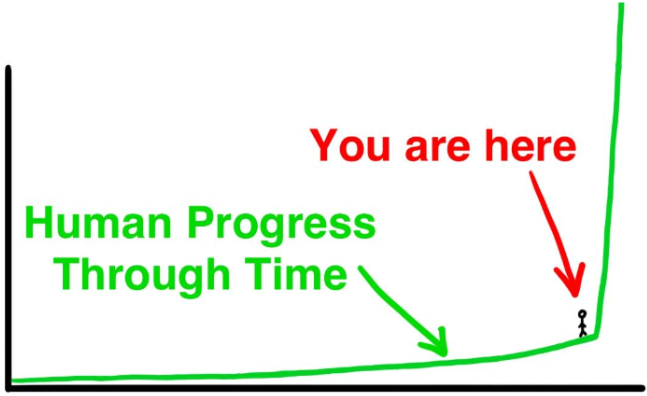
But now, for the first time, humanity possesses intelligent systems that operate non-linearly: they compound, provide self-feedback, and continually accelerate. Simultaneously, five or six exponential growth curves have reached the steep upward slope of their S-curves, bringing multiple transformations at once.
In April 2021, I first introduced this thesis in my GMI column, "The Exponential Age." Looking back now, I didn't fully realize at the time that the trends I was observing were of a magnitude far greater than I had imagined.
What Did I Get Right, and Where Was I Wrong?
In 2021, my core thesis was clear: fiat currency was depreciating at a rate far beyond market pricing, and only a handful of assets could compound fast enough to outpace inflation, with Bitcoin and tech stocks being prime examples. This judgment still holds. However, I severely underestimated the scale of the subsequent transformation at the time.
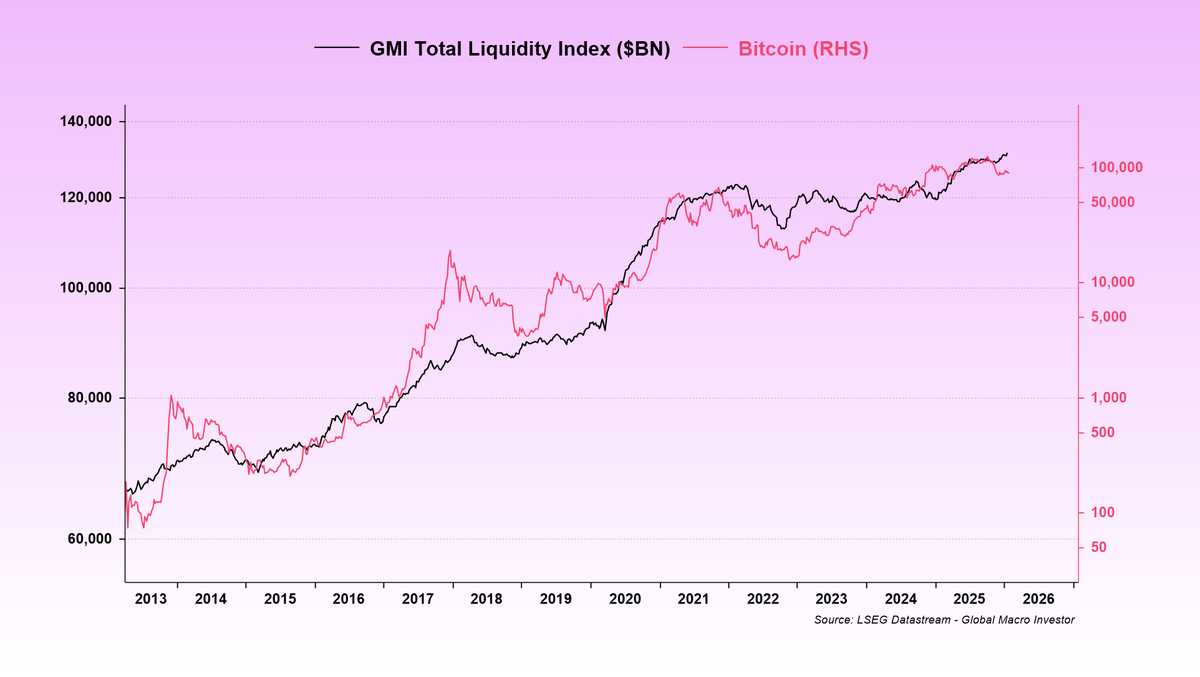
Back then, my focus was primarily on central bank balance sheets, especially the Federal Reserve. That analytical direction wasn't wrong, but the observation lens was incomplete. The true core driver wasn't a single central bank, but global aggregate liquidity: major central banks worldwide, rolling government debt from treasuries, credit expansion by commercial banks—all acting in a relay race. When the Fed tightens, China or Europe picks up the easing baton.
Focusing on a single central bank leads to misjudging the entire market cycle. 2017 was a classic case: the Fed was shrinking its balance sheet, but global markets soared in a one-way rally because China and Europe eased simultaneously, expanding global aggregate liquidity. Those only tracking the Fed completely missed that bull market.
Currently, global liquidity is expanding at about 8% annually. Combined with conventional inflation, for an asset to maintain its purchasing power, your required minimum real return is close to 11%.
The Truly Novel Force of Change
The logic of currency depreciation explains why money buys less, but it doesn't fully account for the feeling that *everything* is accelerating now. It's not just market moves; the pace of societal change itself is rapidly increasing.
This is another independent force layered on top of liquidity, and it's the core reason why the "Exponential Age" thesis has become even more critical five years later.
In 2021, I outlined five major growth curves: Artificial Intelligence, Robotics, Solar PV & Storage, Biotechnology, and Blockchain Networks. The list of sectors hasn't changed; what has changed is their stage of growth.
In 2021, most of these technologies were on the cusp of theoretical implementation. Keen observers could see the trends, but large-scale commercialization hadn't arrived. Five years later, all five technologies are accelerating simultaneously, empowering and synergizing with each other. This technological convergence is completely rewriting the development logic.
Artificial Intelligence
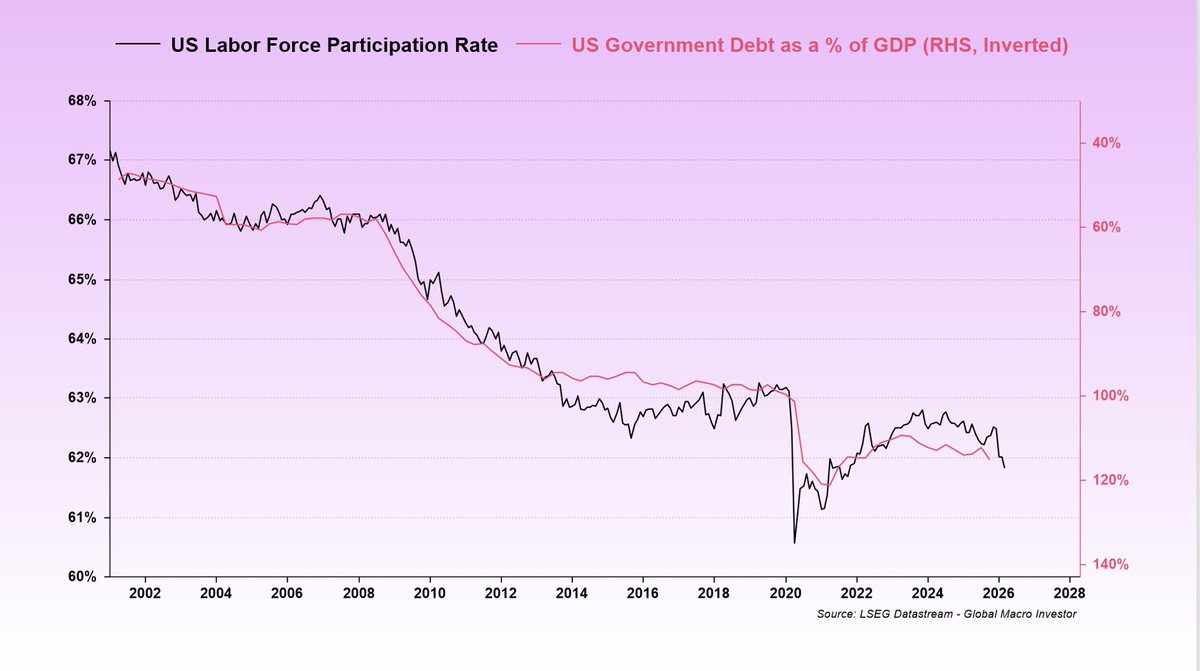
Most people miss the underlying logic behind debt expansion. Countries keep increasing debt not because leaders are stubborn or incompetent, but due to demographics. Aging populations, shrinking workforces, fewer producers, more social benefit recipients. Relying solely on human labor, natural economic growth is impossible, forcing nations to borrow and expand, balancing the gap by growing their balance sheets.
AI breaks this cycle. AI agents can perform white-collar knowledge work; humanoid robots can handle physical labor. Economic growth is no longer constrained by the size of the working-age population. We have created an "artificial labor supply." The productivity curve, dragged down by demographics, turns upward again, and it doesn't require the debt expansion we've depended on for the past fifty years.
Simultaneously, a deflationary force is at work. The marginal cost of intelligent services approaches zero, driving down the prices of many goods and services rapidly. This doesn't immediately solve currency debasement but reshapes the calculus of returns. When AI compresses costs across entire supply chains, the meaning of that 11% return threshold mentioned earlier changes completely.
The speed of this development is staggering and deserves a moment of reflection. Over the past six years, the complexity of tasks AI can perform autonomously has been doubling approximately every seven months. OpenAI's o3 model already surpasses human PhDs in corresponding scientific fields, with no signs of slowing down.
Energy
All technological transformations face a core bottleneck: energy. AI and robots run on compute, and compute consumes electricity. The scale of compute under construction globally is unprecedented, making energy the hard constraint for this entire technological shift. Microsoft's investments in nuclear and Google's geothermal deals aren't just for carbon neutrality; local grid power is already insufficient to support compute clusters.
China saw this first and has been the most aggressive in its布局 (layout). In 2024 alone, China added more new solar PV capacity than the rest of the world combined.
The core behind this is a little-known economic law—Wright's Law. Derived in 1936 from aircraft manufacturing data, it states: For a given type of product, costs decrease by a fixed percentage each time the cumulative total production doubles. Worker proficiency increases, defect rates fall, engineers optimize materials (less silver, thinner silicon wafers, etc.), continuously driving down costs.
Solar PV is the technology known to humanity that most closely follows Wright's Law. Every time global cumulative installed PV capacity doubles, manufacturing costs drop by over 20%. By leveraging massive manufacturing capacity, China dramatically increases global cumulative PV production, pulling the entire industry down the cost curve faster.
PV prices are now ~90% lower than a decade ago, with ample room for further cost reductions. PV boasts four unique advantages: low cost, short construction cycles, distributed deployment, and infinite scalability—qualities fossil fuels simply cannot match. Other energy sources always hit a supply chain bottleneck; PV's only limit is the available area with sunlight.
Storage was once PV's biggest weakness, but that gap is closing fast. Tesla's Megapack storage business is growing 50%–70% annually, with new factories coming online to meet demand. Grid-scale battery storage costs are plummeting, and most people haven't yet grasped the magnitude of change this will bring.
More crucially, a closed positive feedback loop is forming: AI optimizes grid management, reducing electricity costs; cheaper power further lowers compute costs; cheap compute iterates stronger AI, which in turn optimizes the energy system again. The growth curves are no longer parallel but amplify each other's growth rates.
Cryptocurrency
The linkage between Bitcoin and global liquidity cycles is well-documented. Since 2012, about 90% of Bitcoin's price movements correlate with liquidity cycles. This core logic still holds, perhaps even more strongly than I summarized back then.
But the crypto industry now has a core logic that was almost non-existent in 2021 and is impossible to ignore today. AI agents need to transact. In the future, there will be millions, even billions, of intelligent agents autonomously procuring services, allocating resources, and settling transactions machine-to-machine. The existing human financial system—with clearinghouses, correspondent banks, and three-day settlement cycles—is utterly incapable of handling this demand. An intelligent economy cannot be built on top of traditional financial plumbing.
Crypto technology fits the need perfectly: programmable, trustless, instant settlement, no counterparty risk. Blockchain is the only financial infrastructure that can scale synchronously with and adapt to a super-intelligent economy. The adoption thesis for crypto was already compelling in the past; the hard requirement for facilitating AI-autonomous transactions makes cryptocurrency an inevitability.
Convergence
This is precisely what's unique about this transformation wave. Past technological waves arrived individually, taking decades to普及 (popularize): the Internet was one independent growth curve, mobile Internet another. They reshaped the economy sequentially, with ample buffer time in between for institutions to adapt gradually.
But now, multiple exponential curves are simultaneously hitting the steep upward slope of their S-curves and pushing each other forward. AI designs more advanced chips; advanced chips train more powerful AI. Cheap energy supports massive compute; massive compute optimizes energy调度 (dispatch). Crypto networks enable trustless, bankless transaction settlement between intelligent agents.
Each technological curve can grow on its own, but when converged, the overall growth rate far exceeds the sum of their independent developments.
Global cloud service providers' capital expenditures exceed $600 billion annually, growing 36% year-over-year. This figure doesn't even include investments from Tesla, xAI, frontier AI labs, or national-level compute infrastructure projects in Middle Eastern countries. Corporate CapEx as a percentage of GDP now exceeds the scale of national spending on atomic bomb development in the past.
Double Exponential Growth
This compounding effect has a specific name, and it's the real reason human intuition fails to keep up. Single exponential growth already stretches beyond human comprehension. When multiple curves empower each other, they don't just create a steeper ordinary exponential curve; they give rise to *double exponential growth*—where the growth rate itself is accelerating. There's a clear mechanism behind it.
We can understand it layer by layer using three network laws:
- Sarnoff's Law: A broadcast network's value grows linearly with the number of users (n).
- Metcalfe's Law: A network where any two points can connect has value proportional to the square of the number of users (n²).
- Reed's Law: A network that supports forming groups has value growing at 2^n, as the number of possible collaborative groups far exceeds simple pairwise connections.
Throughout history, Reed's Law remained largely theoretical because network nodes were humans: humans act slowly, supply is limited, and one can only participate in a few groups at a time.
Now, the network nodes are intelligent AI agents—never tire, can replicate infinitely, and can form, disband, and reconfigure collaborative groups at machine speed and scale unthinkable for human networks. For the first time in history, the network nodes themselves are intelligent, and Reed's Law is fully manifesting at the macroeconomic level. 2^n is not just a steep line; even when plotted on a logarithmic scale, the curve keeps bending upward.
This is the true shape of the current growth curve.
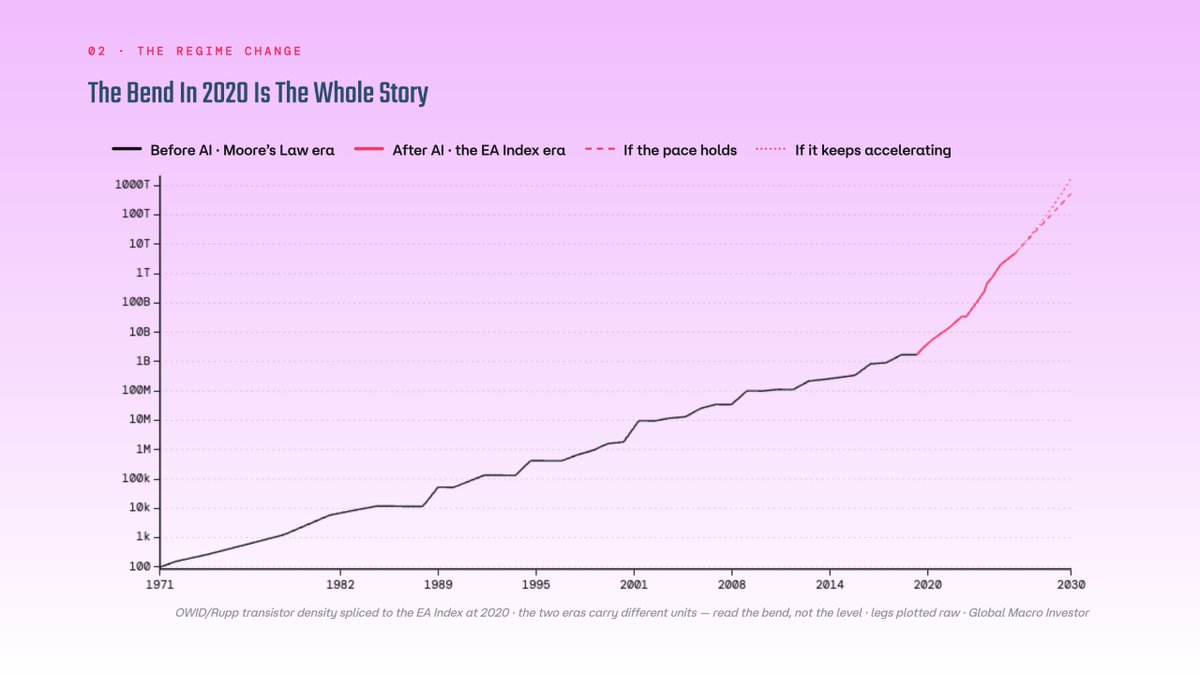
Returning to the coin example: Single exponential growth already breaks human intuition. Double exponential growth is of a completely different order of magnitude. No life experience, mental model, or evolutionary instinct can predict its scale. None of us can mentally picture this curve.
This is also what has truly changed since 2021. The technology sectors themselves haven't been added to; I listed all five directions back then. But I underestimated one critical point—they are no longer growing independently but are converging into a single super-curve rocketing off the top of the chart. Right now, we are likely still in the gentle起步阶段 (starting phase) of this curve. The future space is unimaginable.
How Should Ordinary People Respond?
So, how should you respond to all this?
If you accept that artificial labor will replace human labor, and AI agents and robots become the core productive force of the economy, then you must understand that returns will ultimately flow to those who own the machines and the underlying infrastructure.
The core question is no longer "How do I keep my job from being replaced by a machine?" but "How do I own a share of the machine-related assets?" The same logic that has AI replacing human labor also points to where value will accrete, and ordinary people can participate.
Scaling this logic across society is known as "universal basic fairness." Citizens directly own productive machine assets, and the gains from productivity increases are returned to owners as asset appreciation, rather than relying on a fixed wage. This is one of the主流解决方案 (mainstream solutions) for addressing the breakdown of the wage system.
I define the 2030-2032 period as the "Economic Singularity" window, when all technological trends fully converge, the economic system undergoes a fundamental transformation, and traditional economic models will彻底失效 (completely fail). Whether this transition is smooth or turbulent depends on the choices everyone makes today.
I'm not merely predicting the future; I'm showing the facts unfolding: quantifiably expanding global liquidity, plottable technology adoption curves, double exponential growth bursting off charts, and a handful of core assets directly tied to all these trends. Even if you label the current market action a bubble, the objective data doesn't support that judgment.
This is the Exponential Age.