A third of arXiv papers are actually written by AI?
A recent unslop study has caused a stir overseas.
Over the past year, 65% of new papers in computer science have been flagged by its detector.
Netizens have even coined a term for it – 'The Great Slurry Era'.
Yet, for the same period, only 0.7% of math papers were flagged.
ChatGPT Appears, Curve Takes Off
In this study, the team scanned 12,750 arXiv papers spanning from January 2023 to July 2026.
The target was ten disciplines, with about 25 full-text papers sampled per field per month.
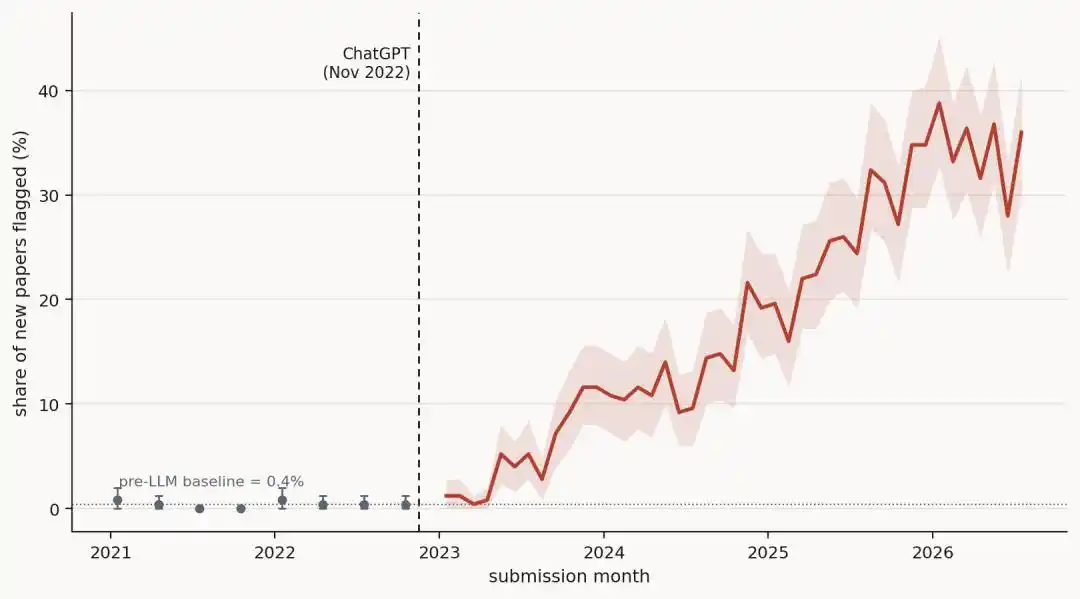
The control group was set from 2021 to 2022, the pure human era before ChatGPT's birth.
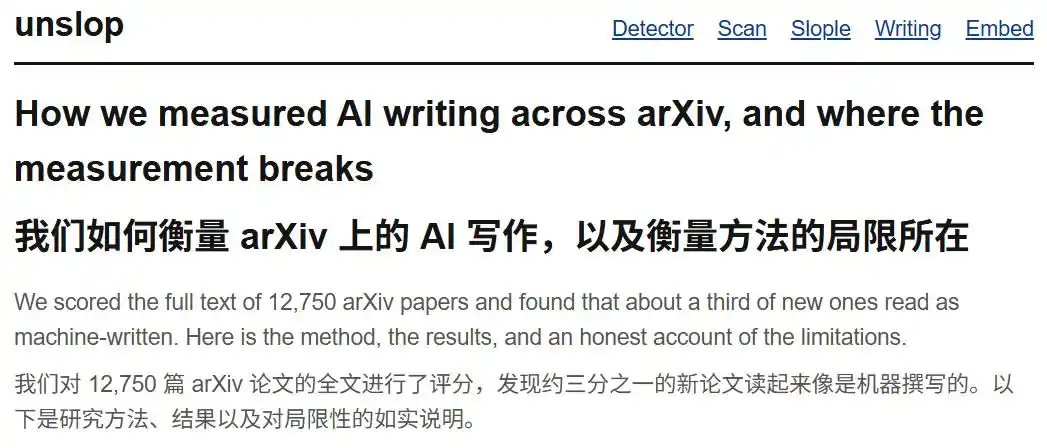
The results show that from 2021-2022, the flagging rate was stable at 0.4%; but with ChatGPT's release, the curve shot up within months.
In the most recent complete quarter, the flagging rate reached 32%, and in early 2026, the peak approached 39%.
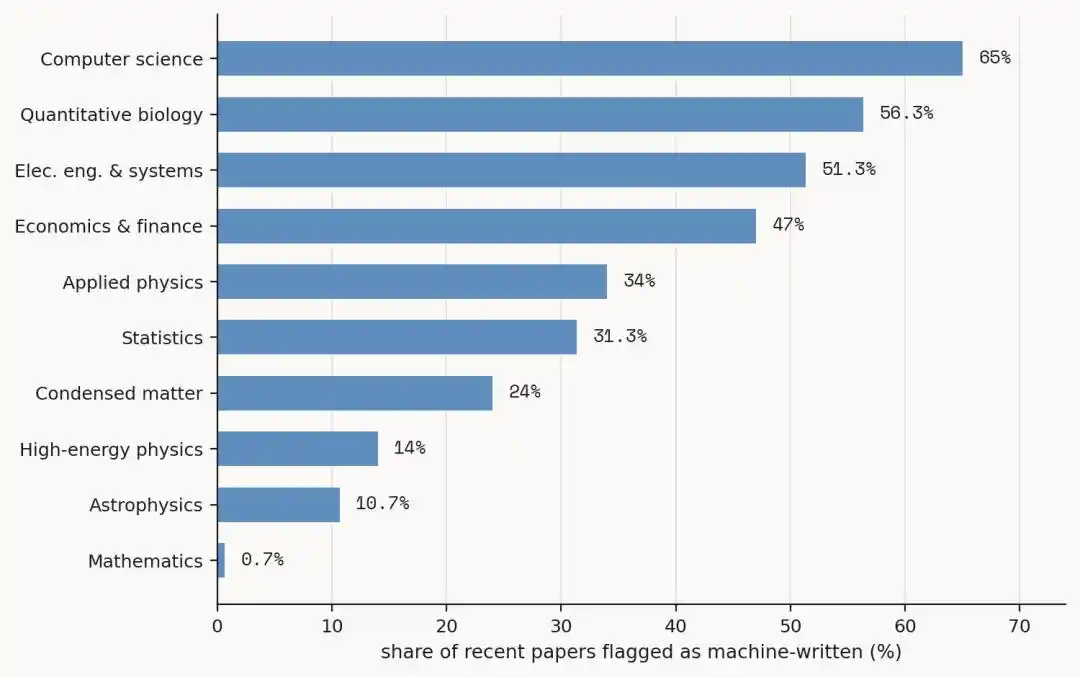
By discipline, computer science fared the worst, with a flagging rate of 65%.
Before ChatGPT, its baseline was only 0.2%. In just three years, the number soared over 300-fold.
Following closely were quantitative biology at 56.3%, electrical engineering at 51.3%, economics & finance at 47%; then applied physics at 34%, statistics at 31.3%, condensed matter physics at 24%, high-energy physics at 14%, and astrophysics at 10.7%.
The bottom of the list was mathematics: 0.7%.
And this is just the lower bound. If AI text is hidden well enough, the detector can't identify it.
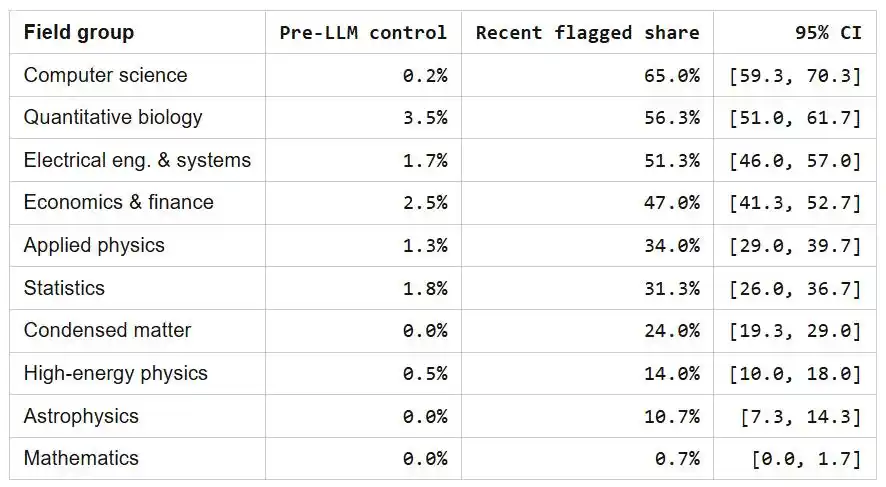
The same detector, the same paper database, a gap nearing 100-fold.
Are mathematicians collectively sticking to pure manual writing? Or is this machine simply blind in the face of mathematical formulas?
The Bottomed-Out 0.7%: Machine Blindness
In fact, the answer has been written into the unslop report itself.
Think, what does a standard mathematics paper look like? Screens full of symbols, formulas, theorems, and proofs. The genuine prose sentences written in English are pitifully few.
This detector only recognizes text. It focuses on sentence structure, word usage habits, paragraph organization.
And the few remaining lines of text in math papers are all formulaic expressions like 'Let X be such and such' or 'By Lemma 3, we can derive', which basically aren't in the same realm as the scientific English the detector was trained on.
So the team itself admits the study currently has several limitations:
The 0.7% for math doesn't prove much yet. It might be that mathematicians really don't use AI much, or the detector simply can't read math papers, but this data can't distinguish which.
The control group is also relatively small. Only 200 pre-ChatGPT papers per discipline, with a 0.4% false positive rate, means only about 8 flagged papers out of 2000 total. This level can only be considered a rough estimate.
Then there's the aforementioned issue of incomplete detection. So, these numbers are just lower bounds; the real proportions are certainly higher.
The More Competitive the Field, the More Reliance on AI
So, who is using AI to write papers?
The answer lies in another two-year Stanford study.
In March 2024, Stanford's Weixin Liang team first measured peer reviews: in ICLR 2024 review comments, about 10.6% of sentences were heavily modified by LLMs. The reviewers used it themselves before even finishing evaluating the papers.
In August 2025, the same team expanded the sample to 1.12 million papers and directly published in Nature Human Behaviour.
The research showed that as of September 2024, the proportion of LLM-modified text in CS paper abstracts had reached up to 22.5%. And the heaviest users were researchers publishing preprints most frequently, operating in the most competitive fields.
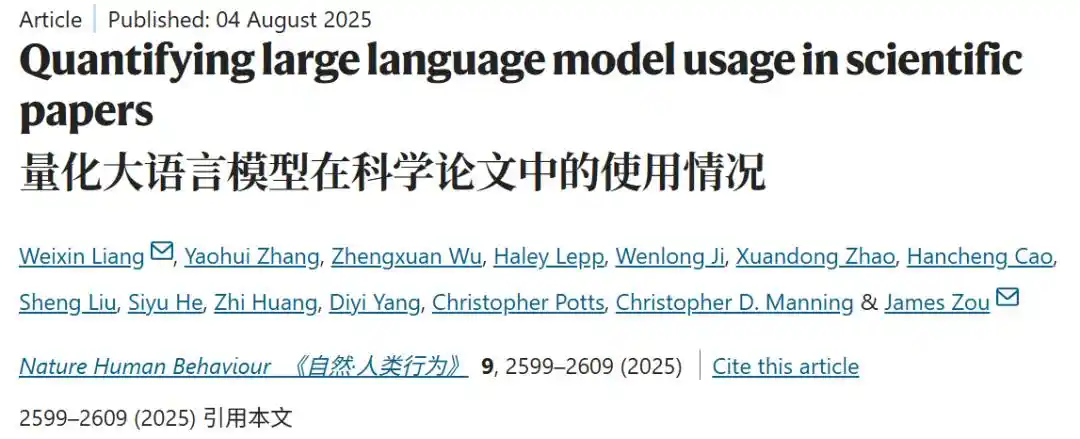
The more competitive the field, the heavier the use.
Here, AI writing has become an arms race: peers are using AI to speed up; those writing by hand alone fall a step behind.
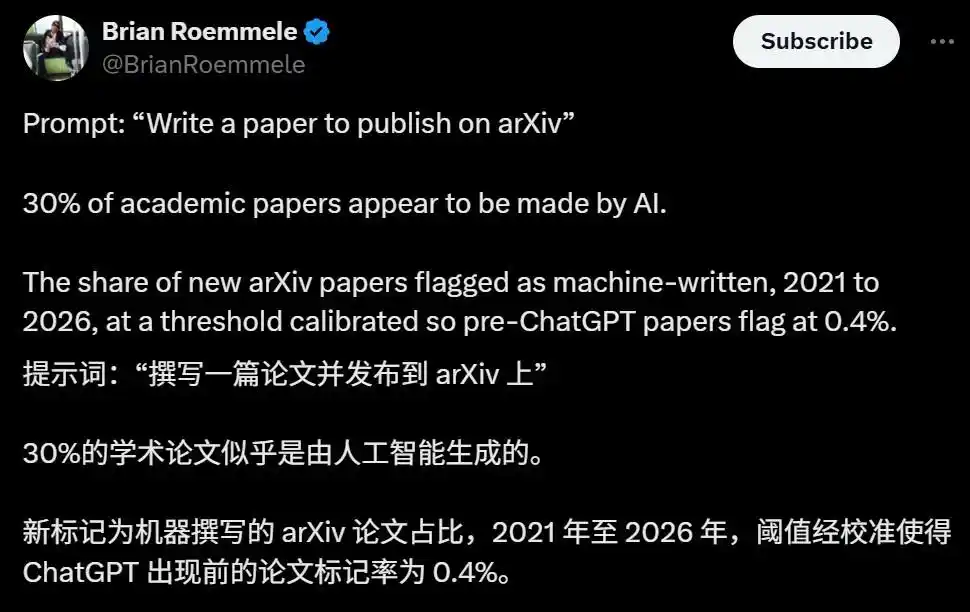
No wonder a widely circulated related repost on X had the first line: 'Prompt: Write a paper publishable on arXiv.'
It Sniffs the 'Smell', Not the AI
But don't rush to convict based on that 65%.
The team also admits in the report that the detector cannot distinguish between 'AI polished the grammar' and 'the whole thing was machine-made'. It only detects the concentration of machine-like scent in the text.
So the correct understanding of 65% is '65% of papers smell like AI', not '65% of papers are written by AI'.
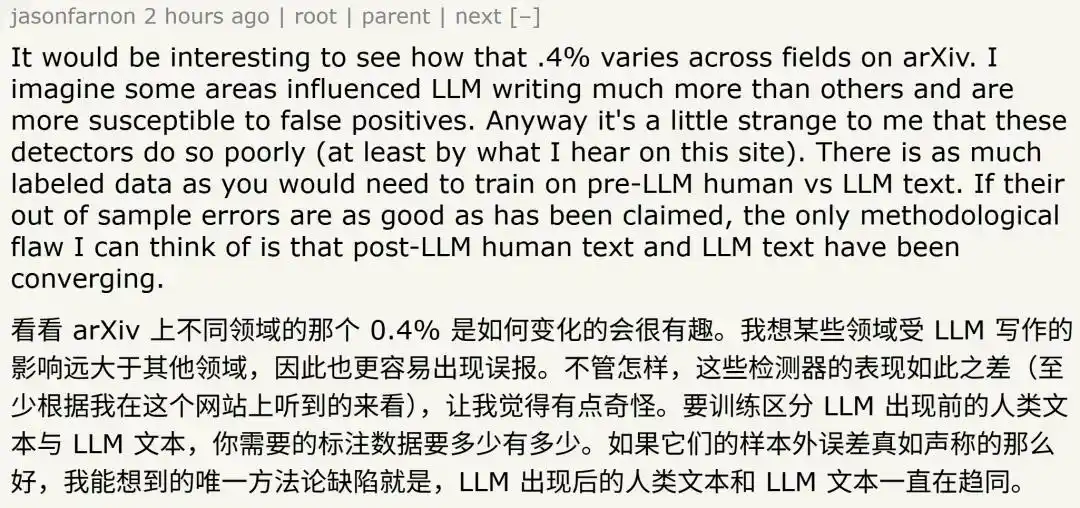
The trouble is, humans themselves can acquire this machine scent.
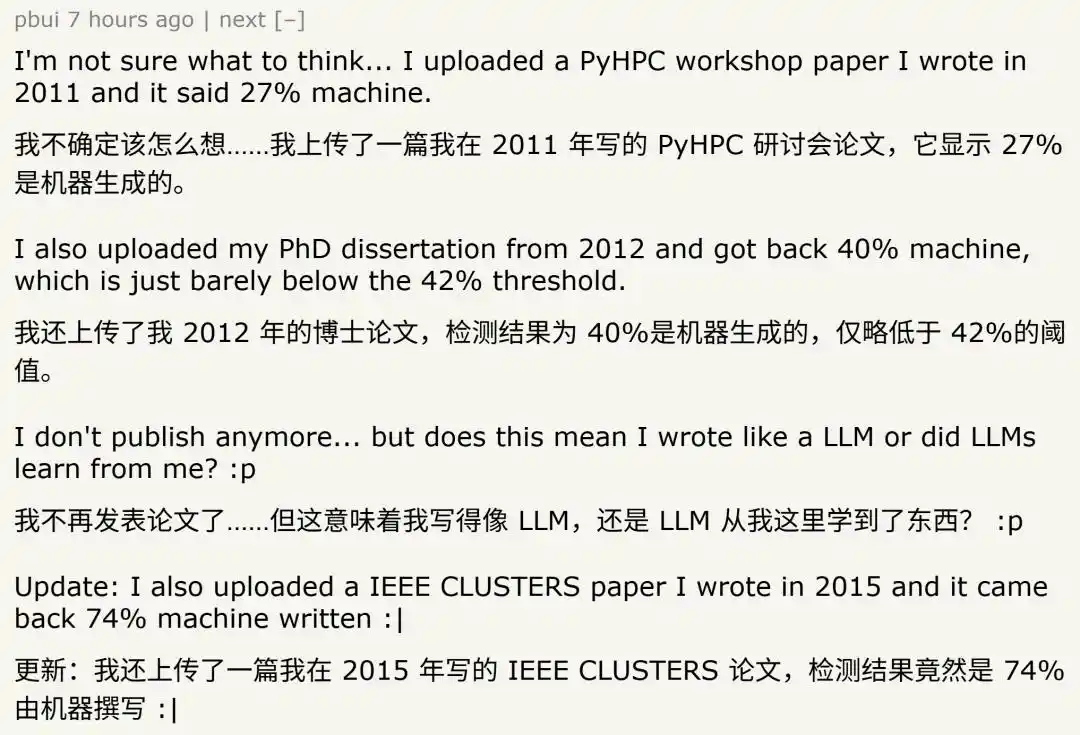
A skeptical researcher fed their own old papers from years ago into a detection tool, and 27% to 74% of the content was flagged red.
Remember, in that era, ChatGPT wasn't even a glimmer.
The reason isn't hard to find.
Open any academic journal today, and pages are filled with large language models, benchmark tests, state-of-the-art. The more standardized the phrasing, the more structured the composition, the more likely it is to hit the machine-like features recognized by the detector.
Besides, LLMs were trained on such papers. It's not that scholars write like AI; it's that AI was born writing like scholars.
When All Text Becomes Suspect
Actually, in recent years, we've all been doing the same thing as the detector.
Reading a passage that's perfectly balanced, neatly phrased, occasionally popping with 'not only... but also...', our hearts skip a beat: 'This must be AI-written, right?'
Unslop's detector essentially turned this mystical sense of smell into an instrument that mass-produces numbers.
After all, once suspicion enters the mind, it's hard to remove.
In the past, 'writing it down' was itself an endorsement. Someone willing to spend hours organizing text at least showed seriousness.
Now, no matter how beautifully written, it might only earn a 'AI, right?'.
Some have even started deliberately avoiding words they've used all their lives, simply because they 'sound too AI'.
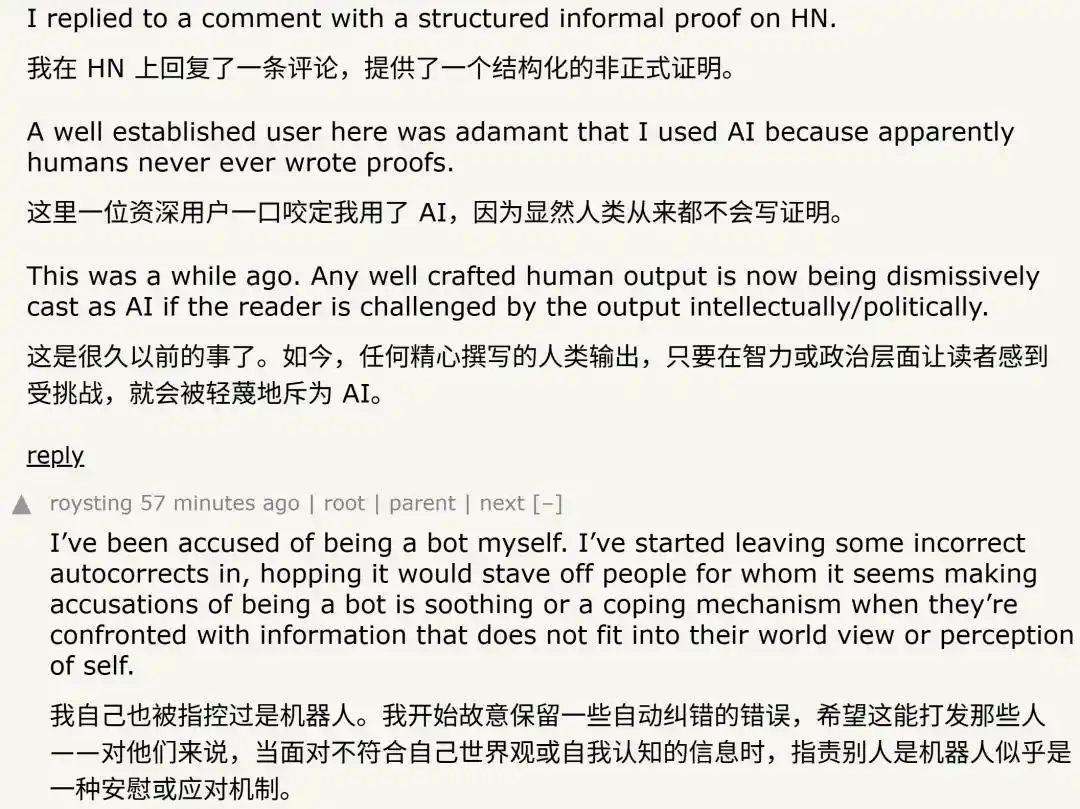
Now, 'AI scent' is becoming a new type of original sin sweeping through the world of writing.
The ironic part is, to this day, we still haven't precisely measured what exactly constitutes this 'AI scent'.
This article is from WeChat public account 'Xinzhiyuan', author: ASI Revelation